Tag: Skoda

  • Skoda Enyaq RS Race Concept

    Škoda Motorsport presents a new all-electric racing car concept: the Enyaq RS Race. Rooted in the Czech brand’s racing DNA, this concept supports the development of innovative technologies and sustainable materials, serving as a pilot project for future production models. The lower and wider concept car incorporates innovative, sustainable biocomposite parts that provide the same rigidity and weight advantages as carbon fibre, contributing to an overall weight reduction of 316 kg compared to the Škoda Enyaq Coupé vRS on which it is based.

    Johannes Neft, Škoda Auto Board Member for Technical Development, says: “The Škoda Enyaq RS Race was developed completely in-house by Škoda Motorsport. Based on the Enyaq Coupé vRS production model, the car features a distinctive design with strong racing DNA, enhanced aerodynamics and excellent acceleration. In terms of sustainable solutions, the new concept car also serves as a pilot project for future innovations in series production. The biocomposite parts have led to a significant weight reduction, and we are trialling them in motorsport, including in the current Škoda Fabia RS Rally2, with a view to future implementation.”

    An all-electric race car defined by the motorsport DNA of the Škoda Fabia RS Rally2
    Škoda Motorsport engineers have developed an all-electric racing car that closely matches the handling and interior space of the successful Škoda Fabia RS Rally2. Škoda’s racing DNA and the rigorous demands of motorsport continue to push the boundaries of technical innovation.

    Development of the Enyaq RS Race began in 2023. The project showcases Škoda’s activities in the field of electrified motorsport, driving progress towards a more sustainable future. Based on the Škoda Enyaq Coupé vRS, the concept car uses the same electric powertrain but is 70 mm lower, 72 mm wider at the front, and 116 mm wider at the rear. Most importantly, it is significantly lighter than the production model. Biocomposite parts, incorporating flax fibres in both the body and interior, help to reduce the car’s weight. Additionally, the concept benefits from numerous visual and technical modifications, including a wider, lowered chassis, redesigned bumpers, as well as modified shock absorbers and springs. A completely new high-performance braking system, racing seats, and a roll cage ensure the highest possible active and passive safety. The darkened front headlights feature the distinctive Škoda Motorsport logo, with the headlight housings modified to accommodate the larger wheels. The rear lights have also been darkened. In the Škoda grille, the production model’s Crystal Face has been replaced by a single elongated LED strip connecting the two headlights.

    Biocomposite parts: reducing weight and enhancing sustainability
    To reduce the weight compared to the production model, Škoda Motorsport engineers employed innovative and sustainable materials, removing all components not needed for the car’s intended use. Additionally, they incorporated side and rear windows made of lightweight polycarbonate. These measures together resulted in total weight savings of 316 kg. The sustainable biocomposite parts, developed in collaboration with Škoda’s motorsport partner Bcomp, are used in the bodywork, including the bumpers, fenders, roof, roof vent, and rear wing. These lightweight materials are also applied in the interior, such as the dashboard, door panels, and footrests for the driver and passenger. Additionally, the standard model’s panoramic glass roof was replaced with a biocomposite panel.

    Sustainable flax fibre components: a carbon alternative
    A total of 16 vehicle components are made from sustainable materials, with natural flax fibres replacing carbon in both the interior and the exterior. These are tested under the most challenging racing conditions, for instance in the Škoda Fabia RS Rally2, alongside sustainable lubricants for engines, motors, transmissions and dampers. One example is AmpliTex, a technical reinforcement fabric made from renewable flax fibres grown in Europe. These woven fibres not only reduce vibrations in the interior and contribute to weight reduction but also serve as a visually appealing design element. Moreover, the fibres are processed mechanically rather than chemically, and flax cultivation has a significantly lower impact on the soil compared to other crops.

    Bcomp’s PowerRibs™ technology utilises extremely lightweight, high-performance natural fibres also made from flax. PowerRibs™ combine maximum stiffness and minimum weight by creating a 3D structure to reinforce the thin-walled panels of the car body. The benefits include raw material savings, weight reduction, and lower production costs due to using fewer consumables. The material offers comparable rigidity and weight advantages to carbon fibre while reducing CO2 emissions by approximately 85%. This is the first time Škoda Auto has used this material for large, complex components such as the front wings, side panel and bumpers. The engineers also made extensive use of 3D printing in preparing and producing the prototype, using recycled materials such as nylon and CO2-neutral biodegradable biopolymer filaments.

    Aerodynamic optimisation of the bodywork
    To create the body of the Enyaq RS Race, individual bodywork parts were taken from the production line, redesigned from scratch, and reassembled. In addition to the roll cage made of high-strength chrome-molybdenum steel—which reinforces the body and protects the occupants—the concept car features other safety elements derived from the Škoda Fabia RS Rally2. These include Atech racing seats with six-point seatbelts, safety door filling, and an automatic fire extinguisher. Like WRC rally cars, green and red lights on either side of the vehicle indicate the status of the high-voltage system. The ride height has been lowered by 70 mm, and special protective skids on the underside of the vehicle prevent excessive wear to the chassis components and protect the battery.

    The aerodynamics package includes a large rear wing, an aerodynamically optimised roof, and a NACA air intake channelling air into the interior. Small winglets at the rear of the roof direct airflow straight onto the rear wing. The air intake for the cooling system has also been redesigned, with the front section now completely solid and air drawn in through the lower part of the bumper, necessitating a tilted radiator wall. Redesigned bumpers with two additional air curtains at the front, wider fenders, and a new rear diffuser along with the large rear wing increase the downforce, improving drivability at higher speeds. Turbulence around the wheels is minimised by wing-shaped air-guiding elements, while ventilation grilles in the front and rear wheel arches enhance both aerodynamics and brake cooling. The Enyaq RS Race can also be fitted with aerodynamically optimised wheels.

    Race-ready adjustments: handbrake, suspension, and limited-slip differentials
    Škoda Motorsport experts have adapted several components of the Enyaq RS Race. For example, the production model’s brake system has been replaced with a high-performance setup, featuring carbon-ceramic brake discs, ten-piston callipers at the front, four-piston callipers at the rear and a new brake cooling system. Moreover, the concept car has been fitted with a rally-type hydraulic handbrake with a long lever and the pedal system from the Škoda Fabia RS Rally2. Instead of the standard DCC suspension, a special sports suspension has been installed, allowing for individual adjustments to spring stiffness, compression, and rebound settings.

    The 20-inch wheels are fitted with low-profile tyres. The two electric motors, delivering a combined output of 250 kW, and the 82 kWh battery are identical to those in the production model. Like the Škoda Enyaq Coupé vRS, the top speed is 112 mph (180 km/h), but the lighter Enyaq RS Race can now accelerate from 0 to 62 mph in under five seconds.

    Enhanced steering and controls for on-track performance
    The completely redesigned interior is inspired by the Škoda Fabia RS Rally2 and also includes a modified infotainment system. Featuring new buttons, the racing steering wheel resembles the one from the successful customer rally car. Instead of the progressive rack-and-pinion steering used in the Enyaq Coupé vRS, the Enyaq RS Race is fitted with linear steering, with adjustable steering weight controlled via software, and the drive ratio has been optimised for racing performance. The drive selector and central panel for starting the car and activating the automatic fire extinguishing system are positioned between the seats in this two-seater vehicle.

    Havas sound system: amplified for an authentic motorsport experience
    The Enyaq RS Race features a Havas premium sound system that incorporates a digital sound amplifier to deliver the characteristic, exhilarating motorsport sound. This entirely new system is significantly louder than the unit in the production Enyaq Coupé vRS model, and its note can be changed. The sound is also activated at speeds above 18 mph, ensuring an exciting acoustic experience throughout the drive.


  • Skoda Epiq Concept

    Škoda has unveiled a significant step forward in its electric vehicle (EV) strategy with the introduction of the Škoda Epiq. This new city SUV crossover represents an attractive and accessible option for customers seeking to transition to electric driving.

    An Electric SUV for Everyday Needs

    The Škoda Epiq boasts a competitive starting price of around €25,000, making it a compelling choice for budget-conscious EV buyers. Despite its compact size (4.1 meters in length), the Epiq offers ample interior space for five passengers and a generous cargo capacity of up to 490 liters. Additionally, the impressive electric range of over 248 miles (400 kilometers) on a single charge alleviates range anxiety, ensuring stress-free commutes and weekend adventures.

    Modern Solid Design Language

    The Škoda Epiq embodies the brand’s new “Modern Solid” design philosophy, seamlessly blending functionality with aesthetics. The sculpted bonnet showcases a refreshed Škoda wordmark, while the innovative “Tech-Deck Face” reinterprets the familiar grille, housing advanced technologies like distance radar and front cameras. Striking T-shaped LED elements flank the Tech-Deck Face, serving as daytime running lights and indicators. The lower headlamp position with Matrix LED technology adds a touch of sophistication. The robust exterior is further accentuated by a striking spoiler and aerodynamically optimized wheels.

    Functional and Sustainable Interior

    The Škoda Epiq prioritizes functionality and sustainability within its minimalist interior. The free-floating center console integrates a wireless mobile phone charger and additional “Simply Clever” compartments for maximized storage. The boot incorporates Škoda’s hallmark practical features, including bag hooks, cargo elements, and hidden underfloor storage. The two-spoke steering wheel emphasizes the new Škoda lettering and offers physical buttons and haptic scroll wheels for intuitive control. The mobile digital key facilitates a seamless user experience, and Škoda’s “mobile first” approach is further exemplified by bidirectional charging capabilities, allowing the car to function as a rolling energy storage unit.

    A Name Reflecting Škoda’s EV Commitment

    The Škoda Epiq’s name signifies a pivotal moment in the brand’s history. The “E” prefix aligns with Škoda’s BEV SUV nomenclature, while the “Q” denotes its SUV family membership. Drawing inspiration from the ancient Greek word “epos,” meaning “tale” or “poem,” the Epiq evokes a sense of remarkable achievement. This versatile city SUV caters to both family and lifestyle-oriented customers, offering a practical and engaging electric driving experience.

    Škoda’s Electric Future

    The Škoda Epiq marks the beginning of an exciting new chapter for Škoda. The company is committed to significant investments in e-mobility, with the forthcoming Škoda Elroq, a battery-electric compact SUV, scheduled for launch later this year. This dedication underscores Škoda’s unwavering commitment to a sustainable future.

  • Skoda Enyaq RS iV

    ŠKODA AUTO is expanding its vRS family to include another all-electric model – the ENYAQ iV vRS. Just like the ENYAQ COUPÉ iV vRS, the Czech carmaker has opted for two motors with a total system output of 299 PS (220 kW) and all-wheel drive for the top version of the SUV. Thanks to an exceptional drag coefficient of cw 0.265, the ENYAQ iV vRS has a range of over 310 miles (500 kilometres) in the WLTP cycle.

    A new addition to ŠKODA’s range: The Czech car manufacturer’s sporty vRS line-up has been expanded to include a second all-electric model – the new ENYAQ iV vRS. The SUV features all‑wheel drive and two electric motors with a system output of 299 PS (220 kW) as does the ENYAQ COUPÉ iV vRS. This makes the two vRS versions of the ENYAQ iV family the most powerful vehicles in ŠKODA’s portfolio. The ENYAQ iV family is based on the Volkswagen Group’s Modular Electrification Toolkit (MEB) and rolls off the production line at ŠKODA’s main plant in Mladá Boleslav. The ENYAQ iV and ENYAQ COUPÉ iV are the only MEB models to be manufactured in Europe outside Germany. ŠKODA AUTO has announced that in the coming days, the 100,000th car from the ENYAQ iV family will roll off the production line. This figure includes both the ENYAQ iV SUV and the ENYAQ COUPÉ iV series in all their respective variants, such as the sporty vRS and SportLine versions. Alongside all-electric models, the car manufacturer also offers customers a ŠKODA iV ecosystem, which includes wallboxes for convenient at-home charging and the POWERPASS, a charging card that can be used throughout Europe.

    The ENYAQ iV vRS has a dynamic appearance, with sports suspension as standard, large 20- or 21-inch wheels and distinctive vRS features, to make it instantly recognisable as a vRS model. With a top speed of 111 mph (180 km/h), it is 12 mph (20 km/h) faster than the other ENYAQ iV models, as is the coupé variant. Locally emission-free, the vehicle sprints from 0 to 62 mph in 6.5 seconds and boasts a maximum torque of 460 Nm, which is available from standstill, as is typical for an e-vehicle. Its 82 kWh battery, high energy efficiency and drag coefficient of cw 0.265 give the model a maximum range of over 310 miles (500 kilometres) in the WLTP cycle. Thanks to a maximum charging power of 135 kW, the ENYAQ iV vRS’s lithium-ion high-voltage battery can be charged from 10% to 80% in just 36 minutes at fast-charging stations.

    ENYAQ RS iV offers excellent driving dynamics and generous space

    Besides its sporty look and dynamic handling, the new ŠKODA ENYAQ iV vRS offers a generous amount of space for up to five people. The SUV is 4,653 millimetres long, 1,879 millimetres wide and 1,605 millimetres high, with a wheelbase of 2,768 millimetres. At 585 litres, the boot capacity is 15 litres larger than the ENYAQ COUPÉ iV vRS and can be expanded to up to 1,710 litres by folding down the rear seat backrests.

    vRS-specific exterior, full LED Matrix headlights and Crystal Face as standard

    The ENYAQ iV vRS sports a particularly dynamic exterior with numerous vRS-specific details: The frame of the ŠKODA grille is in high-gloss black, as are the window frames, exterior mirror covers and rear diffuser, as well as the ŠKODA wordmark and model designation at the rear. The front apron sports high-gloss black accents on the air curtain surrounds, which are E-shaped on the vRS model. The side skirts are painted in the body colour and the red reflector in the rear apron runs across the entire width of the vehicle – a distinguishing feature of all ŠKODA vRS models. The front wings bear exclusive green vRS logos, and the ENYAQ iV vRS comes with the Crystal Face as standard; 131 LEDs illuminate the vertical ribs as well as the horizontal bar of the ŠKODA grille. They combine with the full LED Matrix headlights and full LED rear lights, both of which come as standard on the vRS model, to create an animated welcome effect.

    Large wheels, lower body and outstanding aerodynamics

    Underlining the ENYAQ iV vRS’s dynamic appearance, the standard sports suspension lowers the body by 15 millimetres at the front axle and 10 millimetres at the rear axle. This ensures excellent aerodynamics, with a drag coefficient of cw 0.265. The streamlined plastic aero inserts on the large wheels also have a positive influence on the aerodynamics. As standard, the ENYAQ iV vRS comes with black 20-inch Taurus wheels, while anthracite-coloured 21-inch Vision wheels are available as an option. The solid paint finish in eye-catching Hyper Green is exclusive to the vRS models, and all other colours offered for the series are also available. Another option for the ENYAQ iV vRS is a large panoramic sunroof, which can be opened halfway at the front.

    Sporty interior with vRS details and two exclusive Design Selections

    The interior, which is predominantly black with generous space for up to five passengers, is characterised by a sporty ambience typical of the vRS series. The ENYAQ iV vRS’s comprehensive standard equipment includes carbon-look decorative trim on the dashboard and door panels as well as aluminium design pedal covers and heated sports seats with integrated headrests, bearing the vRS logo. A 3-zone climate control system, LED ambient lighting that also illuminates the dashboard and door panels, as well as the Phone Box for inductive smartphone charging also come as standard. The 585-litre boot can be accessed easily thanks to the factory-fitted electric tailgate with virtual pedal. Customers also have a choice of two Design Selections exclusive to the ENYAQ iV vRS models. The black seats in the vRS-series-standard Lounge design selection are upholstered in Suedia microfibre and feature lime-coloured piping and contrast stitching. Contrast stitching in the same colour is also featured on the heated multifunction sports leather steering wheel, bearing the vRS badge and the Suedia-trimmed dashboard. The optional Design Selection vRS Suite offers black perforated leather seat upholstery with grey piping and contrast stitching, which is also found on the multifunction sports leather steering wheel. The dashboard sports a leather-look finish with contrasting stitching.

    Two digital displays, head-up display with Augmented Reality available as options

    The ENYAQ iV family has the largest central display currently available in a ŠKODA production model, with a screen diagonal of 13 inches. The displays are customisable and can be controlled by touch function including touch slider, multi-touch gestures, gesture control or with the help of the online digital voice assistant Laura, who understands 15 languages. Added to this is a 5.3-inch Digital Cockpit, which presents information on speed, driving data, navigation and assistance systems clearly in four different layouts. The data displayed, as well as numerous vehicle functions and assistance systems, can be controlled using the multifunction steering wheel. The optional head-up display with augmented reality projects additional information into the driver’s field of vision. In addition, the CANTON sound system with twelve speakers and digital equaliser is available as an option to create an immersive sound world.

    Permanent Internet connectivity and ŠKODA Connect functions for electric vehicles

    ŠKODA ensures that the ENYAQ iV vRS’s software is always up to date thanks to a permanent online connection via an integrated eSIM, which also allows the driver to download additional apps or activate new functions in the infotainment system. The latest ME3 vehicle software includes updates for the displays as well as optimised climate control and improved battery management with battery care mode. The Internet connection supports numerous functions, including traffic information, route planning and searching for parking spaces with real-time data, and enables a wider range of voice control functions. Some of the comprehensive ŠKODA Connect mobile online services have been specially developed for all-electric vehicles. For example, the MyŠKODA app can be used to control battery charging remotely, and the air conditioning can be switched on and scheduled before the start of a journey. The navigation system will identify charging stations nearby or along a planned route. In addition, the MyŠKODA app can prompt the driver to switch on the heating or start a charging cycle if the temperature outdoors is too low at the ENYAQ iV vRS’s location for the battery to be used efficiently.

    Highest-performance powertrain in ŠKODA’s model range

    The ŠKODA ENYAQ iV vRS is based on the Volkswagen Group’s Modular Electrification Toolkit (MEB) and, like the ENYAQ COUPÉ iV vRS, boasts the highest-performance powertrain in the current model portfolio. One electric motor sits on the front axle while the second is on the rear axle. The ENYAQ iV vRS benefits from all-wheel drive, with a system output of 299 PS (220 kW) and a maximum torque of 460 Nm.

    Comparison of the ENYAQ iV vRS to other ŠKODA models from the ENYAQ iV family:

    ENYAQ iV vRS ENYAQ COUPÉ iV vRS ENYAQ iV 80x
    Output 220 kW / 299 PS 220 Kw / 299 PS 195 kW / 265 PS
    Max. torque 460 Nm 460 Nm 425 Nm
    Acceleration
    0-62 mph
    6.5 s 6.5 s 6.9 s
    Max. speed 111 mph / 180 km/h 111 mph / 180 km/h 99 mph / 160 km/h
    Drive All-wheel drive, dual-motor configuration

    Sporty chassis and 82 kWh battery for long range

    Delivering the energy for a maximum range of over 310 miles (500 kilometres) in the WLTP cycle is an 82 kWh high-voltage battery, the largest battery in the range. It can be charged at DC fast charging points with a charging power of up to 135 kW and at AC wallboxes at up to 11 kW. The ‘Plug & Charge’ function is new. This makes it possible to start the charging process at suitable charging points stored in the POWERPASS app simply by connecting the charging cable; the vehicle is identified at the charging point and the charging session is billed automatically.

    The centre of gravity in the ŠKODA ENYAQ iV vRS is very low thanks to the battery being mounted in the underbody. This, in combination with the sports suspension and progressive steering as standard, makes for particularly dynamic handling. Adaptive Chassis Control (DCC) is available as an option. It constantly monitors the situation on the road and automatically adjusts the damping. Drive Mode Select offers the predefined profiles Eco, Comfort, Normal and Sport, while a custom slider allows the driver to adjust the settings to their own preferences. The ENYAQ iV vRS also offers the additional driving profile Traction. This is ideal for driving on unpaved roads or slippery surfaces, offering constant all-wheel drive at speeds of up to 12 mph (20 km/h).

    Excellent active and passive safety as well as numerous assistance systems

    The ENYAQ iV vRS offers a high level of active and passive safety. The base model ENYAQ iV achieved the highest rating of five stars in the 2021 Euro NCAP test, scoring 94% for adult passenger protection and 89% for child passenger protection. In addition, the ENYAQ iV was awarded the safest vehicle in its class in the 2021 test year with the best rating for an electric SUV up until that point. The ENYAQ iV vRS comes with up to nine airbags, with driver and front passenger airbags, front side airbags and two head airbags as standard, which also cover the side windows in the first and second rows of seats. A central airbag between the front seats prevents the front passengers from hitting each other in the event of a collision. There is also an option for two side airbags on the outer rear seats. Proactive Occupant Protection, included as standard, tightens the seat belts and closes the windows in the event of an imminent collision, emergency braking, or risk of skidding or tipping over. All the assistance systems ŠKODA currently offers are available for the ENYAQ iV vRS. Travel Assist provides comprehensive support, for example with longitudinal and lateral vehicle guidance. In addition to Adaptive Cruise Control (ACC), it also includes Adaptive Lane Keeping Assist with Roadworks Detection, Traffic Jam Assist and Emergency Assist. Online access to current traffic data enables the assistance systems to perform even more accurately. In addition to Front Assist with predictive pedestrian and cyclist protection, which comes as standard, Blind Spot detect including Rear Traffic Alert is available, as well as Collision Avoidance Assist, Turn Assist and Exit Warning. The optional Parking Assist also offers the Trained Parking function, where the system records the path to a frequently used parking space, for example through a narrow, winding driveway. The vehicle can then repeat this path at any time as required.

    The full LED Matrix headlights and the head-up display with augmented reality also improve safety. With 24 individually controllable LEDs in each high beam module, the matrix technology makes it possible to keep the high beam on permanently without dazzling other road users. As soon as the camera on the windscreen detects vehicles, people or objects that reflect light, the beam is automatically adjusted to eliminate any glare. The optional head-up display projects information onto two fields on the windscreen so that the driver can keep their eyes on the road at all times. In the augmented reality projection, for example, direction arrows from the navigation system are displayed as larger symbols and projected virtually onto the road in front of the vehicle.

    Maximum electrical power 220 kW: Maximum power determined in accordance with UN-GTR.21, that can be engaged for a maximum of 30 seconds. The power available in individual driving situations depends on various factors, including the temperature outdoors, the temperature of the high-voltage battery, and its charging status, condition and physical ageing. The maximum power is only available if the temperature of the high-voltage battery is between 23 and 50°C and its charge level exceeds 88%. If these parameters are not met, the maximum power may be reduced or unavailable. The battery temperature can to a certain degree be influenced indirectly via the stationary air conditioning function, and the charge level can be set in the vehicle. The currently available power is shown on the vehicle’s driving performance screen. To optimally maintain the capacity of the high-voltage battery, a charging target of 80% is recommended for everyday use (this can be changed to 100% before long-distance journeys, for example).

  • 2022 Skoda Vision GT Concept

    Skoda Vision GT Concept - Exterior Sketch

    SKODA Design has introduced a new design concept, the VISION GT, which is an all-electric racing car in the form of a computer-generated model. It is currently being showcased at the ‘Design and Transformation’ exhibit in Brussels, as part of the Czech Republic’s EU Presidency. The VISION GT draws inspiration from SKODA’s 1100 OHC concept from 1957 and is part of the ‘Icons Get a Makeover’ series that reinvents iconic models from SKODA’s past, such as the 130 RS, FELICIA, and RAPID MONTE CARLO.

    The ŠKODA VISION GT is a featured exhibit at the ‘Design and Transformation’ exhibition in Brussels. It is an all-electric racing car in the form of a computer-generated model that draws its inspiration from SKODA’s 1100 OHC concept from 1957. The exhibit showcases Czech products and designs from 1990 to 2020, in alignment with the Czech Republic’s EU presidency. The SKODA design team has infused the VISION GT with the company’s commitment to sustainable sportiness and emotion in the digital age.

    The VISION GT’s single-seater design, with the driver placed in the center, is based on the SKODA 1100 OHC, featuring a futuristic carbon steering wheel that is flattened at the top and bottom, and a red, open-top design. The active cockpit with a flexibly suspended seat aims to offset g-forces for a superior driving experience. The on-screen bar, located above the wheel, serves as a windshield and displays critical information on the driver’s helmet visor, similar to a head-up display.

    2022 Skoda Vision GT Concept

    The VISION GT’s design is flat, with clear lines and sharp edges, inspired by the design of Formula E racing cars. The two-piece rear wing is a standout feature, with active aerodynamics to maximize performance. The holographic SKODA wordmark is situated between the upper wing profiles and on the front of the car, referencing the curved SKODA line.

    In conclusion, SKODA Design’s VISION GT concept, a computer-generated all-electric racing car, has been displayed at the ‘Design and Transformation’ exhibit in Brussels. Drawing inspiration from the 1100 OHC and featuring a red, open-top design, the VISION GT’s flat and sharp design is inspired by Formula E racing cars. The VISION GT is part of SKODA’s ‘Icons Get a Makeover’ series, reinventing iconic models from the company’s history with a commitment to sustainable sportiness and emotion in the digital age.

  • Skoda Vision 7S Concept

    Unveiling its seven-seater VISION 7S study, ŠKODA AUTO provides a first view on the brand’s new design language, which combines robustness, functionality and authenticity. The VISION 7S is also the first ŠKODA with a matt body colour. The interior ambience is characterised by sustainable materials and interactive surfaces. The concept car boasts a range of over 600 kilometres (370+ miles) in the WLTP cycle thanks to an 89 kWh battery.

    New front view with Tech-Deck Face

    The ŠKODA VISION 7S is the first model to feature the Czech carmaker’s new, striking design language. Along with the Tech-Deck Face at the front end, it sports a solid underbody and aerodynamic roof lines, enhancing its efficiency. At first glance, the long passenger compartment hints at the generous interior space.

    The front of the vehicle also incorporates familiar design elements, such as the signature ŠKODA line. The redesigned ŠKODA wordmark replaces the brand’s picturemark and is complemented by a new ambient light strip. This extends across the entire width of the vehicle at the upper edge of the front section and features illuminated graphics. The so-called Tech‑Deck Face embodies a modern reinterpretation of the familiar ŠKODA grille. Though it has similar lines, the Tech-Deck Face is significantly flatter and wider than the previous styling. The ribs have been replaced by dark glass that conceals the vehicle’s sensors.

    New T light cluster, front and rear

    The narrow headlights are positioned further outwards and arranged in two rows one above the other, extending the four-eye light cluster to form a ‘T’. The daytime running lights extend well into the wings and form the sharply defined upper line of the ‘T’, visually framing the front. The rear LED lights are also arranged in a ‘T’. Again, the upper line extends laterally into the wings. This design accent is repeated on the camera exterior mirrors as well as the sensor door handles, which are recessed into the body and arranged vertically.

    Robust bumpers with distinctive air intakes

    The bumpers at the front and rear of the ŠKODA VISION 7S are particularly striking. They are made of durable, recycled tyres. This material is also used for the wheel arch linings and adds a rugged visual highlight. Seven vertical air intakes are integrated into the front, through which air is directed to the cooling systems and brakes. The VISION 7S has nine vertical air outlets in the rear bumper. A control element in bright Flashy Orange is located in the centre of both the front and rear. These can be pulled out to serve as hooks. In addition, they can be used to safely cut off the vehicle’s high-voltage current from the outside, if required.

    High tornado line and gently sloping roof for aerodynamic efficiency

    A high tornado line separates the solid underbody from the side windows and emphasises the powerful shoulder sections through its curve. The squared-off wheel arches beneath it are prominent and clearly recessed. The wheels have a diameter of 22 inches; the aerodynamically optimized rims are almost completely closed. Additional air outlets are positioned between the wheel arches and above the side skirts. These act as running boards for the portal doors that swing up in opposite directions and also have cover grilles. These grilles channel the warm air generated from cooling the high-voltage battery to the outside. The flat roofline gently slopes to the rear and merges with a pronounced roof spoiler for high aerodynamic efficiency. The triangular D-pillar extending to the rear features a bold design. At the bottom, it bears the new ŠKODA wordmark, which also appears on the tailgate and is lit up in the same way as at the front of the vehicle. The matt metallic paint finish in the bright colour Explorer Green underscores the minimalistic look of the VISION 7S. This is also the first ŠKODA with a matt body colour.

    Sustainable materials in the interior, operation even more intuitive

    The minimalistic interior is as spacious as you would expect from ŠKODA and conveys a sense of security, which is further enhanced by the combination of dark and light materials. These are leather-free, mostly come from sustainable sources and are extremely durable thanks to some smart material combinations. One example is the floor of the VISION 7S, which is also made from recycled tyres. The interior trim is also sustainable. This is coated with a fine, matt metallic layer and thus conserves valuable resources. The fabrics are made of 100% recycled polyester yarns.

    Great emphasis was placed on further optimising usability. In addition, the vehicle’s menu structure and infotainment functions have been streamlined, and the controls on the central, free-standing touchscreen, as well as haptic keys for important or frequently used functions, are particularly intuitive.

    The right interior for every setting

    The VISION 7S represents a compelling further development of ŠKODA’s interior concept, combining a spacious, protective interior for up to seven passengers with a complete reconceptualization of the natural human-machine interaction (HMI). The highlights include two distinct interior configurations – Driving and Relaxing – and an ideal balance between haptic and digital controls. A sense of safety and protection is conveyed by the innovative child seat, which is mounted in front of the second row of seats on the centre console opposite to the direction of travel. All of this is surrounded by durable, sustainable materials and many new Simply Clever ideas. Rounding off the interior design is the unique X-shaped decorative stitching, which accentuates the SUV character.

    The interior of the VISION 7S embraces its (up to) seven passengers with the spaciousness typical of a ŠKODA as well as a feeling of safety and protection. The interior is symmetrical, giving all passengers the same generous sense of space. The upper line of the instrument cluster continues into the door panels, completing the wrap-around design and supporting the feeling of protection. In addition, the wide, horizontal dashboard extends to the doors, accentuating the airy and spacious interior.

    Two interior configurations: Driving and Relaxing

    The VISION 7S offers passengers two different interior configurations, with a rotating central touchscreen and sliding elements to create the perfect ambience for different situations – Driving and Relaxing. While driving, all the controls are in their ideal position within easy reach for the driver, and the central 14.6-inch touchscreen is oriented vertically for enhanced accessibility and information stacking. When charging or stopping, the Relax mode can be selected at the touch of a button in the centre console. The interior transforms in one elegant, synchronous movement; the steering wheel and instrument cluster slide backwards away from the driver and passengers to create additional space. The first-row seats rotate inwards and recline for extra comfort, also allowing the rear passengers to view the screen. The seats in the second row also recline. All passengers can then enjoy a more comfortable seating position and a better view of the screen, which rotates to a horizontal position to optimally display the entertainment content.

    Natural HMI operation completely re-envisioned

    For the VISION 7S, the ŠKODA Design team reconceptualised the car’s HMI from the ground up, emphasising the perfect harmony between the haptic (manual) and virtual (on-screen) controls. Everything was designed with the aim of simplifying the user experience. The control elements are intuitive, always enabling the driver to easily find and use the function they are looking for.

    In Drive mode, the driver benefits from an advanced AR head-up system displaying the most important driving data and an 8.8-inch digital instrument display for extra information.

    The steering wheel has been completely redesigned, with two solid spokes at the 12 and 6 o’clock positions. The new ŠKODA wordmark is positioned centrally. The steering wheel rim is flattened at the top and bottom, making the 8.8-inch digital instrument display easy to see. There are dedicated haptic scroll wheels for the most important functions during driving, highlighted by Flashy Orange accents for quick orientation. In Relax mode, the driver can control more sophisticated functions through the integrated touchpad on the lower spoke.

    The centre of the interior is dominated by the large, rotating 14.6-inch screen, the largest ever installed in a ŠKODA car. In Drive mode the display is oriented vertically, allowing for information to be perfectly stacked; the upper area of the screen, for example, is dedicated to important visual content such as the map and navigation guidance, while the lower area is easy to reach and control. It is supported by an ergonomically placed hand rest atop the centre console. The user can adjust the amount of information simply by swiping up or down. In addition, the menu widget can be used to scroll through various functions. For instance, the baby camera image can be placed anywhere in the user-defined area. The remaining area could be used in high resolution for the maps, for example. In Relax mode, in particular with the screen oriented horizontally, user-installed apps can be used for watching films or gaming. Given the longer distance to the screen when the seats are reclined, the infotainment system can also be operated by smartphone.

    Three rotary controls for easy usability

    The redesigned centre console features six additional buttons that give the driver direct access to the infotainment, phone, vehicle settings, navigation and app menus; the sixth button can be user-assigned. Below are three large rotary controls; the two outer dials are dedicated to climate control, while the middle one controls the screen content. It can be used to zoom in and out on the map and scroll through lists. Beneath these are two buttons for switching between the Drive and Relax modes and a dedicated volume scroll wheel. Like the steering wheel controls, the buttons and dials feature accents in Flashy Orange to aid orientation.

    Smartphones can be placed in the centre console. These are the main sources of information and customisation for the entire system and can be used as a remote trackpad. They are held in place by magnets and partially covered by the central armrest for protection. In this position, the armrest can be used to support the arm for perfect ergonomics in conjunction with the hand support under the screen.

    Passengers in the second and third row can magnetically attach their devices to the seat backrests in front of them for optimal viewing. Interactive surfaces with coloured lights shining through the fabric are integrated into the door panels; a bright light in Flashy Orange, for example, points to the door openers hidden in the lower part of the panel, while a blue or red light visualises air‑conditioning temperature changes. You can also write on the fabric with your finger – to leave short notes or for children to create little drawings.

    Maximum protection: Child seat in the safest position in the vehicle

    The position of the child seat is also innovative and mounted in the safest place in the vehicle. It is integrated into the centre console, which extends to the second row of seats, opposite to the direction of travel. This means the child is optimally protected, and the passengers in the second row can always keep an eye on him or her. An optional interior camera in the rear roof area can also transmit a video of the child to the central infotainment display. This makes it possible for the driver and front passenger to see the little ones on board at all times.

    More Simply Clever features

    The VISION 7S introduces a new series of Simply Clever features ŠKODA is famous for. The air vents on the dashboard work in a discreet, diffuse mode until more direct ventilation is needed; at the touch of a button, they slide upwards to provide a direct stream of air.

    Passengers will also find magnetic surfaces under the floating centre console, where metal ŠKODA drinks bottles or a first-aid kit can be securely attached. The VISION 7S also includes practical backpacks that are magnetically attached to the seat backrests magnetically and can be taken with the family on days out. A large panoramic glass roof floods the interior of the VISION 7S with light. In front of the central screen on the instrument cluster is a large crystal that indicates the battery and charging status of the VISION 7S using different colours. This can be seen easily from outside the car.

    Sustainable materials and ambient lighting

    The entire interior is trimmed in a mix of sustainable, durable materials. The upper part of the dashboard and doors are finished in a dark artificial leather and bordered by indirect ambient lighting that emphasises the protective wrap-around design. The lower parts, like the dashboard and the door armrests, are trimmed in a lighter artificial leather that echoes the exterior colour Explorer Green and is accentuated by direct ambient lighting. In the area where the B-pillar would be and the counter-hinged doors meet, the lower part of the door trim is drawn upwards at an angle, culminating in a crystal on both the front and rear doors. These crystals illuminate the entry into the vehicle with a running white light, for example, or warn of an oncoming vehicle or cyclist with a red light when the door is open. The central zone of the door panels is upholstered in a black fabric made from recycled polyester yarns. Recycled fabric is also used for the inner areas of the seats and on the dash. Rounding off the interior design is the unique X-shaped decorative stitching, which accentuates the SUV character.

    This is the first time ŠKODA has replaced the traditional chrome accents with a unique matt paint. All functional elements, including the controls, seatbelts and first-aid kit, are highlighted in the eye‑catching Flashy Orange colour.

    The floor and boot, which are made entirely of recycled-tyre veneer, also follow the VISION 7S’ sustainable ethos. This special material is scratch-resistant and easy to clean, underlining the car’s suitability for exploring the great outdoors as well as its practicality and family friendliness.

  • First exterior sketches of SKODA VISION 7S

    SKODA VISION 7S - Front Angle

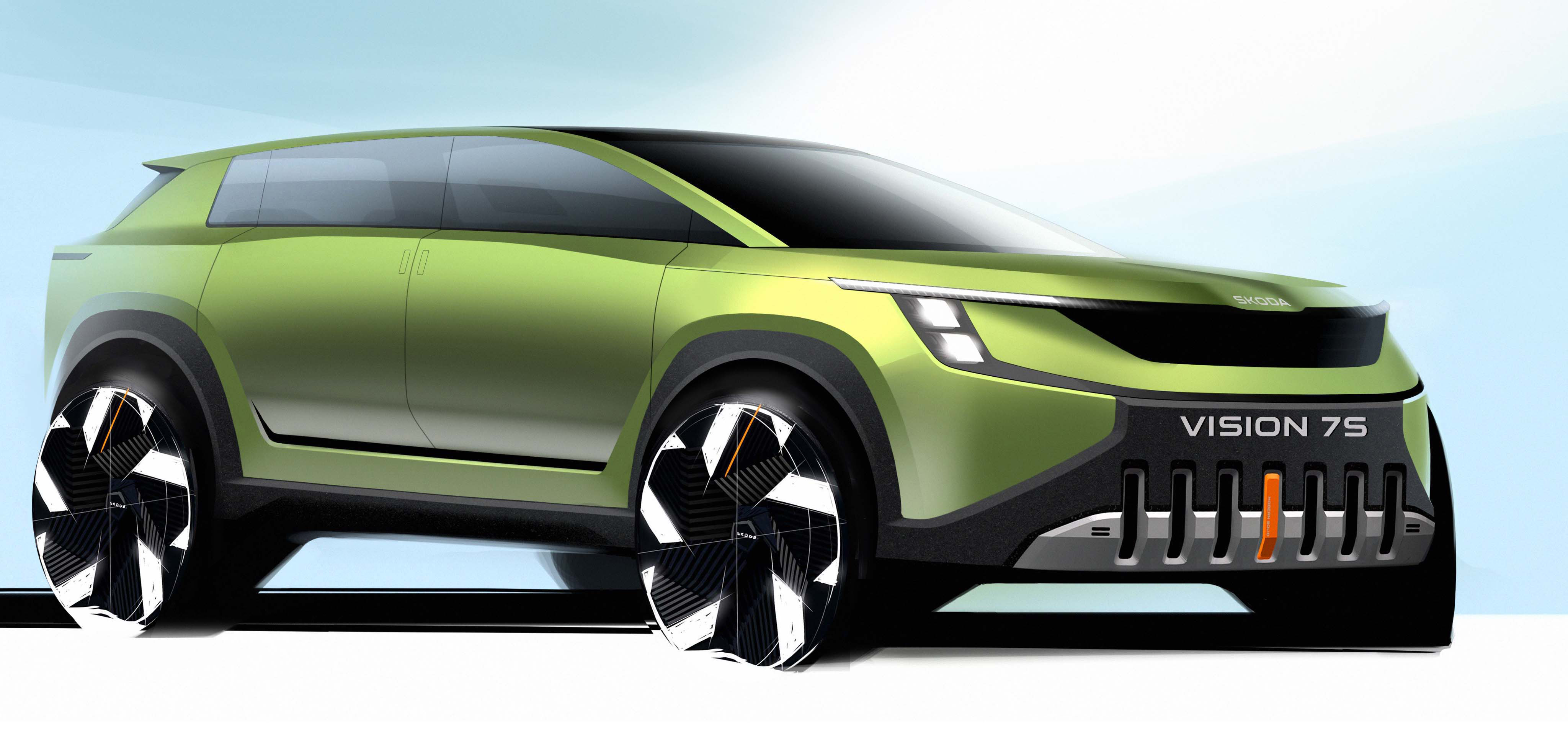
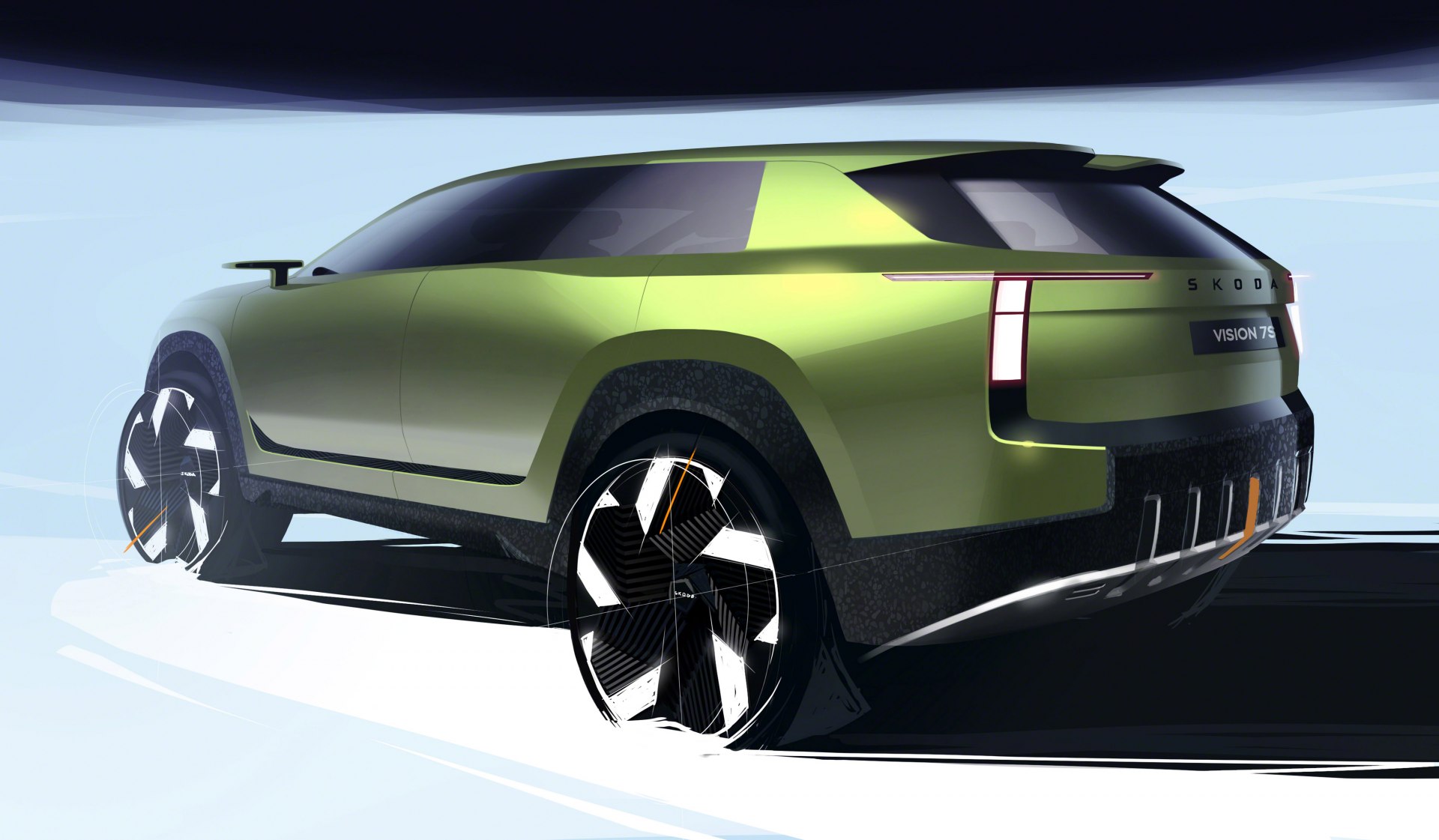
    Releasing the first exterior sketches of the VISION 7S concept car, ŠKODA AUTO reveals further details of its new design language. The drawings provide a preview of the study’s body. The sketches show a powerful SUV featuring a striking front end with T-shaped headlights.

    The exterior sketches of the all-electric ŠKODA VISION 7S concept car depict a newly designed, striking front end. The significantly wider and flatter ŠKODA grille is dark and closed. The front headlights, which have been repositioned far out to the edge of the vehicle, are arranged in two rows one above the other, and the sharply defined daytime running light strip above them extends laterally into the pronounced wings, extending the light cluster to form a ‘T’.

    The sharply contoured bonnet cites the well-known ŠKODA line. The striking, completely redesigned bumper features seven vertically arranged air inlets, with the central one sporting an insert in eye-catching orange. The lower apron area is fitted with an aluminium underride guard. Large, aerodynamically optimised wheels emphasise the VISION 7S’s powerful visual appearance. The side view is defined by clear surfaces and a gently sloping roof line to the rear.

    ŠKODA’s new design language reflects familiar brand values, such as robustness, functionality and authenticity, and stands out with its spacious interior, durable, sustainable materials and aerodynamic, efficient body.

    SKODA VISION 7S - Rear Angle

  • SKODA FABIA RS Rally2: Next chapter in the success story

    2023 Skoda Fabia RS Rally2 - Front Angle

    Clear the way for the new ŠKODA FABIA RS Rally2: ŠKODA Motorsport presents the successor to the FABIA Rally2 evo. The new rally model from Mladá Boleslav is based on the fourth-generation ŠKODA FABIA and follows on from the most successful Rally2 vehicle of recent years. ŠKODA Motorsport has developed a new engine for the FABIA RS Rally2, as well as improving the handling, powertrain and electronics and enhancing the safety features for the driver and co-driver. The new FABIA RS Rally2 has demonstrated its capabilities in a demanding test series on asphalt, gravel and ice as well as in a wide range of weather conditions and is ideally equipped to claim victories and titles in the hands of customer teams in the future.

    Michal Hrabánek, Head of ŠKODA Motorsport, says: “Standing still means going backwards, and this is especially true in motorsport. That’s why, in developing the new FABIA RS Rally2, we applied the experience we gained from the predecessor model and optimised every detail. The aim was to improve the most successful rally car in the world. I’m proud of the entire ŠKODA Motorsport team who have pursued this goal with great dedication. I would also like to thank our colleagues in Series Development; the fourth-generation FABIA provided us with a perfect basis for the FABIA RS Rally2.”

    The all-new ŠKODA FABIA RS Rally2 is a rally vehicle for the Rally2 category and benefits from the best-in-class aerodynamics and exceptionally stiff bodywork of the production model. Compared to the successful predecessor model, the ŠKODA Motorsport team have optimised the powertrain in particular, as well as the electronics, safety and handling. The engineers also developed a new 1.6-litre turbocharged engine based on the 2.0 TSI from the EA888 engine series, which is used in the RS models, among others. ŠKODA’s new motorsport paintwork highlights the close ties to the sporty RS series models; the Hyper Green colourway echoes the OCTAVIA vRS and the ENYAQ Coupé iV vRS.

    Demanding test series under a range of weather conditions

    To prepare the new ŠKODA FABIA RS Rally2 optimally for action on the rally track, ŠKODA Motorsport subjected the newcomer to extensive tests on asphalt, gravel and snow for almost a year. This included trials in the Czech Republic, France, Italy, Croatia, Germany, Belgium and Spain, as well as under extreme winter conditions in northern Finland since the summer of 2021.

    Overview: Technical highlights of the new rally car

    • Wider body and longer wheelbase for improved weight distribution
    • Motorsport braking system with exceptionally powerful braking and efficient cooling
    • Durable suspension components designed to withstand extreme conditions
    • Roll cage made of 35.8 metres of steel tubing and highly protected fuel tank

    ŠKODA Motorsport has incorporated a host of components optimised for rally use in the new FABIA RS Rally2. A special braking system and a precisely balanced chassis deliver valuable tenths of a second on the track. The roll cage, consisting of 35.8 meters of steel tubing and a specially protected fuel tank, ensures a high level of safety on board. In addition, the electronics and controls meet the exact requirements of the driver and co-driver during a rally.

    Some of the components used in rally vehicles differ significantly from their counterparts in production vehicles. Instead of having up to nine airbags and numerous electronic assistance systems like those found in the production FABIA, the new ŠKODA FABIA RS Rally2 relies purely on mechanics in many aspects. It also features specialised components, such as a roll cage and specially protected fuel tank. Unlike the production FABIA, the rally version only uses sensors for engine management and displaying the brake pressure, steering wheel position and fuel. The sensors merely provide information; in contrast to the production model, they do not perform any control functions. Only the engine control unit uses sensor data to ensure that it functions optimally in all driving modes and various weather conditions.

    Different front-axle brake discs for asphalt and gravel tests

    In a rally vehicle, the braking system can save valuable tenths of a second in the fight against the clock. The stronger the deceleration, the later the drivers can brake into a bend. In hard braking manoeuvres, the brake discs easily reach temperatures of more than 700 degrees Celsius. To ensure efficient cooling at all times, the FABIA RS Rally2’s brake discs are internally ventilated, and an optimised brake cooling system is also available for gravel and asphalt stages. The brake discs for asphalt have a diameter of 355 millimetres at the front and 300 millimetres at the rear, requiring 18-inch wheels with a rim size of 8×18. The brakes for use on gravel measure 300 millimetres at both the front and rear. In this case, 15-inch wheels with a size of 7×15 are used.

    Special fuel tank for 100% sustainable petrol or for fossil racing fuel

    The FABIA RS Rally2 has a special fuel tank and shock-resistant rubber in line with the FIA World Automobile Federation’s regulations. Its volume is 82.5 litres. A special foam filling prevents fuel from leaking. Additional protection is provided by a Carbon/Kevlar composite cover and an absorbent layer on the underside. Throughout the 2022 season, 100% sustainable petrol will be used in the FIA World Rally Championship (WRC). This is based on modern raw materials and high-purity renewable components. The bio-fuels are derived from biological waste and synthetic e-fuels. These are produced using renewable energies that enable electrolysis from ‘green’ hydrogen as well as CO2, which is extracted from the air and industrial processes. The 100% renewable petrol is then mixed in a laboratory without any fossil-fuel components.

    35.8 metres of steel tubing protect the crew

    ŠKODA Motorsport engineers have developed a roll cage for the new FABIA RS Rally2, which consists of a total of 35.8 metres of high-strength chrome-molybdenum steel tubing and is welded to the chassis during body construction. The side panels and roof are then mounted. This procedure allows for even greater manufacturing precision, as well as a better fit and connection to the body.

    Special rally chassis and longer service life of components

    The chassis of the FABIA RS Rally2 is also engineered to meet the demands of rallying. Compared to the previous model, the suspension stroke of the dampers is now longer and the MacPherson struts are stiffer. In addition, the designers reduced the friction in the dampers. The longer wheelbase also prompted the development of new suspension kinematics. In addition to the design of the differential, the shift characteristics of the transmission and the durability of various components have also been optimised.

    Easy operation using touchpad and steering wheel buttons

    The FABIA RS Rally2’s larger main display, which can even play back video information, allows for intuitive operation during a rally. The interior also features a new central control panel with a touch screen and integrated intercom. The driver can access numerous functions directly using buttons on the steering wheel, and the engine start button is also integrated into the steering wheel, where it can be quickly accessed if, for example, the engine stalls after a spin.

    Enhanced weight distribution thanks to wider body and longer wheelbase

    The chassis, based on the current generation of the ŠKODA FABIA production model, allowed the engineers to further optimise the rally car’s driving characteristics. The FABIA RS Rally2 benefits from the longer wheelbase of the fourth-generation FABIA, making the car quieter while ensuring a more stable rear. Compared to the ŠKODA FABIA Rally2, the fuel tank has been repositioned and the additional space in the engine compartment has been used for a larger intercooler.

    Drive: Newly developed turbo engine, sequential gearbox and all-wheel drive

    • ŠKODA FABIA RS Rally2 features new engine based on the 2.0 TSI from EA888 engine series, delivering approx. 214 kW (289 hp)
    • Sequential 5-speed transmission allows gear changes in milliseconds
    • Front-rear axle separation clutch now operated hydraulically

    ŠKODA Motorsport has developed a new engine for the FABIA RS Rally2 and further optimised the time-proven powertrain. The FABIA RS Rally2’s 1.6-litre turbo engine is based on the 2.0 TSI from the EA888 engine series with an output of around 214 kW (289 hp). The maximum 430-Nm torque is distributed across all four wheels via a 5-speed sequential gearbox and two differentials.

    The Rally2 regulations of the Fédération Internationale de l’Automobile (FIA) stipulate a 1.6-litre turbo engine based on a production engine for vehicles in this category. When developing the powertrain for the new ŠKODA FABIA RS Rally2, ŠKODA Motorsport opted to base it on the 2.0 TSI with an integrated exhaust manifold from the EA888 engine series, which is used in the brand’s RS models, among others. Compared to the FABIA Rally2 evo engine, the newly developed four-cylinder features redesigned intake and exhaust ports, optimised pistons and combustion chambers, variable valve timing and a redesigned lubrication system for a significantly enhanced combustion process. The engineers also revised the exhaust system, which has a new turbocharger, and developed an innovative intercooler and cooling circuit with greater cooling capacity. The FABIA RS Rally2 also features new engine management software. The diameter of the air restrictor is 32 millimetres, in line with the FIA’s technical regulations for the Rally2 category. This translates to an engine output of around 214 kW (289 hp) and a maximum torque of 430 Nm.

    Power transmission via five-speed gearbox and two differentials across all four wheels

    The sequential 5-speed transmission, specially designed for rally use, enables the driver to change gears in milliseconds using the gear stick alone. Although the FABIA RS Rally2 has a mechanical clutch, it is only used for starting, parking or when driving slowly. For optimum acceleration on tight, winding rally stages, the FABIA RS Rally2 has a relatively short gear ratio, offering a top speed of around 200 km/h (124mph).

    The FABIA RS Rally2’s drive concept differs considerably from the production model, not least due to the all-wheel drive. Since the FIA’s technical regulations prohibit the use of electronic driving aids to improve traction, only mechanical differential locks on the front and rear axles are allowed; an additional centre differential is not permitted. The separating clutch between the front and rear axles, which is activated when the handbrake is applied, assists when turning into bends on the rally track. The suspension features MacPherson struts on both axles, which are designed to handle extreme loads.


    Design and Aerodynamics: Production model offers the perfect basis

    • FABIA RS Rally2 benefits from the fourth-generation FABIA’s best-in-class aerodynamics
    • Downforce almost doubled compared to predecessor model
    • Emotive design language; paint finish in the RS colour Hyper Green

    The new ŠKODA FABIA RS Rally2 brings the emotive design language of the fourth-generation FABIA to the international racing tracks. The new rally vehicle benefits from the production model’s aerodynamics. ŠKODA Motorsport developed a highly efficient aerodynamic package based on the FABIA’s best-in-class drag coefficient. As a result, the new FABIA RS Rally2 generates almost twice as much downforce as its predecessor. ŠKODA Motorsport’s new Hyper Green paintwork ties in with the sporty vRS series models OCTAVIA vRS and ENYAQ Coupé iV vRS.

    The new FABIA RS Rally2 rally model translates the fourth-generation FABIA’s design language to the world of motorsport. In addition to the longer roof spoiler with lateral finlets, the rally model also features the production vehicle’s flat, sharply contoured front headlights that extend right up to the large, hexagonal ŠKODA grille. The front and rear lights set visual accents with LED technology. The Rally FABIA also differs from its production counterpart with significantly wider front and rear wings and numerous air outlets on the body. The Hyper Green paintwork references ŠKODA’s vRS family, echoing the OCTAVIA vRS and the ENYAQ Coupé iV vRS.

    Downforce values practically doubled

    The production version of the ŠKODA FABIA has the best drag coefficient in its class. The experts at ŠKODA Motorsport used this perfect foundation to develop the aerodynamics package for the FABIA RS Rally2. Paying meticulous attention to detail, the team managed to almost double the downforce compared to its predecessor – an enormous advantage on the track, as greater downforce facilitates higher cornering speeds. For regulatory reasons, the engineers did not include active aerodynamic parts such as the radiator louvre from the production FABIA.

    Lukáš Vojík, an aerodynamics specialist from Technical Development at ŠKODA AUTO, explains: “Some aerodynamic elements from the production model have also proven their worth in the rally car. With this model, we have paid more attention to the aerodynamics than we did with its predecessor, and we’ve closely examined every detail. Our goal: Greater downforce for higher cornering speeds and improved handling, while at the same time increasing the vehicle’s aerodynamic efficiency.”

    The air curtains in the front bumpers of the production FABIA guide the airstream closely and aerodynamically over the body and wheels. These are also used in the FABIA RS Rally2. They increase the downforce in combination with new side skirts, which prevent air from flowing under the vehicle from the side. Incorporating a front splitter across the entire lower edge of the front bumper, they ensure optimum aerodynamic efficiency at the front. The splitter also reduces the amount of air flowing under the vehicle, thus ensuring faster airflow and lower pressure under the vehicle, which increases the downforce.

    Aerodynamic components typical of a rally car

    Several aerodynamic components have been specially developed for the FABIA RS Rally2. In addition to the wider front and rear fenders, the newly developed rear wing increases the downforce. The dimensions and position comply with the regulations for the vehicle’s width and height. A small spoiler lip, the so-called Gurney flap, serves as a tear-off edge and also improves the downforce. The airflow over the roof is optimised thanks to a centrally positioned air scoop, which simultaneously supplies fresh air to the cockpit. On a production model, this air intake is located below the windscreen, but on rally cars, this area is very susceptible to dust or water.

    Cooling air for engine and brakes

    The engine and brakes require more cooling air during racing. This is supplied via special aerodynamic components in the FABIA RS Rally2. Two large, central air inlets at the front allow fresh air for the radiator to be directed to the upper section of the engine compartment and to the turbocharger intercooler, which is positioned lower down. Openings on both sides of the bonnet vent the hot air. In addition, cooling air flows directly onto the front brake callipers via two inlets in the front apron and small ventilation pipes.

    Safety: Even better protection for driver and co-driver

    • Rally2 car’s safety equipment exceeds FIA’s strict technical regulations
    • Side impact protection made of carbon fibre, Kevlar and energy-absorbing foam

    The engineers at ŠKODA Motorsport have introduced numerous measures to protect the driver and co-driver in the FABIA RS Rally2 even better in the event of a collision. One priority was safety in the event of a side impact, and comprehensive analyses of accidents provided important information on this issue.

    The measures and equipment to protect the occupants in a rally vehicle differ significantly from those in a production model. The airbags installed in the fourth-generation production FABIA cannot be used in rallying because the sensors and electronic control systems react too sensitively to the high G-forces during asphalt stages, on gravel tracks or in long jumps. The safety concept, therefore, relies on mechanical solutions such as a roll cage and side protection made of carbon fibre and energy-absorbing foam. Six-point harnesses and racing seats with integrated head protection also come into play.

    Roll cage made of high-strength chromoly steel

    In designing the new model, the engineers at ŠKODA Motorsport used analysis data from previous rally accidents. The roll cage for the new FABIA RS Rally2, made of 35.8 metres of high-strength chromium-molybdenum steel, consists of longitudinal, transverse and diagonal tubes in the door openings, under the vehicle roof, around the windscreen and behind the seats. The dimensions and material of the safety cell are defined by the Fédération Internationale de l’Automobile’s (FIA) technical regulations. ŠKODA Motorsport goes far beyond these requirements with the new Rally FABIA. The gusset plates that are relevant in the event of a side impact are also more robust than stipulated in the regulations.

    Designed with the aid of computer calculations, the roll cage secures the survival space of the driver and co-driver in the event of an accident, even if the bodywork is badly damaged. It also forms an integral part of the chassis, to which it is hand-welded by certified professionals. This significantly increases the torsional rigidity of the body, which is already stiffer thanks to the MQB-A0 platform. Every FABIA RS Rally2 is assembled exclusively at ŠKODA Motorsport in Mladá Boleslav.

    Side impact protection made of carbon fibre, Kevlar and energy-absorbing foam

    In a rally car, the driver and front passenger are particularly vulnerable in the event of a side impact. While the production FABIA is protected by a combination of B-pillars, door reinforcements and airbags, the rally version is protected by a roll cage with two door pillars and gusset plates. In addition, the FABIA RS Rally2 has an energy-absorbing structure made of foam between the outer door skin and the interior, as well as door panels made of composite materials. The structure of the composite panels is predefined: Five layers of carbon 280 and one layer of Kevlar 300. The Kevlar layer is closest to the driver and co-driver and protects them from sharp carbon fragments in the event of an accident. The absorbing foam must be approved by the FIA and have the minimum volume specified in the regulations in order to reduce the impact energy and thus the force on the human body. In the FABIA RS Rally2, special racing seats, six-point harnesses and personal equipment, including the mandatory head-and-neck support system (HANS) on the helmet with restraint straps also contribute to effectively mitigating the impact forces. This system protects the crew’s heads from sudden and violent movements.

    To better distribute the forces generated in a side impact, both body sides of the FABIA RS Rally2 are joined by the seat bracket structure and an additional rail. The door crosses of the roll cage are even more robust and exceed the FIA’s requirements. To optimise the strength of the shoulder belt attachment points, the FABIA RS Rally2 has been fitted with an additional cage tube on each side of the vehicle.

    Automatic fire extinguishing system on board

    The FABIA RS Rally2’s polycarbonate side windows can be easily removed in accordance with FIA regulations. In addition, the on-board safety equipment includes a fire extinguishing system, comprising an automatic system with nozzles in the cockpit and engine compartment and a manual fire extinguisher in the co-driver’s footwell. The system can also be activated externally.

  • The SKODA ENYAQ COUPE iV: electromobility at its most elegant

    SKODA ENYAQ COUPE iV - Front View

    Following the successful launch of the ENYAQ iV, ŠKODA is now adding an elegant coupé to the range. The line-up will also include a sporty vRS variant. The ŠKODA ENYAQ COUPÉ iV features an even more emotive design and, displaying sporty lines, generous space and a boot capacity of 570 l. At a value of 0.234, its drag coefficient (cd) has also been improved in comparison to the ENYAQ iV SUV. Depending on specification, this enables a range of up to 339 miles*** in the WLTP cycle, making the car perfectly suitable for travelling long distances. In the UK the coupé will be available with one battery size and a choice of rear- or all-wheel drive, and three power outputs ranging from 150 kW* to 220 kW** (vRS variant) for the ENYAQ COUPÉ iV. As with the ENYAQ iV, Design Selections replace the classic trim levels for the interior.

    Thomas Schäfer, ŠKODA AUTO CEO, says: “Following the successful launch of the SUV, the new ENYAQ COUPÉ iV brings even more emotiveness, sports styling and elegance to the ŠKODA iV family. Our designers and engineers have once again succeeded in combining a high degree of functionality with an emotive design. The brand-new range-topping model is also the first-ever all-electric ŠKODA vRS. The ENYAQ COUPÉ iV perfectly combines emotion with efficiency, offering the ŠKODA-typical generous amounts of space, even in a particularly elegant body.”

    The new ŠKODA ENYAQ COUPÉ iV and the ENYAQ iV are produced at ŠKODA’s main plant in Mladá Boleslav, making them the only MEB-based Volkswagen Group vehicles in Europe to be built outside of Germany. Due to its composition and a long wheelbase, the MEB modular electric car platform enables new options in terms of body proportions and design. As the high-voltage battery for the drive system is fully incorporated into the underbody, and because electric vehicles don’t have a transmission tunnel, the space available for rear-seat passengers is also particularly generous.

    Dark tinted panoramic glass roof as standard and gently rearward sloping roofline

    The new ŠKODA ENYAQ COUPÉ iV features an even more emotive design than the SUV variant and, in addition to a SportLine derivative, is also available as an athletic range-topping model, the ENYAQ COUPÉ iV vRS. This model features a discrete sporty front apron as well as body‑coloured side skirts and is equipped with alloy wheels measuring between 19 and 21 inches. From the B-pillar, the roofline gently slopes towards the rear and merges with the tailgate that features a sharp trailing edge. The vehicle’s lines are further accentuated by the dark tinted panoramic glass roof, which is a standard feature for the coupé. It is the largest panoramic glass roof in the ŠKODA range, spanning the entire roof and seamlessly merging with the rear window. It is thinner than the full roof, providing plenty of headroom for the car’s occupants. The panoramic glass roof allows more daylight into the interior, giving the car a more airy feel. Its coating helps to ensure that the climate within the cabin is pleasant at all times. Just as with the ENYAQ iV, the coupé is available with the optional Crystal Face where the vertical ribs of the striking ŠKODA grille are illuminated by 131 LEDs, while a horizontal light strip rounds off the car’s stunning look. The ENYAQ COUPÉ  iV vRS comes with the Crystal Face as standard.

    One battery size and three power variants including the range-topping ENYAQ COUPÉ iV vRS

    The new coupé is available in three performance levels. Power output starts at 150kW* with the rear-wheel drive ENYAQ COUPÉ iV 80, which is equipped with 82-kWh battery (net: 77 kWh) and produces 150 kW. In addition, the ENYAQ COUPÉ iV 80x and ENYAQ COUPÉ iV vRS feature a second motor on the front axle, making them all-wheel-drive. The ENYAQ COUPÉ iV 80x has a system output of 195 kW**, while the top-of-the-range ENYAQ COUPÉ iV vRS delivers as much as 220 kW** and a maximum torque of 460 Nm. This is the first-ever all-electric ŠKODA vRS. Characteristic features include a particularly dynamic driving performance, a host of black design details, and the full-length red reflector strip at the rear that is typical of the brand’s vRS models. The ENYAQ COUPÉ iV vRS takes just 6.5 seconds to sprint from 0 to 62 mph and reaches a top speed of 111mph and is available in the striking Hyper Green paintwork.

    Increased efficiency and range thanks to excellent aerodynamics

    The outstanding aerodynamics of ŠKODA’s brand-new all-electric coupé – which, boasting a drag coefficient (cd) of 0.234, are even better than the already excellent cd value set by the ENYAQ iV – contribute to the car’s high level of efficiency. The low drag has a significant impact on the vehicle’s maximum range, which is up to 339 miles*** in the WLTP cycle for the ENYAQ COUPÉ iV 80. Its fast‑charging capability makes the new coupé perfectly suitable for travelling long distances. Equipped with the optional tow bar, the ENYAQ COUPÉ iV can tow trailers weighing up to 1,400 kg on gradients of 8%.

    Interior with Design Selections, a 13-inch screen and head-up display with augmented reality

    Just as with the SUV, the coupé’s interior features holistically coordinated Design Selections based on modern living environments and using natural, sustainably processed and recycled materials. The clear structure of the choices available, including ten cleverly arranged themed packages and select individual options, make car configuration much easier. Standard features include a 13-inch central infotainment screen and the 5.3-inch Digital Cockpit, which can optionally be supplemented by a head-up display with augmented reality.

    SKODA ENYAQ COUPE iV - Interior

    Exterior: emotive design, progressive lines and illuminated Crystal Face

    The new ŠKODA ENYAQ COUPÉ iV exhibits an even more emotive design than the SUV variant, the ENYAQ iV. Its roof – which slopes gently towards the rear from the B-pillar and features a dark tinted panoramic glass roof spanning its entirety as standard – and the striking rear give the brand-new coupé a distinct character. Large alloy wheels with diameters ranging from 19 to 21 inches make the car look athletic and powerful. This impression is further emphasised by the ENYAQ COUPÉ  iV vRS as this latest range-topping model also sports black design features and the vRS-typical red reflector strip at the rear. The Crystal Face – 131 LEDs illuminating the distinctive ŠKODA grille – comes as standard for the ENYAQ COUPÉ  iV vRS.

    Oliver Stefani, Head of ŠKODA Design, says: “In our brand-new production car, the ENYAQ COUPÉ iV, we have retained almost all aspects of the VISION iV study, which attracted a great deal of attention just over two years ago. Its elegant design featuring sculptural and crystalline details give the car a powerful appearance. Sporting athletic lines, our brand-new, all-electric first-class model is even more emotive than the successfully launched ENYAQ iV. At the same time, the coupé also offers brand-typical qualities, such as generous amounts of space and a high level of functionality.”

    Like the ENYAQ iV, the new ŠKODA ENYAQ COUPÉ iV is also based on Volkswagen Group’s MEB modular electric car platform. The coupé is 4,653 mm long and 1,879 mm wide. Its height is 1,622 mm while its wheelbase measures a generous 2,765 mm. The sporty lines ensure outstanding aerodynamics boasting a drag coefficient (cd) of 0.234. Large alloys measuring 19 to 21 inches emphasise the car’s athletic look. The launch of the coupé also sees two new colour options added to the ENYAQ iV range: the striking metallic Phoenix Orange and metallic Graphite Grey, which replaces ŠKODA’s metallic Quartz Grey. Hyper Green is exclusively reserved for the ENYAQ COUPÉ iV vRS.

    Distinct lines and exclusive coupé details

    The body of the new coupé is characterised by athletic, elegant lines. Sporting its own, distinct front apron, it looks different to the ENYAQ iV, its body-coloured side skirts are also exclusive to the ENYAQ COUPÉ iV and make the car look even more elongated.From the B-pillar, the roofline gently slopes towards the rear and seamlessly merges with the sharp rear trailing edge. ‘ŠKODA’ in block lettering on the tailgate is another eye-catching detail. The black panoramic glass roof (standard feature), spanning the entire roof and seamlessly merging with the low-lying rear window, accentuates the coupé’s elegant lines. It is the largest panoramic glass roof in the ŠKODA range, spanning the entire roof and seamlessly merging with the rear window. It is thinner than the full roof, providing plenty of headroom for the car’s occupants. The panoramic glass roof allows more daylight into the interior, giving the car a more airy feel. Its coating helps to ensure that the climate within the cabin is pleasant at all times. Striking contrasts are provided by the chrome surround of the ŠKODA grille and chrome window trim.

    Even more dynamic: the ENYAQ COUPÉ  iV SportLine and ENYAQ COUPÉ iV vRS

    The ENYAQ COUPÉ iV SportLine and ENYAQ COUPÉ iV vRS look even more dynamic. Featuring a sports chassis as standard, they are 15 mm lower at the front and 10 mm at the rear. Sporty design details also include the surround of the ŠKODA grille, window trim and rear diffuser, which are all gloss black, as are the model designations, ŠKODA tailgate lettering and air curtain trim on the front apron. The air curtain trim is C-shaped on the SportLine and comes with an additional centre piece forming an E on the vRS variant. The ENYAQ COUPÉ iV vRS, like all other vRS models by the Czech carmaker, sports a full-length red reflector on its rear bumper.

    Both models come with acoustic front and rear side windows made of laminated glass that reduces the noise level in the interior, as well as dark tinted rear side and rear windows. The anthracite Vega alloy wheels on the ENYAQ COUPÉ iV SportLine are 20 inches in diameter, while the optional 21-inch Betria alloys are black. The ENYAQ COUPÉ  iV vRS comes with black 20-inch Taurus wheels as standard; 21-inch Vision wheels with an anthracite finish are optional. Both feature aerodynamically optimised plastic Aero trims. The two sporty coupé variants can also be identified by their model-specific wing badges either displaying SportLine lettering or a vRS emblem.

    Full-LED Matrix headlights and the Crystal Face create visual highlights

    ŠKODA equips both the ENYAQ COUPÉ iV SportLine and the ENYAQ COUPÉ iV vRS with full-LED Matrix headlights as standard. Within these, each high-beam module features 24 LEDs, which can be controlled individually and enable the driver to have the high beam on at all times without dazzling other road users. For the other models, the full-LED Matrix headlights are optional; their standard range of equipment includes LED modules for low beam, high beam and daytime running lights. The Crystal Face – with 131 LEDs illuminating the ŠKODA grille’s vertical ribs and horizontal strip – creates a special visual highlight. This is a standard feature for the ENYAQ COUPÉ  iV vRS and optional for all other variants. Furthermore, the Crystal Face’s LED modules of the full-LED Matrix headlights for low beam and high beam, as well as the daytime running lights, create an animated welcome display. The full-LED tail lights, forming the brand-typical C-shaped light cluster, feature crystalline, additionally illuminated areas, dynamic indicators and an animated Coming/Leaving Home function.

    2022 Skoda Eenyaq Ccoupe RS iV Full LED Matrix headlights

    Interior: Design Selections and option packs

    As with the ENYAQ iV, the classic trim levels have been replaced by Design Selections for the ENYAQ COUPÉ iV’s interior, offering a new and clear structure of the choices available. The Design Selections have been inspired by modern living environments. The style, colours and materials used, some of which are sustainably focused, are perfectly aligned. For the ENYAQ COUPÉ  iV vRS, there are two model‑specific designs on offer. Ten intelligent packages as well as some individual options make it possible to fully configure a brand-new ŠKODA ENYAQ COUPÉ iV in just six steps.

    As with the SUV, the interior of the ŠKODA ENYAQ COUPÉ iV is characterised by the new Design Selections. They are based on modern living environments and follow a certain style for the upholstery, decorative trims, dashboard and materials. The entry-level specification for the new coupé is the Design Selection ‘Loft’, presenting a modern and homely feel with easy-to-clean materials and a harmonious combination of grey and black shades.

    Seat covers made of new wool and recycled PET bottles

    Particularly sustainable materials are used in the Design Selection ‘Lodge’. The seat covers are made of 40% natural new wool with the Woolmark Company quality seal and 60% polyester from recycled PET bottles. The dashboard is upholstered in fabric; soft materials and light colours dominate. Leather and Suedia microfibre provide the Design Selection ‘Lounge’ with distinct aesthetics and lend it a modern look. Coloured piping and contrasting stitching are exclusive details.

    Style and comfort, optionally with ecologically tanned leather

    The soft, black leather seats with contrasting cognac-coloured stitching and piping in the Design Selection ‘Suite’ offer a high level of comfort. The ‘ecoSuite’ takes a step further, combining a classic and luxurious feel with a high degree of sustainability. Here, the cognac-coloured leather seat upholstery is tanned through an eco-friendly process using olive leaf extracts, and without the use of any chemicals. Stone-grey piping and contrasting stitching finish off the look with style.

    ENYAQ COUPÉ iV SportLine with black interior

    Black sports styling characterises the Design Selection available exclusively for the SportLine variant in the ENYAQ COUPÉ iV range. The Suedia-upholstered sports seats with integrated headrests feature grey decorative stitching, as does the leather multifunction sports steering wheel with three spokes, paddles for selecting the various recuperation levels and a SportLine badge. The roof lining is black while the leather-style dashboard and door trim feature model-specific carbon-fibre-effect decorative strips.

    Design Selection exclusively for the ENYAQ COUPÉ iV vRS

    In the ENYAQ COUPÉ  iV vRS is available with one model-specific Design Selection exclusively reserved for this particular variant. The Design Selection ‘vRS Suite’ is exclusively reserved for the sports-styled range-topping model and features seat covers made of black perforated leather with grey piping and contrasting stitching; this is continued on the leather multifunction sports steering wheel which is also adorned by an vRS badge. The dashboard is upholstered in a leather-look material to match the seats, and is decorated with contrasting stitching. The standard equipment includes carbon‑fibre‑effect decorative strips on the dashboard and door trim, pedal covers in aluminium design, and sports seats with integrated headrests and an vRS emblem.

    Extensive range of standard equipment and themed optional packages

    The ENYAQ COUPÉ iV’s range of standard equipment includes the Digital Cockpit with a 5.3-inch display and a 13-inch central touchscreen that provides access to the infotainment system and all vehicle functions. All coupés come with dual-zone Climatronic, a two-spoke multifunction leather steering wheel sporting control buttons and knurled wheels for intuitive operation, and the KESSY GO keyless start button. All models also feature a heated steering wheel with paddles to adjust the degree of energy recovery. The equipment can be expanded with ten optional packs arranged by elements, such as comfort, driving dynamics, climate control, assistance systems and infotainment. Most of these packages are available as a Basic as well as a Plus bundle.

    The range of options for climate control includes heated front and rear seats as well as a heated windscreen and, for the ENYAQ COUPÉ  iV vRS, tri-zone Climatronic is standard. The ‘Seating Comfort’ pack offers electric seat adjustment; the Plus bundle also comprises a massage function for the driver’s seat. A selection of individual options is available for all models. These include an anti-theft warning feature with interior surveillance, rear side airbags, an electrically retractable tow bar and a sports chassis which is lower by 15 mm at the front and 10 mm at the rear. This chassis, as well as progressive steering, comes as standard for the ENYAQ COUPÉ iV SportLine and the ENYAQ COUPÉ iV vRS.

    Generous amounts of space and a boot with a capacity of 570 l

    The ENYAQ COUPÉ iV offers plenty of space for five people and their luggage. The long wheelbase and flat floor space mean that there is plenty of legroom. Despite the model’s sloping roofline, the headroom is on par with that of a ŠKODA OCTAVIA estate. The boot has a capacity of 570 l and, thanks to a low loading sill and an optional electric tailgate, can also be conveniently accessed via the virtual pedal, which allows the tailgate to be opened with just a foot movement.

    Electric powertrain: 82-kWh battery and three power variants

    Power output ranges from 150 kW* in the ENYAQ COUPÉ iV 80 with rear-wheel drive and a 82-kWh battery, to 220 kW** in the all‑wheel-drive ENYAQ COUPÉ iV vRS fitted with two electric motors. The new coupé’s outstanding aerodynamics contribute to its high level of efficiency, enabling a range of up to 339 miles*** in the WLTP cycle. This, as well as its fast-charging capability, means that the car is perfectly suitable for travelling long distances. The ŠKODA ENYAQ COUPÉ iV is based on Volkswagen Group’s MEB modular electric car platform. Rolling off the line at ŠKODA’s main plant in Mladá Boleslav, the ENYAQ COUPÉ iV and ENYAQ iV are the only MEB-based models in Europe to be produced outside Germany.

    Johannes Neft, ŠKODA AUTO Board Member for Technical Development, says: “The brand-new ENYAQ COUPÉ iV is our second MEB vehicle after the ENYAQ iV SUV. With the launch of our new top-of-the-range model, the ENYAQ COUPÉ iV vRS, we are presenting our first-ever all‑electric vRS. The coupé’s lower weight and improved aerodynamics enable even greater efficiency and a maximum range of up to 339 miles*** in the WLTP cycle.”

    As with the ŠKODA ENYAQ iV, the new coupé is based on the MEB modular electric car platform from Volkswagen Group. Just like the ENYAQ iV, the ENYAQ COUPÉ iV is available with a rear motor and rear-wheel drive or with two motors and all-wheel drive. The ENYAQ COUPÉ iV 80 features a battery, with a capacity of 82 kWh (77 kWh net) providing a maximum range of up to 339 miles*** in the WLTP cycle. The electric motor in the rear delivers 150 kW* and 310 Nm of torque.

    Two motors and four-wheel drive: the ENYAQ COUPÉ iV 80x

    The ENYAQ COUPÉ iV 80x is also fitted with the 82-kWh battery, but has a second electric motor on the front axle, making it all-wheel-drive. The two motors provide a combined power output of 195 kW** and a maximum torque of 425 Nm. This model’s top speed, as well as that of the rear‑wheel-drive variants, is 160 km/h.

    Sporty range-topping model: the ENYAQ COUPÉ iV vRS

    The most powerful car in the ENYAQ iV range is also fitted with the 82 kWh battery, as well as two electric motors. It is therefore also an all-wheel-drive. The ENYAQ COUPÉ iV vRS has a system output of 220 kW** and achieves a maximum torque of 460 Nm. As a result, ŠKODA’s first all‑electric vRS model can accelerate from 0 to 62 mph in just 6.5 seconds; it is the only coupé variant in the range to reach a top speed of 111 mph . On gradients of 8%, the ENYAQ COUPÉ iV vRS and ENYAQ COUPÉ iV 80x each have a maximum towing capacity of 1,400 kg, while the ENYAQ COUPÉ iV 80 can tow braked trailers weighing up to 1,200 kg.

    Fast-charging capability: from 10 to 80% in 29 minutes

    The ŠKODA ENYAQ COUPÉ iV is capable of fast charging. The 82‑kWh battery can be topped up from 10 to 80% in just 29 minutes. At home, the ENYAQ COUPÉ iV can be conveniently charged overnight in six to eight hours using an AC ŠKODA iV Charger wall box delivering up to 11 kW. ‘Refuelling’ at a public AC charging point with the same maximum power will take about as long. That’s why the ENYAQ COUPÉ iV comes with a Mode 3 charging cable as standard. The coupé can also be recharged with 2.3 kW using a conventional 230-volt household socket and an optional Mode 2 cable. The iV universal charger – a mobile solution with interchangeable connector plugs – provides maximum flexibility and is available as an optional extra. A CEE adapter enables recharging with up to 11 kW using a 400‑volt socket, while a Schuko adapter enables charging at household sockets.

    High levels of efficiency thanks to outstanding aerodynamics and optional heat pump

    The drag coefficient (cd) of 0.234, which is outstanding for an SUV coupé of this size, enables high levels of efficiency and thus long ranges. This top value is the result of ŠKODA-typical Simply Clever solutions, such as an active cooling roller blind in the lower air inlet of the front bumper and numerous aerodynamic measures that specifically guide the airstream around the body or under the vehicle. To this end, the ENYAQ COUPÉ iV features an optimised front apron, front spoiler, a covered and flat underbody, air curtains and a rear spoiler. The optional heat pump for heating and air conditioning the interior provides even greater efficiency. A highly efficient heat pump system compresses refrigerant under high pressure. This produces heat, which is used to warm up cold air flowing into the car, meaning less energy from the vehicle battery is required to power the high-voltage heater, thereby increasing the vehicle’s range.

    Connectivity: state-of-the-art infotainment with the largest ŠKODA display and new functions

    The launch of the brand-new ENYAQ COUPÉ iV also sees ŠKODA introduce a new variant of its infotainment system. The latest software version ME 3 brings updates to the infotainment and head-up display, as well as improved battery management. The largest ŠKODA touchscreen, measuring 13 inches, and the 5.3-inch Digital Cockpit come as standard in the new coupé. The permanent internet connection enables the use of the ŠKODA Connect online services, many of which are specifically designed for an electric vehicle. The features included allow battery charging or the interior’s air conditioning to be controlled remotely via the MyŠKODA app.

    Like the ENYAQ iV, the new ŠKODA coupé comes equipped with a 5.3-inch Digital Cockpit that clearly displays information regarding speed, driving data, navigation and assistance systems. The four different cockpit layouts, as well as numerous vehicle functions and assistance systems, can be controlled via the multifunction steering wheel. The optional head-up display projects additional information in clear view for the driver. The free-standing central screen, as found in the ENYAQ iV, and measuring 13 inches, is the largest in ŠKODA’s current portfolio. The layouts can be personalised and the touchscreen can be operated using a touch slider, multi-touch gestures, gesture control or the Laura digital voice assistant who, backed by online data, understands 15 languages. A DAB digital radio receiver as well as internet and hybrid radio come as standard. Wireless SmartLink, Android Auto and Apple CarPlay allow a smartphone to be integrated without requiring a cable while devices can be wirelessly charged. The CANTON sound system with twelve speakers and a digital equaliser is another optional extra.

    ‘Over-the-air’ updates and additional features to download

    Thanks to a built-in eSIM, the ENYAQ COUPÉ iV is always online. This allows navigation maps or the system software to be updated remotely and offers users the option to download further vehicle functions. From the second half of 2022, additional colours for the ambient lighting, Adaptive Cruise Control or Light Assist, for example, can be activated via the infotainment system in the vehicle or the ŠKODA Connect web portal – these features may also be activated for a limited period of time only, if desired.

    ŠKODA Connect features specific to an all-electric vehicle

    The permanent internet connection also enables the use of numerous online-backed services. Traffic information is based on real-time data obtained from the internet, as is the route planner of the optional navigation function. Likewise, available parking spaces nearby can be displayed. Some options in the comprehensive range of ŠKODA Connect online services have been specifically designed for the operation of an electric vehicle. The MyŠKODA app can be used to remotely control battery charging or switch on the air conditioning ahead of the journey. It is also possible to set corresponding schedules. The navigation system can identify charging points nearby or on a planned route.

    New software functions

    The ŠKODA ENYAQ COUPÉ iV has the latest ME 3 software version of Volkswagen Group’s MEB platform with new features and upgrades. For example, the control of the vehicle’s air conditioning and the management of the high-voltage battery have been optimised, which now includes a battery care mode. The new ME 3 vehicle software improves battery management and increases efficiency and service life by initiating the battery’s temperature control at lower temperatures than before and no longer only switching it on and off but continuously monitoring and adjusting it. As a result, the drive battery reaches its ideal temperature window quicker. This ensures optimised power output and recuperation. There are also new layouts for the infotainment system, and the main menu now features an icon for vehicle charging, as well as new icons for augmented reality functions. In addition, the increased brightness and contrast of the rear-view camera display make parking and detecting obstacles even easier, especially in the dark. A new function of the intelligent Park Assist feature now also allows frequently accessed parking spaces to be stored in the system and automatically executed on demand. The ME 3 software offers an upgraded multi-stop route planner and the new assistance system Travel Assist 2.5. Lane Assist can be switched off via ‘Favourites’, making it even easier for the driver to access.

    Safety: head-up display with augmented reality and advanced assistance systems

    The ŠKODA ENYAQ COUPÉ iV features a head-up display with augmented reality, full-LED Matrix headlights and a high level of passive safety with up to nine airbags. Travel Assist 2.5 provides support with longitudinal and lateral steering, while other clever assistance systems warn of potential collisions or make parking more convenient. The head-up display provides the driver with even more targeted information so they don’t have to take their eyes off the road, while the full-LED Matrix headlights provide greater safety when visibility is poor, allowing the driver to leave the high beam on at all times.

    Following the ŠKODA debut for the head-up display with augmented reality that launched with the ENYAQ iV, this feature is now also available as an option for the ŠKODA ENYAQ COUPÉ iV. It projects information for the driver onto two different areas of the windscreen. The car’s speed and detected traffic signs, navigation instructions and information from the assistance systems are displayed just above the dashboard in clear view for the driver. Higher up on the windscreen, in the larger projection zone for augmented reality, larger symbols such as directional arrows from the navigation system are displayed and virtually projected onto the road up ahead, also in clear view for the driver. Information relating to Adaptive Lane Assist or Adaptive Cruise Control is also shown here, as are traffic signs and warnings. The driver can individually adjust the position of the display area on the windscreen, set the colour and brightness, and select what information is to be shown in the infotainment system menu.

    Up to nine airbags and proactive Crew Protect Assist

    The ŠKODA ENYAQ COUPÉ iV can be equipped with up to nine airbags. Driver and front passenger airbags are fitted as standard, as are front side airbags and two curtain airbags, which cover the side windows in the first and second rows of seats. A central airbag between the front seats reduces the impact between the driver and front passenger in the event of a collision. Two side airbags for the outer rear seats are optional. If the sensors detect an impending collision, the driver initiates a sudden braking manoeuvre, or the car is in danger of skidding or tipping over, the proactive Crew Protect Assist feature will automatically take precautions to protect the vehicle’s occupants. The system will then tension the seat belts and close any open windows.

    All ŠKODA assistance systems available

    For maximum levels of active and passive safety, the ENYAQ COUPÉ iV has been fitted with all of ŠKODA’s assistance systems. Travel Assist 2.5 provides active support for longitudinal and lateral steering and comprises Adaptive Cruise Control (ACC), Adaptive Lane Assist including roadwork recognition, Traffic Jam Assist and Emergency Assist. The system is activated at the touch of a button, which is located on the multifunction steering wheel, keeping the ENYAQ COUPÉ iV in its current lane and automatically monitoring the distance to the vehicle in front. In congested traffic, Travel Assist 2.5 can autonomously bring the ENYAQ COUPÉ iV to a stop, make it pull away and follow other vehicles. At speeds of over 90 km/h, the system now assists in changing lanes on the motorway when the indicator is activated, and it provides steering support through tight corners. Travel Assist 2.5 displays the vehicle’s surroundings on the ENYAQ COUPÉ iV’s screens, allowing the driver to see any objects the vehicle sensors detect. The current version of the system can take over lateral steering in narrow spaces in the city using online information based on current swarm data.

    Adaptive Cruise Control, which in its predictive version also incorporates data from the navigation system and detected traffic signs, is now also able to react to obstacles reported via online traffic data. The Travel Assist 2.5 function requires the driver to keep their hands on the steering wheel. If the vehicle detects that the driver is no longer steering, braking or accelerating, Emergency Assist attempts to initially warn them visually, then acoustically and ultimately by jolting the brakes. If the driver fails to react, the hazard lights are activated, the vehicle is brought to a standstill in its current lane, and eCall is triggered.

    Front Assist with Predictive Pedestrian and Cyclist Protection and Blind Spot Detection with Rear Traffic Alert warn of collisions with other vehicles, cyclists, pedestrians and static obstacles. Collision Avoidance Assist supports the driver in the event of an impending collision with a pedestrian, cyclist or another vehicle by actively amplifying the steering moment to prevent the accident. When turning left at junctions, Turn Assist warns of detected oncoming traffic at an early stage, automatically bringing the car to a stop if necessary. When a door is opened, Exit Warning alerts the occupant if another vehicle or a cyclist is approaching from behind. It does this acoustically and visually via a light signal on the inside of the wing mirror housing.

    New assistance functions for parking

    The optional Park Assist feature automatically manoeuvres the vehicle into and out of parallel and bay parking spaces and can now also brake automatically and prevent the car from colliding with pedestrians or objects. With the Trained Parking feature, the system records the route into a frequently used parking space, for example in a narrow and awkward driveway, and can automatically repeat this route at any time. Area View is even better than the optional rear-view camera, as its four cameras create a 360-degree top-down image of the ENYAQ COUPÉ iV’s immediate surroundings.

    High beam can be left on at all times thanks to the optional full-LED Matrix headlights

    The ENYAQ COUPÉ iV’s optional full-LED Matrix headlights significantly increase safety when driving in the dark. Each Matrix high-beam module contains 24 LEDs, which can be controlled individually and enables the driver to have the high beam on at all times without dazzling other road users. If a camera on the windscreen detects vehicles as well as people and objects reflecting the light, the intelligent lighting technology automatically turns off individual segments of the light beam.

    The ŠKODA ENYAQ COUPÉ iV vRS: the first all-electric car in the sporty vRS range

    2022 SKODA ENYAQ COUPE iV vRS - Front Angle View

    With the launch of the ENYAQ COUPÉ iV vRS, ŠKODA is writing the next chapter of its successful vRS story. Following the ŠKODA OCTAVIA iV vRS  plug-in hybrid, the SUV coupé is the first all-electric car of the brand’s sporty vRS line-up. Its coupé shape resembles that of the 180 RS and 200 RS rally prototypes, for which ŠKODA introduced the abbreviation RS (Rally Sport) in 1974. In 1975, ŠKODA presented the 130 RS, which achieved a 1-2 finish in the legendary Monte Carlo Rally in 1977. Since 2000, the RS emblem has also marked out the sportiest ŠKODA production models.

    ŠKODA RS – the abbreviation has been synonymous with international motorsport victories for 47 years and with the Czech manufacturer’s sportiest production models for more than two decades. ŠKODA used the designation RS – the abbreviation of ‘Rally Sport’ – for the first time in 1974, for its rally prototypes ŠKODA 180 RS and 200 RS. One year later, the legendary ŠKODA 130 RS made its debut. The coupé, weighing just 720 kg, secured numerous wins at international rallies as well as race tracks until 1983. In 1977, the ŠKODA 130 RS finished first and second in its category at the ‘Monte’ and also won the Acropolis Rally. On the track, it then took the overall win in the European Touring Car Championship in 1981.

    Sporty ŠKODA production models with vRS DNA since 2000

    From 2000 onwards, ŠKODA continued the success story of its rally models by adding performance-oriented vRS production cars to its portfolio. The first vRS production model – launched in 2000 alongside the OCTAVIA WRC, which marked ŠKODA’s entry into the World Rally Championship – was the OCTAVIA vRS, fitted with a 1.8-litre turbocharged engine producing 132 kW (180 PS). The first-ever OCTAVIA estate vRS followed just one year later. The second-, third- and fourth-generation OCTAVIAs also included vRS variants in both body styles, as well as with powerful diesel engines, and 2020 saw the introduction of the first-ever electrified OCTAVIA vRS, a plug-in hybrid with a power output of 180 kW (245 PS).

    The KODIAQ was the first SUV in the vRS family

    In 2003, ŠKODA added the FABIA to its vRS line-up: a homologated model of the new FABIA WRC rally car presented at the same time. This was fitted with a 1.9 TDI delivering 96 kW (130 PS). In 2010, the vRS variant of the second-generation FABIA was unveiled, equipped with a 1.4‑litre petrol engine producing 132 kW (180 PS) with combined turbocharger and compressor. As a first, this model was also offered as an estate. The first SUV to enter into the ranks of the vRS models was the KODIAQ vRS, launched in 2018. The 2.0 TDI developing 176 kW (240 PS) set a lap record for seven-seater SUVs around the Nürburgring’s legendary Nordschleife, completing the 20.832‑km‑long lap in just 9:29.84 minutes. The model’s biturbo diesel was replaced with a 2.0 TSI petrol engine producing 180 kW (245 PS) in summer 2021. The new engine is 60 kg lighter and provides the KODIAQ vRS with even greater driving performance and dynamics.


    * Maximum power output may not be fully available. The power available in individual driving situations depends on various factors, such as the ambient temperature, the charge level and the temperature, condition or age of the high-voltage battery.

    ** Maximum electrical power of 195 kW and 220 kW respectively: maximum power determined in accordance with UN-GTR.21 that can be called up for a maximum of 30 seconds. The power available in individual driving situations depends on various factors such as the external temperature, the high-voltage battery’s physical age as well as its temperature, charge level and conditioning state. Maximum power can only be available if, in particular, the high-voltage battery’s temperature is between 23°C and 50°C and its charge level exceeds 88%. If these parameters are not met, maximum power may not be available. The battery temperature can – to a certain degree – be influenced indirectly via the stationary air conditioning function, and the charge level can be set in the vehicle. The power currently available is shown on the vehicle’s driving performance screen. To maintain the high-voltage battery’s capacity in the best possible way, we recommend setting a battery charging target of 80% for daily use (can be changed to 100% before long-distance journeys, for example).

    *** All figures stated are provisional
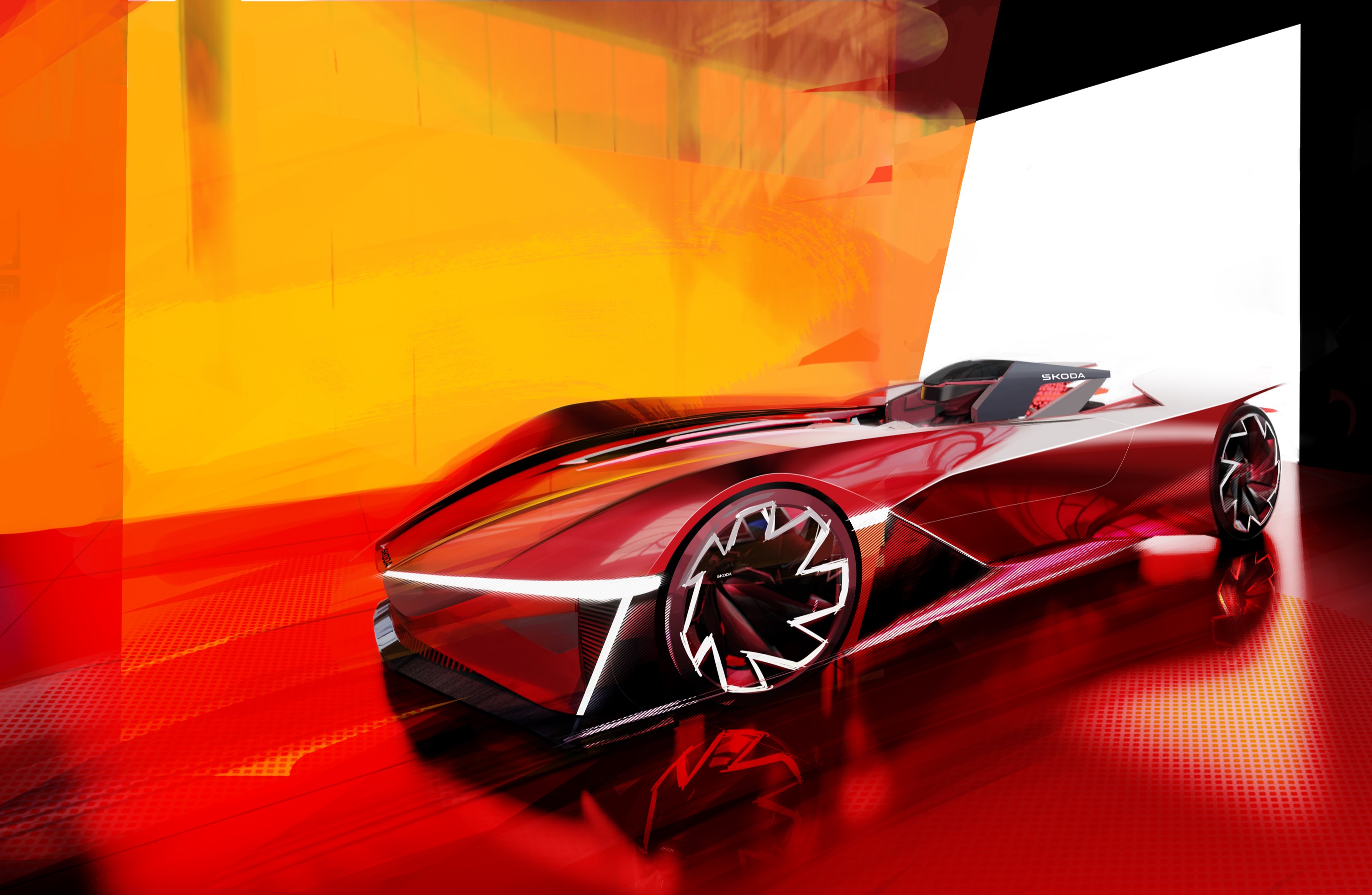
  • 2022 Skoda Karoq: the successful model gets an update

    2022 Skoda Karoq Sportline Front Angle

    Four years after its launch, the ŠKODA KAROQ gets an update: the Czech carmaker has refreshed its second SUV model range to ensure its continued success. In addition to an even more refined design language, the update brings sustainable materials, new technology and more efficient engines from the current EVO generation to the compact SUV. Surpassed only by the OCTAVIA, the KODIAQ’s smaller brother was the second most delivered ŠKODA model worldwide in 2020, as well as in the first six months of 2021.

    Thomas Schäfer, ŠKODA AUTO CEO, said: “With over half a million units sold, the KAROQ is key to our brand’s success. To ensure that this will remain the case, we have developed it further: now sporting a fresher design and optimised aerodynamics along with state-of-the-art assistance systems and infotainment features. I am confident that this overall package will enable us to continue the KAROQ’s success story.”

    A fresh design, improved aerodynamics and sustainable materials in the interior

    ŠKODA AUTO has continued to develop its design language for the revised KAROQ, making the SUV look even more striking. The wider, now hexagonal ŠKODA grille, slimmer headlights as well as tail lights, and aerodynamically optimised alloy wheels with black plastic Aero trim create fresh visual highlights.

    The new wheels, rear window finlets and a new rear spoiler all improve the car’s aerodynamics while lowering its CO2 emissions. The interior features new upholstery which, as an option, can be made from sustainable materials. New technology – such as full-LED Matrix headlights and an expanded range of assistance systems – also debuts in the range. Five efficient engines from Volkswagen Group’s EVO generation round off the KAROQ’s update. Two diesels and three petrol engines deliver power outputs ranging from 81 kW (110 PS) to 140 kW (190 PS). The 2.0 TSI producing 140 kW is reserved for the KAROQ SPORTLINE and exclusively with all-wheel drive. The 2.0 TDI with an output of 110 kW is available with front- or all-wheel drive. Launched in 2017, the KAROQ was the Czech car manufacturer’s second SUV. Offering generous amounts of space, a high level of practicality and excellent value for money, it delivers on the brand’s promise. The KAROQ is produced in the Czech Republic, Slovakia, Russia and China, and available in 60 countries.

    Exterior: striking front profile and redesigned lights

    More striking, more elongated and more aerodynamic: the updated KAROQ is characterised by the refined ŠKODA SUV design language. As with other models by the Czech brand, it now sports a wider, hexagonal ŠKODA grille, which – together with the new front apron – makes the KAROQ look more rugged. The headlights are slimmer, as are the tail lights, and feature a four-light cluster design, now also available with full-LED Matrix technology. A longer rear spoiler, a front apron with air curtains, aerodynamically optimised fuel tank undertrays and new alloy wheels with a diameter of 17, 18 or 19 inches help to reduce the car’s drag by more than 9% to a coefficient (cd) of 0.30. This makes the KAROQ one of the most aerodynamic cars in its segment.

    Oliver Stefani, Head of ŠKODA Design, said: “The revised KAROQ now comes across as much more self-assured. The wider, hexagonal ŠKODA grille and the new bumper make the front more stunning. In addition, the slimmer, newly arranged LED headlights with a four-light cluster design lend the car a more dynamic look. The redesigned tail lights emphasise this appearance, while the new rear spoiler makes the KAROQ look longer.”

    The restyled and sculptured bumper is body-coloured while the wide lower air inlet comes in a crystalline mesh-effect design. The L-shaped finishing touches on the sides accentuate the air curtains while a rugged, black-grained spoiler completes the front section. The air curtains direct the air through the sides of the front bumper as well as through the wheels, reducing air vortices and improving airflow. To reduce underbody drag, the all-wheel-drive KAROQ now comes with aerodynamically optimised fuel tank undertrays, which also cover the rear axle.

    Newly arranged, slimmer headlights with full-LED Matrix technology as an option

    The significantly slimmer headlights extend to the ŠKODA grille. Redesigned daytime running lights, which are now split in two, further accentuate the car’s dynamic look. For the optional top-end headlights, ŠKODA is offering full-LED Matrix technology for the KAROQ for the first time. Here, two LED modules are arranged one above the other. They provide low beam and high beam, and create a distinct four-light cluster, particularly in driving mode in the dark. Even the entry-level KAROQ comes with LED modules in the upper headlight as standard, with a separate fog light in the lower housing.

    New rear apron and razor-sharp LED tail lights

    New rear apron and razor-sharp LED tail lights The redesigned rear of the ŠKODA KAROQ is now adorned with an extended, body-coloured spoiler, which makes the vehicle look longer when viewed from the side. Together with side finlets, as seen in aircraft construction, the spoiler reduces air turbulence at the rear, improving the car’s aerodynamics and lowering its CO2 emissions. The restyled rear apron is finished in body colour below the loading sill and the robust black plastic rear diffuser bears a striking sculptured shape. The ŠKODA designers have remodelled the KAROQ’s tail lights too. They are now sharper and come with full-LED technology as standard. From the Ambition trim level upwards, they feature dynamic indicators and an animated welcome effect. ŠKODA-typical design details include the crystalline structures and the brand’s signature C-shaped light cluster.

    New Aero alloy wheels and two new colours

    There is a choice of nine body colours for the updated ŠKODA KAROQ, with the two metallic paint finishes Phoenix Orange and Graphite Grey making their debut in the range. Aerodynamics are improved by three new alloys: two of which – Scutus (17 inch) and Sagitarius (19 inch) – feature black plastic Aero trim that reduces air turbulence. The 18-inch Miran alloy is also aerodynamically optimised. The Style trim level comes with the Scutus design as standard, while the Miran and Sagitarius Aero wheels are optional.

    Three trim levels and a SPORTLINE variant

    The new ŠKODA KAROQ is available in the Active, Ambition and Style trim levels and as a SPORTLINE variant. This model has a Black pack as standard, with gloss black roof rails and window frames. The new KAROQ is 4,390 mm long and 1,841 mm wide. The front-wheel-drive features a wheelbase of 2,638 mm while the wheelbase of the all-wheel-drive measures 2,630 mm. The boot capacity is the same as in the previous model: 521 l with the seats in their default position and 1,630 l when folded down. With VarioFlex seats, the boot can hold 588 l, or 1,605 l with the rear seats folded down, and 1,810 l with the rear seats removed.

    Interior: more sustainability and additional comfort

    The interior of the updated KAROQ is even more sustainable and comfortable. The new, optional Eco pack includes seat covers made of vegan and recycled materials, while the enhanced LED ambient lighting and new decorative strips on the instrument panel and door trims create new visual highlights. As an option, the front passenger seat can now also be adjusted electrically.

    Oliver Stefani, Head of ŠKODA Design, said: “Thanks to the redesigned decorative trim and seat covers, the KAROQ’s interior has a fresh, modern look and the car now also comes with additional comfort features. A special highlight is the new Eco pack, in which we focus on the use of vegan, recycled and reclaimed materials. The seat covers, for example, are made of disposed PET bottles.”

    With the Eco pack, ŠKODA is offering a particularly sustainable specification for the revised KAROQ: the seat covers include details that are made of vegan, leather-like materials, and the trim-specific armrests are made of Suedia (microsuede) – exclusively in Mocca Brown. The Nisha decorative trim on the doors features a soft surface, complementing the enhanced LED ambient lighting, which now illuminates the front as well as the rear door panels in one of ten colour options and the footwell in white. On request, this is also available as a stand-alone feature separate from the Eco pack. The Ambition specification can be ordered with a ‘Unique Chrome’ trim on the instrument panel, while Piano Black trim can be found from the KAROQ Style upwards. The door panels now bear an Anodized Cross Line (Ambition) or a soft-touch Linear Diamonds design (Style). In the KAROQ SPORTLINE, the interior is characterised by door trims in a carbon look, sports seats with integrated headrests and a multifunction three-spoke sports steering wheel.

    2022 Skoda Karoq Interior

    Increased comfort thanks to new functions of the seats

    In addition to new decorative trims and upholstery, the revised ŠKODA KAROQ offers increased passenger comfort. From the Style specification upwards, electric adjustment including a memory function is available for the first time as an option for the front passenger seat. The built-in memory function saves personal settings and restores them at the touch of a button. Electrically adjustable lumbar support is also an option, allowing the front seats to be adapted to suit the driver and passenger preferences. The VarioFlex system is also available on request. This allows the three rows of seats to be divided in a ratio of 40:20:40.

    Powertrains: EVO engines with lower fuel consumption and emissions

    The revised ŠKODA KAROQ comes with a choice of five advanced and efficient EVO-generation engines from Volkswagen Group, which deliver an output from 81 kW (110 PS) to 140 kW (190 PS). With an injection pressure of up to 350 bar, the three TSI petrol engines are particularly efficient. The nitrogen oxides (Nox) emitted by the two diesels are significantly below the standards stipulated thanks to the ‘twin dosing’ exhaust gas treatment. ŠKODA offers the 2.0 TSI engine with an output of 140 kW (190 PS) exclusively in the KAROQ SPORTLINE in combination with 7-speed DSG and all-wheel drive. For the more powerful diesel, 4×4 and 7-speed DSG are available as options.

    Johannes Neft, ŠKODA AUTO Board Member for Technical Development, said: “The current generation of our modern EVO engines have allowed us to make our cars more efficient while reducing their CO2 and NOx emissions. For the diesels, we apply a particularly effective ‘twin dosing’ exhaust gas treatment and for the petrol engines, we reduce fuel consumption by using high injection pressures, among other things. The current engines now develop their power much more harmoniously.”

    ŠKODA KAROQ engines at a glance:

    Engine Cylinders Max. power output Transmission Max. torque
     [PS] [kW] [Nm]*
     1.0 TSI EVO  3  81  110  6-speed M  200
     1.5 TSI EVO  4  110  150  6-speed M
    7-speed DSG
     250
    2.0 TSI EVO  4 140 190  7-speed DSG
    4×4
     320
    2.0 TDI EVO  4 85 116  6-speed M
    7-speed DSG
     300
    250
    2.0 TDI EVO  4 110 150  6-speed M
    7-speed DSG
    4×4
     340
    360


    Highly efficient EVO engines and reduced emissions

    ŠKODA AUTO has integrated a number of technical measures to make the current EVO-generation engines even more efficient and reduce their emissions. For the diesels, weight-optimised crankshafts and extensive modifications to the exhaust gas routing – as well as the turbo, injection and thermo-management systems – result in lower fuel consumption. In addition, the TDIs are equipped with a further developed SCR exhaust gas treatment system and two catalytic converters. Using what is known as ‘twin dosing’, AdBlue® is injected in front of the two SCR catalytic converters that are positioned one after the other, reducing nitrogen oxide (NOx) emissions to far below the required standards. As a result, the EVO-generation TSI petrol engines are more efficient than their predecessors. An injection pressure of up to 350 bar ensures lower hydraulic losses and a reduced fuel delivery rate. In the 1.0 TSI and 1.5 TSI engines, an innovative powder-coated layer measuring just 150 μm (0.15 mm) replaces cast-iron cylinder liners. This reduces internal friction, which lowers fuel consumption and emissions. Through better distribution and dissipation of heat in the combustion chamber, it also lowers the thermal load on the engine. Equipped with Active Cylinder Technology (ACT), the 1.5 TSI automatically shuts down two cylinders when engine load is low, thereby further reducing fuel consumption.

    Connectivity: digital instruments and advanced infotainment

    The ŠKODA KAROQ’s connectivity features are state of the art: the SUV is equipped with systems from Volkswagen Group’s third-generation modular infotainment matrix and is always online thanks to a built-in eSIM. Infotainment apps provide weather forecasts and the latest news, and include calendar management. Over the course of 2022, the KAROQ will be offered exclusively with a digital instrument cluster: the 8-inch display will be standard or there will be the option of a customisable 10.25-inch screen.

    The Bolero, Amundsen and Columbus infotainment systems are based on Volkswagen Group’s third-generation modular infotainment matrix. Thanks to a built-in eSIM, they offer digital DAB radio and are always online. The Bolero and Amundsen systems come with an 8-inch screen and optionally receive web radio thanks to the permanent internet connection. The system can be operated via the touchscreen, the buttons and knurled wheels on the multifunction steering wheels, or through Laura, the digital voice assistant which, using online data, understands 15 languages. The range-topping Columbus system displays information on a 9.2-inch screen. Map and software updates are installed ‘over the air’. The entry-level Swing radio features a 6.5-inch display.

    Digital instrument cluster as standard over the course of 2022

    Over the course of 2022, the ŠKODA KAROQ will be equipped with a digital instrument cluster as standard. The 8-inch display will replace the previous analogue instruments. From the Ambition trim level upwards, the digital instrument cluster (or ‘Virtual Cockpit’ as it is also referred to) is available with a 10.25-inch display as an option. This offers five basic layouts and can be configured individually.

    Mobile ŠKODA Connect online services and infotainment apps

    The KAROQ provides access to a wide range of ŠKODA Connect mobile online services. The infotainment online services, for example, enable remote access to the vehicle via the MyŠKODA app. This allows the driver to lock and unlock their KAROQ via a smartphone, display the car’s location on a map or activate the Honk & Flash function to make it easier to find the vehicle in a large car park. The online features in the new KAROQ also include infotainment apps that display news and weather, and can connect a personal Google calendar to the vehicle. Smartphones can be paired with the car using Wireless SmartLink technology, Android Auto or Apple CarPlay and can also be inductively charged when placed in the optional Phone Box.

    Safety: up to nine airbags and various assistance systems

    Improved assistance and safety systems as well as up to nine airbags ensure the best possible protection for all occupants in the ŠKODA KAROQ. Travel Assist incorporates five to eight assistance systems, including Predictive Cruise Control, Adaptive Lane Assist and an improved version of Traffic Sign Recognition. The optional Crew Protect Assist system reacts to impending collisions to prevent an accident or minimise the severity of its consequences.

    The KAROQ’s occupants are protected by up to nine airbags. Driver and front passenger airbags are fitted as standard in the EU, as are front side airbags, curtain airbags and a knee airbag for the driver. Side airbags in the second row of seats are optional together with Crew Protect Assist. If the vehicle sensors – now also at the rear – detect an imminent collision or register sudden braking, the system automatically closes any open windows and, if necessary, the panoramic roof, and activates the hazard lights and pre-tensions the front seat belts. Following a collision, the Multi-Collision Brake prevents the vehicle from rolling any further in an uncontrolled manner.

    Increased safety and improved comfort thanks to various assistance systems

    In the EU, the standard equipment includes Front Assist with Predictive Pedestrian Protection and City Emergency Brake. The optional Travel Assist comprises several assistance systems, some of which are also available separately. There is a choice of two Travel Assist variants, both of which include Predictive Cruise Control, which uses images from the camera on the windscreen as well as data from the navigation system and, if desired, reacts in good time to speed limits or corners. In combination with a DSG, the cruise control’s Stop & Go function can automatically bring the vehicle to a standstill and have it pull away again automatically within up to three seconds. Travel Assist also includes a more accurate version of Traffic Sign Recognition (thanks to an improved camera), Adaptive Lane Assist (now able to identify road works and all road markings), Traffic Jam Assist and Emergency Assist. The enhanced version of Travel Assist also has Park Assist and Side Assist with Rear Traffic Alert. Side Assist warns the driver of vehicles approaching from behind up to 70 m away. Using Hands-on Detect, this system also checks whether the driver is touching the steering wheel every 15 seconds or if they no longer have control due to a potential medical emergency. In this case, Emergency Assist activates the hazard lights and brings the car to a stop in its current lane. Parking is made more convenient by the integrated Manoeuvre Assist – which detects obstacles in front of and behind the vehicle, and brakes automatically, if necessary – the 360-degree image of the optional Area View system, as well as the optional Trailer Assist. Some of the afore-mentioned assistance systems for the revised ŠKODA KAROQ will be launched later in 2022.

    The ŠKODA KAROQ SPORTLINE: dynamic top-of-the-range model

    The KAROQ SPORTLINE is the range-topping model of the successful ŠKODA SUV. Apart from the 1.0 TSI, it is available with any of the engines in the range, while the most powerful engine is exclusively reserved for this KAROQ variant. The 2.0 TSI petrol engine delivers 140 kW (190 PS), which is transferred to all four wheels via a 7-speed DSG as standard. Visually, the KAROQ SPORTLINE can be identified by numerous black design features, and the interior is also dominated by black sports styling.

    The range-topping model of the updated KAROQ can immediately be recognised by the SPORTLINE-typical black design features. These include the gloss black ŠKODA grille, which provides a stunning contrast to the body-coloured front apron. The Black pack, sporting gloss black window frames and roof rails, is part of the standard equipment. Additional black design details include the rear diffuser on the body-coloured rear apron, the wing mirror caps and the 18-inch Procyon alloy wheels, which feature an Aero trim, as do the optional 19-inch Sagitarius alloys. The rear side windows and the rear window are tinted (SunSet), and the front wings are adorned with a SPORTLINE badge. The standard equipment of the KAROQ SPORTLINE also includes full-LED Matrix headlights.

    2022 Skoda Karoq Sportline - Front

    Black ThermoFlux seat covers

    The interior is characterised by black sports styling, with Piano Black decorative strips on the instrument panel and a carbon-fibre-effect decor on the doors. The roof lining is also black, as are the breathable ThermoFlux covers of the sports seats with integrated headrests. The leather gearstick features silver contrasting stitching. The three-spoke multifunction sports steering wheel is adorned with a SPORTLINE badge and the front door sill trims bear KAROQ lettering. The LED ambient lighting is a standard feature in the sporty range-topping model and now also illuminates the rear door panels in one of the ten colour options.

    Source: Skoda

  • SKODA Team announces the development plan for the new Fabia Rally vehicle

    2021-SKODA-FABIA-RALLY-910SKODA team announces the development of an all-new Fabia, with the first prototype featuring Rally2 specs.

    Following the launch and the success of the rally-ready Fabia, the engineering team is now ready to up their game with an even more advanced and refined version of the machine.

    “The all-new ŠKODA Fabia for the Rally2 category has entered the development and testing stage. Fortunately, our technicians can build on comprehensive know-how and expertise of the ongoing ŠKODA Fabia Rally2 evo project, which still is very successful worldwide,” comments Michal Hrabánek, Head of ŠKODA Motorsport.

    Since 2015, SKODA Fabia has won numerous rally trophies and is the leader in its class in terms of awards and achievements. Since the iteration of the new R5 version, the model has gone on to take nine titles in support categories to the FIA World Rally Championship, numerous regional and national championships, nearly 1,400 overall and class victories as well as close to 3,300 podium positions worldwide. ŠKODA Motorsport has already sold more than 400 units of the R5, Rally2, and Rally2 Evo variants.

    According to the Rally2 regulations of the FIA, the next generation Rally2 version of the ŠKODA Fabia is again powered by a 1.6-litre turbo petrol engine connected to a five-speed sequential gearbox and four-wheel drive with mechanical differentials.

  • Skoda Superb lineup turns 20!

    2021-Skoda-Superb-910SKODA Superb, the flagship model of the brand celebrates its 20th anniversary. On 11th on September 2001 the Skoda team unveiled the 4.8-meter long saloon with its spacious interior, powerful engines and many safety and utility features at the International Motor Show in Frankfurt.

    This first generation of Superb also marked the dramatic return of the brand in the large family car segment. The 2001 version is 4,803 mm long, 1,765 mm wide, and 1,469 mm tall. In terms of drivetrain system, 2001 Superb features front-wheel drive and a wheelbase of 2,803 mm.

    The engine range included three petrol and two diesel drivetrains. The 2.0- litre four-cylinder engine generated 85 kW (115 hp), while the other petrol engines were a 1.8-liter four-cylinder turbo with 110 kW (150 hp) and the flagship was a 2.8-liter V6 with 142 kW (193 hp). With this powerful engine, the SUPERB was able to reach a top speed of 237 km/h. The 1.8-liter four-cylinder turbo with 110 kW (150 hp) and the 2.8- liter V6 also featured innovative five-valve technology. For customers seeking efficiency and economics, the 1.9-liter TDI with 96 kW (130 hp) was the model of choice, with a standard consumption of only 5.7 liters per 100 km. Another alternative was a six-cylinder TDI with a displacement of 2.5 liters and an output of 114 kW (155 hp). A six-speed direct-shift gearbox was fitted as standard, while a five-speed Tiptronic automatic transmission was optionally available with the two V6 engines.

    Other features included bi-xenon headlights with integrated headlight washers, electrically adjustable and heated front seats, Climatronic automatic air conditioning, and a color-screen navigation system.

    Successors offer even more features and luxury

    In March 2008, ŠKODA presented the next generation of the Superb at the Geneva Motor Show. By 2015, the Czech brand had produced 618,000 second-generation Superbs, which received the ‘Luxury Car of the Year’ award from Top Gear magazine in 2009.

    The third generation of the Superb was a sensation at its world premiere in Prague in 2015. Its design language, luxurious interior, wide range of modern assistance systems and highly efficient engines were well received. Also, the third-generation Superb introduced several technical innovations to the Czech carmaker’s model range: Dynamic Chassis Control, adaptive chassis, parking assist and three-zone air conditioning. The spacious Superb estate was added to the range in the same year.

    SEE ALSO: Toyota introduces the new 2022 Corolla Cross

    ŠKODA AUTO took the next step in autumn 2019, by launching the Superb iV with plug-in hybrid drive. The model’s overall output is 160 kW (218 hp) with a range of up to 62 km (WLTP) in electric-only mode. To date, ŠKODA AUTO has produced more than 700,000 units of the current Superb generation.


  • SKODA proves that the brand’s EV range is as safe as its conventional models

    2021 SKODA Enyaq iVSKODA AUTO engineers employ a wide range of measures to ensure that all vehicles in the iV lineup offer optimal safety, even in the event of a severe accident. Special attention is paid to the installing of high-voltage batteries in a way that they are impact-proof and protect in the terms of overloading. This approach makes the vehicles as safe as their siblings with internal combustion engine systems.

    The entire SKODA Enyaq iV has proven itself worthy of numerous awards in terms of safety, even the renowned Euro NCAP tests, which proves that the approach is indeed effective. Enyaq iV comes with a well-protected high-voltage battery which doesn’t pose an increased risk. This has also been confirmed in independent studies by accident researchers and fire safety experts: battery electric vehicles have the same level of crash safety as models with conventional combustion engines.

    Engineers have paid special attention to prevent the energy storage unit from being overloaded and by applying sophisticated tech approaches that include applying protective relays and extensive sensors. Furthermore, the high-voltage system is also designed to be safe and in the event of a defect or accident, the electrical components are immediately disconnected from the battery in a matter of milliseconds and do not endanger passengers anymore.

    SEE ALSO: SKODA Octavia celebrates its 25th anniversary

    Independent tests, some of which go far beyond the legal requirements, have shown that the well-protected battery packs remain undamaged even if the body is deformed and that there would be no increased risk of fire in a rear collision.