Tag: quattro

  • Audi SQ8 Sportback e-tron quattro

    With the Audi e-tron, the premium manufacturer entered the age of electromobility in 2018, marking the start of the electric future for the four rings. Since then, the model has been setting standards in the electric luxury-class SUV segment. The new Audi Q8 e-tron is now building on the success story of this electric pioneer. The top-of-the-line electric SUV and crossover impress with their optimized drive concept, improved aerodynamics, higher charging performance, and battery capacity and increased range of up to 582 kilometers in the SUV version (in accordance with the WLTP) and up to 600 kilometers in the Sportback version (in accordance with the WLTP). Significant changes, especially at the front of the vehicle, lend the new flagship SUV a fresher appearance.

    Since the introduction of the Audi e-tron around four years ago and sales of 150,000 units, Audi has been following a systematic electric roadmap. Its electric portfolio now comprises eight models. By 2026, it will have more than 20. At that point, Audi will only be releasing fully electric models on the global market. “With our corporate strategy ‘Vorsprung 2030’, we’ve set a fixed date for our withdrawal from combustion engines and clearly decided that Audi will be a fully electric brand within 11 years,” said Markus Duesmann, Chairman of the Board of Management of AUDI AG. “The new Audi Q8 e-tron, with its improved efficiency and range and refined design, is another important component in our electric portfolio to get people excited about electromobility with emotional models that are suitable for everyday use.” Audi Board Member for Technical Development Oliver Hoffmann also focused on the customer benefits enhanced by these refinements. “In the new Q8 e-tron, we were able to significantly increase both battery capacity and charging performance. This allowed us to achieve an optimal balance between energy density and charging capacity, as well as to increase efficiency,” Hoffmann said. “On top of that, we improved the motors, progressive steering, and chassis control systems – and thus the dynamic driving characteristics that are typical of Audi in all versions of the Q8 e-tron.”

    New face, new name, new corporate identity

    By calling this model the Q8, Audi is making a clear statement that the Audi Q8 e-tron is the top model among its electric SUVs and crossovers. The Audi Q8 e-tron and Q8 Sportback e-tron are immediately identifiable as fully electric models at first glance. This is thanks to the new front and rear designs with the characteristic Singleframe mask, the inverted grille, and blade above the redesigned rear diffuser, which systematically carry Audi’s electric design language forward. An exclusive highlight on the edition S line package is the Singleframe grille, which is finished in body color.

    As a prestigious electric SUV model from Audi, the Q8 e-tron ushers in the new corporate identity with a two-dimensional design of the four rings on the exterior. In order to elevate the family logo as a central element, Audi highlights the vehicle’s face with the projection light Singleframe. Additionally, the Q8 e-tron is the first model to feature the new model badge with Audi lettering on the B-pillar.

    Maximum amount of space and comfort

    With a vehicle length of 4.915 meters, a width of 1.937 meters, and a height of 1.619 meters for the Sportback and 1.633 meters for the SUV, the Q8 e-tron offers a maximum amount of space and comfort. The SQ8 e-tron and SQ8 Sportback e-tron are each two millimeters lower and 39 millimeters wider. Its wheelbase of 2.928 meters allows for a lot of legroom in the back seats too. It has a generous storage volume of 569 liters for the SUV and 528 liters for the Sportback. There are also 62 liters available in the front storage area, the so called “frunk”.

    Three drivetrain variants

    For both body shapes, three drivetrain variants with electric all-wheel drive can be selected. With their two motors, the base models of the Audi Q8 50 e-tron and the Audi Q8 Sportback 50 e-tron generate 250 kW in boost mode and 664 Nm of torque, and they get a range of up to 491 km (SUV) and up to 505 km (Sportback), in accordance with the WLTP.

    With their two motors, the Audi Q8 55 e-tron and Audi Q8 Sportback 55 e-tron generate 300 kW in boost mode and 664 Nm of torque. Their ranges are up to 582 km for the SUV and up to 600 km for the Sportback, in accordance with the WLTP. Their top speed, and that of the Q8 50 e-tron, is limited to 200 km/h.

    The top-end Audi SQ8 e-tron and Audi SQ8 Sportback e-tron are powered by three motors. Their boost performance amounts to 370 kW and 973 Nm of torque.

    The range of the S models is up to 494 km for the SUV and up to 513 km for the Sportback. Their top speed is limited to 210 km/h.

    More battery capacity and higher charging performance

    Two battery sizes can be selected. The battery of the Q8 50 e-tron has a storage capacity of 89 net kilowatt-hours (95 gross kWh), while the more powerful versions of the Q8 55 e-tron and SQ8 e-tron have 106 net kWh (114 gross kWh). Thanks to an adjustment to the battery management system, the battery capacity usable for customers has increased as well. At a high-powered charging station, the Audi Q8 50 e-tron reaches a maximum charging performance of 150 kW. With the Q8 55 e-tron and SQ8 e-tron, the maximum charging performance increases to up to 170 kW. The big battery can be charged from ten to 80 percent during a roughly 31-minute charging stop – under ideal conditions, this corresponds to a range of up to 420 kilometers (according to WLTP). At an AC charging station or wallbox, the Audi Q8 e-tron charges at up to 11 kW. Audi offers an optional AC charging performance of up to 22 kW.

    Under ideal conditions, the Audi Q8 50 e-tron can completely charge in around nine hours and 15 minutes (22kW: around four hours and 45 minutes) using alternating current. The big battery’s numbers are around 11 hours and 30 minutes at 11 kW and six hours at 22 kW. The Audi Q8 e-tron comes standard with the Plug & Charge function. At compatible charging stations, the vehicle authorizes itself when inserting the charging cable and activates the charging point. Billing happens automatically. The new charging service Audi charging, which is set to launch in 2023 and will in the future replace the existing e-tron Charging Service, will allow for convenient access to around 400,000 public charging points across Europe. The e-tron route planner provides reliable support when searching for charging points along your route.

    Revised rear-axle motor and electric torque vectoring for better dynamics

    For the new Audi Q8 e-tron, the asynchronous motor concept on the rear axle was modified. Instead of 12 coils generating the electromagnetic field, there are now 14. The motor consequently generates a stronger magnetic field with similar electricity input, which in turn allows for more torque. If this isn’t needed, the electric motor requires less energy to generate torque. This lowers consumption and increases range. With the e-tron range’s S model, Audi used a three-motor concept for the first time in large-scale production.

    This was refined for the new SQ8 e-tron. A 124-kW electric motor is at work on the front axle. On the rear axle, there are two electric motors each with 98 kW of output that each separately power a rear wheel. This allows for a boost performance of up to 370 kW. The drive torque can be distributed across both rear electric motors between both wheels within a split second.

    Balancing act between comfort and sportiness

    The new Audi Q8 e-tron comes standard with an air-spring suspension with controlled shock absorption. The height of the car body can be varied by a total of 76 millimeters, depending on the driving situation. To optimize the lateral dynamics of the vehicle, its air-spring tuning was adjusted. Moreover, its electronic stability control (ESC) will allow for even more maneuverability in the future – especially in tight corners. The Audi Q8 e-tron handles these with noticeably more agility thanks to its revised progressive steering. The gear ratio of the steering system was changed so that the steering responds much more quickly, even when making delicate steering movements. The effect of the direct steering ratio is supported by more rigid suspension bearings on the front axle. Steering movements are thus transmitted to the wheels more directly, and feedback from steering reactions is improved as well. All the chassis control systems were adjusted, but they remain balanced and perfectly attuned – true to the Audi DNA.

    Further improved aerodynamics

    With the Audi Q8 e-tron, the topic of aerodynamics was a top priority. This resulted in a reduction of the drag coefficient from 0.26 to 0.24 cw for the Q8 Sportback e-tron and from 0.28 to 0.27 cw for the Q8 e-tron. The wheel spoilers mounted on the underbody help divert airflow around the wheels. The spoilers on the front axle were enlarged, and the Audi Q8 Sportback e-tron now has spoilers on the rear wheels as well. With the SQ8 Sportback e-tron, spoilers are only mounted on the rear axle. In the area around the grille, this is the first time an Audi model has had a self-sealing system in addition to the electric shutters that automatically close the radiator. This system further optimizes the airflow at the front of the car and prevents undesired losses.

    Convenient parking with remote park assist plus

    There are around 40 driver assistance systems available in the Audi Q8 e-tron. Up to five radar sensors, five cameras and 12 ultrasonic sensors provide environmental information that’s then analyzed by the central driver assistance control unit. Something new is remote park assist plus, which will be available to order starting in 2023. With its help, the Audi Q8 e-tron can maneuver into even the tightest parking spaces. Customers can control the parking procedure through the myAudi app on their smartphones. When the car reaches its final position in the parking space, it automatically switches off, puts on the parking brake, and locks the doors. To leave the parking space, the motor is powered on through the myAudi app, then the vehicle maneuvers out enough for comfortable entry.

    Digital Matrix LED headlights

    The Q8 e-tron optionally comes with digital Matrix LED headlights. While driving on the highway, the orientation light marks the car’s position in the lane and helps the driver remain securely in the center in narrow spaces. Three other new features are available as well: enhanced traffic information, the lane light with a direction indicator and the orientation light on country roads.

    Luxury-class interior

    The glass panorama roof makes the interior appear lighter and reinforces the sense of airiness and expansiveness. The glass elements open and close electronically. The blackout sunshades are controlled just as conveniently. When it’s open, the two-part glass roof improves the climate in the interior thanks to efficient ventilation. An integrated wind deflector reduces wind noise as well. As an alternative to the standard two-zone automatic climate control, Audi is also offering four-zone automatic climate control and an air quality package. The three-stage ventilation provides for comfortable seating, even at high outdoor temperatures. This is available for the standard seats, whose leather is intricately perforated. The highly adjustable individual contour seats are the highlight among the interior options. In addition to pneumatic seat and backrest adjustments, they can also be ordered with a massage function. All furnishings come with optional decorative inlays of porous wood veneers such as grainy ash and sycamore, aluminum or, for the S line and edition S line versions, a carbon fiber structure. New additions include light brown walnut wood and a sustainable technical material made partially from recycled PET bottles.

    High-resolution touch displays and voice control

    Like all luxury-class Audi models, the Q8 e-tron uses the MMI touch response operating system. Its two large high-resolution displays – the top one with a 10.1-inch diagonal and the bottom one with an 8.6-inch diagonal – replace nearly all conventional switches and knobs. Beyond operation with the two touch displays, a lot of features can be activated through natural voice control. The digital display and operating concept in the Audi Q8 e-tron is rounded out by the standard Audi virtual cockpit with full HD resolution. Specific graphics depict all the important aspects of electric driving, from charging performance to range. On request, a heads-up display can be added. On the German market, the Audi Q8 e-tron will come standard with MMI Navigation plus. Its media center supports the high-speed data transmission standard LTE Advanced, and it has an integrated WiFi hotspot for the passengers’ mobile devices. The navigation system intelligently recommends destinations based on previously traveled routes. On top of that, the Audi connect Navigation and Infotainment package includes car-to-X services.

    Materials from recycling processes

    The Audi Q8 e-tron will be certified as net-carbon-neutral for customers in Europe and the USA. Audi also uses recycled materials for some components in the Audi Q8 e-tron. These materials, treated through a recycling process, reduce the amount of resources used and ensure a closed, efficient and sustainable material loop.

    In the interior of the Audi Q8 e-tron, Audi uses recycled materials for insulation and damping, as well as for carpeting. The decorative inlay above the display, called the Tech Layer, is available with a new anthracite-colored technical material that’s partially composed of recycled PET bottles. With the S line equipment package, the sport seats are upholstered in synthetic leather and the microfiber material Dinamica. Dinamica is made from up to 45 percent polyester fibers that are manufactured from recycled PET bottles, used textiles and fiber residue. In contrast to previous microfiber quality, the production of Dinamica is also solvent-free – another contribution to environmental protection.

    Furthermore, some safety-related components that partially comprise mixed automotive plastic waste treated through a chemical recycling process are used for the first time – specifically, the plastic covers for the seatbelt buckles. As part of the PlasticLoop project, Audi worked with the plastics manufacturer LyondellBasell to establish a process in which chemical recycling will be used for the first time to reuse mixed automotive plastic waste in the series production of the Audi Q8 e-tron. In this process, jointly implemented with LyondellBasell, plastic components from customer vehicles that can no longer be repaired are dismantled and separated from foreign materials such as metal clips before being shredded and processed into pyrolysis oil through chemical recycling. This pyrolysis oil is then used as a raw material in the production of new plastics in a mass-balance approach.

    Market launch in spring 2023

    The market launch of the new Audi Q8 e-tron and Audi Q8 Sportback e-tron, which will be available to order starting in mid-November, is planned to happen at the end of February 2023 in Germany and the most important European markets. In the USA, the model is expected to come to the market at the end of April. The base price for the Audi Q8 e-tron in Germany will be 74,400 euros.

  • Audi SQ8 e-tron quattro

    With the Audi e-tron, the premium manufacturer entered the age of electromobility in 2018, marking the start of the electric future for the four rings. Since then, the model has been setting standards in the electric luxury-class SUV segment. The new Audi Q8 e-tron is now building on the success story of this electric pioneer. The top-of-the-line electric SUV and crossover impress with their optimized drive concept, improved aerodynamics, higher charging performance, and battery capacity and increased range of up to 582 kilometers in the SUV version (in accordance with the WLTP) and up to 600 kilometers in the Sportback version (in accordance with the WLTP). Significant changes, especially at the front of the vehicle, lend the new flagship SUV a fresher appearance.

    Since the introduction of the Audi e-tron around four years ago and sales of 150,000 units, Audi has been following a systematic electric roadmap. Its electric portfolio now comprises eight models. By 2026, it will have more than 20. At that point, Audi will only be releasing fully electric models on the global market. “With our corporate strategy ‘Vorsprung 2030’, we’ve set a fixed date for our withdrawal from combustion engines and clearly decided that Audi will be a fully electric brand within 11 years,” said Markus Duesmann, Chairman of the Board of Management of AUDI AG. “The new Audi Q8 e-tron, with its improved efficiency and range and refined design, is another important component in our electric portfolio to get people excited about electromobility with emotional models that are suitable for everyday use.” Audi Board Member for Technical Development Oliver Hoffmann also focused on the customer benefits enhanced by these refinements. “In the new Q8 e-tron, we were able to significantly increase both battery capacity and charging performance. This allowed us to achieve an optimal balance between energy density and charging capacity, as well as to increase efficiency,” Hoffmann said. “On top of that, we improved the motors, progressive steering, and chassis control systems – and thus the dynamic driving characteristics that are typical of Audi in all versions of the Q8 e-tron.”

    New face, new name, new corporate identity

    By calling this model the Q8, Audi is making a clear statement that the Audi Q8 e-tron is the top model among its electric SUVs and crossovers. The Audi Q8 e-tron and Q8 Sportback e-tron are immediately identifiable as fully electric models at first glance. This is thanks to the new front and rear designs with the characteristic Singleframe mask, the inverted grille, and blade above the redesigned rear diffuser, which systematically carry Audi’s electric design language forward. An exclusive highlight on the edition S line package is the Singleframe grille, which is finished in body color.

    As a prestigious electric SUV model from Audi, the Q8 e-tron ushers in the new corporate identity with a two-dimensional design of the four rings on the exterior. In order to elevate the family logo as a central element, Audi highlights the vehicle’s face with the projection light Singleframe. Additionally, the Q8 e-tron is the first model to feature the new model badge with Audi lettering on the B-pillar.

    Maximum amount of space and comfort

    With a vehicle length of 4.915 meters, a width of 1.937 meters, and a height of 1.619 meters for the Sportback and 1.633 meters for the SUV, the Q8 e-tron offers a maximum amount of space and comfort. The SQ8 e-tron and SQ8 Sportback e-tron are each two millimeters lower and 39 millimeters wider. Its wheelbase of 2.928 meters allows for a lot of legroom in the back seats too. It has a generous storage volume of 569 liters for the SUV and 528 liters for the Sportback. There are also 62 liters available in the front storage area, the so called “frunk”.

    Three drivetrain variants

    For both body shapes, three drivetrain variants with electric all-wheel drive can be selected. With their two motors, the base models of the Audi Q8 50 e-tron and the Audi Q8 Sportback 50 e-tron generate 250 kW in boost mode and 664 Nm of torque, and they get a range of up to 491 km (SUV) and up to 505 km (Sportback), in accordance with the WLTP.

    With their two motors, the Audi Q8 55 e-tron and Audi Q8 Sportback 55 e-tron generate 300 kW in boost mode and 664 Nm of torque. Their ranges are up to 582 km for the SUV and up to 600 km for the Sportback, in accordance with the WLTP. Their top speed, and that of the Q8 50 e-tron, is limited to 200 km/h.

    The top-end Audi SQ8 e-tron and Audi SQ8 Sportback e-tron are powered by three motors. Their boost performance amounts to 370 kW and 973 Nm of torque.

    The range of the S models is up to 494 km for the SUV and up to 513 km for the Sportback. Their top speed is limited to 210 km/h.

    More battery capacity and higher charging performance

    Two battery sizes can be selected. The battery of the Q8 50 e-tron has a storage capacity of 89 net kilowatt-hours (95 gross kWh), while the more powerful versions of the Q8 55 e-tron and SQ8 e-tron have 106 net kWh (114 gross kWh). Thanks to an adjustment to the battery management system, the battery capacity usable for customers has increased as well. At a high-powered charging station, the Audi Q8 50 e-tron reaches a maximum charging performance of 150 kW. With the Q8 55 e-tron and SQ8 e-tron, the maximum charging performance increases to up to 170 kW. The big battery can be charged from ten to 80 percent during a roughly 31-minute charging stop – under ideal conditions, this corresponds to a range of up to 420 kilometers (according to WLTP). At an AC charging station or wallbox, the Audi Q8 e-tron charges at up to 11 kW. Audi offers an optional AC charging performance of up to 22 kW.

    Under ideal conditions, the Audi Q8 50 e-tron can completely charge in around nine hours and 15 minutes (22kW: around four hours and 45 minutes) using alternating current. The big battery’s numbers are around 11 hours and 30 minutes at 11 kW and six hours at 22 kW. The Audi Q8 e-tron comes standard with the Plug & Charge function. At compatible charging stations, the vehicle authorizes itself when inserting the charging cable and activates the charging point. Billing happens automatically. The new charging service Audi charging, which is set to launch in 2023 and will in the future replace the existing e-tron Charging Service, will allow for convenient access to around 400,000 public charging points across Europe. The e-tron route planner provides reliable support when searching for charging points along your route.

    Revised rear-axle motor and electric torque vectoring for better dynamics

    For the new Audi Q8 e-tron, the asynchronous motor concept on the rear axle was modified. Instead of 12 coils generating the electromagnetic field, there are now 14. The motor consequently generates a stronger magnetic field with similar electricity input, which in turn allows for more torque. If this isn’t needed, the electric motor requires less energy to generate torque. This lowers consumption and increases range. With the e-tron range’s S model, Audi used a three-motor concept for the first time in large-scale production.

    This was refined for the new SQ8 e-tron. A 124-kW electric motor is at work on the front axle. On the rear axle, there are two electric motors each with 98 kW of output that each separately power a rear wheel. This allows for a boost performance of up to 370 kW. The drive torque can be distributed across both rear electric motors between both wheels within a split second.

    Balancing act between comfort and sportiness

    The new Audi Q8 e-tron comes standard with an air-spring suspension with controlled shock absorption. The height of the car body can be varied by a total of 76 millimeters, depending on the driving situation. To optimize the lateral dynamics of the vehicle, its air-spring tuning was adjusted. Moreover, its electronic stability control (ESC) will allow for even more maneuverability in the future – especially in tight corners. The Audi Q8 e-tron handles these with noticeably more agility thanks to its revised progressive steering. The gear ratio of the steering system was changed so that the steering responds much more quickly, even when making delicate steering movements. The effect of the direct steering ratio is supported by more rigid suspension bearings on the front axle. Steering movements are thus transmitted to the wheels more directly, and feedback from steering reactions is improved as well. All the chassis control systems were adjusted, but they remain balanced and perfectly attuned – true to the Audi DNA.

    Further improved aerodynamics

    With the Audi Q8 e-tron, the topic of aerodynamics was a top priority. This resulted in a reduction of the drag coefficient from 0.26 to 0.24 cw for the Q8 Sportback e-tron and from 0.28 to 0.27 cw for the Q8 e-tron. The wheel spoilers mounted on the underbody help divert airflow around the wheels. The spoilers on the front axle were enlarged, and the Audi Q8 Sportback e-tron now has spoilers on the rear wheels as well. With the SQ8 Sportback e-tron, spoilers are only mounted on the rear axle. In the area around the grille, this is the first time an Audi model has had a self-sealing system in addition to the electric shutters that automatically close the radiator. This system further optimizes the airflow at the front of the car and prevents undesired losses.

    Convenient parking with remote park assist plus

    There are around 40 driver assistance systems available in the Audi Q8 e-tron. Up to five radar sensors, five cameras and 12 ultrasonic sensors provide environmental information that’s then analyzed by the central driver assistance control unit. Something new is remote park assist plus, which will be available to order starting in 2023. With its help, the Audi Q8 e-tron can maneuver into even the tightest parking spaces. Customers can control the parking procedure through the myAudi app on their smartphones. When the car reaches its final position in the parking space, it automatically switches off, puts on the parking brake, and locks the doors. To leave the parking space, the motor is powered on through the myAudi app, then the vehicle maneuvers out enough for comfortable entry.

    Digital Matrix LED headlights

    The Q8 e-tron optionally comes with digital Matrix LED headlights. While driving on the highway, the orientation light marks the car’s position in the lane and helps the driver remain securely in the center in narrow spaces. Three other new features are available as well: enhanced traffic information, the lane light with a direction indicator and the orientation light on country roads.

    Luxury-class interior

    The glass panorama roof makes the interior appear lighter and reinforces the sense of airiness and expansiveness. The glass elements open and close electronically. The blackout sunshades are controlled just as conveniently. When it’s open, the two-part glass roof improves the climate in the interior thanks to efficient ventilation. An integrated wind deflector reduces wind noise as well. As an alternative to the standard two-zone automatic climate control, Audi is also offering four-zone automatic climate control and an air quality package. The three-stage ventilation provides for comfortable seating, even at high outdoor temperatures. This is available for the standard seats, whose leather is intricately perforated. The highly adjustable individual contour seats are the highlight among the interior options. In addition to pneumatic seat and backrest adjustments, they can also be ordered with a massage function. All furnishings come with optional decorative inlays of porous wood veneers such as grainy ash and sycamore, aluminum or, for the S line and edition S line versions, a carbon fiber structure. New additions include light brown walnut wood and a sustainable technical material made partially from recycled PET bottles.

    High-resolution touch displays and voice control

    Like all luxury-class Audi models, the Q8 e-tron uses the MMI touch response operating system. Its two large high-resolution displays – the top one with a 10.1-inch diagonal and the bottom one with an 8.6-inch diagonal – replace nearly all conventional switches and knobs. Beyond operation with the two touch displays, a lot of features can be activated through natural voice control. The digital display and operating concept in the Audi Q8 e-tron is rounded out by the standard Audi virtual cockpit with full HD resolution. Specific graphics depict all the important aspects of electric driving, from charging performance to range. On request, a heads-up display can be added. On the German market, the Audi Q8 e-tron will come standard with MMI Navigation plus. Its media center supports the high-speed data transmission standard LTE Advanced, and it has an integrated WiFi hotspot for the passengers’ mobile devices. The navigation system intelligently recommends destinations based on previously traveled routes. On top of that, the Audi connect Navigation and Infotainment package includes car-to-X services.

    Materials from recycling processes

    The Audi Q8 e-tron will be certified as net-carbon-neutral for customers in Europe and the USA. Audi also uses recycled materials for some components in the Audi Q8 e-tron. These materials, treated through a recycling process, reduce the amount of resources used and ensure a closed, efficient and sustainable material loop.

    In the interior of the Audi Q8 e-tron, Audi uses recycled materials for insulation and damping, as well as for carpeting. The decorative inlay above the display, called the Tech Layer, is available with a new anthracite-colored technical material that’s partially composed of recycled PET bottles. With the S line equipment package, the sport seats are upholstered in synthetic leather and the microfiber material Dinamica. Dinamica is made from up to 45 percent polyester fibers that are manufactured from recycled PET bottles, used textiles and fiber residue. In contrast to previous microfiber quality, the production of Dinamica is also solvent-free – another contribution to environmental protection.

    Furthermore, some safety-related components that partially comprise mixed automotive plastic waste treated through a chemical recycling process are used for the first time – specifically, the plastic covers for the seatbelt buckles. As part of the PlasticLoop project, Audi worked with the plastics manufacturer LyondellBasell to establish a process in which chemical recycling will be used for the first time to reuse mixed automotive plastic waste in the series production of the Audi Q8 e-tron. In this process, jointly implemented with LyondellBasell, plastic components from customer vehicles that can no longer be repaired are dismantled and separated from foreign materials such as metal clips before being shredded and processed into pyrolysis oil through chemical recycling. This pyrolysis oil is then used as a raw material in the production of new plastics in a mass-balance approach.

    Market launch in spring 2023

    The market launch of the new Audi Q8 e-tron and Audi Q8 Sportback e-tron, which will be available to order starting in mid-November, is planned to happen at the end of February 2023 in Germany and the most important European markets. In the USA, the model is expected to come to the market at the end of April. The base price for the Audi Q8 e-tron in Germany will be 74,400 euros.

  • Audi Q8 Sportback e-tron quattro

    With the Audi e-tron, the premium manufacturer entered the age of electromobility in 2018, marking the start of the electric future for the four rings. Since then, the model has been setting standards in the electric luxury-class SUV segment. The new Audi Q8 e-tron is now building on the success story of this electric pioneer. The top-of-the-line electric SUV and crossover impress with their optimized drive concept, improved aerodynamics, higher charging performance, and battery capacity and increased range of up to 582 kilometers in the SUV version (in accordance with the WLTP) and up to 600 kilometers in the Sportback version (in accordance with the WLTP). Significant changes, especially at the front of the vehicle, lend the new flagship SUV a fresher appearance.

    Since the introduction of the Audi e-tron around four years ago and sales of 150,000 units, Audi has been following a systematic electric roadmap. Its electric portfolio now comprises eight models. By 2026, it will have more than 20. At that point, Audi will only be releasing fully electric models on the global market. “With our corporate strategy ‘Vorsprung 2030’, we’ve set a fixed date for our withdrawal from combustion engines and clearly decided that Audi will be a fully electric brand within 11 years,” said Markus Duesmann, Chairman of the Board of Management of AUDI AG. “The new Audi Q8 e-tron, with its improved efficiency and range and refined design, is another important component in our electric portfolio to get people excited about electromobility with emotional models that are suitable for everyday use.” Audi Board Member for Technical Development Oliver Hoffmann also focused on the customer benefits enhanced by these refinements. “In the new Q8 e-tron, we were able to significantly increase both battery capacity and charging performance. This allowed us to achieve an optimal balance between energy density and charging capacity, as well as to increase efficiency,” Hoffmann said. “On top of that, we improved the motors, progressive steering, and chassis control systems – and thus the dynamic driving characteristics that are typical of Audi in all versions of the Q8 e-tron.”

    New face, new name, new corporate identity

    By calling this model the Q8, Audi is making a clear statement that the Audi Q8 e-tron is the top model among its electric SUVs and crossovers. The Audi Q8 e-tron and Q8 Sportback e-tron are immediately identifiable as fully electric models at first glance. This is thanks to the new front and rear designs with the characteristic Singleframe mask, the inverted grille, and blade above the redesigned rear diffuser, which systematically carry Audi’s electric design language forward. An exclusive highlight on the edition S line package is the Singleframe grille, which is finished in body color.

    As a prestigious electric SUV model from Audi, the Q8 e-tron ushers in the new corporate identity with a two-dimensional design of the four rings on the exterior. In order to elevate the family logo as a central element, Audi highlights the vehicle’s face with the projection light Singleframe. Additionally, the Q8 e-tron is the first model to feature the new model badge with Audi lettering on the B-pillar.

    Maximum amount of space and comfort

    With a vehicle length of 4.915 meters, a width of 1.937 meters, and a height of 1.619 meters for the Sportback and 1.633 meters for the SUV, the Q8 e-tron offers a maximum amount of space and comfort. The SQ8 e-tron and SQ8 Sportback e-tron are each two millimeters lower and 39 millimeters wider. Its wheelbase of 2.928 meters allows for a lot of legroom in the back seats too. It has a generous storage volume of 569 liters for the SUV and 528 liters for the Sportback. There are also 62 liters available in the front storage area, the so called “frunk”.

    Three drivetrain variants

    For both body shapes, three drivetrain variants with electric all-wheel drive can be selected. With their two motors, the base models of the Audi Q8 50 e-tron and the Audi Q8 Sportback 50 e-tron generate 250 kW in boost mode and 664 Nm of torque, and they get a range of up to 491 km (SUV) and up to 505 km (Sportback), in accordance with the WLTP.

    With their two motors, the Audi Q8 55 e-tron and Audi Q8 Sportback 55 e-tron generate 300 kW in boost mode and 664 Nm of torque. Their ranges are up to 582 km for the SUV and up to 600 km for the Sportback, in accordance with the WLTP. Their top speed, and that of the Q8 50 e-tron, is limited to 200 km/h.

    The top-end Audi SQ8 e-tron and Audi SQ8 Sportback e-tron are powered by three motors. Their boost performance amounts to 370 kW and 973 Nm of torque.

    The range of the S models is up to 494 km for the SUV and up to 513 km for the Sportback. Their top speed is limited to 210 km/h.

    More battery capacity and higher charging performance

    Two battery sizes can be selected. The battery of the Q8 50 e-tron has a storage capacity of 89 net kilowatt-hours (95 gross kWh), while the more powerful versions of the Q8 55 e-tron and SQ8 e-tron have 106 net kWh (114 gross kWh). Thanks to an adjustment to the battery management system, the battery capacity usable for customers has increased as well. At a high-powered charging station, the Audi Q8 50 e-tron reaches a maximum charging performance of 150 kW. With the Q8 55 e-tron and SQ8 e-tron, the maximum charging performance increases to up to 170 kW. The big battery can be charged from ten to 80 percent during a roughly 31-minute charging stop – under ideal conditions, this corresponds to a range of up to 420 kilometers (according to WLTP). At an AC charging station or wallbox, the Audi Q8 e-tron charges at up to 11 kW. Audi offers an optional AC charging performance of up to 22 kW.

    Under ideal conditions, the Audi Q8 50 e-tron can completely charge in around nine hours and 15 minutes (22kW: around four hours and 45 minutes) using alternating current. The big battery’s numbers are around 11 hours and 30 minutes at 11 kW and six hours at 22 kW. The Audi Q8 e-tron comes standard with the Plug & Charge function. At compatible charging stations, the vehicle authorizes itself when inserting the charging cable and activates the charging point. Billing happens automatically. The new charging service Audi charging, which is set to launch in 2023 and will in the future replace the existing e-tron Charging Service, will allow for convenient access to around 400,000 public charging points across Europe. The e-tron route planner provides reliable support when searching for charging points along your route.

    Revised rear-axle motor and electric torque vectoring for better dynamics

    For the new Audi Q8 e-tron, the asynchronous motor concept on the rear axle was modified. Instead of 12 coils generating the electromagnetic field, there are now 14. The motor consequently generates a stronger magnetic field with similar electricity input, which in turn allows for more torque. If this isn’t needed, the electric motor requires less energy to generate torque. This lowers consumption and increases range. With the e-tron range’s S model, Audi used a three-motor concept for the first time in large-scale production.

    This was refined for the new SQ8 e-tron. A 124-kW electric motor is at work on the front axle. On the rear axle, there are two electric motors each with 98 kW of output that each separately power a rear wheel. This allows for a boost performance of up to 370 kW. The drive torque can be distributed across both rear electric motors between both wheels within a split second.

    Balancing act between comfort and sportiness

    The new Audi Q8 e-tron comes standard with an air-spring suspension with controlled shock absorption. The height of the car body can be varied by a total of 76 millimeters, depending on the driving situation. To optimize the lateral dynamics of the vehicle, its air-spring tuning was adjusted. Moreover, its electronic stability control (ESC) will allow for even more maneuverability in the future – especially in tight corners. The Audi Q8 e-tron handles these with noticeably more agility thanks to its revised progressive steering. The gear ratio of the steering system was changed so that the steering responds much more quickly, even when making delicate steering movements. The effect of the direct steering ratio is supported by more rigid suspension bearings on the front axle. Steering movements are thus transmitted to the wheels more directly, and feedback from steering reactions is improved as well. All the chassis control systems were adjusted, but they remain balanced and perfectly attuned – true to the Audi DNA.

    Further improved aerodynamics

    With the Audi Q8 e-tron, the topic of aerodynamics was a top priority. This resulted in a reduction of the drag coefficient from 0.26 to 0.24 cw for the Q8 Sportback e-tron and from 0.28 to 0.27 cw for the Q8 e-tron. The wheel spoilers mounted on the underbody help divert airflow around the wheels. The spoilers on the front axle were enlarged, and the Audi Q8 Sportback e-tron now has spoilers on the rear wheels as well. With the SQ8 Sportback e-tron, spoilers are only mounted on the rear axle. In the area around the grille, this is the first time an Audi model has had a self-sealing system in addition to the electric shutters that automatically close the radiator. This system further optimizes the airflow at the front of the car and prevents undesired losses.

    Convenient parking with remote park assist plus

    There are around 40 driver assistance systems available in the Audi Q8 e-tron. Up to five radar sensors, five cameras and 12 ultrasonic sensors provide environmental information that’s then analyzed by the central driver assistance control unit. Something new is remote park assist plus, which will be available to order starting in 2023. With its help, the Audi Q8 e-tron can maneuver into even the tightest parking spaces. Customers can control the parking procedure through the myAudi app on their smartphones. When the car reaches its final position in the parking space, it automatically switches off, puts on the parking brake, and locks the doors. To leave the parking space, the motor is powered on through the myAudi app, then the vehicle maneuvers out enough for comfortable entry.

    Digital Matrix LED headlights

    The Q8 e-tron optionally comes with digital Matrix LED headlights. While driving on the highway, the orientation light marks the car’s position in the lane and helps the driver remain securely in the center in narrow spaces. Three other new features are available as well: enhanced traffic information, the lane light with a direction indicator and the orientation light on country roads.

    Luxury-class interior

    The glass panorama roof makes the interior appear lighter and reinforces the sense of airiness and expansiveness. The glass elements open and close electronically. The blackout sunshades are controlled just as conveniently. When it’s open, the two-part glass roof improves the climate in the interior thanks to efficient ventilation. An integrated wind deflector reduces wind noise as well. As an alternative to the standard two-zone automatic climate control, Audi is also offering four-zone automatic climate control and an air quality package. The three-stage ventilation provides for comfortable seating, even at high outdoor temperatures. This is available for the standard seats, whose leather is intricately perforated. The highly adjustable individual contour seats are the highlight among the interior options. In addition to pneumatic seat and backrest adjustments, they can also be ordered with a massage function. All furnishings come with optional decorative inlays of porous wood veneers such as grainy ash and sycamore, aluminum or, for the S line and edition S line versions, a carbon fiber structure. New additions include light brown walnut wood and a sustainable technical material made partially from recycled PET bottles.

    High-resolution touch displays and voice control

    Like all luxury-class Audi models, the Q8 e-tron uses the MMI touch response operating system. Its two large high-resolution displays – the top one with a 10.1-inch diagonal and the bottom one with an 8.6-inch diagonal – replace nearly all conventional switches and knobs. Beyond operation with the two touch displays, a lot of features can be activated through natural voice control. The digital display and operating concept in the Audi Q8 e-tron is rounded out by the standard Audi virtual cockpit with full HD resolution. Specific graphics depict all the important aspects of electric driving, from charging performance to range. On request, a heads-up display can be added. On the German market, the Audi Q8 e-tron will come standard with MMI Navigation plus. Its media center supports the high-speed data transmission standard LTE Advanced, and it has an integrated WiFi hotspot for the passengers’ mobile devices. The navigation system intelligently recommends destinations based on previously traveled routes. On top of that, the Audi connect Navigation and Infotainment package includes car-to-X services.

    Materials from recycling processes

    The Audi Q8 e-tron will be certified as net-carbon-neutral for customers in Europe and the USA. Audi also uses recycled materials for some components in the Audi Q8 e-tron. These materials, treated through a recycling process, reduce the amount of resources used and ensure a closed, efficient and sustainable material loop.

    In the interior of the Audi Q8 e-tron, Audi uses recycled materials for insulation and damping, as well as for carpeting. The decorative inlay above the display, called the Tech Layer, is available with a new anthracite-colored technical material that’s partially composed of recycled PET bottles. With the S line equipment package, the sport seats are upholstered in synthetic leather and the microfiber material Dinamica. Dinamica is made from up to 45 percent polyester fibers that are manufactured from recycled PET bottles, used textiles and fiber residue. In contrast to previous microfiber quality, the production of Dinamica is also solvent-free – another contribution to environmental protection.

    Furthermore, some safety-related components that partially comprise mixed automotive plastic waste treated through a chemical recycling process are used for the first time – specifically, the plastic covers for the seatbelt buckles. As part of the PlasticLoop project, Audi worked with the plastics manufacturer LyondellBasell to establish a process in which chemical recycling will be used for the first time to reuse mixed automotive plastic waste in the series production of the Audi Q8 e-tron. In this process, jointly implemented with LyondellBasell, plastic components from customer vehicles that can no longer be repaired are dismantled and separated from foreign materials such as metal clips before being shredded and processed into pyrolysis oil through chemical recycling. This pyrolysis oil is then used as a raw material in the production of new plastics in a mass-balance approach.

    Market launch in spring 2023

    The market launch of the new Audi Q8 e-tron and Audi Q8 Sportback e-tron, which will be available to order starting in mid-November, is planned to happen at the end of February 2023 in Germany and the most important European markets. In the USA, the model is expected to come to the market at the end of April. The base price for the Audi Q8 e-tron in Germany will be 74,400 euros.

  • Audi Q8 e-tron quattro

    With the Audi e-tron, the premium manufacturer entered the age of electromobility in 2018, marking the start of the electric future for the four rings. Since then, the model has been setting standards in the electric luxury-class SUV segment. The new Audi Q8 e-tron is now building on the success story of this electric pioneer. The top-of-the-line electric SUV and crossover impress with their optimized drive concept, improved aerodynamics, higher charging performance, and battery capacity and increased range of up to 582 kilometers in the SUV version (in accordance with the WLTP) and up to 600 kilometers in the Sportback version (in accordance with the WLTP). Significant changes, especially at the front of the vehicle, lend the new flagship SUV a fresher appearance.

    Since the introduction of the Audi e-tron around four years ago and sales of 150,000 units, Audi has been following a systematic electric roadmap. Its electric portfolio now comprises eight models. By 2026, it will have more than 20. At that point, Audi will only be releasing fully electric models on the global market. “With our corporate strategy ‘Vorsprung 2030’, we’ve set a fixed date for our withdrawal from combustion engines and clearly decided that Audi will be a fully electric brand within 11 years,” said Markus Duesmann, Chairman of the Board of Management of AUDI AG. “The new Audi Q8 e-tron, with its improved efficiency and range and refined design, is another important component in our electric portfolio to get people excited about electromobility with emotional models that are suitable for everyday use.” Audi Board Member for Technical Development Oliver Hoffmann also focused on the customer benefits enhanced by these refinements. “In the new Q8 e-tron, we were able to significantly increase both battery capacity and charging performance. This allowed us to achieve an optimal balance between energy density and charging capacity, as well as to increase efficiency,” Hoffmann said. “On top of that, we improved the motors, progressive steering, and chassis control systems – and thus the dynamic driving characteristics that are typical of Audi in all versions of the Q8 e-tron.”

    New face, new name, new corporate identity

    By calling this model the Q8, Audi is making a clear statement that the Audi Q8 e-tron is the top model among its electric SUVs and crossovers. The Audi Q8 e-tron and Q8 Sportback e-tron are immediately identifiable as fully electric models at first glance. This is thanks to the new front and rear designs with the characteristic Singleframe mask, the inverted grille, and blade above the redesigned rear diffuser, which systematically carry Audi’s electric design language forward. An exclusive highlight on the edition S line package is the Singleframe grille, which is finished in body color.

    As a prestigious electric SUV model from Audi, the Q8 e-tron ushers in the new corporate identity with a two-dimensional design of the four rings on the exterior. In order to elevate the family logo as a central element, Audi highlights the vehicle’s face with the projection light Singleframe. Additionally, the Q8 e-tron is the first model to feature the new model badge with Audi lettering on the B-pillar.

    Maximum amount of space and comfort

    With a vehicle length of 4.915 meters, a width of 1.937 meters, and a height of 1.619 meters for the Sportback and 1.633 meters for the SUV, the Q8 e-tron offers a maximum amount of space and comfort. The SQ8 e-tron and SQ8 Sportback e-tron are each two millimeters lower and 39 millimeters wider. Its wheelbase of 2.928 meters allows for a lot of legroom in the back seats too. It has a generous storage volume of 569 liters for the SUV and 528 liters for the Sportback. There are also 62 liters available in the front storage area, the so called “frunk”.

    Three drivetrain variants

    For both body shapes, three drivetrain variants with electric all-wheel drive can be selected. With their two motors, the base models of the Audi Q8 50 e-tron and the Audi Q8 Sportback 50 e-tron generate 250 kW in boost mode and 664 Nm of torque, and they get a range of up to 491 km (SUV) and up to 505 km (Sportback), in accordance with the WLTP.

    With their two motors, the Audi Q8 55 e-tron and Audi Q8 Sportback 55 e-tron generate 300 kW in boost mode and 664 Nm of torque. Their ranges are up to 582 km for the SUV and up to 600 km for the Sportback, in accordance with the WLTP. Their top speed, and that of the Q8 50 e-tron, is limited to 200 km/h.

    The top-end Audi SQ8 e-tron and Audi SQ8 Sportback e-tron are powered by three motors. Their boost performance amounts to 370 kW and 973 Nm of torque.

    The range of the S models is up to 494 km for the SUV and up to 513 km for the Sportback. Their top speed is limited to 210 km/h.

    More battery capacity and higher charging performance

    Two battery sizes can be selected. The battery of the Q8 50 e-tron has a storage capacity of 89 net kilowatt-hours (95 gross kWh), while the more powerful versions of the Q8 55 e-tron and SQ8 e-tron have 106 net kWh (114 gross kWh). Thanks to an adjustment to the battery management system, the battery capacity usable for customers has increased as well. At a high-powered charging station, the Audi Q8 50 e-tron reaches a maximum charging performance of 150 kW. With the Q8 55 e-tron and SQ8 e-tron, the maximum charging performance increases to up to 170 kW. The big battery can be charged from ten to 80 percent during a roughly 31-minute charging stop – under ideal conditions, this corresponds to a range of up to 420 kilometers (according to WLTP). At an AC charging station or wallbox, the Audi Q8 e-tron charges at up to 11 kW. Audi offers an optional AC charging performance of up to 22 kW.

    Under ideal conditions, the Audi Q8 50 e-tron can completely charge in around nine hours and 15 minutes (22kW: around four hours and 45 minutes) using alternating current. The big battery’s numbers are around 11 hours and 30 minutes at 11 kW and six hours at 22 kW. The Audi Q8 e-tron comes standard with the Plug & Charge function. At compatible charging stations, the vehicle authorizes itself when inserting the charging cable and activates the charging point. Billing happens automatically. The new charging service Audi charging, which is set to launch in 2023 and will in the future replace the existing e-tron Charging Service, will allow for convenient access to around 400,000 public charging points across Europe. The e-tron route planner provides reliable support when searching for charging points along your route.

    Revised rear-axle motor and electric torque vectoring for better dynamics

    For the new Audi Q8 e-tron, the asynchronous motor concept on the rear axle was modified. Instead of 12 coils generating the electromagnetic field, there are now 14. The motor consequently generates a stronger magnetic field with similar electricity input, which in turn allows for more torque. If this isn’t needed, the electric motor requires less energy to generate torque. This lowers consumption and increases range. With the e-tron range’s S model, Audi used a three-motor concept for the first time in large-scale production.

    This was refined for the new SQ8 e-tron. A 124-kW electric motor is at work on the front axle. On the rear axle, there are two electric motors each with 98 kW of output that each separately power a rear wheel. This allows for a boost performance of up to 370 kW. The drive torque can be distributed across both rear electric motors between both wheels within a split second.

    Balancing act between comfort and sportiness

    The new Audi Q8 e-tron comes standard with an air-spring suspension with controlled shock absorption. The height of the car body can be varied by a total of 76 millimeters, depending on the driving situation. To optimize the lateral dynamics of the vehicle, its air-spring tuning was adjusted. Moreover, its electronic stability control (ESC) will allow for even more maneuverability in the future – especially in tight corners. The Audi Q8 e-tron handles these with noticeably more agility thanks to its revised progressive steering. The gear ratio of the steering system was changed so that the steering responds much more quickly, even when making delicate steering movements. The effect of the direct steering ratio is supported by more rigid suspension bearings on the front axle. Steering movements are thus transmitted to the wheels more directly, and feedback from steering reactions is improved as well. All the chassis control systems were adjusted, but they remain balanced and perfectly attuned – true to the Audi DNA.

    Further improved aerodynamics

    With the Audi Q8 e-tron, the topic of aerodynamics was a top priority. This resulted in a reduction of the drag coefficient from 0.26 to 0.24 cw for the Q8 Sportback e-tron and from 0.28 to 0.27 cw for the Q8 e-tron. The wheel spoilers mounted on the underbody help divert airflow around the wheels. The spoilers on the front axle were enlarged, and the Audi Q8 Sportback e-tron now has spoilers on the rear wheels as well. With the SQ8 Sportback e-tron, spoilers are only mounted on the rear axle. In the area around the grille, this is the first time an Audi model has had a self-sealing system in addition to the electric shutters that automatically close the radiator. This system further optimizes the airflow at the front of the car and prevents undesired losses.

    Convenient parking with remote park assist plus

    There are around 40 driver assistance systems available in the Audi Q8 e-tron. Up to five radar sensors, five cameras and 12 ultrasonic sensors provide environmental information that’s then analyzed by the central driver assistance control unit. Something new is remote park assist plus, which will be available to order starting in 2023. With its help, the Audi Q8 e-tron can maneuver into even the tightest parking spaces. Customers can control the parking procedure through the myAudi app on their smartphones. When the car reaches its final position in the parking space, it automatically switches off, puts on the parking brake, and locks the doors. To leave the parking space, the motor is powered on through the myAudi app, then the vehicle maneuvers out enough for comfortable entry.

    Digital Matrix LED headlights

    The Q8 e-tron optionally comes with digital Matrix LED headlights. While driving on the highway, the orientation light marks the car’s position in the lane and helps the driver remain securely in the center in narrow spaces. Three other new features are available as well: enhanced traffic information, the lane light with a direction indicator and the orientation light on country roads.

    Luxury-class interior

    The glass panorama roof makes the interior appear lighter and reinforces the sense of airiness and expansiveness. The glass elements open and close electronically. The blackout sunshades are controlled just as conveniently. When it’s open, the two-part glass roof improves the climate in the interior thanks to efficient ventilation. An integrated wind deflector reduces wind noise as well. As an alternative to the standard two-zone automatic climate control, Audi is also offering four-zone automatic climate control and an air quality package. The three-stage ventilation provides for comfortable seating, even at high outdoor temperatures. This is available for the standard seats, whose leather is intricately perforated. The highly adjustable individual contour seats are the highlight among the interior options. In addition to pneumatic seat and backrest adjustments, they can also be ordered with a massage function. All furnishings come with optional decorative inlays of porous wood veneers such as grainy ash and sycamore, aluminum or, for the S line and edition S line versions, a carbon fiber structure. New additions include light brown walnut wood and a sustainable technical material made partially from recycled PET bottles.

    High-resolution touch displays and voice control

    Like all luxury-class Audi models, the Q8 e-tron uses the MMI touch response operating system. Its two large high-resolution displays – the top one with a 10.1-inch diagonal and the bottom one with an 8.6-inch diagonal – replace nearly all conventional switches and knobs. Beyond operation with the two touch displays, a lot of features can be activated through natural voice control. The digital display and operating concept in the Audi Q8 e-tron is rounded out by the standard Audi virtual cockpit with full HD resolution. Specific graphics depict all the important aspects of electric driving, from charging performance to range. On request, a heads-up display can be added. On the German market, the Audi Q8 e-tron will come standard with MMI Navigation plus. Its media center supports the high-speed data transmission standard LTE Advanced, and it has an integrated WiFi hotspot for the passengers’ mobile devices. The navigation system intelligently recommends destinations based on previously traveled routes. On top of that, the Audi connect Navigation and Infotainment package includes car-to-X services.

    Materials from recycling processes

    The Audi Q8 e-tron will be certified as net-carbon-neutral for customers in Europe and the USA. Audi also uses recycled materials for some components in the Audi Q8 e-tron. These materials, treated through a recycling process, reduce the amount of resources used and ensure a closed, efficient and sustainable material loop.

    In the interior of the Audi Q8 e-tron, Audi uses recycled materials for insulation and damping, as well as for carpeting. The decorative inlay above the display, called the Tech Layer, is available with a new anthracite-colored technical material that’s partially composed of recycled PET bottles. With the S line equipment package, the sport seats are upholstered in synthetic leather and the microfiber material Dinamica. Dinamica is made from up to 45 percent polyester fibers that are manufactured from recycled PET bottles, used textiles and fiber residue. In contrast to previous microfiber quality, the production of Dinamica is also solvent-free – another contribution to environmental protection.

    Furthermore, some safety-related components that partially comprise mixed automotive plastic waste treated through a chemical recycling process are used for the first time – specifically, the plastic covers for the seatbelt buckles. As part of the PlasticLoop project, Audi worked with the plastics manufacturer LyondellBasell to establish a process in which chemical recycling will be used for the first time to reuse mixed automotive plastic waste in the series production of the Audi Q8 e-tron. In this process, jointly implemented with LyondellBasell, plastic components from customer vehicles that can no longer be repaired are dismantled and separated from foreign materials such as metal clips before being shredded and processed into pyrolysis oil through chemical recycling. This pyrolysis oil is then used as a raw material in the production of new plastics in a mass-balance approach.

    Market launch in spring 2023

    The market launch of the new Audi Q8 e-tron and Audi Q8 Sportback e-tron, which will be available to order starting in mid-November, is planned to happen at the end of February 2023 in Germany and the most important European markets. In the USA, the model is expected to come to the market at the end of April. The base price for the Audi Q8 e-tron in Germany will be 74,400 euros.

  • Audi R18 E-Tron Quattro Demonstrates Refreshed Design and Features

    Audi R18 e-Tron Quattro debuts with refreshed styling and bodywork features. In fact, the whole concept is different, compared to the Audi model, that won the FIA World Endurance Championship WEC season at Silverstone. As you know, it is kind of a tradition for Audi team to create different bodywork concepts for each individual race. Just to be prepared for everything. And this proofed to be a successful strategy.

    As you might remember, the visual changes in previous models was not that interesting or recognizable, but now, the skilled engineer team created a body, that is especially designed and tweaked, just to be in great condition to the Le Mans race. The specific tweaks and configurations are especially done to achieve better downforce, higher speed and even better aerodynamics.

    SEE ALSO: Audi on Demand Shows Latest Possibilities for Ownership and Usage

    In fact, the result is more than satisfying. the greater downforce levels, along with the different fairing, sidespots, openings and the overall bodywork and styling are essential for the latest Audi vehicle and promise to achieve the best results available on the sports track.

    With all the innovations and tweaks, Audi team is ready to show great results not only in the training place, but also on the Le Mans track itself.

    We wish Audi team luck and numerous occasions for celebrations!

    Source: Audi

  • Audi Q7 – First season, Episode Finale

    Myths and legends. Superheroes with unlimited power. Fairytales where things always go the right way. That’s how the stories for Q7 sounded for me. Especially after the rhetorical question “Have you ever driven a Q7?!” asked in a Bulgarian mafia serial the interest for the superpower Q7 graded. I have been listening to fisherman stories for the off-road ability and the road behavior and all my touts were “Yeah, right. 9-years old SUV can not be that good”. Oldschool technics powered by modern technology. It is like installing Android 4.4 on Nokia 5110. Unnatural? Let’s put a touch screen. Now you get my idea.

    This was going to be my first test-drive on the latest Audi Q7 TDI Quattro. I was sure in my associations. It all started when I got the key. When I pressed a button the metal part of it popped. Cool. But for the middle of the last decade. But here’s the modern technology – keyless access and start/stop engine. Perfect start! I have downloaded some music on my USB-drive and I was thinking of playing them. I started to look for USB-slot, but was I forgotten where it was? In the front armrest? No. In the refrigerated glovebox? No. Somewhere around the gearknob and the Bose audiosystem controls? Again no. On the face of the player I saw a button which says Open. I pressed it and a tiny cover really opened. There were hidden not one but two SD-card slots. I asked Google how to play my music and the answer was “you name it but without the USB-flas”. Somewhere in the dashboard there was 20GB of storage for the MMI-system but how was I supposed to transfer the files? Then I started doing some gymnastics. I copied the music to a laptop, got the SD-card from my photocamera, downloaded the music to the card and uploaded it to the MMI-drive. Well done, Georgi! Then I started the engine and left. It all began with a city traffic. This new 8-gears auto transmission was working perfectly with the shifts and the intelligent auto start/stop engine system was reacting fast enough. After I got use to the controls of the multifunctional steering wheel, the navi-system ant the setup controls everything became clear. All the tools are sorted intuitively and I believe that they won’t be a problem for a regular car-user.

    In one of the gearshifts I accidental used the gear levers on the steering wheel. The gear was perfectly changed but I was a bit disappointed touching the lever. It is plastic with a strange surface and did not make any sound (we all well know the clicking sound of an Audi button). Strange way to save money from a materials. These two will probably work just fine in the next years (20-30) but every touch will make you hate them.

    Favourite song. I pumped up the volume. The Bose audio system was brutal. Crystal clear sound. But something was “dancing” with the beat. The noise was coming from the right side somewhere between the doors. I couldn’t find what is the problem there but while I was trying to I found some more bad plastic materials. The good thing about them is that they are low where your feet will be and the engineers knew that nobody will ever touch there trying to find quality materials.

    Because of the total weight the fuel consumption would be bad for some people but for me it was okay. 12 liters per a hundred kilometers. It is quite a bad efficiency but lets not forget that we are in a SUV with a big boot and an all-wheel drive system. Fast accelerations and moving nervously in the city traffic are not the Q7 things. This clumsy body and the slow operating system of the modern gearbox make every try for a fast lane-change a risky business. But let’s face the fact. Q7 is made for a slow movement and for looking respecting and good, not for a street racing.

    On the highway things are similar. Accelerations are not well accepted by this 3.0 TDI engine, delivering 240 horse power. Yes, it is a fact that the gear ratios are perfectly arranged for the ideal revs but the system that controls it is slow. The kick-down button under the gas pedal is pressed but the gearbox reacts some two seconds after that. Then the motor needs another second for getting the boost. After that you can count on the full power. I got used to it.

    There is an option where you can save a second or two. All you need to do is switch the gearknob from D to S. By doing this the gearbox is not keeping the revs lazy. So the time between pressing the gas and the actual movement is shortened.

    The ride in Q7 is allright because of the air suspension. It has got 4 settings (Off-road, Off-road +, Comfort and Dynamic). The first two lift the clearance and the Plus mode can be used while driving with less than 15 km/h. Our poor roads are well stubbed in Comfort mode and you have got enough clearance to use your SUV normal. If you are quite enthusiastic as I am then put it on Dynamic. The clearance is unnatural. Q7 looks like something on the suspension is broken. But the ride is stiff, the front wheels are better connected to the steering wheel. I am sure that with these 4 modes the suspension is going to answer all your emotions.

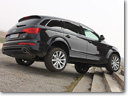
    Doing some off-road was not my idea because I did not want to brake any of the S-line details. And as me and my colleague wrote, doing multitasking is not the favourite thing for a SUV like this. Yes it definitely works for once or twice but it is obvious that Q7 is not feeling comfortable. Never the less I succeeded doing some climbs but I did them to prove to myself this theory. I think that the most important thing for a SUV is the comfort for 5 adults and enough space for their luggage. The panoramic glass roof makes the comfort level even better.

    But lets talk about the road performance. This was my only unanswered question and I was going to find out what happens on the twisty road. Before looking the official technical data I assumed that Q7 weights about 2.2 tons. And how the hell this SUV will corner almost as good as perfectly prepared track car? There was no other options rather than fighting the physics. Right turn for third gear. Entry speed – 75 kms. I am keeping the line and after the apex trying to corner some more with the idea of catching some understeer. But no. Even the exit speed is the same. I assumed that I did not do it correctly. Combination of left, right and again right for about 80 km/h. In the first corner I am in the perfect line but then I decide that I must apply some acceleration. I believed that with the changes of direction the big body will get the disbalance and if not in the second corner in the third the line will be mistaken. Again the answer is no. Instead of this all my luggage in the trunk was a mess. And, by the way, the total weight of this allroader is 2345 kilos. This made the magic Quattro even more mystic and interesting. I don’t know how it works. I don’t care how it does. The only thing I know is that It makes Q7 perfect for a twisty roads like this.

    And this is how the story ends as the first Q7 model. In 2015 we are waiting for the second generation which will be on sale in 2016. I hope that it is going to be fully-modernized and even better than before. I assume that the engineers will do their job that well that they are going to fix some little things in the next decade.

    by Georgi Stefanov

  • Audi A3 Clubsport Quattro Concept – 525HP and 600Nm

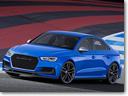
    Audi has unveiled a spectacular A3 Clubsport Quattro Concept, which will make public debut at the 2014 Wörthersee Motor Show starting on May 28th. It is based on the S3 Sedan and comes with incredible engine and other performance upgrades.

    2014 Audi A3 Clubposrt Quattro Concept is powered by a 2.5 liter five-cylinder TFSI engine with epic 525HP (386 kW) and 600Nm (442 lb-ft) of torque. Compared to the “tiny” 2.0 liter TFSI and its 300HP (221 kW) and 420Nm (310 lb-ft), the new power unit is sensational. The performance is more than scary – 0-100 km/h in 3.6 seconds and a top speed of 310 km/h (193 mph). The curb weight of the car is just 1,527 kg (3,366 lbs), so it has a power-to-weight ratio of 343HP / ton. The power is put on the road through Quattro AWD (all-wheel drive) system and a 7-speed S-tronic gearbox featuring launch control.

    Other highlights include an improved suspension and lowered ride height by 10mm. There is also a set of enormous 9.5J x 21” alloy wheels fitted with 275/25 R21. Of course, the manufacturer has fitted the performance sedan with carbon fiber ceramic brake system – 370 millimeters discs.

    The exterior boasts impressive Magnetic Blue paint scheme and an aggressive body kit including CFRP front blade and side sills as well as a big rear diffuser and dual oval exhaust pipes. The popular Matrix LED headlights are also present.

    The interior features bucket seats equipped with four-point seatbelts. The luggage compartment is present only to fit your racing helmets (two).

    The Audi A3 clubsport quattro concept is 4,490 millimeters (14.7 ft) long, 1,856 millimeters (6.1 ft) wide and 1,382 millimeters (4.5 ft) tall. Its wheelbase measures 2,631 millimeters (8.6 ft).

    Source: Audi

  • Audi TT Quattro Sport Concept – 420HP and 450Nm

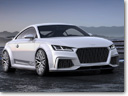
    Audi is currently presenting the spectacular and very powerful TT Quattro Sport Concept coming with uprated 2.0 liter TFSI engine and impressive exterior.

    The engine delivers 420HP (309 kW) at 6,700RPM and 450Nm (331 lb-ft) of torque at 2,400RPM. 0-100 km/h in 3.7 seconds and a top speed of 250 km/h (155 mph) – electronically limited. Its weight is just 150 kg and produces 210HP / liter specific power, which is more than the 2001 Le Mans-winner Audi R18. The power is put on the road through an S-tronic dual-clutch gearbox and Quattro all-wheel drive system. The curb weight of Audi TT Quattro Sport Concept is just 1,344 kg (2,963 lbs), which explains its epic performance.

    The exterior boasts some new interesting details like a diamond-pattern front grille flanked by matrix LED headlights and massive air intakes providing engine cooling. Other features include a CFRP splitter along with extended wheel arches and a diffuser also manufactured from carbon fiber reinforced plastic. There are also new 20” alloy wheels fitted with performance tires. Last, but not least is the big rear wing increasing the downforce.

    The interior matches to the exterior. There are no speakers or armrest, while in the cargo area there is space for two racing helmets. There are also two bucket seats with black four-point seatbelts along with a 12.3” TFT fully digital display.

    For now, the TT Quattro Sport remains only a concept car, but it will be great, if Audi decides to start series production.

    Source: Audi

  • 2014 Audi S1 and S1 Sportback – EU Price €29,950 and €30,800

    Audi has officially unveiled the 2014 S1 Quattro and S1 Sportback Quattro. Both hot hatchbacks will make their official debuts at the 2014 Geneva Motor Show, next month.

    The top-of-range A1 comes with an aggressive body kit including modified front and rear bumpers, bigger side sills as well as a rear wing and a quad sport exhaust system. The exterior looks pretty amazing and it suits the performance just perfectly.

    The S1 Quattro is powered by the well-known 2.0 liter TFSI from Golf GTI Performance – 231HP (170 kW) and 370Nm (273 lb-ft) of torque. The power is sent to the road through Quattro all-wheel drive system. 0-100 km/h in 5.8 seconds for the small S1 and the Sportback is 0.1 seconds slower, because of the extra weight.

    Other highlights include a set of 17” alloy wheels fitted with 215/40 R17 tires. There is also an option for bigger 18” wheels with 225/35 R18. There are also xenon plus headlights combined with LED taillights, enormous 310mm front disc brakes with red calipers and S1 logo.

    The interior boasts black theme combined with dark gray scales for the instruments, stainless steel pedals  and standard sport seats. There is an option for S-sport seats featuring built-in head restraints.

    The 2014 Audi S1 and S1 Sportback will hit the market in June with pricing starting from €29,950 and €30,800, respectively.

    Source: Audi

  • Audi Shooting Brake Allroad Concept Debut at NAIAS

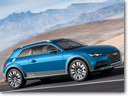
    Audi-allroad-shooting-brake-show-car-shadowAudi-allroad-shooting-brake-show-car-mediumThe mysterious Audi NAIAS Show concept has been revealed. It’s a compact crossover allroad shooting brake thing that is, apparently, very “functional for recreational sports” and a “concrete look into the near future”. Now, where have we heard that before?

    It also has something called “sex appeal” according to Prof. Dr Ulrich Hackenberg who is a Member of the Board of AUDI AG. Technical Development. Must be related to those short overhangs, or the double LED rings within the front lights playing the part of quattro legacy in the flesh, or the succulent aluminum underbody at the raar. Erhm, let’s not get too carried away here. The body is a blend of a carbon fiber reinforced polymer (CFRP) and aluminum. The wheels too (255/40 tires, 19-inch) are CFRP. All that space technology has brought down the weight to just 1600 kg-ish.

    Sure it’s compact – measuring at 4.20 meters from end to end, 1.85 meters long and 1.41 meters wide – the Ice Blue Audi NAIAS concept contains a complex hybrid drive system. It has an already powerful 2.0-liter TFSI engine that boasts 292 hp and 380 Nm of torque, it has a disk-shaped electric motor supplementing the said TFSI with 40 Kw of power and 270 Nm of torque, and a second electric motor which works independently on the rear axle. The total output amounts to 400 hp and 650 Nm of torque. That’s 4.6 seconds from 0 to 60 mph and a top speed of 155 mph. All the while, you get back 123 mpg and 45 g/km of CO2 emissions based on the ECE standard if you don’t put your foot down.

    The e-S tronic dual clutch transmission sends the combined power output of the TFSI and the disc-shaped motor to the front wheels only. The third electric motor at the back runs only when the allroad is in EV mode (purely electric), in Sport mode, or when the on-board systems decides that AWD is needed. Consequently, Audi have called the system “e-tron quattro”. There’s also a Hybrid mode which regulates all three sources accordingly in order to achieve the best milage. If needed, the disk-shaped motor can act as a generator, charging the 8.8 kWh battery pack, which stands right in front of the rear axle.

    All that clever stuff, is an extension of the interior really. You’ve got Audi’s MMI terminal with its 12.3-inch screen, a comprehensive instrument panel which displays with varying (depending on the mode of driving) priorities the speedometer, the powermeter, the navigation map, and the tachometer. The interior is also a nice place to be in in general. So they tell us.

    Audi-allroad-shooting-brake-show-car-medium-2

    Source: Audi

  • Audi Debuts Sport Quattro Laserlight Concept Car At CES In Las Vegas

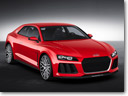
    Audi-Sport-quattro-laserlight-concept-shadowAudi-Sport-quattro-laserlight-concept-mediumSo, remember that mysterious Audi coupé concept that was about to début at NAIAS? Yeah, this has nothing to do with it, although, we did mix them up for a moment. It’s Audi’s other concept that is set to make a world-first appearance at the 2014 CES in Las Vegas (kicks off on the 6th of January) – it’s low, it’s sleek and it has “quattro” in its name.

    They’ve also added “laserlight” to the title. Apparently, Audi want to much as much emphasis on their future tech. Headlights as possible. We don’t blame them. Who has lasers on their car and wants to keep quiet about it. Whoa, whoa! Lasers?! It’s not as exciting as it sounds, but yes, Audi are using laser technology for the high-beams to complement the now “démodé” LED matrix that’s been employed. The two inner trapezoidal elements of the dual headlights (nice quattro touch by the way) use laser diodes that are only a few microns in diameter. With their 500 meters of illumination, these laser high-beams have approximately twice the lighting range and three times the luminosity of LED high beam lights.

    So when not blinded by the headlights, you’ll notice that it has only two doors and a swept-back C-pillar. It’s low (1,386 mm high) and stout (1,964 mm wide) with a wheel base of no more than 2,784 mm. The remaining 1818 mm of the total length goes to the overhangs (which are short). Most of the car concept is a blend of steel and aluminum, but there’s also a prolific use of CFRP material throughout: the jutted front splitter, the diffuser at the back which runs quite high, the door sills. Even the quattro-ish tail lights are backed by a black CFRP panel.

    The total weigh comes down to 1,850 which is pretty good considering that beneath the again CFRP hood you’ll find a V8 bi-turbo engine mated to a powerful electric motor that’s being charged by a pretty big li-ion battery. That’s right, the Audi Sport concept is a parallel hybrid that can run on pure electricity for around 31 miles. The total power output comes to around 700 hp. 560 of those come from the 4.0 TFSI alone. The torque? 800 Nm combined. The stated 94 mpg fuel economy might just be possible with the cylinder on demand (COD) system, which deactivates four cylinders under partial load, and the start-stop system. Put it in sport mode, 0 to 60 should be possible in just 3.7 seconds while the top speed is limited at 190 mph.

    Needless to say that such performance requires immense stopping power and grip. The front suspension is comprised of five links per wheel, while the rear suspension is based on the company’s self-tracking trapezoidal link principle. The stiff springs and shocks may brake your back over the occasional pebble, but you’ll forgive them when indulging in high-speed cornering. Carbon-ceramic is, of course, used for the brake disks.

    Inside, a driver-oriented approach dictates that the climate controls should be integrated in the air nozzles; a single element is used to control the intensity, temperature and volume of the air stream. The TFT display has its own graphics card for exceptional 3D rendering, an iDrive-type-of-knob gives you control over the new user interface that has a menu structure akin to that of a smart phone.

    That’s essentially it. Looks exciting and sounds interesting, but will it have what it takes to pay tribute to the quattro name? More importantly, though, is it ever going to be made?

    Source: Audi

  • Audi R18 e-Tron Quattro

    Audi R18 e-Tron Quattro - Front View

    Audi Sport has developed a fundamentally new Le Mans prototype that corresponds to the Technical Regulations for 2014 and is designed for maximum efficiency. The new Audi R18 e-Tron Quattro is being tested on the race track where all new Le Mans prototypes of the manufacturer have had to prove their worth – at Sebring racetrack.

    “We’ve reached a crucial stage in this project,” commented Head of Audi Motorsport Dr. Wolfgang Ullrich.

    “After building the first prototype, testing on various race tracks is now taking center-stage. The tests are mainly focused on achieving high mileage, coordinating the highly complex hybrid drive systems and working out an efficiencyoptimized total package that has never before been as complex as this one.”, he added.

    Audi has won the manufacturers’ and drivers’ classifications in the FIA World Endurance Championship (WEC) for the second time in succession and the Le Mans 24 Hours for the twelfth time this year. Until the end of this year, the manufacturer will introduce the next generation of its hybrid sports car.

    Stay tuned!

    Source: Audi