 The Porsche 911 stirs emotions in sports car enthusiasts the world over. Timeless emotions that have been experienced by generations since the model series was first launched in 1963. This summer, Porsche is introducing the next generation of the 911: a car that exemplifies the core 911 principles of distinctive design with inner strength. (more…)
Tag: Porsche
-
Next generation Porsche 911 powers ahead with direct fuel injection and double-clutch gearbox
-
Porsche celebrates 60 years of Sports Cars
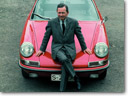 Exactly 60 years ago, the cornerstone was laid for a family-operated company, whose rise from modest beginnings into one of the most important sports car marques in the world no one at the time could ever have foreseen.
-
Audi R8 vs Bugatti Veyron vs Porsche 911 GT3 vs Lamborghini Gallardo vs Aston Martin DB9
httpv://youtube.com/watch?v=aUjw5ijqqcM
Porsche 911 GT3 RS 2007
Brakes & Tires Brakes F/R: ABS, vented disc/vented disc Driveline: Rear Wheel Drive Tires F-R: 235/35 ZR19 – 305/30 ZR19 Engine Displacement cu in (cc): 219 (3600) Power bhp (kW) at RPM: 415(305) / 7600 Redline at RPM: 8400 Torque lb-ft (Nm) at RPM: 300(407) / 5500 Type: Flat-6 Exterior Dimensions & Weight Length × Width × Height in: 176.9 × 72.9 × 50.4 Weight lb (kg): 3031 (1375) Performance Acceleration 0-60 mph s: 4.0 Fuel Economy EPA city/highway mpg (l/100 km): 17/24 (n.a.) Top Speed mph (km/h): 193 (310) Audi R8 2007
Brakes & Tires Brakes F/R: ABS, vented disc/vented disc Driveline: All Wheel Drive Tires F-R: 235/35 R19 – 295/30 R19 Engine Displacement cu in (cc): 254 (4163) Power bhp (kW) at RPM: 420(313) / 7800 Redline at RPM: 8250 Torque lb-ft (Nm) at RPM: 317(430) / 4500 Type: V8 Exterior Dimensions & Weight Length × Width × Height in: 172.8 × 74.1 × 48.8 Weight lb (kg): 3434 (1558) Performance Acceleration 0-60 mph s: 4.4 Fuel Economy EPA city/highway mpg (l/100 km): n.a. Top Speed mph (km/h): 187 (301) Bugatti Veyron 16.4 2006
Brakes & Tires Brakes F/R: ABS, vented disc/vented disc Driveline: All Wheel Drive Tires F-R: 265-680 ZR500A – 365-710 R540A (PAX System) Engine Displacement cu in (cc): 488 (7993) Power bhp (kW) at RPM: 1001(736) / 6000 Redline at RPM: 6500 Torque lb-ft (Nm) at RPM: 923(1250) / 2200-5500 Type: Quad-Turbocharged W16 Exterior Dimensions & Weight Length × Width × Height in: 174.2 × 77.9 × 47 Weight lb (kg): 4162 (1888) Performance Acceleration 0-62 mph s: 2.5 Fuel Economy EPA city/highway mpg (l/100 km): n.a. (24.1) Top Speed mph (km/h): 253 (407) Lamborghini Gallardo 2006
Brakes & Tires Brakes F/R: ABS, vented disc/vented disc Driveline: All Wheel Drive Tires F-R: 235/35 ZR19 – 295/30 ZR19 Engine Displacement cu in (cc): 303 (4961) Power bhp (kW) at RPM: 520(362) / 8000 Redline at RPM: n.a. Torque lb-ft (Nm) at RPM: 376(510) / 4250 Type: V10 Exterior Dimensions & Weight Length × Width × Height in: 167.7 × 74.1 × 45.4 Weight lb (kg): 3153 (1430) Performance Acceleration 0-62 mph s: 4.0 Fuel Economy EPA city/highway mpg (l/100 km): 9/15 (17.0) Top Speed mph (km/h): 196 (315) 2007 Aston Martin DB9
Brakes & Tires Brakes F/R: ABS, vented disc/vented disc Driveline: Rear Wheel Drive Tires F-R: 235/40 – 275/35 ZR19 Engine Displacement cu in (cc): 362 (5935) Power bhp (kW) at RPM: 450(331) / 6000 Redline at RPM: n.a. Torque lb-ft (Nm) at RPM: 420(570) / 5000 Type: V12 Exterior Dimensions & Weight Length × Width × Height in: 183.2 × 73.1 × 51.4 Weight lb (kg): 3769 (1710) Performance Acceleration 0-62 mph s: 4.7 Fuel Economy EPA city/highway mpg (l/100 km): n.a. Top Speed mph (km/h): 186 (300) -
Hamann Porsche Cayenne Cyclone
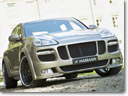 The Porsche Cayenne enjoys great popularity with the customers. No wonder, since the noble SUV combines power and design. HAMANN MOTORSPORT in Laupheim offers various modifications for Porsche Cayenne to refine it and to make it more individual. The most obvious alteration ist the shapely and mighty envelopment. Fitted with the HAMANN wide body-kit the Cayenne becomes the “Cyclone”!
-
Porsche Cayenne GTS
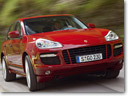 With the new Cayenne GTS, Dr. Ing. h.c. F. Porsche AG of Stuttgart, Germany, is reiterating the successful Cayenne series’ prominence in the sporty SUV segment. The model, which celebrates its world debut at the IAA in Frankfurt, features an enhanced 4.8-liter V8, has been lowered by 24 millimeters and has a specially developed chassis: it is the first Cayenne to feature the electronically controlled damping system, Porsche Active Suspension Management (PASM), with steel springs. This combination was previously reserved exclusively for Porsche sports cars. (more…)
-
Porsche Cayman S Edition
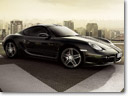
 Porsche is to expand its mid-engine coupе model range with the launch, in November 2007, of the Cayman S “Porsche Design Edition 1”, a limited-edition special series. Porsche has incorporated various design disciplines into this very special mid-engine coupé: the black exterior emphasizes the purist nature of the 295-bhp sports car and, at the same time, is a nod to Porsche Design and the famous Chronograph 1s designed by Ferdinand Alexander Porsche precisely 35 years previously.
This look, cultivated by Porsche Design, imparts additional luxury and class on the Cayman S: the black leather and Alcantara upholstery harmonizes with refined details such as the instrument dials, the layout of which reflects that of all Porsche Design chronographs. Even the center console, dashboard, and door trims glisten in black, while the three-spoke sports steering wheel, the gear lever, the handbrake grip, and the roof lining are clothed in non-slip black Alcantara. The Porsche logo (crest) is embossed on the headrests.
The vehicle’s technical features are equally sophisticated: beneath the ten-millimeter-lower body, standard Porsche Active Suspension Management (PASM) actively controls the hardness of the shock absorbers and it features a special Sport mode that can be activated at the touch of a button for a really dynamic driving feel. Five-millimeter spacers together with 19-inch turbo wheels give the Cayman S “Porsche Design Edition 1” a presence that is reinforced yet further by the 235/35 ZR 19 tires at the front axle and the 265/35 ZR 19 tires at the rear.
The Porsche Design Studio, created by Ferdinand Alexander Porsche 35 years ago, has rapidly become a top international name for industrial design, luxury items, and consumer goods. Top-class functionality and esthetics glisten in the new “Porsche Design Edition 1” collection – in black or black matt, of course.


The Cayman S “Porsche Design Edition 1” standard equipment thus includes an elegant briefcase containing the Flat Six Chronograph, a pocket knife, a pair of sunglasses, a pen, and a key ring – all in black, even the knife blade, in keeping with the vehicle’s styling. The number of Cayman S “Porsche Design Edition 1” units is to be as exclusive as this series-production luxury package: only 777 are being built, and each will be identifiable from a badge on the lid of the glove box.
The market launch of this black Cayman with exclusive Porsche Design equipment, including briefcase, will begin in Germany in November 2007 and in the United States in January 2008. The base price is 58,600 Euros and, factoring in 19 percent value-added tax, the price in Germany will be 69,942 Euros.
-
TechArt Magnum
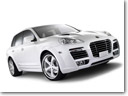
 With more than 500 produced units the Magnum is the most successful model in the 20-year history of TECHART Automobildesign. At the Frankfurt International Auto Show IAA 2007 the new TECHART Magnum based on the latest Porsche Cayenne celebrates its world debut.
Like its predecessor the new TECHART Magnum sets itself apart with a spectacular aerodynamic-enhancement package that fits all versions of the Porsche SUV. All body components are manufactured from PUR-RIM plastic in OEM quality.
The curved TECHART fender flares add eight centimeters to the width of the Cayenne. The Magnum rocker panels provide a fluent transition between the wider wheel arches.
The new aprons for front and rear that replace their production counterparts were designed to correspond visually to the more pronounced contours of the wheel arches. The TECHART Magnum front apron lends the latest Cayenne generation an even more striking appearance. Its large air inlets feature elegantly styled slats and provide ample cooling air for radiators and front brakes. A total of four auxiliary headlights and daytime running lights improve active safety.
The TECHART Magnum rear apron with integrated diffuser reduces lift on the rear axle and provides the perfect backdrop for the TECHART stainless-steel sport exhaust system with two chrome tailpipes on either side.


The body conversion can be rounded out with moldings for front and rear lights, as well as with a new hood that features two air outlets that optimize heat balance in the engine bay.The Magnum also features custom-tailored wheels and tires. The largest possible version features TECHART Formula II light-alloy wheels in size 10.5Jx22 in front and in size 11,5Jx22 in the rear. For optimal tires TECHART chose ContiCrossContact UHP tires in sizes 295/30 ZR 22 and 335/25 ZR 22, which are approved on the Cayenne for a top speed of 300 km/h.
These tires also make the Magnum a prime candidate for the engine tuning of the Cayenne Turbo that is currently under development and in its most powerful incarnation will produce up to 620 hp / 456 kW.
The air suspension of the Cayenne Turbo is modified with the TECHART sport module that lowers the ride height for enthusiastic on-road driving by 30 millimeters. The entire range of adjustment from the lowest ride height (loading level) to the highest (special off-road level) measures some 110 millimeters.
The TECHART Magnum repertoire also includes countless interior options. The range of products starts with exclusive accessories such as an ergonomically shaped sport steering wheel and carbon-fiber applications for the cockpit, available in a number of different colors.
Requests for an even higher degree of customization can be fulfilled with exclusive TECHART fully leather interiors in any color and design imaginable.
The TECHART interior line de Sede of Switzerland, created in cooperation with the Swiss furniture manufacturer, represents an especially exclusive option. The high-quality de Sede leather skins are transformed by the company-own TECHART upholstery shop into meticulously finished upholstery for seats, door and side trim, dashboard, roof pillars and headliner.
-
Porsche 911 GT2
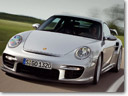
 Presenting the new 911 GT2 at the Frankfurt Motor Show, Dr. Ing. h.c. F. Porsche AG, Stuttgart, is proudly launching the most powerful 911 so far homologated for road use. Through its striking design with large air intakes at the front and the rear wing so characteristic of this very special model, the new 911 GT2 expresses the power and performance potential of the fastest-ever 911 right from the start even at a standstill.
Available exclusively with rear-wheel drive and a manual six-speed gearbox, this high-performance athlete accelerates to 100 km/h in just 3.7 seconds and reaches a top speed of 329 km/h (204 mph) on average fuel consumption of just 12.5 litres/100 km (equal to 22.6 mpg imp) in the New European Driving Cycle (NEDC), thus offering a level of fuel economy regarded as quite impossible in this performance class just a few years ago.
The power unit of the new 911 GT2 is based on the six-cylinder boxer engine of the 911 Turbo, with air supply by two exhaust gas turbochargers featuring variable turbine geometry (VTG). The 3.6-litre boxer engine achieves its maximum output of 530 bhp (390 kW) at 6500 rpm, with maximum torque of 680 Newton-metres maintained consistently between 2,200 and 4,500 rpm. With its unladen weight of 1,440 kg or 3,175 lb, finally, the 911 GT2 offers a power-to-weight ratio of just 2.72 kg/6.00 lb per horsepower.


The increase in engine power by 50 bhp over the ”regular“ power unit is provided in the new 911 GT2 by two turbochargers with a larger compressor wheel and a flow-optimised turbine housing raising turbocharger pressure to an even higher level. And for the first time Porsche’s engineers have combined the turbocharged engine with an expansion-type intake manifold – a genuine revolution on turbocharged power units.
The expansion intake manifold uses the principle of oscillating air in the intake manifold during the cooler expansion phase, keeping the temperature of the fuel/air mixture lower than in the 911 Turbo. This, in turn, means a significant increase in all-round efficiency, with fuel consumption down by up to 15 per cent under full load despite the increase in engine output.
The 911 GT2 offers new achievements also in terms of emission management and control: This is the first Porsche homologated for the road to feature a rear silencer and tailpipes made of titanium as standard equipment. This expensive material reduces weight by approximately 50 per cent versus a comparable component made of stainless steel to just 9 kg.
The new 911 GT2 comes as standard with PCCB brakes featuring brake discs made of a composite carbon fibre/ceramic compound ensuring maximum stopping power maintained with an extremely high level of consistency. A further advantage is that PCCB brakes reduce the weight of the unsprung masses versus comparable grey cast-iron discs by approximately 20 kg or 44 lb.
Yet another feature fitted as standard is the electronically controlled PASM Porsche Active Suspension Management. (PASM). The GT2 comes on 19-inch light-alloy wheels running at the front on 235/35 ZR 19, at the rear on 325/30 ZR 19 sports tyres.
The new 911 GT2 will be at the dealership in November 2007. The base price of the car in Germany is Euro 159,100.-, the market price including 19 per cent value-added tax Euro 189,496.-.
-
Porsche 911 Turbo Cabriolet
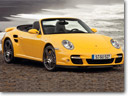
 Porsche will be sending the new 911 Turbo Cabriolet to the starting line on September 8. The 20-year tradition within the 911 Series of the 911 Turbo with a classic soft top is continued with this open, top model. Firstly, the open 2+2 seater offers the driving performance of a high-performance sports car while still providing convertible driving pleasure. Secondly, compared to the competition the 911 Turbo Cabriolet is economical in its fuel consumption, thanks to its deliberate design, outstanding aerodynamics and advanced engine technology.
As with the 911 Turbo Coupe, the Cabriolet will also be powered by a 3.6 liter six-cylinder ‘boxer’ engine with biturbo turbocharging and Variable Turbine Geometry (VTG). The powerplant already generates 480 hp (353 kW) and 620 Nm of torque at 1950 rpm. With the new, optional “Sport Chrono Turbo Package”, which includes an overboost function, up to 680 Nm is even intermittently possible. The manual transmission version can accelerate from 0 to 100 km/h in just four seconds. With Tiptronic S the time can be cut to 3.8 seconds. Both versions can reach speeds of up to 310 km/h. Fuel consumption for the 911 Turbo Cabriolet is 12.9 liters per 100 kilometers – an exemplary value in the competitive environment.
In spite of the convertible-specific reinforcement of the chassis and automatic and the extendable rollover protection behind the rear seats, the open version of the 911 Turbo only weighs 70 kilos more than the Coupe. The light, three-layer soft top, which can completely automatically be opened or closed in roughly 20 seconds, enables a low balance point.


Together with the running gear that is tuned to convertible-specific needs, which includes the active suspension system Porsche Active Suspension Management (PASM) as standard equipment, the new 911 Turbo Cabriolet offers the sporting driving performance typical for a Porsche 911 as well as extremely high driving safety together with appealing driving characteristics. The driving stability control Porsche Stability Management (PSM) and the managed all-wheel drive Porsche Traction Management (PTM) also contribute to its uncommon performance. The system with an electronically controlled multi-plate clutch can, according to the requirements, alternatively shift the drive output from the engine between the front and rear axles, and – with shift intervals of a maximum of 100 milliseconds – quicker than the reaction of the engine to load changes.
With a drag coefficient of Cw=0.31, the 911 Turbo Cabriolet travels at the level of the coupé models. Together with the rear spoiler, which automatically extends at speeds from 120 km/h – extending 30 mm further than with the Coupé, the vehicle is the only standard series convertible that generates negative lift at the rear axle. Along with its passive safety systems, including six airbags as standard equipment and the comprehensive rollover protection system – with steel tubing integrated into the windshield frame and an extendable rollover protection behind the rear seats – the 911 Turbo Cabriolet also fulfils all legal requirements for passive safety applicable in the worldwide sales markets.
Furthermore, it is equipped with one the most high-performance brake systems. The six-cylinder fixed-brake caliper up front stems from the Porsche Carrera GT. Upon request, the race-proven and light Porsche Ceramic Composite Brake (PCCB) ceramic brake system is also available for the 911 Turbo Cabriolet.
Also included in the extensive standard series equipment of the 911 Turbo Cabriolet are Bi-Xenon headlights, 19 inch forged wheels with two-tone appearance, an air conditioner, the wind deflector, the Porsche Communication Management (PCM) – with the navigation module and 5.8 inch color monitor and the Bose Surround Sound System, among other things. The basic price in euro for the Turbo Cabriolet is EUR 126,600. In Germany the price is EUR 150,862 (including VAT and country-specific requirements).
-
Ruf CTR3
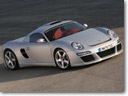
 Exactly 20 years after the legendary CTR “Yellow Bird” and 10 years after the second CTR, RUF announces the all new CTR3. The RUF Porsche CTR3 was presented at the grand opening of the new RUF facility in Bahrain. While the first two CTR generations still had their engines in the rear, the new CTR3 has a mid engine design. However, one thing that the CTR3 has in common with its two predecessors is that it is a pure driving machine. The CTR3 is made to involve the driver in the driving experience.
The mid engine design provides exceptional balance and agile handling, while the longer wheel base provides better driving stability at high speed. The body of the Porsche CTR3 is a completely new development which is not based on any existing mid engine concept. It is aerodynamically designed for high speed. The body is constructed in steel, aluminium and kevlar-carbon. Zinc dipped steel is used for the front structure and the passenger compartment. The engine and transmission are fixed in a space frame and birdcage. The passenger compartment is protected the latest version of the famous RUF Integrated Roll Cage which is integrated into the A pillar and birdcage. The doors, with integrated side impact protection beams, and the front hood are made of aluminum. The body shell is made of kevlar-carbon composite.


Ben Soderberg’s design team created a classic sports car line. They realised an idea, that Alois Ruf had for a long time in mind.
RUF has 30 years of experience with turbo charged boxer engines. The CTR3’s twin turbo charged 3.8 liter flat six cylinder engine has an output of 700hp at 7,000 rpm. The maximum torque is 657 ft/lbs at 4,000 rpm. This engine design combines a compact construction with high performance. Each turbo charger is provided an intercooler which is placed in front of each rear wheel.The sequential shift six speed transmission in the CTR3 is a new design and is transversally mounted. It can manage torque of up to 885 ft/lbs. A shift indicator on the dashboard shows the gear in use. A limited slip differential is provided to maximize performance.
The sport suspension is designed for high level driving dynamics and safety. The front axles use McPherson struts and an anti-roll bar. The rear axles utilize motor sport technology with horizontal coil over shock absorbers fixed over push rods connected to the wheel carriers.
The brake system is designed to match the high performance of the engine and suspension. Both front and rear axles utilize 6 piston fixed light alloy calipers and ventilated, cross drilled ceramic composite discs. Each brake disc is 380mm in diameter. A specially designed Bosch anti-lock braking system is standard.
The CTR3 rolls on forged aluminum wheels with central locking. At the front 255/35 ZR 19” tires are mounted on 8.5” X 19” wheels, while at the rear 335/30 ZR 20” tires are mounted on 12.5” X 20” wheels.The interior can be designed to the customer’s taste, from a functional light weight finish to sporty luxury finish with a leather and alcantera. The aluminum gear shift lever for the sequential shift transmission is a central unit to the interior. In addition, the 260 mph speedometer shows the driver that the CTR3 is made for high performance.
The lightweight construction allows for an empty weight (according to DIN) of 3,086 lbs. The result is a power to weight ratio of only 4.4lbs per hp.
The performance of the CTR3 is incredible. The acceleration from 0-100 kilometers per hour (62 mph) takes only 3.2 seconds. The maximum speed is 375 kph (235mph). The sale price will be Euro 380,000.00 (plus VAT).
-
Porsche Cayenne S Transsyberia
 Porsche is adding yet another highlight to the Company’s wide range of customer sports activities: the Porsche Cayenne S Transsyberia based on the new Porsche Cayenne S and serving as the perfect vehicle especially for long-distance rallies. This ultra-sporting offroader is making its debut in the Transsyberia Rally taking contestants from Moscow all the way though Siberia to Ulaanbaatar in Mongolia from 2-17 August.
The Porsche Cayenne is well-known and admired for its outstanding onroad qualities in the SUV segment. Now the second generation, which is making its debut at Porsche Centers the world over at this very moment, moves up this benchmark to an even higher standard.
The new power units with direct gasoline injection, for example, provide even more power and performance on less fuel, cutting fuel consumption by up to 15 per cent versus the former models. Another highlight is Porsche’s new PDDC Dynamic Chassis Control featuring two active anti-roll bars to almost completely eliminate body sway in bends. Off the beaten track, the new Cayennes are naturally also on home ground, maximum axle articulation ensured by PDDC when driving offroad serving to further improve the already superior traction offered by the electronically controlled all-wheel drive.
Last year two private teams participated in the Transsyberia Rally for the first time with the Porsche Cayenne S, finishing first and second in their very first attempt. Attracted by the successful participation of these two cars, Porsche has obviously become aware of the event and, in response, now offers the dyed-in-the-wool Cayenne driver the option to enter motorsport successfully with this outstanding model.


To ensure such superiority in motorsport, Porsche has enhanced the already very good offroad qualities of the Cayenne to an even higher standard, developing a special model suited particularly for successful participation in long-distance rallies. Precisely this is why the new Cayenne S Transsyberia being built from the beginning in a small series of just 26 units comes, inter alia, with extra-rough special offroad tyres, a safety cage, a shorter final drive ratio, a transverse lock, a reinforced, even larger underfloor cover, as well as beefed-up track control arms on the front axle. At 385 bhp (283 kW), engine output of the eight-cylinder remains unchanged.
Now sporting, ambitious Porsche customers will be participating at the wheel of a Cayenne S Transsyberia in one of the last adventures in the world on four wheels – the Transsyberia Rally. From 2-17 August, they will be following the route of this very demanding orientation rally from Moscow all the way through Siberia to the finish line in Ulaanbaatar in Mongolia.
In all, they will be covering almost 6,200 kilometres or 3,850 miles on public roads, gravel tracks and the toughest trial paths, even crossing rivers and taking special tests in the Gobi Desert. And while navigation is perhaps the biggest challenge on the long stages of the Rally, it is particularly the driver’s personal skill and, of course, the qualities of the car that count in the special trials on tracks closed to the public.
Twenty-Six Porsche Cayenne S Transsyberias for a Start
With its intelligent all-wheel drive, high-performance and efficient V8 direct injection power unit, as well as height-adjustable air suspension including Porsche Active Suspension Management (PASM), the Porsche Cayenne S is perfectly prepared for even the toughest roads and tracks.
Proceeding from the Cayenne S, Porsche’s specialists have built a small series of special models at the Company’s Development Center in Weissach near Stuttgart optimised especially for the demands of even the toughest long-distance rally: the Cayenne S Transsyberia. So following the outstanding success of the two Cayenne Teams last year, no less than 26 customer teams from all over the world are now entering the Rally with this special rallying version of the Cayenne S. Clearly, this will give the Porsche Cayenne the opportunity under extreme conditions to prove its supreme potential in driving dynamics versus the keenest competition.
The Transsyberia Rally is split up into six categories of vehicles, with the Cayenne S Transsyberia featuring a 4.8-litre V8 entering the race in Class 1C for gasoline-powered passenger cars with engine capacity of more than four litres.
Porsche Customer Sport
This long-distance rally racing activity with the Porsche Cayenne S Transsyberia forms an additional highlight in the wide range of customer sport. The broad foundation in this area is provided by Porsche’s Sports Driving Schools, Porsche Clubsport, as well as popular brand racing series such as the Porsche Sports Cup in Germany where various versions of the 911 Carrera, mainly top sports performers such as the 911 GT3 and 911 GT3 RS, prove their sporting qualities.
Moving up a level, Porsche offers ambitious amateurs entering the GT3 Cup Challenges in the USA, Brazil and New Zealand the opportunity to enjoy the thrill of motorsport in a racing car closely related to its production counterpart, the 911 GT3 Cup. The next step is the Carrera Cups in Asia, Australia, Germany, France, Great Britain, Italy, Japan and Scandinavia, where semi-professional and professional teams and drivers show their skills, again driving the 400-bhp Porsche 911 GT3 Cup.
The top series and, at the same time, the fastest brand trophy in the world is the Porsche Mobil1 Supercup, the only Gran Turismo racing series to be held exclusively on the occasion of various races for the FIA Formula 1 World Championship. Again, the exclusive model raced at these events is the Porsche 911 GT3 Cup.
For years, many customers have placed their confidence in the both fast and reliable Porsche 911 GT3 Cup and 911 GT3 RSR when participating in internationally renowned long-distance races such as the 24 Hours of Le Mans or the 24 Hours of the Nürburgring, the various races in the American Le Mans Series, as well as the Le Mans Series or the FIA GT Series.
The RS Spyder sports prototype comes right at the top of Porsche’s customer sports programme, with three teams scheduled to enter the current season in the middle of the year, racing a total of six of these 1.25 million-Euro expensive high-tech prototypes in the LM P2 class of the American Le Mans Series.
The Sporting All-Round Performer
The Porsche Cayenne S Transsyberia is a typical Porsche through and through, tailored precisely to the needs and requirements of the sporting, ambitious customer – which in this case means a car tailored specifically to the requirements of long-distance rally racing. Compared with the “regular” version of the Cayenne S, the Porsche Cayenne S Transsyberia as a special rally version has been modified on a number of points serving first and foremost to enhance safety and the car’s racing performance.
Production Engine, Shorter Transmission Ratio
The power unit of the Porsche Cayenne S Transsyberia has been carried over from the regular road version of the Cayenne S with hardly any changes: Output of this 4.8-litre naturalaspiration V8 with direct gasoline injection remains 385 bhp (283 kW) at 6200 rpm. Maximum torque of 500 Newton-metres or 369 lb-ft, in turn, comes at just 3500 rpm.
VarioCam Plus valve management ensures a smooth and consistent surge of power throughout the entire speed range, with engine management varying valve lift on the intake side between 3.6 and 10 millimetres as a function of engine speed. And with the intake manifold also being variable in length, the engine provides muscular torque right from the start even at low engine speeds. Despite the increase in power over the previous engine, the new 4.8- litre reduces fuel consumption by approximately 15 per cent, giving the Cayenne S a significantly longer cruising range than before – obviously a big advantage particularly in a long-distance rally. Automatically detecting the quality of the fuel it is running on, the engine is also able to run on regular fuel with an octane rating of 91 or more, even though this will reduce both engine output and torque. In fact, the engine is also able to run on a mixture of gasoline and ethanol, with up to 25 per cent of the latter. A sports exhaust system reduced for minimum weight gives the Cayenne S Transsyberia a particularly powerful and muscular sound, while Tiptronic S transmission with a shorter final drive ratio helps to ensure even better acceleration both from the start and in gears. And last but not least, the transmission management has been optimised for offroad use of the vehicle.
Even Better off the Beaten Track
Like all other models in the Cayenne range, the Cayenne S Transsyberia also comes with Porsche Traction Management (PTM) permanent all-wheel drive. In its basic mode, PTM feeds 62 per cent of the engine’s torque to the rear wheels and 38 per cent to the front.
Then a multiple-plate clutch operated by an electric motor and controlled electronically is able to vary the distribution of power as a function of driving conditions, if necessary feeding as much as 100 per cent of the engine’s power completely to the front or rear. The map-controlled longitudinal lock and the differential lock on the rear axle respond not only to lack of traction on the front or rear wheels, but also benefit from sensors measuring the speed of the vehicle, its lateral acceleration, the steering angle and the position of the accelerator pedal. Using this information, PTM is able to consistently calculate the degree of lock required on the two axles and feed precisely the power required to the axle at the front and rear.
A transverse lock fitted additionally in the Cayenne S Transsyberia serves to enhance offroad driving qualities to an even higher standard (and is also available in the regular production model as part of the optional Offroad Technology Package). Particularly in heavy terrain, PDDC Porsche Dynamic Chassis Control, interacting with air suspension and PASM Porsche Active Suspension Management, enhances traction to an even higher standard.
And should the driver activate the low-range mode on the six-speed automatic transmission by means of the control paddle, PDCC will automatically switch over to the offroad mode, the system thus allowing maximum articulation of the axles. In the Special Offroad Mode provided by the air suspension, the maximum depth when crossing rivers and streams, etc, is approximately 75 centimetres or almost 30″. To make such an extreme depth possible, both the body and the doors are sealed off against the penetration of water all the way up to the side windows. And using a flexible air filter snorkel, the air intake has been moved up even further to the roof of the vehicle, ensuring that the front wave typical when crossing water is not able to reach, let alone enter, the intake manifold.
The wheels and suspension of the Cayenne have naturally also been modified for the most extreme, long-term demands of rough tracks and rocky surfaces. As an example, the doublearm front axle comes with reinforced track control arms, with track itself being increased by 34 millimetres or 1.34″ for extra stability.
The usual high-speed tyres fitted on the regular model are replaced by special offroad tyres measuring 255/55 R 18 T and homologated for speeds of up to 190 km/h or 118 mph. The tyres themselves are fitted on 18-inch, 15-spoke Cayenne S II light-alloy wheels and the rim hubs are finished in orange, like on the Porsche GT3RS.
Massive Safety Cell within the Interior
It is already well known that the Porsche Cayenne ranks right at the top in the offroader market also in terms of body stiffness and passive safety – which is no surprise, considering that more than 60 per cent of the body-in-white is made of high-strength steel. Forces generated in an accident are absorbed by three load levels above one another and fed into the stiff longitudinal floor support, the side-sills and tunnel areas. The reinforcements in the A- and B-pillars, in turn, are made of ultra-high-strength steel to improve safety in a rollover.

And to offer both the driver and passenger even better protection from the consequences of a collision or rollover under racing conditions, the Cayenne S Transsyberia comes with a safety cage bolted on to the passenger cell. Indeed, this cage even follows the rules and requirements of the FIA Motorsport Authority, with the driver also being protected by an airbag for extra safety.
Optimised for Minimum Weight All Round
To set off the extra weight of the safety cage and rally equipment, and to further lower the vehicle’s centre of gravity, the rear seat bench, interior body panels and sound-proofing material have all been removed from the car. Central locking, in turn, is replaced by a manual door opening mechanism on the front doors with orange-coloured opening and closing loops.
Both the rear window and the side windows at the rear are made of light polycarbonate, while the side windows at the front, as on all Cayenne models, feature special hydrophobic treatment at the outside to make water run off more quickly and smoothly and ensuring that the glass remains far cleaner for far longer than with conventional windows. As another important advantage, both the driver and front passenger enjoy the benefits of lightweight sports seats with a leatherette/Alcantara cover.
Sporting Exterior
The new models in the Cayenne range are even more sporting and dynamic also in their looks than their predecessors. And so it is no surprise that the Cayenne S Transsyberia comes with the same brand-new front end as well as the dynamic rear-end design of the new model enhanced to an even higher standard, extra-large air intake scoops bearing clear testimony to the car’s superior power and performance. On the tailgate the Cayenne S Transsyberia boasts a roof spoiler with a double-wing profile fitted in position to provide even greater stability at high speeds.
The front and rear air dams, in turn, are finished in stainless steel, and orange-coloured wheels give the Cayenne S Transsyberia a sporting look, making the vehicle easily recognisable at very first sight. At the side this special rally model proudly boasts orange-coloured stripes bearing the name “Cayenne S Transsyberia 2007″ in a look similar to that of the Porsche Carrera GT3 RS.
The Cayenne S Transsyberia is available exclusively in two special colour schemes – either Basalt Black Metallic or Crystal Silver Metallic. And matching the model designation at the sides as well as the wheel rims, contrasting elements such as the exterior mirrors, the rear wing, the additional headlights and crossbars on the cooling air intakes are all finished in orange.
Wide Range of Rally Equipment
All 26 units of the Cayenne S Transsyberia come as standard with a navigation unit enabling the team to plan their routes also off the beaten track, with the navigation system naturally being masterminded by the passenger for optimum efficiency. The glove compartment is replaced on this special model by a Tripmaster computer enabling the co-pilot to exactly scrutinize the route between individual navigation points on the way. Most of the control units are fitted within the interior, and all electric lines and wires have been installed at new points and in new positions. Using a central switch at the right beneath the driver’s seat, the man at the wheel or the co-driver are able to switch the on-board electrics on and off in one quick and convenient operation, thus re-setting the electronic system if necessary even while driving.
Air for the engine is drawn in through a special opening above the engine compartment lid, a snorkel serving to move the air intake up even higher all the way to roof level, thus ensuring that the front wave generated when crossing rivers or streams, etc, is not able to enter the intake manifold. Reinforced and extra-large underfloor protection panels made of aluminium and an additional cover made of stainless steel for the exhaust tailpipes protect the Cayenne S Transsyberia from the particular damage and exposure easily encountered on a rally with its extremely tough conditions.
The regular foot-operated parking brake is replaced by a handbrake enabling the driver to oversteer the vehicle intentionally in a tight bend. Four additional headlights are fitted on the roof, and to successfully master particularly difficult and demanding terrain, as well as to salvage other vehicles, the Cayenne S Transsyberia comes with a winch easy to fit when necessary and stored for convenient use in the luggage compartment.
The luggage compartment also comes with two 20-litre reserve cans, a hydraulic offroad car jack, two fire extinguishers, two sand boards, two full-size spare wheels, and two transport boxes for tools. Further features included as standard are two two-man tents, two heat-insulated mats, four lashing belts, a nine-metre-long salvage belt complete with tackle, a folding spade, a folding saw, an axe, a manually operated and adjustable headlight, four towing bar openings and a complete Hazet toolkit.
-
TechArt Magnum de Sede
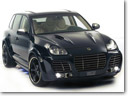 Exclusive automobile interiors have gained TechArt Automobildesign worldwide fame and recognition. The Swiss furniture manufacturer de Sede occupies the same lofty position in the area of seating furniture. The idea of combining the unique qualities of both companies in new automotive creations was born in 2006. At the Geneva Motor Show 2007 they present a 600-hp / 442-kW TechArt MAGNUM featuring the new TechArt interior line ‘de Sede of Switzerland.’

TechArt Porsche Cayenne Magnum de Sede Interior de Sede was founded more than 50 years ago, and is run by its two owners, Hans-Peter Fässler and Bernhard Schüler. Privateer Fässler is a passionate art and car enthusiast. The world-renowned manufacturer of exclusive luxury furniture is home in Klingnau, Switzerland. Only cows from Switzerland and southern Germany are used to make the various types of de Sede leathers. de Sede sells its chairs, sofas and tables in 120 countries around the globe.
With the TechArt interior line ‘de Sede of Switzerland’ these exquisite materials now also find their way into the automobile. The exclusive de Sede leathers are specially treated to account for the harsh climate conditions in an automobile.
TechArt Automobildesign’s company-own upholstery shop places utmost importance on perfect workmanship down to the last detail. Highly experienced upholsterers transform the high-quality de Sede leathers into covers for seats, doors, dashboard, roof pillars and headliner.

TechArt Porsche Cayenne Magnum de Sede 


In addition to choice de Sede leathers the seats also feature a unique soft-touch padding structure with areas of gradual firmness that are custom-tailored to the human body. The result is exceptional seating comfort combined with excellent lateral support.
Maximum comfort is paramount in the rear compartment too: Custom-developed individual seats for the rear mirror the front-seat design, and come with a custom-tailored center console covered with the finest de Sede leather. The integrated compartment for drinks, snacks and storage is lined with elegant Microsede material and features illuminated glass holders for the two Rosenthal® glasses with engraved TechArt MAGNUM logo. A small refrigerated compartment is hidden behind a precious-wood lid between the rear seatbacks.
The TechArt interior line ‘de Sede of Switzerland’ also features a state-of-the-art multimedia system. Two LCD touch screens are integrated into the back of the front headrests. Rear passengers can choose between watching a DVD on the 6-disc DVD changer or programs from the integrated digital TV tuner. They also serve as monitors for playing games on a Playstation2 game console. The sound is carried by wireless RF hi-fi headphones.
Color-coordinated carpets with de Sede leather borders and embroidered TechArt logo round out the design concept in the interior and even in the trunk. TechArt further adds color-coordinated instruments, sporty aluminum or hand-made precious-wood applications as well as a sport-steering wheel covered with comfortable de Sede.
With the TechArt interior line ‘de Sede of Switzerland’ the two partners offer a unique interior design that brings the legendary comfort of a de Sede sofa to the automobile. The MAGNUM is based on the Porsche Cayenne Turbo. With it, TechArt Automobildesign offers not just exclusive interior design but also dominating power and a strikingly styled exterior.
With the TechArt TA 048/T3 performance kit the twin-turbo V8 engine delivers 600 hp / 442 kW and a peak torque of 865 Nm. The 4×4 storms from rest to 100 km/h in just 4.5 seconds, on its way to a top speed of 292 km/h.
The perfect complement to the power kit is the TechArt fully stainless-steel TechArt sport exhaust system. Cayenne owners can choose to combine the rear muffler with the stock tailpipes of the car or with four chrome-plated TechArt tailpipes.
The fender flares of the TechArt MAGNUM body conversion add eight centimeters to the width of the SUV from Zuffenhausen. That means there’s room for king-size 10Jx22 one-piece TechArt Formula or the new Formula II multi-piece design light-alloy wheels all around. The ContiCrossContact UHP tires in size 295/30 ZR 22 on front and rear axles are approved on the Cayenne for speeds up 300 km/h.
The TechArt MAGNUM front apron looks great with its strikingly styled large air inlets. It features two fog lamps and two high beams, and its refined shape reduces lift on the front axle at high speeds.
The TechArt MAGNUM side sills form a harmonious transition between front and rear fender flares.The TechArt MAGNUM rear apron features custom cutouts for the two intertwined oval-shaped tailpipes of the stainless-steel TechArt sport exhaust system. An integrated diffuser helps reduce lift on the rear axle.
TechArt Automobildesign further refines the Cayenne body with headlight moldings, a three-piece tail lamp molding and a rear panel that carries the shape of the rear apron over to the tailgate.
The new TechArt hood is strikingly styled and features air outlets for improved venting of hot air from the engine bay, thus contributing to a thermally healthy engine.
TechArt Automobildesign also modifies the suspension of the widened Cayenne extensively. For vehicles equipped with air suspension there is the TechArt sport module, which can lower the ride height of the SUV for on-road operations by up to 60 millimeter. For tough off-road use the ride height can be increased by up to 70 millimeters.
TechArt Automobildesign can also refine the Cayenne interior in countless ways. The options for the Porsche Cayenne range from exclusive cockpit accessories to the completion of the leather interior available ex-factory to an entirely new individual TechArt fully leather interior. Also available is a stylishly integrated state-of-the-art multimedia system.


