Tag: Mazda

  • Mazda Tribute Hybrid SUV

    Showing its commitment to improving the world’s air quality, Mazda North American Operations (MNAO) will unveil the all-new 2008 Mazda Tribute Hybrid-Electric Vehicle (HEV) at the 2007 North American International Auto Show. With a hydrogen-powered version of the RX-8 and a hydrogen-powered hybrid version of the MAZDA5 undergoing extensive testing in Japan, the Tribute HEV is the latest environmentally friendly vehicle to join the Mazda lineup.

    Tribute HEV will debut in mid-2007, as a 2008 model-year vehicle. Mazda will provide more details – exact timing, pricing, distribution, sales volumes, etc. – closer to the launch date.

    “With virtually all new Mazda vehicles sold in the U.S. earning either Low Emission Vehicle (LEV) or Ultra Low Emission Vehicle (ULEV) status, protecting the global environment is a long-standing concern of ours,” said Robert Davis, senior vice president, Quality, Research and Development, MNAO. “The Tribute HEV is the next step towards strengthening Mazda’s environmental efforts.”
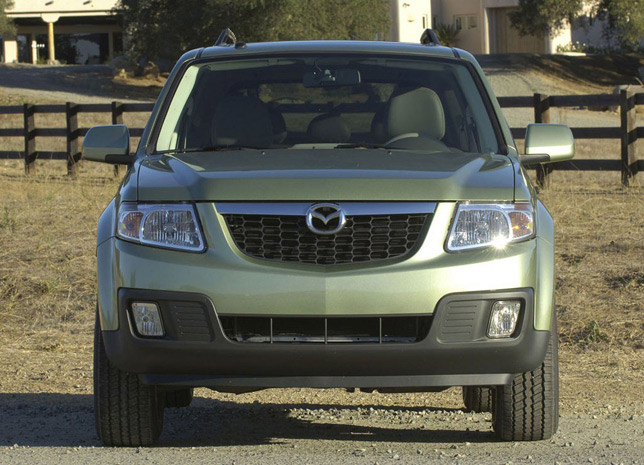
    Mazda Tribute Hybrid SUV
    Mazda Tribute Hybrid SUV

    A “full” hybrid, the Tribute HEV can run on 100 percent electric power up to approximately 25 mph, maximizing in-city fuel economy and making it one of the least-polluting vehicles sold. Still, the Tribute HEV stays true to the Zoom-Zoom Mazda owners have come to expect by delivering the performance required by SUV owners. The Tribute HEV provides plenty of power yet meets California’s strict Advanced Technology Partial Zero Emissions Vehicle (AT-PZEV) requirements by achieving Super Ultra Low Emissions Vehicle II (SULEVII) standards, plus zero evaporative emissions standards – the strictest emission regulations a gasoline-fueled vehicle can meet.

    The Tribute HEV offers superior environmental performance with its MZR 2.3-liter gasoline engine, which has been modified to run on the Atkinson combustion cycle for superior fuel efficiency. The Atkinson cycle modifies the timing of the closing of the valves, enabling the engine to realize more power with cleaner emissions. At low speeds or in low-load situations, drive is provided by a permanent magnet AC synchronous electric motor, producing 70 kW @ 5,000 rpm and 330 V maximum voltage.

    When additional power is required, the Tribute HEV’s 2.3-liter DOHC 16-valve Atkinson cycle four-cylinder engine seamlessly engages, contributing 133 horsepower at 6,000 rpm and 124 lb.-ft of torque at 4,250 rpm. As a result, the Tribute HEV pushes out a combined 155-hp, with 0-60 times comparable to a 200-horsepower V-6 engine, while increasing city-driving fuel economy by nearly 75-percent. The Tribute HEV is equipped with a smooth-shifting, electronically controlled Continuously Variable Transmission (CVT) that realizes seamless, highly efficient adjustment of the gear ratio under electronic control.

    Once the vehicle reaches speeds above 25 mph, or vehicle load exceeds a certain threshold (such a fully-laden vehicle or a “jack-rabbit” start), the motor supplements the gasoline engine, providing extra torque as needed. During deceleration, it charges the battery by working as a generator. The generator-motor also provides power boosts during heavy load situations, helping Tribute HEV accelerate briskly to speed. In addition to fuel-free operation, electric motors deliver maximum torque at low rpm, so they are an ideal complement to gasoline engines that generate peak power at higher rpm.

    The transition through four modes – all-electric, gas-electric, gas-only and charging the battery pack – is seamless, and the only clue to the mode in which the vehicle is operating is the “charge/assist” gauge on the dashboard.

    An electronic vehicle system-controller manages charging, drive-assist and engine-starting functions. This device shuts the engine down during coasting and at stoplights to save fuel. It also enables the traction motor to convert to a generator to provide engine-braking and recharge the batteries.

    Equipped with standard front-wheel-drive or optional electronic four-wheel-drive, Tribute HEV is offered in two trim levels, Touring and Grand Touring. Mirroring design cues shared by its gasoline-powered sibling, Tribute HEV offers a bold, rugged exterior set off by 16″ alloy wheels and new front and rear fascias, hood, liftgate, body-side molding, power side view mirrors, headlamps, taillamps and standard fog lights – features that can all be found on the redesigned conventional 2008 Tribute as well.

    Like all good SUVs, the Tribute HEV has a commanding driving position, great visibility, good ground clearance, a tall roof and large cargo area. The elevated seating position and superb visibility mean drivers get a better view of the road when weather conditions are bad, such as heavy driving rain. The vehicle seats five adults in comfort. Storage compartments in both front doors provide easily accessible storage options. In addition, a center console storage compartment with removable bins offers enough space to store a laptop. There is 29.2 cubic feet of carrying space behind the rear seat when it’s up, and 66 cubic feet when the seatback is reclined. The rear seat is asymmetrically split 60:40, which improves carrying versatility. For extra practicality, the tailgate features a rear window that lifts separately, ideal for loading less heavy objects.

    Safety is a priority. The all-steel unibody construction is not only very rigid, it is also enormously strong. The crumple zones and ‘Triple H’ construction are designed to absorb and redirect energy away from the passenger cabin. ‘Triple H’ refers to the H-shaped structures in the sides, floor and roof that provide a rigid cell around the cockpit. Side impact door beams are also fitted, further to improve safety in a side impact.

    The Tribute HEV comes with advanced front airbags that use various sensors to deploy each front airbag with exactly the right amount of force to deal with the impact. Sensors measure the weight of the seat occupant, the force of the impact and the seat distance from the steering wheel. Side airbags, fitted into the seats rather than the doors – so they work equally effectively, irrespective of seat position – are standard. Front side-impact airbags, side-impact air curtains, independent multilink rear suspension and four-wheel Anti-lock Braking System (ABS) are also standard. Front three-point seat belts have pre-tensioners to reduce slack in the early moments of a frontal impact. In the rear, all three seats have three-point belts and adjustable head restraints for extra safety. Providing additional safety and security, a tire pressure monitoring system is standard.
  • Mazda Ryuga

    How will Mazda‘s Zoom-Zoom spirit achieve form and substance in the future? Laurens van den Acker, Design Division General Manager for Hiroshima, Japan’s Mazda Motor Corporation, disturbed the status-quo and challenged every designer in his three global studios with that very question upon his arrival at Mazda early last year.

    After months of soul searching, hundreds of sketches and thousands of discussions, meetings, arguments and revisions, the first part of the answer was unveiled at the recent Los Angeles Auto Show. Mazda’s provocative Nagare (pronounced “nah-gah-reh”) – Japanese for “flow” – concept introduced a new surface language that evokes the emotion of motion in a stationary automobile.

    Nagare is one of a hundred or more Japanese words that describe the embodiment of motion – such as how wind shapes desert sand, the way currents stir the ocean’s floor or the way waves lap at the shores of a lake. van den Acker explains, “Nagare is purposely emotional and expressive. Anyone who sees it is drawn for a closer look; they’re moved to caress surfaces inspired by nature, to understand how they could work on an automobile.

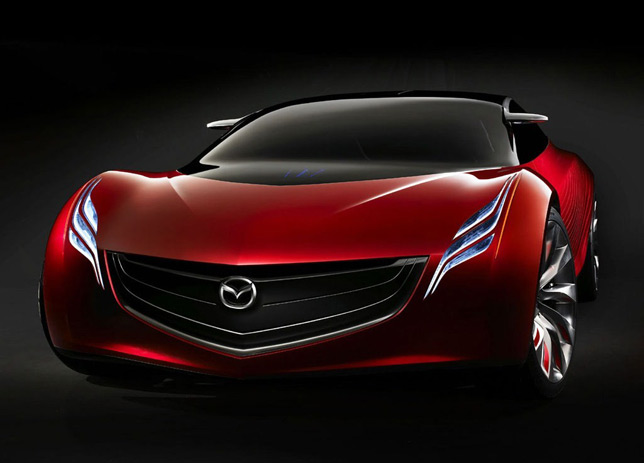
    Mazda Ryuga
    Mazda Ryuga

    “But we wanted to take the idea further,” van den Acker continued. “The Ryuga concept we’re presenting in Detroit is our next step in the evolution of Nagare. It’s an exploratory design study that’s more realistic than Nagare and therefore more useful in gauging reactions from those who see it.

    “To put this in fashion terms, if Nagare is haute couture (a custom designed and tailored garment), Ryuga is prêt-a-porter (ready-to-wear, not one of a kind).”

    RYUGA: “ree-yoo-ga,” Japanese for gracious flow

    “Ryuga celebrates refined and controlled motion,” van den Acker continued. “Nagare is a dream or an emotion that’s just beginning to take shape; Ryuga extends that idea by adding definition.

    “To draw this new surface language closer in time to a car Mazda will produce for sale, we’ve added interior and powertrain details that were purposely absent from Nagare.

    “Mazda is a brand that thrives on distinctive design. We are standing up to be recognized for boldness and originality. We have the courage to forge leadership in selected areas such as dynamic performance and striking design. Combined, these attributes give each of our products the soul of a sports car. The flow expressions that Nagare and Ryuga embody will be seen both in the near term on other concept cars and in the long term on production models.

    “We’re working on the face of Mazda to make it more distinguished and instantly recognizable. We can adjust this new surface language to suit various models within the Mazda family. The recent success of our product line has given us the confidence to seize this look as our own.

    GRACIOUS FLOW – MOTION BORN IN NATURE

    Large wheels placed at the far corners of Ryuga’s exterior lend a highly stable, balanced stance. The aggressive wedge shape imparts motion even when this sports coupe is parked. Volumes that are small in front, larger at the rear, wrap around and over the wheels to give the exterior tension and direction.

    “After we began studying natural phenomenon for inspiration, Mazda designers were initially hesitant to apply their findings, but I encouraged them to blend artistic and sculptural beauty to see where it led. Once we did, the results were both original and instantly appealing. While this initiative began with textures inspired by nature, it goes much deeper than that. We’re looking at grand gestures that wrap all over the vehicle’s exterior and throughout the interior. Some of the proportions are dramatically wind-swept. There’s drama at every turn. There are no square corners.”

    Yasushi Nakamuta, chief designer for this project, previously headed the design of Mazda’s immediately successful third-generation 2006 MX-5 Miata. Nakamuta says, “Ryuga incorporates elegant and refined design treatments which express Japanese concepts of mysterious beauty and intelligence, based on the new design theme that began with the Nagare concept car unveiled at the LA Auto Show.”

    Reflecting its Japanese origin, Ryuga is both simple and complex. While the dominant flow theme is simple, the details – such as the side surfaces and the wheels – are intricate. Solidity and fluidity live here together, in harmony.

    FLOW THROUGH INTERIOR

    Thanks to Mazda’s innovative packaging expertise, Ryuga is significantly shorter and lower than today’s four-passenger RX-8 sports car, yet it too accommodates four passengers in roomy comfort. A relatively long (110.2-inch) wheelbase and two large gull-wing doors provide a wide-open invitation to the interior.

    As the doors rise to expose the interior of Ryuga and allow easy slide-in access, the passengers are presented
    with the fusion of a cockpit – designed to maximize the emotional connection between the car and driver – with the social atmosphere of the rear passenger space, where lounge-like comfort is ensured through expansive space and Nagare-inspired design.

    The front bucket seats provide ample lateral support for energetic driving with the shape of the seats creating an impression of movement which is further emphasized by the patterns in the material.

    The experimental ‘floating’ center cluster allows a high level of interface between the driver and the multi-function touch panel without having to take one’s eyes off the road ahead. Information necessary for safe and dynamic driving is available to the driver with RPM and speed (which is shown in both analog and digital formats) being displayed on the same axis.

    Flowing upwards, the center cluster dynamically penetrates the front information panel which reflects Zoom-Zoom futuristic and sporty design craftsmanship, as well as an integrated interface between man and machine. Elongated pods give the cockpit depth while bringing information closer to the driver’s eyes. An open-top steering wheel provides enhanced sight lines to the instruments and the road ahead.

    Flow textures are emphasized in the door trim with lines that begin at the center of Ryuga’s Mazda-trademark five-pointed grille and sweep rearward through interior surfaces. The artistic combination of leather, polished aluminum and translucent plastic give the interior a warm glow reminiscent of illumination themes already in use in current Mazda products.

    DRIVING PERFORMANCE – ENVIRONMENT AND SAFETY TECHNOLOGIES TO SUPPORT ZOOM-ZOOM

    Mazda is working on various technologies to deliver Zoom-Zoom driving in the future, including earth-friendly environmental technologies and people-friendly safety technologies. As part of the initiatives, an E85/Gasoline FLEX FUEL engine which runs on sustainable bio fuel could be used in Ryuga. This engine delivers torque and power, balancing driving and environmental performance. Other important features that will support safe driving are the Charge-Coupled Device (CCD) cameras installed for the rear monitoring system and the blind-spot monitoring system. These help ensure safe driving while changing lanes and allow easy identification of potential obstacles.

    In order to ensure the car provides a Zoom-Zoom driving experience, which is the basis behind all the other features, an open top steering wheel is employed with highly sensitive settings to respond to the driver’s smallest input. The car also features steer-by-wire technology and gauges that deliver superbly clear information to the driver. The dramatic wheels with TOYO PROXES 245/35R-21 tires complete the driving experience, and the sophisticated original tread pattern perfectly suits the Ryuga’s design concept.

    FLOW, AS A STATE OF MIND

    “The real significance of both Nagare and Ryuga,” notes van den Acker, “is that it’s the first time Mazda has ventured forth in search of a design motif that is undeniably new. Both concepts are exploratory studies and neither is planned for production. While Mazdas of the past and present have embraced flow in various ways, it’s our intention to greatly intensify that character in the future.”