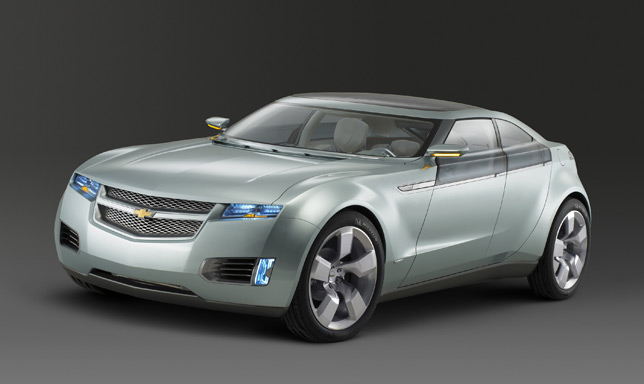
While the technologically advanced Chevrolet Volt has the capability to travel 40 miles on electricity alone, at first glance, the concept could easily be mistaken as simply a design statement.
The Volt conveys an immediate message of agility and sophistication, with exterior proportions more commonly associated with classic sports cars. Twenty-one-inch wheels and sheer, taut surface relationships reiterate the statement. The Chevrolet Volt’s athletic design challenges the notion that an environmentally conscious vehicle can’t be beautiful and possess an aesthetic spirit that matches its driving characteristics.
“We’ve leveraged our resources around the globe to develop the design aesthetic for the Volt,” said Ed Welburn, vice president, GM Global Design. “It was important that the design capture the face of Chevrolet as it’s recognized around the world.” Design and engineering collaboration between GM designers and GE Plastics, using unique material technology and design engineering support, helped achieve the Volt’s distinctive appearance. True to the heritage of its Chevrolet bowtie, the Volt’s exterior design suggests spirited performance and is wrapped in a stylish package, with classic Chevrolet performance cues that hint at both Camaro and Corvette.
Inside, a host of current or near-term technologies and materials, combined with ingenious use of ambient light, creates an interior environment that’s light, airy and thoughtful.
“First and foremost, this is an advanced technology vehicle that uses little or no fuel at all. But we didn’t see any reason why that should compromise its design,” said Anne Asensio, executive director, GM Design. Asensio led the design team that created the Volt concept, with designs solicited from GM’s studios around the world.
“We wanted a size that connected with everyone, so we designed a small car,” said Asensio. “In the end, the interior design team from England inspired the final interior execution, and the exterior was the work of the Michigan advanced design team.
“Our job was to design a vehicle people could easily imagine seeing on the road,” said Asensio. “It couldn’t be a ‘science project,’ because that’s not what this car is all about. It had to be realistic, executable and carry the essence of the Chevrolet brand.”
Athletic, bold exterior
Sized for an urban-centric lifestyle, the Volt concept sedan carries dimensions similar to a Chevrolet Cobalt, with an overall length of approximately 170 inches (4,318 mm), a height of 52.6 inches (1,336 mm) and a width of 70.5 inches (1,791 mm). However, the Volt’s proportions, dictated by the layout of its electrically driven powertrain system, make it distinctly different from its mainstream Cobalt sibling.
“The configuration of the drive and energy components dictated we push the front wheels forward and outward to the corners,” said Bob Boniface, design director, GM Design, and lead exterior designer. “We wanted to keep the overall dimensions relatively small. This is an urban-centric car, so it needs to fit into small areas.”
The Volt’s proportions, combined with large wheels, wide front and rear tracks (64 inches / 163 mm, front and rear) and a tight wheel-to-body relationship, enable a sporty, confident stance. Other key proportional highlights include a dash-to-axle length that positions the driver far rearward of the front wheels; large 21-inch by 7.5-inch wheels; short front and rear overhangs and departure angles that deliver a sense of taut, compact energy. Also, the offsets between the upper glass elements and tire planes (the glass is inboard of the face of the tires) contribute to the sedan’s balanced stance and enhance the vehicle’s dynamic static image, resulting in pure, athletic proportions.
“What’s beautiful about the proportions is that when you think about some of the competitors out there, you tend to think of those vehicles as ‘the sensible shoe,’ “said Boniface. “People buy environmentally friendly cars because they feel it’s the right thing to do, not necessarily because of their looks or to make a fashion statement. But the Volt is different. It’s something one would buy because it is so compelling to look at, and the fact that it has the potential to never burn any gasoline – that’s just a bonus.”
Transparent roof and beltline
The Volt’s roof, side glass and beltline are constructed of GE Plastics transparent, glazed polycarbonate material that delivers the scratch resistance and gloss surface appearance of glass, combined with the formability of a plastic composite.
As a result, the Volt provides the driver and occupants with exceptional visibility, enabling a “city lights” theme in which the outside world passes through to the interior of the vehicle. Also contributing to the visibility is a shouldered, tinted side glass – constructed of the same GE polycarbonate material – that enables a dual beltline.
Additional exterior design elements
In addition to the upper daylight opening and roof, key exterior panels are made with a GE Plastics composite, and each – in and of itself – is designed as an artful shape that could be displayed on its own. As a result, the exterior panels fit together like a well-crafted puzzle, with flowing surface-to-surface cut lines that bring a sophisticated composition and overall harmony to the Volt’s exterior appearance.
The front door hinges enable enhanced entry/egress to the vehicle, as well as a graceful, forward-leaning door cut line. Milled from billets of stainless steel, the hinges serve as design elements, extending into the front quarter fenders and incorporating a plug-in recharging port access on both sides of the vehicle.
The vehicle face – designed to carry a serious, confident appearance – is clearly Chevrolet, with a twin-port front grille, center-positioned bowtie and lower air intake. Horizontal headlamps with aluminum bezels deliver a jeweled appearance, leading to translucent light-emitting diode (LED) forward illumination elements.
The underside of the vehicle consists of a flat, composite molded belly pan that is integrated with the fascias and rockers for a clean, uncluttered and finished appearance. The belly pan – which contributes significantly to the Volt’s 0.30 coefficient of drag – contributes to the sedan’s overall impression of refinement and demonstrates the design of the underbody was just as important as the upper body.
Thoughtful interior
The interior environment of the Volt was designed to appeal to an urban dweller who desires a smart, daily-use vehicle, according to Wade Bryant, design director, GM Design.
“On the interior of the Volt, you’ll find technologies, materials and an environment that enable the car to help make life simpler for a person who’s environmentally conscious and leads a city-centered lifestyle,” said Bryant. “It’s ergonomically correct, provides connectivity to the world, and demonstrates smart responsibility through the use of lightweight, recyclable materials.” Two such examples are the instrument panel topper and steering wheel made with GE Plastics.
Bryant said the interior environment of the four-passenger Volt is defined by a host of current or near-term technologies and materials combined with the ingenious use of ambient light. “It’s definitely based in reality. All the things you see on the interior are within reach in the next few years.”
According to Bryant, the interior team and the exterior designers worked closely together to make the Volt look like one vehicle. Two examples of their collaboration are the dual beltline and the door hinge that’s visible outside of the car. “We designed this as one element that comes inside the door and becomes the interior pull handle,” said Bryant. “It’s all about integration, refinement and thoughtfulness.”
Super Imaging instrument cluster
Super Imaging is an innovative, dual-mode technology display that provides two visual levels of vehicle information to the driver in the instrument cluster. It is a design innovation developed to provide a primary interface between the driver and the vehicle’s key feature: the next-generation, electrically driven propulsion system.
“The dual-mode instrument cluster was developed to highlight the car’s plug-in capability,” said Bryant. “The powertrain technology is the key feature, so we wanted to make sure the interior communicated that, and the driver would have a sophisticated, fun and useful interaction with the electric-drive system.”
The first level of information – configured similarly to a conventional instrument cluster – provides traditional data in the form of analog, three-dimensional (3D) LED displays, including three gauges for fuel level, speedometer, odometer, battery level and the transmission “PRNDL” indicator. The second level of information – a transparent screen positioned in front of the 3D LED displays – delivers color, animated data related to the Volt’s advanced propulsion system with a holographic-like appearance.
Super Imaging works by using invisible, fluorescent inks that are printed on the transparent screen. When illuminated by an ultraviolet (UV) laser projector located behind the instrument cluster (from the driver’s perspective), the inks become excited, and provide four-color illumination and animation.
Foam/fabric surfaces
Compression-molded foam with a textile-patterned surface layer is applied on the entire lower instrument panel, lower door trim panels and rear quarter trim areas. The material enables soft, tactile, low-gloss surfaces throughout the interior cabin that appear hand-crafted and specifically tailored to the car.
This material, used in some of the latest luggage designs, enables zippered access to traditional storage areas such as the glove box, doors, etc. The material is very inexpensive, wears well and enables flexibility in design.
Composite panels
Molded GE plastic panels provide thin, structural interior surfaces that can be cantilevered in space. The material is applied on the upper instrument panel, seat backs, center console sides and door inserts.
Light, strong, affordable and recyclable, the panels are sheathed in reconstructed scrap leather to achieve a soft, hand-crafted surface.
Use of ambient light
The aspect of light – from outside and within the vehicle – is played throughout the interior environment. Highlights include a transparent upper roof that provides large quantities of natural light and is enhanced with thinner pillars and rail sections; Gelcore® LED indirect lighting around the roof periphery that illuminates during evening hour entry/egress and can be seen from outside the vehicle; LED functional storage lighting that passes through transparent zippers and provides ambient light during evening hours; and conductive ink controls situated on the interior surface of the glass roof that provide touch access to lights, OnStar buttons and more.
“All the storage areas are lighted internally, and the light escapes through the clear zippers, so you’ll always be able to find your storage at night,” Bryant said. “It all adds a nice little ambient effect, and the illumination will be color-keyed to the instrumentation lighting color. It’s functional and cool, and when you open it, light from the interior storage area spills out.
“A big enabler is the transparent upper roof. It provides the Volt with more natural light than most other vehicles. It’s very distinctive and appealing.”

 An urban crossover concept that’s equally at home on the trails or in traffic, it gets a low-cost all-wheel-drive system and looks the part of a rugged SUV many times its size, thanks to a voluminous one-piece bumper and fender system in the front and back, a rear-mounted spare tire and a roof rack. Trax is powered by a 1-liter gas engine


 To celebrate the success of Corvette in sports car racing – and in particular the prestigious Le Mans 24-Hour event, a limited series of just 250 ‘Victory Edition’ Corvette Coupes is being produced. Since Corvette Racing made its debut in 1999, the team has won over 50 races, including five class wins at the 24 Hours of Le Mans between 2001 and 2006.


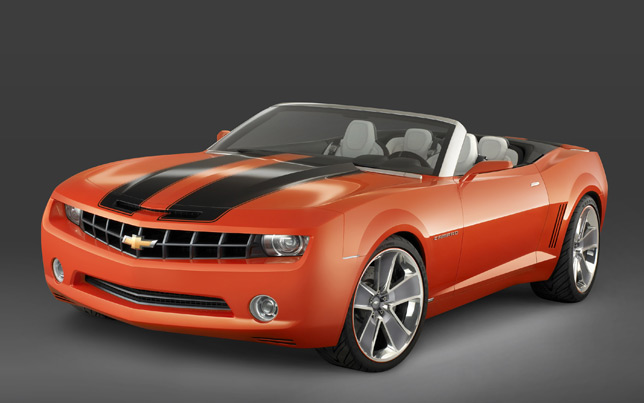
 The Chevrolet Camaro concept was the celebrated star of the American 2006 auto show season. Now, at the beginning of the 2007 auto show season, there is a new star rising: The Chevrolet Camaro convertible concept. It will be unveiled on the eve of the North American International Auto Show at GM Style, an exclusive, fashion-splashed event combining celebrities, couture and automobiles. Chevrolet already has announced production plans for the Camaro, which will go on sale in the US in 2009. A production convertible model will be added later that year.