 Organiser Live Promotions has announced that Race Retro, the international historic motorsport show, will be held from Friday 12th to Sunday 14th March 2010, returning to Stoneleigh Park, Warwickshire. After its extremely successful first year as owners, Live has also chosen the Alfa Romeo as its celebrated marque as the Italian manufacturer celebrates its centenary year. (more…)
Tag: Formula 1
-
Race Retro Announces 2010 Dates And Alfa Romeo Celebrations
-
Ferrari 458 Italia
 The Ferrari 458 Italia is a completely new car: engine, design, aerodynamics, handling, instrumentation and ergonomics.
Four and a half liter V8 delivers 570 horse powers at 9000 revs and 540 N/m at 6000 rpm. This makes the incredible 127 hp/liter from naturally aspirated engine.
Despite the fact that the new engine is significantly more powerful than the V8s that preceded it, the Ferrari 458 Italia produces just 320 g/km of CO2 and fuel consumption is 13.7 l/100 km (combined cycle), the best in the entire segment.
The 458 Italia compared to other super sports cars is a featherweight – 1380 kg with a power-to-weight ratio of 2.42 kg/hp and the results are more than exceptional: 0-100 km/h in under 3.4 seconds top speed of 325 km/h.
The low weight of the car helps a lot with the braking, 32.5 metres 100-0

Like everything else the interior is revolutionary too. The ergonomics are perfect and the main controls are all clustered on the steering wheel.
This car is a perfect proof that Ferrari can make extraordinary cars from every single point of view.


Ferrari 458 Italia – Technical specifications
Dimensions Length 4527 mm (178.2 in.) Width 1937 mm (76.3 in.) Height 1213 mm (47.8 in.) Wheelbase 2650 mm (104.3 in.) Dry weight 1380 kg (3042 lbs)* Weight/power ratio 2,42 kg/CV (7.16 lbs/kW) Weight distribution fr/r 42% / 58% Engine Type V8 – 90° Displacement 4499 cc (274.5 cu in.) Maximum power 570 CV (425 kW)** @ 9000 rpm Maximum torque 540 Nm (398 lbs/ft) @ 6000 rpm Specific power output 127 CV/l Compression ratio 12.5:1 Tyres Front 235/35 ZR20 8.5″ Rear 295/35 ZR20 10.5″ Performance Maximum speed >325 km/h (>202 mph) 0-100 km/h <3.4 s Fuel consumption + emissions Fuel consumption*** 13.7 l/100 km Emissions*** 320 g CO2/km Gearbox Dual-clutch, 7-speed F1 Electronics E-Diff3, F1-Trac, high-performance ABS * With forged wheels and Racing seats
** Including 5 CV of ram effect
*** Combined cycle (ECE+EUDC) -
Renault Celebrates Espace Silver Jubilee – Spanning Four Generations Of The First Mpv
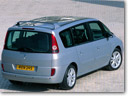 Summer marks the twenty-fifth anniversary of the Renault Espace first going on sale. Sales of the groundbreaking vehicle, which started the MPV revolution back in the early Eighties and has had four distinct generations, have now reached almost 1.2 million since its launch in 1984, 80,000 of which are in the UK. (more…)
-
Monaco Grand Prix – Timo Glock and Jarno Trulli at the Bottom
 Panasonic Toyota Racing left the Monaco Grand Prix empty-handed despite a valiant effort from Jarno Trulli and Timo Glock. Following yesterday’s disappointing qualifying session, the team fully expected a challenging race and prepared accordingly. (more…)
-
Fioravanti LF1
 Fioravanti is a means of transport design company, mainly involved in the automobile field, which is recognized for its “out-of-the-box” thinking.
Thanks to this characteristic combined with the strong passion of its personnel, for the 79° edition of the Geneve International Motor Show, Fioravanti deals with the topic of Formula 1. (more…)
-
Lagonda V12 Prototype gets the gold at Double Twelve
 The inaugural Brooklands Motoring Festival: The Double Twelve, which took place over 28/29 June, was a resounding success with almost 15,000 visitors attending over the weekend. (more…)
-
Tramontana a.d.
 It has never been seen in the automotive history a street sports car which resembles so much a Formula 1 like the Tramontana does. It is the first time in the sports car market that it has been incorporated a 100 % carbon fibre monocoque chassis inspired in the design of a Formula 1 and manufactured with the same criteria, guaranteeing a high protection for its passengers. Moreover, it introduces a new structural system that combines an indeformable central zone (cockpit) with a weight of 128kg with other 8 deformable zones calculated for the absorption of the impact energy. In fact, the results extracted of the Crash Test (according to the FIA regulation) confirm that the structural calculation guarantees the integrity of its passengers displacing the lateral components toward the outside. This shows the high impact resistance of the carbon fibre used in the vehicle.
On the other hand, this monocoque, especially developed for the Tramontana, contributes a lightness and maximum rigidity to the whole, factor that together with its suspension system, unique on its market of double wishbones with pushrod and a great length of arms, improves the dynamical aptitudes of the vehicle. All this elaborated with materials of last generation of aerospace technology like the steel to the cromolibdenium, magnesium and duraluminium. Without doubt in the Tramontana the efficiency of the geometry and the weight has been tested, obtaining as result an unequalled performance.


The structure of the monocoque carried out in carbon fibre offers a high torsion resistance, which makes the driver feel like going on a rail.
In the assembly process have been adopted handcraft techniques like the obsession by pre-impregnate and cured in autoclave to 120 ºC, that provides an exceptional finish level and makes the construction of light and strong pieces easier.
Engine, from the competition to the asphalt
Lubrication system Dry sump Fuel Unleaded 98 Octane
Among the final solutions of the Tramontana, we find a new electronic system and a central gasoline engine V12 Biturbo capable to offer a power from 550 Hp to 720 Hp, selectable through a switch situated in the dashboard.
Associated to a 6-speed gearbox, specially developed for the Tramontana, this 12 cylinders propeller in V reaches the 720 Hp to 5.750rpm with a maximum pair torque of 920nm at 4.000rpm. The result, 345 km/h of top speed and 3,7 seconds to reach the 100 km/h from stopped departure.
The weight-power relation is elevated to the 1,7 Kg/Hp, significant data that allow us to discover the kind of sensations that this fantastic assembly of chassis and engine can offer us.
The development of the electronic switchboard is made to measure, in a craft process of more than 2000 hours, that includes full silver wiring and a power map capable to obtain the maximum performance of the engine. Moreover, for the first time in a street car, lifelong relays, fuses and protections have been replaced by a module with just one connector that has only one terminal that brings together all the functions of a conventional device. This innovative system has reduced the wiring, the complexities of the consoles of relays and the fuses, avoiding any electromechanical deterioration.
Car body, beauty and functionality
Without doubt, the design of the Tramontana combines the curves of a fighter with a narrow front and a wider rear of big dimensions and finished in first quality leather and wood imported of the classics of the Spanish automotive industry. This aesthetics remains totally clear thanks to the design of the hardtop, which covers and protects the passengers, and to the rear and front spoilers, in the form of an airplane wing, that assures a great beauty and an excellent support at the same time. In short, a perfect harmony between sensuality, fine materials and elegant lines, an authentic jewel for the collectors.
All the pieces of the Tramontana car body are also elaborated in carbon fibre, assuring the maximum lightness of the vehicle with a total weight of 1.250 kg.Thanks to the dynamic study carried out by a.d. Tramontana, the pieces that form part of the car body have been created by considering its functionality and the important vehicle performance.
The result is some compacted forms, an expressive front and a suggestive aerodynamic outline with a marked silhouette. Everything in the Tramontana transmits force, character, personality and, above all, sportsmanship, nevertheless the new model is a worthy heir of the sports tradition of the Formula 1.
Suspensions, balance between sportsmanship and comfort
One of the key items of the Tramontana is its system of suspensions of double wishbones with push-rod and its great length of arms, elaborated with a sort of steel of aeronautical and competition specifications of the latest generation.
Two special programs have been used for the development, which have permitted the static and dynamic simulation of the whole vehicle. Different defined adjustments in theoretical calculations have been projected and experienced on it in order to analyze the performance before proceeding to the validation and arriving this way to the definition of the suspensions rates. Finally, a.d. Tramontana has bet on a suspension system that provides a better control, driving comfort, smaller oscillation and better speed cornering, due to the distance between axes, identical to that of a Formula 1.
In the same way, the Tramontana has a system of double electronic height regulation especially developed for the Tramontana, which allows the driver to raise or to lower the height of the vehicle according to the driving needs. It has been looked for a balance between the performance of a street car (at 130mm) and a sports car (at 85mm) considering the different driving styles.
Tyres
To put “shoes” to the Tramontana it has been determined an intermediate solution of standard tyres with asymmetric design with wide longitudinal channels and very hard radial silent block. Together with a low tread pattern, allows the Tramontana to avoid the drift of the tyre and facilitates a perfect performance in the cornering. The running band is side divided in three distinctive elements to satisfy the most demanding performance that the Tramontana requires.
Steering, very sport sensations
The steering column with double cardan system is adjustable in reach and lift, permitting the drivers to adapt the driving position according to their preferences. Also the a.d. Tramontana engineers have modified the parameters of steering assistance to increase the sport feeling, fact that added to the easy access to the cams on the gear change, situated behind the steering wheel, facilitates the driver the execution of layout you need in any situation. All this contributes to a better driving precision and permits to enjoy all the sports qualities of the model.
Brakes
a.d. Tramontana has developed an ABS system that allows, by means of braking distributor, to distribute between the front and the rear train the power of braking obtained by the discs of carbon-ceramic.
Likewise, the rear and front brake discs are elaborated with carbon-ceramic that do not need of high temperatures for their maximum efficacy of braking. It is referred to a material that combines the most innovative aerospace technology with the know-how of the Formula 1, providing thus a purely sports performance and a high durability of the brakes. To the advantages of the carbon-ceramic it is important to add other benefits of great benefit for the performance of the Tramontana, like the weight reduction up to a 70%, the improvement of the friction coefficient or the high energy absorption capacity and the scarce possibility to suffer fatigue in the braking system.
The effectiveness is spectacular. Combining the lightness of the monocoque with the power of the six pistons per disc on the 4 wheels it permits to minimize the braking distance to beyond incredible limits.
Ensured safety
To get the best mark in the subject of security, the Tramontana has been submitted to a Crash Test whose demands have followed the dictations of the official regulation of the FIA. The car, built with a carbon fibre monocoque, has needed a software developed especially to be adapted to the characteristics of the Tramontana. In this study all the pieces passed through a side, front and rear crash test.
The Tramontana emphasizes for offering a double security. First, all the exterior pieces are designed and distributed so that in case of impact they never get inside. On the other hand, the chassis has been strength with a security arch that protects the passengers. Moreover, the security of the Tramontana is guaranteed thanks to its private structure that combines an undeformable central zone (cockpit) with other eight collision absorption zones.
Aerodynamics, the exigency of the geometry
The engineers team from a.d.Tramontana has worked very hard to find the maximal exigency and perfection regarding the aerodynamic performance of the Tramontana, an aesthetical reasoning as similar as possible to a Formula 1.
The aerodynamic performance is though to great speed cornering and, at the same time, get a minimum air penetration coefficient Cx=0,4.
The air intakes and cooling of the motor they have been designed with the objective to minimize the friction of the air and to optimize the performance of the motor. Moreover, the vehicle has a laminated sheet situated under the vehicle, that eliminates turbulences and improves the drag.
In the same way, the wishbones, designed in the form of drop of water, they help to minimize this coefficient. In fact, all the external elements that stand out from the vehicle are thought to obtain the minimum air resistance. This is the reason of the airplane wing profile of the wishbones.
The front spoilers offer a higher lift compared with the rear ones to avoid loss direction sensations. In this sense, there is an important work to obtain a ground effect thanks to the air flow that penetrates in the lower part of the vehicle. This generates a negative lift toward the ground, making driving to high speeds easier.
Finally, another remarkable factor, has been the study to situate the centre of gravity of the Tramontana as low as possible to increase the cornering speed.
Seats
The Tramontana also surprises for its interior, where the sportsmanship and the comfort breathe in all the details.
The first thing that we notice when we get in a Tramontana is, without doubt, the seating position in tandem, the same as in a fighter. In fact, in its development has collaborated, among others, Manuel Brown, an engineer in the field of aeronautics, member of Euro Fighter design team in Germany.
As opposed to the normal position of the passengers, side by side, the tandem position of the seats of the Tramontana has permitted to centre the weight in an excellent way. Technically, a 42-58 weight distribution has been designed, obtaining thus an entrance in curve with a stable relation of 50-50.
On the other hand, the visibility of the Tramontana is superior to that of a conventional vehicle, due to the privileged position of the driver. The position of the seats can be personalized for each client.
Source: Tramontana
-
Renault Clio F1 R27
 To mark the international launch of the new R27, Renault Sport Technologies will present the Clio Renault F1 Team in Amsterdam today. This will be a unique opportunity for enthusiasts to celebrate the achievements of the two-fold world champion Formula 1 Team with the unveiling of a unique car packed with sports features and technologies. Offering sensations of pure performance, passion and driving pleasure, the special edition Clio Renault Sport asserts its identity across a unique look and sporty dynamics, boosted by range of equipment drawn from the best of competition vehicles.
Asserting the Renault F1 Team identity
With its red brake callipers, its new Sirius yellow colouring and exclusive Renault F1 Team and World Champion markings, this special edition of the Clio Renault Sport will be immediately identified with its older sibling, the Mégane Renault F1 Team. The interior features Récaro seats, and the numbered plate evokes its unique sports character.

Renault Clio F1 R27 Chassis and settings for ultimate efficiency
Clio Renault F1 Team R27 rests on a Cup chassis. BeBop 17” Dark Anthracite wheels provide more sensation and road-holding accuracy. Its base is lower than the Clio Renault Sport, efficiency is improved by adjusted shock-absorbers and specific springs. This means more performance and extreme pleasure. The general public will find more details on this Special Edition Clio Renault F1 Team R27 at the next Geneva Car Show. Test drives and commercial marketing at a later stage.

Renault Clio F1 R27


