SsangYong e-XIV Concept is going to be officially revealed at the 2012 Paris Motor Show. This is an environmentally friendly electric car concept, named e-XIV.
The e-XIV abbreviation stands for exactly the following: electric − eXciting user Interface Vehicle. This EV concept has been included within the SsangYong XIV design series and the B-segment CUV (crossover utility vehicle).
In fact, this concept is a “Range Extender EV” electric car which in addition is also self-chargeable by using a small petrol engine. This allows the vehicle to overcome the issues of limited driving distance and battery charging infrastructure.
In particular, the dimensions of the e-XIV concept are: 4,160 mm in length, 1,790 mm in width, 1,575 mm height, and the wheelbase is a 2,600 mm. The glass roof provides enhanced visibility for passengers, while the roof mounted solar cell panels supply pollution free solar energy.
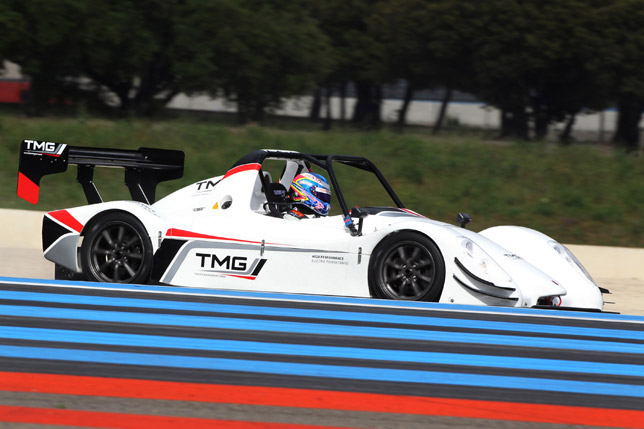
Toyotahas just broken the electric vehicle course record at the Motorsport event Pikes Peak International Hill Climb this Sunday. The winning racecar, driven by the multiple Japanese rally champion Fumio Nutahara, was namely the Toyota TMG EV P002.
The time which broke thee record was exactly 10:15.380. This was estimated on the now fully paved 19.9-kilometre course, which in fact bettered the previous class record by more than two minutes.
Furthermore, the time was also over 15 seconds faster than the nearest electric-powered class competitor – the Mitsubishi i-MiEV Evolution. This in general means that the TMG EV P002 was placed at sixth position in the overall classification.
But what made this Toyota achieve so great results? The answer is that the racecar is powered by two axial flux motors, which deliver a combined output of 476 hp (350kW). The advanced electric motors also offer the impressive 900Nm (664 lb-ft) of torque ad this is achieved through a single gear transmission.
The secret here however is that the fully electric drivetrain maintains full power even in the thin air of the course, which begins at an altitude of 2,862 metres and finishes at the 4,300-metre. As a matter of fact, exactly the air at the summit robs the vehicles of almost 30 per cent of engine power.
Another interesting fact is that the radical chassis-based TMG EV P002 is a development of the street-legal TMG EV P001. The latter broke the electric car lap record at the Nürburgring Nordschleife in 2011.
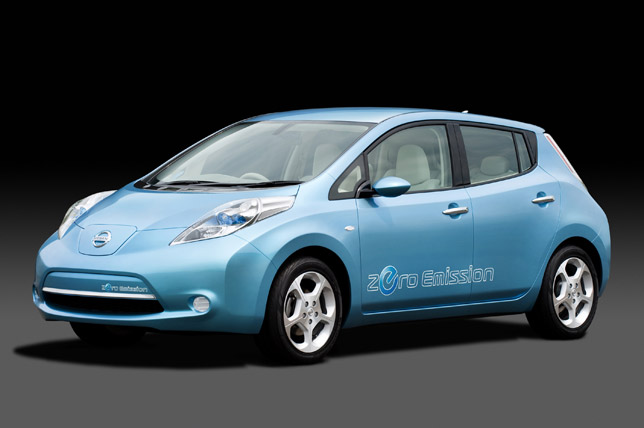
Nissan Leaf Blue Light will be used by the police in Portugal. Not only one example of the Leaf will support the local patrolmen but a whole fleet of eight units.
In fact this Nissan model is famous with its multi-awards for being one of the best zero-emission cars currently on the market. The car will be also utilized in a Safe School Program, and thanks to the flashing blue lights, sirens and clear ‘Polícia’ markings, the students will be called upon to perform thier police duties.
Of course, no other car but Nissan Leaf has been chosen to reduce the ecological footprint in Portugal. The great example given by the local officers is expected to be followed by other people in the country.
Nissan Leaf Blue Light
This makes Portugal an EV pioneer in Europe. And did you know that it was one of the first countries to install a network of EV chargers in its big cities and was the first to sell Nissan Leaf to the European public.
Nissan Leaf is the world’s most selling electric vehicle. Its AC motor generates 80 kW (108 hp) of power and 280 Nm (380 lb-ft) of torque. This means that it has a maximum speed of 145 km/h.
The electric motor is powered by a Nissan-developed laminated lithium-ion battery with an output of more than 90 kW (122 hp). And one of the most convenient facts is that the recharging time is only eight hours, of course we are speaking here for 100% recharging. However, it takes only 30 minutes to “refill” the battery’s power from 0 to 80% thanks to the quick charger in optimal conditions.
European production of Nissan Leaf will start in early 2013.
Toyota TMG EV P002 is going to conquer the high altitudes of the legendary Pikes Peak International Hill Climb. More importantly, what is so specific about this racecar is that it is an electric one. This simply means that Toyota is applying its environmental visions on the race track as well.
Toyota TMG EV P002 doesn’t have a conventional combustion engine but a fully electric drivetrain. It is able to develop full power even in the thin air of the hill climb’s 19.9 kilometre course. The race starts at an altitude of 2,862 metres and finishes at the 4,300-metre Pikes Peak in Colorado Springs.
Furthermore, this racecar has a twin axial flux motors, which are able to offer a combined output of 350kW (476 lb-ft). The vehicle has a top speed of 240km/h. The advanced electric motors contribute to the power of the car as well. They deliver 900Nm of torque through a single gear transmission.
An interesting fact here is that Toyota engineers have spent the past half year working on the Radical chassis-based EV P002. It is a development of the street-legal TMG EV P001, which as you might remember broke the electric car lap record at the Nürburgring Nordschleife last year.
The Japanese rally champion Fumio Nutahara will drive the EV P002 in the event, also known as the ‘Race to the Clouds’.
Toyota TMG EV P002 Electric Racecar
Toyota TMG EV P002 technical specifications:
Performance: Top speed 240km/h (Pikes Peak configuration); Maximum torque 900Nm; Maximum power 350kW; Maximum revs 5000rpm
Powertrain: Electric motor 2 axial flux; Inverter 2 x TMG inverters; Gear ratio 2.5; Transmission Single-reduction gearing; Battery Lithium ceramic; Battery capacity 42kWh; Charging technology Off-board DC charging
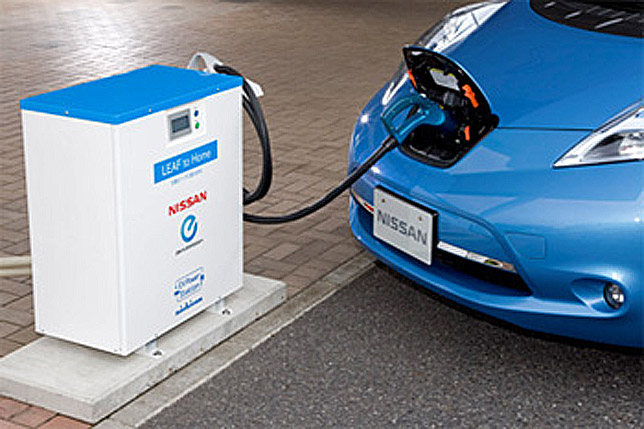
Nissan Motor Corporation and Nichicon are going to launch “LEAF to Home” Power Supply System with “EV Power Station”. The “LEAF to Home” power supply system can supply electricity from batteries onboard in 2012 Nissan LEAF electric vehicles (EV) to homes when used with the “EV Power Station” unit. The latter is developed by Nichicon Corporation.
In fact, “LEAF to Home” is an industry first backup power supply system. What it can do basically is that it can transmit the electricity stored in the large-capacity batteries of Nissan LEAFs to a residential home.
2012 Nissan Leaf EV
Other good news is that Nissan will showcase this system in Japanese dealerships in the days to come. The aim is to promote efficient electricity management and the features built onto electric vehicles.
Behind the technology which moves the electricity from the vehicle to home through the EV Power Station Unit, stays the Nichicon. Its innovative technology enables electricity stored in high-capacity lithium-ion batteries onboard a Nissan LEAF to be sent to an ordinary home. This happens through the connection between the car and the home’s electricity distribution panel with a connector linked to the LEAF’s quick charging port.
The EV Power Station system is not big in size. In fact it is as big as an external air-conditioning unit. It can be therefore mounted outdoors. Furthermore, the system can run on various operating modes and has a timer function which can be controlled with a liquid crystal display (LCD) touch panel. More importantly, the electricity is stored or supplied automatically in accordance with a household’s electricity capacity and consumption.
The full charging time for the LEAF EV is as little as four hours. The great news here is that this is half the time, when the vehicle is charged via normal charger. This consequently means that it also can lower customers’ electricity bills.
2012 Nissan Leaf powered by "LEAF to Home" Power Supply System
The EV Power Station : Specifications
When charging Nissan LEAFs
Input voltage:
Single-phase, AC 200V (±15%), 50 Hz/60 Hz (±5%)
Input current range:
AC 0-36A
Output voltage range:
DC 50-500V (CHAdeMO Protocol)
Peak power output:
6kW
Conversion efficiency:
90% or more (at rated output)
Power factor:
99% or more (at rated output)
When supplying power to households
Input voltage range:
DC 150V-450V
Input current range:
DC 0-30A (Limited by cable specifications)
Output voltage:
Single-phase three-wire system (AC 100V x two-phase)
AC100V (±6%), 50Hz / 60Hz
AC 200V (±6%), 50Hz / 60Hz (Max.±2%)
Output current range:
AC 0 – 30A
Peak power output:
6kW (Single-phased, AC 100V·3kW x two-phase)
Conversion efficiency:
90% or more (at rated output)
External dimensions:
650 mm (W) x 350 mm (D) x 781 mm (H) (excluding projecting parts)
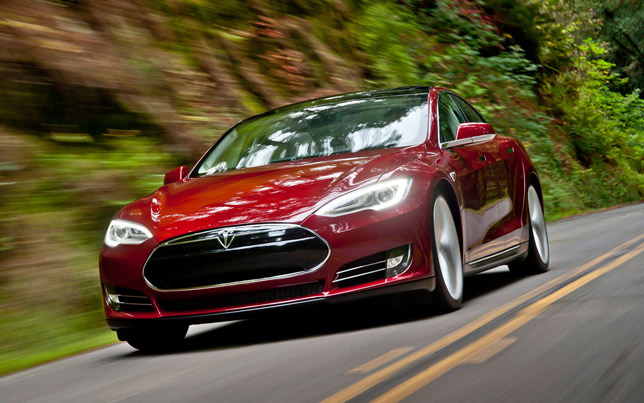
The Tesla Model S is as ready as it can be and the company, which is rather ahead of schedule, is pleased to announce that deliveries will start happening on the 22nd of June. The Tesla Model S is an all-electric, rear-wheel-driven, four-door sedan that brought along a lot of commotion when it was first announced.
It’s one of the most sizable EV of its time with a wheelbase of 116.5”, an overall length of 195.9” and a front track width of 65.4”. Inside you get loads of head room, rear legroom, front leg room and luggage capacity – 28.7 cubic feet at the back and 8.1 cubic feet at the front.
There will be a standard range simply called Model S which will have two sub-options: Model S and Model S performance. Then there will be a Model S Signature range (limited) that also has a “standard” model an a performance version. The cheapest one you can get is the 40 kWh Model S – $49,900. The 85 kWh Model S Signature Performance is prices almost twice as much ($97, 900). That’s a hefty price to pay for a bigger battery pack, 21-inch wheels, some Nappa leather and carbon ornaments. Well yes, you do get also an active air suspension and a sporty traction control but will the Tesla S be able to walk the talk?
According to the figures, chances are it can – The Model S Performance has a time of 4.4 seconds on the 60 mph sprint. The claimed top speed stands at 130 mph while at 55 mph the estimated charge range is 300 miles. Afraid about the diminishable life of batteries? Worry not as all 85 kWh packs have an 8 year/unlimited miles warranty.
George Blankenship, Vice President, Worldwide Sales and Ownership Experience want’s to point out other highlights as well. The Tesla Model S, he says, is widely customizable – the regenerative braking can be either smother or more efficient on request, the power steering can also be adjusted within the options Comfort, Standard and Sport and the suspension can lift up the car high enough to cover spiky rocks and pestering speed bumps, or lower the Tesla so that you get maximum efficiency.
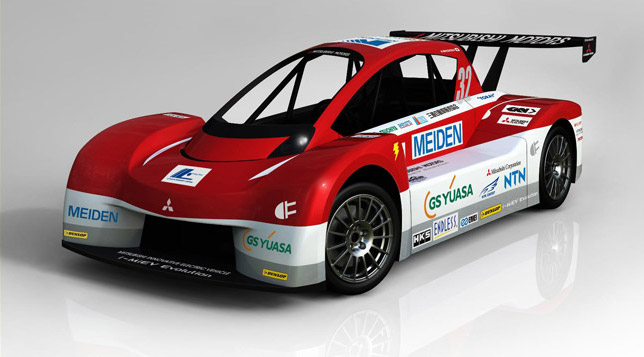
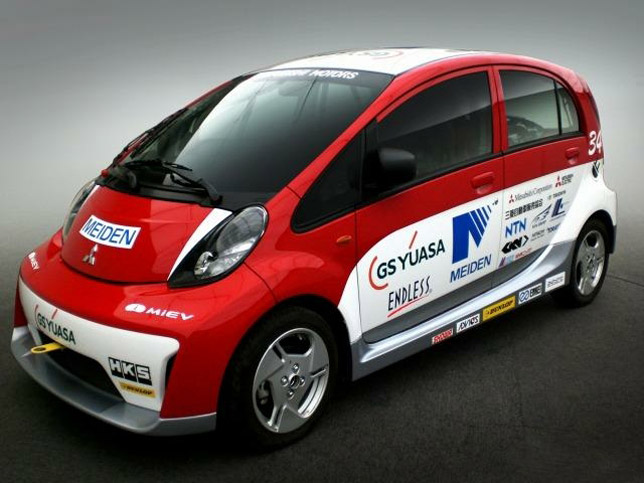
Mitsubishi i-MiEV Evolution and Mitsubishi i all electric vehicle are going to take part in the legendary Pikes Peak International Hill Climb. These two vehicles were specially prepared for the competition. Nonetheless they will also enter a regular production.
First, the Mitsubishi i-MiEV Evolution utilizes the same motor, drive battery and other major components as the production i. Moreover, it was developed in order to showcase Mitsubishi’s advanced EV control and EV component technologies.
It has a racing-specific body which uses a tube-frame chassis and a carbon fiber cowl. Other features of the vehicle also have a reduced weight. The goal here of course is to lessen the overall mass of the car and to improve aerodynamic performance.
More importantly, this car comprises of one motor which drives the front wheels and two – driving the rear wheels. Hence, the EV’s four-wheel-drive system ensures great motive performance and handling.
Mitsubishi will also put in practice their technical knowledge in the development of future EV models with the aim of superior durability and reliability.
Mitsubishi i-MiEV Evolution
Mitsubishi i-MiEV Evolution Specifications
L x W x H (mm)
4341 x 1900 x 1339
Occupants
1
Drivetrain
4-wheel drive
Motors
Number
3 (1 front, 2 rear)
Max. output (kW)
240 (80 kW x 3)
Drive battery
Rated capacity (kWh)
35
Chassis
Specially-designed tube frame
Cowl
Carbon fibre
Tyres
245/40R18
Secondly, for this event the production of Mitsubishi i has been completely transformed with the help of more aerodynamic front bumper, roll bars and other safety equipment.
As promised, Toyota have unveiled the RAV4 EV. The event took place at the 26th Electric Vehicle Symposium in Los Angeles. The hopes are high as some expect it to be no less impressive than the current petrol RAV4 V6 in terms of “driving performance, dynamics and cargo capacity. That’s amibtious.
The drivetrain inside it can provide power for 160 km once every charge. After that, you find a 240V/40A charger and “brim it up” fir six hours. Pretty much all the bits underneath have been made by Tesla. It took both companies 22 months to achieve this but eventually, we end up with the “only all-electric SUV on the market”
The torquey electricity powers goes to the front wheels in two manners – Sport and Normal. While on the former, the RAV4 can go from 0 to 60 mph (96.6 km/h) in 7 seconds dead while the top speed climbs up to 160 km. A more leisurely way to drive up to the grocer’s can be the Normal mode – 0-60 mph in 8.6 seconds and 137 km/h at best.
The maximum output of power has been estimated to be 115kW @ 2,800 rpm. The heavy battery pack buried deep down inside the car benefits the center of gravity while the electric motor purrs in a very serene way. Surrisingly, the RAV4 body is also slippery – a 0.30 drag coefficient is the very best among SUV’s apparently.
In terms of body design, there are some slight deviations from the standard look of the Toyota RAV4. The front bumper, upper and lower grille, side mirrors, rear spoiler and under body shape have all been restyled in favor of aerodynamics. Sales are expected to start somewhere around during the late summer of 2012. Bob Carter, group vice president and general manager of Toyota in the United States, hopes that:
“…the RAV4 EV will attract sophisticated early technology adopters, much like the first-generation Prius,”
Scant pieces of news come forth from Toyota. An all new RAV4 EV is set to appear pretty soon. The venue intended for the debut couldn’t be more appropriate – the 26th International Electric Vehicle Symposium (EVS26) in Los Angeles. A news conference should elaborate on this fact. That would be Monday, May 7 at noon in the West Hall of the Los Angeles Convention Center.
That’s pretty much we know for now. To remind ourselves, two years ago, at the Los Angeles Auto Show, Toyota did bring out prototypes of the supposed second generation of EV RAV4s. They were developed jointly with Tesla (Tesla were responsible for the power plant and batteries). The earliest of them all had a 660-pound lithium-ion battery pack with 50 kWh capacity in total. The estimated single charge range varied from 80 to 120 miles.
Hopefully, those figures will be now even more impressive as the EV still has to win over many admirers of petrol and diesel RAV4 which are completely satisfactory on their own.
More on this topic will surely be coming next week.
Honda brand today announced that it is going to collaborate with Pacific Gas and Electric Company. They are going to launch a new pilot project that will allow communication between electric vehicles and the power grid.
The aim of this project is to show practically and test an electric vehicle’s ability to receive and respond to charge instructions based on the grid condition and the vehicle’s battery state.
In short, all these efforts will allow the customers, through the visibility into charging patterns, to more effectively manage charging during peak hours. In addition to that the companies hope that this will create consumer-friendly programs which will encourage electric vehicle adoption.
In fact, this project aims to ease the infrastructure and consumer concerns related with the mass adoption of EVs. It will do this with the addition of other layer of agility to the EV charging process. What this level of intelligence will do is to help making charging seamless for consumers. On the other hand, at the same time will ensuring that the electricity source is reliable and the infrastructure is stable.
This demonstration will be made with the help of one of the most popular EV’s – 2013 Honda Fit EV. It will collect grid and vehicle data and then create an individualized charging plan for Honda’s Fit EV battery electric vehicles.
In particular, by using the existing in-vehicle communications system in the Honda Fit EV, the electric vehicle can interact with utilities and the grid, thus creating a channel for sending and receiving utilized information that could improve grid management.
When the 2013 Honda Fit EV is plugged into a charge post, it initiates a charge request through the vehicles telematics system. This system is an integrated telecommunication application, which is mainly used for navigation.
What happens next is that this request is sent to IBM’s Electric Vehicle Enablement Platform. There the vehicle data, such as battery state and grid data received from PG&E, is collected and mixed to create an optimized charge schedule. Of course, the next step is to communicate back the processed data to the vehicle. And all this happens in several seconds.
Next, with the help of the aggregated data, the vehicle becomes able to charge to the level that is needed while factoring any current grid constraints.
2013 Honda Fit EV
What is very specific here is that the system utilizes real time and simulated data, thank to which will test and demonstrate the ability to alter, as well as to adapt charging patterns based on grid conditions.
And all this is called simply: smart charging capability. It will enable energy providers to manage the power used by EVs during peak times by instructing vehicles to regulate charging when required.
Furthermore, this new smart charging will have the ability to collate historical EV charging data, thus creating a profile, which can predict the location and duration of EV charge loads.
Through communicating the important information directly to the vehicle, the companies assume that this will crucially enhance driver services.
For instance, the IBM’s cloud based platform will be able to provide charge post location information and availability and send it directly to the vehicle, and then with the help and utilization of the telematics and Satellite-Linked Navigation it will guide the driver to the nearest place to charge.
Peugeot UK now offers their EV – iOn with lower OTR price of just £21 216 after the Government’s £5,000 Plug-in Car Grant.
The EV range will be boosted additionally by other all-electric models along with the recently introduced world’s first diesel-electric HYbrid4. The manufacturer displays its commitment to addressing the environmental challenges facing carmakers, communities, businesses and private car owners.
Peugeot has also introduced a lot of technological solutions and services, adapted to an array of customer needs and designed to drive powerful breakthroughs in fuel efficiency and CO2 emissions.
These include the introduction of Stop & Start Systems, diesel-electric hybrids and zero-emission vehicles, enabling Peugeot to increase its leadership in the European low-carbon vehicle segment and extend its expertise to other markets.
The Peugeot iOn has also been included in the development of existing mobility solutions like ‘Mu by Peugeot’, a personalised mobility service, based on a new vision of mobility.
“2011 marked a return of EVs for Peugeot in the UK. We want to continue to develop our EV strategy as the technology becomes more accepted by consumers and the charging infrastructure continues to develop. Peugeot has been at the forefront of the EV market with iOn and this latest development is a key part in our low CO2 strategy.”, commented Phil Robson, Peugeot UK’s Fleet and Used Car Director.
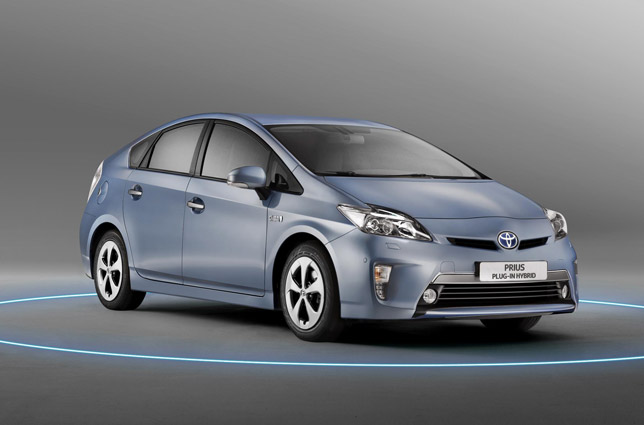
Toyota has just announced the exclusive news about the official EU CO2 emissions and economy figures for the new 2012 Toyota Prius Plug-In Hybrid and they are exceptional. The vehicle emits 49g/km of CO2 on the combined cycle and travel 134.5 miles on one gallon of petrol. These numbers makes it the most efficient Toyota on the market. The engineers in addition have improved the car’s EV driving range to 15.5 miles. This is an improvement of 24% versus the customer trial vehicle. Another thing which makes it unique is that it takes only 90 minutes to recharge the car, using a conventional plug. When the EV battery is depleted, the 2012 Toyota Prius Plug-In Hybrid automatically switches into HV mode. In this mode, the vehicle delivers CO2 emissions of 85 g/km and economy of 76.4mpg. This is an improvement on the emissions and fuel economy of the standard Prius. This leading performance helps to deliver a total driving range of 769 miles. The car continues to offer the same interior space as the standard Prius, with seating for five and 443 litres of bootspace. 2012 Toyota Prius Plug-In Hybrid will be launched in the summer of 2012.

 SsangYong e-XIV Concept is going to be officially revealed at the 2012 Paris Motor Show. This is an environmentally friendly electric car concept, named e-XIV.





 Nissan Leaf Blue Light will be used by the police in Portugal. Not only one example of the Leaf will support the local patrolmen but a whole fleet of eight units.


 Toyota TMG EV P002 is going to conquer the high altitudes of the legendary Pikes Peak International Hill Climb. More importantly, what is so specific about this racecar is that it is an electric one. This simply means that



 The
 Mitsubishi i-MiEV Evolution and Mitsubishi i all electric vehicle are going to take part in the legendary Pikes Peak International Hill Climb. These two vehicles were specially prepared for the competition. Nonetheless they will also enter a regular production.
 As



 Scant pieces of news come forth from


 Peugeot UK now offers their EV – iOn with lower OTR price of just £21 216 after the Government’s £5,000 Plug-in Car Grant.