Tag: Coupé

  • Mercedes-Benz GLC Coupe

    Stylish design and dynamic driving performance: the new GLC Coupe comes into its own. As the sporty sibling of the GLC SUV, it rounds off the best-selling Mercedes-Benz model range. The first impression, before the GLC Coupe even starts, embodies elegance, dynamism and off-road adventure. Striking proportions, dramatic surfaces and precisely shaped edges define the distinctive design, complemented by a high quality interior. The 2024 Mercedes-Benz GLC Coupe will arrive in U.S. dealerships later in 2023.

    The new GLC Coupe combines sporty performance with high efficiency. It is available as a mild hybrid with 48-volt technology and an integrated starter-generator for an extra boost and energy recuperation. And the new GLC Coupe is at home on almost any terrain. Whether on- or off-road, it impresses with its comfort and agility thanks to standard sport suspension. Off-road, the Coupe benefits from numerous features such as 4MATIC all-wheel drive. The off-road screen and the “transparent hood” as an element of the standard Surround View 360-degree camera further enhance the driving experience.

    The high standards of the new GLC Coupe are evident in every detail. The hardware and software of the latest generation of the MBUX (Mercedes-Benz User Experience) infotainment system are even more intuitive.

    Brilliant images in the 12.3-inch driver display and 11.9-inch central display make it easy to control vehicle and comfort functions. The two LCD screens present clear and structured information. The full-screen navigation gives the driver the best possible route guidance. MBUX Augmented Video for navigation is available as an option. A camera registers the surroundings in front of the vehicle. The central display shows the moving images and also superimposes virtual objects, information and markers. These include traffic signs, directional arrows, lane-change recommendations and addresses. This makes navigation much easier, especially in city environments.

    The “Hey Mercedes” intuitive voice assistant is increasingly effective in responding to natural language and user preferences. Music streaming services can be seamlessly integrated into MBUX, including personal settings1, allowing customers to enjoy a personalized music experience in the vehicle.

    The design: Sensual purity, intelligence and emotion

    The defining feature of the new GLC Coupe is its sporty silhouette. It is immediately recognizable as a member of the Mercedes-Benz SUV family. Accentuating the width of the vehicle is the seamless transition from the headlights to the radiator grille. The Mercedes-Benz pattern is standard on the radiator grille cover.

    The dramatic surfaces continue to define the exterior design, which is enhanced with precisely shaped edges that accentuate the proportions and the muscular wheel arches. They also strike a balance between elegance and power. The AMG Line package is fitted standard on the new GLC Coupe and features 19-inch or optional 20-inch wheels, as well as wheel arch liners in body color. Customers can also personalize the vehicle”s exterior with the available Night package and running boards. Accentuating the width of the vehicle are the two-part tail lights with black and dark red connecting elements, closed off below by the simulated chrome underguard.

    The interior: Modern and sporty

    The interior of the new GLC Coupe is equipped with the sporty AMG Line as standard, and showcases a dashboard that is clearly structured. The upper section has a wing-like profile with new, flattened vent outlets. The lower section has a generous trim area that flows seamlessly into the curved center console. The 12.3-inch high-resolution driver display appears to float freely above the wing profile and trim surface. The 11.9-inch central display rises from the center console and likewise appears to float above the trim surface. Like the dashboard, the screen surface is slightly angled towards the driver.

    The modern, reductive design of the door panels frames both ends of the dashboard. The door center panel with integrated armrest transitions from a vertical to a horizontal surface. Reflecting the design of the center console, the front section takes the form of a metallic high-tech element. It can be used as a grab or closing handle and houses the power window controls. A new feature is the floating control cluster, into which the door opener and seat adjustment controls are integrated.

    The seat design in the new GLC Coupe plays with layers and contoured surfaces, lending them visual lightness. The head restraints and their connection to the backrest with an enclosed cover is redesigned. The interior now also features a standard leather-lined dashboard with Nappa-look. Available trim elements include elegant interpretations of open-pore wood veneers in Natural Grain Walnut, Fineline Anthracite and Natural Grain Black with Aluminum inlays.

    Dimensional concept and practical details for day-to-day operating convenience

    The dimensions underscore the dynamic and muscular look of the new GLC Coupe. With a length of 187.5 inches (4,763 mm), it is 1.2 inches (31 mm) longer and 0.2 inches (5 mm) higher than its predecessor. The track widths are larger, by 0.2 inches (6 mm) at the front (now 64.1 inches / 1,627 mm) and 0.9 inches (23 mm) at the rear (now 64.6 inches / 1,640 mm). The longer vehicle length benefits the wheelbase and the front and rear overhangs. The width has remained the same at 74.4 inches (1,890 mm).

    With even more trunk space than before, the GLC Coupe is ready for road trips. The new model features 19.2 cu ft of trunk space behind the second row seats (1.6 cu ft more than the preceding model) and 52.6 cu ft of trunk space with the second row seats folded down (an increase of 3.1 cu ft from the preceding model). The standard EASY-PACK tailgate opens or closes conveniently at the touch of a button using the ignition key, the switch in the driver”s door or the unlocking handle on the tailgate.

    Significantly improved aerodynamics

    In its aerodynamically most favorable configuration, the minimal drag coefficient of the new GLC Coupe is as low as Cd = 0.27. This makes it three hundredths better than its predecessor (Cd = 0.30). The developers optimized the vehicle with respect to aerodynamic drag and wind noise with the help of extensive digital flow simulations (CFD – computational fluid dynamics) as well as tests in the aeroacoustic wind tunnel.

    The new GLC Coupe is a pleasantly quiet vehicle with a serene sound signature and low rolling and wind noise. This is achieved with acoustic optimization of the bodyshell and sophisticated sound insulation. An acoustic membrane in the windshield is standard equipment. Heat and noise insulating glass, included in the optional Pinnacle Line package, meets even higher comfort expectations.

    A panoramic sunroof is fitted standard, offering a significantly increased opening area – 2.4 inches longer than its predecessor. If necessary, the sunroof can be covered with the standard roller blind.

    Significant upgrades to standard equipment

    The standard equipment of the new GLC Coupe now includes the AMG Line package, among a broad range of other new features. This includes large displays, the latest MBUX infotainment system, inductive wireless smartphone charging, heated seats for drivers and passengers, and Burmester® 3D Surround System with Sound Personalization and Music Streaming. In addition, the package logic has been considerably simplified. Features frequently combined by customers in the past are now offered as packages. Where design options such as paint finish, upholstery, trim and wheels are concerned, customers can configure their vehicles individually as before.

    Engine: Systematically electrified

    The new GLC Coupe is available as a mild hybrid with a second-generation integrated starter-generator (ISG) and 48-volt on-board electrical system. The integrated starter-generator supports the combustion engine especially at low engine speeds and complemented by the turbocharger, delivers outstanding power. The 48- volt on-board electrical system supports hybrid functions such as coasting, boost and energy recovery, for increased efficiency. The engine also starts quickly and comfortably with the help of the ISG, with the start/stop function barely perceptible to the driver.

    Suspension: Agility and safety

    The dynamically designed suspension system of the new GLC Coupe is based on a new four-link front suspension and a multi-link independent rear suspension mounted to a subframe. The standard sport suspension and variable steering ratio also contribute to the vehicle”s agile handling.

    Assistance systems: Comfort and safety

    The latest generation of the Driver”s Assistance2 package contains additional and improved functions and is available as an option. These reduce driver workload in day-to-day situations for more comfortable and safer driving and are able to respond to impending collisions as the situation demands. For example, the Active Distance Assist DISTRONIC can maintain a pre-set distance to vehicles ahead on all road types. The current speed limit can be selected as the speed setting at the push of a button. The Active Brake Assist uses the sensors installed in the vehicle to detect imminent collisions with crossing or oncoming traffic or rear-end collisions. When a dangerous situation is detected, the system can issue an acoustic and visual alert. If the driver fails to brake hard enough, it can also assist by appropriately increasing the braking force or initiating an emergency stop. One of the new features of Active Steering Assist is lane detection with an additional 360-degree camera, which offers advantages especially at low speeds. The stop sign and red traffic light warning functions of the Traffic Sign Assist are new.

    Sophisticated parking systems for support during slow maneuvers

    Thanks to more powerful environment sensors, the parking systems can better support drivers when maneuvering. The integration of the sensors into MBUX makes operation more intuitive and provides support through the central display. Emergency braking functions also serve to protect other road users for improved road safety.

    The Surround View system with 360-degree camera is available as standard. It also includes the “transparent hood” and Active Parking Assist functions with PARKTRONIC. The all-round visibility and parking assistance make it easier to maneuver during the parking process. The central display clearly shows the immediate surroundings. Four cameras (front, rear, both sides) provide the images, which are combined in a virtual bird”s-eye view. In addition, the display shows different viewing angles such as front or rear. The driver decides whether to use the displays to park the vehicle or to let the Active Parking Assist take control.

    DIGITAL LIGHT: extremely bright with optional projection functions

    The new GLC Coupe has LED High Performance headlamps as standard. DIGITAL LIGHT with projections is available as an optional extra. This technology uses a matrix of LEDs in the headlight unit that can be individually controlled to deliver a targeted and dynamic distribution and control of light in response to conditions. The result is excellent visibility for the driver without impairing that of other road users. The projections function offers extra safety for the driver by projecting guiding lines, symbols and animations and allows communication with other road users.

    Off-road with the GLC Coupe

    The new GLC Coupe is also suitable for off-road driving and has several new features and systems designed for use off-road. Standard equipment includes an off-road driving mode and DSR (Downhill Speed Regulation).

    In off-road mode, the GLC Coupe with the standard Surround View offers a “transparent hood.” The central display shows a virtual view under the front of the vehicle, including the front wheels and their steering position. This enables the driver to recognize obstacles in their path such as large rocks or deep potholes sooner and more easily.

    The off-road screen mode uses the two displays for clear presentation of information, controls and key functions for off-road conditions. Among other things, the driver display shows inclination, gradient, topographical altitude, geo-coordinates and a compass, as well as vehicle speed and engine speed. The central display shows the vehicle”s current position on the terrain as well as the steering angle of the front wheels. All the driving functions relevant for off-road operation can be controlled easily on one screen.

    High level of passive safety

    When it comes to crash safety, the new GLC Coupe meets the stringent Mercedes safety standards.

    Together with the familiar PRE-SAFE® protection concepts for frontal and rear impacts, the PRE-SAFE® Impulse Side function forms a virtual crumple zone around the vehicle. It is optionally available with Driver”s Assistance package. As only a limited crumple zone is available in the case of a side impact, it pushes the affected driver or front-seat passenger towards the middle of the vehicle and away from the acute danger zone when the system detects a side collision is immediately imminent. To accomplish this, the system inflates air chambers in the side bolsters of the front-seat backrests in a fraction of a second.

    All in all, the safety concept of the GLC Coupe is based on an intelligently designed body with a particularly rigid passenger cell, selectively deformable crash structures and situational interaction between the seat belts, belt tensioners and airbag systems. In addition to legal requirements, the vehicle also fulfils internal Mercedes-Benz test requirements and test criteria derived from real accidents.

    The occupants are particularly well-protected by the vehicle structure in the event of a crash. The bodyshell concept incorporates all areas – front structure, passenger cell, side walls and floor assembly. All structural elements and body parts are designed to withstand stresses through the material mix and appropriate wall thicknesses. The overall concept leads to homogeneous load distributions and high energy absorption with moderate deceleration acting on the occupants. In addition, sufficient protective space is provided for them.

    At a glance

    GLC 300
    4MATIC Coupe
    Displacement cc 1,999
    Rated output hp 255
    at rpm 5,800
    Add. output (boost) hp 23
    Rated torque lb-ft 295
    Add. torque (boost) Nm 148
    Acceleration 0-60 mph s 6.2 (est.)
    Top speed mph 130
  • Hennessey Venom F5 Revolution Coupe

    Hennessey, the Texas-based hypercar manufacturer, and high-performance vehicle creator, has unveiled a new, lighter-weight, track-focused version of the Hennessey Venom F5 that has been comprehensively re-engineered for increased agility, uncompromised handling, and high downforce. The new Venom F5 Revolution Coupe is an apex predator on a racing circuit – it is the most powerful and visceral pure-combustion hypercar in the world.

    The Venom F5 Revolution Coupe is based on the Hennessey Venom F5 Coupe – the two share nearly identical DNA – yet distinguishing the Revolution Coupe from its sibling are its comprehensively reworked aerodynamics, suspension, engine cooling, and digital telemetry. The engineering team also focused on reducing mass. Thanks to a systematic focus on weight reduction, the race-honed model tips the scales below 3,000 pounds – it is the lightest Venom F5 model.

    Honed by Chief Engineer John ‘Heinrocket’ Heinricy, the Revolution capitalizes on every bit of his 38 years of performance car development with GM and his exemplary racing career – Heinricy has more than 240 professional races under his belt, including 35 grueling 24-hour races and multiple race/championship wins (he also holds three FIA Speed Records and has over 1,000 laps of the Nürburgring to his name).

    John ‘Heinrocket’ Heinricy, chief engineer: “I led engineering on some of the most extreme cars to come out of GM, including the Corvette Z06 and Cadillac CTS-V, but nothing compares to designing, developing, and refining a race car for the road like the Venom F5 Revolution. From the outset, we designed the Venom F5 hypercar to be ultra-light and monstrously powerful, with dynamics to match. So, taking these ingredients and adding track-focused aerodynamics, suspension, and gearing, enabled us to create a machine that is the ultimate visceral and emotional driving experience.”

    Mirroring all other Venom F5 models, mid-mounted in the carbon-fiber monocoque chassis is Hennessey’s celebrated twin-turbocharged, 6.6-liter, ‘Fury’ V8 engine rated at an astonishing 1,817 bhp. Power is sent to the rear wheels through a robust automated single-clutch gearbox calibrated for competitive use. With such low mass, the Venom F5 Revolution Coupe promises phenomenal acceleration. Carbon-ceramic brakes are fitted as standard and feature muti-piston calipers, ensuring fade-free stopping power on the road or circuit.

    Most visible to passers-by is the Revolution Coupe’s full-width rear-mounted carbon fiber wing. The adjustable appendage (that allows the owner to adjust the angle of attack through a range of degrees) is fitted with end plates that stop the high-pressure air on top of the wing from spilling underneath – increasing downforce without extending the width of the wing. The end plates also generate vortexes that guide airflow and improve aerodynamics and stability. As a result, the rear wing delivers more than 800 pounds of downforce at 186 mph (300 km/h) and over 1,400 pounds of downforce at 249 mph (400 km/h).

    A significantly larger front splitter, crafted from carbon fiber, complements the rear-mounted wing and rear diffuser. The front splitter prevents air from flowing under the F5 Revolution Coupe, which creates a low-pressure vortex beneath the vehicle (aiding downforce). At the same time, the extended rear diffuser guides air out from the hypercar’s smooth underbelly. Dive planes, positioned on the front fascia in front of the wheels, aggressively channel airflow to shift the aerodynamic balance forward – adding grip to improve turn-in. In addition, the Revolution features a new roof-mounted central air scoop that delivers fresh cool air to the F5’s engine bay, which effectively helps lower component temperatures.

    The double-wishbone suspension, with more aggressive alignment settings, is fitted with adjustable dampers that may be calibrated trackside with simple tools – thus optimizing the suspension system for the particular road course, racing circuit, or track. In addition, new forged alloy wheels present a larger contact patch for improved cornering grip and enhanced braking. Lastly, Venom F5 Revolution owners are offered a digital on-board track telemetry system capable of measuring an array of data points. These include lap times, splits, cornering G-forces, and more. The system allows the driver to monitor the telemetry in real time, or the data may be saved for later analysis or archiving.

    John Hennessey, company founder and CEO: “The new Venom F5 Revolution Coupe combines our outstanding 1,817 bhp V8 ‘Fury’ combustion engine with our lightest and most capable chassis. The hypercar, which is astoundingly fast, is at home on a racing circuit where utmost handling is paramount – it offers the nimbleness of a fighter jet, yet with a powerplant like a Saturn V rocket!”

    The Revolution Coupe is the third model to join the Venom F5 family. Each of the 1,817 bhp variants shares the same decathlete mission – uncompromised acceleration, braking, and handling – yet all have been individually engineered for a specific mission. The F5 Coupe targets ultimate top speed, while the open-roof F5 Roadster delivers the most visceral experience. The new F5 Revolution Coupe dials track performance to an entirely new level.

    The new Venom F5 Revolution Coupe will make its global debut at the Miami Motorcar Cavalcade Concours d’Elegance on January 15, 2023. Priced at $2.7 million and limited to just 24 units, exclusivity is a given in advance of the official release, many of the Revolution models have already been sold to passionate hypercar fans.

  • Hyundai and Giorgetto Giugiaro to Rebuild 1974 Pony Coupe Concept

    1974 Pony Coupe Concept - Front Angle

    Hyundai Motor Company will collaborate with the Italian design firm GFG Style to recreate the 1974 Pony Coupe Concept. The concept was originally created by Giorgetto Giugiaro for Hyundai’s debut at the 1974 Turin Motor Show. The rebuild project will involve both Giorgetto and his son Fabrizio Giugiaro. The new concept will be unveiled in the springtime. Hyundai announced the project during a Design Talk in Seoul, which featured Giorgetto and Fabrizio Giugiaro, as well as Luc Donckerwolke, the Chief Creative Officer of Hyundai Motor Group, and SangYup Lee, the Executive Vice President and Head of Hyundai Motor’s Global Design Center.

    “We are absolutely thrilled to welcome Giorgetto and Fabrizio to Seoul for this rare occasion and we look forward to collaborating with them and GFG Style on this extraordinary design project,” said CCO Donckerwolke. “Not only does this project hold historical value, but it also represents a cross-cultural exchange that could pave the way for more collaborations down the road.”

    “The original Pony and Pony Coupe Concept were one of those rare creations that influenced the designs of not just one but multiple production and concept vehicles, including our award-winning IONIQ 5 and attention-grabbing N Vision 74,” said EVP SangYup Lee. “Since the original concept car no longer exists, we’ve commissioned Giorgetto Giugiaro to rebuild it based on our design philosophy, ‘Shaping the future with legacy.’”

    In 1974, Hyundai Motor approached Giorgetto Giugiaro to design their first independent model and Korea’s first mass-produced car. Since there was no vehicle design capability in Korea at the time, Giugiaro was commissioned to design, make blueprints and build five prototypes, including a coupe. During the design process, Hyundai decided to showcase the Pony and Pony Coupe at the Turin Motor Show to introduce the brand to the global market.

    The Pony Coupe featured a distinctive wedge-style nose, circular headlamps, and geometric lines. It was originally designed for North American and European markets but the project was halted in 1981 due to adverse global economic conditions, preventing mass production.

    Although the concept was never fully realized, its pioneering spirit helped to jumpstart the Korean automotive industry by influencing Hyundai’s first independent production models under the Pony nameplate. These models were manufactured from 1975 to 1990 and sold globally. The Pony Coupe Concept is still an important part of Hyundai’s legacy and a testament to the vision of its Founding Chairman, Ju-Yong Chung.

    Chung, the founder of Hyundai, played a crucial role in paving the way for Korea’s automotive industry with the Pony Coupe Concept and subsequent Pony lineup. His positive mindset, bold leadership, firm belief, and tireless diligence helped Korea transition from the hardship of war to become an economic powerhouse by the late 20th century.

    1974 Pony Coupe Concept - Side

    The Pony Coupe Concept was a significant source of inspiration for Giugiaro’s work on the DeLorean DMC 12, which became famous for its appearance in the ‘Back to the Future’ movies in the 1980s and 1990s.

    The impact of the Pony and Pony Coupe Concept can still be seen today. In 2019, Hyundai Motor drew inspiration from the original Pony for the ’45’ concept car, which later influenced the IONIQ 5 that debuted two years later. Additionally, in 2021, Hyundai created a restomod electric vehicle concept that reimagined the original Pony production car. In 2022, Hyundai paid homage to the coupe concept again with its N Vision 74 hydrogen-hybrid ‘rolling lab’ development vehicle, which was well-received by the public.

    Giugiaro, the original designer of the Pony Coupe Concept, expressed his pride in being tasked with creating a vehicle for Hyundai when he was a young designer just starting his career. He felt honored to be given the opportunity to design a car for a company and country that was about to enter a fiercely competitive global market. Now, he is deeply honored that Hyundai has asked him to rebuild the Pony Coupe Concept for posterity and to celebrate the brand’s heritage.

    1974 Pony Coupe Concept - Exterior Sketch

  • Audi R8 Coupe V10 GT RWD

    12 years after the premiere of the first Audi R8 GT, Audi Sport GmbH is launching the second edition of this exclusive super sports car: the new Audi R8 Coupé V10 GT RWD. The 5.2-litre, naturally-aspirated V10 engine’s output is boosted to 620PS (Combined fuel consumption in l/100 km**: 15.0 (18.8 UK mpg); combined CO2 emissions in g/km: 340), making it the most powerful rear-wheel drive unit in the history of the brand. A new seven-speed dual-clutch transmission for faster shifts and the new Torque Rear driving mode allows drivers to choose their own level of ESC support. This enables controlled and simultaneously precise oversteering. The seven-stage torque rear can be adjusted via the control satellite on the steering wheel. The new R8 GT is limited to 333 units worldwide with just 15 allocated for the UK market – pricing is to be confirmed. New and exclusive exterior and interior features pay homage to the first generation of the R8 GT such as sequential numbering, special light alloy wheels, and an interior in a combination of black and red.

    The R8 GT Says Goodbye to the V10 Engine

    Compared with the R8 V10 performance RWD with 570PS, which forms the basis for the second edition of the R8 GT, Audi Sport GmbH is increasing the performance of the special model to bring it up to the same level as the quattro model. Specifically, this means: 620PS from 10 cylinders, 5.2 litres of displacement, and 565Nm, available from 6,400 until 7,000rpm (max: 8,700 rpm). As a result, the new R8 GT accelerates from 0-62mph in 3.4 seconds, covers 0-124mph in 10.1 seconds, and reaches a top speed of up to 199mph.

    Another decisive difference: a new seven-speed dual-clutch transmission with even faster shift times. Thanks to an altered gear ratio and the associated higher speed, the new gearbox allows even more impressive acceleration in all gears. On top of that, there’s an exclusive design feature for the R8 GT: the intake manifold is painted in black.

    New Torque Rear Drive Mode

    For the first time, Audi Sport GmbH, which manufactures the new R8 GT largely by hand at Böllinger Höfe, is offering Torque Rear mode. Slippage is controlled on the rear axle by the traction control system (ASR). It is part of the ESC. Seven characteristic curves are stored in the ASR, offering different levels of support. Level one allows little slippage, while level seven allows a lot of slippage. The desired torque rear level can be set by turning the control satellite on the steering wheel. This function also enables a different adaptation as driving skills and road conditions develop. Depending on how that progresses and taking into account information from wheel speed sensors, steering angle, accelerator pedal position, and the selected gear, the engine control unit measures engine power on the rear axle.

    Less Is More

    Compared with the R8 Coupé V10 performance RWD, various measures resulted in a weight reduction of around 20kg to a total of 1,570kg (without driver). The exclusive 20-inch, 10-spoke wheels, which can be combined with high-performance Michelin Sport Cup 2 tires, designed for road and racetrack use, play a key role in reducing weight. The lightweight forged wheels are based on Audi’s motorsport vehicles. The extremely powerful ceramic braking system, which is standard equipment in the R8 GT, saves additional weight.

    In addition, there are R8 bucket seats and the performance sports suspension with the CFRP anti-roll bar. The front anti-roll bar is made from carbon fiber reinforced plastic. Together with the two coupling rod connections made of red anodized aluminium (which protects against corrosion), it reduces weight and increases road-holding and cornering dynamics. Even sportier R8 GT coilover suspension is available as an option. This allows you to individually adjust the trim position and the compression and rebound levels for your R8 GT. On delivery, R8 GT customers receive adjustment instructions and the corresponding tools.

    A Look to Fit Its Status

    To differentiate the new Audi R8 V10 GT RWD from its relatives, the special model is equipped with exclusive add-on parts. The first distinguishing feature is the black “R8 GT” lettering on the rear. All other emblems are in black. With the Carbon Aerokit in high gloss Black, which was developed in the wind tunnel, the package generates better stability on the road, and therefore also faster cornering speeds. In all, the Carbon Aerokit consists of the following attachments: front splitter, flics, side skirt covers, cW-elements on the sides of the rear bumper, a diffuser, and a rear wing with gooseneck suspension. This insert ensures optimum wing underflow and thus improves aerodynamic efficiency.

    A carbon fibre engine cover and side blade, and door mirror housings in carbon high gloss will be further standard features on UK R8 GTs. Additional spec also includes the B&O sound system, an Alcantara diamond headlining and dark tinted laser headlamps.

    In the style of its predecessor, the new R8 GT comes in matte Suzuka Gray. Alternatively, Tango Red Metallic, Mythos Black Metallic and Daytona Gray Metallic are available.

    In the interior, Audi Sport GmbH continues its homage to the first R8 GT from 2010. The interior is crafted in a combination of black and red. This includes red belts – only available in the R8 GT from 12 years ago. The floor mats and the R8 bucket seats feature the lettering of the special model in black and red. One highlight: Customers can find the sequential numbering of their R8 GT in the middle of the selector lever, partially matted in the carbon inlay

  • Audi TT RS Coupe Iconic Edition

    Exclusive and performance-focused: the market launch of the Audi TT RS Coupé iconic edition, limited to 100 units in Europe with 11 examples bound for the UK, will celebrate the success story of a quarter-century for the Audi TT Coupé. This iconic sports car has been an inspiration the world over since its premiere in 1998 due to its pure driving dynamics and timeless design. The limited-edition Audi TT RS Coupé iconic edition stands out with its legendary five-cylinder performance combined with sporty design elements, both in the exterior and interior. In the UK, the Audi TT RS Coupé iconic edition will be priced from £87,650 (OTR), with customer deliveries beginning in the first quarter of 2023.

    Timeless through time: the TT has been Audi’s design icon for almost a quarter of a century. Now the Audi TT RS Coupé iconic edition is continuing the trend into the future – a sports car with new innovations whilst retaining the typical TT RS properties: design and dynamics.

    “The name of the Audi TT RS Coupé iconic edition says it all,” says Sebastian Grams, Managing Director of Audi Sport GmbH. “The edition model is reminiscent of the iconic TT design language, which at the same time stands for courage and elegance in uncompromising form. Thanks to the exclusive exterior and interior highlights, the much-loved performance of our ultimate sports coupé, with its multiple award-winning five-cylinder engine, is not only palpable, but also visible to fans.”

    Inspired by the Bauhaus: the TT Coupe

    With a vision of ‘a car for enthusiasts’, Audi presented the Audi TT Coupé as a sports car study at the IAA in Frankfurt in the Autumn of 1995. Almost symmetrical, the Audi TT consistently followed a design principle based on geometric, circular shapes. Three years later, the coupé went into production almost unchanged. One year after the TT Coupé, Audi launched the TT Roadster. In its second model generation, the Coupé was enhanced with an S and RS variant.

    “The TT was inspired by the Bauhaus and its universal design philosophy of ‘less is more,’” says Head of Audi Design Marc Lichte. “The maximum reduction – the omission of everything unnecessary and insignificant – was so radical and so courageous that the TT, in its simplicity, quickly achieved the highest attribute of good design: to be timeless. Once you’ve achieved that, you’re beyond trends and yet you’re never out of fashion – simply because good style doesn’t wear out.”

    This is why – three TT generations and a quarter of a century later – the typical lines of the 1998 coupé can still be found in the current TT RS Coupé iconic edition. The edition model also remains true to the idea of reduction to the essentials; the minimalist design extends from the clear exterior to the interior, which is still clearly and simply focused on the driver to this day. The typical tube and cylinder shapes, which blend into the interior of the instrument design, can also be found in the current Audi TT RS Coupé iconic edition – such as the standard fuel tank cap, round ventilation outlets, shift gate edging, and the striking gear knob. The enthusiasm that was declared back in 1995 continues to inspire the TT Coupé to this day.

    Setting the Right Tone: Dark Elegance on the Exterior

    The special edition Audi TT RS Coupé iconic edition confidently meets the high expectations set by its aesthetics. The RS-specific Nardo Grey finish sets the right tone for the exclusive and athletic demands of the special model. This elegant shade of grey was named after the legendary Italian race track, Pista di Nardó, where Audi RS models also rack up their first test kilometres. As one of the most popular individual finishes with customers, it ensures an optimal first impression.

    The stylish feel is further enhanced by standard Matrix LED lights and the glossy black grille with a matte black single-frame, which clearly emphasizes the quattro lettering in a matte titanium look. The RS model also confidently wears side skirts in glossy black, along with the Audi rings, the TT RS model designation on the front and rear, as well as the casings of the exterior mirrors. The unique 20-inch glossy black alloy wheels with a seven-arm design and matching black brake calipers continue the design language down to the last detail. Partially frosted rear triangular windows with the exclusive “iconic edition” lettering complete the striking dark look of the coupé right down to the rear and the standard OLED rear lights.

    Motorsports Genes: Aerokit Enhances Sporty Character

    The Audi TT RS Coupé iconic edition also gains dynamic strength from the Aerokit, developed in a wind tunnel. Inspired by motorsports, the front apron features side flics, a front splitter, and blades in the side front air intakes.

    At the rear, the fixed carbon rear wing, with its side winglets, ensures a sporty finish and, as part of the aerodynamic concept, supports both performance and efficiency.

    There are vertical design elements on both sides above the RS-specific diffuser. The two striking, oval-shaped exhaust tailpipes remain the RS signature at the rear end.

    The relationship between drag and lift was explicitly taken into account during the development of the Aerokit in the wind tunnel and is thus optimally balanced – improving both aerodynamics and driving performance. The increased contact pressure of the rear wing and rear diffuser places the sports car much more firmly on the road and significantly improves handling in fast corners.

    11 of 100: Highly Exclusive Interior Design Accents

    The interior of the TT RS Coupé iconic edition is characterized by exclusivity and attention to detail. Here, too, the dark colour scheme of the exterior remains the central motif, which is further accentuated by the deliberate use of accents from Audi-exclusive components. The RS sports seats are two-tone with fine Nappa side panels in jet grey and centre panels in black Alcantara, along with honeycomb stitching in calendula yellow. Exclusive “iconic edition” embroidery is embedded in the black Alcantara at shoulder height. The black floor mats are finished with RS embroidery in calendula yellow, whilst the door armrest and centre console are also in jet grey and decorated with contrast stitching in calendula yellow – just like the black cowl of the Audi virtual cockpit.

    Further enhancements include black Alcantara on the door panels, the RS sports Alcantara steering wheel with calendula yellow marking at 12 o’clock, and a numbered badge on the selector lever which marks each of the 100 vehicles.

    While the moody ambient light creates an atmosphere in the interior, the Bang & Olufsen Premium Sound System with 3D sound, enables a rich sound audible experience. A rear-view camera and comfort key enhance the day-to-day experience.

    Form Needs Function: Legendary Five-Cylinder Engine Brings Unparalleled Sound

    The TT RS Coupé iconic edition (combined fuel consumption in l/100 km**: – (NEDC); 9.1 (25.8 US mpg) (WLTP); combined CO2 emissions in g/km**: – (NEDC); 207 (333.1 g/mi) (WLTP)) relies on Audi Sport’s proven 2.5 TFSI engine with 400PS and maximum torque of 480 Nm. Numerous successes in motorsports make it one of Audi’s most compelling powertrains. Countless motorsports victories and strong day-to-day performance have earned the five-cylinder engine the “International Engine of the Year Award”, nine consecutive times since 2010.

    As is typical of the TT RS, its power goes via a seven-speed S tronic to the permanent all-wheel quattro drive. An electro-hydraulically controlled multi-plate clutch, which debuted in 1998 as part of the Audi TT, distributes all-wheel power freely between the front and rear axles. The Audi drive select driving dynamics system allows the driver to control the quattro drive system and other components, such as steering, seven-speed S tronic, exhaust flaps, and engine characteristics.

    The top speed of the TT RS Coupé iconic edition is increased to 174mph. This compact sports car sprints from 0-62mph in just 3.7 seconds. The engine provides a highly emotional driving experience, with its typical 1-2-4-5-3 firing order and the accompanying throaty sound. Because of the firing order, adjacent and non-adjacent cylinders fire alternately, producing a very specific rhythm and character which is emphasized by the RS Sport Exhaust system.

    In addition to the usual low weight (1,475kg TT RS Coupé), the RS sport suspension plus with adaptive dampers in the Audi magnetic ride technology, ensure excellent handling and stability. Steering feel can also be adjusted through the Audi drive select driving dynamics system.

  • Hagerty to display ultra-rare 1954 Pegaso Saoutchik Coupe at 2022 Goodwood Revival

    1954 Pegaso Saoutchik Coupe - Front

    Hagerty returns to the Goodwood Revival in style for 2022 with one of the rarest cars of the event due to be the star of the Hagerty stand.

    The stunning 1954 Pegaso was built in the old Hispano-Suiza factory and features an all-alloy 90-degree V8 with four overhead camshafts. The V8 revs to 9000rpm, and a variety of carburetion set-ups was offered from new, including a single Weber for touring, twin carburetters for amateur competition, or a race specification with four carburetters.

    The glamorous Z-102B on display is one of 18 cars bodied by Saoutchik between 1952 and 1954, a coachbuilder which had a long tradition of creating some of the most spectacular-looking automobiles. Founded by Jacques Saoutchik, a cabinet-maker turned coachbuilder, the company made its mark in the 1930s with a succession of designs for the likes of Hispano-Suiza, Mercedes-Benz and Bucciali.

    The Hagerty display car is chassis 0146, originally shown at the 1954 Paris Salon in the Grand Palais, where it was purchased by Jean-Claude Lamy. Lamy subsequently entered the car into several competitions including the ’54 Rallye PanArmoricaine and the Rallye Sablé-Solesmes. Later, the Saoutchik coupe found its way to America, eventually being sold to Bill Harrah, who added the Pegaso to his ever-growing collection in Reno, Nevada. Harrah kept the highly original Z-102B in his 1450-car museum until his death in 1978. Then, the Pegaso was acquired by Ralph Engelstad for the Imperial Palace Auto Collection in Las Vegas. In February 2019, 65 years after its debut in the Grand Palais, the Saoutchik coupe returned to Paris to appear at the Rétromobile event.

    In addition to the wonderful Pegaso, the Hagerty stand, situated ‘over the road’ at the 2022 Goodwood Revival Meeting, will also feature a Hagerty lounge and bar, a racing simulator and members of the Hagerty team available to offer advice and guidance on their range of specialist insurance and membership products.

    Mark Roper, Hagerty International Managing Director, said, “What a privilege it is to be custodians of such a rare and beautiful car for the duration of the 2022 Goodwood Revival. Not only will our stand offer a relaxed environment for guests to explore our enthusiast-led products and services, but it will also provide a rare opportunity to see the Pegaso Saoutchik Coupe up close, where every detail can be savoured. I look forward to welcoming guests to our stand throughout the Revival weekend and presenting this special car.”

    Pegaso Saoutchik Coupe (1954) 1954 Pegaso Saoutchik Coupe - Side 1954 Pegaso Saoutchik Coupe - Engine 1954 Pegaso Saoutchik Coupe 1954 Pegaso Saoutchik Coupe - Wheels / Rims 1954 Pegaso Saoutchik Coupe - Interior

  • Genesis X Speedium Coupe at EV-focused event

    2022 Genesis X Speedium Coupe Concept - Front Angle

    Today, Genesis premiered the Genesis X Speedium Coupe at Genesis House New York, a cultural space in Manhattan’s Meatpacking District. The concept car incorporates Genesis’ DNA, while looking ahead to the next wave of EVs and highlighting Genesis’ future as a luxury electric vehicle brand.

    The brand also announced plans for U.S. production of its upcoming Electrified GV70 SUV at its manufacturing facility in Montgomery, Ala. Production is set to start in December.

    In a series of electrification-focused announcements, the brand also revealed its GV60 Priority One program for U.S. consumers.

    Envisioning a new styling convention for the future

    The Genesis X Speedium Coupe was born out of a “freestyle” design exercise based on the Genesis X Concept.  Luc Donckerwolke, Genesis Chief Creative Officer and 2022 World Car Person of the Year led the initiative. It embodies the timeless Genesis’ design philosophy, Athletic Elegance, in an even more progressive way.

    The name Speedium was inspired by the Korean racetrack in the city of Inje and the passion for motorsport it inspired in Genesis designers. The name also encapsulates Genesis’ belief that the emotional value of driving will remain strong in the era of electrification. The addition of the word “coupe” further accentuates the enjoyment of driving through aesthetic designs.

    Genesis followed the principle of reductive design, or “less is more,” for the concept car. The Genesis X Speedium Coupe stands out for its restrained elegance, clean lines, and subtle curves.

    The model challenges the status quo of a defined car type. It is not a conventional concept car that previews plans for the production lineup.

    “This car is an open-door moment in Genesis’ journey towards our future EV design,” said Luc Donckerwolke, chief creative officer of Genesis. “This isn’t a show car — it’s a look into our design processes as we explore ideas for the next wave of EVs, one that incorporates Genesis’ DNA.”

    On the front of the vehicle, Genesis’ signature Two Lines lamps have evolved into a full-width element that encompasses the shape of the crest resembling the Genesis Crest Grille. It was designed to carry the brand signature of the wing face for the electrification era by integrating the daytime running lamps with the low beam and high beam together. It carries an EV face that symbolizes Genesis’ transformation towards becoming an all-electric car brand with a six-model lineup by 2030.

    From an overhead perspective, the hourglass silhouette highlights the car’s passion and character. The curvaceous and sensuous form accentuates the wheel arches creating muscular presence.

    Viewed from the side, the Parabolic Line extending from the front to the rear of the car maintains a certain tension in the design as a classic car would. The deliberate “anti-wedge” design culminates in a streamlined look that exudes understated elegance.

    Meanwhile, an elliptical tail balances out the look for a visually engaging tension between convex and concave surfaces in the rear. The V-shaped brake lights interrupt the circular shape by producing the striking contrast that is one of the hallmarks of a Genesis vehicle.

    “We are giving each design element space to breathe,” said Donckerwolke. “It’s not about making the design elements compete with each other, but about orchestrating the elements so that they complement and respect one another.”

    The concept’s metallic emerald green shade is referred to as “Inje Green.” As expected of a car that was inspired by a Korean racetrack, the color encompasses the mountainous landscape where the track is located, completing the image of a classic car that embodies dynamism, speed, and timeless elegance.

    Genesis Priority One

    Genesis has shown significant growth in the U.S. market, setting monthly sales records for the past 16 months. The brand recorded 11,723 sales in Q1 2022, the largest quarterly sales achievement since its foray into the U.S. market in 2016.

    Starting today, clients in select U.S. markets may enroll in Priority One, a program designed to curate a personalized purchase experience for GV60, the brand’s first dedicated electric vehicle. By visiting genesis.com and providing their contact information and $500 refundable deposit, a Genesis Concierge will simplify the process and match clients with a qualified retailer.

    “We are pleased to bring the highly-anticipated first Genesis EV to market in the U.S. with GV60,” said Claudia Marquez, chief operating officer of Genesis Motor North America. “With Genesis Priority One, we are renewing our promise to our clients to provide a purchase experience tailored to them.”

    Genesis Priority One will be available at launch in California, Connecticut, New Jersey, and New York for a limited time while quantities last.

    Production Plans for the Electrified GV70

    Genesis announced that the Electrified Genesis GV70 will be its first vehicle produced in the U.S. at its manufacturing facility in Montgomery, Ala. Production is expected to begin in December 2022 with the goal of strengthening Genesis’ EV market position in the region and continuing its commitment to electrification.

    “We are pleased to bring Genesis production to the United States for the first time,” said José Muñoz, president & CEO of Genesis Motor North America. “The GV70 SUV has won the hearts and minds of American consumers and industry experts alike. We are proud to begin offering consumers the new electrified model, built right here in America.”

    About Genesis House

    Genesis House New York opened in November 2021 as the brand’s base in the U.S. It’s more than just a showroom — it’s a cultural oasis in the heart of the city. Measuring over an acre of floorspace (over 46,000 square feet) and consisting of three floors, it carries forward the bold and innovative spirit of the brand by welcoming guests in a gracious manner that is deeply rooted in Korean culture.

    The announcements took place during a press-only event at the Cellar Stage — a basement space outfitted with floor-to-ceiling LED-lit staging and state-of-the art audio-visual technology. Genesis holds numerous events at the Cellar Stage in collaboration with artists in the local community.

    The first floor is an exhibition space where guests can experience the Genesis vehicle lineup, both existing models and concept cars that express the brand’s future vision. The architects used tessellated mirrors to beautifully set off the cars on display, and curators are on hand to provide detailed explanations. The curator service at Genesis House is provided in English, Spanish, French, Chinese, and Korean, among other languages.

    On the second floor, guests can enjoy a Korean cultural experience in the library, the Tea Pavilion, Genesis House Restaurant and the Terrace Garden.

    Genesis House Restaurant, established in collaboration with Onjium — a Michelin-starred restaurant and traditional cultural research center in Seoul — offers a creative and elegant gastronomic experience that harkens back to the Korean Noble class cuisine that took inspirations from what Joseon-era royalty once enjoyed in their palaces.

    At the event, the Genesis House Restaurant unveiled its new Spring menu, curated by Onjium.

    The 9,493-square-foot Terrace Garden, located outside on the second floor, overlooks Hudson Yards, the Hudson River, and the High Line. Reminiscent of a courtyard outside a “hanok,” or traditional Korean house, it is surrounded by low walls and an alley, serving as a cozy spot to enjoy a cup of coffee or tea.

    Building upon the success of Genesis House New York, the brand is exploring future plans to open branded cultural spaces in other regions.

    Genesis Gives

    To mark the occasion and give back to the local New York community, Genesis presented a $50,000 donation to Girls Who Code, an organization whose mission is to close the gender gap in technology and to change the image of what a programmer looks like and does. Girls Who Code is building the largest pipeline of future female engineers in the world. In nine years, they have reached more than 450,000 girls globally.

    This charitable contribution marks the continuation of Genesis Gives, a new initiative that supports STEAM (science, technology, engineering, arts, mathematics) education, sports, and athletics programming for youth. Genesis Gives has contributed more than $300,000 to causes across the United States since its launch in November 2021.

  • The Porsche 911 Classic Club Coupe

    2022 Porsche 911 Classic Club Coupe - Front Angle

    Introducing the Porsche 911 Classic Club Coupe, a one-of-one restoration project completed by Porsche Classic in collaboration with the Porsche Club of America (PCA). That this is a unique car will not surprise anyone who sees it, but a “No. 001/001” badge on the dashboard underscores its scarcity. A ducktail spoiler reminiscent of the 1972 911 Carrera RS 2.7, a double-bubble roof, 18-inch forged aluminum Fuchs wheels and unique paint combine to create a striking resemblance to the Type 997 911 Sport Classic. Those looks are only part of the story.

    “We wanted to take a different route – to base this unique project on a car less obvious – a modern classic – that would appeal to a slightly different group of enthusiasts,” said Tom Gorsuch, President of the Porsche Club of America (PCA). “The fact that the finished Porsche 911 Classic Club Coupe looks so cohesive, with the changes appearing so natural, is what’s really incredible about this challenging project.”

    Based on a 1998 911 Carrera, the chassis, brakes and engine in this sports car are both taken from the 996.2 911 GT3, the first such model homologated for sale in the U.S. Accordingly, the naturally aspirated 3.6-liter flat-six generates 381 horsepower. The donor car, which PCA Executive Director Vu Nguyen found in a state of neglect in Colombia, Virginia, traveled to the Porsche Classic workshop near the main plant in Stuttgart-Zuffenhausen where it was originally built. There, it went through a complete restoration including total disassembly, and strengthening of the body-in-white using both original and newly developed parts.

    “The Type 996 is unjustly overshadowed by the other 911 ranges. That’s why we were happy to choose it as the basis for demonstrating all the things we can do with Porsche Classic and the recently expanded Sonderwunsch program of Porsche AG,” says Alexander Fabig, Head of Individualization and Classic. “In 2009, the 911 Sport Classic, a limited series of 250, had already generated worldwide interest. However, this special model was not sold in the U.S. With this one-off, we’ve now managed to bring a similarly exciting vehicle concept to the U.S. as well.”

    Exterior

    Styling and design plans were finalized in parallel with the restoration process to keep the project on schedule. Input from the PCA and Porsche Classic in both Germany and the United States gave direction to the final car.

    Experts from Porsche Individualization, Porsche Classic, and Style Porsche drew up proposals and regularly discussed them with the PCA over the course of the project, which took a total of two and a half years to complete.

    The result was given a sneak preview at The Amelia in March. Sport Grey Metallic paint including stripes in light Sport Grey Metallic with Club Blue outlines run the length of the hood, roof and spoiler to reference the Type 997 911 Sport Classic. Accents in light Sport Grey along the sides of the car also feature “Classic Club Coupe” script with an accent line in Club Blue.

    The double-dome roof is also a detail with a motorsport connection. Tall racing drivers used to bulge the roofs to make enough headroom for wearing a helmet – the modern roof design alludes to this. The Style Porsche design concept 911 Panamericana from 1989, the Carrera GT and the 911 Sport Classic also had a roof shaped like this. Today, the double-dome roof is a classic design feature of many limited series from Porsche Exclusive Manufaktur and the 911 GT models. The fixed rear spoiler made of glass-fiber-reinforced plastic takes the shape of the legendary “ducktail” of the 911 RS 2.7 from 1972. The third brake light is built into it. The model designation “Classic Club Coupe” appears in the middle between the tail lights.

    In tandem with the roof design and spoiler – both hand-built for the project – the paint scheme creates a unique appearance rooted in Porsche heritage. In particular, the roof is a reference to the past when race drivers would dome the roof of their car to accommodate additional headroom for helmets.

    Interior

    It might seem difficult to find a more extensive example of what is possible through the Sonderwunsch program until viewing the Classic Club Coupe interior.

    Custom door sill plates call out the model name, while the interior, primarily upholstered in black leather with Slate Grey accents and a perforated Alcantara headliner. Most notably, the seat centers and door panels feature woven black and grey leather in a twill Pepita pattern. Club Blue stitching decorates much of the interior including the steering wheel and “911 Classic Club Coupe” embroidery on the headrests. That logo is also visible in the tachometer, flanked by two grey stripes and lines in Club Blue. Finally, the Classic Club Coupe is equipped with Porsche Classic Communication Management Plus, which offers modern infotainment conveniences including Apple CarPlay and Google® Android Auto as well as preparation for Sirius XM. By special request, the start screen on this model shows “Classic Club Coupe.”

    Bringing such an extensive project to life also required support from many parts of the company. The most intensive adaptation work took place on the special features of the 911 Classic Club Coupe: the double-bubble roof and the fixed rear spoiler. This meant the part of the body between the rear window and ducktail had to be handmade. The biggest challenge in the interior, on the other hand, was to match new materials with the geometry of the Type 996 interior.

    The technical modifications to the 911 Classic Club Coupe were evaluated by a team of experts from Porsche Individualization and Classic, Porsche Cars North America and the Porsche Development Center in Weissach to make sure the vehicle remained in compliance with applicable U.S. regulations.

    Vehicle dynamics validation testing also factored into the process. Standing in for the valuable one-off, a test vehicle went through extensive trial runs at test sites including Weissach in Germany, Nardò in Italy and Idiada in Spain. These included endurance runs at top speed and wind tunnel testing. However, once the verification program was completed, the test vehicle was dismantled – ensuring the final product is truly a one-off. The overall vehicle was approved after a road test by the Porsche Development Centre in Weissach.

  • BMW 2 Series Coupe [UK]

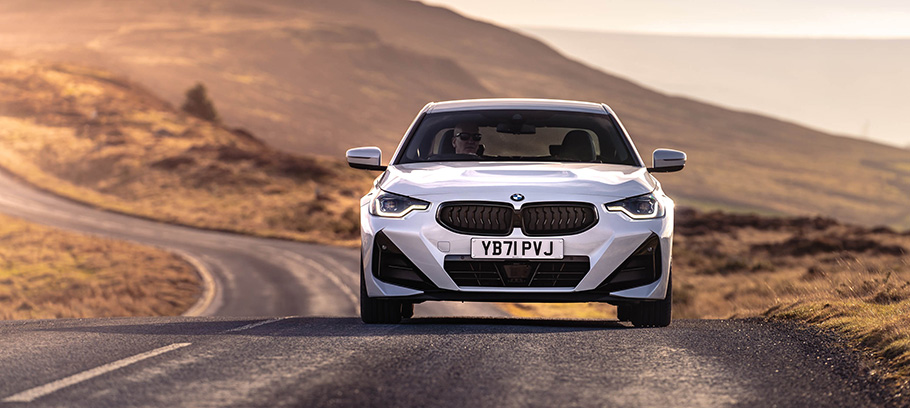
    2022 BMW 2 Series Coupe UK - Front View

    Striking looks, exceptional handling and classical rear-wheel drive will leave potential customers of the new BMW 2 Series Coupé in no doubt that this is a car to excite and inspire.

    The new generation of the two-door model incorporates the new BMW design language to highlight a fresh, youthful feel with meticulously engineered and perfectly balanced driving attributes.

    Reaffirming its sector-leading status, the BMW 2 Series Coupé boasts rear-wheel drive, a six-cylinder in-line engine option and new equipment features that combine to underscore its standout sporting characteristics.

    The advances made over the predecessor model are also reflected in a far broader range of driver assistance systems and the latest connectivity innovations.

    The standalone vehicle concept of the BMW 2 Series Coupé puts clear water between it and the BMW 1 Series models (which are based on an advanced front-wheel-drive architecture) and borrows extensively from the technology used in the BMW 3 Series and BMW 4 Series. As a result, the new BMW 2 Series Coupé occupies a defiantly niche position in both the brand’s model portfolio and among its rivals.

    The UK market launch begins in March 2022 with three model variants initially available. Topping the range is the all-wheel-drive BMW M240i xDrive Coupé, which is powered by a 374hp six-cylinder in-line engine, while customers can also choose from four-cylinder petrol and diesel versions in the standard M Sport specification.

    The new BMW 2 Series Coupé is built at the BMW Group’s San Luis Potosí plant in Mexico.

    Individual proportions, optimised aerodynamics

    The exterior dimensions provide the ideal starting point for excellent driving dynamics. A length of 4,537mm and width of 1,838mm represent increases over the predecessor model of 105mm and 64mm respectively. The new car is 28mm lower, however, with a vehicle height of 1,390mm. Its wheelbase is also 51mm longer at 2,741mm. Wider track widths of 1,575mm (an increase of 54mm) at the front axle and 1,587mm (an increase of 31mm) at the rear axle (BMW M240i xDrive Coupé: +63mm at the front, +35mm at the rear) are ideal for excellent cornering dynamics.

    The new BMW 2 Series Coupé’s boot offers load capacity of 390 litres – a 20-litre increase in primary capacity over its predecessor – and the height of the loading edge is 35mm lower.

    The concept for the new BMW 2 Series Coupé body also includes targeted measures for optimising its aerodynamics. An active air flap control system for the BMW kidney grille – adjustable through ten stages according to need – and the lower intake in the front apron, plus air curtains, flush-fitting door handles, aerodynamically optimised light-alloy wheels and an almost completely sealed underbody, serve to channel the airflow effectively. The BMW M240i xDrive Coupé also has turning vanes and splitters at the front of the underbody which deflect the air precisely as required to reduce lift.

    Intelligent lightweight design optimises rigidity and weight

    An intelligent mix of materials succeeds in minimising the weight of the new BMW 2 Series Coupé, while also enhancing the body’s rigidity and crash safety.

    As in the new BMW 4 Series Coupé, die-cast aluminium spring struts and an engine side member made from extruded aluminium profiles are deployed to save weight at the front end. Other advances over the outgoing model have been achieved through the aluminium construction of the bonnet and front side panels of the new BMW 2 Series Coupé. These measures alone account for a reduction in weight of around 9.6kg.

    A comprehensive passive safety concept maximises occupant protection and the BMW 2 Series Coupé is also equipped as standard with an active bonnet system to optimise pedestrian protection.

    Sporty, classically designed exterior with eye-catching front-end design

    The exterior design of the new BMW 2 Series Coupé instantly announces its overtly sporting nature. With powerful proportions set within the classical three-box design of bonnet, passenger compartment and boot, it truly embodies the extraordinary dynamic potential of the new 2 Series Coupé.

    Three-dimensional surfaces, triangular forms and diagonal lines are integral to the front end of the new BMW 2 Series Coupé. The low-reaching front apron, headlights positioned to the outer edges of the front end and the horizontal BMW kidney grille give the car a wide, low-slung look.

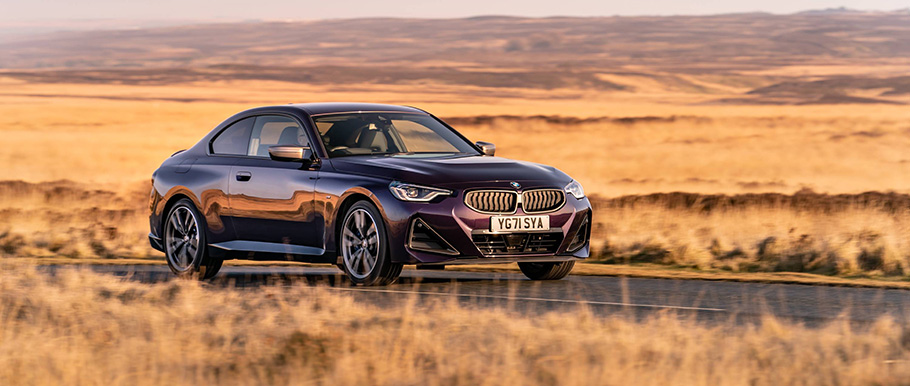
    2022 BMW2  Series Coupe M240i

    The BMW kidney grille features vertically arranged air flaps at its heart in place of the classical bars. These operate electrically and only open when the engine has an increased need for cooling air.

    Inspired by the legendary BMW 02 models, the headlight units each have a single individual circular headlight using full-LED technology for both low beam and high beam.

    A long bonnet, short overhangs and a set-back passenger compartment give the new 2 Series Coupé proportions cut from the time-honoured BMW mould. The car’s roofline, that dramatically swoops down from the B-pillar, and the short boot lid culminating in a pronounced spoiler lip, typify sporting compact BMW coupés.

    Powerful rear with striking light and shadow effects

    Horizontally pronounced surfaces give the rear end of the new BMW 2 Series Coupé its structure. They produce an interplay of light and shadow effects to accentuate the rear end and complement the darkened rear lights.

    The rear end also features a dark shadow rear apron insert, while the exhaust tailpipes on petrol-engined models come in a dual-branch arrangement. The tailpipes are circular on the BMW 220i Coupé and trapezoidal on the BMW M240i xDrive Coupé.

    Customers can choose from one non-metallic and six metallic exterior paint shades. A new addition to the range is the Thundernight metallic colour available exclusively for the sporty two-door model.

    Distinctive M accents enhance the performance-focused appearance

    Specific design features of the six-cylinder BMW M240i xDrive Coupé highlight its performance attributes. The surfaces bordering the lower air intake in the front apron display the U-shaped graphic typical of BMW M cars. A black splitter rounds off the front apron at its lowest point. The BMW kidney grille surround and side air-intake trim come in Cerium Grey, as do the M-specific exterior mirror caps, the exhaust tailpipes and the model badges. Also part of the standard specification for the BMW M240i xDrive Coupé are M High-gloss Shadow Line trim and 19‑inch M light-alloy wheels. Like the rear apron inlay, its side skirts are also in High-gloss Black. An M-specific boot-lid spoiler painted in body colour and a black diffuser between the exhaust tailpipes optimise the airflow at the rear of the car.

    The standard M Sport specification also sends a clear message about the car’s dynamic ability. It includes the powerfully structured front apron with large side air intakes, M High-gloss Shadow Line trim and 18-inch M light-alloy wheels. The side skirts and the lower section of the rear apron with integral diffuser are painted in Dark Shadow metallic.

    Interior: sports-car flair meets a premium ambience

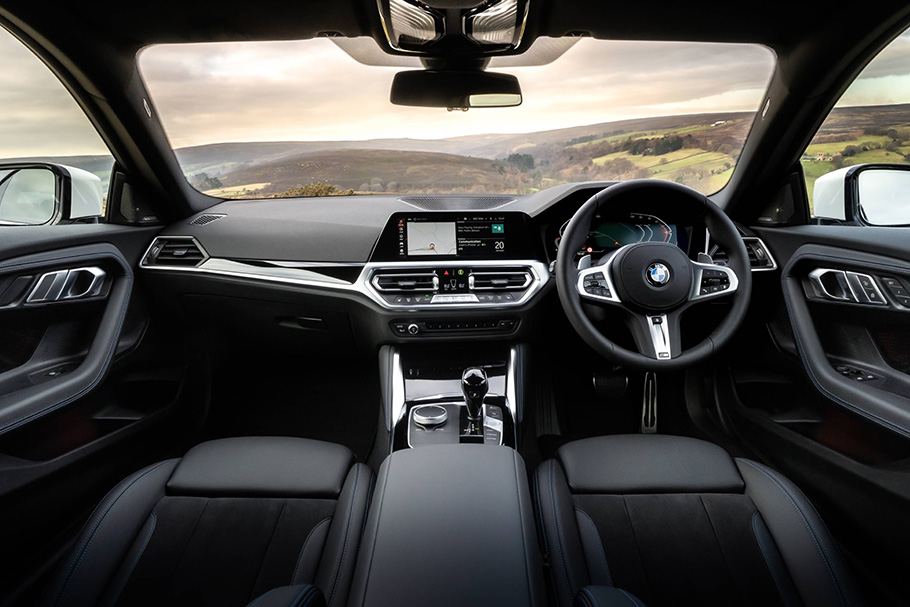
    Inside the new BMW 2 Series Coupé, the latest interpretation of the driver-focused cockpit design is defined by the ergonomically optimised arrangement and operation of the displays and controls. The BMW Controller, gear selector lever, Start/Stop button, Driving Experience Control switch and numerous other function buttons are grouped within a modern-looking control panel in the centre console. High-quality materials, precise workmanship and carefully executed details mark out the elevated quality levels of the interior.

    Standard equipment includes a Sport leather steering wheel with newly designed multifunction buttons. The standard M Sport specification come with Alcantara/Sensatec upholstery in Black with blue contrast stitching and the BMW M240i xDrive Coupé comes with Vernasca leather.

    The standard heated sport seats for the driver and front passengers of M Sport provide both excellent long-distance comfort and pronounced lateral support. Electric M Seats with integrated headrests and M seatbelts feature in the six-cylinder flagship model.

    2022 BMW 2 S0eries Coupe UK Interior

    The Easy-Entry function slides the electric front seats forward in a controlled movement when the backrests are folded, making it easier for passengers to access the rear compartment. The contours and integral headrests of the two rear seats give them a sporty look and feel.

    The combination of triangular surfaces and diagonal lines in the exterior of the car is carried over into the interior. A new design feature comes in the form of trapezoidal accent surfaces above the armrests in the doors.

    The interior trim strips on all variants come in High-gloss Black as standard. Standard equipment also includes cushioned knee pads on the centre console, an M headliner in Anthracite, door sill finishers bearing the M logo, M pedals, M floor mats and M-specific displays in the instrument cluster.

    Advanced chassis technology honed to deliver class-leading driving dynamics

    From day one, the series production development process for the new BMW 2 Series Coupé was focused squarely on leading the way in terms of dynamic performance in the premium compact segment. Compact dimensions, intelligent lightweight design for the body and chassis, almost perfect 50:50 weight distribution and optimised aerodynamics create an ideal blueprint for a vehicle character focused on sporting excellence.

    Another central element of the vehicle concept underpinning the new BMW 2 Series Coupé is power transfer to the rear wheels or – in the new BMW M240i xDrive Coupé – via intelligent all-wheel drive with a noticeable rear-wheel bias.

    In all model variants, sophisticated chassis components originally designed for the BMW 3 Series and BMW 4 Series models ensure supreme driveability at all times. While the new BMW 2 Series Coupé outstrips its predecessor in terms of performance agility, the comfort it offers remains at the same high level. When it comes to rolling comfort and acoustics, the new car has made significant improvements.

    Highlights of the chassis technology include a two-joint spring strut-front axle, five-link-rear axle, wheel bearings that are 2.7kg lighter and have 45 per cent less friction than before, lift-related dampers with bespoke characteristics, and weight-saving construction throughout.

    Adaptive M suspension spans an extremely wide spectrum between sportiness and comfort

    The adaptive M suspension available as an option for the new BMW M240i xDrive Coupé allows drivers the widest possible spread between sporty and comfort-oriented responses. Adaptive M suspension combines the characteristics of M Sport suspension with electronically controlled dampers.

    Switching between the various Driving Experience Control modes produces a clearly perceptible variation in the damping characteristics – from the well-balanced long-distance refinement of COMFORT mode through to the highly dynamic set-up activated in SPORT PLUS.

    An extra mode can be selected using the Driving Experience Control switch on models with adaptive M suspension. In the ADAPTIVE setting, the steering, damping and accelerator responses along with the transmission’s shift characteristics are automatically adjusted to suit the driving style.

    Variable sport steering is fitted as standard to all versions of the new BMW 2 Series Coupé.

    M Sport braking system with model-specific adjustments

    Powerful lightweight braking systems with a bespoke configuration also play a part in the car’s precisely controllable performance. The optional M Sport brakes (standard on the new BMW M240i xDrive Coupé) provide excellent braking performance through a specification that includes four-piston fixed callipers at the front and single-piston floating callipers at the rear. The callipers bear the M logo and are painted red as standard or with a blue finish option available at no cost.

    The functions provided by the Dynamic Stability Control (DSC) system include not only anti-lock braking (ABS) and Dynamic Traction Control (DTC), but also a variety of stabilising functions and the drive-off assistant. The Performance Control function gives the car even more agile handling by varying the distribution of drive torque to the rear wheels according to the situation at hand.

    BMW 2 Series Coupe M Sport braking system

    M Sport differential fitted as standard on the BMW M240i xDrive Coupé.

    The outstanding performance attributes of the new BMW M240i xDrive Coupé stem from a carefully composed package of powertrain and chassis technology, which also includes an M Sport differential as standard. Its electronically controlled, fully variable locking function in the rear differential optimises traction and directional stability, as well as agility and cornering dynamics.

    Trio of engine options include a six-cylinder in-line petrol engine in the BMW M240i xDrive Coupé

    The flagship model in the 2 Series Coupé range is equipped with the most powerful six-cylinder in-line petrol engine in the core BMW brand engine portfolio. Producing 374hp, the 3.0-litre unit develops 34hp more than the engine in its predecessor. Its peak torque of 500Nm is on tap from 1,900-5,000rpm. The BMW M240i xDrive Coupé accelerates from 0 to 62mph in only 4.3 seconds.

    Developed using the motor-racing expertise of BMW M GmbH, the engine features an aluminium crankcase with a closed-deck construction and an alloy cylinder head. Internal engine efficiency is increased by weight-optimised pistons and con rods and a forged steel crankshaft. Power development and efficiency also benefit from the latest BMW M Twin Power Turbo technology. The standard M Sport exhaust system provides the perfect soundtrack to the engine’s spirited power delivery.

    As well as the latest version of BMW TwinPower Turbo technology with twin-scroll turbocharging and High Precision Injection, the four-cylinder 2.0-litre petrol engine of the new BMW 220i Coupé also has a cylinder head with integrated exhaust manifold. Making its debut in the 184hp unit, this design enables particularly effective exhaust gas cooling, which helps to minimise emissions. It generates 300Nm of torque, enabling acceleration of 0-62mph in 7.5 seconds.

    The enhanced 2.0-litre power unit in the new BMW 220d Coupé develops 190hp and peak torque of 400Nm. It now features two-stage turbocharging and further developed common rail direct injection. Mild-hybrid technology supports the diesel engine. A 48V starter generator takes the role of an electric drive system, providing an extra 11hp of power. This electric boost enhances dynamic response when accelerating off the line and overtaking. The BMW 220d Coupé sprints from 0-62mph in 6.9 seconds.

    Model Max Power(hp) Peak Torque(Nm) Acceleration(0-62mph) Top Speed(mph)** Fuel economy(mpg)* CO2 emissions(g/km)* OTRStarting Price
    220i 184 300 7.5 147 44.8 155-144 £34,980
    220d 190 400 6.9 147 60.1 132-122 £36,900
    M240i xDrive 374 500 4.3 155** 34.9 200-185 £45,795

    **Electronically governed.

    Standard across the new BMW 2 Series Coupé: eight-speed Steptronic Sport transmission

    The eight-speed Steptronic Sport transmission fitted as standard in all BMW 2 Series Coupé model variants helps the driver to execute dynamic manoeuvres. As well as gearshift paddles on the steering wheel, this transmission also brings a Launch Control function for when the driver is looking to power off the line with optimal traction. For quick bursts of speed while on the move, meanwhile, there is the Sprint function. Here, the transmission automatically shifts into the lowest usable gear when the driver pulls the left-hand shift paddle for at least one second.

    BMW xDrive: precisely controlled power distribution for optimal traction and driving pleasure

    The intelligent all-wheel-drive system BMW xDrive in the new BMW M240i xDrive Coupé increases traction, directional stability and agility. It uses an electronically controlled multi-plate clutch in the transfer case interlinked with the powertrain and chassis systems to distribute power between the front and rear wheels as required for the situation at hand. In this way, any tendency of the vehicle to oversteer or understeer is nipped in the bud.

    In driving situations where all-wheel drive is not necessary, the power from the six-cylinder in-line engine is sent to the rear wheels alone. This set-up and the M Sport differential likewise fitted as standard in the new BMW M240i xDrive Coupé work together to deliver the type of performance experience customers expect from a BMW when pushing the dynamic limits.

    Standard equipment includes three-zone automatic climate control and BMW Live Cockpit Professional

    The standard-fitted BMW Live Cockpit Professional features a fully digital screen grouping. It includes a high-resolution instrument cluster behind the steering wheel with a screen diagonal of 12.3 inches and a 10.25-inch control display. The fully digital instrument display in the cockpit provides enough room to accommodate an excerpt from the navigation map, media content or status indicators for the driver assistance systems.

    The new BMW 2 Series Coupé is fitted as standard with acoustic glazing for the windscreen and a rain sensor with automatic headlight activation. Electrically adjustable, heated and folding exterior mirrors also form part of the standard specification, as does three-zone automatic climate control and LED lighting for the interior. The new version of the optional glass slide/tilt electric sunroof has a transparent surface that is 80mm longer than in the outgoing model and is nearly 20 per cent larger overall.

    Tailor-made performance: M Sport package Pro and M Performance Parts

    The standard M Sport trim can be further enhanced with the M Sport package Pro. Comprising M Sport brakes, 19-inch M light-alloy wheels, M High-gloss Shadow Line with extended features, the M lights Shadow Line, a black M rear spoiler, this package delivers optimised driving dynamics and particularly striking looks. A sporty drive sound in the interior, Steptronic Sport transmission, the harman/kardon hi-fi speaker system and M seat belts also increase levels of driving pleasure.

    In addition, the M Performance Parts available for the new BMW 2 Series Coupé allow customers to give their car an extra sporting touch, as per their personal tastes.

    New and improved driver assistance systems

    The new BMW 2 Series Coupé enhances safety and comfort with a significantly expanded selection of driver assistance systems. The automated assistance functions are among the best on the market. They assist the driver or lighten their workload in a wide variety of driving situations and when parking.

    The BMW 2 Series Coupé is fitted as standard with front-collision warning. This system includes Collision Warning with braking function and pedestrian and cyclist warning with braking function. Speed Limit Info with no-overtaking indicator is another feature fitted as standard.

    Also to be found on the standard equipment list is an enhanced version of Lane Departure Warning with lane return, which can be used when travelling at speeds between 44 and 130mph.

    Active Cruise Control with Stop&Go function is also optional as part of Driving Assistant. This system works when driving at speeds of 19-99mph and is capable of braking the vehicle to a standstill, if necessary, and even setting off again automatically after short pauses lasting up to 30 seconds. The standard and optional cruise control systems both include a manual Speed Limit Assist function.

    Drivers of the new BMW 2 Series Coupé can also benefit from effective assistance when parking and manoeuvring, for example from the standard Park Distance Control (PDC) with sensors at the front and rear. The optional Parking Assistant Plus offers even more assistance with features that, among other functions, generate an excellent 360-degree image of the vehicle and its surroundings.

    Innovative digital services enabled by the standard BMW Operating System 7

    Both driver and passengers will benefit from the enhanced options offered in the standard-fit BMW Operating System 7. Individually configurable display content and intelligent connectivity underpin multimodal and seamless interaction between driver and vehicle. Drivers can take their pick of control interface depending on the situation, using either the control display touchscreen, the BMW Controller, multifunction buttons on the steering wheel or voice control. The new BMW 2 Series Coupé also gives customers on-board access to a range of highly advanced digital services, including the BMW Intelligent Personal Assistant, optional BMW Digital Key, Real Time Traffic Information including hazard alert, Connected Music and Remote Software Upgrades.

    Making its BMW 2 Series Coupé debut: the BMW Head-Up Display

    The BMW Head-Up Display – available for the BMW 2 Series Coupé for the first time as an optional extra – helps the car to provide focused and safe driving experience. It projects driving-related information directly into the driver’s field of vision on the windscreen without the need to divert their eyes from the road. The latest generation of the system boasts a very large projection area and full-colour graphics.

    2022 bmw 2-series coupe uk navigation

    Fast, accurate, informative: the BMW Maps navigation system

    The cloud-based BMW Maps navigation system boasts significantly enhanced performance and excellent accuracy along with a simplified method of destination entry. The new-generation navigation system offers extremely fast route calculation carried out dynamically and based on precise real-time traffic data transmitted at short intervals.

    BMW Maps also uses Connected Parking to provide assistance when searching for a parking space close to the destination, providing information at both the start of a journey and near its end.

    Smartphone linking and integration of third-party services

    BMW Live Cockpit Professional comprises optimised smartphone integration, e.g. via Apple CarPlay, allowing customers to access an array of digital services such as Siri, various map apps, music streaming services like Apple Music and WhatsApp.

    The BMW Group has extended the reach of seamless connectivity in its vehicles with the addition of another customer-centric service. Android Auto™ provides a simple, safe way to use smartphone functions such as music, media and messaging apps during a journey. Customers can interact with their smartphone with the help of the Google Assistant. Highlights of the interplay between Android Auto and BMW include user-friendly and wireless connectivity and the intelligent integration of Google Maps™ navigation instructions in the BMW Head-Up Display.

    The My BMW App is available in more than 40 countries for both iOS and Android operating systems, and can be downloaded free from the Apple App Store or Google Play Store. It acts as a new universal interface to the car, providing information on the vehicle’s status at any time. Depending on the equipment fitted, it also enables remote operation of functions, such as vehicle locating, locking and unlocking the doors or monitoring the car’s immediate vicinity (Remote 3D View).

    The deep integration of Amazon Alexa means customers can now use the voice assistant from Amazon in their car in exactly the same way they already do at home. Amazon Alexa can be installed in the car in just a few steps with the help of the My BMW App.

    The optional BMW Digital Key enables customers to lock and unlock their new BMW 2 Series Coupé via Near Field Communication (NFC) with their Apple iPhone, making a conventional car key superfluous. Holding the smartphone up to the door handle opens the car. Once inside, the engine can be started as soon as the phone has been placed in the wireless charging tray.

    BMW Intelligent Personal Assistant with extended functions

    The latest generation of the BMW Intelligent Personal Assistant provides a particularly close connection between driver and car in the new BMW 2 Series Coupé. Activated by a spoken prompt (for example “Hey BMW”) or at the touch of a button, this digital companion acquires new capabilities all the time. Naturally formulated spoken instructions can now also be used to adjust the air conditioning. In addition, the BMW Intelligent Personal Assistant is also capable of learning routines that increase both convenience and driving pleasure in specific situations. For instance, the driver’s window can be opened automatically when the vehicle reaches a chosen location entered using GPS coordinates, such as the entrance to a garage or multi-storey car park.

    Always up to the minute: Remote Software Upgrades for over-the-air updates

    The BMW Group is one of the key players in the field of over-the-air function upgrades. The Remote Software Upgrades function keeps the BMW 2 Series Coupé right up to date with the latest software. All updates can be imported over the air, either on a smartphone via the My BMW App or directly into the car using its built-in SIM card. The intelligent connectivity technology also makes it possible to incorporate additional vehicle functions at a later date.

  • The SKODA ENYAQ COUPE iV: electromobility at its most elegant

    SKODA ENYAQ COUPE iV - Front View

    Following the successful launch of the ENYAQ iV, ŠKODA is now adding an elegant coupé to the range. The line-up will also include a sporty vRS variant. The ŠKODA ENYAQ COUPÉ iV features an even more emotive design and, displaying sporty lines, generous space and a boot capacity of 570 l. At a value of 0.234, its drag coefficient (cd) has also been improved in comparison to the ENYAQ iV SUV. Depending on specification, this enables a range of up to 339 miles*** in the WLTP cycle, making the car perfectly suitable for travelling long distances. In the UK the coupé will be available with one battery size and a choice of rear- or all-wheel drive, and three power outputs ranging from 150 kW* to 220 kW** (vRS variant) for the ENYAQ COUPÉ iV. As with the ENYAQ iV, Design Selections replace the classic trim levels for the interior.

    Thomas Schäfer, ŠKODA AUTO CEO, says: “Following the successful launch of the SUV, the new ENYAQ COUPÉ iV brings even more emotiveness, sports styling and elegance to the ŠKODA iV family. Our designers and engineers have once again succeeded in combining a high degree of functionality with an emotive design. The brand-new range-topping model is also the first-ever all-electric ŠKODA vRS. The ENYAQ COUPÉ iV perfectly combines emotion with efficiency, offering the ŠKODA-typical generous amounts of space, even in a particularly elegant body.”

    The new ŠKODA ENYAQ COUPÉ iV and the ENYAQ iV are produced at ŠKODA’s main plant in Mladá Boleslav, making them the only MEB-based Volkswagen Group vehicles in Europe to be built outside of Germany. Due to its composition and a long wheelbase, the MEB modular electric car platform enables new options in terms of body proportions and design. As the high-voltage battery for the drive system is fully incorporated into the underbody, and because electric vehicles don’t have a transmission tunnel, the space available for rear-seat passengers is also particularly generous.

    Dark tinted panoramic glass roof as standard and gently rearward sloping roofline

    The new ŠKODA ENYAQ COUPÉ iV features an even more emotive design than the SUV variant and, in addition to a SportLine derivative, is also available as an athletic range-topping model, the ENYAQ COUPÉ iV vRS. This model features a discrete sporty front apron as well as body‑coloured side skirts and is equipped with alloy wheels measuring between 19 and 21 inches. From the B-pillar, the roofline gently slopes towards the rear and merges with the tailgate that features a sharp trailing edge. The vehicle’s lines are further accentuated by the dark tinted panoramic glass roof, which is a standard feature for the coupé. It is the largest panoramic glass roof in the ŠKODA range, spanning the entire roof and seamlessly merging with the rear window. It is thinner than the full roof, providing plenty of headroom for the car’s occupants. The panoramic glass roof allows more daylight into the interior, giving the car a more airy feel. Its coating helps to ensure that the climate within the cabin is pleasant at all times. Just as with the ENYAQ iV, the coupé is available with the optional Crystal Face where the vertical ribs of the striking ŠKODA grille are illuminated by 131 LEDs, while a horizontal light strip rounds off the car’s stunning look. The ENYAQ COUPÉ  iV vRS comes with the Crystal Face as standard.

    One battery size and three power variants including the range-topping ENYAQ COUPÉ iV vRS

    The new coupé is available in three performance levels. Power output starts at 150kW* with the rear-wheel drive ENYAQ COUPÉ iV 80, which is equipped with 82-kWh battery (net: 77 kWh) and produces 150 kW. In addition, the ENYAQ COUPÉ iV 80x and ENYAQ COUPÉ iV vRS feature a second motor on the front axle, making them all-wheel-drive. The ENYAQ COUPÉ iV 80x has a system output of 195 kW**, while the top-of-the-range ENYAQ COUPÉ iV vRS delivers as much as 220 kW** and a maximum torque of 460 Nm. This is the first-ever all-electric ŠKODA vRS. Characteristic features include a particularly dynamic driving performance, a host of black design details, and the full-length red reflector strip at the rear that is typical of the brand’s vRS models. The ENYAQ COUPÉ iV vRS takes just 6.5 seconds to sprint from 0 to 62 mph and reaches a top speed of 111mph and is available in the striking Hyper Green paintwork.

    Increased efficiency and range thanks to excellent aerodynamics

    The outstanding aerodynamics of ŠKODA’s brand-new all-electric coupé – which, boasting a drag coefficient (cd) of 0.234, are even better than the already excellent cd value set by the ENYAQ iV – contribute to the car’s high level of efficiency. The low drag has a significant impact on the vehicle’s maximum range, which is up to 339 miles*** in the WLTP cycle for the ENYAQ COUPÉ iV 80. Its fast‑charging capability makes the new coupé perfectly suitable for travelling long distances. Equipped with the optional tow bar, the ENYAQ COUPÉ iV can tow trailers weighing up to 1,400 kg on gradients of 8%.

    Interior with Design Selections, a 13-inch screen and head-up display with augmented reality

    Just as with the SUV, the coupé’s interior features holistically coordinated Design Selections based on modern living environments and using natural, sustainably processed and recycled materials. The clear structure of the choices available, including ten cleverly arranged themed packages and select individual options, make car configuration much easier. Standard features include a 13-inch central infotainment screen and the 5.3-inch Digital Cockpit, which can optionally be supplemented by a head-up display with augmented reality.

    SKODA ENYAQ COUPE iV - Interior

    Exterior: emotive design, progressive lines and illuminated Crystal Face

    The new ŠKODA ENYAQ COUPÉ iV exhibits an even more emotive design than the SUV variant, the ENYAQ iV. Its roof – which slopes gently towards the rear from the B-pillar and features a dark tinted panoramic glass roof spanning its entirety as standard – and the striking rear give the brand-new coupé a distinct character. Large alloy wheels with diameters ranging from 19 to 21 inches make the car look athletic and powerful. This impression is further emphasised by the ENYAQ COUPÉ  iV vRS as this latest range-topping model also sports black design features and the vRS-typical red reflector strip at the rear. The Crystal Face – 131 LEDs illuminating the distinctive ŠKODA grille – comes as standard for the ENYAQ COUPÉ  iV vRS.

    Oliver Stefani, Head of ŠKODA Design, says: “In our brand-new production car, the ENYAQ COUPÉ iV, we have retained almost all aspects of the VISION iV study, which attracted a great deal of attention just over two years ago. Its elegant design featuring sculptural and crystalline details give the car a powerful appearance. Sporting athletic lines, our brand-new, all-electric first-class model is even more emotive than the successfully launched ENYAQ iV. At the same time, the coupé also offers brand-typical qualities, such as generous amounts of space and a high level of functionality.”

    Like the ENYAQ iV, the new ŠKODA ENYAQ COUPÉ iV is also based on Volkswagen Group’s MEB modular electric car platform. The coupé is 4,653 mm long and 1,879 mm wide. Its height is 1,622 mm while its wheelbase measures a generous 2,765 mm. The sporty lines ensure outstanding aerodynamics boasting a drag coefficient (cd) of 0.234. Large alloys measuring 19 to 21 inches emphasise the car’s athletic look. The launch of the coupé also sees two new colour options added to the ENYAQ iV range: the striking metallic Phoenix Orange and metallic Graphite Grey, which replaces ŠKODA’s metallic Quartz Grey. Hyper Green is exclusively reserved for the ENYAQ COUPÉ iV vRS.

    Distinct lines and exclusive coupé details

    The body of the new coupé is characterised by athletic, elegant lines. Sporting its own, distinct front apron, it looks different to the ENYAQ iV, its body-coloured side skirts are also exclusive to the ENYAQ COUPÉ iV and make the car look even more elongated.From the B-pillar, the roofline gently slopes towards the rear and seamlessly merges with the sharp rear trailing edge. ‘ŠKODA’ in block lettering on the tailgate is another eye-catching detail. The black panoramic glass roof (standard feature), spanning the entire roof and seamlessly merging with the low-lying rear window, accentuates the coupé’s elegant lines. It is the largest panoramic glass roof in the ŠKODA range, spanning the entire roof and seamlessly merging with the rear window. It is thinner than the full roof, providing plenty of headroom for the car’s occupants. The panoramic glass roof allows more daylight into the interior, giving the car a more airy feel. Its coating helps to ensure that the climate within the cabin is pleasant at all times. Striking contrasts are provided by the chrome surround of the ŠKODA grille and chrome window trim.

    Even more dynamic: the ENYAQ COUPÉ  iV SportLine and ENYAQ COUPÉ iV vRS

    The ENYAQ COUPÉ iV SportLine and ENYAQ COUPÉ iV vRS look even more dynamic. Featuring a sports chassis as standard, they are 15 mm lower at the front and 10 mm at the rear. Sporty design details also include the surround of the ŠKODA grille, window trim and rear diffuser, which are all gloss black, as are the model designations, ŠKODA tailgate lettering and air curtain trim on the front apron. The air curtain trim is C-shaped on the SportLine and comes with an additional centre piece forming an E on the vRS variant. The ENYAQ COUPÉ iV vRS, like all other vRS models by the Czech carmaker, sports a full-length red reflector on its rear bumper.

    Both models come with acoustic front and rear side windows made of laminated glass that reduces the noise level in the interior, as well as dark tinted rear side and rear windows. The anthracite Vega alloy wheels on the ENYAQ COUPÉ iV SportLine are 20 inches in diameter, while the optional 21-inch Betria alloys are black. The ENYAQ COUPÉ  iV vRS comes with black 20-inch Taurus wheels as standard; 21-inch Vision wheels with an anthracite finish are optional. Both feature aerodynamically optimised plastic Aero trims. The two sporty coupé variants can also be identified by their model-specific wing badges either displaying SportLine lettering or a vRS emblem.

    Full-LED Matrix headlights and the Crystal Face create visual highlights

    ŠKODA equips both the ENYAQ COUPÉ iV SportLine and the ENYAQ COUPÉ iV vRS with full-LED Matrix headlights as standard. Within these, each high-beam module features 24 LEDs, which can be controlled individually and enable the driver to have the high beam on at all times without dazzling other road users. For the other models, the full-LED Matrix headlights are optional; their standard range of equipment includes LED modules for low beam, high beam and daytime running lights. The Crystal Face – with 131 LEDs illuminating the ŠKODA grille’s vertical ribs and horizontal strip – creates a special visual highlight. This is a standard feature for the ENYAQ COUPÉ  iV vRS and optional for all other variants. Furthermore, the Crystal Face’s LED modules of the full-LED Matrix headlights for low beam and high beam, as well as the daytime running lights, create an animated welcome display. The full-LED tail lights, forming the brand-typical C-shaped light cluster, feature crystalline, additionally illuminated areas, dynamic indicators and an animated Coming/Leaving Home function.

    2022 Skoda Eenyaq Ccoupe RS iV Full LED Matrix headlights

    Interior: Design Selections and option packs

    As with the ENYAQ iV, the classic trim levels have been replaced by Design Selections for the ENYAQ COUPÉ iV’s interior, offering a new and clear structure of the choices available. The Design Selections have been inspired by modern living environments. The style, colours and materials used, some of which are sustainably focused, are perfectly aligned. For the ENYAQ COUPÉ  iV vRS, there are two model‑specific designs on offer. Ten intelligent packages as well as some individual options make it possible to fully configure a brand-new ŠKODA ENYAQ COUPÉ iV in just six steps.

    As with the SUV, the interior of the ŠKODA ENYAQ COUPÉ iV is characterised by the new Design Selections. They are based on modern living environments and follow a certain style for the upholstery, decorative trims, dashboard and materials. The entry-level specification for the new coupé is the Design Selection ‘Loft’, presenting a modern and homely feel with easy-to-clean materials and a harmonious combination of grey and black shades.

    Seat covers made of new wool and recycled PET bottles

    Particularly sustainable materials are used in the Design Selection ‘Lodge’. The seat covers are made of 40% natural new wool with the Woolmark Company quality seal and 60% polyester from recycled PET bottles. The dashboard is upholstered in fabric; soft materials and light colours dominate. Leather and Suedia microfibre provide the Design Selection ‘Lounge’ with distinct aesthetics and lend it a modern look. Coloured piping and contrasting stitching are exclusive details.

    Style and comfort, optionally with ecologically tanned leather

    The soft, black leather seats with contrasting cognac-coloured stitching and piping in the Design Selection ‘Suite’ offer a high level of comfort. The ‘ecoSuite’ takes a step further, combining a classic and luxurious feel with a high degree of sustainability. Here, the cognac-coloured leather seat upholstery is tanned through an eco-friendly process using olive leaf extracts, and without the use of any chemicals. Stone-grey piping and contrasting stitching finish off the look with style.

    ENYAQ COUPÉ iV SportLine with black interior

    Black sports styling characterises the Design Selection available exclusively for the SportLine variant in the ENYAQ COUPÉ iV range. The Suedia-upholstered sports seats with integrated headrests feature grey decorative stitching, as does the leather multifunction sports steering wheel with three spokes, paddles for selecting the various recuperation levels and a SportLine badge. The roof lining is black while the leather-style dashboard and door trim feature model-specific carbon-fibre-effect decorative strips.

    Design Selection exclusively for the ENYAQ COUPÉ iV vRS

    In the ENYAQ COUPÉ  iV vRS is available with one model-specific Design Selection exclusively reserved for this particular variant. The Design Selection ‘vRS Suite’ is exclusively reserved for the sports-styled range-topping model and features seat covers made of black perforated leather with grey piping and contrasting stitching; this is continued on the leather multifunction sports steering wheel which is also adorned by an vRS badge. The dashboard is upholstered in a leather-look material to match the seats, and is decorated with contrasting stitching. The standard equipment includes carbon‑fibre‑effect decorative strips on the dashboard and door trim, pedal covers in aluminium design, and sports seats with integrated headrests and an vRS emblem.

    Extensive range of standard equipment and themed optional packages

    The ENYAQ COUPÉ iV’s range of standard equipment includes the Digital Cockpit with a 5.3-inch display and a 13-inch central touchscreen that provides access to the infotainment system and all vehicle functions. All coupés come with dual-zone Climatronic, a two-spoke multifunction leather steering wheel sporting control buttons and knurled wheels for intuitive operation, and the KESSY GO keyless start button. All models also feature a heated steering wheel with paddles to adjust the degree of energy recovery. The equipment can be expanded with ten optional packs arranged by elements, such as comfort, driving dynamics, climate control, assistance systems and infotainment. Most of these packages are available as a Basic as well as a Plus bundle.

    The range of options for climate control includes heated front and rear seats as well as a heated windscreen and, for the ENYAQ COUPÉ  iV vRS, tri-zone Climatronic is standard. The ‘Seating Comfort’ pack offers electric seat adjustment; the Plus bundle also comprises a massage function for the driver’s seat. A selection of individual options is available for all models. These include an anti-theft warning feature with interior surveillance, rear side airbags, an electrically retractable tow bar and a sports chassis which is lower by 15 mm at the front and 10 mm at the rear. This chassis, as well as progressive steering, comes as standard for the ENYAQ COUPÉ iV SportLine and the ENYAQ COUPÉ iV vRS.

    Generous amounts of space and a boot with a capacity of 570 l

    The ENYAQ COUPÉ iV offers plenty of space for five people and their luggage. The long wheelbase and flat floor space mean that there is plenty of legroom. Despite the model’s sloping roofline, the headroom is on par with that of a ŠKODA OCTAVIA estate. The boot has a capacity of 570 l and, thanks to a low loading sill and an optional electric tailgate, can also be conveniently accessed via the virtual pedal, which allows the tailgate to be opened with just a foot movement.

    Electric powertrain: 82-kWh battery and three power variants

    Power output ranges from 150 kW* in the ENYAQ COUPÉ iV 80 with rear-wheel drive and a 82-kWh battery, to 220 kW** in the all‑wheel-drive ENYAQ COUPÉ iV vRS fitted with two electric motors. The new coupé’s outstanding aerodynamics contribute to its high level of efficiency, enabling a range of up to 339 miles*** in the WLTP cycle. This, as well as its fast-charging capability, means that the car is perfectly suitable for travelling long distances. The ŠKODA ENYAQ COUPÉ iV is based on Volkswagen Group’s MEB modular electric car platform. Rolling off the line at ŠKODA’s main plant in Mladá Boleslav, the ENYAQ COUPÉ iV and ENYAQ iV are the only MEB-based models in Europe to be produced outside Germany.

    Johannes Neft, ŠKODA AUTO Board Member for Technical Development, says: “The brand-new ENYAQ COUPÉ iV is our second MEB vehicle after the ENYAQ iV SUV. With the launch of our new top-of-the-range model, the ENYAQ COUPÉ iV vRS, we are presenting our first-ever all‑electric vRS. The coupé’s lower weight and improved aerodynamics enable even greater efficiency and a maximum range of up to 339 miles*** in the WLTP cycle.”

    As with the ŠKODA ENYAQ iV, the new coupé is based on the MEB modular electric car platform from Volkswagen Group. Just like the ENYAQ iV, the ENYAQ COUPÉ iV is available with a rear motor and rear-wheel drive or with two motors and all-wheel drive. The ENYAQ COUPÉ iV 80 features a battery, with a capacity of 82 kWh (77 kWh net) providing a maximum range of up to 339 miles*** in the WLTP cycle. The electric motor in the rear delivers 150 kW* and 310 Nm of torque.

    Two motors and four-wheel drive: the ENYAQ COUPÉ iV 80x

    The ENYAQ COUPÉ iV 80x is also fitted with the 82-kWh battery, but has a second electric motor on the front axle, making it all-wheel-drive. The two motors provide a combined power output of 195 kW** and a maximum torque of 425 Nm. This model’s top speed, as well as that of the rear‑wheel-drive variants, is 160 km/h.

    Sporty range-topping model: the ENYAQ COUPÉ iV vRS

    The most powerful car in the ENYAQ iV range is also fitted with the 82 kWh battery, as well as two electric motors. It is therefore also an all-wheel-drive. The ENYAQ COUPÉ iV vRS has a system output of 220 kW** and achieves a maximum torque of 460 Nm. As a result, ŠKODA’s first all‑electric vRS model can accelerate from 0 to 62 mph in just 6.5 seconds; it is the only coupé variant in the range to reach a top speed of 111 mph . On gradients of 8%, the ENYAQ COUPÉ iV vRS and ENYAQ COUPÉ iV 80x each have a maximum towing capacity of 1,400 kg, while the ENYAQ COUPÉ iV 80 can tow braked trailers weighing up to 1,200 kg.

    Fast-charging capability: from 10 to 80% in 29 minutes

    The ŠKODA ENYAQ COUPÉ iV is capable of fast charging. The 82‑kWh battery can be topped up from 10 to 80% in just 29 minutes. At home, the ENYAQ COUPÉ iV can be conveniently charged overnight in six to eight hours using an AC ŠKODA iV Charger wall box delivering up to 11 kW. ‘Refuelling’ at a public AC charging point with the same maximum power will take about as long. That’s why the ENYAQ COUPÉ iV comes with a Mode 3 charging cable as standard. The coupé can also be recharged with 2.3 kW using a conventional 230-volt household socket and an optional Mode 2 cable. The iV universal charger – a mobile solution with interchangeable connector plugs – provides maximum flexibility and is available as an optional extra. A CEE adapter enables recharging with up to 11 kW using a 400‑volt socket, while a Schuko adapter enables charging at household sockets.

    High levels of efficiency thanks to outstanding aerodynamics and optional heat pump

    The drag coefficient (cd) of 0.234, which is outstanding for an SUV coupé of this size, enables high levels of efficiency and thus long ranges. This top value is the result of ŠKODA-typical Simply Clever solutions, such as an active cooling roller blind in the lower air inlet of the front bumper and numerous aerodynamic measures that specifically guide the airstream around the body or under the vehicle. To this end, the ENYAQ COUPÉ iV features an optimised front apron, front spoiler, a covered and flat underbody, air curtains and a rear spoiler. The optional heat pump for heating and air conditioning the interior provides even greater efficiency. A highly efficient heat pump system compresses refrigerant under high pressure. This produces heat, which is used to warm up cold air flowing into the car, meaning less energy from the vehicle battery is required to power the high-voltage heater, thereby increasing the vehicle’s range.

    Connectivity: state-of-the-art infotainment with the largest ŠKODA display and new functions

    The launch of the brand-new ENYAQ COUPÉ iV also sees ŠKODA introduce a new variant of its infotainment system. The latest software version ME 3 brings updates to the infotainment and head-up display, as well as improved battery management. The largest ŠKODA touchscreen, measuring 13 inches, and the 5.3-inch Digital Cockpit come as standard in the new coupé. The permanent internet connection enables the use of the ŠKODA Connect online services, many of which are specifically designed for an electric vehicle. The features included allow battery charging or the interior’s air conditioning to be controlled remotely via the MyŠKODA app.

    Like the ENYAQ iV, the new ŠKODA coupé comes equipped with a 5.3-inch Digital Cockpit that clearly displays information regarding speed, driving data, navigation and assistance systems. The four different cockpit layouts, as well as numerous vehicle functions and assistance systems, can be controlled via the multifunction steering wheel. The optional head-up display projects additional information in clear view for the driver. The free-standing central screen, as found in the ENYAQ iV, and measuring 13 inches, is the largest in ŠKODA’s current portfolio. The layouts can be personalised and the touchscreen can be operated using a touch slider, multi-touch gestures, gesture control or the Laura digital voice assistant who, backed by online data, understands 15 languages. A DAB digital radio receiver as well as internet and hybrid radio come as standard. Wireless SmartLink, Android Auto and Apple CarPlay allow a smartphone to be integrated without requiring a cable while devices can be wirelessly charged. The CANTON sound system with twelve speakers and a digital equaliser is another optional extra.

    ‘Over-the-air’ updates and additional features to download

    Thanks to a built-in eSIM, the ENYAQ COUPÉ iV is always online. This allows navigation maps or the system software to be updated remotely and offers users the option to download further vehicle functions. From the second half of 2022, additional colours for the ambient lighting, Adaptive Cruise Control or Light Assist, for example, can be activated via the infotainment system in the vehicle or the ŠKODA Connect web portal – these features may also be activated for a limited period of time only, if desired.

    ŠKODA Connect features specific to an all-electric vehicle

    The permanent internet connection also enables the use of numerous online-backed services. Traffic information is based on real-time data obtained from the internet, as is the route planner of the optional navigation function. Likewise, available parking spaces nearby can be displayed. Some options in the comprehensive range of ŠKODA Connect online services have been specifically designed for the operation of an electric vehicle. The MyŠKODA app can be used to remotely control battery charging or switch on the air conditioning ahead of the journey. It is also possible to set corresponding schedules. The navigation system can identify charging points nearby or on a planned route.

    New software functions

    The ŠKODA ENYAQ COUPÉ iV has the latest ME 3 software version of Volkswagen Group’s MEB platform with new features and upgrades. For example, the control of the vehicle’s air conditioning and the management of the high-voltage battery have been optimised, which now includes a battery care mode. The new ME 3 vehicle software improves battery management and increases efficiency and service life by initiating the battery’s temperature control at lower temperatures than before and no longer only switching it on and off but continuously monitoring and adjusting it. As a result, the drive battery reaches its ideal temperature window quicker. This ensures optimised power output and recuperation. There are also new layouts for the infotainment system, and the main menu now features an icon for vehicle charging, as well as new icons for augmented reality functions. In addition, the increased brightness and contrast of the rear-view camera display make parking and detecting obstacles even easier, especially in the dark. A new function of the intelligent Park Assist feature now also allows frequently accessed parking spaces to be stored in the system and automatically executed on demand. The ME 3 software offers an upgraded multi-stop route planner and the new assistance system Travel Assist 2.5. Lane Assist can be switched off via ‘Favourites’, making it even easier for the driver to access.

    Safety: head-up display with augmented reality and advanced assistance systems

    The ŠKODA ENYAQ COUPÉ iV features a head-up display with augmented reality, full-LED Matrix headlights and a high level of passive safety with up to nine airbags. Travel Assist 2.5 provides support with longitudinal and lateral steering, while other clever assistance systems warn of potential collisions or make parking more convenient. The head-up display provides the driver with even more targeted information so they don’t have to take their eyes off the road, while the full-LED Matrix headlights provide greater safety when visibility is poor, allowing the driver to leave the high beam on at all times.

    Following the ŠKODA debut for the head-up display with augmented reality that launched with the ENYAQ iV, this feature is now also available as an option for the ŠKODA ENYAQ COUPÉ iV. It projects information for the driver onto two different areas of the windscreen. The car’s speed and detected traffic signs, navigation instructions and information from the assistance systems are displayed just above the dashboard in clear view for the driver. Higher up on the windscreen, in the larger projection zone for augmented reality, larger symbols such as directional arrows from the navigation system are displayed and virtually projected onto the road up ahead, also in clear view for the driver. Information relating to Adaptive Lane Assist or Adaptive Cruise Control is also shown here, as are traffic signs and warnings. The driver can individually adjust the position of the display area on the windscreen, set the colour and brightness, and select what information is to be shown in the infotainment system menu.

    Up to nine airbags and proactive Crew Protect Assist

    The ŠKODA ENYAQ COUPÉ iV can be equipped with up to nine airbags. Driver and front passenger airbags are fitted as standard, as are front side airbags and two curtain airbags, which cover the side windows in the first and second rows of seats. A central airbag between the front seats reduces the impact between the driver and front passenger in the event of a collision. Two side airbags for the outer rear seats are optional. If the sensors detect an impending collision, the driver initiates a sudden braking manoeuvre, or the car is in danger of skidding or tipping over, the proactive Crew Protect Assist feature will automatically take precautions to protect the vehicle’s occupants. The system will then tension the seat belts and close any open windows.

    All ŠKODA assistance systems available

    For maximum levels of active and passive safety, the ENYAQ COUPÉ iV has been fitted with all of ŠKODA’s assistance systems. Travel Assist 2.5 provides active support for longitudinal and lateral steering and comprises Adaptive Cruise Control (ACC), Adaptive Lane Assist including roadwork recognition, Traffic Jam Assist and Emergency Assist. The system is activated at the touch of a button, which is located on the multifunction steering wheel, keeping the ENYAQ COUPÉ iV in its current lane and automatically monitoring the distance to the vehicle in front. In congested traffic, Travel Assist 2.5 can autonomously bring the ENYAQ COUPÉ iV to a stop, make it pull away and follow other vehicles. At speeds of over 90 km/h, the system now assists in changing lanes on the motorway when the indicator is activated, and it provides steering support through tight corners. Travel Assist 2.5 displays the vehicle’s surroundings on the ENYAQ COUPÉ iV’s screens, allowing the driver to see any objects the vehicle sensors detect. The current version of the system can take over lateral steering in narrow spaces in the city using online information based on current swarm data.

    Adaptive Cruise Control, which in its predictive version also incorporates data from the navigation system and detected traffic signs, is now also able to react to obstacles reported via online traffic data. The Travel Assist 2.5 function requires the driver to keep their hands on the steering wheel. If the vehicle detects that the driver is no longer steering, braking or accelerating, Emergency Assist attempts to initially warn them visually, then acoustically and ultimately by jolting the brakes. If the driver fails to react, the hazard lights are activated, the vehicle is brought to a standstill in its current lane, and eCall is triggered.

    Front Assist with Predictive Pedestrian and Cyclist Protection and Blind Spot Detection with Rear Traffic Alert warn of collisions with other vehicles, cyclists, pedestrians and static obstacles. Collision Avoidance Assist supports the driver in the event of an impending collision with a pedestrian, cyclist or another vehicle by actively amplifying the steering moment to prevent the accident. When turning left at junctions, Turn Assist warns of detected oncoming traffic at an early stage, automatically bringing the car to a stop if necessary. When a door is opened, Exit Warning alerts the occupant if another vehicle or a cyclist is approaching from behind. It does this acoustically and visually via a light signal on the inside of the wing mirror housing.

    New assistance functions for parking

    The optional Park Assist feature automatically manoeuvres the vehicle into and out of parallel and bay parking spaces and can now also brake automatically and prevent the car from colliding with pedestrians or objects. With the Trained Parking feature, the system records the route into a frequently used parking space, for example in a narrow and awkward driveway, and can automatically repeat this route at any time. Area View is even better than the optional rear-view camera, as its four cameras create a 360-degree top-down image of the ENYAQ COUPÉ iV’s immediate surroundings.

    High beam can be left on at all times thanks to the optional full-LED Matrix headlights

    The ENYAQ COUPÉ iV’s optional full-LED Matrix headlights significantly increase safety when driving in the dark. Each Matrix high-beam module contains 24 LEDs, which can be controlled individually and enables the driver to have the high beam on at all times without dazzling other road users. If a camera on the windscreen detects vehicles as well as people and objects reflecting the light, the intelligent lighting technology automatically turns off individual segments of the light beam.

    The ŠKODA ENYAQ COUPÉ iV vRS: the first all-electric car in the sporty vRS range

    2022 SKODA ENYAQ COUPE iV vRS - Front Angle View

    With the launch of the ENYAQ COUPÉ iV vRS, ŠKODA is writing the next chapter of its successful vRS story. Following the ŠKODA OCTAVIA iV vRS  plug-in hybrid, the SUV coupé is the first all-electric car of the brand’s sporty vRS line-up. Its coupé shape resembles that of the 180 RS and 200 RS rally prototypes, for which ŠKODA introduced the abbreviation RS (Rally Sport) in 1974. In 1975, ŠKODA presented the 130 RS, which achieved a 1-2 finish in the legendary Monte Carlo Rally in 1977. Since 2000, the RS emblem has also marked out the sportiest ŠKODA production models.

    ŠKODA RS – the abbreviation has been synonymous with international motorsport victories for 47 years and with the Czech manufacturer’s sportiest production models for more than two decades. ŠKODA used the designation RS – the abbreviation of ‘Rally Sport’ – for the first time in 1974, for its rally prototypes ŠKODA 180 RS and 200 RS. One year later, the legendary ŠKODA 130 RS made its debut. The coupé, weighing just 720 kg, secured numerous wins at international rallies as well as race tracks until 1983. In 1977, the ŠKODA 130 RS finished first and second in its category at the ‘Monte’ and also won the Acropolis Rally. On the track, it then took the overall win in the European Touring Car Championship in 1981.

    Sporty ŠKODA production models with vRS DNA since 2000

    From 2000 onwards, ŠKODA continued the success story of its rally models by adding performance-oriented vRS production cars to its portfolio. The first vRS production model – launched in 2000 alongside the OCTAVIA WRC, which marked ŠKODA’s entry into the World Rally Championship – was the OCTAVIA vRS, fitted with a 1.8-litre turbocharged engine producing 132 kW (180 PS). The first-ever OCTAVIA estate vRS followed just one year later. The second-, third- and fourth-generation OCTAVIAs also included vRS variants in both body styles, as well as with powerful diesel engines, and 2020 saw the introduction of the first-ever electrified OCTAVIA vRS, a plug-in hybrid with a power output of 180 kW (245 PS).

    The KODIAQ was the first SUV in the vRS family

    In 2003, ŠKODA added the FABIA to its vRS line-up: a homologated model of the new FABIA WRC rally car presented at the same time. This was fitted with a 1.9 TDI delivering 96 kW (130 PS). In 2010, the vRS variant of the second-generation FABIA was unveiled, equipped with a 1.4‑litre petrol engine producing 132 kW (180 PS) with combined turbocharger and compressor. As a first, this model was also offered as an estate. The first SUV to enter into the ranks of the vRS models was the KODIAQ vRS, launched in 2018. The 2.0 TDI developing 176 kW (240 PS) set a lap record for seven-seater SUVs around the Nürburgring’s legendary Nordschleife, completing the 20.832‑km‑long lap in just 9:29.84 minutes. The model’s biturbo diesel was replaced with a 2.0 TSI petrol engine producing 180 kW (245 PS) in summer 2021. The new engine is 60 kg lighter and provides the KODIAQ vRS with even greater driving performance and dynamics.


    * Maximum power output may not be fully available. The power available in individual driving situations depends on various factors, such as the ambient temperature, the charge level and the temperature, condition or age of the high-voltage battery.

    ** Maximum electrical power of 195 kW and 220 kW respectively: maximum power determined in accordance with UN-GTR.21 that can be called up for a maximum of 30 seconds. The power available in individual driving situations depends on various factors such as the external temperature, the high-voltage battery’s physical age as well as its temperature, charge level and conditioning state. Maximum power can only be available if, in particular, the high-voltage battery’s temperature is between 23°C and 50°C and its charge level exceeds 88%. If these parameters are not met, maximum power may not be available. The battery temperature can – to a certain degree – be influenced indirectly via the stationary air conditioning function, and the charge level can be set in the vehicle. The power currently available is shown on the vehicle’s driving performance screen. To maintain the high-voltage battery’s capacity in the best possible way, we recommend setting a battery charging target of 80% for daily use (can be changed to 100% before long-distance journeys, for example).

    *** All figures stated are provisional

  • Cor.Speed Sports Wheels Europe Volkswagen on big feet: Cor.Speed DeVille at the Arteon

    Volkswagen new1

    Although Volkswagen, after its original name, builds cars for the people, i.e. rather simple and above all affordable cars, this is not always the case these days. After the attempt to place a luxury sedan on the market with the Phaeton more or less failed and has now been terminated, apart from the Touareg, the most luxurious model in the Wolfsburg-based range is currently the Arteon.

    A copy of the four-door coupé has now been equipped with a set of high-quality wheels from Cor.Speed ​​Sports Wheels. The specialists from JM Car Design from Bergheim near Cologne, who act as the Cor.Speed ​​dealer base, were responsible for the conversion. The choice fell on the powerfully drawn DeVille rims in the dimensions 9×21 inches, which are covered with 225/30 tires. With their gunmetal matt finish, they perfectly match the silver-gray paintwork of the VW. The wheel could be mounted without any adjustments to the body – despite the additional KW Variant 3 coilover kit that was installed, which lowered it by 45 millimeters at the front and 40 millimeters at the rear, thus ensuring an even more harmonious appearance.

  • The new BMW 4 series Convertible

    Fabian Kirchbauer Photography

    The sporting prowess and exhilarating driving experience of the new BMW 4 Series are taken to even greater heights with the addition of the new Convertible version.

    With its standalone design, brand new soft-top construction, diverse line-up of engines, advanced chassis technology, and impressive levels of standard equipment, the new BMW 4 Series Convertible delivers the brand’s hallmark driving pleasure in a highly exclusive form.

    Sharper than its predecessor and echoing the bold style of the BMW 4 Series Coupé, the new BMW 4 Series Convertible blends sporting driving pleasure and open-air thrills to continue the 35-year legacy in this model class that began with the first BMW 3 Series Convertible.

    All models feature the M Sport specification as standard, with the new, even more, performance-focused M Sport Pro Edition also available. In addition, both specifications can be upgraded with the Technology Pack – one of several option Packs that enable a high level of personalization.

    The new arrival to the sixth model generation’s model range – the BMW M440i xDrive Convertible – offers standout performance courtesy of a 374hp six-cylinder in-line petrol engine, with power transferred to the road via a Steptronic eight-speed gearbox and the intelligent xDrive all-wheel-drive system.

    There will also be a choice of two four-cylinder petrol units and a four-cylinder diesel from launch in March 2021. Two straight-six diesel engines will join the engine line-up later in 2021.

    The new BMW 4 Series Convertible will be built at BMW Plant Dingolfing.

    Exterior design: distinctive, sporty, and elegant

    The striking proportions and stylish elegance of this open-top four-seater follow the lead of the BMW 4 Series Coupé and ensure the car’s sporty profile.

    At the same time, the brand’s new design language has produced a distinctive interpretation of the low-slung silhouette long-established as a signature feature of midsize BMW convertibles.

    The newcomer’s powerful presence also stems from its larger exterior dimensions. At 4,768 millimeters, it is 128mm longer than its predecessor, while width has increased by 27mm to 1,852mm and the wheelbase by 41mm to 2,851mm. With the roof closed, it stands at 1,384mm. It also benefits from increased track widths (+ 28mm at the front, + 18mm at the rear).

    Front end with expressive, tradition-rich styling highlights 
    Alongside the car’s proportions, it is the front end of the new BMW 4 Series Convertible that highlights its standalone character and distinguishes it most clearly from the new BMW 3 Series Saloon. The defining element is its large, vertically emphasized BMW kidney grille, which – as on the new BMW 4 Series Coupé – has a pronounced forward slant and, for optimized cooling, employs large air intakes with a mesh structure as standard.

    Full-LED headlights are fitted as standard. There is also the option to specify the Visibility Pack, which adds BMW Laserlight and high beam assist. BMW Laserlight includes the adaptive cornering function with variable road illumination optimized for urban and motorway driving and, at speeds above 37mph, increases high-beam range to a maximum 550 meters and follows the course of the road.

    New darkened headlights are also available for the M440i xDrive as part of the exclusive Shadowline Pack. Other variants can also be fitted with these stylish headlights if the optional performance-focused M Sport Pro Pack is chosen.

    Dynamic side profile, powerful stance, elegant roofline 
    Its dynamic side profile helps to give the new BMW 4 Series Convertible a low-to-the-road look, while contoured surfaces intensify the car’s high-performance character.

    The precise lines and three-dimensionally sculpted surfaces of the rear wheel arches combine to give the new BMW 4 Series Convertible a striking look, particularly with the roof down. This impression is reinforced by the slim rear light units extending into the flanks. The lights are darkened, with their rear bars illuminating to reproduce the L shape familiar from other BMW models. When closed, the roof flows into the car’s shape to reinforce its sporty appearance.

    New panel bow soft-top: comfort, timeless style and minimised weight blended into one 
    The innovative panel bow soft-top on the new BMW 4 Series Convertible blends the strengths of a retractable hard-top and the traditional appeal of a fabric roof. It comprises large panel bow elements with a flush-fitting glass rear window, several layers of insulation and a fabric cover available in Black as standard and Anthracite as an option. The acoustic and thermal comfort of the panel bow soft top roof are far superior to that on a conventional soft top. It also 40 per cent lighter than the outgoing model’s retractable hardtop.

    The roof is powered by an electric motor that enables it to open or close within 18 seconds at the push of a button, including while on the move at speeds up to 31mph. The variable soft top compartment allows luggage capacity to be increased from 300 to 385 litres when the roof is closed.

    Interior: premium seating for four with an emphasis on refinement and driving enjoyment 
    The BMW 4 Series Convertible’s driver-centric cockpit design features a large screen-grouping formed by the instrument cluster and Control Display. The ergonomically-optimised arrangement of the controls emphasises that this is a car built for driving enjoyment – as do standard features including electric sports seats in the front with automatically extending and retracting belt feeders, Vernasca leather trim, seat heating and a leather sports steering wheel, plus the clear individual seat design of the two rear seats.

    M Sport as standard. M Sport Pro Edition for even more excitement 
    Every BMW 4 Series Convertible comes with the M Sport specification as standard. This includes large front air intakes, a sculpted rear apron, M Sport suspension, 18-inch M light-alloy wheels, sport seats upholstered in Vernasca leather trim, knee pads on the centre console and a Sensatec dashboard.

    The Live Cockpit Professional, Ambient Lighting, electric seats, reverse camera, reversing assist, Welcome Light Carpet, three-zone automatic climate control and 10.25-inch CID are also included in the generous standard specification.

    Customers can opt for the M Sport Pro Edition specification, which adds such highlights as Jet Black 19-inch M light-alloy wheels, a choice of three Individual paint shades – Tanzanite Blue, Dravit Grey and Aventurin Red (from 07/21) – and the M Sport Pro Package. This package encompasses a selection of features including darkened headlights, M seatbelts, the new Sprint Mode, Adaptive M Suspension and Enhanced Active Sound Design that delivers a sporty engine soundtrack in the interior.

    M440i xDrive: the ultimate BMW 4 Series Convertible
    New to the BMW 4 Series Convertible line-up is the M440i xDrive.

    Powered by a 374hp six‑cylinder in-line petrol engine, the flagship model has a standard specification designed to complement the enjoyment of open-air driving with performance that would be respectable on a racetrack.

    The M Sport differential, with electronically-controlled, fully-variable locking function in the rear differential, is fitted as standard along with red M Sport brakes, M seat belts, 19-inch light M alloy wheels and the M Adaptive Suspension.

    Four- and six-cylinder engines with BMW TwinPower Turbo and mild-hybrid technology for greater performance and efficiency.
    Mild-hybrid technology features in the new BMW M440i xDrive Convertible and all diesel model variants to boost both performance and efficiency. Fitting a powerful 48V starter-generator and a second battery allows far more braking energy to be regenerated and stored. This energy is used to supply the electrical system, lighten the combustion engine’s workload and increase its power. The starter-generator produces an electric boost effect that instantly delivers an additional 11hp for overtaking or even quicker getaways off the line.

    The 374hp straight-six engine under the bonnet of the flagship model is joined in the range by two four-cylinder petrol units, generating an output of 184hp in the new BMW 420i sDrive Convertible and 258hp in the new BMW 430i sDrive Convertible. The entry-level unit delivers combined fuel consumption of up to 49.6mpg and CO2 emissions from 140-131g/km, while the more powerful version’s figures are 47.1mpg and 147-138g/km.

    A 190hp four-cylinder diesel engine, featuring BMW TwinPower Turbo technology with two‑stage turbocharging, powers the new BMW 420d sDrive Convertible. It returns combined fuel consumption of up to 67.3mpg, with CO2 emissions of 119-111g/km, while the similarly-turbocharged BMW 430d sDrive Convertible, which is due to arrive later in 2021, delivers figures of up to 50.4mpg and 147g/km.

    Eight-speed Steptronic transmission as standard 
    This is the first time that all model variants in the BMW 4 Series Convertible range have been fitted with an eight-speed Steptronic transmission as standard.

    The advanced transmission offers sharp shift dynamics, comes with shift paddles on the steering wheel and introduces the new Sprint function. This prompts the powertrain and shift characteristics to maximise handling performance when putting in a sudden burst of speed or overtaking.

    Improved body rigidity and optimised chassis geometry 
    The body’s rigid structure is stiffened further still by the addition of features such as convertible-specific bracing, an aluminium shear panel at the bottom of the front end, and side skirts with extremely high torsional rigidity. As a result, the static torsional rigidity of the new BMW 4 Series Convertible is four per cent higher overall than that of its predecessor. An intelligent mix of materials serves to optimise both weight and crash safety. The car’s low centre of gravity, improved aerodynamic properties and highly developed chassis geometry, mounting and set-up result in even sharper handling.

    The standard M Sport suspension incorporates specially tuned lift-related dampers. Customers can also opt for adaptive M suspension with electronically controlled dampers as part of the M Sport Pro Pack.

    High level of personalisation via option packs and single options 
    An array of option Packs allows customers to tailor the BMW 4 Series Convertible to their individual preferences.

    Available for all models are the M Sport Pro, Technology, Technology Plus, Comfort and Visibility Packs. All combine several features that together enhance the BMW 4 Series Convertible in a variety of areas, the wide range of Packs ensuring there is one to suit the requirements of every owner whether they have a preference for refinement, performance, style or comfort.

    The Packs are complemented by five, top-quality single options that can be added to all variants, consisting of Harman Kardon speakers, Anthracite roof, heated steering wheel, trailer tow hitch and the innovative Air Collar that ensures front seat occupants are comfortable with the roof down even in colder conditions.

    Wide range of driver assistance systems 
    A far wider selection of driver assistance systems compared to the preceding generation of the BMW 4 Series Convertible serves to boost comfort on long journeys and increase safety in situations where the driver does not have a clear view. Park Distance Control with sensors at the front and rear, front collision warning with brake intervention, Lane Departure Warning including lane return with steering assistance, and the Speed Limit Info system are all now fitted as standard. A reversing camera and Reversing Assist are also standard.

    The optional Driving Assistant Professional, included as part of the Technology Pack, adds several features. These include the Steering and Lane Control Assistant with the new Active Navigation function, which enables it to use navigation data to detect any necessary lane changes. There is also a new Emergency Lane Assistant which automatically guides the new BMW 4 Series Convertible to the most appropriate side of its lane in tailbacks on the motorway. In conjunction with BMW Live Cockpit Professional, 3D visualisation of the surrounding area presents both the traffic situation and the possible courses of action offered by activated driver assistance systems as a graphic in the centre of the fully digital instrument cluster.

    New digital services: BMW Maps, BMW Intelligent Personal Assistant, smartphone integration, Remote Software Upgrade 
    The driver and passengers in the new BMW 4 Series Convertible will benefit from the wealth of possibilities brought by the introduction of BMW Operating System 7. Display content can be configured individually, while the Control Display’s touchscreen, the proven iDrive Controller, the multifunction buttons on the steering wheel and voice control provide intuitive multimodal interaction between driver and vehicle, depending on the situation.

    A built-in SIM card with 4G LTE connectivity and the standard Connected Package Professional enable use of the BMW Intelligent Personal Assistant and other digital services, including BMW TeleServices, Intelligent Emergency Call, Real Time Traffic Information with hazard warning, and the Remote Services and Concierge Services.

    The standard BMW Live Cockpit Professional features a fully digital screen grouping comprising a digital instrument cluster (with a screen diagonal of 12.3 inches) behind the steering wheel and a 10.25-inch Control Display. The cockpit’s fully digital instrument display provides enough room to accommodate an excerpt from the navigation map, status indicators for the driver assistance systems or 3D visualisation of the surrounding area.

    Besides calculating routes and arrival times with speed and precision and updating real-time traffic data at frequent intervals, the cloud-based navigation system BMW Maps also lets drivers enter any word when searching for the journey’s destination. Thanks to the optimised smartphone integration feature, also included as standard, the vehicle’s operating system now supports Android Auto in addition to Apple CarPlay. The Remote Software Upgrade feature enables improved vehicle functions and additional digital services to be imported into the car over the air.