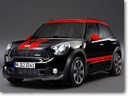
MINI has introduced the new 2013 Countryman John Cooper Works, which will make its official debut at the Geneva Motor Show in March. This is the most powerful member of the new generation.
The Countryman JCW has a 1.6 liter four-cylinder turbocharged petrol with 218PS (160 kW) at 6000RPM and 280Nm (207 lb-ft) of torque at 2000RPM, and 300Nm in overboost mode. The engine sends all that power to 6-speed manual gearbox an ALL4 AWD system to the road. There is an option for 6-speed automatic transmission. The Countryman is heavy, but fast – 0-100 km/h in 7.0 seconds flat and a top speed of 255 km/h (140 mph). Furthermore, it needs 7.2 l / 100km on combined cycle (39.2 mpg UK) with 167 g/km CO2. The automatic version is more thirsty – 8.0 l/ 100km with 187 g/km CO2.
The exterior comes with complete aerodynamics package including front and rear bumpers and a pair of side skirts. Of course, there are also some JCW badges. The ride is lowered by installing a sports suspension and sits 18” alloy wheels fitted with low-profile tires (19” light-alloy wheels are available as an option). There is also a high performance brake system and a sports exhaust system bringing deeper and sporty sound.
The interior boasts sports leather seats, a sports multifunction steering wheel and piano black or Chili Red trim. The instrument cluster is revised and there are John Cooper Works door sills.
When the first ever MINI went out on the market on 26th of August, no one expected its future success. There is even no clue how many different variations were to follow the original MINI. For five years since its production, MINI made a great success Till 1964 the car underwent through different modifications and had been transformed in many versions (for example an estate version, a pick-up on or a van version). In 1961 Issigonis’ friend John Cooper, who was the owner of the Cooper Car Company saw a big and special potential for the MINI. Since he was an expert in designing and building Formula One and rally cars, he was drawn immediately to MINI’s racing potential. And this is how the famous MINI Cooper appeared. The first ever Austin Mini Cooper and Morris Mini Cooper made their world first appearances in 1961. The standard 848cc engine which delivered 34bhp (25 kW) was now replaced by 997cc engine putting out there the 55bhp (41 kW). In addition, the car featured a racing-tuned engine, twin SU carburetors, a closer-ratio gearbox. More importantly, it also included for the first time front disc brakes, uncommon at the time in a small car. Later in 1964, its engine was replaced by a shorter stroke 998, which delivered a top speed close to 100 mph. Then the model MINI Cooper S came about and captured many cars as being an outstanding rally car. In details, the “S” model won the Monte Carlo Rally three times. Later, in 1964, this version was equipped with new 1275cc version of the A-series engine. All other MINIs were produced with the same 998cc engine. In this year debuted the MINI Moke model, which was very simple and lightweight vehicle, and was originally intended for military applications. Also in 1964 in the production of the MINIs were featured the interconnected Hydrolastic gas/fluid suspension system.
Mark I MINI1964 Austin Mini Cooper S
Mark II MINI was born in 1967 when it was introduced for the first time. The transformed new version featured small face lift, new radiator grilles, bigger rear windows, and other cosmetic changes. More importantly, the standard models now got the 998cc engine instead of the 848cc one. And this is when the MINI became famous for its name. The Austin and Morris names were replaced by the name MINI, which now became established as a brand in its own right. Enhancements included wind down windows replacing the original sliding door windows, and new concealed door hinges. The exterior now featured different front end design, and also was introduced for the first time the new 1275 GT model. The first million production vehicle came out of the factory in 1965 and the second million – in 1969.
In 1969 Mark III MINI appeared on the marked. It got modified bodyshell, larger doors with concealed hinges, winding windows, rubber cones suspension. Ten years later and the MINI got enormous attention and already made a world-wide success. However, it got new rivals in the face of for instance Ford Fiesta, Fiat 127, Volkswagen Polo or Peugeot 104. Mark IV MINI debuted in 1976 and had new front rubber mounted subframe with single tower bolts, the rear frame had some larger bushes, the twin stalk indicators were introduced with larger foot pedals, the rear indicator lamps had the reverse lights incorporated in them. Nonetheless, by the beginning of the 80’s the Mini was beginning to fall out of favor in many export markets.1981 was the last year for the brand to be in the ten of Britain’s top selling cars. Mark V MINI was born in 1984 and it now featured a 8.4-inch (210 mm) brake discs and plastic wheel arches, although it retained the same Mark IV body shell shape. The production of Mark V lasted till 1990, when the Mark VI MINI Version appeared. In it, the engine mounting points were moved forward to take 1275 cc power units. Moreover, it featured HIF carb version, plus the single point fuel injection. Its production lasted six years and in the beginning of 1996 the Mark VII MINI was launched. This was the final version of the famous car. It included twin point injection with front mounted radiator, full-width, internal bonnet release, and for the first time – an airbag on driver’s side.
During the 80’s the MINI received many “special editions” which made it a real fashion icon. This aspect of the car got a lot of attention from other companies, especially a particular one – BMW. The latter bought later the remnants of BMC and took control of it. BMW retained the Mini name and the planned new model. And later in 2000 the range of the MINI models consisted now of four versions: MINI Classic Seven, MINI Classic Cooper, MINI Classic Cooper Sport, MINI Knightsbridge. The new BMWMINI has technically nothing to do with the old car. However, it has the same classical transverse 4-cylinder, front-wheel-drive and the iconic appearance of the original model. The new MINIis larger than the original one: 58 cm (23 in) longer, 50 cm (20 in) wider, 7 cm (2.8 in) higher. It has a total weight of 1,144 kg (2,522 lb). In addition, it is now being classified as compact car rather than city car.
2000 Mini Cooper Classic
By this date there are a lot of new versions, which the BMW produces. One of them is the absolutely new 2012 MINI Roadster which is the first open-top two seater model in MINI history! In addition, the car has a 240-litre boot which offers versatility of loading options. The model variants got the whole 211 hp (157 kW, which requires just 4.5 litres of fuel per 100 km (62.77 mpg imp)! Other new models are 2012 MINI Baker Streetand 2012 MINI Bayswater, which have a lot of innovative technologies featured, but also are retaining the excellent stance of the classical MINI. Both cars feature expressive design highlights and nice equipment. The MINI Baker Street embodies the youthful, fresh and innovative trend-setting style of the brand, while the MINI Bayswater focuses primarily on the sporting verve and agile handling for which MINI is renowned. And this is how the iconic vehicle continues writing the history of the automotive world.
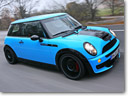
The CoverEFX & CFC StylingStation company in Erftstadt has two tuned MINIs.
The first one is foiled in Sunflower yellow and the second is finished in Smurf-blue. Both MINIs have all attached parts painted black, including the interior lights and Wiecher’s cage. The plastic wheel arches had to be reworked after the assembly of the suspension and brakes.
The performance upgrades include a modified PreKat and an ECU re-map giving the engine additional 17PS (13 kW) and 22Nm (16 lb-ft). The hand-crafted and dynamic pressure-optimized exhaust system with stainless steel manifolds and down pipe by the KBR Motorsports.
The stance is thanks to a Bilstein B16 suspension. There are also n OMP strut brace and a supporting arm, and an adjustable rear stabilizer – 17 mm by H & R. Both MINIs stand on Crono rims by OZ Racing 7J x 17” fitted with 205/40 R17 Toyo tires.
The interior boasts RECARO seats upholstered with Alcantara.
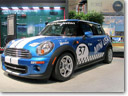
A new MINI Cooper B-Spec race car will take place in the 2012 race season in USA. B-Spec vehicles are production-based cars that are equalized on power and weight to make the racing as competitive as possible and all four of the major racing sanctioning bodies will host B-Spec races in 2012.
“B-Spec racing is a great fit for MINI because the car is developed with racing heritage in mind and the races are run with vehicles very similar to those already sitting in the driveway,” said Jim McDowell, Vice President – MINI USA.
“Getting involved with B-Spec racing offers a fun and competitive race environment without requiring MINI drivers to make a large financial investment to make their car a serious competitor.”, he added.
The race car is built by MINI of Charleston and features minor upgrades – a coilover suspension, Carbotech brake system and 15” light alloy wheels fiited with Hoosier racing tires.
The engine is not extremely powerful, but it brings good performance. Despite that performance specs are not released, the factory version accelerates from 0 to 60 mph in 8.4 seconds and a top speed of 203 km/h (126 mph). The power unit is 1.6 liter four-cylinder petrol with 123PS (90 kW) and 154Nm (114 lb-ft) of torque.
2012 MINI Cooper Hardtop B-Spec Racer
2012 MINI Cooper Hardtop B-Spec Racer:
HP: 121 @ 6,000, factory rated
TQ: 114 @ 4,250, factory rated
Steering: Electric power-assisted rack and pinion, 14.1:1 ratio
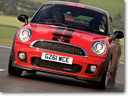
2012 MINI Coupe is priced at just £16 640 on-the-road. The brand offers industry leading tlc servicing packages available on all MINI Coupe models.
The engine range includes outputs from 122PS (90 kW) to 211PS (155 kW) powering the flagship MINI John Cooper Works Coupe. There is also a 143PS (105 kW) Cooper SD – diesel engine.
Fuel economy on the combined cycle stretches from 39.8 mpg in the MINI John Cooper Works Coupe to a frugal 65.7mpg in the Cooper SD model while CO2 emissions are as low as just 114g/km on the Cooper SD. Even the MINI John Cooper Works Coupe emits only 165g/km.
The standard equipment includes: Park Distance Control with rear sensors, height-adjustable sports seats (Cooper S upwards), air conditioning, electrically adjustable heated exterior mirrors, DAB digital radio and the MINI Radio Boost CD audio system with AUX IN connection. Standard safety equipment includes twin front and head-thorax airbags.
The options list is huge: automatic climate control, heated seats, multi-function steering wheel (standard on Cooper S, Cooper SD and John Cooper Works), automatically dimming rear-view and exterior mirrors, Harman Kardon hi-fi loudspeaker system, Bluetooth, USB audio interface, storage package and preparation for a rear luggage rack. Additional options are available from the John Cooper Works ranges.
2012 MINI Coupe
Model
OTR Price
CO2
MPG*
Insurance Group
MINI Cooper Coupé
£16,640
127g/km
52.3
18E
MINI Cooper S Coupé
£19,775
136g/km
48.7
31E
MINI Cooper SD Coupé
£20,510
114g/km
65.7
22E
MINI John Cooper Works Coupé
£23,795
165g/km
39.8
36E
MINI John Cooper Works Coupe:
Four-cylinder petrol engine with twin-scroll turbocharger and direct injection, plus numerous technological details carried over directly from motorsport.
Displacement: 1,598 cc
Output: 211hp/155kW at 6,000 rpm
Max torque: 260 Nm/192 lb-ft at 1,850 – 5,600 rpm
(280 Nm/207 lb-ft with Overboost at 2,000 – 5,100 rpm)
Acceleration: 0–62 mph: 6.4 seconds
Top speed: 149 mph
Average fuel consumption (combined cycle): 39.8 mpg
CO2 emissions: 165 g/km
MINI Cooper S Coupe:
Four-cylinder petrol engine with twin-scroll turbocharger and direct injection.
Displacement: 1,598 cc
Output: 184hp/135kW at 5,500 rpm
Max torque: 240 Nm/177 lb-ft at 1,600 – 5,000 rpm
(260 Nm/192 lb-ft with Overboost at 1,700 – 4,500 rpm)
Acceleration: 0–62 mph: 6.9 seconds
Top speed: 143 mph
Average fuel consumption (combined cycle): 48.7 mpg
CO2 emissions: 136 g/km
MINI Cooper SD Coupe:
Four-cylinder turbo diesel with aluminium crankcase, common-rail injection and variable turbine geometry.
Displacement: 1,995 cc
Output: 143hp/105kW at 4,000 rpm
Max torque: 305 Nm/225 lb-ft at 1,750 – 2,700 rpm
Acceleration: 0–62 mph: 7.9 seconds
Top speed: 134 mph
Average fuel consumption (combined cycle): 65.7 mpg
CO2 emissions: 114 g/km
MINI Cooper Coupé:
Displacement: 1,598 cc
Output: 122hp/90kW at 6,000 rpm
Max torque: 160 Nm/118 lb-ft at 4,250 rpm
Acceleration: 0–62 mph: 9.0 seconds
Top speed: 127 mph
Average fuel consumption (combined cycle): 52.3 mpg
CO2 emissions: 127 g/km
Exterior dimensions:
Length: 3,728 millimetres (MINI Cooper Coupé)
3,734 millimetres (MINI Cooper S and Cooper SD Coupé)
3,758 millimetres (MINI John Cooper Works Coupé)
Width: 1,683 millimetres (1892 millimetres including door mirrors)
Height: 1,378 millimetres (MINI Cooper Coupé)
1,384 millimetres (MINI Cooper S, Cooper SD and John Cooper Works Coupé)
Wheelbase: 2,467 millimetres
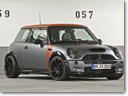
CoverEFX has introduced their tuning program for MINI R53. The German tuning house offers both styling as well as a performance package.
The exterior boasts a full metal coating of the car using the special CoverEFX paints such as “teflon-gray-metallic” and “electro-red-metallic”. There are also some elements covered with shiny black lacquer.
R53 ProjectONe stands on 17” Multispoke alloy wheels finished in matte black with an orange rim. The stance is further improved by a lowered sports suspension.
The performance package boosts the small 1.6 liter turbocharged petrol engine to whopping 240PS. There is no data for the performance, but there is no doubt that this will be one fast MINI Cooper.
Most of you have strong memories from your father’s or grandfather’s car. “One day I will have one for myself”– we thought. Unfortunately most cars have no more than 10 years on the production line meaning that whatever it was that you fancied as a kid is now about 30-40 years old and looks like(or actually is) scrap or costs an amount of money with a lot of zeroes. Luckily someone thought of all these enthusiasts. So, who did?
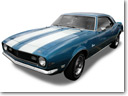
Chevrolet Camaro
The first Camaro was built back in 1966/1967. Very long front end, massive rear tires and wide arches made the Camaro look really inspiring. It also had engines to make the picture even better. Top versions boasted 8 cylinder engine, 7+ litres and more than 400 hp. How about 5.2 seconds for 0-60 and less than 13 seconds for a quarter mile – impressive results for its time and not only. So back to reality, what is available today? In 2009 the fifth generation Camaro was introduced.
1968 Chevrolet Camaro
Having plenty of new gadgets and modern stuff, it has something very important – the spirit of Camaro – 550 hp, V8 and shares a lot of the curves from its predecessor – same large arches, same aggressive and appealing look – you can simply never mistake this car. If you want to celebrate Camaro’s 45th anniversary, wait for the special edition in 2012 – one-of-a-kind badges, unique interior and something more maybe.
Volkswagen Beetle
This model has about 73 years of history and has played a huge role in German car manufacturing as a whole. This car was ordered by Adolf Hitler and its task was to be a car for the people (Volks Wagen – German). Being almost airtight, this car could even stay afloat for a couple of minutes and its aircooled flat-4 engine turned to be very suitable for the conditions in Africa’s deserts. The beetle was not meant to beat records.
1938 Volkswagen Beetle
The 1200 model was capable of 100 km/h in 37 seconds and the diesel model with 1,3 N/A did 100 in 1 minute! What not too many people know is that the last year of manufacturing of the Beetle as we know it from black and white pictures is 2003 – In Mexico. The entirely new Beetle was announced in 1997 and the design was definitely inspired by the original. Apart from this however it does not share too much – Engine is in the front, the car is FWD. What is more, this is no more a car for the people – the top model costs $ 58 000 – not something everyone can afford.
Mini Cooper
The original was introduced in 1959 and was a great hit back then. This was a really small car with wheelbase of just 2 metres and the FWD set up would save a lot of space for passengers and luggage. There is a reason why this car was voted the second most influential car of the 20th century after the Ford Model T.
1959 Mini Cooper
The weight distribution and the size of the car made it also very successful in sports. Not too many cars have won the Monte Carlo rally 4 times in a row. A famous car magazine awarded the Mini “Car of the century” in 1995. More than 5 000 000 were sold on the market making it the most successful UK car for the moment. The main drawback of the Mini Cooper is its safety – it also has some awards about this – in the negative aspect. In 2000 BMW (the new owner) presented the new Mini. Take a magnifying lens, look at the old one and you will see the new one. Exterior is quite similar, yet the new one is really sleek and has modern curves and styling. In terms of power the new generation offers a good range of engines 75-204 hp. Similar to the original, the new Mini Cooper will try to participate in the world rally championship and be just as successful. Good luck!
Each car enthusiast has a movie that makes them smile just thinking of it. You will have the opportunity to read a little more about some of the most cherished cars used in movies.
Number 5
AUDI A8 W12- Transporter 2
This car is taking a serious part in the plot of the movie. Jason Statham needs to chase the bad guys all over the place and the Audi is a serious partner in his mission. The movie is abundant with stunts that the A8 has to perform. Thanks to the massive twelve-cylinder 6.0 liter engine and some driving skill of course, it almost looks easy to do.
Audi A8 6.0 Quattro
Number 4
Nissan Skyline R34- The Fast and the Furious
One of the fastest cars in the world, the dream of the PlayStation generation. The Skylines used in the movie are GTRs but not quite – the purpose of these cars was to draw attention and being all wheel drive, the grip was too much for burnouts and fun. That’s why the Skylines used, had their front driveshafts excised and the magic was done. As you already know the GTRs are claimed 280 hp from the factory, which is ridiculous for a 6 cylinder 2.6 twin-turbo engine. Still one of the two fastest skylines used in the movies is claimed 505 hp, which is enough to do 12 seconds in the quarter mile run. The main car used in the movie has been equipped with HKS tuning parts, JIC’s suspension and 3 NOS bottles, neither of which had something to do with the engine. Being so full of “extras”, AWD and AWS removed, the performance is not quite as what is expected from a skyline though.
Nissan Skyline GT-R R34
Number 3
Mini Cooper S John Cooper Works– The Italian Job
Complicated relations, a lot of money, a lot of thrill and a couple of Mini Coopers as a final touch. In the plot several old friends are trying to get to a huge amount of gold. For the purpose they need small, maneuverable and still fast cars. The Mini Cooper turns out to be the best option for the job. The Aero body kit makes the cars look stunning. Did you know that gasoline-powered vehicles were not allowed in the subway system of LA, that’s why a couple of electric cars were built for these scenes? In total 32 Minis were used in the movie, some of them specially customized to make some of the incredible stunts possible.
Mini Cooper S John Cooper Works
Number 2
Volkswagen Beetle – Herbie Fully Loaded
This is a car with a lot of history in the movie world. It has participated in a couple of Disney movies starting in 1968 – The Love Bug. What is strange and interesting about Herbie is that it is almost a human being – has his own thoughts, soul and drives himself. 30 Beetles were used for the footage of the last movie of the series – “Herbie Fully Loaded”. One of the beetles has a 200hp engine that is capable of getting the car to over 135 mph. Unfortunately having all the effects of modern cinema, the car looks normal no more. It moves its bumper, blinks, gives out noises etc. Unlike the first movies from the series, where you could just feel that there was something special about the car, some kind of emotion, without making it look human.
1963 Volkswagen Beetle Herbie
Number 1
Ford Mustang Shelby GT500 ‘Eleanor’ – Gone in Sixty Seconds
The dream machine from “Gone in 60 seconds”. Alike the movie, this car is a true masterpiece and quite a mystery. The car is named Eleanor, but initially the plan was not to use a mustang at all. At first the idea was to have a GT40 grabbing the attention. However, it turned out that building one would cost a fortune even considering what the purpose was. Basically it was all making a car from scratch – literally. The car was first put on paper and then various specialists started creating the separate parts and adapt them to fit the Mustang. What not too many people know is that the side exhausts are not functional and neither are the side air feeds. The car in the movie is shown so fast that the driver was scared of it and would talk to it prior to driving. The car ended up in a private collection, $216 700 were paid for the beauty. Still, there are garages that can build another one for you for some (in) decent amount of money.
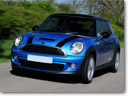
Superchips has revealed a tuning program for the performance R56 MINI Cooper S Turbo. The ECU re-map for “Phase 2” versions of the hot hatchback boosts the 184PS 1.6 litre turbocharged engine, produced from 1st March 2010 onwards.
The ECU re-map adds 25PS at 5444RPM and 32Nm at 3765Nm. The total power of the vehicle is 209PS and around 290Nm of torque.
Of course, the fuel economy remains the same – 48 mpg on combined cycle.
Customers can be assured the Superchips conversion is covered by a full Customer Service Guarantee and an industry-leading 12 month / 30,000 supplementary full vehicle warranty.
The ECU re-map is suitable for all “Phase 2” 184PS R56 MINI Cooper S models produced from March 2010 onwards. The performance package is now available directly from Superchips and its UK dealer network. The price tag is at £455.00, including VAT. Really, a great price for such modification.
So, if you have Phase 2 R56 MINI – don’t compromise, optimise.
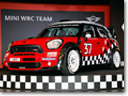
MINI WRC Team will compete in six rounds of the FIA World Rally Championship. The team will use the MINI John Cooper Works WRC race car, which will be tested at the Rally d’Italia Sardegna from 5th to 8th May 2011 for the first time. The aim of the team is to gain a lot of experience to be perfectly prepared to take on the entire 2012 WRC.
“On the one hand, MINI can look back on a unique success story,” commented Ian Robertson, Member of the Board of Management of the BMW AG for Sales and Marketing.
“On the other hand, MINI is the epitome of excitement for millions of fans around the world and thrills them with its energy. This is precisely what we are able to authentically represent through our motorsport involvement in the World Rally Championship. Thrilling rally events, ultimate performances by man and machine, and as much success as possible, of course: motorsport is pure emotion – just as MINI is for its fans.”, Mr. Robertson added.
2011 MINI John Cooper Works WRC has a 1.6 litre turbocharged petrol engine, which is used in the road cars, but the power unit was specially prepared by BMW Motorsport to meet FIA Super 2000 regulations, including the World Touring Car Championship.
We wish luck to Meeke and Sordo during the 2011 WRC season!
MINI has exhibited the new John Cooper Works S2000 WRC, which actually will be driven by Dani Sordo (ES) and Kris Meeke (GB) in its rally debut at the Rally Italy from 5 – 8 May 2011.
The car will also enter the competition in various other events which will take place in Finland, Germany, France, Spain and Great Britain. (more…)
CoverEFX, the well known Germany-based tuner has released an astonishing and at the same time extremely different conversion of Mini Cooper Works. Showcasing upgrades in both tuning aspects – performance and styling, the CoverEFX MINI stands out as a true masterpiece, with own individuality and impact. (more…)
 MINI has introduced the new 2013 Countryman John Cooper Works, which will make its official debut at the Geneva Motor Show in March. This is the most powerful member of the new generation.


 The CoverEFX & CFC StylingStation company in Erftstadt has two tuned MINIs.


 A new MINI Cooper B-Spec race car will take place in the 2012 race season in USA. B-Spec vehicles are production-based cars that are equalized on power and weight to make the racing as competitive as possible and all four of the major racing sanctioning bodies will host B-Spec races in 2012.


 2012 MINI Coupe is priced at just £16 640 on-the-road. The brand offers industry leading tlc servicing packages available on all MINI Coupe models.


 CoverEFX has introduced their tuning program for MINI R53. The German tuning house offers both styling as well as a performance package.


 Most of you have strong memories from your father’s or grandfather’s car. “One day I will have one for myself”– we thought. Unfortunately most cars have no more than 10 years on the production line meaning that whatever it was that you fancied as a kid is now about 30-40 years old and looks like(or actually is) scrap or costs an amount of money with a lot of zeroes. Luckily someone thought of all these enthusiasts. So, who did?


 Each car enthusiast has a movie that makes them smile just thinking of it. You will have the opportunity to read a little more about some of the most cherished cars used in movies.


 Superchips has revealed a tuning program for the performance R56 MINI Cooper S Turbo. The ECU re-map for “Phase 2” versions of the hot hatchback boosts the 184PS 1.6 litre turbocharged engine, produced from 1st March 2010 onwards.

 MINI WRC Team will compete in six rounds of the FIA World Rally Championship. The team will use the MINI John Cooper Works WRC race car, which will be tested at the Rally d’Italia Sardegna from 5th to 8th May 2011 for the first time. The aim of the team is to gain a lot of experience to be perfectly prepared to take on the entire 2012 WRC.


 MINI has exhibited the new John Cooper Works S2000 WRC, which actually will be driven by Dani Sordo (ES) and Kris Meeke (GB) in its rally debut at the Rally Italy from 5 – 8 May 2011.
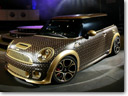 CoverEFX, the well known Germany-based tuner has released an astonishing and at the same time extremely different conversion of Mini Cooper Works. Showcasing upgrades in both tuning aspects – performance and styling, the CoverEFX MINI stands out as a true masterpiece, with own individuality and impact.