 BMW Group further extends its leading position in the reduction of fuel consumption and exhaust emission levels – 23 models with a CO2 level of maximum 140 grams/kilometre – 23 models fulfil the exhaust emissions norm EU5 as of autumn 2008, new BMW 330d with BMW BluePerformance Technology even at EU6 level. (more…)
Tag: CO2
-
BMW goes into the model year 2009
-
The new Audi Q5: Concentrated hi-tech for maximum efficiency
 Audi is maintaining its successful efficiency strategy: the new Audi Q5, the sports car in the SUV category, is its latest model to combine high performance with low consumption. This progress is underpinned by an extensive package of hi-tech solutions ranging from energy recuperation to engine downsizing. (more…)
-
All-nеw Ford Fiesta
 Ford Fiesta is not just the most dramatic and distinctive Fiesta ever, it also marks a significant landmark in Ford’s history as the first Fiesta to be developed for customers around the world and as the template for the company’s future generations of global vehicles.
Since the very first Fiesta was launched in 1976, over 12 million have been sold, with over 400,000 customers in 2007 (103,000 in the UK alone) proving the enduring popularity of the model’s style, efficiency and value for money.
The Fiesta is set to extend these values, while appealing to a generation of small car buyers with its mix of kinetic design and latest big car technology. Three- and five-door Fiestas will begin rolling off production lines in Europe in summer 2008, with regionally-tailored models on sale in Asia, South Africa, Australia and the Americas by 2010.


Developed for Customers Globally
The Fiesta is the first product of Ford‘s Global Product Development System (GPDS) and has been designed and developed to meet the differing needs of customers as diverse as Western and Eastern Europe, North America, China, Australia and South Africa.
Extensive research by Ford in these regions provided the basis for the GPDS process, which will dictate the future of Ford product development. Fiesta is also the first product of Ford Motor Company CEO, Alan Mulally’s ‘One Ford’ vision of a single, global company designing and building cars for a single, global customer base, not divided by regional or national borders.
“It’s an incredibly exciting project,” says Marin Burela. “ Fiesta is a landmark moment for Ford. It’s our most significant global vehicle project since the Model T and heralds the future for Ford product development.”
Designed for a New Generation
Fiesta is the latest interpretation of Ford’s kinetic design philosophy, exuding presence and individuality in a way that will appeal to a generation of buyers.
Building on the exciting momentum of the Verve Concept and latest-generation production models like the Mondeo and Focus, Fiesta brings the modern and dynamic Ford of Europe family look to the small-car segment.
It wears the distinctive, bold Ford ‘face’ including the signature lower grille and large, centred Ford oval badge that characterises both the Verve Concept and other modern Ford vehicles. Details such as chrome and brightwork accents, sleek, wraparound headlamps, bold, pronounced wheel arch lips and a strong bodyside beltline create a dynamic look, even when stationary, while a distinctive rear view is formed by a sweeping roofline that finishes in a small spoiler, with dramatic, honeycomb tail lamps.
This impact continues on the inside, with courageous use of dynamic lines, full surfaces and bold graphics, with an ambience ranging from sporty to sophisticated, created by the careful use of colours and materials in different contrasts Zetec S incorporates snowboard and street fashion designs and Zetec and Titanium feature high contrast dark gloss surfaces and high-tech metallic accents.
Executive Director of Design, Martin Smith comments: “This is the most complete, expressive and exciting Fiesta Ford has ever produced, inside and out. To me, it is a car that evokes an instant emotional response – ‘I want one’ – before you even get near it.”
Commitment to Driving Excellence
Buying a Fiesta has always meant owning a great car to drive and Fiesta is set to extend that reputation even further, with key changes and an ‘Zetec S’ model in the range.
Standing on virtually the same footprint, but 40 kilogrammes lighter than its predecessor, Fiesta delivers a ‘light-yet-solid’ handling precision, enhanced by the first use of an Electric Power Assist Steering system in a European Ford.
An Fiesta Zetec S model will be available at launch, with a 120 PS 1.6-litre Duratec Ti-VCT petrol engine bringing performance to the heart of the Fiesta range
At the same time, a level of driving refinement echoes Fiesta’s visual sophistication and is set to raise the standard for small cars for road, powertrain and wind noise isolation.
Ford’s commitment to driving quality will feature in Fiestas, whether built in Cologne, Germany, Valencia, Spain, or Nanjing, China, but with each tuned to suit regional driving conditions and customer preferences, under Ford’s global engineering approach.
“We wanted to make sure that driving quality remains at the heart of Fiesta – we had to ensure that the driving experience delivered on the promise made by its dynamic kinetic design”, says Dieter Schwarz, Vehicle Engineering Manager for global Fiesta development. “I am confident we have fulfilled that promise.”
Stronger, Safer, Lighter
Under Fiestas’ stylish exterior is a robust body structure, crafted from high-strength steels, to protect occupants in the event of a collision.
More than 55 per cent of the body structure is high-strength steel, making Fiesta approximately 10 per cent stiffer torsionally than its predecessor and providing an exceptionally rigid safety cell for all occupants.
Supporting this is Fiestas’ Intelligent Protection System, offering up to seven airbags, including the first use of a driver’s knee-airbag in a small Ford car.
This intense focus on safety extends to those outside the car, with an array of pedestrian protection features, from the shape and structure of Fiestas’ front bumper, bonnet and windscreen, to small details such as the shape of its headlamps and wiper blades.
“Fiesta is a clear example that making a safe car doesn’t mean making a large car, or a heavy car. There is no need to compromise between safety and good design or driving character”, says Bernd Liesenfelder, Body Engineering Manager for Ford of Europe.
Big Car Features and Clear Series Choice
Fiesta brings an array of ‘big car’ premium features to the small car segment, which customers will notice even before they turn the key for the first time.
Fiestas’ striking centre console features a mobile phone-inspired entertainment system that is styled very differently to traditional automotive switchgear, to provide a completely intuitive interface.
Keyless entry, combined with a ‘Ford Power’ start button, adds to the Fiesta premium experience, with other ‘surprise and delight’ options available including automatic, projector headlamps, automatic windscreen wipers, Ford’s sophisticated Human Machine Interface with large 89 mm (3.5 inch) screen and cruise control.
The driving position is given a ‘cockpit’ feel, with improved position and adjustment to both the driver’s seat and steering wheel, while passengers receive more personal and luggage space overall than the previous Fiesta, despite the stylish, sweeping exterior profile. Stowage space abounds from a boot capable of swallowing 295 litres, to ingenious storage areas throughout the cabin, including charging points for mobile phones and MP3 players.
While Fiesta has been designed and engineered to meet a wide range of customer requirements, a clear series choice makes selecting the right model a simple task, with options from feisty to frugal, ultra-modern to traditional and a comprehensive list of standard features at all levels.
A simple six-series range provides maximum choice from the affordable and well-equipped Studio and the popular Style and Style Plus, or the modern, techno style of Zetec, Zetec S and Titanium.
A high level of equipment provides items such as power door mirrors as standard across the range. Completing the premium feel are features on Zetec and Titanium, such as the Aesthetic Lighting Pack, which bathes the centre console, gearshift area and passenger side dashboard area in a soft red glow.
“You immediately feel the quality of a bigger car that will be at the core of the Fiesta ownership experience. When we consider all the comfort and convenience features in the Fiesta range, we think of it not as our small car, but our smallest large car”, says Giovanni De Pasca, Driving Environment and Occupant Package Manager for Ford of Europe.
New, Revised and Enhanced Powertrains
Fiesta combines newly-developed, revised and enhanced powertrains with its overall weight reduction to deliver better performance, fuel economy and reduced CO2 emissions.
Fiesta’s engine range comprises four 16-valve Duratec petrol and two Duratorq TDCi diesel engine choices, refined to deliver a potential annual saving of over 11,000 tonnes of CO2 across Europe, versus the previous Fiesta.
A key development is the Fiesta ECOnetic, offering the impressive torque of the 1.6-litre Ford Duratorq TDCi engine with target CO2 emissions of just 99 grams per kilometre (g/km), achieved through careful engine calibration, lowered suspension and aerodynamic improvements and a no-maintenance, coated Diesel Particulate Filter (c-DPF). The sub-100g Fiesta ECOnetic joins the sub-140 g/km Ford Mondeo and sub-120 g/km Ford Focus ECOnetic models as Ford achieves its commitment to deliver a range of ultra-low CO2 models at the heart of its product portfolio.
Other Duratorq TDCi engines also benefit from refinements to their state-of-the-art common rail injection systems to deliver enhanced fuel economy, lower CO2 emissions and improved performance.
Driving enthusiasts are not forgotten, thanks to an, 120PS, 1.6-litre Duratec Ti-VCT petrol engine, available in the Fiesta Zetec S and Titanium models. Despite its feisty character and 20 extra horsepower, the Duratec Ti-VCT is even more fuel efficient than the 100 PS, 1.6-litre engine in the previous Fiesta. The Fiesta Zetec S can accelerate from zero to 0-62 mph in 9.9 seconds, while still achieving a combined fuel economy of 47.9 mpg and CO2 emissions of 139 g/km.
Three other 16-valve Duratec petrol engines are offered for Fiesta, in 1.25- and 1.4-litres and outputs from 60 PS to 96 PS, with an automatic transmission option available on the Duratec 1.4-litre.
An added feature on Fiesta is Stall Prevention, designed to assist in low speed manoeuvres by altering the engine’s ignition profile to increase the amount of available torque and tuned for each individual powertrain.Overall, Fiesta achieves a 22 per cent improvement in 0-62 mph acceleration and 14 per cent better in-gear acceleration in passing manoeuvres, versus its predecessor, thanks to its reduced weight and improved powertrain calibration.
“Thanks to its mix of careful calibration and latest powertrain technology, Fiesta is a tailored driving experience, carefully and precisely tuned to respond to all drivers and driving styles,” says Joerg Beyer, Chief Carline Engineer for Fiesta.
Low Cost of Ownership
It is not just in its contemporary styling and technologies that Fiesta will be attractive to a discerning and demanding generation of customers – extensive thought and effort has ensured it still stands for value for money and reliability.
Helping owners minimise running costs was key, with fuel economy at the top of the list. Fiesta boasts increased efficiency across the range, with owners of the 1.4-litre Duratorq TDCi saving approximately a tankful of fuel a year – 45 litres over 9,300 miles – through efficiency improvements alone.
Insurance premiums and repair costs are kept low by an intelligent approach to manufacturing. Bake-hardened steel on front wings offers better resistance to low-speed bumps and scrapes, while headlamps and tail lamps are positioned high, away from potential impacts and specially shaped ‘crash cans’ are designed as sacrificial parts, collapsing predictably in an impact to prevent more extensive damage and higher repair costs.
Durability has been assessed at each stage in its development, with a total of 2.2 million miles of on-road testing and over 300,000 test operations on doors, bonnet and tailgate in real world environmental conditions.
Fiesta is manufactured with sophisticated techniques more commonly found in big-car production, all part of delivering higher quality than ever for customers across the world.
“Fiesta proves how you can make a small car affordable and reliable, without compromising style, quality or features”, concludes Joerg Beyer. “That’s the key to making Fiesta truly desirable.”
32 Years of Success
For the past 32 years, Ford Fiesta has provided practicality and driving pleasure to millions of customers across Europe. From its origins in 1976, as the product of a mission to build a European small car with modern features and a respectable price tag, the Fiesta name became ingrained in European culture and is now known across a variety of markets in Asia and South America. Fiesta is a brand that has attracted a loyal and dedicated following.
Fiesta has always been at the forefront of Ford’s commitment to driving quality and innovative technology. In 1983, the Mk II Fiesta was one of the most economical cars in the world and the only vehicle of its size to offer diesel power. In 1989 Fiesta introduced anti-lock braking to the small car market and in 1994 a driver’s airbag came as standard.
Accolades have abounded for the car during its lifetime, from rallying and motorsport success to prestigious titles such as ‘Car of the Year 1989’, ‘Best Small Car in the World’, ‘Smartest Small Car’, and ‘Best City Car’.
“Welcome to Ford Fiesta.
This vehicle is very special to us in Ford of Europe and to our customers. Over the past 32 years, Fiesta has consistently been at the top of the list of Europe’s best-selling cars.
Over 12 million Fiestas have found homes with customers over that time and the Fiesta name continues to carry an overwhelmingly positive image in all its markets, standing for style, efficiency, driving quality and value for money. Our model is set to continue this success story and carry Fiesta forward to a generation of car buyers.But this completely model marks something of a departure for Ford of Europe. In contrast to previous generations of Fiesta, this car has been conceived and developed by the European arm of Ford’s global product development team to meet the demands and expectations of our customers around the world.
It is also the blueprint for future Ford global product development, bringing together Europe, the Americas and Asia where it will be tailored for each region and go on sale progressively between now and 2010.
I believe this is the most dramatic Fiesta since the very first model and it is the most complete and expressive interpretation yet of our kinetic design philosophy, echoing both inside and out the major elements of the exciting Verve Concept vehicles that inspired such a positive reaction around the world.
Of course, you would expect a Ford to be great to drive and our engineers have worked hard to ensure that Fiesta will deliver excellent driving quality. This is one of our core vehicle attributes, and one we have developed and applied consistently throughout the Ford of Europe range.
One of the development team’s greatest achievements is that it has been able to make the Fiesta stronger, safer and more comfortable, yet lighter and more fuel efficient than the car it replaces. An exceptionally rigid body structure means a robust crash protection, even before you include up to seven airbags available as part of Fiesta’s Intelligent Protection System.
Increased fuel efficiency and lower emissions are two qualities that our small car customers are looking for on a daily basis and Fiesta will not disappoint. Chief amongst a range of efficiency improvements is the extension of our acclaimed Ford ECOnetic ultra-low CO2 range, with a 1.6-litre ECOnetic Duratorq TDCi offering CO2 emissions of less than 100g/km, while each and every engine in the range has been revised and enhanced for greater fuel efficiency and lower emissions.
We’re also introducing an 1.6-litre Ti-VCT engine and a Zetec S model for driving enthusiasts, while a host of comfort and convenience features you would normally expect to find on our much larger vehicles combine to make Fiesta truly a compelling choice.
We’re immensely proud of the Ford Fiesta, as the latest addition to Ford’s increasingly successful line-up of models for Europe, and as the template for future generations of vehicles developed from the outset for our customers around the world.”
John Fleming, President and CEO, Ford of Europe
July 2008“Everything about the Ford Fiesta is new from the styling, materials and technologies to the core development and manufacturing processes that bring it to life. It represents our future, in more ways than one.”
Marin Burela, Executive Director of Small Cars, Ford of Europe -
Hyundai to Start Retail Sales of First Hybrid in July 2009
 World’s first LPI hybrid, first to use advanced Lithium-Polymer batteries Operation costs poised to be lowest of any hybrid in the market “Hybrid premium” cost can be recouped in two years through fuel savings Emits just 103g/km of CO2 and 90% fewer pollutants to qualify as Super Ultra Low Emission Vehicle Initial sales restricted to Korea (more…)
-
Peugeot 308 SR – tuned to the needs of the business driver
 Peugeot introduces the 308 SR business range to the 308 hatchback and SW models, aimed squarely at the Local Business and Contract Hire / Leasing market.
Based on the 308 S model and available in both five-door hatchback and SW versions, the SR range sees the standard fitment of SmartNav – satellite navigation, Bluetooth hands free phone kit and 16” alloy wheels. It will be available with two HDi diesel engines, HDi 90 and HDi 110 and in September a Bioflex engine will be introduced in to the hatchback version. The Bioflex engine will be able to operate on either E85 ethanol or unleaded petrol. (more…)
-
Opel Insignia: Double Premiere at London Motor Show
 Opel will showcase to the public for the first time at the British International Motor Show (July 23 – August 3) both the four-door notchback and five-door hatchback versions of its new flagship car, the Insignia. (more…)
-
Audi A4 2.0 TDI achieves CO2 emissions of 88 grams per kilometer
 The second part of the efficiency drive through Austria and Switzerland, like the first, was thoroughly successful: 20 randomly selected readers of a motoring magazine and a team of two from Audi once again fully exploited the efficiency potential of the new Audi A4 2.0 TDI with an output of 88 kW (120 hp) in order to drive a route of 1,650 kilometers (1,025.26 miles) from Vienna to Basel and back on a single tank of fuel. (more…)
-
New SEAT Ibiza SportCoupe

 Ibiza SportCoupe raises the bar of sportiness on SEAT’s newest model, combining impressive, vanguard exterior design with exceptional dynamic qualities and a wide range of engine options, which now includes the efficient 80 hp 1.4 and 90 hp 1.9 diesel versions. In addition, with a seven-speed DSG transmission making its debut in this segment, the Ibiza range now features a technical innovation that provides it with greater response and excellent driving comfort.
The fundamental sportiness of the SEAT brand is maximised in the Ibiza SportCoupe thanks to its compact coupé body. With a length of 4.034 metres and height of 1.428 metres to match its character, the proportions lend the car both agility and comfort in the city and on the motorway. Likewise, the Volkswagen Group platform designed for this segment also favours the dynamic qualities of the SEAT Ibiza SC.


Design and precision quality are two elements that distinguish the brand’s model from its competitors. The aesthetic and practical vision of the car created by SEAT Design Director Luc Donckerwolke with the SportCoupé “Bocanegra” prototype lends unique strength and personality to the 2008 Ibiza SportCoupe.
The evolution of the “Dynamic Line” and the “Arrow Design” concept are noteworthy – the latter characterised by a lower positioning of the headlights and radiator grille for a sportier look, and the robust look of the rear features light clusters set into prominent shoulders.
Painstaking interior and exterior detailing on the Ibiza SC include the dashboard, the instrument panel, ventilation nozzles and central console, which houses audio equipment and the Bluetooth connection, accessed via controls located on the steering column.
5-star Euro NCAP result
Safety aspects have been carefully considered, with the application of strenuous virtual simulations and real crash tests. The addition of head-thorax airbags as standard enhances the safety credentials on the ibiza, while a newly defined bonnet and front bumper greatly increase pedestrian safety.
Proof of this is an excellent rating after the stringent crash tests organised by the prestigious Euro NCAP organisation – 5 stars in passenger protection, 4 stars in child safety and 3 stars in pedestrian protection.
Top-notch equipment
SEAT model can boast one of the most complete lists of safety feeatures in its segment, including standard ESP (Electronic Stability Control), Hill Hold Control – where the car remains stationary on a gradient for two seconds after the brake pedal is released prior to accelerating, and the low tyre-pressure warning system. It also includes the sweeping sidelight cornering function on the foglamps, which greatly enhances visibility in turns at speeds lower than 40 km/h.
Also noteworthy is the availability of bi-xenon + AFS (Adaptive Frontlighting System) headlights, a rear parking assistant, radio-integrated Bluetooth connection, and a portable navigation pre-installation in the centre of the dashboard.
DSG gearbox for the first time in this segment
SEAT Ibiza SportCoupé is equipped with a seven-speed DSG gearbox (on the 105 hp 1.6 version) for the first time in this segment, placing the Spanish brand’s car in an enviable position compared with its rivals. The Ibiza’s inherent sportiness combines with the comfort and reliability of one of the most efficient automatic transmissions on the market.
With shorter first and second gears and a smaller gear ratio, this, twin-clutch automatic transmission provides the Ibiza SportCoupé with greater acceleration. In addition, this system produces remarkable fuel consumption, since the seventh gear is ideal for long motoring trips.
The full offer on sale
The range includes three petrol engines – the 70 hp 1.2, 85 hp 1.4 and 105 hp 1.6; as well as three diesel engines each with a DPF particulate filter – the 80 hp 1.4 TDI and the newcomers 90 and 105 hp 1.9 TDI. All engines are mated to a five-speed manual gearbox, except the 105 hp 1.6, which of course is equipped with the seven-speed DSG, and feature reduced consumption levels and CO2 emissions – less than 120 g/km for the diesel engines and less than 160 g/km for the petrol units.
Agile, seductive and characterful, the Ibiza SC will be available in three trim levels – Reference, Stylance and Sport, with an outstanding standard equipment list from the entry-level model. In the near future, the Ibiza range will be joined by the ecological ECOMOTIVE, plus sporty FR and Cupra versions.
As with the 5-door version, the Ibiza SportCoupé will be manufactured exclusively at the SEAT Martorell factory near Barcelona.
EXTERIOR DESIGN
Modern and distinctive- 3-door body with distinct coupé styling
- Arrow Design concept makes front end more aggressive
- Strikingly modern Dynamic Line
The cutting-edge, emotional design of the Ibiza SportCoupé demands close scrutiny, in order to take in all the detailing created by the talented Design team led by Luc Donckerwolke.
It is quite evident that the Ibiza SportCoupé carries several elements of the SportCoupé “Bocanegra”, the SEAT prototype showcased at the last Geneva Motor Show, which previewed what is today the Ibiza. To begin with, the aggressively bold arrowhead shaped front end seen on the “Bocanegra” is one of the most distinctive traits also found on the newest SEAT car.
“Arrow Design” concept resorts to simpler, more defined geometric lines that create both balance and aesthetic continuity. The front end looks are much sportier due to the positioning of the captivating eye-shaped headlights and the radiator grille.
In profile, the car reveals two details – the position of the door mirrors and the direction taken by the classic SEAT Dynamic Line.
The door mirrors are located on the door itself beneath the base of the windows, a design trait that lends a sporty image.
Luc Donckerwolke has redefined the Dynamic Line, making it more suggestive with the aim of attracting attention at first glance, with the perfect stroke across the side of the new Ibiza.
The robust shoulders stand out at the rear, where the inset light clusters are, the rear hatch has been newly designed, and the addition of a refined spoiler that blends in with the roofline in a perfectly designed curve lend a more compact, more suggestive look to the vehicle.
The coupé styling reduces the Ibiza’s length and height when compared to the 5-door version, which contributes to making the SEAT Ibiza SportCoupé the sportiest car in its segment. This characteristic is heightened with a colour palette, including Fashion Colours Lumina Orange, Galia Blue, Furia Grey and Limette, since the target of the SportCoupé is portrayed as a youthful car enthusiast who is proud of the performance delivered by the 2008 Ibiza.
INTERIOR CONCEPT
Sportier driving position- Driver oriented dashboard
- Greater quality materials and precision fit elements
- 284 litre boot volume
The philosophy applied to designing the interior of the Ibiza SportCoupé is based on facing all the instruments toward the driver to create a sporty atmosphere to match the car’s exterior.
The interior dimensions are uncluttered, resulting in greater roominess and practicality. The first thing that attracts attention is the sporty driving position, which has been lowered by 22 mm. Now there is a distance of 980 mm to the ceiling for both the driver and passenger.
Since the vehicle is longer, the boot capacity is 284 litres (17 litres greater than on the previous Ibiza). On selected versions, the side lining includes a storage net for small objects, and a recess with a strap to hold the light bulb case. Surrounding the lock there is also a recess and restraints for the emergency triangles, and there are four further optional anchor rings to attach a restraining net.
The sporty dashboard features an ergonomic driver-oriented instrument panel with two large circular dials for easy visual access.
Available across the range, some areas on the dashboard are soft to the touch. They are located away from the windscreen dazzles and feature a broader colour range, including light shades. There are also noticeably more painted components compared with the previous model, including metallic tones. The circular air nozzles guarantee the ideal air flow direction for greater passenger comfort.
SEAT has carefully chosen the materials that make up the dashboard and improved the development of the textures, which are now more scratch resistant and easier to clean. In general, the visual impact is much greater than on the previous Ibiza.
Practical central console
The buttons on the console include several functions, such as the hazard lights, door locking/unlocking, TCS disconnection, tyre pressure, seat heater and a warning to indicate if the passenger airbag is disconnected.
There are also three object holders, and each one is suitable for housing an ashtray, as well as a lower side recess for a mobile phone. On the driver side there is a compartment beneath the light switch, and an integrated drawer can be optionally installed beneath the glove compartment to hold an umbrella and the emergency vest. In the lining of the lower A pillar, which is a single piece along with the sill (on the previous Ibiza there were two pieces) there is also a storage pouch.
The shape of the front seats follows a modern design. With optimised firmness, the sides give much greater support, the seats feature side stitching and there are two pockets on the rear backrest (optional on Reference) and two optional storage drawers beneath.
The passenger seat features the “Easy entry” system, where the backrest folds and slides at the same time, providing more room and better access to the rear seats.
As on the 5-door version, the Ibiza SC features a front central armrest which is optional across the range. It is upholstered and contains a handy storage compartment. Its ergonomic position and height have been studied for easy driver access, and can be folded open 90 degrees.
SAFETY AND STRUCTURE
Five-star Euro NCAP result- Brilliant results after Euro NCAP testing
- One of the safest vehicles in its segment
- Body parts use 60% high and very high resistance steel
SEAT Ibiza received an excellent rating after stringent crash tests organised by the prestigious Euro NCAP organisation – 5 stars in passenger protection (of a total of 5), 4 stars in child safety (of a total of 5) and 3 stars in pedestrian protection (of a total of 4). This result places the Spanish model in a privileged position, scoring it as one of the safest cars of its segment.
Ibiza performed magnificently in all the tests, with a total of 34 points in occupant safety (including the highest score in the side impact and pole tests), for a 5-star rating.
The Ibiza scored 38 points or 4 stars in child protection, making it one of the best models in this category of protection.
The last test evaluated pedestrian protection. Ibiza achieved an excellent result of 19 points, deserving 3 stars, with a green bumper rating which is the best for this part of the car.
Occupant protection features two airbag setups
The Euro NCAP results would not have been possible without the efforts made by SEAT’s Technical Centre in Martorell. The Ibiza SportCoupé features two airbag setups – one standard, which includes side head-thorax airbags and two front airbags; and alternative equipment which includes side thorax-pelvis airbags and head airbags.
The safety concept has been considerable enhanced on the generation Ibiza. One key area is the development of a passenger airbag module, focussing efforts on improving the airbag’s performance under extreme temperature conditions. Results are a weight reduction and less complexity than on the previous model.
This evolution has not only affected the performance of the passenger airbag, but has also improved the looks of the dashboard, since the deployment area on the lining is seamless and invisible to the eye.
The Ibiza SC also features a fasten seatbelt warning system for the front seats and Isofix anchoring points for the rear seats, enabling two child seats to be securely fastened. A complementary accessory is the possibility of installing a third anchoring point called Top Tether, which prevents the child seat from rotating in the event of a crash.
Active safety elements on the Ibiza include ABS, TCS and ESP with EBA and tyre pressure warning.
Pedestrian safety – essential
Improving pedestrian protection is one definite area of safety closely studied on the Ibiza, as the Euro NCAP results have shown. The two zones on the car that are more prone to cause injuries to a pedestrian’s head and lower legs are the bonnet and the bumper.
The bonnet features two areas of maximum energy absorption where the risk of causing head injuries is the greatest. On the whole, the great distance between the bumper and its crossbeam but no distance between the bumper and its rear support both contribute to protecting the legs in the event of collision.
The former guarantees that the knee avoids impact and at the same time advances forward and reduces its acceleration. The latter implies that the resulting zone is very rigid (the spoiler beneath the bumper) and not prone to deformation, so a leg impact prevents the shinbone from advancing. Euro NCAP’s green bumper rating is the best for this part of the car.
The combination of both conditions causes reduced angles related to the femur/shinbone, much less than 15 degrees, which implies that a pedestrian’s legs do not suffer any injuries.
More lightweight, more rigid body
The right balance between rigidity and weight reduction (47 kg on average) has been achieved in the development of the sheet metal body parts of the Ibiza thanks to the 60% use of high and very high resistance steel (5% more than on the previous Ibiza) on the highest load-bearing areas. At the same time, this implies greater energy efficiency and material savings during both production and the car’s afterlife.
Laser welding has also been applied on the body of the Ibiza to join the roof with the flanks, like on the former model, but extended until the seam that joins the A pillar and the windscreen. The use of adhesives has been increased by 50%, maintaining the same number of welding points.
Innovative panoramic sunroof
The Ibiza SportCoupé is equipped with a panoramic sunroof that covers the entire width of the roof, from the windscreen to beyond the B pillar. It is 130% larger than on the previous Ibiza, with a solid frame around the glass. Its dimensions let in 78% more light than on the former model. The sunroof has two positions – open and closed – that are controlled by a switch on the dashboard. It also has a manual window blind to regulate the amount of light entering the passenger compartment.
Optimised manufacturing processes
The commitment to achieve increasingly demanding and complex design concepts has directly influenced the optimisation of technological applications during manufacturing processes, specifically the area of the front mudguard attached to the front end, the area of the tail lights and the water duct, where parts that are difficult to stamp have been created, and the boot, where the floor and the stamping depth of the rear wall have led to greater volume.
Thanks to the rust protection measures applied to the body of the Ibiza, SEAT can offer a three-year corrosion guarantee against surface rust and a twelve-year guarantee against perforation rust. Such protection is the result of applying surface treatments, sealants to protect the body and the undercarriage and waxing cavities.
The surface coatings applied are water-based, which reduces emissions of volatile organic compounds and eliminates paint toxicity during the painting process. The paint composition has been modified and is now a dual compound that increases weathering and enhances gloss.
Undercarriage protection has been improved with the introduction of streamlining that has reduced the use of PVC by 2.6 kg while increasing the possibility of recycling (95% of the SEAT Ibiza can be recycled). Furthermore, structural cavities have been additionally insulated, resulting in water tightness and better acoustics.
CHASSIS
Standard ESP- Wider tracks and greater wheel diameter
- Significant modifications to steering and brake systems
- Improved “Agile Chassis”
There are four factors that directly influence the sportiness of the SEAT Ibiza SportCoupé – wider tracks, greater distance between shafts, larger diameter wheels and a substantial improvement to the Agile Chassis concept that affects all the elements and systems anchored to it, such as suspensions, steering and brakes.
Add standard ESP electronic stability to these, which was first available in this segment on the Ibiza Cupra in 2000, as well as TCS traction control, and the response of the SEAT Ibiza in any situation is extraordinary.
TCS acts on the engine management to prevent the wheels from skidding on slick surfaces. Furthermore, the Ibiza is also equipped with EBA (Emergency Brake Assistance), which increases braking power in emergency situations, taking advantage of the system’s full capacity.
Enhanced dynamic qualities
The track width has directly influenced the need to carry out modifications to both wheel shafts. The front shaft is 30 mm wider, which prompted modifying the steering gear, the front sub-chassis, stabiliser bar, both lower transversal arms and the drive shaft ball joint.
On the Ibiza, the sub-chassis is a single part and provides tighter specifications to the area where it is attached to the body and on the lower crossbeams, resulting in improved kinematics precision.
The assembly including the ball joint and transversal arm has displaced the centre of the wheel by five mm, increasing the distance between shafts and enabling the use of wheels with 2% more diameter.
The transversal arms are attached to the sub-chassis with a different silentblock, which gives the front shaft greater agility.
On the coil/shock absorber assembly, a washer corrects the position and the movement of the coil spring while the hydraulic shock absorber’s internal valves improve road handling and driving comfort.
The main difference on the rear shaft is also related to the wider track. The 33 mm increase has resulted in a different setup and the need for silent-blocks to join it to the body.
To complement the adaptations made arising from the wider tracks and the position of the hydraulic pump, the EHPS (Electrically Powered Hydraulic Steering) system’s characteristic assistance curves have been modified to achieve greater sensitivity, reduced catch up, optimised handling, less parking effort and a greater difference between the basic and sporty characteristics.
Two distinct chassis ratings
The new generation Ibiza features two different ratings for the chassis, one that focuses on comfort and the other on sportier performance. The modifications affect both the front and rear shafts and the steering gear.
All the Ibiza versions come equipped with the normal chassis as standard, while the sporty chassis is only available at no extra cost on the Sport finish, and optional on Reference and Stylance.
The main differences on the front shaft centre on the ratings of the shock absorbers, which develop variable compression and extension depending on speed; the coils, which are around 25% stiffer than on the comfort version, and the stabiliser bar, whose diameter on the sporty version has increased from 18 to 19 mm.
On the rear shaft, the link is 15% stiffer and the silent-blocks that anchor them to the body have been modified, providing more agile, more precise handling. Finally, the software that regulates assistance to the steering gear also varies, and is stiffer on the sporty version.
Efficient brake system
The brake callipers on the Ibiza SC guarantee more rigidity and less noise. On versions equipped with the 105 hp TDI engine, the disc brakes measure 15 inches to improve efficiency.
On left-hand drive versions, the brake servo diameter has been increased, which greatly improves braking smoothness.
The wider tracks and the greater distance between shafts have made it possible to install larger diameter wheels. Ibiza is available with 185/60 R15 tyres on 15 inch rims, 215/45 R16 tyres on 16 inch rims and 215/40 R17 tyres on 17 inch rims.
ENGINES AND GEARBOX
First vehicle in its segment with DSG gearbox- 7-speed DSG gearbox mated to the 105 hp 1.6 engine
- additions to the range: 80 hp 1.4 TDI and 90 hp 1.9 TDI engines
- Three petrol and three diesel engines in all
With the arrival of the SEAT Ibiza SportCoupé, the diesel engine range of the Spanish brand’s most emblematic car now features 80 hp 1.4 TDI and 90 hp 1.9 TDI versions.
The range now features three petrol and three diesel engines, all mated to 5-speed manual gearboxes except the 105 hp 1.6, which is also equipped with the efficient 7-speed DSG gearbox for the first time in this segment. All six engines fully comply with strict EU4 emissions regulations.
Seven-speed DSG
The Ibiza SportCoupé the first vehicle in its segment equipped with the seven-speed DSG gearbox, which is both highly effective and comfortable in mid-range engines such as the 105 hp 1.6.
Ibiza can boast an attractively complete list of standard elements. With the introduction of ESP (Electronic Stability Control) and Hill Hold Control on the 5-door version, the Ibiza attained an enviable position within its segment. The current addition of the 7-speed DSG gearbox to the range makes the car a veritable benchmark.
With shorter first and second gears and a smaller gear ratio, this, twin-clutch automatic transmission provides the Ibiza with greater acceleration. Additionally, this system allows remarkably low fuel consumption, since the seventh gear is ideal for long motoring trips.
A shorter first gear has a positive effect on accelerating from standstill, and the shorter gear ratios are also more comfortable at any speed.
Designed to withstand a maximum torque of up to 250 Nm, the seven-speed DSG gearbox features two clutch packs. The outer clutch pack drives gears 1, 3, 5 and 7, while the inner clutch pack drives gears 2, 4 and 6 and reverse.
The DSG gearbox is small and lightweight at 73 kg. It is also very fast, with two gears engaged at the same time as the two independent pairs of shafts have their own clutch. When one clutch is engaged and a gear is selected, the next gear is pre-selected but the second clutch remains disengaged, depending on the vehicle speed and the amount of power being requested by the driver.
Both clutch discs on the seven-speed DSG gearbox adopt a pair of dry, organic bonded friction linings that do not require cooling, reducing the amount of oil from 7 to just 1.7 litres. This also eliminates the need for a filter, a radiator and their corresponding hydraulic circuits, simplifying the internal system.
The four-cylinder 1.6 litre petrol engine with 16 valves and multi-point fuel injection equipped with the DSG gearbox delivers 105 hp (77 kW) and 153 Nm of engine torque at 3,800 rpm. Despite its higher performance, fuel consumption is still contained at 6.7 litres, and CO2 emissions fall beneath 160 g at 159 g/km.
The entry-level 1.2 litre petrol engine has a three-cylinder block, a cylinder head with four valves per cylinder and multi-point fuel injection. It develops 70 hp (51 kW) and its maximum engine torque is 112 Nm at 3,000 rpm, giving it exceptional fuel economy and performance levels. Average fuel consumption is 5.9 litres per 100 km and CO2 emissions are listed at 139 g/km.
The intermediate 1.4 litre petrol engine has four cylinders, a cylinder head with 16 valves and multi-point fuel injection. It delivers 85 hp (63 kW) and its maximum engine torque is 132 Nm at 3,800 rpm. As with the smallest engine, this one strikes a perfect balance between performance, consumption and emissions. Average fuel consumption is 6.2 litres per 100 km and CO2 emissions are listed at 149 g/km.
Diesel range – clean and economical
The entry-level diesel engine on the SEAT Ibiza SportCoupé is the three-cylinder 1.4 TDI with DPF particulate filter and direct fuel injection pump-injector system. Delivering 80 hp, it delivers 195 Nm of engine torque at 1,800-2,200 rpm and offers magnificent fuel consumption and CO2 emission figures – an average of 4.3 litres/100 km and 114 g/km respectively.
The other arrival is the 90 hp 1.9 TDI, also equipped with DPF. This engine completes the range midway between the 80 hp 1.4 TDI and the 105 hp 1.9 TDI. With a maximum torque of 210 Nm at 1,800-2,500 rpm, this engine provides a fuel consumption figure of only 4.5 l/100 km and emission levels of 119 g/km.
The range is complete with the 1.9 litre four cylinder TDI equipped with a direct fuel pump-injection system enhanced with an Intercooler turbo. It develops 105 hp (77 kW) and delivers a maximum torque of 240 Nm at 1,900 rpm. It features a DPF particulate filter and consumes 4.5 litres on average for every 100 km and maintains CO2 emissions at 119 g/km.
The work carried out on the manual and automatic gearboxes contribute to optimising fuel consumption and emissions. The gear ratios programmed and the optimisation of the engine’s electronic management have led to lower engine speeds without reducing the car’s dynamic qualities.
ELECTRONICS
Intelligent solutions- Hill hold control and tyre pressure warning as standard
- Bi-xenon headlamps with AFS technology and foglamps with Cornering function
- Radio with steering column controls and Bluetooth technology
The fourth generation SEAT Ibiza features a fully, complete standard equipment level with several outstanding solutions aimed at satisfying customer needs.
Thanks to the addition of standard ESP, the Ibiza offers the Hill Hold Control rollback assistant, where the car remains stationary on a slope for two seconds when the brake pedal is released before accelerating, becoming a hand solution for manoeuvring and in city driving.
Sweeping bi-xenon headlights
Ibiza SportCoupé also features Bi-xenon headlights with AFS (Adaptive Frontlighting System) technology for the first time in this segment, improving the car’s lighting system with two functions – sweeping headlights and daylight driving light.
The first greatly increases visibility around corners, since the headlight beam sweeps in the turn direction according to steering wheel angle and speed, while the second function, located outside the headlights, works as a signal to reduce pedestrian injuries by making the car much more visible.
Ibiza is also equipped with the static cornering light function on the foglamps, which greatly improves visibility on corners when the sidelights come on at speeds lower than 40 km/h. The system is automatically activated with the corresponding indicator signal or when the steering wheel exceeds a certain angle.
It also includes the Coming Home function already seen on other models, which turns on the dipped beams for 30 seconds after removing the key from the ignition.
Rear parking assistant
The generation Ibiza also features a rear parking assistant which sends a beep to warn of obstacles at the rear through four ultrasound sensors located on the rear bumper.
The driver hears an intermittent beep when the car is put in reverse, and sensors begin measuring from 0.6 metres at the side and 1.6 metres at the rear of the car. When the distance shortens to about 30 cm, the beeping is continuous.
Portable navigator pre-installation
A portable navigator can be connected to the Ibiza SC thanks to the pre-installation located in the centre console above the vents, which eliminates the need for cables and suction cups to keep it in place on the windscreen.
The handy location of the semi-integrated navigator gives easy access to both the driver and passenger. Currently there is an adaptor available for the Tom Tom One V3, while in future customers can choose among similar navigators.
There is also the possibility of installing a combined USB/Aux-in connection on the dashboard, which is compatible with an iPod, audio MP3 or similar and data storage devices.
The iPod can be controlled from the radio controls located on the steering column, which include volume adjustment, channel finder, audio CD-MP3 and external device control, and direct access to the Menu (Mode), which processes all the information contained in the external devices, created files, telephone, radio, CD, MP3, etc.
For greater comfort, the steering column controls feature a small wheel in the centre that activates any option intuitively. There is also a slot on the console for an iPod and a 12 volt socket.
Radio integrated Bluetooth connection
Another highlight of the fourth generation Ibiza is the “black panel” radio, which gets its name from its appearance. Both attractive and highly functional, the radio features a sophisticated Bluetooth telephone system, which directly influences driver and passenger comfort and safety.
The sound system includes two bass speakers on the front doors, two tweeters next to the windscreen and two full range speakers on the rear panels.
Depending on the make and model of mobile telephone, the available functions include Signal strength/Call option; Voice dialling, Accept/Reject calls and Microphone On/Off (mute).
Finally, the instrument panel features a multi-function screen with a wide range of information to the driver, such as fuel level, clock, trip computer, outside temperature, distance remaining until the next service appointment, etc.
RANGE
More to choose fromTwo engines and seven speed DSG gearbox
Standard ESP + four airbags
Three trim levels – Reference, Stylance and SportThe Ibiza SportCoupé range boasts a complete equipment level even from the entry model Reference, which features standard ESP, head-thorax airbags, hill hold control, tyre pressure warning, MP3, Aux-in connection, steering column controls, front power windows, remote controlled central locking and fasten seatbelts warning, among others.
The standard equipment for each trim level is as follows:
Reference
EXTERIOR
- Manual door mirrors and black door handles
- 15 inch steel rims, 185/60 tyres and hubcaps
- Single parabolic headlights
- ABS
- ESP and TCS + EBA
- Anti-theft radio aerial
- Spare wheel
ELECTRICS
- Hill Hold Control
- Tyre pressure warning light
- MP3 audio equipment with Aux-in and 6 speakers
- Steering column controls
- Front power windows
- Remote controlled central locking
- Electric rear hatch locking
- Outside temperature display
INTERIOR
- Height and reach adjustable steering column
- Driver + passenger airbag
- Head-chest airbags
- Fasten seatbelt warning
- Isofix anchoring points on rear side seats + Top Tether readiness
- Central console with 2+1 cupholders and power socket
- Height adjustable driver and passenger seats
- Passenger seat with “Easy entry” system
- 3 height adjustable rear headrests
- Choice of two interior decor schemes
- Boot light
Stylance
Reference equipment, plus:
- Climate control
- Body colour electric heated door mirrors
- Body colour door handles
- Double parabolic headlights
- Foglights with static turning (cornering) function
- Coming Home
- Cruise control
- 15 inch aluminium rims, 185/60 tyres
- Trip computer
- Split folding rear seat
- Leather steering wheel and gearknob
- Storage pouches on front seat backrests
- Rear power windows
- Dome light and reading light
Sport
Reference equipment, plus:
- Air conditioning
- Body colour electric heated door mirrors
- Body colour door handles
- Double parabolic headlights
- Foglights with static turning (cornering) function
- Cruise control
- 16 inch aluminium rims and 215/45 tyres
- Trip computer
- Split folding rear seat
- Leather steering wheel and gearknob
- Sport seats
- Storage pouches on front seat backrests
- Rear power windows
Long list of optional equipment
Depending on the trim level, the complete standard equipment package on the SEAT Ibiza SportCoupé can be complemented with a long list of optional elements.
To enhance interior and exterior comfort, the Ibiza features several interesting options. The storage package (available on all three trim levels) provides drawers beneath the front seats, a boot cargo net and side nets and storage pouches on the backs of the front seats (on the Reference version).
There is also a technical package (on Stylance and Sport), which includes parking sensor, rain sensing wipers, Coming home and anti-dazzle rear-view mirror, and the Winter package, with heated wiper nozzles and headlight wipers.
The Stylance and Sport design packages feature light tones on the dashboard, front armrest and the storage package option, while the Sport design package further comes with dark glass.
The alloy wheel range available on the Ibiza SC Reference trim includes the 15 inch Caloria, 16 inch Sonda and 17 inch Saga; the 16 inch Sonda and 17 inch Saga on the Stylance trim and the 17 inch Saga on the Sport version.
The list of optional equipment includes the following elements:
- Rear parking sensor – optional on Reference
- Cruise control -optional on Reference
- Foglamps with static cornering light function – optional on Reference
- Electric heated door mirrors -optional on Reference
- Air conditioning – optional on Reference, standard on Sport
- Climatiser -standard on Stylance, optional on Sport
- Bi-xenon headlights + AFS + headlight wipers – optional on Stylance and Sport
- Front and rear airbags + side airbags
- Switchable passenger airbag
- Navigator pre-installation
- Sports suspension
- Electric heated folding park position door mirrors
- Dark glass
- Front armrest
- Electric panoramic sunroof
- Heated front seats
- Volumetric alarm
- iPod compatible USB slot
- Bluetooth connection
- Metallic paint, emoción red, custom colour paint
-
Volkswagen wins the “Golden Drop of Oil 2008” award for energy and environment
 Volkswagen has won the international competition “Golden Drop of Oil 2008” for its innovative engine-gearbox combination, the powerful 90 kW TSI engine and the new 7-speed DSG gearbox. The energy and environment prize is awarded annually by the German automobile club “Kraftfahrer-Schutz e. V. (KS)”. The club awards this prize for technical developments in passenger cars which make a significant contribution towards reducing fuel consumption and safeguarding the environment. (more…)
-
Ford Focus Econetic Voted Car Of The Year By WhatGreenCar?
 Environmental motoring website Whatgreencar? has awarded its first Green Car of the Year award to the Ford Focus ECOnetic.
Whatgreencar.com’s lifetime impact rating covering cars’ use and manufacture scored the 1.6-litre ECOnetic Focus better than the site’s benchmark hybrid. (more…) -
Maximum efficiency all the way to the finish
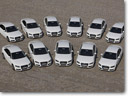 Powerful dynamism, stamina and endurance are just as important in sport as out on the road. To be successful, you need to use your energy as efficiently as possible: On June 23, eleven white Audi A4 2.0 TDI models took to the start in the efficiency competition organized by Audi and Auto Bild. To stand a chance of winning, however, the teams have to complete the total distance of over 1,650 kilometers (1,025.26 miles) with an average fuel consumption of under four liters (over 58.80 US mpg). (more…)
-
R 320 BlueTEC, ML 320 BlueTEC and GL 320 BlueTEC – The cleanest solution
 In October 2006, Mercedes-Benz was the first manufacturer to commence a BlueTEC initiative in the passenger car segment which was timed to coincide with the introduction of low-sulphur fuel in the United States of America. The E 320 BlueTEC proved a great success from the outset, and was voted “World Green Car of the Year 2007”. As a next step, Mercedes-Benz is now due to offer the R, ML and GL 320 BlueTEC in the USA, the world’s first three diesel cars which not only meet the particularly demanding criteria of the American Bin 5 standard, but also have the potential to fulfil the stringent EU6 standard due in the future – and which therefore considerably better all the current, worldwide exhaust emission standards for diesel passenger cars. (more…)


