Tag: Aston Martin

  • Aston Martin Vantage GT4

    Aston Martin is thrilled to announce the arrival of the brand new Vantage GT4, the latest addition to their formidable racing lineup. This track-focused beast is built for both professional racers and passionate enthusiasts, offering a thrilling and competitive experience.

    Building on the success of its predecessor, the new Vantage GT4 boasts significant performance upgrades derived from the stunning new Vantage road car. It features a host of improvements across the chassis, aerodynamics, drivetrain, and efficiency, making it a true force to be reckoned with on the racetrack.

    Born to Win

    Aston Martin Chief Brand Officer, Marco Mattiacci, hails the Vantage GT4 as a “born winner,” highlighting its class-leading power and technology inspired by the new Vantage road car. This close collaboration between road and race car programs translates into exceptional performance on the track, further solidifying Aston Martin’s commitment to motorsports at all levels.

    Engineered for Excellence

    Developed and built by Aston Martin Racing (AMR), the official GT racing partner since 2005, the Vantage GT4 benefits from their unmatched experience and knowledge. Drawing inspiration from the championship-winning predecessor, the new car incorporates advancements from the Vantage road car to deliver even greater speed and efficiency. While adhering to strict regulations, the Vantage GT4 retains around 80% of the road car’s core structure and mechanics, ensuring a familiar and reliable base.

    Precision on the Track

    The 4.0-liter twin-turbo V8 engine and transmission are derived from the road car, featuring modifications to the electronic control systems for optimal performance and precise control. Bespoke software transforms the eight-speed transmission into a six-speed paddle shift, perfectly tailored for racing applications. New two-way adjustable KW dampers, developed in partnership with the renowned suspension manufacturer, offer exceptional precision and control, while maintaining the driver-friendly characteristics that made the previous Vantage GT4 so popular.

    Aerodynamic Advantage

    The Vantage GT4’s stunning design closely resembles the road car, with subtle yet effective aerodynamic modifications. Utilizing advanced Computational Fluid Dynamics (CFD) and collaborating with Aston Martin’s Design department, AMR crafted a high-performance aerodynamic package that seamlessly integrates with the car’s aesthetics. Larger front splitter and a new rear wing, permitted by GT4 regulations, generate increased downforce and reduced drag for superior handling and speed.

    Ready to Race

    The new Vantage GT4 successfully completed its development program and made its international racing debut at the Rolex 24 Hours at Daytona. Production is already underway, with several cars delivered to customer teams and over 40 units ordered for the 2024 season.

    A Legacy of Success

    Since its debut in 2009, the Aston Martin Vantage GT4 has established itself as a dominant force in GT racing, consistently securing victories in various series and endurance events worldwide. Building on this winning legacy, the new Vantage GT4 is poised to continue this tradition, offering a fast, reliable, and exploitable package for racers of all levels to challenge for victory.

  • Aston Martin DB12

    Aston Martin is thrilled to introduce the brand-new DB12. This next-gen member of the iconic DB lineage sets a whole new standard in athleticism and dynamic prowess, carving out its own unique category. Fusing an exhilarating driving experience with unparalleled elegance, cutting-edge technology, and luxurious indulgence, the DB12 demands a fresh definition. Being merely grand doesn’t cut it anymore; this is the world’s first-ever Super Tourer.

    The DB12 embarks on a daring new path, making it the most accomplished and well-rounded DB model in Aston Martin’s history. Endowed with extraordinary performance and handling to satisfy even the most discerning drivers, its painstakingly refined chassis seamlessly partners with a top-of-the-line 680PS/800NM V8 Twin-Turbo powertrain. The result is a reinvigorated Aston Martin that radiates authenticity, capability, and a profound passion, delivering an unrivaled driving experience.

    Designed to maximize performance and intensify emotions, the DB12 is the fruit of a holistic approach. It begins with significant enhancements in structural rigidity and culminates with Michelin Pilot Sport 5 S tires custom-crafted to Aston Martin’s meticulous specifications. Supported by an all-new suspension system boasting state-of-the-art adaptive dampers, the connection and control are further amplified by an exquisitely precise and direct Electronic Power Assisted Steering (EPAS) system and an Electronic Rear Differential (E-Diff) that heightens agility, bringing the DB12 to life on the most dynamic of roads.

    Backed by an industry-leading Electronic Stability Control (ESC) system that leverages six-axis inertia measurement to anticipate available grip, the DB12 also grants the driver the freedom to choose from five pre-set driving modes, enabling incremental exploration of the limits of grip and traction with absolute confidence and safety. In simple terms, no other Aston Martin in series production has devoted itself so completely to setting new benchmarks in dynamics.

    The announcement of the DB12 coincides with Aston Martin’s celebration of two momentous milestones in 2023: its monumental 110th anniversary and 75 years of the illustrious DB model lineage. When Lionel Martin and Robert Bamford founded the partnership that birthed Aston Martin, they ignited over a century of automotive passion, cutting-edge British innovation, and high-octane racing triumphs. This comes at a time when Aston Martin is experiencing one of the most dynamic periods in its 110-year history, thanks to its continued success on the Formula 1® podium in the 2023 season. Competing at the apex of global motorsport remains a fundamental pillar of the brand’s strategy.

    The core values of high-performance and ultra-luxury embodied by the DB12 are spearheading Aston Martin’s next generation of sports cars, heralding a new era. From now on, all Aston Martin models will be characterized by prodigious performance, pinpoint dynamics, seamless integration of advanced technologies, and the sublime style and exquisite craftsmanship that have long defined the brand.

    Roberto Fedeli, Group Chief Technology Officer of Aston Martin, expressed his thoughts on the new DB12, stating, “DB12 is a car that makes a statement. It firmly establishes Aston Martin as a leader in performance, dynamics, engineering, and technology. We have pushed every aspect of this car to achieve excellence. The outcome is more power and performance than its competitors, accompanied by exceptional handling and an exhilarating soundtrack. It is a car with a passionate and genuinely sporty character. Crucially, we have achieved all this without compromising refinement, comfort, and luxury. Alongside our employment of industry-leading dynamic control and infotainment systems, the DB12 signifies the beginning of Aston Martin’s most thrilling new era.”

    Performance

    DB12 doesn’t hold back; it makes a bold and unequivocal statement. It exudes the confidence of a car that sprints from 0 to 60mph in a mere 3.5 seconds, reaches a top speed of 202mph, and boasts unparalleled power from its 4.0 Twin-Turbo V8 engine. This extraordinary engine, meticulously crafted by Aston Martin engineers, unleashes an industry-leading 680PS/671bhp at 6000rpm and 800Nm/590lb ft of torque between 2750-6000rpm—an impressive 34% increase compared to its predecessor, the DB11.

    To achieve these heightened performance outputs, various enhancements have been made. The cam profiles have been modified, compression ratios optimized, turbochargers enlarged, and cooling capacity increased. The entire cooling system has undergone a complete redesign, with two additional auxiliary coolers added to the central main radiator to meet the elevated thermal demands. To ensure the engine maintains desired intake air temperatures under all conditions, a supplementary low-temperature radiator has been integrated into the charge cooler water circuit.

    Furthermore, the auxiliary outboard engine oil cooler now boasts more than twice the surface area of its predecessor, effectively managing the lubrication circuit’s requirements. Optimal cooling has been further achieved by enhancing thermal airflow, increasing the open apertures by 56% to allow a greater influx of cold air into the radiators. Additionally, centrally positioned bonnet vents situated above the twin turbos facilitate the escape of hot air.

    Handling and dynamics 

    Power is transmitted through an 8-speed automatic gearbox, accompanied by a first-time inclusion on an Aston Martin DB model: the Electronic Rear Differential (E-Diff). Unlike a traditional Limited Slip Differential, the E-Diff is linked to the car’s Electronic Stability Control (ESC) system. It can swiftly transition from fully open to 100% locked, providing the driver with immediate response and precise, consistent handling.

    Working seamlessly with the latest generation ESC system, the E-Diff significantly enhances the DB12’s cornering capabilities under any circumstances. In low to medium-speed corners, the DB12 exhibits impressive agility and responsiveness, truly coming alive on demanding roads with exceptional front-end grip and remarkable traction. Moreover, the DB12 maintains complete composure in high-speed corners, instilling the driver with a sense of confidence and control.

    To enhance driver engagement and intensify performance, the DB12 incorporates a revised Final Drive Ratio (3.083:1), which results in punchier acceleration during gear shifts. Additionally, a unique transmission shift calibration reduces shift speeds and provides distinct shift characteristics tailored to the DB12’s diverse range of dynamic modes.

    The DB12’s bonded aluminum structure has undergone enhancements, resulting in a 7% increase in global torsional stiffness. This improvement stems from modifications to various underbody components, such as the engine cross brace, front and rear undertrays, front crossmember, and rear bulkhead. As a result, torsional rigidity and lateral stiffness have been refined, particularly between the front and rear strut towers. This strengthens the attachment points for the dampers and rear axle, leading to improved suspension performance, isolation, refinement, on and off-center steering feel, and an overall heightened sense of driver connection.

    With the introduction of new-generation intelligent adaptive dampers and meticulous engineering of key elements like stiffer anti-roll bars, the DB12 boasts class-leading driving dynamics and a significantly expanded range of capabilities.

    These cutting-edge dampers possess a 500% increase in force distribution bandwidth, offering a vast improvement that allows for greater control and refinement across the DB12’s various drive modes. By leveraging this expanded scope, Aston Martin’s vehicle attribute engineers have pushed the DB12’s character well beyond that of its class rivals.

    Thoughtful calibration of the dampers enables the gradual introduction of heightened response and tighter body control as the dynamic modes are cycled through. The suspension bushings have been meticulously tuned to deliver exceptional refinement and isolation. Combined with the E-Diff and ESC system, this means that in GT mode, the DB12 retains a luxurious ride quality for sublime and agile cruising. In Sport and Sport+ modes, the DB12’s responsiveness is intensified, and body control is tightened, enveloping the driver in a more compact driving experience, allowing the car to truly come alive on challenging roads like never before.

    As the primary point of interaction between the car and the driver, considerable attention has been dedicated to perfecting the DB12’s Electronic Power Assisted Steering system (EPAS). The process begins with the installation of a non-isolated steering column, enhancing the dynamic feel by preserving the purity and uncorrupted nature of steering inputs from the driver and feedback from the road.

    The calibration of the EPAS focuses on providing a balanced on-center feel along with a swift and natural rate of response. Care has been taken to avoid exaggerated or overly aggressive steering responses, resulting in an intuitive and confidence-inspiring feel in the DB12. This allows the driver to relax during long journeys while still being able to enjoy the car’s precision, responsiveness, and agility when attacking corners.

    To maintain consistency and enhance driver connection, the EPAS features a constant 13.09:1 ratio rack with variable, speed-sensitive assistance and 2.4 turns lock-to-lock. The level of assistance is dynamically adjusted based on the DB12’s drive mode programs, gradually reducing as the car moves towards the most aggressive mode (Sport+).

    To match its impressive speed, the DB12 is equipped with standard cast-iron 400mm front discs and 360mm rear discs. These discs have grooved and drilled faces to improve thermal capacity. The brake booster has also been fine-tuned to provide better pedal feedback, instilling greater confidence in the driver with a firm pedal feel and immediate stopping power combined with progressive response.

    Emphasizing its Super Tourer credentials, the DB12 offers an optional Carbon Ceramic Brake (CCB) system. The CCB option provides enhanced braking performance and reduced brake fade even at high temperatures of up to 800°C. By choosing the CCB, the car benefits from a weight reduction of 27kg in unsprung mass compared to the standard braking system. This reduction contributes to improved ride quality and steering response.

    As a testament to its commitment to the DB12’s Super Tourer nature, Aston Martin has partnered with Michelin to introduce the new Michelin Pilot Sport 5 S tires, specifically designed for this model. The front tires are sized 275/35 R21 103Y, while the rear tires are 315/30 R21 108Y. These tires are not off-the-shelf versions but feature bespoke compounds and tuning by the Aston Martin dynamics team. They offer exceptional reactivity for precise steering, along with maximum grip in both wet and dry conditions.

    The Pilot Sport 5 S tires also incorporate noise-cancelling polyurethane foam inserts in their construction, reducing tire noise transmitted to the car’s interior by 20%. This results in lower noise levels, improved refinement, and enhanced driver comfort.

    The DB12 comes standard with 21-inch forged alloy wheels, with a front size of 9.5J and a rear size of 10.5J. There are three design options available: the standard Five-Spoke, and the optional Multi-Spoke and Y-Spoke. These wheels come in various colors and finishes, including Gloss Silver, Satin Platinum, Satin Black, Satin Black Diamond Turned, Satin Bronze, and Satin Black Diamond Turned. Aston Martin has optimized the structure of these lightweight wheels to maximize performance without compromising aesthetics, using advanced simulation techniques to remove excess mass. As a result, these wheels are 8kg lighter than the previous 20″ offerings.

    Driver centricity

    The DB12 is equipped with an industry-leading Electronic Stability Programme (ESP) system designed to provide the driver with optimal dynamic support without feeling overly restrictive. The system offers four pre-defined ESP modes: Wet, On, Track, and Off, which can be selected via the ESP button on the center console. These modes are seamlessly integrated to deliver progressive control while avoiding abrupt interventions.

    The ESP system utilizes information from various sensors positioned around the vehicle, including the advanced six-axis inertia measurement unit. This unit collects complex accelerometer data in real-time, enabling the system to build a precise picture of the car’s behavior. Using advanced algorithms, the ESP system predicts the available grip level and reacts to momentary instabilities.

    The goal of this sophisticated system is to operate discreetly in the background, allowing the driver to extract the best performance from the car while maintaining a high level of safety. The same predictive and model-based technology is applied to all the car’s chassis control systems, including ABS, Traction Control, and Lateral dynamics, resulting in an unprecedented integration that enhances driver confidence and enjoyment.

    In addition to the multi-mode ESP, the DB12 offers five pre-defined drive modes: GT, Sport, Sport+, Wet, and Individual. Each mode progressively adjusts the car’s dynamic behavior, with increasing freedom for the driver to explore the limits of grip and traction. Wet mode enhances stability on low-grip surfaces, while Individual mode allows precise customization of the vehicle systems according to the driver’s preferences, including chassis, powertrain, ESP, and traction control settings.

    The drive modes can be selected using a knurled rotary controller on the center console, enabling quick and easy cycling through the five pre-sets. Additionally, individual override buttons for the chassis, ESP, and exhaust are located on the center console, allowing the driver to prioritize their preferred settings and override the default drive mode settings.

    Exterior

    The DB12 boasts a bold and confident exterior design that embodies power and potency. Aston Martin’s impeccable style is showcased in the car’s design, integrating 75 years of DB heritage and featuring proportions that set it apart as the world’s first super tourer. With its athletic physique, measured aggression, and unparalleled elegance, the DB12 commands attention on the road.

    The front-end of the DB12 has been redesigned to reflect its increased power, featuring a larger radiator aperture and a reshaped splitter. The new Light Emitting Diode (LED) headlights with a distinctive Daytime Running Lamp (DRL) signature and intricate surface detailing further enhance the car’s presence. The wider track, increased by 6mm at the front and 22mm at the rear, emphasizes the DB12’s wide-track stance. Standard-fit 21-inch forged alloy wheels complete the look, while the iconic Aston Martin wings badge takes its place proudly on the nose of the car. The DB12 is the first sports car to showcase the new wings design. The addition of smaller, frameless wing mirrors improves both aesthetics and aerodynamics. The car’s exterior design also features welcome door handles to facilitate entry.

    Marek Reichman, Executive Vice President and Chief Creative Officer of Aston Martin, describes the DB12 as the epitome of a Super Tourer, combining comfort, speed, refinement, handling, dynamics, powertrain, sense of space, and styling into a remarkable driving experience. The car intuitively understands the driver’s desires and effortlessly delivers the optimal combination of performance and control at any given moment. The DB12 represents a new breed of Super Tourer, blending speed, performance, and the thrill of open-road driving with safety and command.

    Inside, the DB12 offers a completely redesigned interior with clean horizontal lines that create a sense of space. The cabin provides the perfect contemporary backdrop for the new state-of-the-art infotainment system. The design is emphatically fresh while unmistakably Aston Martin, representing the brand’s progression into the future.

    For customers who seek to personalize their DB12, Aston Martin offers the Q by Aston Martin personalization service. This service allows customers to embark on a unique commissioning journey, from small distinguishing details to fully bespoke components. The Q design team and craftspeople provide endless possibilities to create a truly one-of-a-kind DB12 that reflects individual style and preferences.

    Interior

    The DB12’s interior is a luxurious haven that combines modern opulence with Aston Martin’s bespoke infotainment system and cutting-edge connected technology. Crafted with a blend of contemporary design, classic craftsmanship, and premium materials, it provides a stylish and sumptuous space for both the driver and passengers. The driver-centric cockpit seamlessly integrates everyday technologies with luxury materials, ensuring maximum comfort and engagement. The cabin features elegant details, exquisite trim, and ergonomic controls that enhance the driving experience.

    Craftsmanship is a hallmark of Aston Martin, and the DB12 upholds this tradition with swaths of hand-stitched Bridge of Weir hides that exude comfort and luxury. The new quilting pattern, available in full leather or Alcantara®, adds a unique character and exquisite detailing to the interior.

    Aston Martin introduces its next-generation in-house infotainment system in the DB12, a fully integrated multi-screen system with 10.25-inch high-resolution touchscreens. The system supports wireless Apple CarPlay™ and Android Auto™*, providing a seamless connectivity experience. To strike a balance between touch controls and tactile feedback, the DB12 retains physical buttons for key operations such as gear selection and heating, offering a blend of digital and analogue controls. Override switches for chassis, ESP, exhaust, Lane Assist, and Park Distance Control ensure convenient access to frequently used features.

    The DB12’s navigation system offers online connectivity for a smarter and more informative experience. Drivers can search for their favorite restaurants, read reviews, and set them as destinations through the Aston Martin App or the car’s navigation system. The 3D mapping with lane guidance and real-time traffic overlays ensures intuitive and efficient routing, while satellite view provides detailed visualizations of the surroundings.

    Central to the DB12’s infotainment system is online connectivity and the Aston Martin App, enabling communication and interaction with the car. Online connectivity allows for Over The Air (OTA) updates and diagnostics, enhancing ease of use and peace of mind. The Aston Martin App, available on iOS and Android, provides seamless control, feedback, and personalized content specific to the vehicle. Customers can monitor, locate, and protect their DB12, access navigation features, manage their account details, and engage with the Aston Martin community through integrated media feeds.

    To enhance the ownership experience, Aston Martin offers three connected car subscription packages, free for the first three years. These subscriptions provide additional benefits and are tied to the vehicle, even if it is re-purchased through the Timeless approved pre-owned sale program. The connected car ecosystem is powered by the DB12, the Aston Martin App, and Aston Martin’s secure data servers, connected through global 4G LTE / GSM cellular networks.

    In summary, the DB12’s interior offers a blend of luxury, technology, and craftsmanship, with Aston Martin’s bespoke infotainment system and connected features enhancing the driving experience. The Aston Martin App provides seamless control and interaction with the car, while the connected car subscriptions offer additional benefits and peace of mind to owners.

    The connected subscriptions and features are as-follows:

    Convenience

    Connected Navigation / Theft Alert / Voice Assistant / Geofence Alert

    Vehicle Management

    Locate / Identify / Protect / Speed Alert / Trip Data / Vehicle Status / Remote Lock / Unlock

    Vehicle Services

    Emergency Call / Breakdown Call / Aston Martin Concierge / Privacy Mode / Over The Air Updates / Subscriptions / Diagnostics

    For those seeking even more personalization and enhanced features, an optional Advantage subscription is available for DB12 owners. This subscription offers additional customization options, interaction capabilities, and functional benefits. Starting with a Stolen Vehicle Tracker, Advantage allows owners to expand and enrich their ownership experience with a portfolio of additional features and subscription services.

    Aston Martin’s commitment to excellence extends to the audio experience in the DB12. As standard, the car comes with the Aston Martin 390w 11 speaker audio system. This advanced system utilizes QuantumLogic® sound processing and offers a surround sound mode, delivering an audio performance that perfectly complements the DB12.

    To satisfy the discerning ears of audiophiles, Aston Martin has collaborated with renowned audio partner Bowers & Wilkins to develop an optional bespoke surround sound system. Drawing on the technology and innovation found in Bowers & Wilkins’ world-class hi-fi systems, this 15-speaker, double-amplified 1,170W surround sound system is acoustically engineered to deliver an exceptional listening experience tailored to the DB12’s interior volume and shape.

    Featuring high-performance loudspeakers such as Aluminium Double Dome tweeters and Continuum® midrange speakers, along with dedicated 3D headline speakers and a powerful subwoofer, this system ensures a balanced and accurate sound reproduction. The speaker positions have been carefully optimized for perfect location, direction, and symmetry within the DB12’s structure, resulting from close collaboration between Aston Martin and Bowers & Wilkins’ engineers.

    The seamless integration of the audio system’s design ensures that it looks as impressive as it sounds. The stainless steel speaker grilles, available in finishes that match the interior jewelry of the DB12, feature perforations designed for both optimal acoustics and striking aesthetics.

    Amedeo Felisa, Chief Executive Officer of Aston Martin, expressed his enthusiasm for the DB12, stating, “With the new DB12, we are reinvigorating the DB model line and reasserting Aston Martin as a maker of truly exceptional performance sports cars. By combining class-leading performance and exceptional chassis dynamics with cutting-edge technology, impeccable craftsmanship, and immaculate design, DB12 leads Aston Martin into a new era of excellence.”

    The DB12 is set to begin its first deliveries in the third quarter of 2023, marking a new category of its own and setting the bar for performance, driving excitement, ultra-luxury, and style. It transcends the traditional GT concept and proudly claims the title of The World’s First Super Tourer.

    DB12 TECHNICAL SPECIFICATION

    Body                          

    Two Door Body Style with 2+2 Seating
    Extruded Bonded Aluminium Body Structure with Composite Panels
    Deployable spoiler with Aston Martin Aeroblade system

    Engine                                   

    4.0-litre V8 Twin Turbo
    Water-to-air-charge cooling
    Front mid mounted engine, rear wheel drive
    Maximum power: 680PS / 671bhp / 500kw @ 6,000rpm
    Maximum torque: 800Nm / 590 lb-ft @ 2,750 – 6,000rpm
    Top speed: 202mph / 325km/h
    0-60mph: 3.5s
    0-62mph / 0-100km/h: 3.6s
    Compression ratio: 8.6
    Dual Variable Camshaft Timing
    Fully CNC machined combustion chambers


    Transmission                        

    Rear mounted eight-speed automatic transmission
    Torque converter
    Electronic rear limited slip differential
    Carbon fibre prop shaft


    Gear ratios

    1st Gear Ratio: 4.714 2nd Gear Ratio: 3.143 3rd Gear Ratio: 2.106
    4th Gear Ratio: 1.667 5th Gear Ratio: 1.285 6th Gear Ratio: 1
    7th Gear Ratio: 0.839 8th Gear Ratio: 0.667 Final Drive: 3.083


    Steering                                 

    Variable Electrical Power Assistance
    Steering ratio: 13.09.1
    Turns lock to lock: 2.375


    Suspension                           

    Front-Independent Double Wishbone, Coil Springs & Anti-Roll Bar
    Rear – Multi-link Suspension, with Coil Springs & Anti-Roll Bar
    Adaptive Damping System (ADS) with Skyhook Technology & Intelligent Adaptive Dampers


    Drive Modes                          

    Five selectable drive modes: Wet, GT, Sport, Sports Plus and Individual
    (Tailoring Drivetrain, Steering and Chassis calibrations)


    Advanced Driver Assistance Systems (ADAS)                               

    Forward Collision Warning
    Autonomous Emergency Braking
    Adaptive Cruise control with Stop & Go function
    Lane Departure Warning
    Lane Keep Assist
    Auto High Beam
    Traffic Sign Recognition
    Blind Spot Monitoring
    Door Open Assist
    Rear Cross Traffic Assist
    Driver Drowsiness Detection (Coffee Cup)
    360˚ 3D Surround Camera view


    Wheels and Tyres                 

    21″ Wheels
    Michelin Pilot Sport 5 S
    Front: 275/35/ZR21
    Rear: 325/30/ZR21
    Bespoke Summer Tyres – designed specifically for DB12
    Bespoke Winter Tyres – designed specifically for DB12


    Brakes & Chassis Systems  

    Steel Brake System

    • Front: 400mm x 36mm 6-piston Caliper
    • Rear: 360mm x 36mm with a 4-piston Caliper

    Carbon Ceramic Brake System

    • Front: 410mm x 38mm Carbon Ceramic Disc
    • Rear: 360mm x 38mm Carbon Ceramic Disc

    Electric Park Brake

    Dynamic Stability Control (DSC)
    Anti-lock braking system (ABS)
    Electronic Brake Distribution (EBD)
    Emergency Brake Assist (EBA)
    Traction Control (TC)
    Hydraulic Brake Assist (HBA)
    Positive Torque Control (PTC)
    Dynamic Torque Vectoring (DTV)


    Dimensions

    Height: 1,295 mm
    Width (including mirrors): 2,145 mm
    Width (mirrors folded): 2,060 mm
    Length: 4, 725 mm
    Wheelbase: 2,805 mm
    Ground Clearance: 120 mm
    Front Overhang: 925 mm
    Rear Overhang: 995 mm
    Approach Angle: 10.1 °
    Approach Angle: (with lower body packs): 10 °
    Departure Angle: 20.5 °
    Boot Volume: 262 litres
    Fuel Tank: 78 litres
    Weight : 1685kg *dry weight
    Weight Distribution (Front:Rear): 48: 52
    Turning Circle: 12.4 m

    DESIGN


    Standard Specification (Exterior)     

    Paint – Solid
    Lower Body Package – Body Colour
    Upper Body Package – Body Colour
    21” Five Spoke Wheel – Satin Silver
    Grille – Satin Chrome Vaned
    Brake Calipers – Dark Grey Anodised
    Brake Discs – Steel Brake System
    Tail Lights – Red
    Roof Panel – Body Coloured
    Badging – Enamel Wings Badge with Green Infill
    Clear Glass

    Standard Specification (Interior)      

    Interior Trim – Create – Haircell Leather
    Seating – Comfort Seat
    Trim Split – Monotone
    Stitch – Matched
    Brogue – Matched
    Seatback – Leather
    Headlining – Black Alcantara
    Carpet – Black 600GSM
    Seat Technology – Seat Heating
    IP and Door Trim inlay – Gloss Black
    Centre Trim Inlay – Gloss Black
    Interior Jewellery – Satin Chrome
    Steering Wheel – Sports – Colour Keyed Leather
    Seatbelt – Black
    Audio – Aston Martin Audio

    Optional Features (Exterior) 

    Paint

    • Metallic
    • Signature metallic
    • Racing Line
    • Q – Satin
    • Q – Special
    • Q – Heritage

    Lower Body Package

    • Gloss Black
    • Gloss 2×2 Twill Carbon Fibre

    Upper Body Package

    • Gloss Black
    • Gloss 2×2 Twill Carbon Fibre

    Privacy Glass2


    Brake Calipers – Painted:

    • Black3
    • Red
    • Silver
    • Yellow
    • Bronze
    • New Aston Martin Racing Green

    Roof Panel

    • Gloss Black Painted
    • Gloss 2×2 Twill Carbon Fibre

    Tail Lights

    • Smoked

    21” Wheels

    • Multi Spoke Wheel – Satin Platinum
    • Multi Spoke Wheel – Satin Black
    • Multi Spoke Wheel – Satin Black Diamond Turned
    • Y Spoke Wheel – Satin Bronze
    • Y Spoke Wheel – Satin Black
    • Y Spoke Wheel – Satin Black Diamond Turned

    Badging

    • Black Chrome Wings Badges

    Optional Features (Interior)              

    Seating

    • Sports Plus Seat
    • Carbon Fibre Performance Seat

    Interior Trim

    • Accelerate – Haircell Leather & Alcantara
    • Inspire – Semi Aniline Leather
    • Inspire Sport – Semi Aniline Leather & Alcantara

    Trim Split

    • Duotone

    Seat Technology

    • Seat Ventilation
    • 16- way Seat Adjustment

    Seatback – Matched to Door Trim Inlay

    Headlining

    • Coloured Alcantara
    • Leather – Matched to Environment

    Carpet

    • Coloured Carpet 720GSM

    Trim Inlay

    • Light Brushed Aluminium
    • Dark Brushed Aluminium
    • Light Ash Open Pore Wood
    • Dark Walnut Open Pore Wood
    • Satin 2×2 Twill Carbon Fibre7

    Jewellery

    • Dark Satin Chrome

    Steering Wheel

    • Heated and Colour Keyed Sports Wheel

    Seatbelts – Core Palette

    Audio

    • Bowers & Wilkins Audio

    Personalisation

    • Heavy pile floor mats
    • Garage Door Opener
  • Aston Martin DBX707 AMR23 Edition

    Aston Martin is celebrating the triumph of the Aston Martin Aramco Cognizant Formula One® Team by launching an exclusive AMR23 Edition of the world’s most potent and luxurious SUV, the DBX707. The AMR23 Edition is named after the brand’s Formula 1® contender, which gives the DBX707 a racing identity similar to both the AMR23 F1® car and the Official Medical Car of Formula 1®.

    The Aston Martin Aramco Cognizant Formula One® Team has had a fantastic start to the 2023 FIA Formula One World Championship™ season and currently holds the second position in the 2023 Constructor Standings. At the opening round in Bahrain, Fernando Alonso set the benchmark high with a podium finish. Lance Stroll, who was recovering from a cycling accident, was just a few positions behind him. Further podium finishes followed at Saudi Arabia, Australia, and most recently, Miami last weekend.

    To commemorate this achievement, the DBX707 AMR23 Edition elevates the intensity and road presence of the brand’s widely praised ultra-luxury SUV. Aston Martin’s bespoke service, Q by Aston Martin, has crafted a distinctive color and trim combination to create a DBX707 that integrates the exciting universe of F1® with the world’s most vigorous and powerful luxury SUV, giving it a genuinely dynamic and authentic racing appearance. The AMR23 Edition provides unique content to the exterior of the vehicle, such as customized Podium Green paint, an exclusive Q by Aston Martin fender badge, and Aston Martin Racing Green brake calipers.

    The AMR23 Edition highlights increase the attention levels and emphasize the F1® connection with lime accents on the sculpted carbon body kit, inspired by both the AMR23 F1® car and the Official Medical Car of Formula 1®.

    The interior of the AMR23 Edition also includes eye-catching lime contrast stitching on the Inspire Sport Duotone Onyx Black / Eifel Green interior, carbon fiber veneers, and dark satin with carbon fiber jewelry. The AMR23 logo is also visible on the door sills, making it clear to passengers that the Aston Martin racing pedigree runs through the car’s veins.

    The Aston Martin DBX707 is the epitome of high-speed performance, impeccable handling, unmistakable style, and pure luxury. Designed to offer the driver unparalleled control and precision, the vehicle has been refined in terms of its engine, transmission, suspension, brakes, electronic systems, and aerodynamics, ushering in a new era of performance and driving pleasure. The addition of the AMR23 Edition reinforces the DBX707’s driver-focused credentials by providing a genuine racing appearance.

    Alex Long, Aston Martin’s Head of Product and Market Strategy said: “The AMR23 Edition takes DBX707 to a new level of intensity, creating a stand-out ultra-luxury SUV with incredible road presence. It is a real pleasure to offer this special edition in celebration of the recent successes of our Formula 1® team. We are successfully competing at the pinnacle of world motorsport and this represents a key pillar in our brand and product strategy for our road cars. We look forward to getting behind the Aston Martin Aramco Cognizant Formula One® Team once again, at the next round in Italy”.

    Customers can now order the DBX707 AMR23 Edition and enjoy the additional AMR23 highlights.

  • Aston Martin DBS770 Ultimate Volante

    Aston Martin introduced the final DBS model earlier this year with a V12 engine generating 770 horsepower. Now, they have unveiled the DBS 770 Ultimate Volante convertible, which uses the same 5.2-liter twin-turbocharged V12 engine, producing 770 horsepower and 900 Nm of torque.

    Both cars have identical technical specifications, but the convertible model is 0.2 seconds slower in accelerating to 100 km/h due to its open-top design. The coupe takes 3.4 seconds to complete the exercise, while the convertible does it in 3.6 seconds. The maximum speed for both models is 340 km/h.

    The car comes with an 8-speed ZF transmission and adaptive suspension. It also features a mechanical limited-slip differential with increased friction mounted on the rear axle, and carbon-ceramic brake discs tasked with controlling the 21-inch wheels. A similar brake system can be found on the Valkyrie hypercar and the Victor coupe.

  • DBX707: Aston Martin’s powerful beast in Formula 1

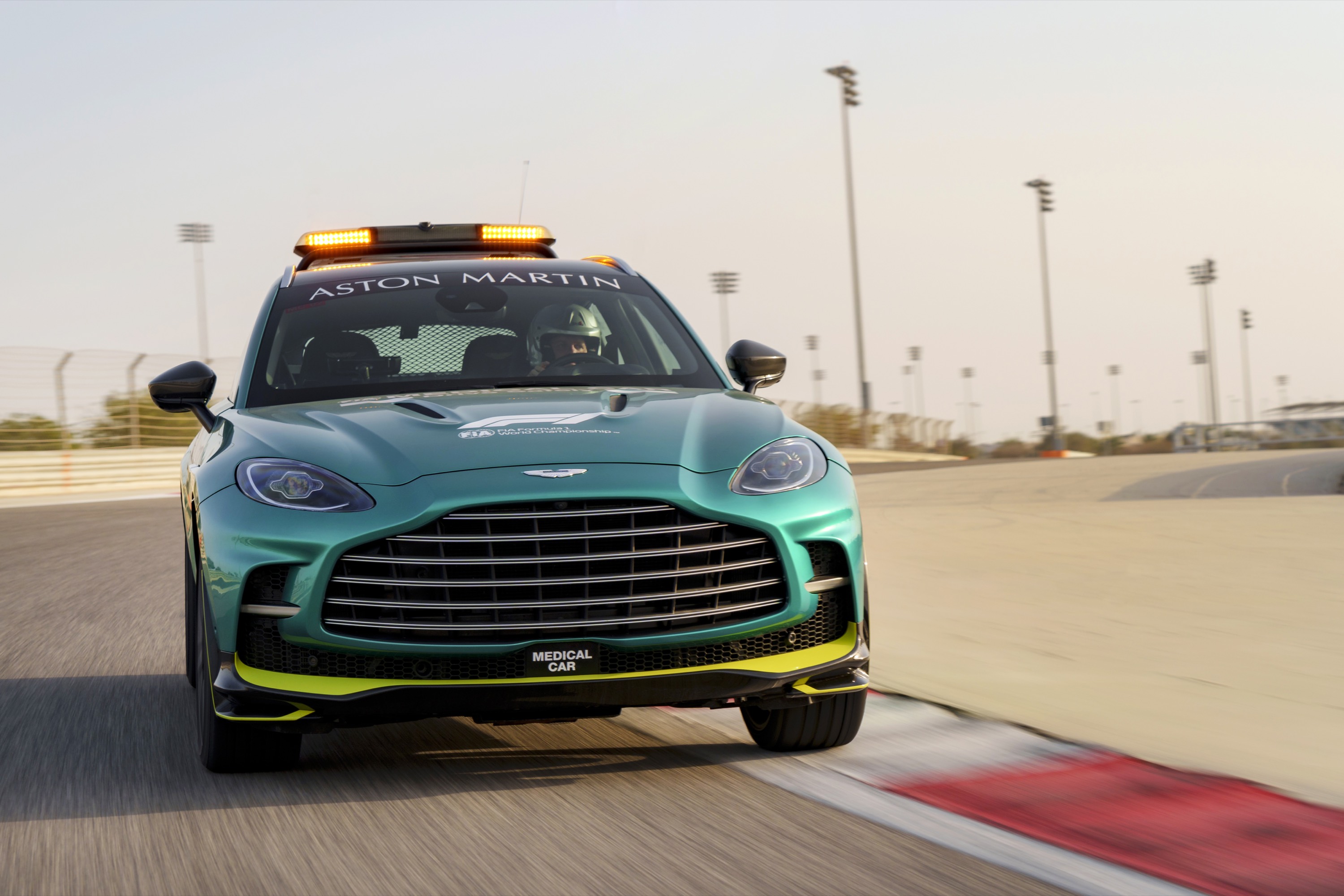
    Aston Martin DBX707 - Front

    The 2023 Formula 1® season is finally upon us and with it comes a new addition to the world of ultra-luxury vehicles, the Aston Martin DBX707. As the new Official Medical Car for Formula 1®, the DBX707 has been upgraded in significant ways, including engine, transmission, suspension, and brake upgrades. It is now the fastest, most powerful, and best-handling car of its kind.

    In its role as the Official Medical Car, the DBX707 will be responsible for transporting medics to the scene of any incidents that may occur during the race. With an impressive 0-60mph acceleration time of just 3.1 seconds, the DBX707 is capable of achieving 707PS with 900NM of torque, allowing drivers to get medics to where they are needed faster than ever before.

    One of the key upgrades to the car is the new wet clutch transmission, which provides noticeably faster gear changes and an improved launch capability known as “Race Start.” This feature is ready and waiting for the call to action from Race Control, making the DBX707 a vital tool for the sport’s officials and medics.

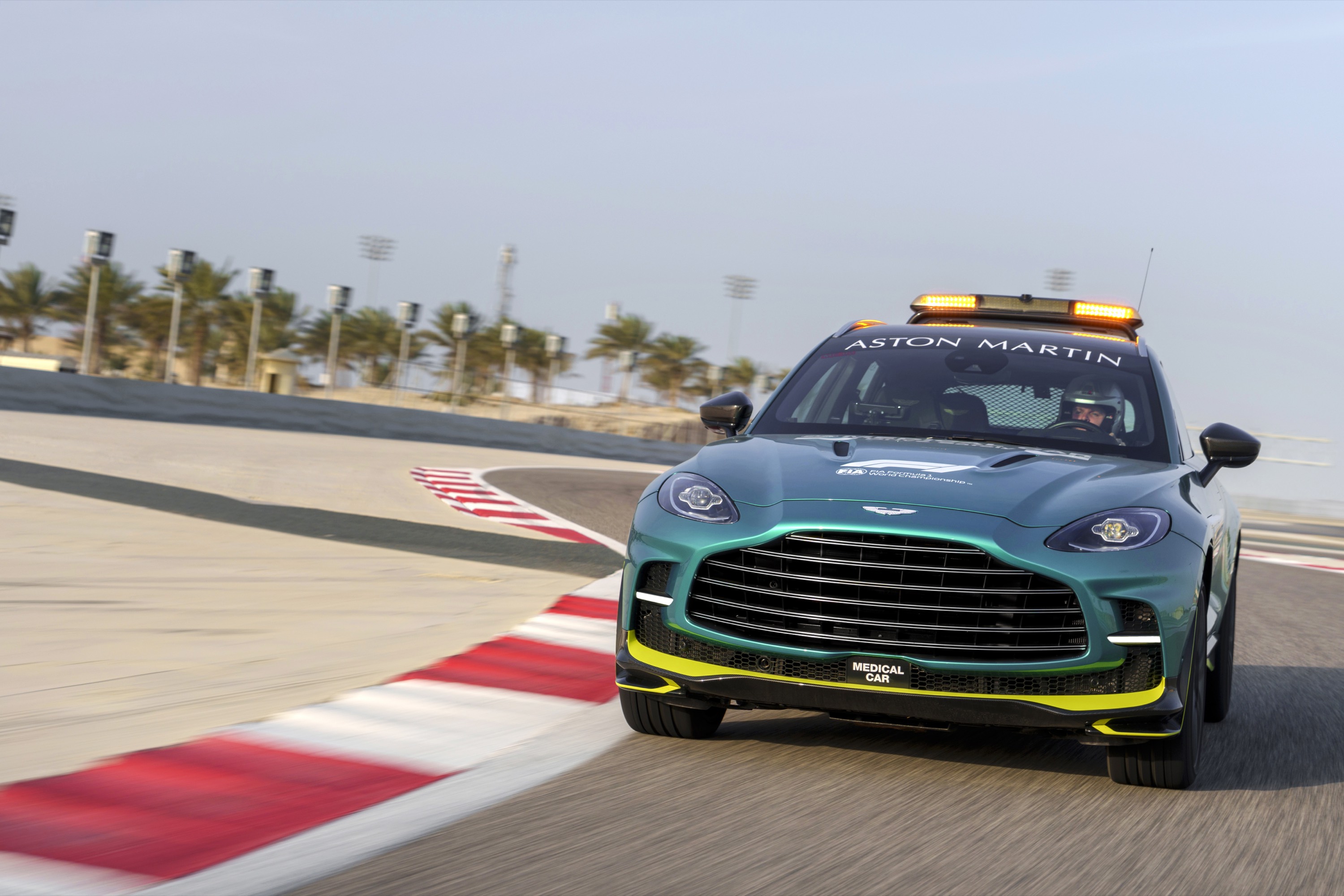
    Aston Martin DBX707 - Front Angle

    The DBX707 will be fully adapted and equipped for its role as Official FIA Medical Car, with essential equipment such as fire extinguishers, medical bags, and a defibrillator, all having its own place in the car for easy access. The car is fitted with FIA-approved racing seats, each with a six-point racing harness, ensuring the safety of passengers.

    In addition to the DBX707, the Aston Martin Vantage FIA Safety Car will continue to lead the F1® cars around on the formation lap, as well as continuing its role as the Official Safety Car of Formula 1®. Equipped with FIA-specified safety equipment, the Vantage FIA Safety Car is the fastest of its kind and has had a winning start to the 2023 racing season, taking the GT victory in January’s Rolex 24 at Daytona.

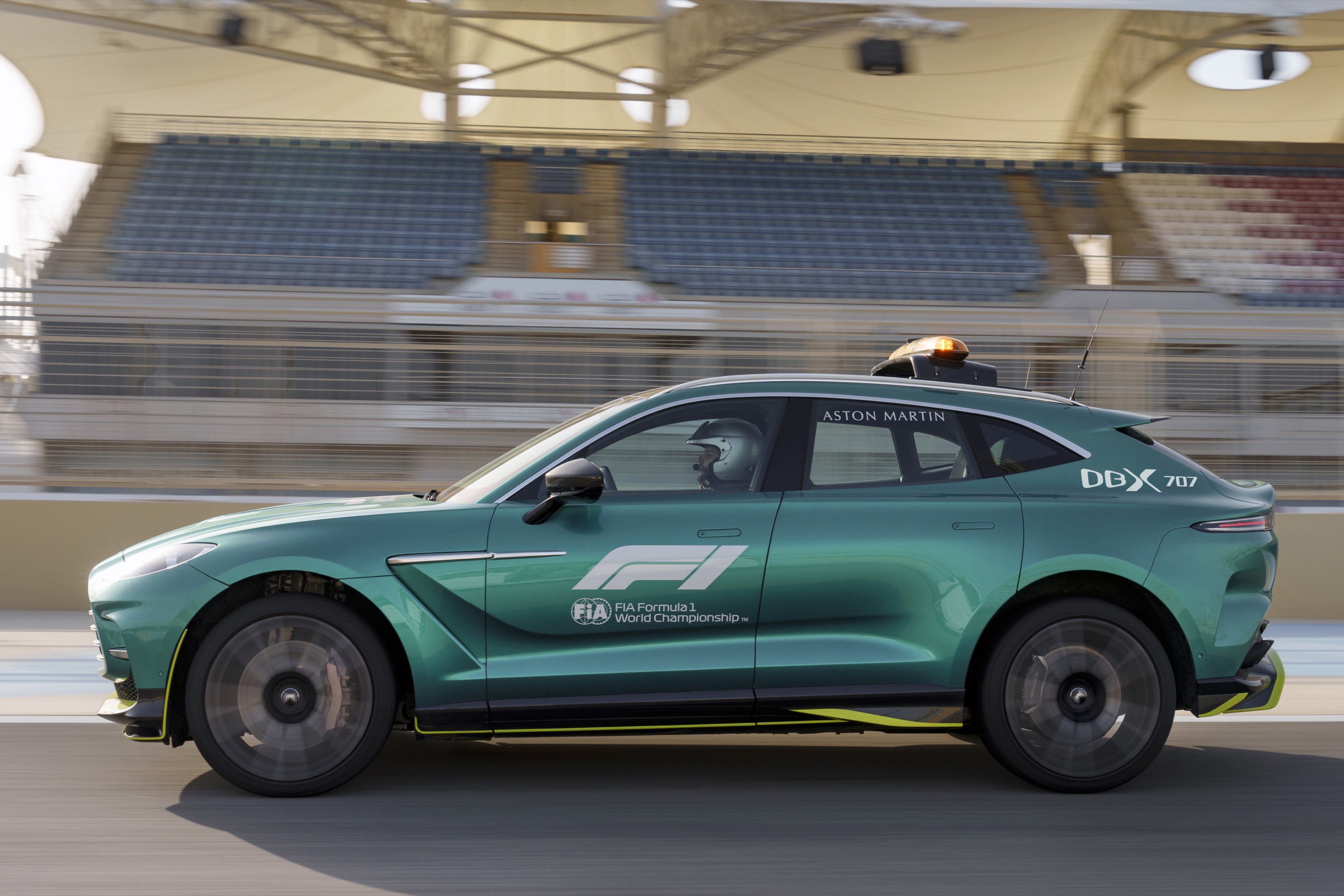
    Aston Martin DBX707 - Side

    Developed by the Engineering team at Aston Martin’s world-leading sports car design and engineering facility in Gaydon, UK, this one-of-a-kind Vantage is packed with performance learnings from the many Aston Martin Vantage race cars that compete across the globe every year.

    Roberto Fedeli, Aston Martin Chief Technology Officer, said, “DBX707 is the perfect vehicle for the critical role as an Official FIA Medical Car of Formula 1®, providing the performance and punch required for the world’s greatest racing circuits, in addition to the flexibility and space required by the sport’s officials and medics.”

    With the eyes of the world on their products, Aston Martin is proud to continue their partnership with Formula 1® and the FIA, showcasing the capabilities of their ultra-luxury high-performance cars.

    In conclusion, the Aston Martin DBX707 and Vantage FIA Safety Car are the perfect combination of performance and luxury, providing a vital service for the world’s greatest racing circuits. As the 2023 Formula 1® season gets underway, fans of the sport can look forward to seeing these incredible vehicles in action, supporting the drivers and ensuring their safety throughout the race.

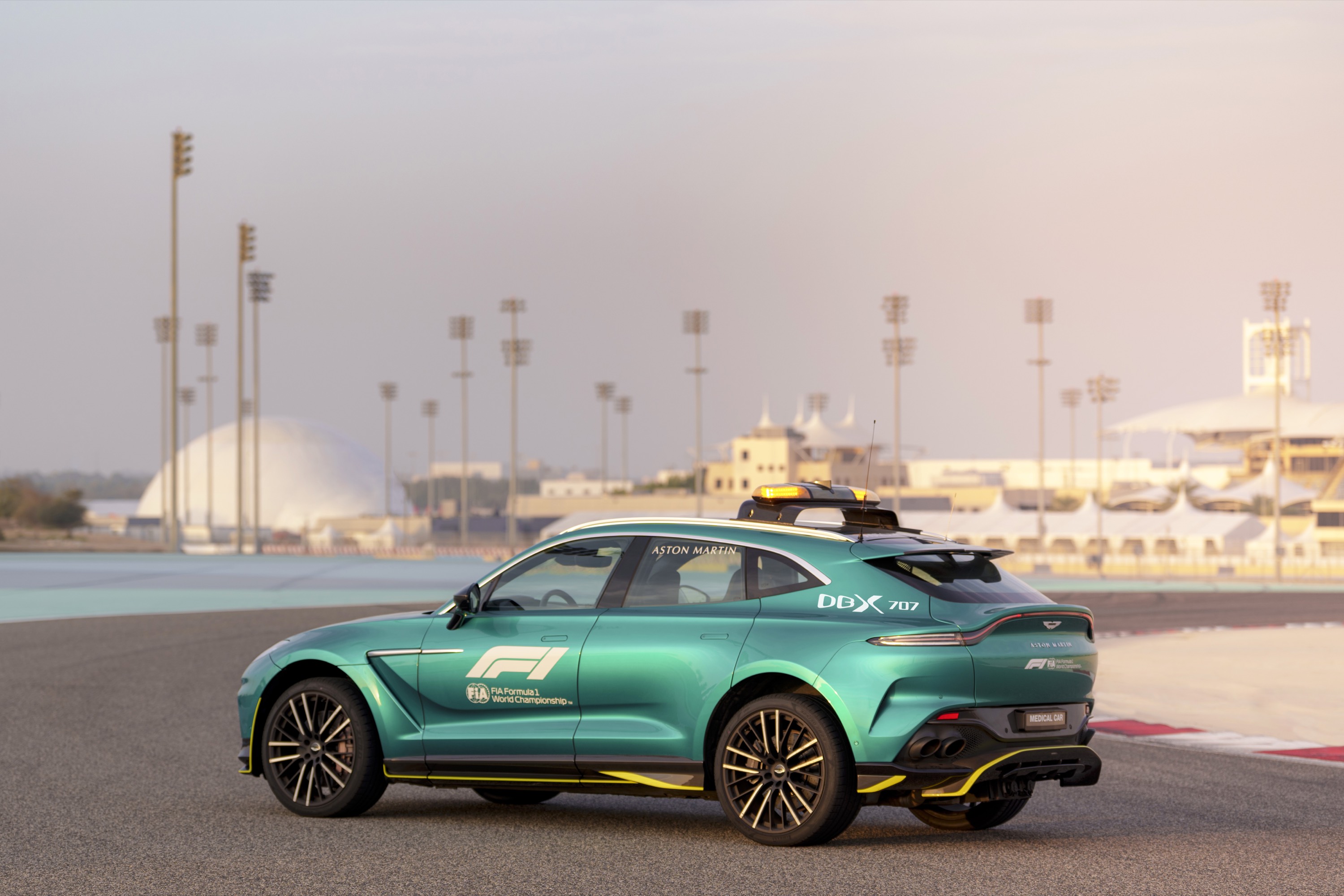
    Aston Martin DBX707 - Rear Angle

  • Aston Martin V8

    It’s 1972, and Aston Martin is undergoing one of its periodic seismic changes. Sir David Brown, the talented industrialist who steered the business through some of its most memorable 20th Century moments, has sold the firm to a new owner, Company Developments Ltd, and a fresh spirit of optimism takes hold.

    Enter the AM V8. A car that, while launched early in the tenure of Company Developments was firmly rooted in the engineering and design ethos of the David Brown era. Replacing the DBS V8, which had itself championed the use of Aston Martin’s first V8, and the first new engine for more than ten years, the AM V8 was essentially a styling exercise – replacing the angular nose of the DBS with a more curvaceous, purposeful front end that, together with some subtle styling changes elsewhere, gave the new car a much more muscular look. Key to that new nose was the arrival of two seven-inch quartz iodine headlamps and a black mesh grille.

    The return of a small open ‘power bulge’ on the bonnet; the ‘Coke-bottle’ flanks; and the use of Aston Martin V8 side strake badges completed the exterior styling revisions. That this same William Towns’ shape, in essence, would represent the Aston Martin ‘look’ for almost two decades – the last AM V8 styling-inspired cars only ending production in 1989 – shows not only the importance of its 1972 debut, but also the appeal of a styling silhouette that is utterly unmistakable today as a product of the marque’s Newport Pagnell era.

    This first iteration of the 5.3-litre engined AM V8 retained the Bosch fuel injection system from the DBS V8, and while power and torque figures were not commonly quoted, it is believed that these cars were good for as much as 320 bhp, with around 360 lbs/ft of torque. Mated to a ZF five-speed manual gearbox, or optional Chrysler Torqueflite 3-speed auto, that was ample urge to carry this early ‘70s sports car from rest to 60 mph in around six seconds with a top speed of circa 160 mph.

    As was often the case in Aston Martin history, production numbers of these early cars were incredibly small by today’s standards. A mere 289 AM V8 models of this iteration were built between April 1972 and July ’73. They were succeeded by cars with less complex Weber carburetion, the later cars also featuring larger bonnet scoops.

    Numerous iterations of the AM V8 followed over the years – the 1978 ‘Oscar India’ cars with closed bonnet scoop among their changes being among the most plentiful – along with the arrival of Volante versions in June 1978 for those seeking open top motoring. What united the cars, though, aside from their style, performance and exclusivity, was their luxury. The finest Connolly hides, sumptuous Wilton carpeting and, from the arrival of the ‘Oscar India’ cars, the use of burr walnut dashboard trim, were among the many features that marked out these cars as luxury models.

    V8 Vantage

    No AM V8 retrospective would be complete without reference to the original Aston Martin V8 Vantage. It was hailed at its 1977 introduction as “Britain’s first supercar”. It could outrun a Ferrari Daytona in the 0-60 mph sprint, and if pushed to the limit it could record a top speed of 170 mph thanks to its use of high-performance camshafts, an increased compression ratio, larger inlet valves and bigger carburettors mounted on new manifolds for increased output.

    A true British bruiser, the V8 Vantage’s performance belied its significant heft. Critical to the huge performance leap of this Vantage was a significant upgrade to the V8 engine, thereby triggering the ‘Vantage’ moniker, of course.

    The carburettors were changed to the larger 48 IDF Weber which were fitted to revised inlet manifolds. Together with larger valves, revised exhaust manifolds, revised camshafts and a higher compression ratio, once run-in, the engines were capable of 380bhp. At the time, though, and with true British modesty, the power output was described by Aston Martin simply as “adequate”.

    The V8 Vantage’s chassis was stiffened with adjustable Koni dampers, shortened springs and a larger front anti-roll bar. Wider 255/60 VR15 Pirelli CN12 tyres were fitted together with spacers to widen the track.

    External modifications were clear, and aerodynamic in nature. It was easily distinguished for the standard AM V8 by the front air dam, twin Cibie H4 driving lights within the blanked off grille (cooling air for the radiator being drawn in from beneath the bumper) and a boot lid spoiler at the rear. All of these aerodynamic additions were essential to reduce lift. Another feature was the use of a sealed bonnet bulge to cover a larger airbox above the down draught carburettors.

    The V8 Vantage evolved significantly over the course of its reign – which spanned two decades and only ended in 1989 with final deliveries of the last 5.3-litre ‘X-Pack’ car. It even provided the basis for a shorter, radical, and hyper rare, V8 Vantage Zagato saloon.

    Throughout its build period this iteration of Vantage remained the jewel in Aston Martin’s burnished crown.

    Bond is back

    Towards the end of its reign the AM V8 saloon, and corresponding V8 Volante, played another important part in Aston Martin history by reuniting the marque with its most famous ‘owner’ – James Bond.

    In the 1987 film The Living Daylights, which featured Timothy Dalton as 007, producers EON took the decision to return Bond to his familiar position behind the wheel of an Aston Martin using a V8 Volante that, through the magic of the movies, is ‘winterised’ into a V8 saloon by Q branch.

    Bristling with gadgets including a jet engine booster rocket, retractable outriggers for use on snow and ice, and twin heat-seeking missiles, the ‘Oscar India’ saloon has become a regular display piece and, indeed, so iconic was the car’s appearance that, in the most recent film No Time To Die, James Bond (Daniel Craig) is once again seen behind the wheel of his beloved V8.

    Sports car racing

    Naturally enough, AM V8 saloons also had a proud club racing history and cars were campaigned by enthusiast owners across the UK, and far beyond.

    Perhaps the most famous of these weekend warriors was the car that came to be known, affectionately, as ‘The Muncher’ by virtue of its apparently insatiable appetite for brake discs.

    Admittedly this car was developed from a DBS V8 but very quickly acquired the revised front end of the AM V8 as it went through numerous design and aerodynamic developments, some of which were very much an acquired taste!

    The car was the brainchild of Aston Martin enthusiast, service agent and one-time distributor, Robin Hamilton.

    Early club racing success spurred Hamilton on to push the V8 into Le Mans 24 Hours competition at a time when the brand itself was not prioritising its motorsport activity. RHAM/1 as it was called shocked not only the French spectators but also, perhaps, the competition by notching up a highly creditable 17th overall in the 1977 running of the famous 24-hour race, before further developments – including the addition of twin turbochargers – saw it achieve an outrageous peak power output of 800 bhp.

    Reflecting on the enduring appeal of the AM V8 in all its many forms over almost two decades of production Aston Martin Works President, Paul Spires, said: “The 1970s were, in many ways, a testing time with social and economic unrest rife. Yet, through it all, we created the AM V8 which, today, is rightly seen as one of the jewels in our illustrious history. That so many of these big, brutish sports cars survive and thrive today is testament not only to their enduring appeal but also to the legion of owners, past and present, who have worked so hard with us to keep the cars running.

    “As all things ‘70s seem, once again, to be back in fashion it’s only right that, today, we mark the 50th anniversary of one of our most desirable heritage models.”

  • Aston Martin V12 Vantage Roadster

    Aston Martin is proud to introduce the new V12 Vantage Roadster – a uniquely exciting and ultra-exclusive limited production model which combines the thrilling performance of the most powerful Aston Martin Vantage ever made with the freedom and sensory stimulation of roof-down driving.

    With production strictly limited to just 249 customer examples globally, with all examples sold ahead of release, the V12 Vantage Roadster boasts a compelling combination of dramatic widebody design, ground-hugging wide-track suspension and – for the first time in a Vantage Roadster – the mighty 5.2-litre Twin-Turbo V12 engine. With searing straight-line speed and the unfiltered howl of Aston Martin’s sonorous 700PS 12-cylinder engine, the V12 Vantage Roadster elevates the open-top driving experience to a scintillating new level.

    Roberto Fedeli, Aston Martin Chief Technical Officer, said: “We have worked extremely hard to ensure the V12 Vantage Roadster possesses the same potency and dynamism that characterises the V12 Vantage, while surpassing it in terms of raw sensory excitement that you only achieve with roof down driving. With more power and torque than any Vantage Roadster before it, a wide-track chassis with precisely tuned suspension calibration, and up to ten times the downforce of the series production Vantage Roadster, this is a breathtaking machine created for our most enthusiastic customers”.

    Key to this exhilarating driving experience is the powerhouse of the engine. Developing 700PS at 6500 rpm and 753Nm of torque at 5,500 rpm, the quad-cam 60-deg 5.2-litre V12 is a true force of nature. With a power-to-weight ratio of 372PS-per-ton and an endlessly impressive delivery which combines effortless in-gear response with epic acceleration, every squeeze of the V12 Vantage Roadster’s throttle leads to an unforgettable adrenaline rush.

    Accelerating from rest to 60mph in just 3.5sec and with a top speed of 200mph the V12 Vantage Roadster occupies the very highest echelon of open-top sportscar performance. With a ZF 8-speed automatic transmission and mechanical Limited-Slip Differential (LSD) mounted at the rear, the car possesses the purity and balance of a front-mid-engined rear-wheel drive layout. An optimised transmission calibration minimises shift speeds and maximises driver interaction, while adaptive software in the transmission’s control system monitors operating conditions and driver demands to enhance the driver’s feeling of response and control.

    Sharing the same suspension hardware as the V12 Vantage, but featuring a bespoke tune for its adaptive dampers, the V12 Vantage Roadster’s dynamics have been honed to the keenest possible edge. The steering calibration mirrors that found in the V12 Vantage, to offer maximum steering feel and quick response, improvements which bring the car alive through corners and can be felt with every steering input.

    Like the V12 Vantage, the V12 Vantage Roadster features powerful Carbon Ceramic Brakes (CCB) as standard. Measuring 410mm x 38mm the front discs are gripped by 6-piston calipers, while the 360mm x 32mm rear discs are paired with 4-piston calipers. With much increased stopping power and tremendous resistance to brake fade at high temperatures, the CCB technology also makes a considerable 23kg of unsprung weight saving compared to steel brakes, benefitting steering response and ride quality.

    In order to further reduce overall mass the V12 Vantage Roadster’s front bumper, clamshell bonnet, front fenders and side sills are made from carbon fibre, with the rear bumper and deck lid made from weight-saving composite material. Additional savings have been made with the adoption of a lightweight battery and a special centre-mounted twin-exit exhaust system fabricated from lightweight 1mm stainless steel. Tuned to ensure the V12 Vantage Roadster has a rousing voice to match its looks, this new system weighs 7.2kg less than the Vantage Roadster’s exhaust.

    It’s an indication of the V12 Vantage Roadster’s monstrous performance that its dramatic form is driven by function. For example, the formidable physique of the widebody design is necessary to accommodate the widetrack suspension, which is 40mm wider than Vantage. The new front bumper design, complete with full width front splitter generates additional downforce and aerodynamic balance, while increased cooling is achieved by the reshaped front grille, which is 25% larger, and the ‘horse shoe’ engine vent in the bonnet.

    Aerodynamic performance also informs the new sculpted single-piece sills and rear bumper, which comes complete with integrated diffuser – the effectiveness of which has been improved by the routing of the centre mounted, twin tailpipe, exhaust system. In contrast to the V12 Vantage, the V12 Vantage Roadster comes without the dramatic rear wing as standard, though it can be specified as an option. Those who choose the more understated look can do so in the knowledge that aerodynamic balance is maintained thanks to detailed management of underbody airflow.

    Final visual touches come in the form of impressive 21in alloy wheels, which are offered in two finishes, satin black or satin black diamond turned. An optional lightweight forged wheel option is also available in both satin black and satin black diamond turned, which saves a further 8kg of unsprung mass. Michelin Pilot 4S high performance tyres – 275/35 R21 front and 315/30 R21 at the rear – are standard fitment on all rims.

    As flagship of the Vantage range, the V12 Roadster is fitted with Sports Plus Seats trimmed in full semi-aniline leather and featuring ‘Wings’ quilt and perforation pattern as standard. A carbon fibre performance seat with exposed twill carbon fibre shell and manual 6-way adjustment can be had as an option for those looking for the ultimate in dynamic design and maximum support for high performance driving, also saving 7.3kg without skimping on occupant comfort.

    V12 Vantage Roadster customers can further boost the exclusivity of their car by engaging the services of the marque’s bespoke personalisation service, Q by Aston Martin, for everything from striking exterior graphics and liveries to woven leather. With extensive use of exposed carbon fibre in its design, the V12 Vantage Roadster also lends itself perfectly to Q by Aston Martin: Commission’s range of tinted lacquers, which change appearance under different lighting conditions to make a spectacular feature of the hand-laid carbon fibre panels.

    Marek Reichman, Aston Martin Chief Creative Officer, adds: “From a design perspective, V12 Vantage Roadster is a combination of living sculpture and physiology, such as the functions of an elite runner or thoroughbred racehorse. On one hand, much like the way their systems are developed to handle the stresses of peak performance and trained to work together to increase efficiency and power using oxygen, V12 Vantage Roadster was designed to maximize the benefits of airflow into, throughout and around the car. And on the other, for our Drivers, we created this explicit open-top sports car for those craving excitement and drama. The platform presented us with a design opportunity to make a contemporary visual statement of intent. The result is a living, breathing, driving sculpture with a level of control that sits at the fingertips”.

    Production of the V12 Vantage Roadster is due to commence in Q3 of 2022, with first deliveries scheduled to begin during Q4 2022.

  • Aston Martin DBR22 Concept

    Aston Martin has chosen the 2022 Monterey Car Week to unveil the spectacular DBR22 for the first time: A V12-engined two-seater coach-built design concept, celebrating the marque’s extraordinary bloodline of open-cockpit sports racers.

    The creation of the DBR22 design concept, unveiled in California, is the latest in a long line of extraordinary projects expertly handled by in-house bespoke division, Q by Aston Martin, which this year celebrates a decade of building exclusive cars for the world’s most discerning customers. Iconic one-off commissions such as Aston Martin Victor, and low volume specials such as Vulcan – limited to 24 examples worldwide, and Vantage V600 – limited to just 14, are truly magnificent examples of these collaborations. It seems only fitting then, that the DBR22 design concept should also form the basis of a production reality example for an ultra-exclusive number of Q by Aston Martin customers.

    By mating the classic art of coachbuilding with advanced materials and cutting-edge manufacturing technologies, DBR22 is a perfect blend of design purity, engineering precision, heart-pounding performance and true passion. A perfect celebration of Q by Aston Martin and its limitless potential. All underlined by the knowledge it is one of the rarest Aston Martins in the marque’s rich 109-year history.

    With classic proportions and immaculate, muscular curves, DBR22 unashamedly speaks of tradition – specifically Aston Martin’s lifelong lineage of world-beating two-seater open-cockpit sportscars such as the DBR1 and DB3S – but expresses it with a dynamic new take on this compelling theme.

    DB3S represents an important piece of Aston Martin’s competition history. Introduced in 1953, Frank Feeley’s alloy DB3S body became known for its curves and aerodynamic efficiency, establishing Aston Martin as a serious Le Mans contender and scoring some impressive results along the way. DBR1, known as the ultimate Aston Martin sportscar, took Feeleys design language a stage further and became one of the most important, influential Aston Martins of all time – winning a number of notable races, the most famous of course being Le Mans in 1959, driven by Carroll Shelby and Roy Salvadori, and taking the Aston Martin team onto the ultimate victory: winning the World Sports Car Championship in the same year (‘59.)

    The DBR22 design concept showcases a completely new body from the designers at Aston Martin. Its exceptional coach-built form is created from a minimal number of body panels to create a more sculpted, muscular presence.  The result: a smooth and effortless blend of exceptional drama and elegance, with several unique design features to compliment.

    A particularly noteworthy feature is the entirely new front grille which incorporates a unique carbon fibre design in place of the usual veins seen on series production Aston Martins. This design takes inspiration directly from the DBR1 and DB3S, giving a unique identity; one which clearly draws from Aston Martin’s heritage but uses this inspiration to create a truly contemporary design.

    The bonnet features a dramatic horseshoe vent, recessed to aid airflow from the 5.2-litre V12 Twin-Turbo engine that sits beneath it. This long, unbroken bonnet line draws your eye back towards the cockpit, over the lowline wind deflector and delicate mirrors, which are mounted to the tops of the doors on slender, wind-cheating carbon fibre arms.

    Sitting perfectly within the wheel arches is a set of all-new 21in alloy wheels. Featuring a unique 14-spoke design created especially for the DBR22, these lightweight wheels feature a motorsport-derived centre-lock hub, which is also available to spec from an extensive colour pallet.

    The DBR22 design concept also showcases an entirely bespoke paint colour, developed specifically for the occasion using ‘Paint to Sample’ – an exclusive option available through Q by Aston Martin, demonstrating again the vast design possibilities attainable through the marques bespoke service.

    The DBR22’s cockpit continues the fusion of classic and contemporary approaches with many unique components and an extensive use of both leather and exposed carbon fibre. With architecture defined by the all-new dashboard and sleek infotainment displays, it sets the tone for a clean, uncluttered environment. Though taking inspiration from Aston Martin’s world-beating competition cars, the DBR22 is no bare-bones racer inside. Supple aromatic hides swathe the contemporary dashboard, the carbon fibre performance seats and extend over the tops of the doors to create an inviting hint of the interior.

    Rising from behind the seats are twin nacelles which smooth the airflow behind the driver and passenger’s heads.  At the rear, DBR22 design concept has an unmistakable horizontal light graphic courtesy of the slim, full-width light bar made specially for this application. Beneath it sits a perforated panel to allow hot air to exit the tail. This beautifully sculptural piece is yet another unique highlight of the DBR22 intriguing design. Together with the smoothly integrated diffuser and pair of large diameter exhaust tailpipes, the DBR22 has incredible road presence, perfectly capturing the raw emotion of the driving experience.

    With an extensive options palette available through the celebrated bespoke service, Q by Aston Martin offers customers of all Aston Martin models the chance to create something completely unique. As well as paint colours and finishes, bespoke graphics through to tinted carbons and bespoke materials on both the interior and exterior, every Q by Aston Martin car can push the limits of design and desire and is completely tailored to the customer.

    Thanks to an immensely potent 5.2-litre V12 Twin-Turbo powertrain the DBR22 backs-up its extraordinary looks with truly breath-taking performance; peak outputs of 715PS and 753Nm providing sufficient propulsion to accelerate the DBR22 from a standstill to 60mph in just 3.4sec and on to a top speed of 198mph/319kmh. With nothing but the slipstream between the driver and this epic engine’s unforgettable twelve-cylinder howl, the DBR22 promises to be an intense sensory stimulation.

    Dynamically the DBR22 targets true driver connection, with a chassis honed to deliver precision, agility and tactility in equal measure. Unique calibration of the engine and 8-speed paddle-shift automatic transmission uses torque shaping to give the DBR22 a manner and delivery unlike any other model. A pinned steering column brings greater accuracy but also provides more detailed feedback so the driver can build a more accurate picture of available grip.

    Attention has also been paid to the DBR22’s chassis structure. Unique front and rear shear panels further increase tortional rigidity, with a bespoke calibration for the adaptive dampers providing precision and pliancy for a blend of body control and ride refinement that will make the DBR22 an absolute pleasure to drive – on road or racetrack.

    The DBR22 also features a 3D printed rear subframe – the first time Aston Martin has introduced such a method. The component is made from multiple 3D printed parts printed from aluminium, which are then bonded to form the finished subframe. The advantages are clear, with a significant weight saving and no reduction in stiffness, plus the ability to make special parts for ultra-low volume models, where required.

    Roberto Fedeli, Aston Martin Chief Technical Officer, said “Technology is pivotal in the construction of DBR22, with extensive use of carbon fibre throughout, and the use of 3D printing for the manufacture of a structural component. As such DBR22 showcases Aston Martin’s unique capabilities, with world-class design combined with an agile, intelligent approach to engineering and production. For a car that was designed to celebrate the ultimate bespoke customisation service, the engineering developments mean DBR22 truly has the dynamic theatre to match, ensuring the drive is just as addictive as its looks.”

    Marek Reichman, Aston Martin Chief Creative Officer, added: “We set our design systems to “hyper-drive”, pushing the exploration of formalism further and endeavouring to express a future in the here today. Where could we go with the surfaces, proportion and form. Combining this approach with advanced process, technology, and materials, we’ve effectively modernised our racing bloodline and created a new pedigree. DBR22 is a hot-blooded, purebred Aston Martin sports car full of speed, agility and spirit, and a machine that we think will be the basis of many of tomorrow’s icons”.

    The DBR22 design concept will be on display at Pebble Beach Concours D’ Elegance from Friday 19th – Sunday 21st August.

  • Aston Martin Works marks the anniversary of a true British classic

    1992 Aston Martin Virage - Front Angle

    Aston Martin Works – the heritage home of the great British luxury car maker – is marking 30 years since the dramatic debut of, arguably, one of the marque’s most memorable and desired ‘niche’ models: the Aston Martin Virage and Virage Volante 6.3-litre conversion.

    Created as a comprehensive upgrade package for the ‘standard’ Virage – launched in 1989 to worldwide acclaim, not least for being the first entirely new Aston Martin in 20 years – the 6.3-litre conversion was made available by the brand’s Customer Service Division – now known as Aston Martin Works – in the early months of 1992.

    Embracing the ‘more is more’ ethos of the time, the 6.3-litre conversion made the Virage among the most potent sports cars of its day with suspension, braking and comprehensive styling changes complementing the huge uptick in power and performance.

    The Virage 6.3 has its roots firmly in the marque’s motorsport activities of the time. The late 1980s saw Aston Martin return to sports car racing after a 25-year hiatus with its AMR1 Group C machines contesting the World Sports Prototype Championship in 1989. The racing programme saw the capacity of Aston Martin’s all-alloy V8 increase from its standard 5.3 to 6.0 and, later, 6.3-litres. Naturally, then, when the Virage debuted with the V8 in four-valve form it was only logical that it should in due course be offered with the option of 6.3-litre power.

    And what a difference that engine upgrade made! At its launch the standard Virage Coupe’s 5,340 cc V8 was good for around 330 bhp at 5,300 rpm, and 350 lb/ft of torque at 4,000 rpm – hardly modest by the standards of the day.

    However, with the 6.3 conversion the Virage became nothing less than brutally powerful. That reworked 6,347 cc engine now gave 500 bhp at a heady 6,000 rpm, while torque grew to 480 lb/ft at 5,800 rpm – with 400 lb/ft of that on offer at only 2,500 rpm meaning a largely flat torque curve to boot.

    The numbers are breathtaking. This 1,969 kg machine – 4,737 mm from nose to tail and a few millimetres shy of two metres wide – could sprint from rest to 62 mph in 5.1 seconds. 0-100 mph took a mere 11.5 seconds while the top speed was an entirely adequate 174 mph.

    The engine featured specially manufactured Cosworth racing pistons, a new crankshaft, modified cylinder heads and new inlet camshafts. These were combined with modified Weber/Alpha sequential fuel injection, a comprehensively re-mapped engine management system and special exhaust catalysts.

    Suspension and brakes

    The 6.3 conversion’s dramatic increase in power and performance naturally necessitated a corresponding upgrade in the Virage’s suspension and braking capabilities.

    The wishbone/coil spring front suspension and the de Dion rear tube, with radius arms and Watt linkage, featured newly-designed rose joints all round together with uprated springs, bespoke dampers, a larger front anti-roll bar, and the fitment of an anti-roll bar at the rear. Detail geometry changes and improved steering rack mountings further improved driver feedback.

    The 6.3 conversion boasted five-spoke 10.5×18-inch OZ alloy wheels while the 285/45 ZR Goodyear Eagle tyres were tasked with transmitting that prodigious power to the tarmac.

    Bringing two tonnes of Aston Martin to a controlled halt from 174 mph was no mean feat, either, and to that end the 6.3 conversion was fitted with ventilated and cross-drilled disc brakes all round, derived from the AMR1 Group C sports car and featuring an electronically controlled four-channel anti-lock system. Indeed, at 14 inches in diameter the front discs were at the time the largest fitted to any production car in the world and, with their four cylinder racing calipers, provided the immense stopping power demanded by physics.

    Styling

    To accommodate the significantly increased wheel and tyre sizes, the standard Virage’s wheel arches were substantially flared using hand-crafted aluminium panels. These were complemented by extended side sills, a deeper front air dam, an extended rear valance and a prominent boot spoiler.

    Inside, the 6.3 conversions retained all the creature comforts of the day synonymous with Aston Martin luxury such as Connolly hide trim on the seats. Options included such hi-tech features as a mini-disc player and even a mini television receiver with video monitor for rear seat passengers.

    At the time of the 6.3 conversion’s introduction in 1992 the standard Virage was retailing at around £140,000 excluding options. The cost of the conversion added £60,000 to that figure.

    While the precise number of Virage and Virage Volante 6.3 conversions carried out remains unconfirmed, it is thought that as many as 60 conversions were created over the course of a couple of years. The opaqueness around the number of cars built is due largely to a number of special, coach-built Virage models that carried some or all of the constituent parts of the conventional 6.3 conversion. Nevertheless, it is clear that the revisions did make a significant impact on the brand and its customers.

    Aston Martin sold a grand total of 46 cars in 1992 – all Virage – and of those a good number would certainly have then visited what is today Aston Martin Works for the 6.3 conversion work to be carried out over the course of 12 weeks or so, per car.

    Aston Martin Historian, Steve Waddingham, explained: “The Virage and Volante 6.3 conversion came at a testing time for Aston Martin. The business had experienced a boom in the late 1980s, but with the economic downturn of the early 90s sales were harder to come by.

    “This ingenious offering created by the brand’s Customer Service Division – now Aston Martin Works – not only created a huge amount of positive media interest in the marque but also provided many of our well-heeled customers with the opportunity to acquire an iconic road car with real motorsport heritage.”

    Paul Spires, President of Aston Martin Works, was himself involved in the Virage 6.3 conversion project and remembers driving the development and demonstration vehicle, affectionately known today as ‘Minky’.

    He said: “The Virage 6.3 conversion was, and remains, a superb example of the capabilities of the department that is now Aston Martin Works.

    “The car was comprehensively re-engineered, and restyled, right here in Newport Pagnell. It remains a true testament to the ingenuity and vision of the Aston Martin business and I’m thrilled – but also a little shocked from a personal point of view – that we are able to celebrate its 30th anniversary in 2022.”

  • Aston Martin V12 Vantage: a spectacular finale for an iconic bloodline

    Aston Martin V12 Vantage - front view

    For fifteen years the V12 Vantage has boldly represented Aston Martin’s passion for performance. Fast and fierce in equal measure, successive iterations of these great cars have formed an iconic bloodline. One built around the premise of fitting the most compact and driver-focussed model with the largest and most potent series production engine. With this unique lineage nearing its end, Aston Martin is proud to introduce the fastest, fiercest and most dynamically accomplished of them all; the new V12 Vantage.

    With production of the V12 Vantage strictly limited to 333 examples globally, this final edition celebrates the end of an epic era in fitting style. The ultimate expression of extreme performance and driver-focussed thrills, this remarkable machine mixes blistering straight-line speed and scintillating handling with spectacular looks and enviable exclusivity: An extremely enticing proposition.

    So enticing, that since V12 Vantage was confirmed in December last year, Aston Martin have seen unprecedented demand for this future icon with all examples sold ahead of release and an oversubscribed register of interest eagerly waiting in the wings.

    Aston Martin Chief Executive Officer, Tobias Moers, said of the V12 Vantage: “Every great sportscar brand has a hero car. For Aston Martin in more recent years that car has been the V12 Vantage. Right from the moment the first V12 Vantage RS Concept was shown back in 2007 our customers and fans around the world fell in love with the idea of fitting our biggest engine into our smallest and most sporting model. The recipe has been refined over the years with great success, but the essence has remained the same. Now it is time to bring this bloodline to a close, fittingly with the most spectacular example yet – the fastest, most powerful and most dynamically capable V12 Vantage ever. A celebration of its forebears and an embodiment of Aston Martin’s intensifying focus on driving dynamics, it ensures the V12 Vantage goes out on the highest of highs”.

    https://www.youtube.com/watch?v=nBD7GElTOOw

    The engine is the heart of every Aston Martin, but never more so than in this, the fastest and most powerful Vantage ever built. Developing 700PS at 6500 rpm and 753Nm of torque from just 1800rpm to 6000rpm, the quad-cam 60-deg 5.2-litre V12 offers an intoxicating combination of magnificent low and mid-range muscularity with searing top-end power. With a top speed of 200mph, V12 Vantage reaches to 0-60 in just 3.4 seconds. Thanks to the propulsive efforts of this magnificent powerplant – and extensive use of weight-saving materials throughout the car – the V12 Vantage has a power-to-weight ratio of 390PS-per-ton; an increase of more than 20% compared to the V8 powered Vantage.

    These weight saving measures include carbon fibre front bumper, clamshell bonnet, front fenders and side sills, composite rear bumper and deck lid, lightweight battery and a special centre-mounted twin-exit exhaust system. Tuned to ensure the V12 Vantage has a voice to match its looks and performance, this new exhaust system is made from lightweight 1mm stainless-steel, saving some 7.2kg compared with the system fitted to the Vantage.

    The power is fed through a ZF 8-speed automatic transmission and mechanical Limited-Slip Differential (LSD) mounted at the rear of the car. The V12 Vantage receives a unique transmission calibration to enhance shift speeds and driver interaction, with learnings taken from the V12 Speedster and Vantage F1® Edition models. This specially calibrated software delivers a level of shift refinement and usability which is beyond that seen on dual clutch gearboxes. The transmission’s adaptive software is designed to gauge the conditions the car is operating in, along with the demands the driver is making, to ensure the car is in exactly the right gear at the right time providing a truly connected driving experience.

    Like its celebrated forebears the new V12 Vantage is focused on delivering a dynamic driving experience that compliments its unmistakable engine performance and character, while ensuring the driver truly remains at the centre of the driving experience. To achieve this, the car is equipped with a new adaptive damping suspension system including new anti-roll bars, bushes, and spring and damper assemblies.

    Suspension spring rates have been increased by 50% at the front and 40% at the rear, combined with top mount stiffness increasing by 13% and new anti-roll bars are 5% stiffer at the front and 41% softer at the rear.  To maintain comfort for the driver, a secondary tender spring has been introduced to the rear. The tender spring provides a lower spring rate than the main spring providing enhanced ride comfort without affecting dynamic performance.

    Body stiffness is increased with additional front and rear sheer panels, a rear suspension tower strut brace and fuel tank bracing, increasing body stiffness (kNm/Deg) by 8% and lateral stiffness (kNm/mm) by 6.7%, giving the optimum platform stiffness for driving dynamics.

    These changes are also supported by a new steering calibration, improving steering feel and delivering a sharper response – and in turn, an enhanced driver experience.

    For stopping power that’s more than a match for its performance, the V12 Vantage features a Carbon Ceramic Braking (CCB) system as standard – At the front 410mm x 38mm discs with 6-piston calipers, while at the rear 360mm x 32mm discs are paired with 4-piston calipers.

    Offering increased braking performance and significant reduction in un-sprung mass, these CCB discs maintain consistent braking performance at high temperatures and have been engineered to resist brake fade at temperatures up to 800 degrees, helping the V12 Vantage unleash its full performance potential while giving the driver maximum confidence and precise control.

    This CCB technology also saves 23kg of weight when compared to steel brakes. Moreover, as this mass is unsprung, the weight savings further contribute to the V12 Vantage’s ride quality and dynamic handling character.

    Completing the V12 Vantage dynamic package are a choice of two new designs of 21in alloy wheels offered in satin black or satin black diamond turned, plus an optional lightweight option available in Satin Black, which saves a further 8kg.  Further scope to complement or match the colour of the diamond turned highlights to that of the body or graphics package is available via the Q by Aston Martin bespoke service. Michelin Pilot 4S high performance tyres – 275/35 R21 front and 315/30 R21 at the rear – are standard fitment on all rims.

    Such an uncompromising pursuit of performance and driving pleasure demands an equally uncompromising aesthetic. To this end the V12 Vantage boasts a jaw-dropping physique thanks to a bodywork widened by some 40mm new to accommodate a wide track chassis optimised for cornering performance and stability. Employing extensive use of carbon fibre, this new widebody design also features a dramatic aerodynamic package.

    While spectacular from any angle, it is when viewed from the front that the V12 Vantage is at its most dramatic. Perfectly complimenting a new front bumper design, a full width front splitter generates additional downforce and aerodynamic balance as well as perfecting the ground-skimming stance.

    To provide increased air flow through the engine cooling radiators the front grille is 25% larger. In addition, a distinct ‘horse shoe’ design engine vent has been integrated into the bonnet, enhancing cooling and echoing the design character of the magnificent Vantage GT12, Aston Martin’s road-going tribute to the legendary V12 Vantage GT3 racer. The assertive design continues along the side profile with a new sculpted single-piece sill also inspired by motorsport and reminiscent of previous V12 Vantage models.

    At the rear a new and unique bumper with integrated diffuser maintains aerodynamic balance from front to rear. The centre piece of this new design is the lightweight centre mounted, twin tailpipe, exhaust system. Completing this nose-to-tail transformation is a dramatic rear wing which contributes to a maximum downforce of 204kg at top speed and further enhances the V12 Vantage’s unmistakable visual impact. For a more subtle styling with a sleeker silhouette, the option to delete the rear wing is available.  Yet in either configuration, extensive work to the underbody ensures aerodynamic balance is maintained, delivering high speed stability and ultimate performance.

    Maximising the driving experience with the iconic V12 soundtrack, V12 Vantage comes with an open rear load space also placing the new rear suspension strut brace on display.

    Moving to the interior, the V12 Vantage retains the instantly recognisable layout of the current Vantage, whilst signifying its halo positioning with a Sports Plus Seat trimmed in full semi-aniline leather featuring ‘Wings’ quilt and perforation pattern as standard.

    There is also a new carbon fibre performance seat with exposed twill carbon fibre shell and manual 6-way adjustment available as an option, offering a supportive seat design for those enhanced driving dynamics and a distinct design character. This is an Aston Martin patented design inspired by motorsport, optimised to save 7.3kg without compromising comfort.

    Further enhancing the dramatic styling both outside and inside, every V12 Vantage can be individually tailored through the marque’s bespoke personalisation service, Q by Aston Martin. Offering a variety of unique options, customers can create a true one-of-a-kind specification.

    Striking exterior graphics and liveries are available to select in a range of colourways, as well as a selection of coloured brake callipers and painted wheel finishes. In a way to make the exposed Carbon Fibre elements even more unique, the Q by Aston Martin: Commission service also offers a range of tinted lacquers, helping accentuate the craftsmanship behind the hand-laid carbon fibre panels. The tints change appearance under different lighting conditions; parked in a dark street or under faded light, they appear subtle and understated, but placed under a brighter light, the tint transforms the car with a jewel-like glisten.

    Options are equally distinctive inside the car. Woven leather or Alcantara seat inserts, trim inlays and the anodised rotary dials found in the centre console can coloured in a way to match or contrast with the exterior body or graphic colour, providing a more subtle injection of colour inside the cabin. With so many design combinations available, it would not be a surprise to see no two cars the same.

    Marco Mattiacci, Aston Martin Global Chief Brand and Commercial Officer, adds: “At Aston Martin we build cars, but we sell dreams. That is the magic of this brand. Only a select number of customers around the world can buy the V12 Vantage, yet like all our iconic models, its significance extends far beyond its exclusivity. What’s more, such is the level of bespoke personalisation available via Q by Aston Martin even a car as rare as the V12 Vantage can be made to a specification completely unique to its owner”.

    Production of the V12 Vantage – the order book for which is already closed due to unprecedented demand – is due to commence in Q1 of 2022, with first deliveries scheduled to begin during Q2 2022.

  • Aston Martin DBX707: The world’s most powerful luxury SUV

    2022 Aston Martin DBX707 - Front Angle View

    The new DBX707 is an SUV like no other. One which elevates Aston Martin to the pinnacle of the segment with a unique combination of blistering performance, supreme dynamics, unmistakable style and absolute luxury. Engineered with an abundance of character and compelling capability DBX707 is the ultimate SUV in every respect.

    Fastest. Most powerful. Best handling. Three accolades for which the DBX707 was conceived to claim. Not by blindly chasing benchmarks but achieved on its own terms and in its own inimitable way. For Aston Martin this meant ensuring there is nuance behind the numbers – that’s to say world-beating power and pace matched by exceptional precision, dynamic flair and genuine engagement for an addictive and uniquely impressive driving experience. A sabre in a segment of sledgehammers.

    Taking the V8 DBX’s widely acclaimed design, dynamics and driver-pleasing character as its starting point, DBX707 builds brilliantly on those authentic sporting attributes. Every area of the car has been enhanced to boost performance, intensify driving pleasure and amplify its on-road presence.

    Aston Martin Chief Executive Officer, Tobias Moers, said of the DBX707: “Right from its first introduction the DBX has represented Aston Martin’s dynamic and design values in a way that proves not all SUVs have to conform to the same compromises. With the DBX707 we have pushed the boundaries in every area to create a car which sets new standards of performance and desirability. The fastest, most powerful, best handling and most engaging car of its kind, it propels Aston Martin to the pinnacle of SUV performance.”

    Starting with the powertrain, Aston Martin’s engineering team set about realising the full potential of the DBX’s 4.0-litre twin-turbocharged V8. Led by Aston Martin’s Head of Powertrain Engineering, Ralph Illenberger, the DBX707’s engine now features ball bearing turbochargers and a bespoke engine calibration to liberate more power and torque. Also new to Aston Martin’s flagship high performance SUV is a 9-speed ‘wet clutch’ automatic transmission. Capable of managing much increased torque loadings compared with a regular torque converter automatic, this high-performance transmission allows output of the 4.0-litre V8 to be lifted to an immense 707PS and 900Nm, increases of 157PS and 200Nm over the DBX (V8).

    The adoption of the new wet clutch transmission brings further benefits. Most noticeably much faster gear changes compared to the torque converter transmission. The feel of the shift is more immediate and direct, which gives the driver an increased sense of control and responsiveness, and a dramatic character change from the DBX (V8). Launch capability is also improved, which contributes towards the DBX707’s 0-62mph time of 3.3 seconds.

    Aston Martin’s Head of Powertrain, Ralph Illenberger said: “With this exceptional new model we have truly unlocked the performance potential within the DBX to create a world beating high-performance SUV. The huge gains we have found in both power and torque demonstrates not only the inherent prowess of the 4.0-litre biturbo V8, but Aston Martin’s appetite and ability for finding uncompromising engineering solutions. The combination of this magnificent engine with a new 9-speed ‘wet-clutch’ transmission sits at the heart of DBX707’s formidable capabilities and unforgettable character.”

    Integral to the DBX707’s suite of performance enhancements is the standard fitment of Carbon Ceramic Brakes. Measuring 420mm front and 390mm rear, these CCB discs are gripped by 6-piston calipers and result in a 40.5kg reduction in unsprung weight. Revisions to the braking system’s hydraulic sizing and booster tune improve pedal feel and braking response for greater precision and driver confidence. Improved brake cooling has been achieved by taking air from both the main cooling intake and the underfloor, with high performance brake pads delivering excellent friction consistency across a wide temperature range.

    Wheels and tyres are 22in as standard (in a choice of Sport and Ribbon designs), with an optional 23in alloy wheel offered in a choice of textured black or satin black with diamond turned highlights. The adoption of a 23in wheel also brings dynamic benefits, with the larger diameter tyre offering improved steering response, better primary body control and improved lap times.

    DBX707 also features a new version of the electronic limited slip rear differential (e-diff). Strengthened to handle the full 900Nm of torque, it features a revised (shorter) final drive ratio of 3.27 compared to 3.07 for the DBX V8. This aids the DBX707’s sprinting ability through the lower gears and enhances in-gear response, while retaining the efficiency and cruising refinement offered by the 9-speed transmission.

    Torque distribution front-to-rear remains fully automatic, with the ability to send up to 100% of the torque to the rear axle on demand. Careful calibration of the e-diff ensures the DBX707 has the cornering agility, sporting feel and dynamic character of a true sports car. One that integrates chassis and powertrain technology to find the sweetest handling balance and seek to maintain the optimum combination of traction and agility at all times.

    Key to the DBX707’s exceptional handling is its air suspension system. Retaining the basic architecture and triple volume air chambers of the DBX V8 – already regarded as the best-handling SUV in the market – DBX707 features a dedicated chassis tune optimised to its uncompromising demands and objectives.

    Starting with the suspension, DBX707 features new damper valving and recalibration of dynamic spring volume switching to improve body control and steering response. The electronic power steering system has also been adjusted to improve steering feel, with greater effort build-up off centre to help the driver build a clearer picture of increasing cornering loads and available grip.

    Combined with tighter management of heave (vertical movement over bumps and crests or in compressions), pitch (when the car dives under braking or squats under acceleration) and body roll, DBX707 gives the driver easier ability to adjust the yaw of the car with natural pedal or steering inputs. Further detail changes have been made to the eARC (Electronic Active Roll Control) system, with revised parameters that heighten the sense of agility and improve the dynamic balance of the car.

    To underline the DBX707’s driver-focussed credentials there have also been some changes and enhancements to the Dynamic Drive modes. “Race Start” is available in GT Sport and Sport+ modes to maximise off-the-line acceleration and truly showcase the enhanced performance. Revised active logic in the all-wheel drive system transfer case achieves greater harmony and precise control between the driveline and the ESP system, for a more natural, sports car-like driving experience.

    Aston Martin’s Head of Vehicle Engineering and Procurement, Drummond Jacoy, adds: “Creating the ultimate SUV presented formidable challenges for our engineering team. Too often this class of car is characterized by an obsession with brute force. With DBX707 our objective was to match immense performance with impeccable control and precision, combined with an authentic sporting character essential in every Aston Martin model. To this end we applied an uncompromising approach to every area of the vehicle. Engine, transmission, suspension, brakes, electronic systems and aerodynamics have all been subject to extensive enhancement and meticulous tuning. The result is a car which sets new standards and further distinguishes the DBX from its class rivals.”

    In the spirit of placing the driver in control DBX707 introduces a revised lower console containing new drive mode selection switches. Now, rather than having to enter a sub-menu within the infotainment system, the driver has immediate fingertip control of key dynamic modes and setting. These include dedicated buttons for suspension mode, ESP, manual gear selection mode – which now holds manual like a sports car, rather than defaulting back to auto – and active exhaust switch, which opens the valves of new quad tailpipe sports exhaust system without needing to be in Sport drive mode.

    In keeping with its extensive engineering upgrades the exterior and interior of the DBX707 have received an equally thorough design makeover. The result is spectacular – overtly sporting but with the style and attention to detail for which Aston Martin is rightly celebrated.

    Aston Martin DBX707 2022 Interior View

    New front-end treatment sees the DBX receive a larger front grille and all-new design of DRL complete with new air intakes and brake cooling ducts, plus a new front splitter profile. The satin chrome grille – enlarged to significantly increase cooling airflow to both the ultra-high performance V8 and new 9-speed transmission – features double vanes, the six horizontal bars now split to create more visual interest and make this range-topping model immediately identifiable.

    Dark satin chrome window surrounds and new louvred bonnet blades co-ordinate perfectly with the front grille and gloss black splitter, continuing along the flanks with gloss black side sills, which now feature a deeper and more heavily sculpted profile to give the DBX707 a ground-hugging stance. DBX707 also welcomes the addition of soft-close doors, further enhancing the SUV’s luxury credentials.

    Rear-end treatment is just as dramatic. Enhancing both aesthetic form and aerodynamic function a new lip spoiler has been added to the roof wing to reduce lift and increase high speed stability, with a significantly enlarged twin rear diffuser rising to meet the new large diameter quad exhaust system. Finished in satin black to compliment the gloss black treatment of the diffuser this new exhaust has been tuned to deliver a unique sound signature. Completing the rear-end changes a new rear bumper complete with integrated quarter panel vents accentuate the DBX707’s muscular physique.

    Aston Martin’s Chief Creative Officer, Marek Reichman, adds: “The key to DBX707’s design DNA is capturing the confidence that comes from its dynamic supremacy. When you are the alpha SUV you don’t have to try too hard, therefore, we concentrated on those areas of the design that would make the DBX707 instantly recognisable as the highest performing model. Naturally, function is the driver for some of the changes – most notably the larger grille aperture, rear spoiler and optional 23in wheels – but elsewhere – such as the side sills and rear bumper – we expressed the DBX707’s immense performance in ways that create a more aggressive stance and greater muscularity. The result is a design that exudes potency while retaining our commitment to pure lines and perfect proportions. DBX707 is a true performance beast, yet retains the beauty and elegance you expect from Aston Martin’s DNA.”

    The sporting theme continues inside with Sport seats fitted as standard (Comfort seats are available as a no-cost option). All seat options come with 16-way electric adjustment plus heating in front and rear as standard. There are three choices of interior environments – standard-fit Accelerate, which features a mix of leather and Alcantara®, as well as the optional Inspire – Comfort and Inspire Sport, which features full Semi-Aniline leather complete with embroidered Aston Martin wings on the headrest, a contrast stripe down the centre of the seat and perforation pattern in the seat back and base cushion.

    As on the exterior, the DBX707’s interior features a dark chrome finish to switchgear as standard. Bright chrome and carbon fibre can be specified as an option. Piano Black veneer is standard with carbon fibre or bronze metal mesh veneer finishes available as an option.

    For customers looking to further enhance the exclusive nature of DBX707 and create something truly unique, Q by Aston Martin, the brands bespoke service delivers the ultimate in personalisation. Offering an extensive palette of options, from unique graphics through to tinted carbons and bespoke materials on both the interior and exterior, each ‘Q by Aston Martin – Commission’ car can push the boundaries of desire and is completely tailored to the customer.

    As the flagship model in the DBX range, the DBX707 is poised to continue the multi-award-winning achievements of Aston Martin’s first SUV, which has achieved more than 3000 sales in its first year of production and scooped a host of accolades. These include ‘Best Luxury SUV’ at the GQ Car Awards, Top Gear’s ‘Super SUV of the Year’ award and back-to-back wins in PR Arabia National Auto Award ‘Best Super Luxury SUV’ category.

    DBX707 production is due to commence in Q1 of 2022, with first deliveries scheduled to begin during early Q2 2022.

  • Petersen Automotive Museum exhibits the largest official gathering of vehicles from James Bond films

    2015 Aston Martin DB10The Peterson Automotive Museum will present an exclusive exhibit, celebrating the 60th anniversary of the James Bond movie franchise with a diverse collection of iconic screen-used machines. Opening September 25, 2021, in the Mullin Grand Salon gallery, Bond in Motion will be the largest official Bond vehicle display to date in the U.S., and will feature more than 30 cars, motorcycles, boats, submarines, helicopters and even scale filming models of aircraft from an array of both classic and contemporary Bond films.

    Some of the show’s highlights will include Lotus Esprit S1 Submarine from The Spy Who Loved Me (1977), 1985 Aston Martin V8 from The Living Daylights (1987), 1999 BMW Z8 from The World Is Not Enough (1999), and the 2019 Aston Martin DB10 fromSpectre (2015).

    James Bond is an international pop culture icon and the vehicles he drives are an integral part of his character, said Petersen Automotive Museum Executive Director Terry L. Karges, The Petersen is excited to showcase so many of the series’ most well-known vehicles. We are sure that there will be something to satisfy every generation of Bond fan.

    Bond in Motion was created as a collab between EON Productions and The Ian Fleming Foundation, with some support from Goldwyn Mayer (MGM). The idea is to how the vehicles featured in the Bond movies contributed to each movie’s popularity and legacy.

    SEE ALSO: All-New 2022 Mitsubishi Outlander gets the highest safety rating by IIHS

    Prior to the public opening, the Petersen will host an opening reception on the evening of September 23 with live entertainment, and gourmet appetizers and cocktails.

    The exhibit will replace the Hollywood Dream Machines exhibit in the Mullin Grand Salon gallery on the first floor of the museum and will run through October 30, 2022. It will also provide a space for screenings, panel discussions and lectures related to the Bond franchise.