Author: Tsvetan Varbanov

  • Dodge Durango Special Service

    Dodge-Durango-Special-Service-thumbIf you are contemplating a local bank robbery, make sure the police force at your area still hasn’t received its batch of specially made Dodge Durangos. They will be designated by the term “Special Service” and, much like the Dodge Charger Pursuit, will serve the law enforcement or, by choice, the fire department or any other fleet out there. Either way, we are looking at a lean, mean machine, designed to rule over all sorts of terrains and offer as much versatility as possible.

    A standard Dodge Durango comes with two engine choices: A 3.6-liter Pentastar V6 delivers 290 bhp and a range of 550 miles on a single tank. Then there’s the upper edge HEMI V8 with 360 bhp and the healthy 390 lb.-ft. of torque. The former has a towing capacity of 6200 lbs while the latter – 7400 lbs. And that load will cling on as standard equipment includes Trailer-sway Control.

    The Special Service Durangos come with this very same engine choice with the possibility of being either RWD or AWD. But because the cargo area here is custom made to fit the needs of whomever might be using it, several performance components had to be beefed up – the breaks are new, there’s a heavy-duty battery now and a larger alternator. The water pump and engine oil cooler have also been replaced.

    Standard Durangos already have 30 storage areas scattered around but the Special Service vehichles offer even more diversity – under-floor storage compartments and additional storage in the side compartments. Also, one might find service interior dome lamp and headliner and spot lamp wiring prep as additional extras. The otherwise commonly present third row of seats has been sacrificed, but it is all for the better good.

    Since Servicepeople already put their lives at great risks, why not offer them some sense of security inside at the very least. That’s why these Durangos come with a full package of safety features such as Electronic Stability Control (ESC), electronic roll mitigation (ERM) and Hill-start Assist/ There are seat-mounted and side-curtain air bags in the front row. The side one reaches out for the second row as well, and the third, non-existent one.

    Chrysler Group fleet operations will start taking orders now, with deliveries expected to begin in the second quarter of 2012 so fugitives for now will still have some room to breathe. However, just by looking at the gallery here, I already feel discouragement of indulging myself into a life of crime.

    Dodge Durango Special Service line
    Dodge Durango Special Service line

    Source: Chrysler LLC

  • The BMW E90 M3 – A Vorsteiner Project

    Vorsteiner-M3-Sedan-thumbVorsteiner seem to be preoccupied these days with BMWs. More specifically, the M3 range. Well, this time it’s not actually Vorsteiner. It’s one of their dealers – Vivid Racing, based in Glibert, Arizona. They have taken a 2008 BMW M3 Sedan (E90) and have spiced it up in the name of aesthetics. At least, that’s how some people see it.

    Power is not up, but Vivid Racing are considering it as the bar for more performance is now up. By the bar, I mean the stopping power – four new Brembo 380mm crossed drilled rotors complete with six-piston calipers at the front and four-piston ones at the back.

    The handling may also benefit from the newly installed H & R springs and sway bars that give the beemer some more rigidity and a lower stance. For the aerodynamics, Vivid have gone for the Vorsteiner GTS3 Carbon Fiber Front Bumper that comes with an air splitter, and a Vorsteiner Carbon Fiber Boot Lid. The rear also gets a Carbon Fiber diffuser for an overall complete feel.

    Subtle, lean and sleek. We like it.

    BMW M3 (E90) by Vivid Racing
    BMW M3 (E90) by Vivid Racing
    BMW M3 (E90) by Vivid Racing
    BMW M3 (E90) by Vivid Racing
    BMW M3 (E90) by Vivid Racing
    BMW M3 (E90) by Vivid Racing
    BMW M3 (E90) by Vivid Racing
    BMW M3 (E90) by Vivid Racing

    Source: Vorsteiner

  • Rolls Royce Ghost by A.Kahn Design

    Kahn-Rolls-Royce-Ghost-thumbHere’s a Kahn Rolls Royce Ghost modified in ways you would least expect it to be. Yes, this particular one is all dressed up in a shadow line finish and riddled with subtle styling features that make a difference. But the most substantial change is underneath. And sadly, I’m not talking about the engine.

    Let’s start from the top. The side indicators are now clear, the headlights have surrounds, the tail ones as well, the windows also…apparently and there’s some underfloor lighting. Four 9.5 x 22-inch Kahn Silver Mist Rolls Royce wheels complement the overall Kahn look. One still gets Rolls Royce’s original emblazoned center cap however. All and all, not ground braking work this, but enough to give the Ghost some character so that it fits the Kahn philosophy about not submitting to uniformity and striving for perfection.

    The thing about this Rolls Royce is that it offers a great deal more security than the standard one. Although one can only guess by the appearance, all the glassware is bullet resistant. It’s an optional extra that comes with armor reinforced body shell underneath. We are not sure if that takes a toll on the Ghost’s 6.6L twin-turbocharged V12, 563 bhp engine and even if it does, a few extra kilos won’t maim it, right? In fact, at Kahn claim that the technology used in making all the bullet proof glasses results in an overall lighter construction. That’s a bold statement.

    What goes inside the Ghost is up to the customer. For example, instead of reclining separate seats at the back, one can have a single sofa bench which greatly improves the interior atmosphere. When it comes to color – whatever fits best.

    Kahn Rolls Royce Ghost
    Kahn Rolls Royce Ghost

    Source: Kahn Design

  • Turbochargers Explained

    Turbocharged-badge-thumbEver wondered how WRC cars manage to deliver 300 bhp and above from an engine that, by rule, cannot exceed 2.0 liters of displacement? How on earth do the heavy, low-revving diesel engines in cars today stay competitive? Or what is it that makes it possible for the Bugatti Veyron to break the 1000 bhp threshold? Well, it certainly isn’t witchcraft. By means of “forced induction”, turbochargers today boost the automotive industry to a new direction of smaller, more-efficient and bloody good fun engines.

    Volkswagen like to brand their most successful turbo diesel range as TDI while Porsche, being more plain about it, call their turbocharged cars, Porsche (insert model here) Turbo. BMW, on the other hand, would never hesitate to utter their own terms like “bitrubo” or “TwinPower” whenever describing the latest M5 engine. The variety of depicting turbocharged cars is bountiful, but essentially the principles of work remain the same in every case.

    Beware reader, as I am now going to get technical:

    In order to understand how a centrifugal turbocharger works, one must also have some basic knowledge on how four-stroke, piston engines work. We have an engine block that contains the cylinders, right? Inside each cylinder, a piston moves up and down. Every movement made is a phase, a stroke. First we have intake – a mixture of fuel and air is sucked into the cylinder. Compression is the second stroke where the cylinder moves up and…well…compresses the molecules in the mixture. The next ignition stroke is downwards as the piston experiences pressure coming from the combustion of the mixture. The exhaust stroke has the job to expel the remaining gases through the exhaust valve. Then the intake valve lets in a new batch of fuel mixture and thus the process is repeated.

    However, as far as turbochargers are concerned, exhaust gases are not exactly throw-away material. Put simply, the turbocharger utilizes the energy of exhaust to compress the the newly arrived batch of air which is to be shoved in the cylinder. More air molecules means that more fuel can be injected into the mixture and more fuel means more power.

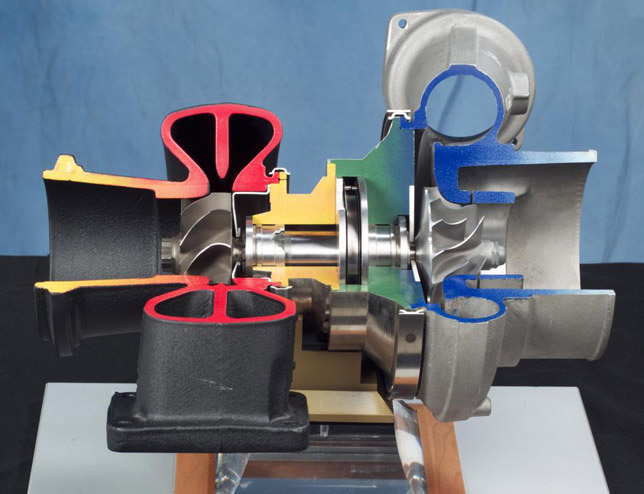
    Before those exhaust gasses reach the exhaust system they go trough a turbine connected to a shaft. The more exhaust that goes through the turbine blades, the faster they spin. On the other end of the shaft we find a compressor which welcomes fresh air from the atmosphere, compresses it using the force of the turbine and then feeds it into the engine. To further increase the efficiency of the turbocharging system, an intercooler is added – it looks much like a car radiator but instead of containing cooling fluid, it holds the compressed air from the compressor. Air is denser when cooler and that’s exactly what the intercooler does – it cools the incoming air.

    Cut-away view of a turbocharger held by a foil-bearing
    Cut-away view of a turbocharger held by a foil-bearing

    There are issues however. First of all, a turbine amidst the flow of exhaust is essentially an obstacle. The exhaust stroke has to deal with more back-pressure thus being slightly less efficient. A functional turboshaft has to handle extreme forces (speeds go up to 150 000 rpm within the turbocharger) so a special kind of baring is needed – liquid ones or state-of-the-art ball bearings. The latter is more efficient but more expensive. Then there’s the dreaded turbo lag. The problem here is that when you put your foot down, the response is far from electric. The turbine needs some time to kick off and start spinning the compressor blades. That’s why at low engine rpm one can’t really tell if the car has a turbo or not.

    There are various ways to tackle this nuisance. Make things smaller and lighter. Tiny turbochargers will grant you that off-the-line jolt but won’t be too good on the upper rpm range. Besides, if too much exhaust starts going through a relatively small turbine things may get hot and disbalanced. Usually however, there’s the wastegate in most turbines – a valve that knows how much exhaust passes through and regulates the flow by simply diverting some of the gases away from the turbine. Some companies have started putting more than one turbochargers in their cars. One small and the other, big. The small one guarantees a more immediate response while the big one takes over at higher speeds.

    Essentially, that’s the story with turbochargers. We can further dive into numbers and calculations about pressure and efficiency but this, I think, is already nerdy enough. Hopefully some of you learned something new while others refreshed their memory on how the turbocharger brings easy power to our everyday lives.

  • Peugeot 508 HYbrid4 RXH and Saloon

    Peugeot-508-RXH-HYbrid4-thumbTo have Peugeot‘s latest hybrid modular technology it takes a 2.0-litre HDi engine and a 37 bhp electric motor put on a single frame. The diesel engine deals with the front axle while the electric motor operates the rear. Such a setup was fist used in the 3008 HYbrid4. Now the Peugeot 508 RXH and 508 Saloon also join the company’s hybrid fleet by succumbing to the HYbrid4 badge.

    By adding such frugal technology to otherwise resourceful saloons and all-roaders (such as the RXH and Saloon), Peugeot hope to optimize the driving performance and economy and increase the model’s versatility. Lower taxation is expected too.

    Both of these AWD cars will carry the same HYbrid4 gear thus delivering identical figures of power – 163 bhp from the 2.0 HDi unit plus 37 bhp from the motor at the back. That’s 200 bhp in overall power. Their combined drive cycle economy is a charm, yet the RHX is the thirstier from the two with 68.9 mpg – the Saloon can go for almost 10 more miles on a gallon. Also the Saloon has a sub-hundred figure on CO2 emissions standing at 95 g/km. The RHX manages 107 g/km. The top speed for both is around 130 mph and zero to sixty takes 9.0 seconds (9.5 for the heavier RHX).

    In terms of equipment, the Saloon HYbrid4 is pretty similar to the 508 Allure – Keyless entry, an ignition button, cruise control with a speed limiter, automatic parking brake with Hill Assist, automatic dual-zone air conditioning, electric folding door mirrors, Peugeot Connect Navigation (RT6) with Bluetooth, Peugeot Connect SOS and Assistance, automatic headlamps and wipers, 18” alloy wheels and half leather seats are all included. All of that for $49,788.

    The Saloon however, is trumped by the $53,343 RXH which has an even vaster array of luxuries. On it, you will find 18” Attila alloy wheels, parking aid, a panoramic glass roof, an additional Colour Head Up display, an USB point and acoustic laminated side windows. It also has a higher stance that gives it an overall crossover look.

    Both models are available for ordering while shipping will start in May for the RXH and in July for the Saloon.

    Peugeot 508 RXH HYbrid4
    Peugeot 508 RXH HYbrid4

    Source: Peugeot

  • JMS Opel Insignia

    JMS-Opel-Insignia-thumbIn search for an executive saloon but tired of BMWs or Audis and Mercedeses? They are the usual choice but one can never get hurt from trying something different. Oh Look! Here’s an Opel Insignia… and it’s been tweaked by German motoring specialists JMS. It’s a starter project with more options due to come. I basically depends on the customer.

    What you do get however, is a KW coilover version 3 inox for a suspension. That will set you back $2,226. Because of it, the Insignia will be lower than usual – specifically, 55mm lower at the front and 45mm at the back. For a more modest sum of $315 you’ll also get a JMS racelook apron which you can screw on the standard front bumper and apply…glue, apparently.

    By far the most expensive feature on this Insignia are the 9×20 AR1 Race wheels wrapped in 245/35R20 tires. All four of them cost $3,423.

    More exterior enhancements and exhaust pipes can be ordered upon request for an overall complete look.

    JMS Opel Insignia
    JMS Opel Insignia

    Source: JMS

  • SR Auto Exkalaber BMW M5 E60

    SR-Auto-BMW-M5-E60-thumbNew stuff from SR Auto. Well, actually it’s the BMW M5, the E60 one. A project called the “Excalaber” – the strange misspelling trend continues – aims to provide a refreshing look on a generation of BMWs that is on the verge of being overshadowed by its current successor.

    The idea here is that, SR Auto do not provide any parts of their own, but rather mash together what they can find and see if it works out as an art piece. That’s why we have here a Hamann aero kit (front lip, side skirts, and rear lip). Top priority for it was to be a perfect fit. Four matte black exhaust ends give away a Dinan exhaust system that apparently helps with the performance.

    The alteration that sticks out the most however, are the PUR 4OUR DEPTH wheels that are usually seen on Lamborghinis and Ferarris. In fact these 21-inch wheels have been originally made for Lamborghini with bolt patterns of 5×112. That’s why the SR people started drilling until they got a size of 5×120. So there you go, PURs on an M5. Neat!

    Overall, the job is not really that extensive. But SR Auto take it very personal when it comes to aftermarket changes. To them, observing a customization of a car is like watching a child growing up – endearing, rejoicing and contentful. Besides, too much flash makes the onlooker dash.

    SR Auto BMW M5 (E60)
    SR Auto BMW M5 (E60)

    Source: SR Auto

  • A Blue BMW M3 GTRS3 by Vorsteiner

    Vorsteiner-GTRS3-BMW-M3-thumbVorsteiner‘s GTRS3 program for the BMW M3 Coupe is not really something that came out yesterday – it’s been around for almost two years now. However, it sill is hot by today’s standards and the latest proof of that is what we see here – a matte blue GTRS3 M3 having a photo shoot in Taiwan and generally gaining popularity.

    The program is mainly visual and consists of a widebody kit – front and rear bumpers (rear end diffuser included), flaring wheel arches and extended side skirts, all made from carbon fiber, adorn the M3. The hood and bood lid have been completely replaced and some piping has been done as well. All summed up, as an end product, it is a flashy looking thing with its big air scoops everywhere, its asphalt grinding stance and its taunting stainless steel quad exhaust system.

    As a round up element, the wheels have been changed as well. It’s the twin 7-spoked, three piece Concave Forged Mesh wheels from Vorsteiner‘s V-308 line. Sizes come in both 19 and 20 inches.

    For how long are the Vorsteiner people going to rely on it? Although, with those looks, its hard to give it up as a portfolio car.

    Vorsteiner GTRS3 BMW M3
    Vorsteiner GTRS3 BMW M3

    Source: Vorsteiner

  • Senner’s Audi S5 Coupe 2012

    Senner-Audi-S5-Coupe-2012-thumbThis year, the Audi S5 Coupe roams the streets with a facelift… and a new engine coincidentally. The engine itself is not new new but it is a first in the S5 – The TFSI 3.0 liter V6 unit has been around for the Cabriolet and Sportback versions. Another techy addition that is not your typical facelift is a stop-start system for better fuel efficiency. Other than that, we have new bumpers, a new radiator grille, aluminum wing mirror caps and a different four-pipe exhaust system. Now, while the updated S5 is still hot, the German based Senner company is among the first to pump up the value.

    The standard TFSI 3.0 liter V6 brings 329 hp – that’s only 20 hp less than the one found in the pre 2012 S5 models, the FSI 4.2 liter V8. Senner engineers however, have managed to eliminate that small gap. In fact, by being fitted with a power converter and some sports air filters, the TFSI gets further ahead with 377 hp and 500Nm of torque. The exhaust pipes now size up to 100 mm in diameter each, which helps the S5 reach a tone most desirable.

    The car sits on a Variant 3 Inox Line-KW coilover suspension, fully adjustable when it comes to height, rebound and pressure. The suspension itself relies on a set of 8,5×20 inch Corniche Challenge wheels with red undercut trim, wrapped in Vredestein Wintrac Extreme 245/30R2090W. Kind of late for winter tires.

    Inside, a steering wheel from the R8 had been lift off complete with its paddle shifters. Trough its nicely flat figure, one can glance at the carbon speedometer panel. A DVD system on the other hand will keep the passengers busy (the driver has some corners to bend, so he/she doesn’t need much multimedia).

    The whole project is still in process so who knows what Senner might offer in the near future.

    Senner Audi S5 Coupe (2012)
    Senner Audi S5 Coupe (2012)

    Source: Miranda Media

  • Ford Mustang, the Konquistador by Reifen Koch

    Reifen-Koch-Konquistador-Mustang-thumbReifen Coch is yet another German based company that customizes performance cars and such. The target car here however is not at all  German. The name they gave their product is the “Konquistador” and it is actually an American icon – a Ford Mustang V. It’s “V” for “Fifth generation” but it might as well be for V8 as this untamed pony moves about with a V8 4.6 liter 309 kW heart.

    So not much room for improvement in the engine compartment. No worries, as Reifen Coch have focused on other aspects of customizing. A flamboyant Cervini-Bodykit has been installed which has holes on the back of the side skirts. These wholes are for the custom made exhaust system. Yes, the Konquistador has side exhaust pipes – a kid’s dream come true. The suspension boasts KW-coilovers with electrically lifting axles and an HLS (Hydraulic Lift System) Kit. The brakes too have been replaced with some “Brembos”.

    However, it would seem that Reifen Coch are most satisfied with what they have done to the wheels – 9Jx20H2 Gotham rims at the front and 11Jx20H2 of the same brand at the back. The wrapping comes in the form of four Dunlop tires in sizes 265/35R20 and 305/30R20, front and back respectively.

    So, the Konquistador then? A keeper or a skipper?

    Reifen Koch Ford Mustang
    Reifen Koch Ford Mustang

    Source: Miranda Media

  • Pininfarina Cambiano Concept

    Pininfarina-Cambiano-Concept-thumbIt’s been a lengthy wait but it was worth it. It’s the Pininfarina Cambiano – the design house’s latest automotive top model. The idea behind it is to sort of celebrate the Pininfarina establishment. 2012 is a dual anniversary for them: 30 years with the Style Centre, set up in Cambiano in 1982 as “Pininfarina Studi e Ricerche”, and 10 years of technological innovation with the Engineering Center that was put in motion in 2002. So this one had to be special. It had to blend genuine good looks with awe inspiring technological advancements. And the end product does exactly that actually: It’s a Plug in hybrid with four electric motors and a turbine. At the same time it is utterly simplistic and elegant, baring fluidic lines and has little to no details in excess on its body. It is all about sustainability, eco-conscious thinking, efficiency, grace and a bit of flash.

    By flash I do mean the mad scissor doors on the right side of it, don’t I? There’s no pillar between them and it all seems quite functional but you can’t help but thinking: “Cool”. On the other hand…side, the driver’s door is kind of lonely which creates a sporty coupe feel. Then there’s the panoramic roof – part translucent, part transparent, it supports itself on a rather futuristic frame that resembles a honeycomb structure. The whole car is meant to be slippery as it has spent quite a while in Pininfarina‘s wind tunnel. Weight reduction is also a priority – the cabin cell is from carbon fiber, while the front and rear frames that support all the techy bits are from aluminum. All and all, the Cambiano weighs 1695 kg which is astonishingly light for a hybrid.

    Inside, light channels carved trough the ceiling, the doors and the floor remind you of those emergency paths you are supposed to follow upon evacuation in commercial airplanes. The floor itself is made up from recycled wooden pieces – one of the Cambiano‘s many sustainable traits.

    Most sustainable of all is the drivetrain. Or should I say drivetrains? It’s got four electric motors (one for each wheel, two at the front frame, two at the rear one). They are a product of the Magnet Marelli company and each one of them provides a continuous supply of 60 kW with peaks of 150 kW. Simple math tells us then, that the Cambiano has an overall maximum power output of 600 kW. Torque is 640 Nm. All motors operate independently and incorporate things such as energy regeneration upon braking, electronic stability control with a Vectoring Stability Program (sends different lumps of torque to each wheel) and ABS. On Sport Mode, zero to a hundred takes 4.2 seconds and the top speed ends up being 250 km/h.

    Pininfarina Cambiano Concept
    Pininfarina Cambiano Concept

    The Cambiano however, doesn’t stop with the electric motors. It also has an APU (Auxiliary Power Unit) which is basically a 50 kW micro turbine made by Bladon Jets. It runs on sips of diesel and charges the batteries when needed. On the flip side, it can also provide power directly to the motors. Although it weights only 40 kg and is Euro 6 complaint, the idea is to avoid running it as much as possible. When the battery charge falls bellow 20%, it automatically kicks in. At speeds of 50 km/h or less it shuts down as it assumes you are in a traffic jam. Of course the driver has the power to override these processes with a fully manual control on the turbine. The whole system is so smart, that it will learn from the GPS system on what kind of road the Cambiano is. After doing so, it will optimize the usage of the APU in what seems the best and most frugal way.

    The lithium ion batteries are provided by FAAM and are placed in between the rear seats and rear axle. The pack has a capacity of 50 kW/h and a peak power delivery of 500 kW. At a 6 Kw/h grid, recharging takes 6h while APU recharging takes only 52 minutes. On a single charge, the Cambiano will run for 250 km. With the turbine running, that range goes up to 800 km. The packs are also temperature regulated so no external factors should play a role on the efficiency.

    It really is a master piece this car – it has the looks, it has the clever insides, it will soften up even the most skeptical environmentalist while putting a smile on a demanding gear head. If the Cambiano becomes a prime example of future motoring, very soon there won’t be any faults with the mainstream cars and we won’t have anything to talk about with our friends.

    Source: Pininfarina

  • EcoBoost for the All-new Ford Escape

    2013-Ford-Escape-thumbThe all-new Ford Escape will pamper itself with a clever EcoBoost engine. It develops 237 horsepower and 250 lb.-ft. of torque and provides 3,500 pounds of towing capability.

    Smaller is better these days. Especially when we take into account the soaring gas prices. That’s why, as an alternative to the 3.0-liter V6 engine in the current Escape, the 2.0 liter EcoBoost seems the logical choice.

    Escape’s greater towing capability is roughly equal to two jet skis or a snowmobile on a trailer. And chances are that you are going to link a trailer behind, even if it is only to make use of Ford’s trailer sway control.

    Besides the 2.0 EcoBoost, there will be a 1.6 liter unit of the same line that returns 177 horsepower and lastly, a 2.5 naturally aspirated engine with a 171 horsepower ability. All three engines are mated to a fuel-saving six-speed automatic transmission. Another good thing for the economy will be the electric power-assist steering.

    Interested? Well, the all-new Escape arrives at showrooms sometimes later this spring. Until then, we’ll have to wait and read frugal figures.

    Ford Escape (2013)
    Ford Escape (2013)

    Source: Ford