Long time, no see from Väth. Still, here’s a Mercedes-Benz C63 AMG Black Series. The German tuners however, would prefer to call it the V63 Supercharged – more power, more pipes, more stopping forces at work and less ride height. Throw in some wheels and you’ve got yourself a true Väth product.
A “normal” engine in a C63 AMG Black is pretty satisfying, isn’t it? Well, according to our friends here, there’s always room for more. And technically, they are right. Sure, it develops 510 hp but it is, and has always been, naturally aspirated. Väth quickly tended to that issue, hence the name (Supercharged?). They also fiddled with the engine electronics, slotted in big intercoolers and concluded that the V63 now shreds it’s tires with 756 hp and 800 Nm of torque. To cite some performance figures here – 0 to 100 km/h – 3.6 seconds, Top speed: 350 km/h (with the right tires).
In addition, a stainless steel exhaust-manifold system has been provided as well as a catalyst device further down the line, and a silencer with a remote-controlled valve at the back. No new tailpipes though. The new shock absorbers allow the Black to be lowered or elevated within a 20-65 mm range. 405 mm discs on the front axle ensure that you have the stopping power to match the dynamic performance. Over them, three-piece forged wheels have a functional and aesthetic purpose – 9 x 12-inches with 255/30/20 of rubber at the front and 11 x 12-inches at the back wrapped in sizes 295/25/20 tires.
Inside, you don’t get much except a costly new steering wheel with leather/leather or carbon/leather or even wood patterns. Also there’s an extension of the speedometer which will now count to 400 km/h.
More updates from rather silent tuners. This one is from SpeedART – the SP81-R based on the PorscheBoxster/S type 981. It incorporates the full package: a body kit, some power increase, noise, wheels and a few suspension tweaks.
The SP81-R body kit comprises of a rear wing plus diffusor, side skirts and a front splitter. The wing attaches itself on the stock spoiler yet one can notice it from afar. The overall body color is one traditional for SpeedART – dual-themed paint first seen on the PS9-Panamera and S91-R Carrera projects. As for shoe ware, the SP81-R Porsches can come with SpeedART modular 20 and 21-inch LSC-Forged wheels – ultra-ultra light, unique and stylish.
Under the hood, both for the Boxster and Boxster S, there will be an ECU chip that will increase the power with around 20 hp and just as much Nm of torque. Not without the help of a sport exhaust system complete with high-performance catalysts and manifolds of course. That said, one also does get a sound switch just for showing off. Also, a range of tailpipes will be available for you to choose from – individuality at its best. A full set of a Titanium-made exhaust system will act as an alternative for the most enthusiastic among you.
The SP81-R Boxsters sit lower on their sport tuned suspensions, height adjustable absorbers and stiff coils. Still, an airlift suspension is also provided in other to tackle even the beefiest of speed humps.
Inside we are promised a completely new interior that makes use of Alcantra and leather. Better yet, SpeedART won’t deny that it will be much different from the interior seen in the most recent 911 at the Geneva Motorshow.
What you’re looking at is a “Moparized” Ram Truck 1500 which recently won a time-trial showdown against a Ford SVT Raptor. We are talking hardcore off-road stuff here as the challenge was conducted at the Ocotillo Wells State Vehicular Recreation Area, Southeast California – acres of dirt, mud and twigs. A 4.73 mile evaluation loop was set up by representatives from PickupTrucks.com and, with the help off-road truck racing champ Chad Ragland, both of the pickups were tested to their limit.
The Ram Truck then – it has a Mopar Runner kit which consists of a Pre-Runner Stage II Lift kit, an off-road fron bumper, front and rear fenders, a rear-tire carrier, sport performance hood and a cat-back exhaust.
The beefed up suspension is one of the most visible aspects of the Ram though – at the front, the upper and steel lower control arms are three inches longer each. Hence the wider wheel track. Heavy-duty outer tie roads size up to 1 inch in diameter. At the same time, the inner rods are as much as .13 inches beefier than the production ones. At the back, a 5-link coil spring rear suspension comes in handy when departure angles of up to 30 degrees take place. The Pre-Runner Stage II kit gives around 14-inches of overall ground clearance and utilizes Fox 3-inch internal bypass shocks.
The front bumper is all steel and has an integrated skid plate. The new fenders are from fiber glass and are more flarey in order to accommodate the wider track. The hood, although made of aluminum, is mostly for show. A spare-tire carrier in the bed of the truck proves more accessible and functional.
The whole kit costs at around $21,000 but Mopar are selling separate upgrades as well.
Last weekend, the Concorso di Eleganza aesthetic competition was held at the Villa d’Este in Italy. No doubt, one can’t spell aesthetic without Alfa Romeo. The rather delicious 4C Concept won the “Design Award for Concept Cars & Prototypes”. Since at the event, the spotlight also falls on classic cars, a 1933 Alfa Romeo 6C 1750 GS also took home some prominent prizes.
But first, make way for the unborn – The Alfa Romeo 4C. Conceived trough the company’s expertise that is reality within the 8C Competizione and 8C Spider. In fact, the concept shares their rear axle entirely. The main idea is to perfect a true racing spirit that bares Italian genes and technical excellence in a single form – a RWD Coupe with two seats and a mid-mounted engine. In length, the 4C is around four meters with the wheel base accounting for no more than 2.4 meters out of them.
Underneath the shell, there’s a 1750 liter (symbolic) straight four engine that brings about 200 bhp. All the while, the curb weight doesn’t exceed more than 850 kg despite the technically advanced 6-speed dual dry clutch transmission operated by paddle shifters.
Alfa Romeo 4C Concept
As for the C6 that was on display – a uniquely rare 1933 model which is no stranger to previous Villa d’Este exhibitions. It has a six-cylinder, in-line 1752-liter engine and pages of history left in its trails.
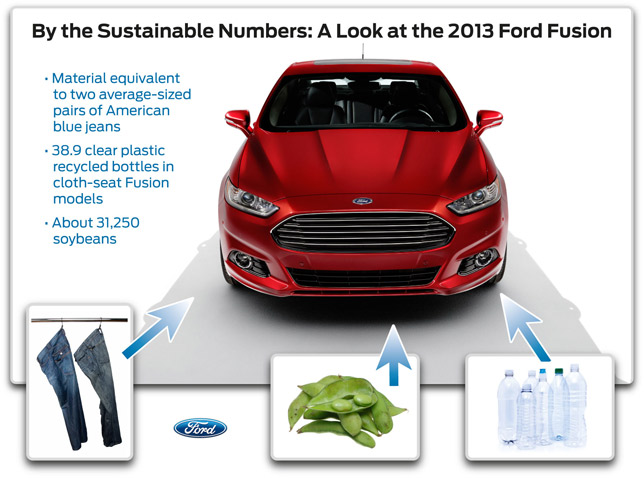
Ford seem to be aware that the latest fad is to go organic. The shops are brimming with lettuce which has been (so they tell us) grown out in the open, natural fertilizers, no pesticides no GMO no nothing. Indeed, very healthy and sustainable. But consider a 2013 Ford Fusion now and try to draw a parallel. Some of the materials used in it, Ford people say, are completely organic, recyclable and downright green.
“Building vehicles with great fuel economy is our highest priority in reducing impact on the environment,” says Carrie Majeske, Ford product sustainability manager. “With every new product design, we also are charged with increasing the use of renewable and recyclable materials in our cars, utilities and trucks to reduce impact on the environment.”
Issues like noise and vibrations have been tackled with something very common in real life and yet it sounds out of place – denim. That’s right, more than two pairs of jeans have given it’s life for the sake of comfort and convenience. Inside, the upholstery is made with pure Repreve yarn which is woven from both post-industrial and post-consumer waste products. The models that will carry such kind of cloth on theirs seats would contain an equivalent of 38.9 recycled, clear 16-ounce plastic bottles. Supposedly, the material is strong as well.
The soft bits within the seats have been garnished with soybeans. Soy foam to be exact. A single Fusion requires approximately 31,250 which sounds a lot but remember; it’s sustainable. It’s not that uncommon actually. The technology was first introduced in 2007 and Ford have been making cars with soy ever since.
Various, not-that-important bits are protected from plastics. Plastics of former car batteries so it’s cheap to replace as well.
“We are holistic in reducing our environmental footprint by utilizing post-industrial (blue jeans), post-consumer (battery cases) and sustainable materials technologies (soy foam),” Majeske says. “We do whatever makes the most sense for each application and environmentally from a lifecycle perspective.“
In it for some high-octane, gut-churning acoustics? Good. Here’s an Internet circulating clip of the supposed DBS successor – the Aston Martin Project AM310 Concept. It was filmed this weekend at the Concorso d’Eleganza Villa d’Este in Italy. An official debut is set for August while sales will most probably start in early 2013. Aston are going to be celebrating one hundred years of engineering very soon and if that’s the party piece, count us in.
As stated, in terms of styling, the AM310 is rather reminiscent of the Aston Martin One-77 (Fun fact: the One-77 was also revealed at the Concorso back in 2009). The details are still a bit wishy-washy but the word out there is that a 6.0-liter V12, 570 and above horsepower engine will be at work. The interior was supposed to be a secret but sneaky photographers and even the operator here manage to “get the picture” – the rev-counter needle moves the wrong way but we don’t care. Oh, and then there’s the sound which, to us, doesn’t sound “insane” but pretty darn close.
The Mazda Demio (or Mazda2) 13C-V Smart Edition is getting a samllish update and from now on, it will be known as the Mazda Demio 13C-V Smart Edition II. Fair enough but there’s a problem – only Japan is getting it. Don’t worry, there’s a reason for that.
Because it’s now 0.4 km/l more economical than before, the 13C-V Smart Edition II qualifies for a 50% reduction in tax according to Japan’s eco-car tax reduction program. Now, if we trust the country’s JC08 mode test cycle, we should be able to cover 20.6 km on a single liter of fuel. That… number basically will make the Smart Edition II much more desirable as it moves closer to the 13-SKYACTIV version which is completely exempt from taxes.
If that doesn’t catch our attention, then maybe the rear roof spoiler will do the trick. There’s also a undercover added. As optional extras, you can get a keyless entry system for it as well as an automatic liftgate and start, front fog lights and auto-leveling low-beams.
The 13-SKYACTIV will be available with three color options for the interior (that includes the Border Black shade when taken with the Sporty or Comfort package).
The Maserati Quattroporte Sport GT S has been around for quite a while now, and yet it still manages to capture the public’s hearts. The latest award to be swept away by the four-door grand tourer comes from the leading Spanish financial magazine “El Economista”. The category is “Best Luxury Car”.
Within 15 days, more than 60, 000 people saw the Quattroporte as the most suitable contestant. Runner ups included the Porsche Panamera GTS, Rolls-Royce Phantom Series II, Audi S8, Jaguar XJ and BMW Series 6 Gran Coupé.
“The Italian Marque can combine like nobody else the best luxury with the strongest performance. This is the very essence of this Sport GT S version of the Maserati Quattroporte saloon. The result of the vote clearly shows that sportiness and luxury work better when they are combined, that people do not want to choose between one or the other: they want both” said Manolo Domenech, Editor of Ecomotor during the award ceremony which took place on the opening day of the Madrid Motor Show.
Popping up the hood, we have to admit, the Sport GT S is a charmer – a 4.7 V8 powertrain that develops 433 bhp and 490 Nm. Further down the line, an automatic/paddle-shigt transmission sends the power to 20-inch, wider-than-standard wheels. Inside various accents incorporate carbon-fiber and Alcantra.
As a model, the Quattroporte has received over 50 awards during its lifetime – which is sort of not enough considering that Pininfarina were responsible for the design.
Shortly after an audacious appearance in China, Rolls-Royce is ready to conquer Europe as well. The Auto Mobil International show in Leipzig to be more exact. In just a few days time, people and journalists alike will experience the debut of the Ghost Six Senses concept which will also be accompanied by the Phantom Series II.
The Rolls-Royce Sic Senses Concept sounds really hedonistic. And bold as well – it sees itself as the six sense. Once you step in, provoked are not only your five prime senses but also the overwhelming fountain of joy within you (roughly paraphrasing here but that’s the general idea). It really is something for the ultra posh who could not be bothered with actually driving it. That’s why the chauffeur profession was invented. Thus not much spotlight is thrown on the the 6.6-Liter V12 BMW engine inside it either. And that’s a shame. 563 bhp and 780 Nm of torque driving around a tray of caviar appetizers and an Armani coat.
Then there are the the grown-up participants which are just as exclusive… only more – The Rolls-Royce Phantom Series II in Drophead Coupe and Extended (wheelbase) forms. They will be the first cars ever to come with full-LED headlights as standard. So there’s a reason to own one. Also, compared to the series I, these will have a new 8-speed automatic gearbox with “unnoticeable” shifts.
In Europe, for the time being, Germany and Russia provide fertile soils in terms of Rolls-Royce marketing. Appearing in Leipzig at the start of June can only prove beneficial for the company.
Rolls-Royce Ghost Six Senses ConceptRolls-Royce Phantom II Drophead Coupe
An auto show in Leipzig (the Auto Mobil International) is dangerously close and automakers are scrambling to get the word out. There, on June the 1st, Volkswagen will introduce the 2013 CC R-Line – hardcore driving action for the four-door coupe type of people.
It’s power will be drawn from a 2.0 liter TSI engine and will amount to 200 horsepower. The transmission for it can be either a six-speed manual or VW’s DSG six-speed dual-clutch engineering piece.
Some specific R Line features include a sporty front bumper with big fog lights on it, an “R” logo on the grille and some side skirts. At the back, in true fast and furious fashion, the taillights are tinted while the mad 18-inch aluminum-alloy wheels complete the overall look. Inside, stainless-steel scuff plates bare a revealing engraving “R-Line” and the wheel is all sporty and functional.
As standard equipment, the CC R-Line gets adaptive Bi-Xenon headlights with accompanying LED Daytime Running Lights, LED taillights, LED license-plate lights, clever windshield wipers, climate control, heated power seats, touchscreen/multimedia/surround….iPod/Bluetooth/V-Tex thingy. Really, not a point of interest for a real gear head.
Sales in the US will start at the end of 2012. The price issue remains to be addressed.
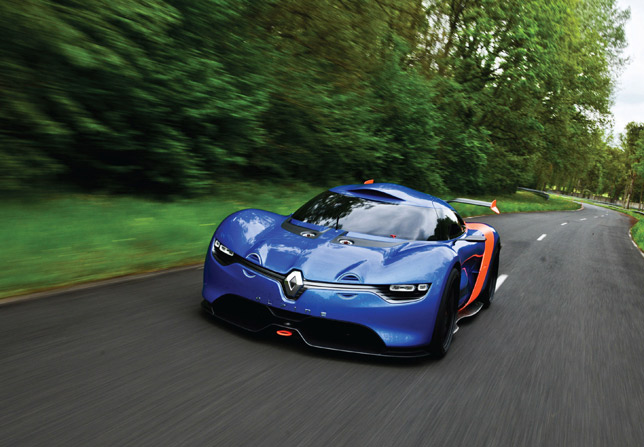
Completely out of the blue, it’s the Renault Alpine A 110-50 – a tribute to the original 1962 Alpine A 110 Berlinetta. A nostalgic DNA strain is clearly visible on the concept’s design cues. Don’t be fooled though – it’s as modern as a teenager’s mobile phone. The base for it is a Renault Mégane Trophy with minor changes in detail that make the difference.
The familiar bits can be seen on the bodywork – a slippery line, a reminiscence of the A 110 additional headlights (yellow LED arches), the 3D rear window, the air vents on the rear-wheel arches serve the same functions as the ones on the Berlinette – the rigt-hand one cools the gearbox while the left-hand one channels air to the engine bay.
The body is made from carbon fiber, the aerodynamic components (the front splitter, rear diffuser and back-wing) have been designed to give maximum downforce. The engine is now mid, instead of rear-mounted. Thus weight distribution stands at 47.8% on the front axle. The wheelbase is identical to that of the Megane Trophy but the track is slightly wider – 1,680 mm at the front and 1,690 mm at the back. Special 21-inch wheels with central bolts complement the whole look and are fitted with homologated Michelin tires.
The suspension is provided by Sachs and can be adjusted in terms of height and compression. Even, further, one can fiddle with the A 110-50’s camber, anti-roll and alignment settings. What is again a throwback however, is the lack of ABS or traction control nonsense. Still, you do get 356 mm disc brakes with six-piston callipers at the front and 330 mm ones at the back clamped by four-piston callipers.
The engine is also taken from the Mégane Trophy – its the Renault V4Y block that has 3.5-liters of displacement, six cylinders in the V formation and 400 bhp. The moving bits have been replaced in order to fit the purpose – think in terms of pistons, connecting rods, crankshaft, camshafts and valve springs. Modifications on the intake and exhaust systems have also been made. (that gash on the roof is not really faulty welding, but in fact an air scoop).
For the transmission, Renault have put all their F1 know-how into work – a semi-automatic sequential box and a ceramic twin-plate clutch operated by either a pedal or a paddle behind the wheel.
Renault Alpine A 110-50 Concept
Here’s a comprehensive list of specs:
CHASSIS
Type
Tubular 25CD4S steel chassis with semi-load bearing engine and gearbox
BODYWORK
Carbon
Aerodynamic
features Front splitter, diffuser, rear wing
ENGINE
Position
Longitudinal, mid-rear
Type
Renault V4Y – 6 cylinders – 24 valves – 3,498cc
Bore x stroke
95.5mm x 81.4mm
Injection/ignition
Magneti-Marelli Marvell 6R
Maximum power
400hp at 7,200rpm
Maximum torque
422Nm at 6,200rpm
Maximum revs
7,500rpm
TRANSMISSION
Type
Rear-wheel drive
Gearbox
Six speeds + reverse – sequential
Gear shift
Semi-automatic (pedal-operated clutch and paddle)
Differential
Limited slip differential
Clutch
Cerametallic twin-plate 184mm-diameter clutch
SUSPENSION & BRAKES
Suspension
Double wishbones, adjustable two-way Sachs damper/spring assemblies, front anti-roll bar
Front brakes
Ventilated steel discs (O 356mm x 32mm) with six-piston AP Racing callipers
Rear brakes
Steel discs (O 330mm x 32mm) with four-piston AP Racing callipers
WHEELS & TYRES
Wheels
Aluminium alloy – Front: 8 x 21 / Rear: 9.5 x 21
Tyres
Michelin 245-35 x 21 (front) and 265-35 x 21 (rear)
The Volvo V40 is still pretty fresh. But Heico Sprotiv – sort of an official tuner house for Volvos – did make haste and came up with this: a bio-diesel sport edition V40. It’s a part of Heico’s initiative called “Green Racing” and thus it’s strictly for the track. But don’t despair as a followup project will give birth to a street version as well.
Heico have been personalizing Volvos for years now by providing accessories and parts. You can drive up to them with whichever of the mainstream Volvo engines and they will have an e.motion ECU upgrade for it. A range of sonorous exhaust systems, suspension and brake kits and Volution wheels are also available. The carbon fiber body kit here is pretty much identical to the one that will go on the road-going ones. At the very least, the diffusor will be the same. You won’t get the flaring wheel arches and we are not sure about that rear wing.
The V40’s D5, 2.0-liter 5-cylinder diesel engine has been remapped to produce 300 hp and a max torque of 600 Nm. The idea is to tackle a number of 2013 long-distance competition such as the the 24 Hour Race at the Nürburgring. Having a torquey fuel-sipper on the line always spells success at the end of the day.
Visitors at the Auto Mobil International (AMI) exhibition in Leipzig will have the privilege to be the Heico Volvo V40’s first spectators. The stand will be open from the 1st of June to around the 10th.
 Long time, no see from Väth. Still, here’s a Mercedes-Benz C63 AMG Black Series. The German tuners however, would prefer to call it the V63 Supercharged – more power, more pipes, more stopping forces at work and less ride height. Throw in some wheels and you’ve got yourself a true Väth product.


 More updates from


 What you’re looking at is a

 Last weekend, the





 In it for some high-octane, gut-churning acoustics? Good. Here’s an Internet circulating clip of the supposed DBS successor – the
 The


 The


 Shortly after an


 An auto show in Leipzig (the Auto Mobil International) is dangerously close and automakers are scrambling to get the word out. There, on June the 1st,


 Completely


 The
