Author: Tsvetan Varbanov

  • 2013 Hyundai Equus

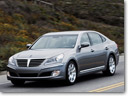
    2013-Hyundai-Equus-thumbHyundai‘s flagship, executive battle cruiser is born again for the year 2013. Hyundai Equus – the biggest, most powerful, safest and most equipped car, the company has ever made. There will be two trim levels (Signature and Ultimate) but no matter how you look at it, both of them are bundled with mind-boggling technology and it’s hard to tell them apart.

    Both will unconditionally get the bulky 5.0-liter Tau DOHC V8 that sends 429 hp and 376 lb-ft of torque through a Hyundai-developed 8-speed automatic gearbox. That power then is transferred to the rear wheels which is a big thing for Hyundai. Because of the Dual Continuously Variable Valve Timing and the high-pressure direct injection system, the economy is good…ish as well – 15 mph city, 23 mpg highway and 18 mpg combined.

    Weight distribution is said to be 52:48 and thanks to a Continuous (lots of continuity with the Equus) Damping Control unit, and road surface can be tackled with the exact level of stiffness and rigidity. Then there’s the Vehicle Stability Management which controls a full bag of features (the ESC, the electronic parking brake and the smart cruise control) thus keeping you out of the ditch. Don’t think however, that the Hyundai Equus engineers went easy on the occupant safety tech. Not even slightly. You get dual airbags at the front, side airbags for both the front and the back as well as curtain ones on the length of the roof and a driver’s knee airbag. The seat belts strap on tightly when the Equus senses an imminent collision while the headrests ensure your head is where it should be – on your shoulders. A camera on the front grille (Ultimate) monitors for objects when parking and sends the data to an LCD monitor inside. The bootlid camera at the back comes as standard.

    Hyundai Equus (2013)
    Hyundai Equus (2013)

    As for luxuries, the Signature lists more than 40 features. Among them, there’s a 608-watt Lexicon 7.1 Discrete surround-sound audio system with 17 speakers, a massaging driver seat, a lane departure system, a set of 19-inch chromed alloy wheels and a Navigation system with DIS and multimedia controller.

    The Ultimate actually looses an occupant space at the back but the remaining two get individual reclining and massaging seats, tinted rear windows an entertainment system for the back and….a refrigerator. This one is obviously for the more bossy type of people. The ones that plan to spend a great portion of their time being driven around rather than driving themselves. But then again, the concept behind the Equus is just that – being executive…at an affordable price (which is still undisclosed).

    Source: Hyundai

  • An Audi A6 by JMS

    JMS-Audi-A6-Typ-4F-thumbA yet another Audi with non-existent wheel housings. This one though is more subtle. It gets even more subtler when you look at the list of upgrades but hey, we rarely get news from JMS so we’ll cherish what we have.

    The program is intended for the A6 – the old one – Typ 4F (it’s not even facelifted). There’s a JMS apron for it available and a front lip spoiler (fits on all 4Fs excluding the S-line). The main feature here however, is the KW stainless steel coilover kit version 1 – responsible for the lowering which can be up to 60 mm on the front axle and 50 mm at the back. Or maybe the most noticeable features here are the wheels? Oxigen 9,5×20 front and back – very flare-y

    And there you have it – a JMS Audi A6. What do you think?

    JMS Audi A6
    JMS Audi A6
    JMS Audi A6
    JMS Audi A6

    Source: JMS

  • Ready for Le Mans 2012: Team Chevrolet

    Chevy-Team-Le-Mans-thumbThe 24 Hours Le Mans is a testing, excruciating, nerve wrecking and even deadly endurance race. It is literally a 24 hour race and at the least two drivers need need to participate in each team. At the finish line, one might think there’s a big sigh of relief for all participants. It is however, more or less a 15 minutes if glory type of thing.

    Here’s the story behind the scenes from the Chevrolet Team point of view. As soon as one race ends, it’s back to the drawing board again – what went wrong, how can they do that better, should they be like this next year? And that’s not even half the story. One would not imagine that the logistics of a car (or several of them) can be so complex. Mind you we are talking about a Le Mans car which has an entourage that can barely fit in a warehouse.

    Check out these mini series and more around the 2012 24 Hours of Le Mans event that’s coming to you this weekend.

    httpv://youtu.be/WgmuknJuwgk

    2012 Le Mans Chevrolet Team
    2012 Le Mans Chevrolet Team

    Source: prattmiller via YouTube

  • Ferrari 458 Spider, California 30, FF at Goodwood

    Good(wood) news: Ferrari are bringing the 458 Spider, the California 30 and the four-seater Ferrari FF to the event.
    For the 456 Spider, this will be a UK debut. It’s particularity appealing because of it’s aluminum retractable roof which is actually 25 kg lighter than the traditional folding soft-top. That’s useful if you don’t want to thwart too much the mid-mounted 4.5 V8 engine and make use of all the 570 hp that it produces. Recently it was again nominated for the International Engine of the Year award which makes sense as no one in their right mind would mount something less then perfect to an F1 style, dual-clutch, state-of-the-art transmission. Put those two entities together and you get a 0-60 mph time of 3.4 seconds and a top speed of 199 mph.

    Ferrari 458 Spider
    Ferrari 458 Spider

    The other player who visits the Island for the first time is the Ferrari California 30 – it’s called that way because of the 30 kg loss in weight. Apparently, with the help of alchemy we suspect, the Ferrari engineers have managed to turn those kilograms into extra hp. So now we are talking about a V8 that rolls out 490 rampaging Italian stallions. An optional package for the California is also a thing now – less body roll and more responsiveness through some in-house tweaking of the suspension.

    Ferrari California
    Ferrari California 30

    The Ferrari FF grand tourer will also make an appearance. It represents the company’s uncharted territories – four-seats, four-wheel-drive, grand touring tech, the lot.

    The front-mid engine in it is the flagship Ferrari unit right now with over 660 hp at 8,000 rpm, 12 cylinders and a displacement of 6,262cc. That renders the FF capable of a 0-60 mph acceleration in 3.7 seconds. And thanks to the abnormally light 4RM (AWD) system and the 47:53 weight distribution, the FF is quick to response to driver input, stable and incredibly fun to drive.

    Ferrari FF
    Ferrari FF

    The Goodwood Festival of Speed is held annually at West Sussex, England. The event for this year is scheduled for the last weekend of June.

    Source: Ferrari

  • The GTA Spano at the Goodwood Festival of Speed

    GTA-Spano-thumbThe GTA Spano – GTA Motor‘s (and Spain’s) only supercar – will take part in this month’s Goodwood Festival of Speed held on the grounds of the Goodwood House, West Sussex, England.

    More specifically, the “Supercar run” challenge will provide the opportunity for the Spano to go head to head with 49 more supercars of world-class. Driving the glass-roofed car will be the Valencian drive Borja Garcia.

    GTA Motor plan to produce only 99 cars in total which makes the Spano, technically, a very rare and exclusive specimen. The power plant for it is an in-house V10 mid-mounted engine that churns out 820 hp and 960Nm of torque. The body and the chassis bits represent a complex mingle of carbon fiber, titanium and Kevlar. As a result of that it’s weight is no more than 1350 kg and the 0 to 60 mph time is just below 3 seconds and the top speed stands at 350 km/h.

    So if you’d like to catch a glimpse of this gem, the Goodwood Festival of Speed speed is the place for you. It starts at the end oh June, properly coordinated with the weekends.

    GTA Spano
    GTA Spano

    Source: GTA Motor

  • 1965 Buick Riviera Piece by eGarage

    You’re sitting there at your kitchen table, bathrobe still on, sipping coffee and casually glancing at the columns on this morning’s Financial Times. Life’s pretty good when you are a self-made man – Two kids, a house big enough for two more and a BMW 5-series at the drive alley. Not the F10 though. It’s an E60 – you have been financially stable for quite a while now and at the time you were buying it, the F10 wasn’t out yet. Maybe you’ll wait for the next generation as to not appear too shallow.

    Suddenly ripples form in your now half empty mug, subtle clinking comes from the cutlery next to your breakfast, the windows tremble in high frequency… and is that a boiling kettle you hear? Stepping outside you witness the embodiment of the one thing that you have always been missing – A matte black ’65 Buick Riviera ominously cruising the streets as your onlooking neighbors seem to shrink behind their neatly trimmed hedges. It’s your dark side basically, making a cameo.

    Buick Riviera (1965) - Front Angle

    Or… it could be just the guys from eGarage.com filming a piece about this prime example of 1960 US Automotive design. As a result, they ended up with this chill-inducing 1 minute or so video that got us all excited. Obviously this Riviera, promptly called “The Freak”, has had a bit of a modification. It was our keen eyes which saw that… in the description bellow – an AccuAir suspension system was used for that extra low-ride.

    Anyway. The important thing is that the key concept behind the Riviera has been preserved…or at least that’s what we are hoping for – a 425 cu in (7.0L) engine rumbling out 340 hp at the least, a Twin Turbine automatic transmission, a double wishbone coil spring suspension plus power brakes and power steering. Those last three… they are not what you’d call innovation but keep in mind that this was the standard setup back in ’65 – a time when the wheel was still a hot topic. Then there are the cocooned (or clam-shell) headlights which might just be the coolest feature on a car…ever.

    Buick Riviera (1965)

    eGarage.com appreciate the aesthetics of cars worldwide. For them, representation, background and legacy is king. Also, we can always count on them for some eye-candy delivered by masterful photographers and cinematographers. The soundtrack here isn’t bad either.

    httpv://vimeo.com/43683513

    Source: eGarage.com via Vimeo

  • 2013 Buick Verano Turbo Debut

    Buick-Verano-Turbo-thumbThe 2013 Buick Verano Turbo is going on sale later this year as a representative of the company’s efforts to downsize it’s engine fleet without sacrificing power output. The Verano will get 250 hp from a 2.0-liter engine.

    “The 2.0L turbo engine was designed for refinement, higher output capabilities and reduced noise,” said Amy Joss, Ecotec 2.0L assistant chief engineer. “The way it sounds, the power delivery and the refined character are all fitting of a luxury sedan with a fun side.”

    The power plant inside is no stranger to fame and acclaim. It’s a Buick 2.0 liter turbocharged Ecotec engine which last year, was named one of WardsAuto World’s 2012 10 Best Engines for North America. It’s sort of clever because of the eAssist tech used along side it, which helps boost performance and fuel-economy through the use of an electric motor and a battery. The Buick Regal luxury sport sedan will also get the same engine bits as standard.

    The popularity of 4-cylinder engine in the US is not widespread to say the least, but with car makers struggling to deal with emission restrictions etc. change might be on the way. According to his Automotive, their use in North America will grow by 74 percent from 6.9 million to 12.2 million over the next 10 years.

    The transmission choice is between a six-speed manual or six-speed automatic. The fuel figures however have not been disclosed yet nor the price.

    Buick Verano Turbo (2013)
    Buick Verano Turbo (2013)

    Source: Buick

  • Ford F-150 Special Service Vehicle Package

    Ford-F-150-SSV-thumbFord have now released a package suitable for those who are planning to use the Ford F-150 as a fleet/utility vehicle. Think in terms of the fire or police department. Besides making the F-150 look pretty bad…posterior, the Special Service Vehicle (SSV) package includes a high-capacity 220-amp alternator and an interior fit for various needs.

    “Our fleet customers have been asking us to create this option for F-Series trucks,” said Ford Government Sales Manager Tony Gratson. “We’re confident the current and updated 2013 F-150 equipped with the SSV Package will be of particular interest to our government customers with rugged jobs such as law enforcement, firefighting, and national and state park patrols.”

    The Ford F-150 underneath the package can be either a SuperCab or a SuperCrew, a 4×2 or 4×4 and a 5.0liter V8 or a 3.5-liter EcoBoost – the combinations are pretty much endless.

    The SSV seating package omits the 20 percent or the original 40/20/40 cabin setup and makes use of the mid-space for task-specific accessories. To provide even more space, the center console is missing as well.

    Individual driver and first-row passenger seating surfaces are upholstered in easily cleaned cloth for

    comfort over the long haul. There are virtually no boundaries however in terms of customization so that government or commercial needs are met. The SSV buyers can specifically order heavy-duty tires, 4×4 skid plates and a range of interior equipment.

    Regardless of the choice you make – the 360 hp, 5.0-liter V8 or the 365 hp, 3.5-liter Ti-VCT EcoBoost V6 – you’ll always get the clever, fuel-saving six-speed automatic transmission.

    Ford F-150 SSV Package
    Ford F-150 SSV Package
    Ford F-150 SSV Package
    Ford F-150 SSV Package

    Source: Ford

  • Top Gear Test Track Summed Up

    Diehard Top Gear fans remember the times when the power lap board was pretty clean and simple – the Pegani Zonda C12 S took the lead right from the start and dominated the Top Gear Test track for 3 whole seasons. As the episodes rolled however, things sort of got out of hand and it became very hard to follow which is what and when.

    Recently we stumbled upon a chart which manages to round up all the times achieved and all the information available in a nutshell. Well… quite a big nutshell but still. At the very beginning we see a wheel-type graphic  which sorts all the cars that were tested by year of airing and track time and even indicates the weather conditions for every run.

    Scroll down bellow and we get a more comprehensive time table of those same cars and the respective leaders marked in yellow. We personally, found out how cars which have held the lead the power board for a limited amount of time, tend to get lost in our consciousness (i.e. the McLaren Mercedes SLR).

    Then there are the memorable runs such as the one of the Koenigsegg CCX which gained massive benefits from the Top Gear-suggested rear wing. Or the Bugatti Veyron‘s lap which at the time was eagerly expected but eventually flopped on the finish line ending up in the forth position leaving the Gumpert Apollo an undisputed king of times for 3 more seasons.

    From then, the Bugatti Veyron Super Sport makes a brief appearance but 2 episodes later, the Ariel Atom 500 V8 pretty much embarrasses everyone and climbs the ladder so high that even as we speak, it still is the fastest road legal thing ever tested on the track.

    Ariel Atom 500 V8 Front Angle

    Further down, there’s some info on the top 10 most affordable cars that were “power lapped” on the track, some info about the track itself and… some say there’s a word or two about the Stig as well.

    Finally, a number of awards which can only underline the show’s touch of comedic genius.The info graphic was styled and compiled by Boost Labs which deal with technology and design and share a fair amount of passion about cars believe it or not.

  • XXX Performance Audi R8 V10

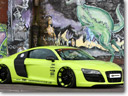
    XXX-Performance-Audi-R8-V10-thumbThat speed hump on the road there is actually an Audi R8 V10 that has underwent a substantial modification by XXX Performance. And don’t worry, that toxic green shade is actually foil wrapping. Unfortunately, the same is true for the “carbon-fiber” mirrors…and side blades…and wheels.

    Let’s talk about the wheel housings. Or more specifically, the lack of them. It’s not that the wheels are tremendously big (Dunlop SP Sport Max 235/30R20 front and 295/25R20 back tires on 20-inch Oxigin 14-Oxrock rims). The bigger factor here is the air G-Ride system of the new H&R coilover kit which can lower the car ridiculously close to the ground. Other then than, the whole body has been brushed off of it’s badges, the head and taillights have been darkened and a strip of foil on the windshield reads “XXX Performance”.

    Most excitingly however, XXX Performance have fiddled with the management system of the Audi’s 5.2 FSI V10 engine, added a BMC carbon air-box and and a high-end sports car exhaust system with Bluetooth flap control system from Capristo. The end result amounts to 650 hp and an appealing sight within the engine bay because of all the carbon-fibery bits inside.

    Inside you get restyled Audi RS seats, carbon-fiber arm supports, leather and plushy Alcantra pretty much everywhere and white white seams.

    XXX Performance Audi R8 V10
    XXX Performance Audi R8 V10

    Source: XXX Performance

  • Volkswagen Caravelle Business

    Back in the 50s hippies, surfers and generally happy-go-lucky people had the Volkswagen Caravelle (Transporter T2) to identify with. It was so big (as a name) that it became a symbol of simple life, peace and love. Jump forward 70 years later and we find ourselves at the other end of the spectrum. It’s the Volkswagen Caravelle Business (Transporter T5) – the executives strike back.

    It’s a conference room on wheels basically. You get your Wi-Fi internet connectivity and Bluetooth, 5+1 Nappa leather seats and a table. The mid-row swivels (standard on all Caravelles) so that you can hold a mildly interesting meeting that involves let’s say Power Point slides. The rear end seats house a fridge in between them. More luxury is brought by the burr wood inserts here and there while additional curtain airbags ensure all-round passenger safety.

    Moving on to the driver, we notice a cruise control option, a 6.5-inch satellite navigation and a 30 GB hard drive. There’s also a lane change assist system which monitors blind spots and a very smart heater that can fine tune the interior temperature (the back seats can do that independently).

    On the outside, the windows are tinted, the wheels are 17-inches and the rear lights are darkened. For the tight spaces the wing mirrors can be folded electrically while front and rear parking sensors annoy the devil out of you every time you approach a lamp post. A camera acts as a rear view mirror and Xenon lights at the front light up automatically. Can’t go without LED daytime running lights and also the side doors slide electronically.

    For the driving force, a 2.0 liter 180 PS bi-turbo TDI is used (best of the best). A lump of 400 Nm hits you in the head as soon as 1,500 rpm. The transmission is a DSG unit as standard and thus the economy stays at 34.9 mpg on the combined cycle and Euro5 type of emissions of 214 g/km.

    Prices for the Volkswagen Caravelle Business starts at £53,856 or $83,628 excluding VAT.

    Volkswagen Caravelle Business
    Volkswagen Caravelle Business

    Source: Volkswagen

  • Underground Racing Lamborghini Gallardo Nera – 405 Km/h [VIDEO]

    UR-Lamborghini-Gallardo-Nera-thumbThere are many benchmarks when talking about the automotive world – some products strike as the ultimate in art and aesthetics. Other excel in real-life (that life with the bends and curves) road performance. Then there are these which have the sole purpose to push the boundaries of what’s physically possible. The Bugatti Veyron is a prime example of that but what we have here, is proof that after-market tuners, like the guys from North Carolina: Underground Racing, also have a reserved place at the engineering hall of fame – it’s a twin-turbocharged Lamborghini Gallardo Nera doing 405 km/h on a push-to-the-limit run. Telemeters don’t lie.

    Underground Racing Lamborghini Gallardo Nera
    Underground Racing Lamborghini Gallardo Nera

    Looking at the specs, this really shouldn’t come as a surprise to anyone – around 1700 bhp (1500 bhp effective). How? Slotting in two massive turbocharges of course. The Lambo’s naturally aspirated 5.2-liter V10 is an ideal host for some forced induction practices. Add some wheels (Hoosier R6A) which can bare the abuse, some explosive jungle juice for fuel and there you have it – 405 km/h and a lot of drama:

    httpv://youtu.be/H8K3Nk3PghU

    Source: DragTimesinfo via YouTube