Author: Tsvetan Varbanov

  • Senner Bling the Nissan Juke Nismo

    2013-Senner-Nissan-Juke-Nismo-shadow2013-Senner-Nissan-Juke-Nismo-medium

    Senner pride themselves with their work on various Nissan 350Z and 370Zs. But anything that’s worthy of the attention of Nismo is worthy of the attention of Senner. Enter the Nissan Juke Nismo – an already vicious powerhouse of aggressiveness, sportiness and testosterone.

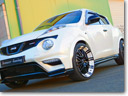
    The first thing you might notice about the Senner Juke is the prevailing black and white. It is an especially pronounced theme on the Oxigin Oxrock 14 wheels with a “white-wrap-refinement” on the rim well. We wouldn’t call it refinement though. Too flashy for our liking. The sizes: 9,5-inches wide, 20-inch diameter fitted with Continental Sport Contact 5P 255/30 tires. The whole vehicle also sits 35 mm lower to the ground with Senner’s springs

    Senner haven’t really tried to improve on the Nismo aerodynamic package. Instead, they have went for small accesorizing – wind deflectors on the side windows, LED daytime running lights, LED license plate illumination and, of all things, Philips Silver Vision chromium flashing indicator bulbs.

    Now to the more serious stuff. The Juke’s 1.6-liter engine has received a boost in power because of some witchcraft with the electronics and because of the brand new INJEN-Cold Air Intake module. That’s 225 hp (as opposed to 200 hp) and 275 Nm of torque (as opposed to 250 Nm).

    For the appropriate soundtrack, Senner have thrown in their custom made stainless steel exhaust system with ridiculously wide end-pipes.

    The whole thing, provided that you already happen to own a Nissan Juke Nismo, will cost you around $12,222. We can’t say if it’s worth it or not.

    Source: Senner

  • More Powerful Yet True to The Original Vorsteiner Lamborghini Aventador-V LP-740

    Vorsteiner-Lamborghini-Aventador-V-LP-740-shadowVorsteiner-Lamborghini-Aventador-V-LP-740-medium

    Vorsteiner are getting more and more ambitious. Today we get a glimpse at their Aventador-V LP-740 programme… erm… for the Lamborghini Aventador LP 700-4. Starting to get the idea of what that package does? That’s right, the Lambo’s ECU has been tweaked to give out 40 hp more at the wheels (so it should be even more in the engine compartment).

    Other than that. it’s mainly a visual feast. Though, it is hard to notice the actual modifications. That’s partly because the original Aventador is flamboyant enough, but also because Vorsteiner decided to go all subtle about it and not actually replace any panels throughout the body. Instead, they simply weaved a few carbon add-ons and glued them on so that they “maintain Lamborghini’s original design language“. It’s all about function apparently.

    The front gets treated with two splitters on each side which should provide additional down force. An optional lower race lip spoiler can link the two splitters for more rigidity and give a tiny bit more visual flare. The Vorsteiner side skirts continue the vertical floating fin design seen at the front and also duct air to all the right directions. Finally, the Aventador-V package seeks to replace, yet recreate, the active aero rear wing in all of its carbon-fibery goodness. Vorsteiner are adamant that everything is OEM and thus no sacrifices will be made on the part of the lucky owner.

    A couple of things more: the rear diffuser can be optionally swapped with a Vorsteiner one that’s made entirely of their quality pre-preg autoclaved carbon fiber materials. A graphic livery strip starts as a V at the Lamborghini badge and runs through the middle of the car. The Aventador-V we see here wears Vorsteiner’s Forged monoblock wheels that measure up 20×9 at the front and 21×13 and save from the total weight of the car.

    Source: Vorsteiner

  • Volvo Polestar S60 and V60 Revealed

    2013-Volvo-S60-and-V-60-Polestar-shadow2013-Volvo-S60-and-V-60-Polestar-medium2

    They are here! The new (ice) cool Volvo S60 and V60 Polestar machines that is. These two crowd-pleasers have drawn inspiration from the C30 and S60 Concept cars and the Australian S60 Polestar and are to mark “the start of an extended Polestar production model range.” Yes please.

    So what are these for?

    Not a fan of the M3? Go for the underdog then; or for that slightly bigger underdog, the V60. The point is, there will always be some appeal in the non-mainstream.

    Are they any good though?

    Of course they are. Well, not 444 hp (BMW M3) good, but still packing a punch.Keep in mind that we are talking about a T6 (six-cylinder) engine that still puts out 350 hp at 5700 rpm and the amazing 500 Nm of torque at barely 2800 rpm. That power is sent to all fours through the Polestar developed Haldex all-wheel drive system and the six-speed automatic gearbox. No wording on anything with a stick, just paddle shifts. As a result the Polestars propel themselves from 0 to 62 mph in just 4.9 seconds and have a limited top speed of 155 mph

    It’s not just sheer grunt though. The Polestar boffins have worked on the chassis, making the springs 80% stiffer than the standard ones on the S60 R-Design. Inside of them, they have slid high-performance Öhlins shock absorbers to cope with the stresses. A highlight of handling are also the front 371 mm brake disks with six-piston Brembo calipers on them. Minor aerodynamic tweaking has also been at play when developing the Polestar S/V 60 (as the teaser suggested). The ones with the most keen eyes will notice the subtle front splitter, the rear spoiler and the diffusor at the lower end.

    httpv://www.youtube.com/watch?v=HPJ-ttLB-cc

    Here’s a list that bares it all:

    Full Technical Specification

    Performance

    0-62 mph 4.9 sec

    0-124 mph 17.7 sec

    Top speed 155 mph – Electronically limited

    Chassis

    Polestar Öhlins shock absorber system

    Polestar bespoke rims, 8×20” ET53 with 245/35R20 tyres

    Engine

    6-cylinder inline T6 engine, 2953 cc

    350 hp @ 5700 rpm

    500 Nm (369 lb-ft) @ 2800-4750 rpm

    Max 6500 rpm

    New twin-scroll Borg Warner turbo

    New intercooler

    Polestar 2.5” stainless full-flow exhaust system with twin 3.5” tail pipes

    Weight

    V60 Polestar: 1822 kg

    Transmission

    AWF21 automatic gearbox with paddle shift system

    Polestar transmission calibration for faster gearshifts, launch control and curve-hold functionality

    Polestar Haldex calibration for more rear torque dynamic distribution

    Polestar calibrated stability control system

    Brakes

    Front: Polestar/Brembo 6 piston brake calipers

    371×32 mm ventilated and floating Brembo discs

    Rear: 302×22 mm ventilated discs

    Source: Volvo

  • B&B Automobiltechnik Beef Up the Volkswagen Polo R WRC Street

    B&B-Automobiltechnik-Volkswagen-Polo-R-WRC-Street-shadowB&B-Automobiltechnik-Volkswagen-Polo-R-WRC-Street-medium

    The Volkswagen Polo R WRC Street is, and there is no other way to put it, a rally car that can do grocery runs. It is truly an exceptional specimen that is limited to only 2500 units worldwide. The one you see here, however, is different from its brothers and sisters. B&B Automobiltechnik have taken up the job of creating something mad from an already mad thing.

    Take its 2.0 TSI engine for example. It normally develops 220 hp which is already well above sensible (for an FWD car). The guys at B&B can buff that output up to 362, depending on which stage you want to draw the line. The first stage is a package of performance tweaks that includes ECU modifications and optimization of the air guides and suction paths. That’s how you get 310 hp and 450 Nm of torque. Stage two adds to that a larger front exhaust pipe and the charging air’s pressure gets increased by 0.25 bar – 326 hp and 457 Nm. To get to 362 hp and 510 Nm, stage three consists of a high-pressure fuel pump, a high-performance charging air cooler and a special oil-cooling system.

    The suspension, on the other hand, can be treated with a height, compression and rebound-adjustable B&B coilover kit that’s supposed to be perfectly in tune with the VW Polo R WRC; and a set of 20/30 millimeter springs. Cough up a little bit more money and you can get the optional B&B front and rear axle stabilizers.

    The final touches on the Polo R concern the exterior – an aerodynamic package brings the Street closer to its prototype, namely the Volkswagen Polo R WRC rally car. Oh, and don’t forget the wheels. We are talking 8×18 inch alloys with tires of 225/35R16 all around. Delicious.

    Source: B&B Automobiltechnik

  • Loder1899 Present Their Ford Fiesta ST

    Loder1899-Ford-Fiesta-ST-shadowLoder1899-Ford-Fiesta-ST-medium

    The Ford Fiesta ST is an impressive little speed imp as it is. Add some German engineering from Loder1899 to the equation, however, and you’ve got yourself a recipe for unlimited fun and a monthly expense for new tires.

    Because of the new exhaust system with a sport cat module, an intecooler and some clever engine management fiddling, the Loder1899 Fiesta has 52 hp and 95 Nm of torque more than the outgoing ST. That’s 235 hp and 335 Nm of torque good for a 0 to 60 mph time of 6.5 seconds. Not bat for what is essentially a 1.6 Ecoboost that, supposedly will return 6 liters per 100 km of fuel economy on the combined cycle.

    To ensure that all of the power is utilized, Loder1899 have also added a Bilstein B14 suspension kit and some lowering springs that put the fiesta -25 mm closer to the ground. For stopping power, there have been provided an ST Big Brake braking system with 318 mm discs 4-pot calipers. To round it off, for around $2100 or 2820, you can go respectively with a set of Matzuda 7.5×18 silver wheels or four black Assetto wheels of the same size. The 205/35R18 tires are also included in the price.

    Source: Loder1899

  • Honda City 4th Generation World Premiere in India

    2014-Honda-City-shadow2014-Honda-City-medium

    The 4th generation mid-sized Honda City is out and about to go on sale next year in India. We can call it cute, or we can go with Honda’s definition of it: “an Advanced Cool Stunner”. You can tell that they are very optimistic about it. Mr. Hironori Kanayama, President & CEO, Honda Cars India Ltd said, “Witth the unveiling of the all new City, we enter a new era of Honda’s dominance in premium cars. City brand has been the face of Honda in India, enjoying strong leadership and popularity in its segment ever since its launch.” Supposedly, with the Honda City, the company has tackled sportiness, comfort and efficiency. Is there any aspect of motoring which they didn’t address.

    Apparently, the latest City is as long and as wide as the previous one, but there should be more headroom now and more legroom because of a 50 mm longer wheelbase. In other words – 4400x1695x1495 mm in dimensions and a 2600 mm wheelbase.

    Amidst the sensible range of engine choice, Honda are introducing a brand new diesel – a 1.5-liters i-DTEC with two overhead camshafts. The petrol variant will be just as big, but with a single camshaft and variable valve timing. No words on the horsepower though. Nor there is any mention of MPGs. Without any figures to back things up, we can only laugh about the silly and vague phrasing such as “Exciting H Design” or “Advansed Sporty Design”,” Best Fuel Efficiency” etc.

    Source: Honda

  • Racing One GmbH Ferrari 458 Competition for Track Use

    Racing-One-Ferrari-458-Competition-shadowRacing-One-Ferrari-458-Competition-medium

    Here we have Racing One, aftermarket experts from Germany, shamelessly flexing their engineering muscle with this strictly-for-the-track Ferrarri 458 called the Competition. There’s nothing wrong with some eye-candy, right? Anyone up for some exposed carbon-ceramic?

    This stripped-out 458 has been built specifically to comply to different race challenge requirements and thus its power output can be as much as 620 hp. That’s almost 60 more than the standard car with the otherwise same engine setup – 4.5-liters of V8 goodness. Specifically tailored for performance, the 7-speed gearbox is at the reach of your fingertips with the custom Getrag rocker switch. There is little else inside that can distract you – no carpets, exposed hinges and welding marks. The center console holds only the ignition and, rather surprisingly, the A/C controls. That’s right, even though the Competition has been completely devout of it’s luxuries, the Racing One team has still managed to squeeze in an air-conditioner. That’s even more impressive when you consider the overall weight of the thing: 1,220 kg as opposed to 1,485 kg as it would normally be.

    The pictures also suggest a KW coilover kit for optimum traction. All the while, a custom made aerodynamics packet works its magic for better balance and efficiency. Not to mention that the the wheel housings can now hold even larger slicks. And just look at the size of that rear-wing. You can land an F-15 jet on it… with a bit of imagination.

    Source: Racing One GmbH

  • Public Feedback Makes Nissan IDx Freeflow IDx NISMO Reality

    2013-Tokyo-Motor-Show-Nissan-IDx-Freeflow-shadow2013-Tokyo-Motor-Show-Nissan-IDx-Freeflow-medium

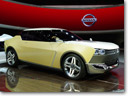
    If you think that the Nissan IDx Freeflow and IDx Nismo on display at the 2013 Tokyo Motor Show are tributes to a long-lost past of boxy cars and general sensibility, you’d be wrong. What you see before you is a product of collaboration between Nissan and the masses. The internet masses that is:

    “It was designed to appeal to “digital natives,” the generation born after 1990, and integrates their feedback into the creation process. Nissan thinks this approach could have real applications in the near future.”

    So no nostalgia was involved in the making of these IDx concepts (ID – identity; x – a “variable representing the new values and dreams born through communication”)? If that really is the case, then we applaud the new age thinking of simple-three box designs and “no nonsense steering wheels”. Let’s face it, these two look brilliant. Nothing too flashy, There isn’t an X-Box bolted to the dashboard and we can’t imagine there is a highly sophisticated vehicle management control somewhere in there that will keep you prisoner for weeks for trying to set the clock. No, in fact, the IDx Freeflow uses an analog clock to tell the time. One thing, however, doesn’t make sense to us – denim covers for the seats, denim patterns here and there? Must have been the work of either hipsters or of someone definitely not born in the 90s. Also, we are not sure what they mean when they say that the cabin has been designed to look like a living room. At 4.1 meters long, just 1.7 meters wide, and 1.3 meters high, the Freeflow is not what a real estate agent would call a bargain. Keep in mind that in addition to four people, the IDx Freeflow needs to accommodate an engine and a gearbox as well. The Nismo Idx, on the other hand is the more racing-oriented twin. An even more simplistic interior is ballenced out by a rather flamboyant exterior that, Nissan admit, has borrowed “liberally from memorable vehicles of yesteryear and the present”. Still, that spirit of the past is said to have come from video games rather then from the real thing.

    Not that it’s relevant (because these are case studies and there are no plans for production), but Nissan say that it would be possible to mate a 1.2-to-1.5L petrol engine to one of their CVT in order to form the IDx base drivetrain – sensible, economically, revvy and smart. ‘Boo’ for not actually doing something about it at this point.

    2013-Tokyo-Motor-Show-Nissan-IDx-Freeflow-medium-2

    Source: Nissan

  • A Subtle LEIB Engineering BMW E93 M3

    LEIB-Engineering-BMW-E93-M3-shadowLEIB-Engineering-BMW-E93-M3-medium

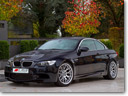
    At first glance, you might think that there’s nothing out of the ordinary with this compact BMW. You’d even be hard pressed to identify it as an E93 M3, but it is. Not only that, but it has also been through the works of LEIB Engineering – a group of after-market experts based in Germany who have chosen to approach the Bavarian in a very subtle way. Even the wheels were specifically chosen not to impress – 1-series M coupé alloys in sizes 9×19 and 10×19

    Of course that elegant discreetness vaporizes once you open the bonnet. The signature orange of the SK II CS compressor system make your eyes bleed. That’s right. LEIB Engineering are working exclusively with G-Power components. In other words, we have a belt ASA T1-523 supercharger, and additional fuel pump, new injector nozzles, colder type of spark plugs and an induction air track made from a blend of carbon fiber and stainless steel. Sports air filters and ECU tweaking also come with the package. What you get then, is a 610 hp V8 with 590 Nm of torque.

    There’s a proper sound track as well: a custom made exhaust system which features not only a double 100-cell sports catalytic converter, but also a valve which can be controlled from the steering wheel:

    “This allows for the modification of the exhaust sound with a touch of the button, from the sonorous yet non-pervasive rumble up until the virtually unfiltered and ear-splitting V8 roar.” – argue from LEIB

    As a final touch, a KW DDC coilover kit has been bolted on and integrated with the M’s iDrive software so that you can fiddle with the settings at any given moment.

    Source: LEIB Engineering

  • Subaru Levorg Concept Debuts at Tokyo

    Subaru-Levorg-Concept-shadowSubaru-Levorg-Concept-medium

    While the audience at the 2013 LA Auto Show are oohing and aahing at the new WRX, Tokyo gets to see a different Subaru product. It’s the world premiere of the Subaru Levorg – a concept with quite possibly the daftest name in the game. It (the name) is actually a combination of three words: “Legacy”, “Revolution” and “Touring”. Who would have thought? Still not in production, the completed version is expected on the spring of 2014.

    It’s always an important car when something within it makes a debut. This time, it’s Subaru’s 1.6 BOXER direct-injection turbo (DIT) engine. That translates into 168 hp and 184 lb-ft of torque. If you find that insufficient, you can always go for a 2.0 BOXER DIT that boasts 296 hp and just as much lb-ft torque.

    You won’t be able to choose your transmission though. As standard, the Levorg is stuck with Subaru’s Lineartronic CVT. That, plus Subaru’s Symmetrical All-Wheel Drive system and Active Torque Vecoring, make for the perfect driving experience.

    To keep you out of trouble, the Levorg engineers have also provided something called Hazard Avoidance Assist which scans for possible collisions and provides steering assistance accordingly. An even more complex-sounding system is the Pre-Collision Reverse Throttle Management. It basically prevents you from doing 60 mph in reverse gear. Ultimately, if you feel that driving as a whole is too much of a bother, you can trust Subaru’s updated EyeSight driver assist system that incorporates a clever cruise control programme, Pre-Collision Braking Control features and Active Lane Keep System.

    In terms of comfort, the Subaru Levorg features high quality materials and a rich design, with piano black and metal trim accents throughout the cabin. The instruments light up in an icy-blue color while technical data is being fed through the 3.5-inch LCD between them. Should you still feel sceptical about the Levorg’s sporty pedigree, even after having seen all of the above, there’s a D-shaped steering wheel sitting right in front of you. Grip it and go.

    Source: Subaru

  • 2015 Subaru WRX Debut at Los Angeles Auto Show

    2015-Subaru-WRX-shadow2015-Subaru-WRX-medium

    Exciting news from the LA Auto Show. The 2015 Subaru WRX is now a fact of life. It’s more powerful and better handling than its iconic predecessors. It is also the first WRX to feature a six-speed manual or, as an option, the newly developed Sport Lineartronic CVT that has two manual modes.

    Subaru say that this latest WRX is an important evolutionary step for their rally-bred performance line. Technologically speaking, we see a new torque-vectoring system that adds to the already sophisticated Symmetrical All-Wheel Drive setup. The chassis is supposedly stiffer, the brakes are larger while the new powertrain returns more fuel-economy. In case you are wondring what that powertrain actually is, we are talking about a 2.0-liter, 4-cylinder BOXER engine complemented by a twin-scroll turbocharger and an intercooler. Because of that, plus an unusally high compression rate (10.6:1), direct-injection, and Subaru’s Dual Active Valve Control System (D-AVCS), it develops 268 hp at 5,600 rpm and 258 lb.-ft of torque between 2,000 and 5,200 rpm. Not exactly the most powerful 2.0 engine in the world, but still blisteringly impressive.

    There are also visual highlights worthy of mentioning. The hood, front fenders, rear doors and quarters, bumpers, and tailight clusters are all new. The now narrower headlights are supposed to remind us of a raptor’s stare. Maybe someone with more imagination can see that. We, on the other hand, will slowly back away and maybe remark on the standard 17-inch wheels which are “more aerodynamic” than before and are wrapped in 235/45 R17 94W Dunlop SP Sport Maxx RT tires.

    What is the Sport Linetronic CVT then? Obviously, it is a continuously variable transmission. But one that can also switch between manners of changing gears – one mode allows stepped automatic shifting of eight pre-selected ratios. The other two are 6-speed and 8-speed “manual shifting modes” where the steering wheel paddle switches can be used.

    If you go for the 6-speed manual, the Subaru WRX will be equipped with the brand’s Continuous AWD system. In normal circumstances a distribution box sends equal amounts of torque to both the front and back wheels. When grip becomes a luxury, however, most torque is sent to the wheel with most traction.

    Should you go for the Sport Linetronic, you will also get the Variable Torque Distribution (VTD) type of Symmetrical All-Wheel Drive – again a type of center differential but with an electronically controlled hydraulic transfer clutch control torque distribution (sheesh!) between the front and rear wheels. Most of the time you will be enjoying 55 percent of the toque going towards the back while the rest ends up at the front. But that can be subject to change depending on the driving conditions, steering wheel input, yaw and the lateral g-forces you are generating. Also, because of the Sport Lineartronic CVT, you get to play with Subaru’s Intelligent Drive (SI-DRIVE) which offers three modes of powertrain settings – “Intelligent”, “Sport”, and “Sport Sharp”. Who’s going to use the second one?! “Oh, I don’t really want to drive economically but let’s be reasonable now.”

    Because the wheel base is now one inch longer and the A-pillers are eight inches pulled forward at the bottom, there is a general feel of roominess. At the back, passengers will enjoy two inches more legroom and there’s more space in the boot. There’s leather on the flat-bottomed steering wheel and “soft-touch” materials on the dashboard, door trim and center console armrest. No expenses were spared on the IT department as well. A 4.3-inch LCD screen displays a plethora of information – you can put the rear-view camera display on it, or you can set the audio, Bluetooth and climate control settings from it. An additional 3.5-inch LCD sits between the two gauges in front of you. There you can keep track on the oil level, selected gear, and, of all things, window washer fluid. This will be also the first WRX that can come with a premium 440-watt, 9-speaker harman/kardon premium audio system and navigation with Aha® smartphone integration. Cool beans!

    Source: Subaru
  • Most Powerful 4-Cylinder Engine with Mercedes-Benz GLA 45 AMG Concept

    Mercedes-Benz-GLA-45-AMG-shadowMercedes-Benz-GLA-45-AMG-medium

    Compact SUV – an oxymoron by itself, yet hugely popular among car manufacturers and, by extension, people. Mercedes-Benz are now aiming at young people “who set great store by styling, dynamism and independence”. I guess that explains the thing we have here – the Mercedes-Benz GLA 45 AMG Concept.

    We are talking small, at least by AMG standards. The “high-performance SUV” brandishes a straight four, 2.0-liter gasoline engine. But because it’s turbocharged and cleverly managed, it has a total output of 360 hp and a maximum torque of 450 Nm. So the “most powerful four-cylinder engine in the world” will be channelling its force through AMG’s SPEEDSHIFT DCT 7-speed transmission and Performance 4MATIC all-wheel-drive system. Quotated acceleration from 0 to 62 mph stands at just under five seconds. For stopping power, refer to the AMG’s performance braking system which, most importantly, brandishes red calipers.

    More exterior flare involves the GLA’s AMG cross-spoked forged wheels painted in matt black with a red flange. One size fits all: 255/35 R21 tires. The splitter at the lower front end sticks out from the apron with its high-gloss black finish. In case you haven’t noticed, there’s also a giant number “45” on each side and a “distinctive AMG logo at the upper edge of the windscreen. Further design elements exclusive to AMG include the “twin-blade” radiator grille in silver chrome, the side sill panels with high-gloss black inserts, the “TURBO AMG” lettering on the front wings, the high-gloss black roof rails and the large rear aerofoil. Then there are sporty silver lines running through the whole body complemented by red highlights on the radiator grille, exterior mirrors, diffuser insert and AMG rear aerofoil. At the back, a big diffuser dominates the view alongside a twin-tailpipe in high-gloss black – part of AMG’s sports exhaust system.

    Source: Mercedes-Benz