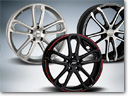
ABT Sportsline has presented a new range of designs for their alloy wheels. The 2014 wheels by the famous tuning company are not to be missed. The cast CR, DR and ER-C and the exclusive, forged ER-F promise a number of special effects and are real highlights.
The “F” stands for “forged” and the ER-F is available in 19” or 20” sizes. The complex production process makes for a very high material density, which, in turn, makes for very slim and dynamically shaped spokes. The ER-F also boasts “black magic“ coat of paint.
The ABT ER-C – C stands for “cast“ – looks very similar. With the “silver bullet“ and “gun metal“ shades, however, ABT has seen to a special mix of colours. And it has not only the 19 and 20’’ variants available but also an 18’’ variant.
The DR wheels come with bi-coloured look and the customers can choose between “mystic black“ and “gun metal“ as prime colours and dimensions of 18” to 22”.
Last, but not least are the ABT CR wheels, which are available in 19” to 22”. The ABT CR is available in an elegant “silver light” or the extremely sporty “silver black“. In “black red“ with a red accentuation, the CR is also available at a lower entry-level price as part of the “Young Collection“ series.
When the first ever MINI went out on the market on 26th of August, no one expected its future success. There is even no clue how many different variations were to follow the original MINI. For five years since its production, MINI made a great success Till 1964 the car underwent through different modifications and had been transformed in many versions (for example an estate version, a pick-up on or a van version). In 1961 Issigonis’ friend John Cooper, who was the owner of the Cooper Car Company saw a big and special potential for the MINI. Since he was an expert in designing and building Formula One and rally cars, he was drawn immediately to MINI’s racing potential. And this is how the famous MINI Cooper appeared. The first ever Austin Mini Cooper and Morris Mini Cooper made their world first appearances in 1961. The standard 848cc engine which delivered 34bhp (25 kW) was now replaced by 997cc engine putting out there the 55bhp (41 kW). In addition, the car featured a racing-tuned engine, twin SU carburetors, a closer-ratio gearbox. More importantly, it also included for the first time front disc brakes, uncommon at the time in a small car. Later in 1964, its engine was replaced by a shorter stroke 998, which delivered a top speed close to 100 mph. Then the model MINI Cooper S came about and captured many cars as being an outstanding rally car. In details, the “S” model won the Monte Carlo Rally three times. Later, in 1964, this version was equipped with new 1275cc version of the A-series engine. All other MINIs were produced with the same 998cc engine. In this year debuted the MINI Moke model, which was very simple and lightweight vehicle, and was originally intended for military applications. Also in 1964 in the production of the MINIs were featured the interconnected Hydrolastic gas/fluid suspension system.
Mark I MINI1964 Austin Mini Cooper S
Mark II MINI was born in 1967 when it was introduced for the first time. The transformed new version featured small face lift, new radiator grilles, bigger rear windows, and other cosmetic changes. More importantly, the standard models now got the 998cc engine instead of the 848cc one. And this is when the MINI became famous for its name. The Austin and Morris names were replaced by the name MINI, which now became established as a brand in its own right. Enhancements included wind down windows replacing the original sliding door windows, and new concealed door hinges. The exterior now featured different front end design, and also was introduced for the first time the new 1275 GT model. The first million production vehicle came out of the factory in 1965 and the second million – in 1969.
In 1969 Mark III MINI appeared on the marked. It got modified bodyshell, larger doors with concealed hinges, winding windows, rubber cones suspension. Ten years later and the MINI got enormous attention and already made a world-wide success. However, it got new rivals in the face of for instance Ford Fiesta, Fiat 127, Volkswagen Polo or Peugeot 104. Mark IV MINI debuted in 1976 and had new front rubber mounted subframe with single tower bolts, the rear frame had some larger bushes, the twin stalk indicators were introduced with larger foot pedals, the rear indicator lamps had the reverse lights incorporated in them. Nonetheless, by the beginning of the 80’s the Mini was beginning to fall out of favor in many export markets.1981 was the last year for the brand to be in the ten of Britain’s top selling cars. Mark V MINI was born in 1984 and it now featured a 8.4-inch (210 mm) brake discs and plastic wheel arches, although it retained the same Mark IV body shell shape. The production of Mark V lasted till 1990, when the Mark VI MINI Version appeared. In it, the engine mounting points were moved forward to take 1275 cc power units. Moreover, it featured HIF carb version, plus the single point fuel injection. Its production lasted six years and in the beginning of 1996 the Mark VII MINI was launched. This was the final version of the famous car. It included twin point injection with front mounted radiator, full-width, internal bonnet release, and for the first time – an airbag on driver’s side.
During the 80’s the MINI received many “special editions” which made it a real fashion icon. This aspect of the car got a lot of attention from other companies, especially a particular one – BMW. The latter bought later the remnants of BMC and took control of it. BMW retained the Mini name and the planned new model. And later in 2000 the range of the MINI models consisted now of four versions: MINI Classic Seven, MINI Classic Cooper, MINI Classic Cooper Sport, MINI Knightsbridge. The new BMWMINI has technically nothing to do with the old car. However, it has the same classical transverse 4-cylinder, front-wheel-drive and the iconic appearance of the original model. The new MINIis larger than the original one: 58 cm (23 in) longer, 50 cm (20 in) wider, 7 cm (2.8 in) higher. It has a total weight of 1,144 kg (2,522 lb). In addition, it is now being classified as compact car rather than city car.
2000 Mini Cooper Classic
By this date there are a lot of new versions, which the BMW produces. One of them is the absolutely new 2012 MINI Roadster which is the first open-top two seater model in MINI history! In addition, the car has a 240-litre boot which offers versatility of loading options. The model variants got the whole 211 hp (157 kW, which requires just 4.5 litres of fuel per 100 km (62.77 mpg imp)! Other new models are 2012 MINI Baker Streetand 2012 MINI Bayswater, which have a lot of innovative technologies featured, but also are retaining the excellent stance of the classical MINI. Both cars feature expressive design highlights and nice equipment. The MINI Baker Street embodies the youthful, fresh and innovative trend-setting style of the brand, while the MINI Bayswater focuses primarily on the sporting verve and agile handling for which MINI is renowned. And this is how the iconic vehicle continues writing the history of the automotive world.
Another iconic car which deserves a thorough examination is the legendary MINI. This vehicle, since day one till now, is absolutely groundbreaking subcompact coupe. It was born in the United Kingdom and achieved astonishing success around the world. The reasons for this are numerous, but it gained popularity mostly because its affordable price, compact exterior dimensions with surprisingly amount of interior space, and at last, but not least – because its unique design bringing the British style to life. With this car every customer experiences the true fun of exciting driving, and moreover he or she could easily park it literally anywhere. But let’s see where it all began.
The Beginning – creation of a masterpiece
The creator of the MINI is Sir Alec Issigonis who undoubtedly was a genius. One beautiful day he had this great idea for cheep, small and fuel-efficient car, which in addition had a safe handling. Issigonis had the ability to visualize the whole process, starting from draft … literally! He first drafted the simple lines of the future MINI on a restaurant table cloth and everything else later fell into place. It is interesting that the car was entirely his work, because he had this unique ability of visualizing the whole process of creation. He had a vision, which later became manifestation of success. Another interesting fact is that his sketches were used for the initial assembly of the first models of the car. Who does this nowadays?
Sir Alec Issigonis and MARK I MINI (1959)
Issigonis with his design fellows continued the work on the vision of making the smallest car on the market. His goal was provocative too, because not only had it to be a real mini car, but also it got to accommodate four adults and some luggage. First he started by figuring out the basic dimensions this car. His design requirements were the car to be contained within a box that measured 10×4×4 ft (3×1.2×1.2 m). Moreover, the passenger accommodation should occupy 6 ft (1.8 m) of the 10 ft (3 m) length. Then on the verge came the question about the engine which is going to fit these sizes. In addition, it had to be an existing one. Before leaving Morris in 1952, Issigonis has created and built the Morris Minor, which was a front-wheel drive with transverse engine. This was the perfect idea to be featured in the new prototype. More importantly, the engine was mounted thank to the idea of putting the gearbox in the sump of the engine. This resulted in terms of saving more space. In addition, the tiny 10 inch wheels. The suspension system, designed by Issigonis’s friend Dr. Alex Moulton at Moulton Developments Limited, used compact rubber cones instead of conventional springs. This also resulted in space-saving. In addition, it included rising progressive-rate springing of the cones, and provided some natural damping. The prototype was built into the subframes. Moreover, the rubber cone system gave a raw and bumpy ride. The seats were with woven-webbing. However, but the rigidity of the rubber cones combined with the wheels being pushed out to the corners of the car, gave the vehicle kart-like handling. Little did they know back then that this handling will become famous. And eventually in October 1957 was born the first prototype, which carried the name “The Orange Box” due to its colour.
1959 MINI Original1959 MINI Original Interior
And there it was, on 26th of August 1959 the modern MINI as born. Actually this is the exact date, when BMC (British Motor Corporation) launched the MINI. The production version of the Mini was shown to the press earlier in April. The iconic now name MINI, wasn’t put on the first vehicle produced. The first models carried the name Austin Seven (sometimes written as SE7EN) and the name Morris Mini-Minor. However, they later became famous under the name MARK I MINI. The modles were characterised by its sliding windows, external door hinges and “moustache” grille. In the United Kingdom the Mark I was produced between 1959 and 1967, with production in Australia continuing until 1970. Furthermore it developed a top speed of 72.4 mph (116.5 km/h) and could accelerate from 0–60 mph (97 km/h) in 27.1 seconds. The fuel consumption was at that time really impressive and unmatchable in numbers: Mark I MINI had 43.5 miles per imperial gallon (6.49 L/100 km; 36.2 mpg). In addition to all these technological advantages, the price of the car cost only £537.
The 2012 tuning season can begin with more color, thank the colorful light alloy wheels and rims, made by Oxigin.
Carmani 6 Impact is now offering bright and colourful variations feturing: green polish, blue polish, orange polish, gold polish, red polish and pink polish.hese are the additional colours to the in addition to the familiar finishes in black polish, and kristal silver. Therefore now every individual taste can be matched. To be more precise the aluminium rims get their colour finishes thank to a special and high-quality colour coating. In addition to the new colour variations, Carmani Light Alloy Wheels is also expanding the portfolio of sizes for the 6 Impact, now available in the following sizes: 6.5 x 15 inch, 7 x 16 inch, 7.5 x 17 inch, 8 x 18 inch, 8.5 x 19 inch.
2012 Ford Focus with Oxigin Carmani 6 Impact Wheels and Rims
Can you believe that at first the now so popular Volkswagen Beetle was firstly intended to be a mass-production car, which can be afforded by an average person? Well, the beginning of the story of the famous car started just like that in pre Second World War period. The history of the emblematic car began in 1934, when Hitler himself, announced his vision for a “peoples car”. To be more precise the literal meaning of Volkswagen is “peoples car”, this is how the brand actually got its name. The most famous car designer at that time – Ferdinand Porsche – was entrusted to construct the vehicle. However, Hitler insisted on his own vision of the car, which must carry two adults and three children and have a low consumption of gasoline. However, the most prominent factor had to be the price – 1000 Reichmarks, which for Ferdinand Porsche seemed to be unreasonably low.
The first prototypes called “Type 60” came out in the 1935, and included one saloon model and one convertible. These vehicles were made from alluminium mounted on wooden frameworks. All this represented the body. A year later the bodies were mounted on steel floor panels. The top speed of the car was estimated around 105 km/h. As expected, this provoked a huge interest among Germans, and everyone wanted to buy a car. Hence, this led to the construction of factory in 1938. Nowadays this same factory is the biggest factory in the world. The name for the future Beelte was chosen by Hitler himself, and meant literally “Strength through Joy Car” – KDF Wagen (or Kraft Durch Freude Wagen). However, as we all are familiar, in 1939 the Second World War began, and hence the production changed its purpose. Now it was for military vehicles.
1938 Volkswagen Beetle Original
The war eventually ended in 1945, but the production of the Volkswagen continued. However, it was much slower than the pre-war. Cars were put together with the last materials left from the bombardment and stored in the basement. In contrast just a year later, the production of the vehicles was 1000 a month. It is almost unbelievable that the numbers of the manufactured cars went to 19 000 in 1948, and the astonishing 46.000 in the next year. In this year the range of the produced Volkswages was extended. It now featured two different convertibles, one with two seats and one with four.
The 1000th Volkswagen Beetle built in 1946 coming from Assembly Line
The 50’s was a prominent decade for the famous vehicle, where the tradition was established. Moreover there were so many additional changes added, which improved the performance of the car. One example is that there were included hydraulic brakes. Another good instance is the 15×5 inch tires, or the taillight of each rear fender. However, probably one of the most important changes in the design that has been made during the 50’s the single oval rear window which took the place of the two-piece one, and thus improving the visibility. In this decade the engine grew to a full 1.2 liters one. Interesting information to be shared is that during 1955 and 1956 there was a Beetle Deluxe, which was the only model of the vehicle exported to the U.S. Although there were a lot of modifications made further throughout these ten years, the Volkswagen remained a slow car, which was considered a huge problem. In the 1956 for example the car acceleration from 0 to 50 km/h was made in 7.5 second, the top speed was just 110 km/h. Nonetheless, people bought the car with eagerness. At the end of the year of 1959 there were in total 575 407 cars sold. Furthermore, 120 442 Beetles of these were sold only in the U.S.
The great success achieved in the 50’s is what made the Volkswagen Beetle and Icon in the next decade. The elements of the new 60’s Beetle were even more enhanced: new steering wheel, better seats design, and plastic headliner. Moreover the fuel tank was redesigned to make more space for the luggage. More importantly, during the first years of the decade there was included a conventional fuel gauge and bigger taillights. In the mid of the decade there was included a new powerful motor and by the end of the 60’s there’s a new 1.5-liter engine, making 53 HP (39 kW). However the car was still not fast enough, although the acceleration form 0 to 50 km/h went to 5.9 seconds. A huge innovation in technical terms was the introduction of the new optional Automatic Stick Shift semiautomatic transmission in 1968. It allowed the driver not to press the clutch pedal while shifting the gear.
However, in the 1970’s the picture weren’t that much successful as was the previous decade. There were several reasons for that, but probably most significant is the presence of other competitor companies like Renault and Toyota on the market. So during the 70’s the fame of the Beetle slowly began fading away. Of course there were a lot of innovations included in the car during these years. In the beginning of it the engine grew to 1.6 liter and now produced 60 HP (44 kW). But again the acceleration was literally disappointing. In the ext years, the Beetle got another significant change that has to be marked – this time in suspension. It adopted MacPherson strut front suspension. This was the beginning of the model, called “Super Beetle”. Of course during those years the car underwent a lot of modifications in order to keep with the trend. Unfortunately, the start of the end of an era was marked with the closure of the VW’s plant in New Zeland in the beginning of the 70’s. Another important factor for the waning fame is the start of the production of the replacement of the Beetle, which was named Volkswagen Golf. This led to more factories which didn’t produce more Beetles and slowly it’s popularity due to lack of innovations and improvements of technology began fading away.
1970 Volkswagen Beetle
In the eighties the production of the iconic vehicles continued, however strongly narrowed to only one plant on Mexico. In addition this plant stopped exporting vehicles for Europe and it was used mainly as a taxicab in Mexico. This plant continued producing Beetles till the first years of the 90’s too. And more interestingly it even produced the 21st million Beetle. However the end was near and the plant ceased working. In the end of the 90’s the designers from Volkswagen decided to revitalize the iconic car. Thus in 1998 was produced (again in the plant in Mexico) a more stylish variant of the vehicle. It now produced the 115 HP (84 kW), had 2.0 liter engine, five-speed manual or four-speed automatic transmissions, and independent suspension. At the end of the 1999 the Beetle included ABS brakes, 150 HP (111 kW) turbocharged 1.8 liter engine.
The beginning of the new Millennium was successful too. In the 2002, there was made a sporty model, called Beetle Turbo S, with venerable 1.8T turbocharged engine, which made the total 180 HP (133 kW) at 5,500 rpm and 173 pound-feet of torque from 1,950 rpm to 5,000 rpm. Due to these numbers in the model was included for the first time a six-speed manual transmission. However there was still something missing, and this time it was something which had to remind the customers for the original Beetle. In 2003 Volkswagen launched a brand new redesigned Beetle Cabriolet with 2.0-liter and 1.8T engines. Since then the brand continued producing the emblematic vehicle further enhanced and improved. In 2006 the brand revealed its “new” Beetle (including a convertible model) which had a subtle but stylish new look that fashionably updates. Yet, it maintained the core emotional appeal of the iconic Beetle design. It got the 2.5 liter, five-cylinder engine which creates 150 HP (84 kW). Another significant technical update here was the standard traction control with Electronic Stabilization Program (ESP).
Now, in 2012, we are about to see the coming of two Beetle versions. The first one is, to say so, a regular one, with improved design, aerodynamics, modern interior and appealing exterior. The second one, in my opinion, is a pure development of the iconic car. Moreover it matches the “demands of the times” and is purely … electric! It is named Volkswagen E-Bugster, and although it is still in a concept mode, it is electrifying! This concept vehicle was revealed at the 2012 North American International Auto Show in Detroit. The new two-seated E-Bugster continues Beetle’s sporty theme, but is powered by an electric motor which provides 85 kWh of power.
2012 Volkswagen Beetle
2012 Volkswagen E-Bugster Concept
To sum up, the Volkswagen Beetle has almost 80 years old history and more importantly – it continues it nowadays successfully. Although it remained mostly unpopular with its original name, which is Volkswagen Type 1, the Beetle remains the longest-running and most-manufactured car of a single design platform. In the world all-in-all there are over 21 million manufactured models of the emblematic Volkswagen.
How important is your car to you? I am pretty sure there are thousands of people’s girlfriends around the world like mine claiming you love your car more than you love her.
There is a huge chance you might be going to bed with the set instead of your wife/girlfriend.
OZ wheels were first manufactured in 1971 by Silvano Oselladore and Pietro Zen. The company itself was actually established 7 years later with some external financing.
The actual rise of the company started in 1992 when it moved to the new headquarters in San Martino di Lupari. So, we are 2011, meaning OZ is quite a young company, at the same time it is one of the most vigorously developing ones. Since 1999 OZ have been manufacturing motorcycle wheels in collaboration with Aprillia, also car alloy wheels for Sparco. In 1982 OZ became the sole supplies to Lamborghini!
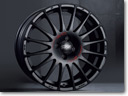
OZ Superturismo GT Black
Just 12 years after the company was created, in 1990 OZ won a title in WRC put on Carlos Sainz’s Toyota. Furthermore, in 1996 Damon Hill and his team Williams became F1 champions using OZ wheels. OZ wheels nowadays can be found in DTM series, GP3, IndyCar, WRC and so on and so on.
So what pushed the brand to the top? On the first place it is the quality – the most titled wheel brand needs to create products to last – the TUV certificate and the wins come to prove this pretty much every day. Being an Italian manufacturer, it is somehow natural OZ makes some of the most beautiful alloys.
Still, if you have any doubts about OZ, keep in mind all alloys are Xray tested , impact tested and so and so on, so that you can be sure you have the best piece of quality fitted – No matter if you need just beautiful alloys for a daily driver, lightweight for your track toy, or vintage looking wheels for your Capri, OZ has something available!


 How important is your car to you? I am pretty sure there are thousands of people’s girlfriends around the world like mine claiming you love your car more than you love her.
