Five Chevrolet-based characters – including four all-new characters – are featured in the upcoming movie “Transformers: Revenge of the Fallen”, presented by Paramount Pictures and DreamWorks Pictures, set to open as of June 24 in European movie theaters. (more…)
Tag: Volt
-
Five Chevrolet-based AUTOBOTS in “Transformers : Revenge of the Fallen”
-
GM, Goodyear and Bose Collaborate to Boost Chevrolet Volt’s Efficiency
 When the Chevrolet Volt extended-range electric vehicle debuts next year, advanced, fuel-efficient tires by Goodyear and a new sound system by Bose will be among the components helping the Volt to achieve up to 40 miles of electric-only range. (more…)
-
Chevrolet Volt
 General Motors today outlined a comprehensive plan of action to help communities get ready for plug-in electric vehicles such as the upcoming Chevrolet Volt. GM announced details of the plan at the Washington Auto Show. (more…)
-
Chevrolet Volt Battery Packs Will Be Manufactured by General Motors in the United States
 The Chevrolet Volt, an extended-range electric vehicle that delivers up to 40 miles of gasoline- and emissions-free electric driving, will use battery packs manufactured in the United States by General Motors, Chairman and CEO Rick Wagoner announced at the North American International Auto Show. (more…)
-
GM EUROPE And IBERDROLA Sign Agreement To Analyse The Recharging Infrastructure For Plug-In Electric Vehicles
 General Motors Europe and Iberdrola have signed an agreement to jointly perform a feasibility study which, ultimately, will analyze the technical requirements of a recharging infrastructure for the integrated marketing and viability of plug-in electric cars. The agreement has been signed by Javier Villalba, Director of Spain Network Business, and Jamal El-Hout, Vice President, Product Planning from General Motors Europe. (more…)
-
GM Holden Showcases Chevrolet Volt In Australia
 The much-anticipated Chevrolet Volt extended range electric vehicle has made one of its first global appearances at the Australian International Motor Show in Sydney.
Volt, to be launched in the US in 2010, uses electricity to move the wheels at all times and speeds in a significant advance from conventional hybrids. (more…)
-
Chevrolet Volt Production Version: A New Breed of Electric Vehicle
 Making its European debut at Paris, the much-anticipated production version of the Chevrolet Volt delivers up to 60 kilometers of gasoline and emissions-free electric driving, with the extended-range capability of hundreds of additional kilometers. (more…)
-
Volt, Orlando, Cruze, Camaro – four see chevrolet’s future!
Not one, nor two nor even three major debuts is good enough for Chevrolet – the 2008 Paris Motor Show will see four brand new cars sharing the limelight as the company proves its commitment to growing its sales in Europe.
The production version of the Volt, unveiled as part of GM’s centenary celebrations on September 16, is the latest all-new model to join the Paris show line-up, which also includes the all-new Cruze saloon, Orlando Show Car and production version of the Camaro.
World premiere: Cruze
On sale in the UK next spring, the Cruze is the first of Chevrolet’s new wave of truly global products. Its four-door coupe-like profile raises the bar in terms of styling in the value compact car segment, while Chevrolet’s distinctive double-decker grille and concave shoulder line further illustrate the focus on styling.

Inside, Cruze features a driver-friendly twin-cockpit interior layout, with high quality materials and smart blue-backlit dials giving it an upmarket feel that buyers wouldn’t necessarily expect from a value brand.
The UK market specification will feature a range of 1.6 or 1.8-litre petrol engines, or a common-rail 2.0-litre diesel.
World premiere: Orlando Show Car
Chevrolet’s first entry into the European seven-seat compact MPV market, the Orlando promises rugged styling, dynamic ride and handling, a high quality interior and a practical seven-seat ‘theatre-style’ seating layout that offers fantastic levels of practicality.

While the Orlando is very much a show car in its current form, it signals the production intent of such a vehicle – a production model based on the concept will debut in 2009.
European premiere: Volt
The production-ready version of the Chevrolet Volt E-REV (Extended-Range Electric Vehicle) clearly illustrates GM’s commitment to providing viable low emissions motoring. Powered at all times by an electric motor, but with a petrol engine to operate as a generator when the battery is depleted, the Volt has the ability to travel up to 40+ miles with absolutely no exhaust tailpipe emissions whatsoever.

Unlike conventional electric cars, which have a limited range, the Volt’s additional petrol engine means that the car can continue to run once the battery is discharged, as the engine then generates power to boost the battery that powers the electric motor.
Yet despite its revolutionary drivetrain, the Volt does not compromise on practicality – it’s a full-size four-seater saloon car, with excellent luggage and passenger space and stylish, contemporary looks. Production begins in 2010.
European premiere: Camaro
A legend reborn! The production Camaro makes its show debut at Paris, and features modern styling that is faithful to that of the original 1967 Camaro – a car with a very important place in the history of American motoring.

Despite its heritage-based styling, the Camaro is every inch the modern performance car, with an advanced chassis and a mighty 400PS, 6.2-litre V8 engine. Sales of the Camaro begin in the USA next year, with European sales following in 2010.
Chevrolet sold over 457,000 cars in Europe in 2007, and is on target to further that growth in 2008. A total of 18,360 of those were sold in Britain, an increase of almost 27.6 per cent over the previous year, while Chevrolet’s UK sales in 2008 are up 12 per cent compared to the same time in 2007.
-
Chevrolet Volt
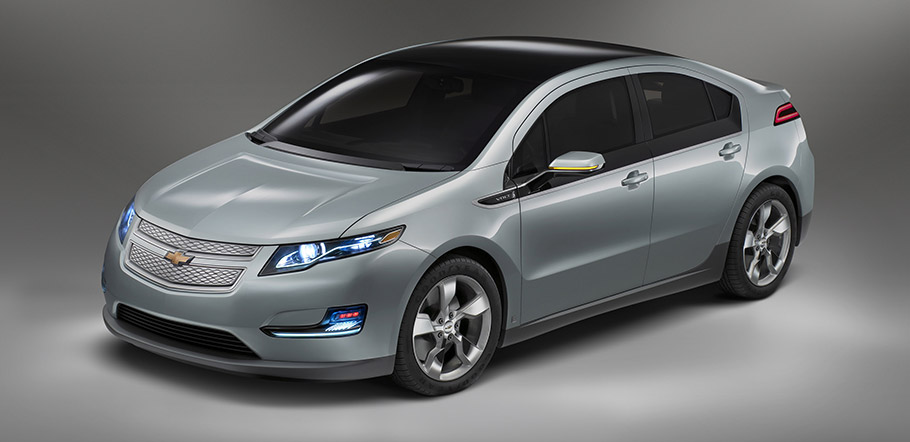
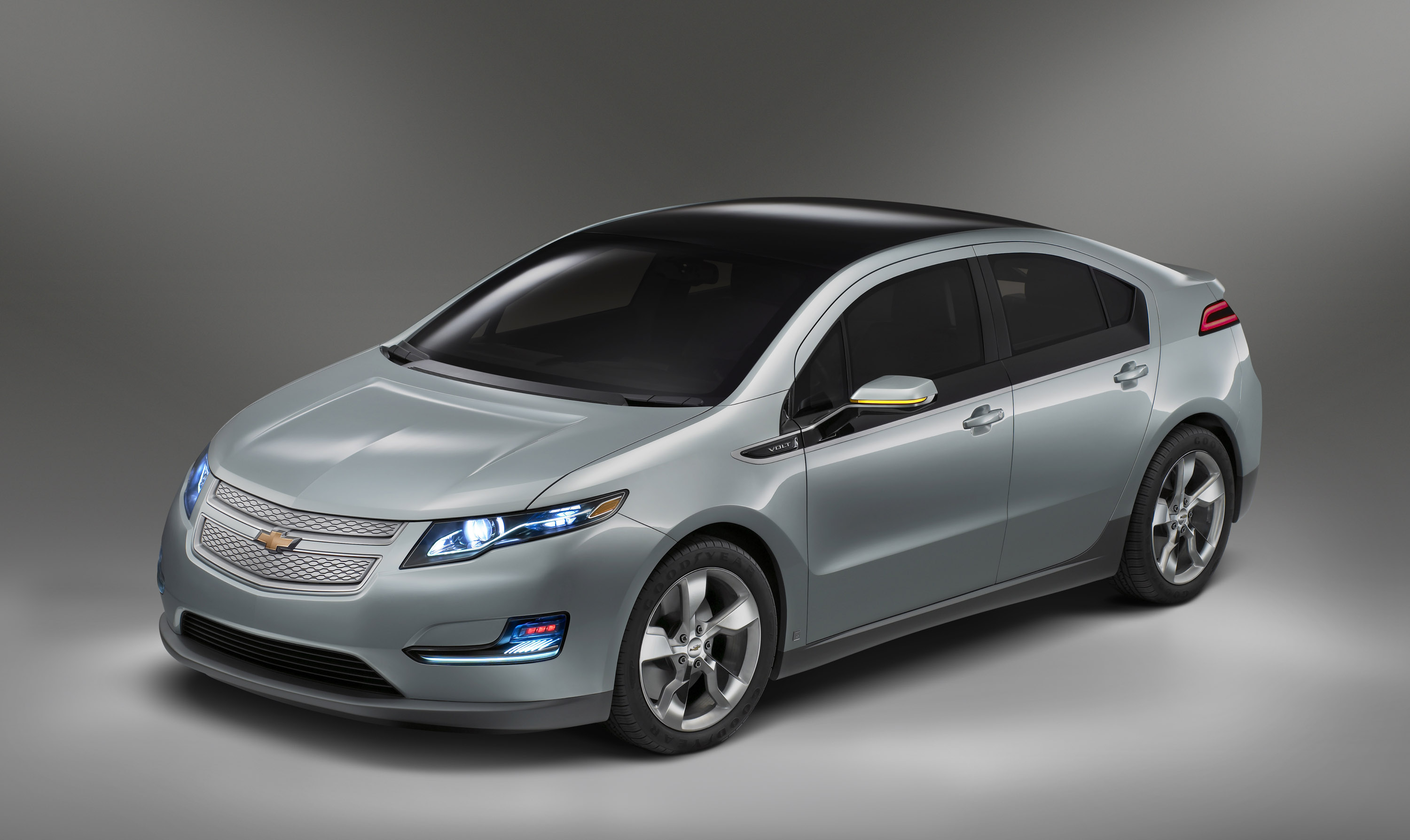
General Motors launched its next 100 years today by unveiling the much-anticipated production version of the Chevrolet Volt – a vehicle that delivers up to 40 miles of gasoline- and emissions-free electric driving, with the extended-range capability of hundreds of additional miles.
“Revealing the production version of the Chevy Volt is a great way to open our second century,” said Rick Wagoner, GM Chairman and CEO. “The Volt is symbolic of GM’s strong commitment to the future … just the kind of technology innovation that our industry needs to respond to today’s and tomorrow’s energy and environmental challenges.”
Form follows function
The design of the Chevrolet Volt production car has evolved from the original concept that was unveiled at the 2007 North American International Auto Show in Detroit.
Because aerodynamics plays a key role in maximizing driving range, GM designers created an aerodynamically efficient design for the production vehicle. Many of the design cues from the concept vehicle endure in the production Volt, including the closed front grille, athletic stance, rear design graphics, outside rearview mirrors and more. The Volt’s rounded and flush front fascia, tapered corners and grille are functional, enabling air to move easily around the car. In the rear, sharp edges and a carefully designed spoiler allow the air to flow off and away quickly. An aggressive rake on the windshield and back glass help reduce turbulence and drag.


Working closely with GM aerodynamicists to shape the Volt, design and engineering teams developed one of the most aerodynamic vehicles in GM’s history. They spent hundreds of hours with the Volt in GM’s wind tunnel, testing and re-testing parts such as the front and rear quarter panels, rear spoiler, rockers and side mirrors. Aerodynamic improvements enabled GM to reach the Volt’s target of driving up to 40 miles (based on EPA city cycle) without using gasoline or producing emissions.
Inside, the Volt offers the space, comfort, convenience and safety features that customers expect in a four-passenger sedan, and it delivers them in a variety of interior color, lighting and trim options unlike any offered before on a Chevrolet sedan. Modern controls and attractive materials, two informational displays, and a touch-sensitive infotainment center with integrated shifter distinguish the Volt’s interior from other vehicles in the market.
Some of Volt’s interior technological features include:
- Driver-configurable, liquid crystal instrument display
- Standard seven-inch touch screen vehicle information display
- Touch screen-style climate and infotainment controls
- Optional navigation system with onboard hard drive for maps and music storage
- Standard Bluetooth for cellular phone and USB/Bluetooth for music streaming
New era in automotive transportation
The Chevrolet Volt is leading a new era of electrification of the automobile by creating a new class of vehicle known as the Extended-Range Electric Vehicle, or E-REV.
The Volt uses electricity to move the wheels at all times and speeds. For trips up to 40 miles, the Volt is powered only by electricity stored in its 16-kWh, lithium-ion battery. When the battery’s energy is depleted, a gasoline/E85-powered engine generator seamlessly provides electricity to power the Volt’s electric drive unit while simultaneously sustaining the charge of the battery. This mode of operation extends the range of the Volt for several hundred additional miles, until the vehicle’s battery can be charged. Unlike a conventional battery-electric vehicle, the Volt eliminates “range anxiety,” giving the confidence and peace of mind that the driver will not be stranded by a depleted battery.
The Chevrolet Volt can be plugged either into a standard household 120v outlet or use 240v for charging. The vehicle’s intelligent charging technology enables the Volt’s battery to be charged in less than three hours on a 240v outlet or about eight hours on a 120v outlet. Charge times are reduced if the battery has not been fully depleted. At a cost of about 80 cents per day (10 cents per kWh) for a full charge that will deliver up to 40 miles of electric driving, GM estimates that the Volt will be less expensive to recharge than purchasing a cup of your favorite coffee. Charging the Volt about once daily will consume less electric energy annually than the average home’s refrigerator and freezer units.
Charge out of driving
The Chevrolet Volt offers spirited driving performance in a remarkably quiet interior. More than 220 lithium-ion cells contained within the Volt’s battery pack provide ample power. The Volt’s electric drive unit delivers the equivalent of 150 horsepower, 273 lb-ft. (370 Nm) of instant torque, and a top speed of 100 miles per hour. The lack of engine noise, combined with special sound-deadening materials, make the Chevrolet Volt an extremely quiet vehicle to drive.GM estimates that the Volt will cost about two cents per mile to drive while under battery power compared to 12 cents per mile using gasoline priced at $3.60 per gallon. For an average driver who drives 40 miles per day (or 15,000 miles per year), this amounts to a cost savings of $1,500 annually. Using peak electric rates, GM estimates that an electrically driven mile in a Chevy Volt will be about one-sixth of the cost of a conventional gasoline-powered vehicle. The cost savings are even greater when charging during off-peak hours, when electric rates are cheaper.
The Chevrolet Volt is expected to be built at GM’s Detroit-Hamtramck manufacturing facility, subject to GM successfully negotiating satisfactory government incentives. Production is scheduled to begin late 2010 for models in the United States. Pricing has not been announced. Visit media.gm.com/volt for more information.
General Motors Corp. (NYSE: GM), the world’s largest automaker, has been the annual global industry sales leader for 77 years. Founded in 1908, GM today employs about 266,000 people around the world. With global headquarters in Detroit, GM manufactures its cars and trucks in 35 countries. In 2007, nearly 9.37 million GM cars and trucks were sold globally under the following brands: Buick, Cadillac, Chevrolet, GMC, GM Daewoo, Holden, HUMMER, Opel, Pontiac, Saab, Saturn, Vauxhall and Wuling. GM’s OnStar subsidiary is the industry leader in vehicle safety, security and information services. More information on GM can be found at www.gm.com.
PRELIMINARY SPECIFICATIONS: 2011 CHEVROLET VOLT
General
Vehicle type: 5-door, front-wheel-drive sedan Category: Extended-Range Electric Vehicle (E-REV) E-REV competitors: none Chassis: independent McPherson struts front, compound crank twist axle rear, four-wheel disc brakes, full regenerative brakes to maximize energy capture, electric power-assist steering Seating capacity: four Manufacturing location: Detroit-Hamtramck Assembly (subject to GM successfully negotiating satisfactory government incentives) Performance
Top speed (mph): 100 EV range, city (miles): 40 (based on EPA city cycle) Dimensions
Wheelbase (in / mm): 105.7 / 2685 Length (in / mm): 177 / 4404 Width (in / mm): 70.8 / 1798 Height (in / mm): 56.3 / 1430 Cargo volume (cu ft / L): 10.6 / 301 Battery system
Type: lithium-ion Energy (kWh) 16 Electric drive unit
Power (kW / hp): 111 / 150 Torque (lb-ft / Nm): 273 / 370 Exterior
Tire and wheel size: specially developed low rolling-resistance tires on 17-inch forged aluminum wheel -
GM readies Volt unveiling to shift focus from crisis
General Motors is rushing to finish the production version of its Chevy Volt and plans to unveil a showroom-ready model of the heavily touted electric car in September, people familiar with the project say.
Battered by a deepening slump in sales and concerns about whether it can ride out the downturn, GM is counting on the Volt to break its costly association with high-mpg vehicles at a time when truck sales are tumbling and gas prices are near record levels.
GM is likely to complete the production version of the Volt by early August and plans to show it off in September, just when the embattled automaker celebrates the 100th anniversary of its founding, people familiar with the plans said.
A GM spokesman declined to comment on the timeline for its next announcements on the Volt, which will include naming a supplier for the vehicle’s lithium-ion battery pack, the single most expensive element of the vehicle and the component seen as critical to its success.


“Everyone is waiting for the next steps,” Rob Peterson, spokesman for GM’s electric vehicle program, told Reuters. GM designers and engineers are “getting very close” to a production-ready version of the Volt, he said.
GM showed off a concept version of the Volt in January 2007 but has retooled the look of the vehicle significantly since then, in part in order to improve its aerodynamics, representatives of the automaker have said.
GM has already shown a near-production version of the Volt to a Los Angeles-area focus group of consumers as it pushes toward production of the vehicle by late 2010 under a development plan the GM board approved in June.
By unveiling the final version of the Volt at a centennial observation in September, GM will be looking to shift the focus for investors and consumers from its current sales slump toward the more fuel-efficient vehicles it has in development.
The automaker, which saw its stock hit a 54-year low last week, is expected to use the circuit of major auto shows that begins with Paris in October to unveil a series of upcoming vehicles that will underscore its effort to move away from a reliance on light trucks.
Those include the production version of the Chevy Beat, a replacement for the Aveo hatchback, and a replacement for the Chevy Cobalt, a small sedan.
VOLT: READY FOR ITS HOLLYWOOD CLOSE-UP
In a further bid to create buzz, the Volt is one of several GM cars set to make an appearance in the action movie “Transformers 2,” scheduled for release next summer, a person familiar with the matter said.
GM was heavily involved in the production of the first Michael Bay-directed “Transformers” film, released last summer, and provided a concept version of its 2009 Camaro for a central turn in the movie.
GM is designing the Volt to run for 40 miles (64 km) on a lithium-ion battery pack that can be recharged at a standard electric outlet. The Volt will also capture energy from braking, like a traditional hybrid, and feature an on-board engine that will be used to send power to the battery on longer trips.
GM is racing Toyota Motor Corp. to bring the first plug-in car to the marketplace and has already featured the Volt in its advertising, part of a bid to improve the public image of the fuel efficiency of its car line-up.
Just as the Detroit-based automakers once rolled out limited-edition performance cars to create a buzz around their brands, the Volt has emerged as a kind of environmentally friendly “halo car” that GM hopes will have as much impact as the Prius hybrid has had for Toyota.
-
Chevrolet Volt Concept
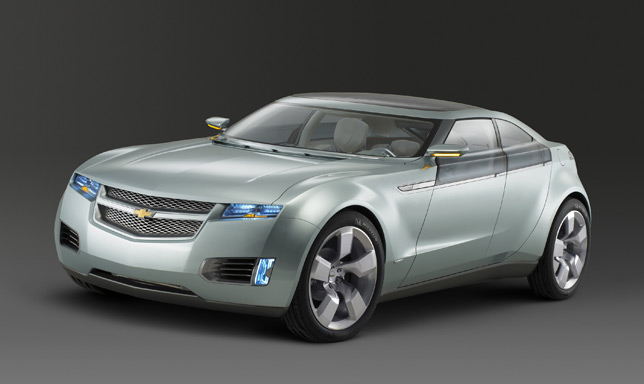
While the technologically advanced Chevrolet Volt has the capability to travel 40 miles on electricity alone, at first glance, the concept could easily be mistaken as simply a design statement.The Volt conveys an immediate message of agility and sophistication, with exterior proportions more commonly associated with classic sports cars. Twenty-one-inch wheels and sheer, taut surface relationships reiterate the statement. The Chevrolet Volt’s athletic design challenges the notion that an environmentally conscious vehicle can’t be beautiful and possess an aesthetic spirit that matches its driving characteristics.
“We’ve leveraged our resources around the globe to develop the design aesthetic for the Volt,” said Ed Welburn, vice president, GM Global Design. “It was important that the design capture the face of Chevrolet as it’s recognized around the world.” Design and engineering collaboration between GM designers and GE Plastics, using unique material technology and design engineering support, helped achieve the Volt’s distinctive appearance. True to the heritage of its Chevrolet bowtie, the Volt’s exterior design suggests spirited performance and is wrapped in a stylish package, with classic Chevrolet performance cues that hint at both Camaro and Corvette.
Inside, a host of current or near-term technologies and materials, combined with ingenious use of ambient light, creates an interior environment that’s light, airy and thoughtful.
“First and foremost, this is an advanced technology vehicle that uses little or no fuel at all. But we didn’t see any reason why that should compromise its design,” said Anne Asensio, executive director, GM Design. Asensio led the design team that created the Volt concept, with designs solicited from GM’s studios around the world.
“We wanted a size that connected with everyone, so we designed a small car,” said Asensio. “In the end, the interior design team from England inspired the final interior execution, and the exterior was the work of the Michigan advanced design team.
“Our job was to design a vehicle people could easily imagine seeing on the road,” said Asensio. “It couldn’t be a ‘science project,’ because that’s not what this car is all about. It had to be realistic, executable and carry the essence of the Chevrolet brand.”
Athletic, bold exterior
Sized for an urban-centric lifestyle, the Volt concept sedan carries dimensions similar to a Chevrolet Cobalt, with an overall length of approximately 170 inches (4,318 mm), a height of 52.6 inches (1,336 mm) and a width of 70.5 inches (1,791 mm). However, the Volt’s proportions, dictated by the layout of its electrically driven powertrain system, make it distinctly different from its mainstream Cobalt sibling.
“The configuration of the drive and energy components dictated we push the front wheels forward and outward to the corners,” said Bob Boniface, design director, GM Design, and lead exterior designer. “We wanted to keep the overall dimensions relatively small. This is an urban-centric car, so it needs to fit into small areas.”
The Volt’s proportions, combined with large wheels, wide front and rear tracks (64 inches / 163 mm, front and rear) and a tight wheel-to-body relationship, enable a sporty, confident stance. Other key proportional highlights include a dash-to-axle length that positions the driver far rearward of the front wheels; large 21-inch by 7.5-inch wheels; short front and rear overhangs and departure angles that deliver a sense of taut, compact energy. Also, the offsets between the upper glass elements and tire planes (the glass is inboard of the face of the tires) contribute to the sedan’s balanced stance and enhance the vehicle’s dynamic static image, resulting in pure, athletic proportions.
“What’s beautiful about the proportions is that when you think about some of the competitors out there, you tend to think of those vehicles as ‘the sensible shoe,’ “said Boniface. “People buy environmentally friendly cars because they feel it’s the right thing to do, not necessarily because of their looks or to make a fashion statement. But the Volt is different. It’s something one would buy because it is so compelling to look at, and the fact that it has the potential to never burn any gasoline – that’s just a bonus.”
Transparent roof and beltline
The Volt’s roof, side glass and beltline are constructed of GE Plastics transparent, glazed polycarbonate material that delivers the scratch resistance and gloss surface appearance of glass, combined with the formability of a plastic composite.
As a result, the Volt provides the driver and occupants with exceptional visibility, enabling a “city lights” theme in which the outside world passes through to the interior of the vehicle. Also contributing to the visibility is a shouldered, tinted side glass – constructed of the same GE polycarbonate material – that enables a dual beltline.
Additional exterior design elements
In addition to the upper daylight opening and roof, key exterior panels are made with a GE Plastics composite, and each – in and of itself – is designed as an artful shape that could be displayed on its own. As a result, the exterior panels fit together like a well-crafted puzzle, with flowing surface-to-surface cut lines that bring a sophisticated composition and overall harmony to the Volt’s exterior appearance.
The front door hinges enable enhanced entry/egress to the vehicle, as well as a graceful, forward-leaning door cut line. Milled from billets of stainless steel, the hinges serve as design elements, extending into the front quarter fenders and incorporating a plug-in recharging port access on both sides of the vehicle.
The vehicle face – designed to carry a serious, confident appearance – is clearly Chevrolet, with a twin-port front grille, center-positioned bowtie and lower air intake. Horizontal headlamps with aluminum bezels deliver a jeweled appearance, leading to translucent light-emitting diode (LED) forward illumination elements.
The underside of the vehicle consists of a flat, composite molded belly pan that is integrated with the fascias and rockers for a clean, uncluttered and finished appearance. The belly pan – which contributes significantly to the Volt’s 0.30 coefficient of drag – contributes to the sedan’s overall impression of refinement and demonstrates the design of the underbody was just as important as the upper body.
Thoughtful interior
The interior environment of the Volt was designed to appeal to an urban dweller who desires a smart, daily-use vehicle, according to Wade Bryant, design director, GM Design.
“On the interior of the Volt, you’ll find technologies, materials and an environment that enable the car to help make life simpler for a person who’s environmentally conscious and leads a city-centered lifestyle,” said Bryant. “It’s ergonomically correct, provides connectivity to the world, and demonstrates smart responsibility through the use of lightweight, recyclable materials.” Two such examples are the instrument panel topper and steering wheel made with GE Plastics.
Bryant said the interior environment of the four-passenger Volt is defined by a host of current or near-term technologies and materials combined with the ingenious use of ambient light. “It’s definitely based in reality. All the things you see on the interior are within reach in the next few years.”
According to Bryant, the interior team and the exterior designers worked closely together to make the Volt look like one vehicle. Two examples of their collaboration are the dual beltline and the door hinge that’s visible outside of the car. “We designed this as one element that comes inside the door and becomes the interior pull handle,” said Bryant. “It’s all about integration, refinement and thoughtfulness.”
Super Imaging instrument cluster
Super Imaging is an innovative, dual-mode technology display that provides two visual levels of vehicle information to the driver in the instrument cluster. It is a design innovation developed to provide a primary interface between the driver and the vehicle’s key feature: the next-generation, electrically driven propulsion system.
“The dual-mode instrument cluster was developed to highlight the car’s plug-in capability,” said Bryant. “The powertrain technology is the key feature, so we wanted to make sure the interior communicated that, and the driver would have a sophisticated, fun and useful interaction with the electric-drive system.”
The first level of information – configured similarly to a conventional instrument cluster – provides traditional data in the form of analog, three-dimensional (3D) LED displays, including three gauges for fuel level, speedometer, odometer, battery level and the transmission “PRNDL” indicator. The second level of information – a transparent screen positioned in front of the 3D LED displays – delivers color, animated data related to the Volt’s advanced propulsion system with a holographic-like appearance.
Super Imaging works by using invisible, fluorescent inks that are printed on the transparent screen. When illuminated by an ultraviolet (UV) laser projector located behind the instrument cluster (from the driver’s perspective), the inks become excited, and provide four-color illumination and animation.
Foam/fabric surfaces
Compression-molded foam with a textile-patterned surface layer is applied on the entire lower instrument panel, lower door trim panels and rear quarter trim areas. The material enables soft, tactile, low-gloss surfaces throughout the interior cabin that appear hand-crafted and specifically tailored to the car.
This material, used in some of the latest luggage designs, enables zippered access to traditional storage areas such as the glove box, doors, etc. The material is very inexpensive, wears well and enables flexibility in design.
Composite panels
Molded GE plastic panels provide thin, structural interior surfaces that can be cantilevered in space. The material is applied on the upper instrument panel, seat backs, center console sides and door inserts.
Light, strong, affordable and recyclable, the panels are sheathed in reconstructed scrap leather to achieve a soft, hand-crafted surface.
Use of ambient light
The aspect of light – from outside and within the vehicle – is played throughout the interior environment. Highlights include a transparent upper roof that provides large quantities of natural light and is enhanced with thinner pillars and rail sections; Gelcore® LED indirect lighting around the roof periphery that illuminates during evening hour entry/egress and can be seen from outside the vehicle; LED functional storage lighting that passes through transparent zippers and provides ambient light during evening hours; and conductive ink controls situated on the interior surface of the glass roof that provide touch access to lights, OnStar buttons and more.
“All the storage areas are lighted internally, and the light escapes through the clear zippers, so you’ll always be able to find your storage at night,” Bryant said. “It all adds a nice little ambient effect, and the illumination will be color-keyed to the instrumentation lighting color. It’s functional and cool, and when you open it, light from the interior storage area spills out.
“A big enabler is the transparent upper roof. It provides the Volt with more natural light than most other vehicles. It’s very distinctive and appealing.”