Tag: Volkswagen XL1

  • Volkswagen XL Sport is Powered by Ducati Superleggera V-Twin Engine

    Volkswagen-XL-Sport-THUMBVolkswagen XL Sport Concept is being shown for the first time at the Paris Auto Show today. This vehicle is a lightweight sports car, based on the XL1. Just like it, the XL Sport will be built in only 250 examples. This concept achieves its best ratio between weight of 1962 pounds, power – 197 hp (147 kW) and aerodynamics – CdA of 0.44 square meters. This combination allows the car to achieve an impressive top speed of 168 mph.

    The vehicle is powered by world’s most powerful two-cylinder engine – the Ducati 1199 Superleggera’s V-Twin unit, which has been modified for use in the XL Sport. It is coupled with a seven-speed DSG dual-clutch automatic transmission. From a standstill the XL Sport needs only 5.7 seconds to reach 100 km/h (62 mph).

    Furthermore, here the chassis has been also significantly redesigned chassis. It incorporates high-strength steel subframes which house upper and lower control arms at the front with pullrod actuation for the dampers. At the back, the control arms at the back have pushrod. The car runs on forged magnesium-alloy wheels fitted with 205/40 R18 front and 265/35 R18 rear high-performance tires. XL Sport has a powerful ceramic brake disc setup.

    XL Sport shares the same basic design as the XL1. Its central monocoque and most of the body panels are manufactured in carbonfiber-reinforced polymer (CFRP) using the RTM (Resin Transfer Molding) process. The monocoque includes slightly offset seats for the driver and passenger. XL Sport that is currently on a display in Paris is 168.9 inches long, 72.7 in wide and 45.4 in mm high. The wheelbase measures 95.4 in.

    The new concept model has some distinctive exterior traits such as the dual LED headlights and the XL1’s signature LED daytime running lights, air intakes on either side of the headlights and vents in the rear fenders. In addition, there are no conventional door mirrors. Instead, they are replaced by e-Mirrors. These are small streamlined cameras integrated in the fenders that send images of the surroundings behind the car to two displays inside.

    At the rear, we see wide “shoulders” above the wheels and an extendable rear spoiler. There also is a coupe-shaped roofline without a rear windshield. The iconic red LED ribbon follows the shape of the rear section and is framed at the sides by another, vertical, LED element. And at last, there is a black diffuser that merges into the completely enclosed underbody and is finished at each side with a chrome exhaust tip.

    Inside, the interior of the XL Sport is based on the XL1’s. There are some changes made, such as the digital instrument cluster which includes a lap timer and oil pressure display. There is also a carbon fiber cowl that extends across the top of the instrument cluster. The steering wheel has decorative red stitching and has been equipped with aluminum-alloy shift paddles. The red color also appears through the seat belts to harmonize the design inside.

    Source: Volkswagen

     

  • Volkswagen Delivered The First XL1 to a Customer

    Volkswagen has finally delivered the first  XL1 to a German customer. The remarkable engineering achievement (XL1) took years of development. Still, it has been whipped by a lot of eco-friendly vehicles, which cost significantly less than €110,000.

    The manufacturer didn’t comment anything interesting about the significant event. The car boasts an onyx white exterior and a titan black and pearl gray interior.

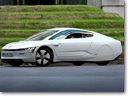
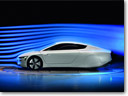
    Volkswagen XL1 is powered by a plug-in hybrid powertrain including a 0.8 liter two-cylinder TDI engine with 48HP (35 kW) and a 27HP (20 kW) electric motor and a 5.5 kWh lithium-ion battery. The car features special lightweight carbon fiber reinforced plastic construction and incredible aerodynamics. It adopts the classic “tear drop” shape and utilizes innovations such as removing traditional wing mirrors and replacing them with small cameras called e-Mirrors which transmit exterior images to interior displays.

    The result of all this technology is awesome – 0.9 liters / 100 km, which is 313.8 mpg UK or 261.3 mpg US. Volkswagen XL1 can travel up to 50 km (31 miles) only on electricity.

    The XL1 is handcrafted using small series production processes.  An initial production run of 250 XL1 vehicles will be made.

    Source: Volkswagen

  • Volkswagen XL1 in London – 0.9 l per 100 km

    Volkswagen has published a nice video showing the futuristic XL1 cruising across London. The manufacturers says that the XL1 is world’s most fuel-efficient production hybrid car capable of doing 313 mpg UK – 0.9 liters / 100 km.

    While one XL1 made its way to the Goodwood Festival of Speed to take pride of place on the Volkswagen stand and make its way up the famous hill climb, another crossed the capital, heading to Buckingham Palace where it will be displayed as part of the Coronation Festival this weekend (for more details see below).

    The XL1 is powered by a two-cylinder 800 cc diesel engine with an electric motor. To achieve the target fuel consumption figure the XL1 was aerodynamically optimised, adopting the classic ‘tear drop’ shape and utilising innovations such as removing traditional wing mirrors and replacing them with small cameras called e-Mirrors which transmit exterior images to interior displays.

    The XL1 is ‘handcrafted’ using small series production processes.  An initial production run of 250 XL1 vehicles will be made.

    Stay tuned for full specs and pricing!

    httpv://www.youtube.com/watch?v=a3Z9kuCvRDc

    Source: Volkswagen

  • Launch Of The 1-litre Fuel Economy Volkswagen XL1

    Volkswagen-XL1-THUMBVolkswagen XL1 is releasing the most fuel efficient production car in its range of vehicles, which manifests into reality the 0.9 litre combined fuel consumption vision. This remarkable efficiency is due to its plug-in hybrid system.

    This two-seater Volkswagen can also cover a distance of up to 50 km in all-electric mode and therefore delivers zero local emissions. The model is rebirth of a concept study and includes pure sports car design attributes such as low weight (795 kg), perfect aerodynamics (Cd 0.189) and a low centre of gravity (1,153 mm high).

    This gives the XL1 the ability to run on the road at a constant speed of 100 km/h utilizing just 6.2 kW (8.4 hp). And in all-electric mode the car spends less than 0.1 kWh in covering a distance of over one kilometer.

    The main attributes of this model are: high-tech lightweight design, perfect aerodynamics and a plug-in hybrid system. The latter comprises of a two-cylinder TDI engine (35 kW / 48 hp), E-motor (20 kW / 27 PS), 7-speed dual clutch gearbox (DSG) and lithium-ion battery. The XL1 is 3,888 mm long, 1,665 mm wide and just 1,153 mm tall.

    They all contribute towards the CO2 emissions of just 21 g/km. The XL1 covers the acceleration sprint from 0 to 100 km/h in 12.7 seconds on its way to the top speed of 160 km/h. Conceptually, the XL1 represents the third evolutionary stage of Volkswagen’s 1-litre car strategy.

    Source: Volkswagen