Volkswagen is spreading a vibe of positivity through its latest campaign named “Get In. Get Happy”. The brand has just unveiled the highly awaited commercial, which you can view below and will air in the second quarter of the Big Game.
In fact, this is the fourth consecutive year that Volkswagen participates with an ad on Game Day. “Get In. Get Happy.” campaign is created with the aim to bring about more joy to the daily routine of the viewers.
In short the advertisement shows the how a man brightens up his dreary office environment with a positive attitude and inexplicable Caribbean accent. He definitely manages to spread a lighthearted and energetic atmosphere throughout his office. But the core of the ad is that it represents the positive energy and sunny disposition that only the Beetle and Volkswagen can deliver.
The latest addition in the range of the famous Volkswagen Beetle model is the Exclusive one, which is characterized by elegance, stylish design, and is optionally available as Exclusive Design or Exclusive Sport.
This means that Volkswagen is offering two new models, which have design that focuses on uniqueness, and are based on the equipment lines Design and Sport. However, the exterior here includes four black 18-inch alloy wheels of the model model “Twister” with polished surface and wheel lock with extended anti-theft protection, as well as tire pressure monitoring display.
The afore mentioned model is a standard. The optional extra is the 19-inch alloy wheels of the “Tornado” model. Unique features regard the interior: three different colored leather seating systems are available. Namely they are in Pepper Beige, Amber Brown and Black, and each comes with an exquisite diamond stitching.
As a standard equipment in the Exclusive line is included the following: dash panel in “Black Uni”, door sills in stainless steel, with lettering “Volkswagen Exclusive”, three-spoke leather steering wheel, gearshift knob, handbrake lever and centre armrest in leather, with same stitching colour as centre seat, sports seats front, centre seat panels and seat lateral supports in “Nappa” Cool Leather, front and rear textile floor mats with coloured edging, door and side trim in leather look.
The starting price of the 2013 Volkswagen Beetle Exclusive Design is € 22 650.
2013 Volkswagen Beetle Fender Edition has just been released. This is a very special edition of the popular car which will excite all musical enthusiasts and especially the guitarists. The Beetle Fender Edition with its style and charm will match perfectly for all those keen on the both brands.
Furthermore, they will benefits from either the 170-horsepower (125 kW) 2.5-liter five-cylinder engine mated to either a five-speed manual or a six-speed automatic transmission; or the turbocharged 2.0-liter TSI® four-cylinder engine that’s matched to a six-speed manual transmission or a six-speed DSG dual-clutch automatic transmission.
First of all, the 2.5L version of this iconic Volkswagen features all of the equipment found on the 2.5L Beetle with Sunroof model. On the other hand the 2.0T Beetle Fender Edition takes the Beetle Turbo with Sunroof and Sound as its starting point.
The unique exterior appearance of this car is due to the Deep Black Pearl Metallic paint, brushed chrome mirrors, Fender badging on the sides of the car, 18-inch “Disc” aluminum-alloy wheels, and Bi-Xenon headlights with LED Daytime Running Lights.
The interior shows high-quality as well. Inside, there’s a striking dashboard that incorporates the Fender badge and was inspired by the iconic Fender sunburst design. The Turbo models also have sport seats upholstered in V-Tex leatherette with unique cloth inserts.
But what distinguishes the most this edition from other Beetles is that it includes the high-performance, award-winning Fender Premium Audio System. The concert-quality audio is the result of proprietary Panasonic speaker technology, which cuts through noise and dual-voice coil speakers that reproduce the sound of a live performance.
In particular, the sound system comprises of a 10-channel amplifier that delivers 400 watts of system power to four Fender Deluxe tweeters, two Fender Twin speakers, two Fender rear speakers, and one Fender Bassman subwoofer.
2013 Volkswagen Beetle Fender Edition is on sale now with a starting price of $24 440.
Volkswagen has announced the new 2013 Beetle Cabriolet, which will make its official debut in the end of November at the L.A. Motor Show.
The new model also incorporates design criteria of the modern Volkswagen line-up: the air inlet under the bumper, the flat contour of the hood’s bottom edge and in particular the tail lights show the close family ties. In the new Beetle Convertible, Volkswagen brings together modern technology and the highest standards of quality with the emotional legacy of the car’s ‘forefather’. As on the nostalgic icon, the headlights still have their classic round shape.
Another feature contributing to the special charm of the new Beetle Convertible is the traditional soft top. When open it lies very flat, enabling good vision to the rear. Despite its compact construction, the top is very wide and elongated in shape. It opens and closes entirely automatically (on all models) within around ten seconds and up to a driving speed of 30mph.
Included with the Beetle Convertible is a standard soft-top cover, which, if desired, tucks the opened top neatly away. Surrounding chrome trim accentuates the borders between steel and fabric. As in other Beetle models, the compact instrument panel with extra large round instrument cluster and several nostalgic elements, such as the additional glove box, create a markedly different design inside the new Beetle Convertible as well.
With its spacious and comfortably designed interior the Beetle Convertible is a fully-fledged four-seat vehicle. The trunk enfolding up to 225 liters includes a fold-down symmetrically split rear bench seat which allows transporting bigger items event when the roof is closed.
To provide added safety in the event of a rollover accident, Volkswagen has developed an active rollover protection system. It consists of two extendable modules fitted inside the vehicle in concealed fashion behind the back of the rear bench seat. If the car were to roll over, the two rollover modules would be activated via the central airbag triggering unit. Along with the fixed A-pillars, they provide effective protection for the occupants of all four seats within a matter of milliseconds. Another extra safety feature is front and head-thorax-airbags that are standard equipment.
The engine range includes seven power units – a highly efficient 1.2-liter TSI with 105HP (77 kW), a BlueMotion Technology version of this gasoline engine will also be available. The other petrol variants are a 1.4-liter TSI and a 2.0-liter version, producing 160HP (118 kW) and 200HP (147 kW), respectively. There are two diesel variants – a 1.6-liter TDI with 105HP (77 kW) (including as a BMT version) and a 2.0-liter TDI with 140HP (103 kW).
The new 2013 Beetle Convertible is priced from €21,350, which is very good value for money.
2013 Volkswagen Beetle R-Line is also named by the brand the Sporty Chic. In fact, Volkswagen is now offering two R-Line packages – exterior and interior one – for the Beetle that are based on the top “Sport” version.
The independent and sporty R-Line options can be combined with any of the twelve Beetle colors. In particular the parts of the exterior package include: front bumpers with independent black grained air inlets and chrome surrounds for the directional indicators, diffuser at the rear, special body side panels and door mirror housings in body color, R-Line logos on the front body beneath the A-pillars, 18-inch “Twister” alloy wheels, Machine-polished 19-inch “Tornado” alloy wheels in black or white with 235/40 tyres (optionally).
The exterior package can be ordered separately. However, the interior package is always offered as an extension of the R-Line exterior details and it includes the following equipment: sport seat system with seats upholstered with an active-breathing fabric in “Kyalami” design, front head restraints with R-Line badge, leather-trimmed sport steering wheel, the gear shift lever boot and the handbrake grip with decorative seams in “Art Grey” and decorative inlays in “Dark Vanadium”.
Furthermore, there are also offered some optional features. For example the seats can be ordered in black leather (“Vienna”) with R-Line badges on the head restraints as well as on the door sill plates and the leather-trimmed sport steering wheel.
The Beetle Sport is available with a 1.4 TSI (118 kW/160 PS), 2.0 TSI (147 kW/200 PS) or 2.0 TDI (103 kW/140 PS). The R-Line exterior package starting price is € 1 290, and when the interior package is included the price starts at € 1 675.
I have just stumbled on this video/thing on YouTube. It’s from the Volkswagen channel and it’s supposed to be a teaser. Yes, the Beetle is newish but the focus is not on it per se. In August, Discovery Channel are going to broadcast their annual “Shark Week” and Volkswagen will somehow be involved in it.
Volkswagen Beetle Shark Observation Cage
Why a Beetle then? Well, since the Inglostadt guys don’t have a particular car named after a certain species of shark, why not? Besides, If we got this right, they will be putting together a “Beetle Shark Observation Cage“, which sounds like the most unsettling, comfortable thing ever. Volkswagen have rigid and reliable history but this stunt takes on a whole new meaning.
However, If the cage is to be modeled after a Beetle, it kind of makes sense since it’s the perfect shape – spacious and view friendly. Thus vigilance won’t be an issue when dipping for sharks.
The whole plan will come to light, we guess, on Sunday, the 12th of August when Discovery’s Shark Week will be in motion. Don’t miss out.
2012 Volkswagen Beetle Spring Drive will feature new entry-level engines, which will deliver even more driving fun with in combination with low fuel consumption. The new version is released of course – just in time for the spring, and will include expanded range of engines: 105 PS (77 kW) diesel engine (TDI) and a 160 PS (118 kW) (TSI) petrol engine. As the brand promises, the new engines are fuel efficient and agile downsized with small displacement, direct injection and charging. All this results in the fact that the 1.6 TDI Beetle needs only 4.5 l/100 km (equivalent to 119 g/km CO2) and to achieve the highest speed of 180 km/h. Fully fuelled (55 liters), the Beetle thus has a theoretical driving range of 1,222 km. On the other hand, with the 1.2 TSI (77 kW / 105 PS), petrol direct-injection engine has a performance data: 5.9 l/100 km or 137 g/km CO2. All this matched to 180 km/h top speed. However, the top engine is currently a 2.0-litre TSI with 147 kW / 200 PS, which has a fuel consumption of 7.7 l/100 km (equivalent to 179 g/km CO2). It accelerates the Beetle to 223 km/h. The vehicle of course, still delivers its well-known suitability for day-to-day use as a full-fledged 4-seater. In addition, to this we have to highlight its high quality and safety standards with a solid basic equipment, which are also included on board, and in fact were always inherent features of the Beetle.
The price of 2012 Volkswagen Beetle Spring Drive 1.2 TSI with 105 PS starts at 16 950 euros.
Abt sportsline has unveiled the tuned 2012 Beetle at the 82nd Geneva Motor Show.
The exterior package includes a new front bumper, a rear diffuser with oval exhaust pipes and a pair of side skirts. There are also headlight brows and some nice graphics. The car is lowered by a set of sport springs. It stands on Abt DR wheels fitted with low profile tires.
The tuning specialists have developed five performance packages for the “bug” – 1.2 TSI with 140PS (103 kW), 1.4TSI with 210PS (154 kW) and the mighty 2.0TFSI is delivering 240PS (176 kW). The diesel range features 1.6 TDI receiving additional 20PS (15 kW) and the bigger 2.0TDI will have 170PS (125 kW).
Actuall, the ABT Beetle looks much better than, it was originally planned. The headlight brows give more aggressive look and the stripes complete the stunning exterior.
Volkswagen of America Inc. have revealed their third consecutive ad campaign project for the Super Bowl. On their YouTube channel we can watch a 0:75 extended commercial that is due to air on Game Day in a 0:60 second form.
“This is a perfect opportunity for Volkswagen to celebrate with the fans that have made 2011 such a record-setting year for the company,” said Tim Mahoney, Chief Product and Marketing Officer, Volkswagen of America, Inc. “This year’s commercial will build on Volkswagen’s ability to tell human stories simply while continuing to build on the brand’s momentum in the year ahead.”
All formalities aside, VW seem reluctant to drop the Star Wars theme despite the fact that the one now, seemingly has nothing to do with drones and Darth Vader. If you remember last year’s commercial, “The Force” spot, features a young Darth Vader who seems determined to make something work with “the Force”. Needless to say that with a little help of the father in the house, the youngster manages to fire up a VW Passat. The commercial went on to become a viral hit with almost 7 million views on YouTube.
This year, VW released a teaser with an ensemble of dogs that bark out the “Imperial March” and now we have a fully revealed commercial. It features an obese dog which for some reason is unable to get out of the house (supposedly opening the door is not an option). After realizing that there is a good chance of having the opportunity to run along a VW Beetle just for the fun of it, the dog goes on a strict diet and engages in an intense workout. Then there is the Star Wars intermission – the commercial is being watched in the iconic Cantina introduced in Star Wars Episode IV where a rather grown up Darth Vader makes a cameo. We also have that loopy tune from the alien jazz band stuck in our head now.
The newest VW Beetle is funky, hip and image laden. So one might think there is no real need to further personalize. Accessory house JE Design however, thing they can push the boundaries of individualism even more.
The Beetle’s chassis for example has underwent JE specialty tuning by replacing the springs with ones that are more stiff so that body roll is reduced to minimum. Despite being shorter (around 30-35 millimeters) than the standard springs, no shock absorber change is needed, The JE Design spring kit is available for 219 euros ($289) in Germany.
8 x 19 inch, exclusive black “Tornado” Volkswagen, multi-spoke alloys can be provided by JE Design. They can be fitted with the standard 235/40 R19 or to do the honor of those 16-spoke wheels one can fit them with even lower profile tires (235/35 R19). Four finishes are available for the rims: black mat spokes and a mat silver rim flange, graphite mat silver spokes with a mat silver rim flange, shadow silver and black shiny spokes with a shiny silver rim flange. The complete JE Design wheel set has a starting price of 2,810 euros ($3,702).
Other distinctive features include a sporty apron insert (476 euros/$627) that comes with a diffuser and a centered air duct. Another thing is the steel muffler developed for the VW Beetle, with a round 90 millimeter large twin tailpipe as a four pipe design and is compatible with all gasoline and diesel motors. That will send you back further 952 euros ($1,254). Needless to say that all JE Design components come with TÜV certificates.
For the VW Beetle Sport which already has 200HP2.0 Golf GTI TFSI engine can also be tweaked by JE Design with an engine management module that kicks it up a notch to 240 HP while torque peaks at 310 newton meters. The time for a zero to sixty sprint stands at 6.9 seconds and top speed reaches 230 km/h. That privilege costs another 1,280 euros ($1,686). After the upgrade emission status remains the same so no road legal issues should follow. All is again TÜV certified.
Can you believe that at first the now so popular Volkswagen Beetle was firstly intended to be a mass-production car, which can be afforded by an average person? Well, the beginning of the story of the famous car started just like that in pre Second World War period. The history of the emblematic car began in 1934, when Hitler himself, announced his vision for a “peoples car”. To be more precise the literal meaning of Volkswagen is “peoples car”, this is how the brand actually got its name. The most famous car designer at that time – Ferdinand Porsche – was entrusted to construct the vehicle. However, Hitler insisted on his own vision of the car, which must carry two adults and three children and have a low consumption of gasoline. However, the most prominent factor had to be the price – 1000 Reichmarks, which for Ferdinand Porsche seemed to be unreasonably low.
The first prototypes called “Type 60” came out in the 1935, and included one saloon model and one convertible. These vehicles were made from alluminium mounted on wooden frameworks. All this represented the body. A year later the bodies were mounted on steel floor panels. The top speed of the car was estimated around 105 km/h. As expected, this provoked a huge interest among Germans, and everyone wanted to buy a car. Hence, this led to the construction of factory in 1938. Nowadays this same factory is the biggest factory in the world. The name for the future Beelte was chosen by Hitler himself, and meant literally “Strength through Joy Car” – KDF Wagen (or Kraft Durch Freude Wagen). However, as we all are familiar, in 1939 the Second World War began, and hence the production changed its purpose. Now it was for military vehicles.
1938 Volkswagen Beetle Original
The war eventually ended in 1945, but the production of the Volkswagen continued. However, it was much slower than the pre-war. Cars were put together with the last materials left from the bombardment and stored in the basement. In contrast just a year later, the production of the vehicles was 1000 a month. It is almost unbelievable that the numbers of the manufactured cars went to 19 000 in 1948, and the astonishing 46.000 in the next year. In this year the range of the produced Volkswages was extended. It now featured two different convertibles, one with two seats and one with four.
The 1000th Volkswagen Beetle built in 1946 coming from Assembly Line
The 50’s was a prominent decade for the famous vehicle, where the tradition was established. Moreover there were so many additional changes added, which improved the performance of the car. One example is that there were included hydraulic brakes. Another good instance is the 15×5 inch tires, or the taillight of each rear fender. However, probably one of the most important changes in the design that has been made during the 50’s the single oval rear window which took the place of the two-piece one, and thus improving the visibility. In this decade the engine grew to a full 1.2 liters one. Interesting information to be shared is that during 1955 and 1956 there was a Beetle Deluxe, which was the only model of the vehicle exported to the U.S. Although there were a lot of modifications made further throughout these ten years, the Volkswagen remained a slow car, which was considered a huge problem. In the 1956 for example the car acceleration from 0 to 50 km/h was made in 7.5 second, the top speed was just 110 km/h. Nonetheless, people bought the car with eagerness. At the end of the year of 1959 there were in total 575 407 cars sold. Furthermore, 120 442 Beetles of these were sold only in the U.S.
The great success achieved in the 50’s is what made the Volkswagen Beetle and Icon in the next decade. The elements of the new 60’s Beetle were even more enhanced: new steering wheel, better seats design, and plastic headliner. Moreover the fuel tank was redesigned to make more space for the luggage. More importantly, during the first years of the decade there was included a conventional fuel gauge and bigger taillights. In the mid of the decade there was included a new powerful motor and by the end of the 60’s there’s a new 1.5-liter engine, making 53 HP (39 kW). However the car was still not fast enough, although the acceleration form 0 to 50 km/h went to 5.9 seconds. A huge innovation in technical terms was the introduction of the new optional Automatic Stick Shift semiautomatic transmission in 1968. It allowed the driver not to press the clutch pedal while shifting the gear.
However, in the 1970’s the picture weren’t that much successful as was the previous decade. There were several reasons for that, but probably most significant is the presence of other competitor companies like Renault and Toyota on the market. So during the 70’s the fame of the Beetle slowly began fading away. Of course there were a lot of innovations included in the car during these years. In the beginning of it the engine grew to 1.6 liter and now produced 60 HP (44 kW). But again the acceleration was literally disappointing. In the ext years, the Beetle got another significant change that has to be marked – this time in suspension. It adopted MacPherson strut front suspension. This was the beginning of the model, called “Super Beetle”. Of course during those years the car underwent a lot of modifications in order to keep with the trend. Unfortunately, the start of the end of an era was marked with the closure of the VW’s plant in New Zeland in the beginning of the 70’s. Another important factor for the waning fame is the start of the production of the replacement of the Beetle, which was named Volkswagen Golf. This led to more factories which didn’t produce more Beetles and slowly it’s popularity due to lack of innovations and improvements of technology began fading away.
1970 Volkswagen Beetle
In the eighties the production of the iconic vehicles continued, however strongly narrowed to only one plant on Mexico. In addition this plant stopped exporting vehicles for Europe and it was used mainly as a taxicab in Mexico. This plant continued producing Beetles till the first years of the 90’s too. And more interestingly it even produced the 21st million Beetle. However the end was near and the plant ceased working. In the end of the 90’s the designers from Volkswagen decided to revitalize the iconic car. Thus in 1998 was produced (again in the plant in Mexico) a more stylish variant of the vehicle. It now produced the 115 HP (84 kW), had 2.0 liter engine, five-speed manual or four-speed automatic transmissions, and independent suspension. At the end of the 1999 the Beetle included ABS brakes, 150 HP (111 kW) turbocharged 1.8 liter engine.
The beginning of the new Millennium was successful too. In the 2002, there was made a sporty model, called Beetle Turbo S, with venerable 1.8T turbocharged engine, which made the total 180 HP (133 kW) at 5,500 rpm and 173 pound-feet of torque from 1,950 rpm to 5,000 rpm. Due to these numbers in the model was included for the first time a six-speed manual transmission. However there was still something missing, and this time it was something which had to remind the customers for the original Beetle. In 2003 Volkswagen launched a brand new redesigned Beetle Cabriolet with 2.0-liter and 1.8T engines. Since then the brand continued producing the emblematic vehicle further enhanced and improved. In 2006 the brand revealed its “new” Beetle (including a convertible model) which had a subtle but stylish new look that fashionably updates. Yet, it maintained the core emotional appeal of the iconic Beetle design. It got the 2.5 liter, five-cylinder engine which creates 150 HP (84 kW). Another significant technical update here was the standard traction control with Electronic Stabilization Program (ESP).
Now, in 2012, we are about to see the coming of two Beetle versions. The first one is, to say so, a regular one, with improved design, aerodynamics, modern interior and appealing exterior. The second one, in my opinion, is a pure development of the iconic car. Moreover it matches the “demands of the times” and is purely … electric! It is named Volkswagen E-Bugster, and although it is still in a concept mode, it is electrifying! This concept vehicle was revealed at the 2012 North American International Auto Show in Detroit. The new two-seated E-Bugster continues Beetle’s sporty theme, but is powered by an electric motor which provides 85 kWh of power.
2012 Volkswagen Beetle
2012 Volkswagen E-Bugster Concept
To sum up, the Volkswagen Beetle has almost 80 years old history and more importantly – it continues it nowadays successfully. Although it remained mostly unpopular with its original name, which is Volkswagen Type 1, the Beetle remains the longest-running and most-manufactured car of a single design platform. In the world all-in-all there are over 21 million manufactured models of the emblematic Volkswagen.
The new 2012 Volkswagen E-Bugster Concept is actually the latest Beetle which is powered purely by electricity! It is the environmentally conscientious version of the famous model, now even more appealing in shape and design! The new concept vehicle was just revealed at the North American International Auto Show in Detroit. As we can see the new two-seat E-Bugster continues Beetle’s sporty theme. However this version is powered by an electric motor which provides 85 kWh of power. This means that it can accelerate the car from 0 to 100 km/h in 10.9 seconds! Yet, it offers a range of at least 110 miles from the 28.3 kWh lithium-ion batteries!
Another important feature here is that it can be completely recharged for only 35 minutes when it is in the function fast-charging. This quick charging is possible due to a new Combined Charging System. The latter was developed in co-operation with Audi, BMW, Daimler, Porsche, Ford and General Motors/Opel, and more importantly allows charging via single-phase AC sources (for example a 120-Volt US or 230-Volt European domestic outlet) or via ultra-fast DC sources at specific charging stations.
Volkswagen E-Bugster Concept
Furthermore the E-Bugster doesn’t only charge when plugged in. Here’s the deal: as soon as the driver’s foot leaves the accelerator pedal kinetic energy is transformed into electricity and stored in the battery. Isn’t that brilliant! In addition, applying the brakes increases the intensity of regeneration – a function which informs the driver through the instrument panel. Other instruments feature driving range and battery state indicators, and a measuring tool which shows how much energy the driver is requesting via the accelerator pedal.
The size of the 2012 Volkswagen E-Bugster Concept is 4,278 mm long and 1,838 mm wide, which makes it the same length as the Beetle, however 30 mm wider. On the other hand the new roof lowers the height by around 90 mm to 1,400 mm. This was done in order to give the E-Bugster more dynamic and sporty look. And it definitely does! The low, swept-back windscreen ensures maximum visibility, as does the wide rear screen, which shows that speedster-style vehicles need not be impractical.
Volkswagen E-Bugster Concept at 2012 NAIAS in Detroit
Other differences from the production Beetle are the front and rear bumpers, which have been substantially modified. In details, at the front, LED daytime running lights at the outer edges of the central air intake form a C-shape on the left that is mirrored on the right. This is a signature which is featured on all Volkswagen’s electric vehicle concepts. This is also happens at the back, where reflectors take the place of LEDs. Additionally there are 20-inch alloy wheels which were adapted from the 18-inch ‘Twister’ alloys of the production car. They come along with 235/35 tyres. Around the bottom edge of the side windows is a chrome strip that loops around the vehicle from A-pillar to A-pillar. From this chrome strip to the top of the E-Bugster’s hard top the height is a low 400mm.
The interior of the car is also as impressive as the exterior – it reflects the E-Bugster’s blend of high-tech and spottiness. In particular it includes sports seats nestling either side of a continuous centre console, plus aluminium door handles and seatbelt guides. Starting the E-Bugster is pure enjoyment and fun. Only with pressing the Start button the interior is bathed in white light, then blue light. It starts with a light pulse in the instrument cluster, from where the light emanates in a millimetre-wide strip, coursing into the doors and around the air nozzles.
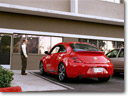
 Volkswagen is spreading a vibe of positivity through its latest campaign named “Get In. Get Happy”. The brand has just unveiled the highly awaited commercial, which you can view below and will air in the second quarter of the Big Game.
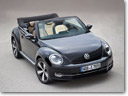
 The latest addition in the range of the famous


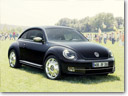
 2013 Volkswagen Beetle Fender Edition has just been released. This is a very special edition of the popular car which will excite all musical enthusiasts and especially the guitarists. The Beetle Fender Edition with its style and charm will match perfectly for all those keen on the both brands.


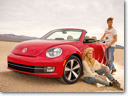


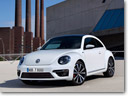
 2013 Volkswagen Beetle R-Line is also named by the brand the Sporty Chic. In fact,


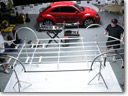 I have just stumbled on this video/thing on YouTube. It’s from the


 Abt sportsline has unveiled the tuned 2012 Beetle at the 82nd Geneva Motor Show.


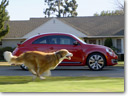 Volkswagen of America


 The newest VW Beetle is funky, hip and image laden. So one might think there is no real need to further personalize. Accessory house JE Design however, thing they can push the boundaries of individualism even more.


