Tag: Vision

  • Mercedes-Benz Vision One-Eleven Concept

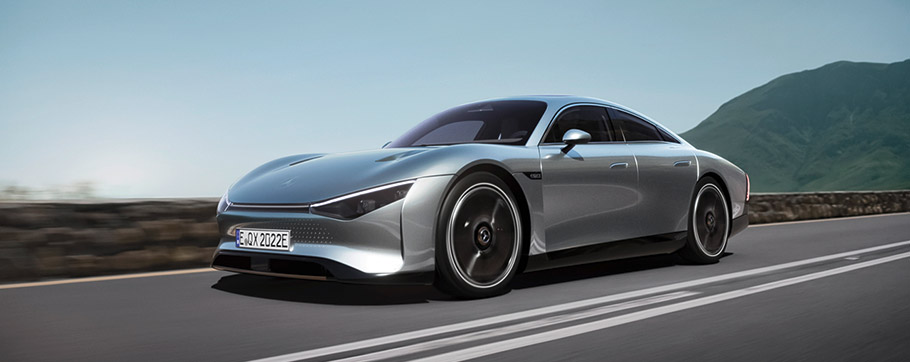
    Mercedes-Benz presents a new sports car study. The Vision One-Eleven combines a highly dynamic design language with innovative all-electric powertrain technology. The supercar silhouette is characterised by skilful execution of the signature Mercedes-Benz One-Bow design that is a marker of its 21st‑century style. The development of this design underscores the positioning of the Mercedes-Benz brand, which stands for ICONIC LUXURY. Its technical highlights include the extremely powerful and highly efficient axial-flux motor developed by electric motor specialist YASA. The British company has been a 100-percent subsidiary of Mercedes-Benz AG since July 2021.

    The Mercedes-Benz Vision One-Eleven is inspired by the tradition of the legendary C 111 experimental vehicles from the 1960s and 70s, which were used to test revolutionary Wankel and turbodiesel engines. They were also prototypes for testing polymer-based bodyshells. The extremely (aero)dynamic mid-engine sports cars are considered design icons of their era, not least due to their distinctive gullwing doors and eye-catching orange-and-black paintwork.

    “Our goal at Mercedes-Benz is not to do styling – our goal is to create icons. To me, that makes the difference between mainstream design and luxury. Design icons like the Type 300 SL and C 111 – both with gullwing doors – are part of our DNA. These legendary vehicles were major inspirations for the iconic design of the Mercedes-Benz Vision One-Eleven. This is beauty and the extraordinary united in one vision of the future. Our all-electric vision show car is the modern-day interpretation of the C 111, which was avant-garde at the time. The element of surprise comes from its exceptionally clean, purist and, at the same time, extremely muscular proportions. This iconic clarity is also reflected in the interior. The equally sensual but minimalist design language stands for ICONIC LUXURY by Mercedes-Benz.”
    Gorden Wagener, Chief Design Officer, Mercedes-Benz Group AG

    “The Mercedes-Benz Vision One-Eleven combines breathtaking design with groundbreaking powertrain technology. Like its historical namesake, it explores new paths for the future of sporting performance. At the heart of the compact and extremely efficient powertrain is the innovative YASA axial-flux high-tech electric motor. It offers a motorsport-like power output from a considerably smaller package. This makes the YASA axial-flux motor ideal for electric high-performance vehicles. Combined with the liquid-cooled cylindrical-cell battery with Formula-1 inspired cell chemistry, the Mercedes-Benz Vision One-Eleven is yet another proof point for the broad performance spectrum encompassed by our four-pronged development strategy for electric drive.”
    Markus Schäfer, Member of the Board of Management of Mercedes-Benz Group AG, Chief Technology Officer

    The exterior

    The body of the Mercedes-Benz Vision One-Eleven centres on skilful execution of the One-Bow design. From the low-slung front end to the muscular hind quarters, it runs in a smooth bow that endows the just 1,170 mm-high vehicle silhouette with an extremely sculptural feel. This harmonises perfectly with the copper-orange alubeam paintwork. It provides an unmistakeable reference to the distinctive colour of the C 111 without adopting it one-to-one. The colour of the Mercedes-Benz Vision One-Eleven is considerably more powerful than that of the C 111 and also changes with the light. It conveys not only a sense of quality but also a certain extravagance.

    Further notable features of the side view include the flush-fit gullwing doors and the side windows, which are opaque from the outside and camouflaged by a pixelated pattern. Yet another is the large-diameter wheels inserted seamlessly into the wheel arches beneath voluminous flared wings. This reinforces the impression of an uncompromisingly sporty and aerodynamically refined driving machine. The wheel design incorporates powerfully structured elements evocative of electric motor windings – a clear indicator of the state-of-the-art, all-electric powertrain underpinning the Mercedes-Benz Vision One-Eleven. They stand in spirited contrast to the vehicle’s iconic, minimalist and smooth surface design, which is more akin to a sculptural art piece. This contrast is typical of the X-factors the brand applies to its design thinking and a distinctive feature of the Vision One-Eleven.

    Another striking contrast arises through the very low-slung front and rear skirts finished in matte black. The two deeply scooped aerodynamic elements are visually connected by two blade profiles in the same colour running along the flanks beneath the sills. These profiles feature piercings that are backlit in blue. The functional aerodynamic elements also serve as a further design reference to the C 111, which is painted black on the lower portion of its bodyshell. The dark “keel line” of the Mercedes-Benz Vision One-Eleven generates an impression of seamless transition between the vehicle and the ground beneath it that is even more powerful than that of the C 111. The form of the car appears fused with the road surface.

    The front-end design

    From the frontal aspect, too, the Mercedes-Benz Vision One-Eleven is powerfully evocative of the C 111. In detail, however, there are striking differences: One stand-out example is the distinctive front end, which on both vehicles consists of a low-lying rectangular element with rounded ends left and right. On the C 111, this is a closed plastic element with a honeycomb structure, fitted with round foglamps. The corresponding part on the Vision One-Eleven appears very similar at first glance. However, upon closer inspection, it reveals itself as a high-tech feature. The panel is a flexible external display with a 3D pixelated look. It interprets the C 111’s characteristic round lights in digitised form and can also convey messages to other road users.

    In contrast to the C 111, the Mercedes-Benz Vision One-Eleven bears a U-shaped and strongly profiled front apron. Above the slender light band, both forefather and descendant show further similarities, most notably the black air intakes on the bonnet.

    The rear-end design

    The rear-end of the Mercedes-Benz Vision One-Eleven is likewise dominated by a powerfully profiled diffuser. Spanning the breadth above it is a display that echoes the shape of its counterpart at the front end and features the same pixelated structure in the red taillights. Similar to the blade profiles along the sides, blue lighting effects are also visible at the rear. The inner face of the wheels is fitted with circular lighting elements.

    The interior design

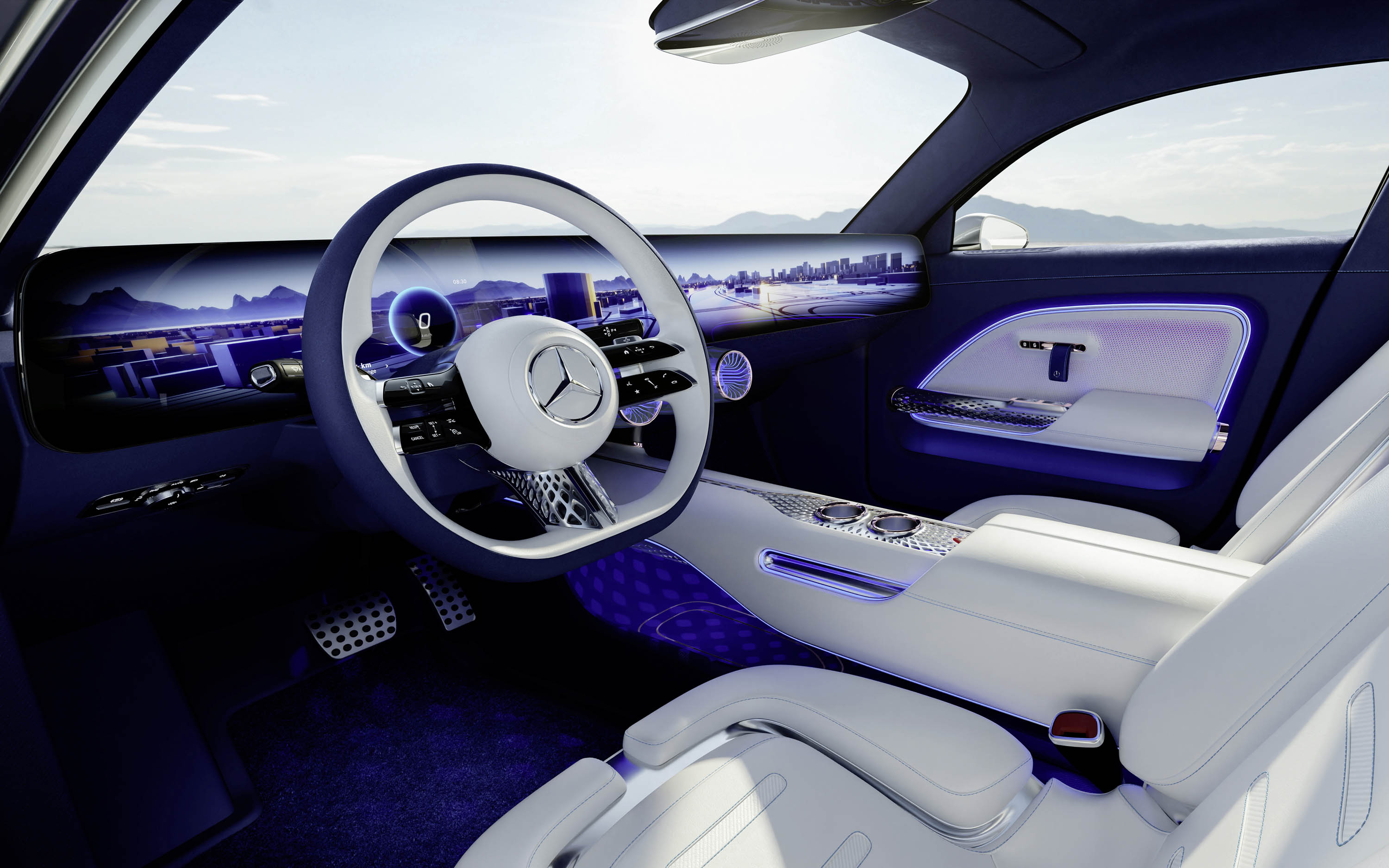
    Inside, the Mercedes-Benz Vision One-Eleven presents the first sports car interior with a lounge concept. It reflects the paradigm shift from self-driven sports car to autonomous electric vehicle within the super sportscar segment and unites two completely different states of being. In race mode with the backrest upright and the compact driver-oriented touchscreen, the interior becomes that of a minimalist driving machine. Conversely, in lounge mode, the seats are fully integrated into the interior sculpture, which merges sills, centre tunnel and luggage compartment into a single unit.

    This creates a whole new, exceptionally airy spatial concept. In contrast to previous mid-engine sports cars, it takes advantage of the compact proportions of electric motors to extend the interior rearwards. Consequently, the lounge-like interior invites occupants to take their time and relax – a completely new approach for the sports car of the future.

    Futuristic and luxurious ambience with contrasting colours

    The interior design of the Vision One-Eleven reflects future luxury based on a progressive colour concept and extraordinary material combinations. The richly contrasting colours and materials attract attention at first glance: Large surfaces such as the dashboard are upholstered in white fabric displaying a tech-look honeycomb structure. The material is made from 100-percent recycled polyester. Other elements such as the armrests on the sills and centre console, as well as the rear parcel shelf beneath the expansive rear windscreen, are clad in bright orange leather. This creates a smooth transition from interior to luggage compartment. The sustainably processed leather was tanned using coffee bean husks. Polished aluminium in the steering-wheel spokes and inlaid as straps across the armrests underscore the tech look and feel. The same applies to the brake and accelerator pedals, both of which are made from polished aluminium and floor mounted.

    Otherwise, the interior equipment in the Mercedes-Benz Vision One-Eleven has been reduced to a minimum. Like the exterior, the task here too was to keep the number of add-on features to a bare minimum. The seats are good examples as they don’t follow the classic format. Instead, the seat cushions are integrated flush-fit into the floor. This creates the initial impression of the bucket seat in a Formula 1 race car. The orange four‑point harness and its high-gloss polished buckle further reinforce the sporting character.

    Nevertheless, the innovative seats combine this sporting feel with luxurious comfort because, unlike in a Formula 1 race car, the angle of the backrest can be adjusted. The silver shimmer of their diamond-quilted upholstery is another eyecatcher that underscores the first-class interior ambience. Between the seats is a compact centre console, freestanding in space like a work of art.

    The only highly complex feature in the interior is the leather-clad steering wheel, which is fitted with various functional controls and state-of-the-art touch elements. This is complemented by a compact touchscreen with high-resolution display mounted to the side of the steering wheel and angled towards the driver. It shows all relevant vehicle information as required.

    Fusion of analogue and digital – UI/UX with retro-futuristic pixel-look

    The contrast to the modern interior is provided by the slender pixel display spanning the entire breadth of the dashboard, picking up on the form of the front and rear light bands. Here too, the pixel structure is intentionally coarse, which gives the information displayed – such as the current speed – a strikingly bold appearance. Moreover, the 3D pixel display shows digital art pieces as a coarsely rasterised stream of QR codes in the style of “early digital” news tickers. This is done with the help of glass pixels that show a changing colour gradient depending on the viewing angle. The corresponding real image then appears razor sharp on the high-resolution screen next to the steering wheel.

    This combination of vastly differing representations of the same image embodies a further interpretation of the MBUX Hyperscreen with a focus on flexible interfaces. The retro-futuristic, 8-bit look thus creates an additional X-factor. The development in the Mercedes-Benz Vision One-Eleven reinforces the increasing fusion of physical and digital.

    Creating an experimental spatial user interface – augmented reality takes the user experience to a new level

    For the premiere of the Vision One-Eleven, Mercedes-Benz designers have created a visionary user experience with the aid of augmented reality (AR), setting it inside a virtual prototype of the Vision One‑Eleven interior. As soon as the driver dons the Magic Leap 2 augmented reality headset, their experience is enriched with high-definition digital content that is contextually integrated into their surroundings. It creates a seamless spatial blend of physical interior and digital user interface beyond the screen. In effect, the entire car becomes the user interface.

    Mercedes-Benz has been exploring the benefits of AR since the launch of the F015 concept car in 2015. The AR UI in this new car presents a vision of the future that works on two levels: the information attached to the dashboard and information placed in the environment inside and outside the car. This marks the next step from screen-based UI with Mercedes-Benz intuitive zero-layer technology to an AR UI that arranges zero‑layer elements around the user in space. Elements include modules, 3D icons and the navigation map. The control interface around the dashboard and steering wheel is also augmented with additional contextualised information attached to actual objects such as buttons or switches.

    The 180-degree AR view incorporates the world outside the virtual prototype – fusing the car effortlessly with its surroundings and placing the driver at the centre. Map elements are projected into the environment, which is enriched with further information such as places of interests or hidden hazards such as roadworks beyond a bend. With this X-ray view, the system enhances situational awareness by blending out unimportant details to create an uncluttered image of relevant input. Elements that obstruct the driver’s line of sight – such as the A-pillar, doors or even the bonnet – then appear “transparent”. Mercedes-Benz designers and experts worked with the technical specialists at Magic Leap to develop and refine the AR experience showcased in the Vision One-Eleven using the highly advanced Magic Leap 2 AR glasses.

    The spatial user interface is a beacon for a Mercedes-Benz user experience that is unencumbered by technology. It is part of a wider vision that looks towards extended reality, whereby technology and hardware cease to be the focal point; instead becoming fully integrated and seamless facilitators of user needs and wishes.

    Innovative electric powertrain – high-performance axial-flux motor and all-new battery technology

    Technology highlights include a new battery concept featuring high-performance liquid-cooled cylindrical cells with a novel cell chemistry. Once more, the extensive knowledge of the motorsport experts from Mercedes-AMG High Performance Powertrain in Brixworth found its way into this promising concept for future performance-oriented batteries. Aside from that, the Vision One-Eleven features two exceptionally powerful and advanced axial-flux motors from YASA. Mercedes-Benz is developing this technology together with YASA to large scale production maturity for its next-generation electric drives. YASA is a British electric-motor specialist based in Oxford and has been a 100-percent subsidiary of Mercedes-Benz AG since July 2021. The company has thus secured access to a unique future technology that has the potential to take electric mobility to a new level of performance.

    “Axial-flux motors are significantly lighter and more compact, yet more powerful than comparable radial-flux motors currently used in 99 percent of all electric cars. In an axial-flux motor, the electromagnetic flow runs parallel to the motor’s rotational axis, which is highly efficient. In a radial-flux motor, the flow runs perpendicular to the rotational axis. Compared to radial-flux motors, they have considerably higher and more enduring power reserves, which delivers a whole new level of performance.”
    Tim Woolmer, Founder and Chief Technology Officer of YASA

    Alongside its power and torque density, another major benefit is the narrow package, which reduces both its weight and dimensions. The weight of an axial-flux motor is just one third of that of current electric motors with the same power output. At the same time, it requires just one-third of the space occupied by a radial-flux motor. This opens up completely new options for engineers as well as new freedoms in the design of an electric vehicle as demonstrated by the Vision One-Eleven.

    The future generation of YASA axial-flux motors will be produced at the Mercedes-Benz Berlin-Marienfelde plant. The motors manufactured there will be at the heart of the forthcoming powertrain for the performance segment.

  • Renault H1st Vision Concept

    An open innovation ecosystem created by six large companies (Atos, Dassault Systèmes, Orange, Renault Group, STMicroelectronics and Thales), Software République has set itself clear objectives to help create a European ecosystem for sustainable, sovereign and safe mobility. Its roadmap sets out the ambition of launching 10 new services and products, incubating 50 or more startups, and offering services in more than 50 geographies around the world by 2025.

    Created only two years ago, Software République is staging the world premiere of a collaborative concept at the Viva Technology 2023 exhibition. It incorporates functional and innovative technologies which illustrate its human-centred visions of the mobility of the future. Its name is H1st vision (Human First vision).

    It’s a revolution in mobility, bringing together 20 concrete, operational innovations.

    This physical vehicle doubles up as a virtual replica, a virtual twin in a digital universe where systems that are currently independent (infrastructure, energy, public services, users of different categories) communicate. This makes it possible to model, visualise and simulate the different use cases that could arise in the real world. Thanks to its interconnection with its environment, H1st vision is in constant dialogue with digital and physical ecosystems. A true experience beyond automotive mobility, H1st vision is not just a concept car: it is a tangible vision of tomorrow’s mobility experience.

    The 20 innovations in this technology demonstrator are centred on people. They are all operational: they take care of the driver, their passengers and other road users.

    H1st vision for example features:

    • all-new and secure biometric access control
    • a one-of-a-kind sound experience inside
    • optimised vehicle range and charging
    • a driver and vehicle health monitor and assistant
    • predictive alerts to protect occupants and other people on the road, using predictive alerts

    H1st vision is packed with the expertise of Software République’s members, which are all major players, and promising startups selected for their unique contributions. It was developed by a team of 100 people in a record six months. With this functional virtual and real concept, Software République is demonstrating the relevance of the open innovation model for incubating true industrial projects that are helping to make Europe a prominent hub for the mobility of the future.

    The H1st vision concept car is a connected, physical and virtual object that demonstrates both a robust method for collaboration between the partners and how the technologies of Dassault Systèmes, Orange, ST Microelectronics, Renault Group and Thales complement each other to build the mobility of the future. Eric Feunteun, Chief Operating Officer, Software République

  • Ferrari Vision Gran Turismo Concept

    The Ferrari Vision Gran Turismo, a closed-wheel single-seater, is the first Ferrari concept car created specifically for the virtual motor sport world. The car’s design has its roots firmly in Maranello’s unparalleled racing tradition, with the number 75 on its flanks reflecting that noble heritage. The launch of the Ferrari Vision Gran Turismo in fact brings the 75th anniversary celebrations of when the marque’s first-ever racing car, the 125 S, exited the iconic factory gates in 1947, to an official close.

    To mark that occasion, this model not only signifies an important step for Ferrari in the virtual environment, where it will inspire new generations of passionate drivers and enthusiasts, but also redefines the company’s stylistic language. It represents a futuristic design manifesto for Ferrari’s road and racing cars, embodying the maximum expression of formal beauty and innovation, and providing a stimulus for both the engineers and drivers (real and virtual) of tomorrow.

    The Ferrari Vision Gran Turismo’s design was penned by the Ferrari Centro Stile under the direction of Flavio Manzoni, and takes its inspiration directly from legendary 1960s and 70s’ Ferrari Sports Prototypes, which enjoyed huge success in endurance races such as the 24 Hours of Le Mans (won by the Prancing Horse a total of nine times), and the 24 Hours of Daytona. Featuring dramatic proportions and futuristic lines, the car succeeds in its stylistic mission by effortlessly embodying the DNA of masterpieces such as the 330 P3 and 512 S, simultaneously paying homage to the Prancing Horse’s glorious racing history and affording a tantalising glimpse of the future evolution of closed-wheel racing cars.

    The design of the Ferrari Vision Gran Turismo was conceived around the idea of a speed form with very geometric, sharp, angular lines that nevertheless underlie a very organic shape. This contrast has a disruptive effect, as the plasticity of the external and internal surfaces binds with the geometric precision of the lines, creating a car with an immediately recognisable character, the architecture of which centres around an advanced aerodynamic concept based on two imposing side channels. This solution has been patented by Ferrari and directs the airflow from the front underbody, around the cockpit and over the striking side pods. This solution generates extremely efficient aerodynamic downforce thanks to the variation in momentum and the suction created by the central part of the underbody. The rear aerodynamics were developed using concepts inspired by the Ferrari 499P, particularly in terms of the diffuser and the rear biplane wing. Lastly, the front S-Duct and the integrated air vents on the wheelarches further boost aerodynamic efficiency and high-speed stability.

    The Ferrari Vision Gran Turismo sports the same 120-degree 3-litre turbo V6 architecture adopted on the 296 GTB, 296 GTS and 296 GT3 that also powers the new 499P. However, in this installation, there were no technical regulation constraints to comply with, so it was further honed to unleash genuinely extreme performance. In this particular configuration, the engine is tuned to deliver a massive 1030 cv at 9000 rpm, with an additional 240 kW (326 cv) available from three electric motors, one on the rear axle and one on each of the front wheels. Ferrari worked with Gran Turismo to ensure that the exhilarating engine sound of this innovative powertrain is faithfully reproduced to give SIM racers an even more realistic racing experience.

    The bodyshell of the Ferrari Vision Gran Turismo appears as if suspended over the flat, carbon-fibre underbody which incorporates all the car’s technical components, thus giving purity to the shape. The chassis is designed to emphasise the car’s lateral dynamics in on-the-limit handling. The powertrain layout guarantees an optimal front-rear weight balance and an extremely low centre of gravity to the benefit of the AWD. The elasto-kinematic suspension set-up was developed around the performance characteristics of the tyres used in Gran Turismo™ together with the car’s aerodynamic balance, the aim being to guarantee superlative performance on both torturously winding city circuits and traditional endurance race tracks.

    The suspension is designed to maintain the tyre contact patch to ensure maximum traction, thereby allowing the Ferrari Vision Gran Turismo to deliver 1100 Nm of rear torque from the combined ICE and MGU-K to the road. The result? Peerless performance. Cutting-edge electronic vehicle controls endow the car with the unrivalled cornering agility and handling balance that Ferrari’s road and racing cars have long been renowned for. The in-game experience is thus designed to faithfully replicate Ferrari’s in-car driving thrills, conveying an accurate feeling of the limits achievable and enhancing the car’s performance.

    The car also boasts hybrid technology that benefits from the unique expertise in electric boost and energy recovery strategies Ferrari has developed in Formula 1. Constantly balancing the state of charge of the battery allows the driver to make full use of the combined power available from the ICE and electric motors, so that maximum performance is available both during qualifying laps as well as over consecutive racing laps.

    The interior design is an extension of the exterior, with a purist, minimalist approach delivering optimal functionality and driver ergonomics. The dashboard lines are clean and spare and, just like the see-through engine cover framing the hybrid V6 powertrain, incorporate transparent high-tech materials to reveal the mechanical components of the sophisticated modern steering wheel. The HMI is designed for immediacy and ease of use so that the driver can always concentrate fully on the road ahead.

    Unveiled during the Gran Turismo World Finals in Monte-Carlo, the Ferrari Vision Gran Turismo will become available to all users of GT7 from the 23rd of December 2022. However, starting right after the unveiling on the 27th of November at 19:00 CET, GT7 users will be able to take part in a viewers’ campaign quiz through the game, with the winning participant receiving the Ferrari Vision Gran Turismo as a gift on the 15th of December. On the same date, the full-scale design study will make its first public appearance at the Ferrari Museum in Maranello, where it will be displayed alongside the current exhibition dedicated to the marque’s exclusive one-off models until March 2023.

    TECHNICAL SPECIFICATIONS

    POWERTRAIN

    Type V6 – 120°, twin turbo, all-wheel drive
    Total displacement 3000 cc
    Max. ICE power output 1030 cv @ 9000 rpm
    Max. ICE torque 900 Nm at 5500 rpm
    Max. power output hybrid system 240 kW (326 cv)

    WEIGHT

    Dry weight 1250 kg
    Weight distribution 43.5% front / 56.5% rear

    TRANSMISSION AND GEARBOX

    F1 dual-clutch gearbox, eight speed

    PERFORMANCE

    Maximum speed
    0-100 km/h
    0-200 km/h
    Fiorano lap time
    > 350 km/h
    < 2.0 s
    < 5.0 s
    < 1 ’10”
  • 2022 Skoda Vision GT Concept

    Skoda Vision GT Concept - Exterior Sketch

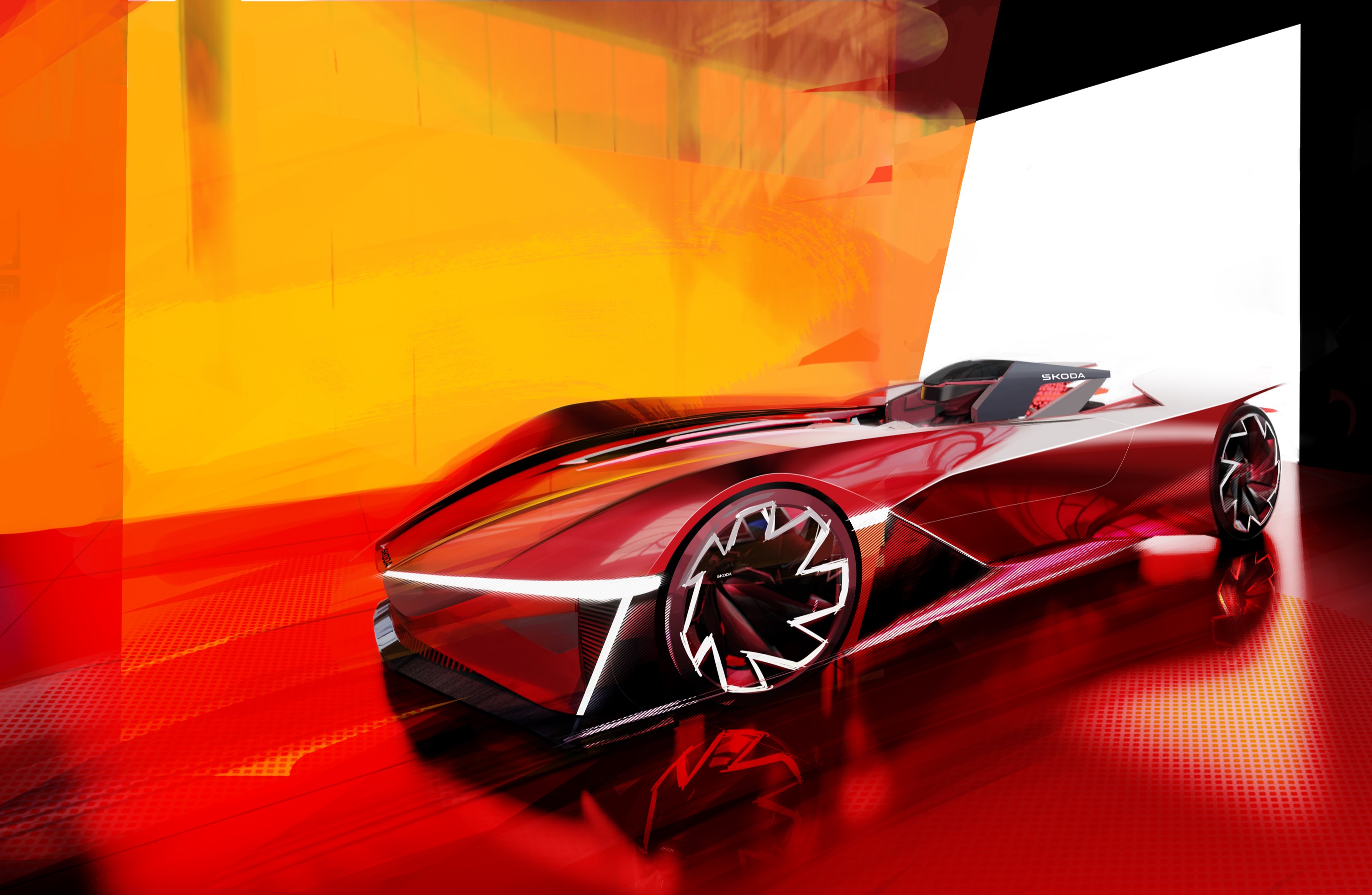
    SKODA Design has introduced a new design concept, the VISION GT, which is an all-electric racing car in the form of a computer-generated model. It is currently being showcased at the ‘Design and Transformation’ exhibit in Brussels, as part of the Czech Republic’s EU Presidency. The VISION GT draws inspiration from SKODA’s 1100 OHC concept from 1957 and is part of the ‘Icons Get a Makeover’ series that reinvents iconic models from SKODA’s past, such as the 130 RS, FELICIA, and RAPID MONTE CARLO.

    The ŠKODA VISION GT is a featured exhibit at the ‘Design and Transformation’ exhibition in Brussels. It is an all-electric racing car in the form of a computer-generated model that draws its inspiration from SKODA’s 1100 OHC concept from 1957. The exhibit showcases Czech products and designs from 1990 to 2020, in alignment with the Czech Republic’s EU presidency. The SKODA design team has infused the VISION GT with the company’s commitment to sustainable sportiness and emotion in the digital age.

    The VISION GT’s single-seater design, with the driver placed in the center, is based on the SKODA 1100 OHC, featuring a futuristic carbon steering wheel that is flattened at the top and bottom, and a red, open-top design. The active cockpit with a flexibly suspended seat aims to offset g-forces for a superior driving experience. The on-screen bar, located above the wheel, serves as a windshield and displays critical information on the driver’s helmet visor, similar to a head-up display.

    2022 Skoda Vision GT Concept

    The VISION GT’s design is flat, with clear lines and sharp edges, inspired by the design of Formula E racing cars. The two-piece rear wing is a standout feature, with active aerodynamics to maximize performance. The holographic SKODA wordmark is situated between the upper wing profiles and on the front of the car, referencing the curved SKODA line.

    In conclusion, SKODA Design’s VISION GT concept, a computer-generated all-electric racing car, has been displayed at the ‘Design and Transformation’ exhibit in Brussels. Drawing inspiration from the 1100 OHC and featuring a red, open-top design, the VISION GT’s flat and sharp design is inspired by Formula E racing cars. The VISION GT is part of SKODA’s ‘Icons Get a Makeover’ series, reinventing iconic models from the company’s history with a commitment to sustainable sportiness and emotion in the digital age.

  • Skoda Vision 7S Concept

    Unveiling its seven-seater VISION 7S study, ŠKODA AUTO provides a first view on the brand’s new design language, which combines robustness, functionality and authenticity. The VISION 7S is also the first ŠKODA with a matt body colour. The interior ambience is characterised by sustainable materials and interactive surfaces. The concept car boasts a range of over 600 kilometres (370+ miles) in the WLTP cycle thanks to an 89 kWh battery.

    New front view with Tech-Deck Face

    The ŠKODA VISION 7S is the first model to feature the Czech carmaker’s new, striking design language. Along with the Tech-Deck Face at the front end, it sports a solid underbody and aerodynamic roof lines, enhancing its efficiency. At first glance, the long passenger compartment hints at the generous interior space.

    The front of the vehicle also incorporates familiar design elements, such as the signature ŠKODA line. The redesigned ŠKODA wordmark replaces the brand’s picturemark and is complemented by a new ambient light strip. This extends across the entire width of the vehicle at the upper edge of the front section and features illuminated graphics. The so-called Tech‑Deck Face embodies a modern reinterpretation of the familiar ŠKODA grille. Though it has similar lines, the Tech-Deck Face is significantly flatter and wider than the previous styling. The ribs have been replaced by dark glass that conceals the vehicle’s sensors.

    New T light cluster, front and rear

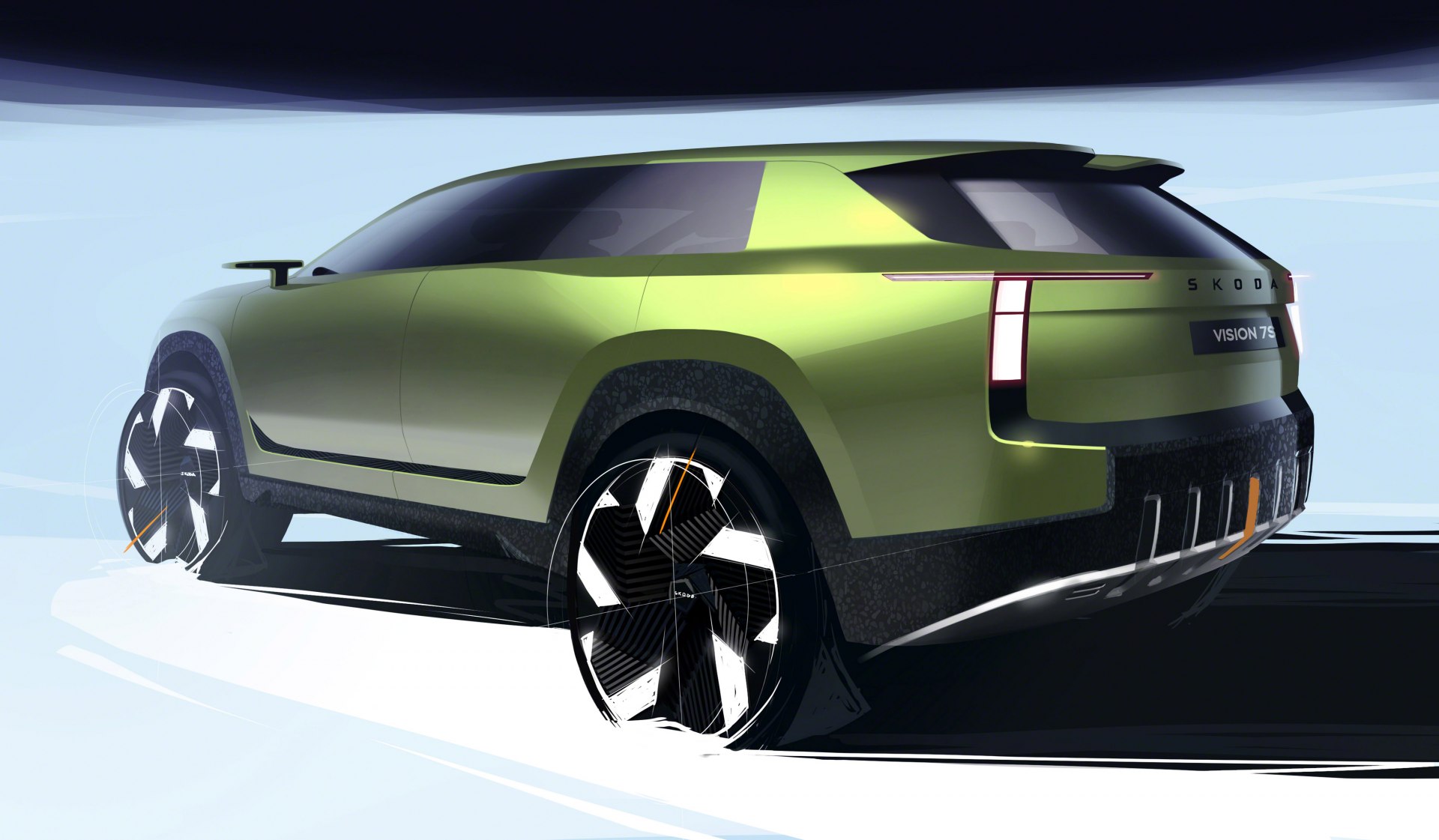
    The narrow headlights are positioned further outwards and arranged in two rows one above the other, extending the four-eye light cluster to form a ‘T’. The daytime running lights extend well into the wings and form the sharply defined upper line of the ‘T’, visually framing the front. The rear LED lights are also arranged in a ‘T’. Again, the upper line extends laterally into the wings. This design accent is repeated on the camera exterior mirrors as well as the sensor door handles, which are recessed into the body and arranged vertically.

    Robust bumpers with distinctive air intakes

    The bumpers at the front and rear of the ŠKODA VISION 7S are particularly striking. They are made of durable, recycled tyres. This material is also used for the wheel arch linings and adds a rugged visual highlight. Seven vertical air intakes are integrated into the front, through which air is directed to the cooling systems and brakes. The VISION 7S has nine vertical air outlets in the rear bumper. A control element in bright Flashy Orange is located in the centre of both the front and rear. These can be pulled out to serve as hooks. In addition, they can be used to safely cut off the vehicle’s high-voltage current from the outside, if required.

    High tornado line and gently sloping roof for aerodynamic efficiency

    A high tornado line separates the solid underbody from the side windows and emphasises the powerful shoulder sections through its curve. The squared-off wheel arches beneath it are prominent and clearly recessed. The wheels have a diameter of 22 inches; the aerodynamically optimized rims are almost completely closed. Additional air outlets are positioned between the wheel arches and above the side skirts. These act as running boards for the portal doors that swing up in opposite directions and also have cover grilles. These grilles channel the warm air generated from cooling the high-voltage battery to the outside. The flat roofline gently slopes to the rear and merges with a pronounced roof spoiler for high aerodynamic efficiency. The triangular D-pillar extending to the rear features a bold design. At the bottom, it bears the new ŠKODA wordmark, which also appears on the tailgate and is lit up in the same way as at the front of the vehicle. The matt metallic paint finish in the bright colour Explorer Green underscores the minimalistic look of the VISION 7S. This is also the first ŠKODA with a matt body colour.

    Sustainable materials in the interior, operation even more intuitive

    The minimalistic interior is as spacious as you would expect from ŠKODA and conveys a sense of security, which is further enhanced by the combination of dark and light materials. These are leather-free, mostly come from sustainable sources and are extremely durable thanks to some smart material combinations. One example is the floor of the VISION 7S, which is also made from recycled tyres. The interior trim is also sustainable. This is coated with a fine, matt metallic layer and thus conserves valuable resources. The fabrics are made of 100% recycled polyester yarns.

    Great emphasis was placed on further optimising usability. In addition, the vehicle’s menu structure and infotainment functions have been streamlined, and the controls on the central, free-standing touchscreen, as well as haptic keys for important or frequently used functions, are particularly intuitive.

    The right interior for every setting

    The VISION 7S represents a compelling further development of ŠKODA’s interior concept, combining a spacious, protective interior for up to seven passengers with a complete reconceptualization of the natural human-machine interaction (HMI). The highlights include two distinct interior configurations – Driving and Relaxing – and an ideal balance between haptic and digital controls. A sense of safety and protection is conveyed by the innovative child seat, which is mounted in front of the second row of seats on the centre console opposite to the direction of travel. All of this is surrounded by durable, sustainable materials and many new Simply Clever ideas. Rounding off the interior design is the unique X-shaped decorative stitching, which accentuates the SUV character.

    The interior of the VISION 7S embraces its (up to) seven passengers with the spaciousness typical of a ŠKODA as well as a feeling of safety and protection. The interior is symmetrical, giving all passengers the same generous sense of space. The upper line of the instrument cluster continues into the door panels, completing the wrap-around design and supporting the feeling of protection. In addition, the wide, horizontal dashboard extends to the doors, accentuating the airy and spacious interior.

    Two interior configurations: Driving and Relaxing

    The VISION 7S offers passengers two different interior configurations, with a rotating central touchscreen and sliding elements to create the perfect ambience for different situations – Driving and Relaxing. While driving, all the controls are in their ideal position within easy reach for the driver, and the central 14.6-inch touchscreen is oriented vertically for enhanced accessibility and information stacking. When charging or stopping, the Relax mode can be selected at the touch of a button in the centre console. The interior transforms in one elegant, synchronous movement; the steering wheel and instrument cluster slide backwards away from the driver and passengers to create additional space. The first-row seats rotate inwards and recline for extra comfort, also allowing the rear passengers to view the screen. The seats in the second row also recline. All passengers can then enjoy a more comfortable seating position and a better view of the screen, which rotates to a horizontal position to optimally display the entertainment content.

    Natural HMI operation completely re-envisioned

    For the VISION 7S, the ŠKODA Design team reconceptualised the car’s HMI from the ground up, emphasising the perfect harmony between the haptic (manual) and virtual (on-screen) controls. Everything was designed with the aim of simplifying the user experience. The control elements are intuitive, always enabling the driver to easily find and use the function they are looking for.

    In Drive mode, the driver benefits from an advanced AR head-up system displaying the most important driving data and an 8.8-inch digital instrument display for extra information.

    The steering wheel has been completely redesigned, with two solid spokes at the 12 and 6 o’clock positions. The new ŠKODA wordmark is positioned centrally. The steering wheel rim is flattened at the top and bottom, making the 8.8-inch digital instrument display easy to see. There are dedicated haptic scroll wheels for the most important functions during driving, highlighted by Flashy Orange accents for quick orientation. In Relax mode, the driver can control more sophisticated functions through the integrated touchpad on the lower spoke.

    The centre of the interior is dominated by the large, rotating 14.6-inch screen, the largest ever installed in a ŠKODA car. In Drive mode the display is oriented vertically, allowing for information to be perfectly stacked; the upper area of the screen, for example, is dedicated to important visual content such as the map and navigation guidance, while the lower area is easy to reach and control. It is supported by an ergonomically placed hand rest atop the centre console. The user can adjust the amount of information simply by swiping up or down. In addition, the menu widget can be used to scroll through various functions. For instance, the baby camera image can be placed anywhere in the user-defined area. The remaining area could be used in high resolution for the maps, for example. In Relax mode, in particular with the screen oriented horizontally, user-installed apps can be used for watching films or gaming. Given the longer distance to the screen when the seats are reclined, the infotainment system can also be operated by smartphone.

    Three rotary controls for easy usability

    The redesigned centre console features six additional buttons that give the driver direct access to the infotainment, phone, vehicle settings, navigation and app menus; the sixth button can be user-assigned. Below are three large rotary controls; the two outer dials are dedicated to climate control, while the middle one controls the screen content. It can be used to zoom in and out on the map and scroll through lists. Beneath these are two buttons for switching between the Drive and Relax modes and a dedicated volume scroll wheel. Like the steering wheel controls, the buttons and dials feature accents in Flashy Orange to aid orientation.

    Smartphones can be placed in the centre console. These are the main sources of information and customisation for the entire system and can be used as a remote trackpad. They are held in place by magnets and partially covered by the central armrest for protection. In this position, the armrest can be used to support the arm for perfect ergonomics in conjunction with the hand support under the screen.

    Passengers in the second and third row can magnetically attach their devices to the seat backrests in front of them for optimal viewing. Interactive surfaces with coloured lights shining through the fabric are integrated into the door panels; a bright light in Flashy Orange, for example, points to the door openers hidden in the lower part of the panel, while a blue or red light visualises air‑conditioning temperature changes. You can also write on the fabric with your finger – to leave short notes or for children to create little drawings.

    Maximum protection: Child seat in the safest position in the vehicle

    The position of the child seat is also innovative and mounted in the safest place in the vehicle. It is integrated into the centre console, which extends to the second row of seats, opposite to the direction of travel. This means the child is optimally protected, and the passengers in the second row can always keep an eye on him or her. An optional interior camera in the rear roof area can also transmit a video of the child to the central infotainment display. This makes it possible for the driver and front passenger to see the little ones on board at all times.

    More Simply Clever features

    The VISION 7S introduces a new series of Simply Clever features ŠKODA is famous for. The air vents on the dashboard work in a discreet, diffuse mode until more direct ventilation is needed; at the touch of a button, they slide upwards to provide a direct stream of air.

    Passengers will also find magnetic surfaces under the floating centre console, where metal ŠKODA drinks bottles or a first-aid kit can be securely attached. The VISION 7S also includes practical backpacks that are magnetically attached to the seat backrests magnetically and can be taken with the family on days out. A large panoramic glass roof floods the interior of the VISION 7S with light. In front of the central screen on the instrument cluster is a large crystal that indicates the battery and charging status of the VISION 7S using different colours. This can be seen easily from outside the car.

    Sustainable materials and ambient lighting

    The entire interior is trimmed in a mix of sustainable, durable materials. The upper part of the dashboard and doors are finished in a dark artificial leather and bordered by indirect ambient lighting that emphasises the protective wrap-around design. The lower parts, like the dashboard and the door armrests, are trimmed in a lighter artificial leather that echoes the exterior colour Explorer Green and is accentuated by direct ambient lighting. In the area where the B-pillar would be and the counter-hinged doors meet, the lower part of the door trim is drawn upwards at an angle, culminating in a crystal on both the front and rear doors. These crystals illuminate the entry into the vehicle with a running white light, for example, or warn of an oncoming vehicle or cyclist with a red light when the door is open. The central zone of the door panels is upholstered in a black fabric made from recycled polyester yarns. Recycled fabric is also used for the inner areas of the seats and on the dash. Rounding off the interior design is the unique X-shaped decorative stitching, which accentuates the SUV character.

    This is the first time ŠKODA has replaced the traditional chrome accents with a unique matt paint. All functional elements, including the controls, seatbelts and first-aid kit, are highlighted in the eye‑catching Flashy Orange colour.

    The floor and boot, which are made entirely of recycled-tyre veneer, also follow the VISION 7S’ sustainable ethos. This special material is scratch-resistant and easy to clean, underlining the car’s suitability for exploring the great outdoors as well as its practicality and family friendliness.

  • First exterior sketches of SKODA VISION 7S

    SKODA VISION 7S - Front Angle

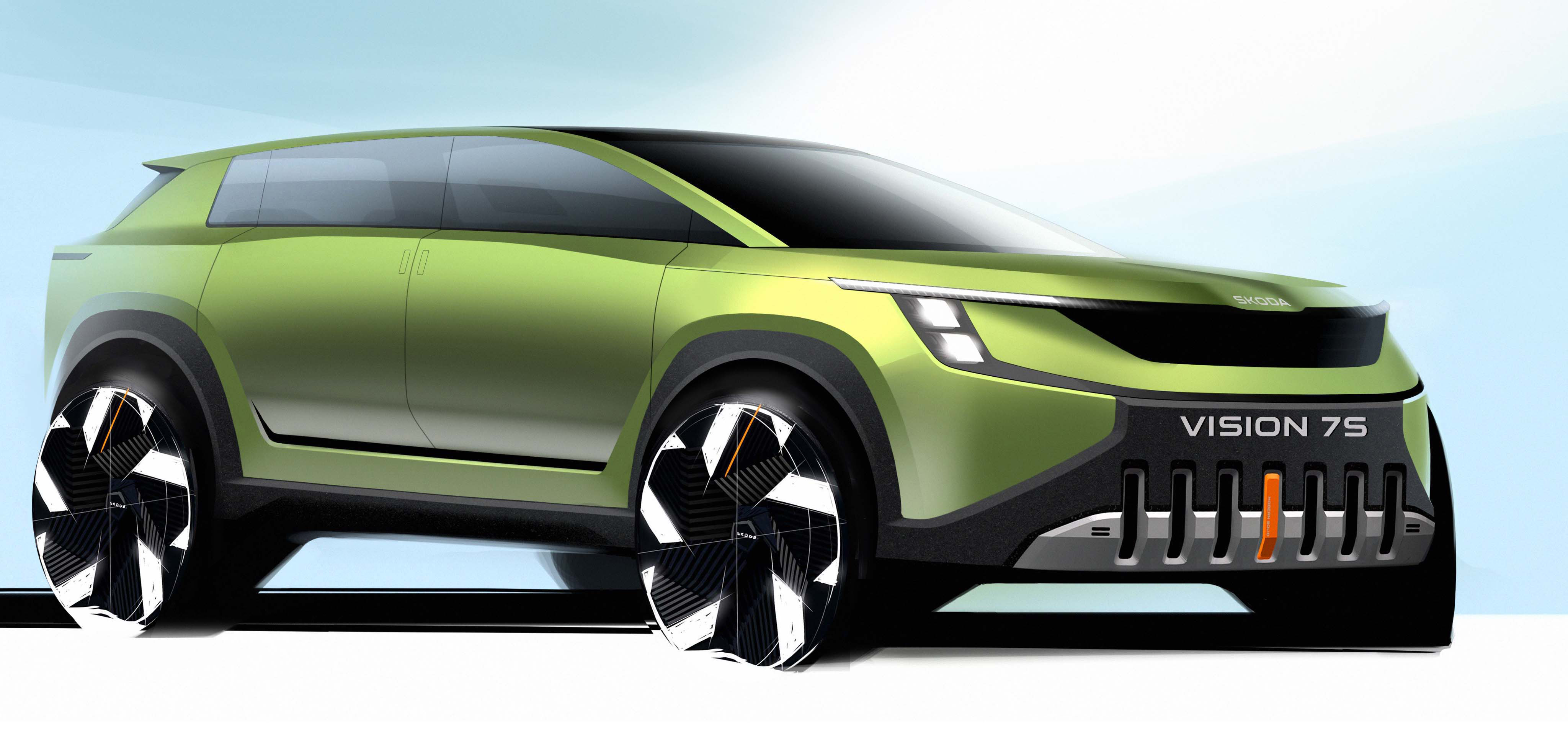
    Releasing the first exterior sketches of the VISION 7S concept car, ŠKODA AUTO reveals further details of its new design language. The drawings provide a preview of the study’s body. The sketches show a powerful SUV featuring a striking front end with T-shaped headlights.

    The exterior sketches of the all-electric ŠKODA VISION 7S concept car depict a newly designed, striking front end. The significantly wider and flatter ŠKODA grille is dark and closed. The front headlights, which have been repositioned far out to the edge of the vehicle, are arranged in two rows one above the other, and the sharply defined daytime running light strip above them extends laterally into the pronounced wings, extending the light cluster to form a ‘T’.

    The sharply contoured bonnet cites the well-known ŠKODA line. The striking, completely redesigned bumper features seven vertically arranged air inlets, with the central one sporting an insert in eye-catching orange. The lower apron area is fitted with an aluminium underride guard. Large, aerodynamically optimised wheels emphasise the VISION 7S’s powerful visual appearance. The side view is defined by clear surfaces and a gently sloping roof line to the rear.

    ŠKODA’s new design language reflects familiar brand values, such as robustness, functionality and authenticity, and stands out with its spacious interior, durable, sustainable materials and aerodynamic, efficient body.

    SKODA VISION 7S - Rear Angle

  • Vision AMG show car offers glimpse of all-electric future of Mercedes-AMG

    2022 Mercedes-Benz Vision AMG Concept

    Spectacular proportions defined by a long wheelbase and emphasised by short overhangs, powerful shoulders, large wheels, a distinctive rear spoiler and star-shaped headlamp signature – the Vision AMG makes an emotional statement from every perspective. This extraordinary show car from Mercedes-AMG offers a glimpse of the all-electric future of AMG Driving Performance. Beneath the breath-taking exterior design of the four-door coupé is the equally extraordinary dedicated AMG.EA platform, which is currently under development in Affalterbach for all-electric performance models.

    “AMG is reinventing itself. As was once the case with our founding fathers, there has been an amazing feeling of new beginnings here in Affalterbach for quite some time now. The course has been well and truly set for an electrified future, and we’ve set the bar high. That’s because our customers expect something very special from all-electric cars. We have already well and truly proven our expertise in this regard with the SLS AMG Electric Drive, our own E PERFORMANCE hybrid technology and the first Mercedes-EQ derivatives. With this study, we are now offering a first glimpse of how we are transferring the AMG DNA into the all-electric future, starting in 2025. Gorden and his team are pointing the way from a visual perspective with this extraordinary design. At AMG, we have always stood for that extra shot of emotion, driving fun, handling, ingenious aerodynamic features and other innovative solutions. And that’s what we continue to stand for with our first BEV developed entirely in Affalterbach. We’re developing everything from scratch, from the dedicated AMG.EA platform to the revolutionary drivetrain technology with which we will take performance electric mobility to a whole new level,” says Philipp Schiemer, CEO of Mercedes-AMG GmbH.

    “The Vision AMG shows in spectacular style what electrification could look like at Mercedes-AMG, while staying true to the brand aesthetic. The study’s extreme proportions create fascination and passion for performance – that’s what AMG is all about. The Vision AMG is an impressive embodiment of the brand’s dual polarity – the interplay of beauty and the extraordinary. At the same time, elements from the future, such as the light signatures with the illuminated high-tech grille, underscore the progressive evolution of our design language of Sensual Purity,” says Gorden Wagener, Chief Design Officer of Mercedes-Benz Group AG. “With its contrasting modern surfacing and radical proportions, this car showcases the next design step, building on the VISION EQXX and moving further towards performance luxury. The seamless flow of beautifully formed surfaces and the monolithic sculpture complete the powerful aesthetic of the Vision AMG. The result is an electric supercar, a style icon that stimulates desire – and that’s exactly what sets a luxury sports car apart.”

    Monolithic sculpture and radical proportions

    The concept car is characterised by flowing, beautifully formed surfaces. Joints and shut lines are reduced to a minimum, and the rear and side windows are painted in the same Alubeam silver as the car itself. The result is an overall look that reinforces the impression of a monolithic sculpture.

    The sporty proportions are particularly evident from the side, and are defined by the technical layout – long wheelbase, sharply raked A-pillar positioned far forward, short front overhang and slightly longer, aerodynamically optimised rear overhang. It clearly expresses the design language of Sensual Purity with distinctive sports car cues such as the widely flared wheel arches and broad, muscular shoulders at the rear.

    The graceful greenhouse is integrated into the flowing overall form and blends seamlessly into the low-lying silhouette. The roof tapers as its line drops elegantly towards the rear, flowing directly into the rear spoiler. The overall effect is a visually fascinating and aerodynamically advantageous teardrop form, not unlike that of the VISION EQXX. The sensual surfacing and the powerfully defined sculpture are representative of the hallmark Mercedes design language. Similarly, the brand’s aspiration to the extraordinary is realised through the radical proportions and sharply chiselled shark nose. The Vision AMG is thus an impressive example of the dual polarity of the brand’s design approach embracing “Beauty & the Extraordinary”.

    The sharply angled tear-off edge at the rear incorporates an active spoiler, elongating the side view while at the same time improving the aerodynamics. It is framed by a precisely cut band of light that accommodates a variety of different light installations, providing an effective contrast with the large black AMG logo on the rear of the car.

    Breathtaking technology for hallmark performance

    The technology of the Vision AMG tributes the spectacular design in many ways. All of its drivetrain components are developed entirely from scratch: not only the AMG.EA platform itself, but also the dedicated high-performance high-voltage battery and the revolutionary drive technology. The powerful heart of the Vision AMG is its innovative Axial Flux Motor developed by Mercedes-Benz’ wholly owned subsidiary YASA. With its compact and lightweight design it delivers substantially more power than conventional electric motors.

    Closed-off AMG grille with illuminated bars

    The AMG-specific grille with vertical bars is retained as a distinctive brand feature – despite the fact that an all-electric drivetrain does not require a classic radiator at the front. The high-tech development of the grille is therefore closed off, painted in body colour and fully integrated into the front end. As the visual focal point, the grille emphasises the futuristic look of the Vision AMG with its illuminated bars and three-dimensional exterior contour. The three-pointed star is positioned prominently on the bonnet – as on the Mercedes-AMG Project ONE.

    Extraordinary star-shaped light signature

    The headlamp light signature points directly into the future. Three LED elements form a stylised, three-dimensional Mercedes star, ensuring the Mercedes and AMG branding is immediately apparent and unmistakable by night and day. The two headlamps are visually connected via the horizontal band of light above the grille. This light band can display a variety of animations – ranging from a welcome signature to constant light.

    The round lights at the rear have a light design that is new yet familiar. On each side, three LED rings are positioned in cylindrical tubes. Here, too, small stars offer a nod to the Mercedes brand. By way of contrast, the expressive rear diffuser is painted deep black.

    Connection to Formula 1 through form and colour cues

    The direct connection to the successful Mercedes-AMG Petronas F1 team is evident in further visual details. These include the silver paintwork with a large-format star pattern across the shoulders and rear wings, functional elements in exposed carbon-fibre, the aerodynamic design of the 22-inch wheels with aero claddings, the AMG logo and elements on the sills and diffuser in the Petronas colours.

    The sporty high-tech seamless design and the breath-taking proportions give the Vision AMG a futuristic character. The four-door configuration also makes clear that the show car offers a taste of a functional all-Mercedes-Benz Vision AMG Conceptelectric sports car of the future. Despite the battery pack in the floor of the car between the axles, the study sits considerably lower than the EQS and, thanks to its intelligently designed interior floor, offers plenty of space for four.

  • Vision EQXX – taking electric range and efficiency to an entirely new level

    2022 Mercedes-Benz Vision EQXX Concept

    Range and efficiency are set to define the electric era. Exceptional range will make electric cars suitable for every journey and help to increase overall adoption. Reduced battery size and weight will improve efficiency, allowing us to go further with less. Mercedes-Benz is determined to lead the way. We are already leading the way in terms of real-world range with the EQS with 245 kW, as evidenced by the recent Edmunds test where an EQS 450+ travelled 422 miles on one charge, 77 miles further than any other car previously tested.

    However, Mercedes-Benz is not stopping there. Driven by the idea of zero impact on our planet and a highly responsible use of green energy, we encouraged our engineers to go above and beyond. They are working intensively to take range and efficiency to a completely new level. The VISION EQXX is the result of a mission we set to break through technological barriers and lift energy efficiency to new heights. It demonstrates the gains that are possible through rethinking the fundamentals from the ground up. This includes advances across all elements of its cutting-edge electric drivetrain as well as the use of lightweight engineering and sustainable materials. Complete with a barrage of innovative and intelligent efficiency measures, including advanced software, the VISION EQXX allows us to explore new frontiers of efficiency.

    “The Mercedes-Benz VISION EQXX is how we imagine the future of electric cars. Just one-and-a-half years ago, we started this project leading to the most efficient Mercedes-Benz ever built – with an outstanding energy consumption of less than 10 kWh per 100 kilometers. It has a range of more than 1,000 kilometers (620 miles) on a single charge using a battery that would fit even into a compact vehicle. The VISION EQXX is an advanced car in so many dimensions – and it even looks stunning and futuristic. With that, it underlines where our entire company is headed: We will build the world’s most desirable electric cars.” Ola Källenius, Chairman of the Board of Management of Daimler AG and Mercedes-Benz AG.

    VISION EQXX – designed for the road trip to electromobility

    There’s a reason why road trips have been a cultural benchmark for at least 70 years, telling stories from the highway in books, movies and music. The road trip defines freedom, individuality, the very spirit of the automobile and the passing world. Stick a pin in the map – and drive. Be in tune with the road, and with the car. This urge to explore, discover and revel in the world beyond our horizon is part of what it is to be human. It’s the pioneering spirit that pairs vision with the tenacity to make it happen.

    The journey to electric mobility is a road trip; as exhilarating as it is challenging, as unknown as it is certain. The Mercedes-Benz VISION EQXX is a vehicle designed for that road trip. It answers the progressive demands of a modern generation of customers for and emotionality through innovation. Part of an advanced technology program, this software-defined research prototype was engineered by women and men with the creativity, ingenuity and determination to deliver one of the planet’s most efficient cars – in every respect.

    They did so using the latest digital technology, the agility of a start-up and the speed of Formula 1.

    The result is an efficiency masterpiece that, based on internal digital simulations in real-life traffic conditions, will be capable of exceeding 1,000 kilometers (620 miles) on a single charge with an outstanding energy consumption of less than 10 kWh per 100 kilometers (efficiency of more than 6 miles per kWh).

    By ripping up the automotive engineering rulebook, Mercedes-Benz has built a software-driven electric car that re-imagines the road trip for the electric era. At the same time, it presents a highly progressive interpretation of the fundamental Mercedes-Benz principles of modern luxury and Sensual Purity. Rather than simply increasing the size of the battery, the cross-functional, international team focused on maximizing long- distance efficiency. They pulled out all the stops in drivetrain efficiency, energy density, aerodynamics and lightweight design.

    “The technology program behind the VISION EQXX will define and enable future Mercedes-Benz models and features,” says Markus Schäfer, Member of the Board of Management of Daimler AG and

    Mercedes-Benz AG, Chief Technology Officer responsible for Development and Procurement. “As a halo car, the VISION EQXX firmly establishes Mercedes-Benz as the brand that pairs luxury with technology in the automotive world and beyond. And the way we developed it is as revolutionary as the vehicle itself. VISION EQXX has seen the best minds from our R&D centers work together with engineers from our Formula 1 and Formula E programs. They are proving that innovations from motorsport – where powertrains are already highly electrified – have immediate relevance for road car development. We are challenging current development processes with innovative spirit and outside-the-box thinking. This truly is the way forward.”

    The VISION EQXX is an exciting, inspirational, yet completely realistic way forward for electric vehicle technology. In addition to its groundbreaking energy efficiency, it offers meaningful answers to pressing issues. For instance, sustainable materials throughout decreases the carbon footprint considerably. Its UI/UX features a radical new one-piece display that comes to life with responsive real-time graphics and spans the entire width of the vehicle. Other elements of the UI/UX help the car and driver work together as one, and even use technology that mimics the workings of the human brain. And the software-led development process that delivered it revolutionizes the way electric cars are designed.

    This car is one outcome of an ongoing program that is delivering a blueprint for the future of automotive engineering. Many of its features and developments are already being integrated into production, including the next generation of the MMA – the Mercedes-Benz Modular Architecture for compact and medium-sized cars.

    VISION EQXX: main points at a glance

    A car with a mission – the most efficient Mercedes-Benz ever built

    Efficiency means achieving more from less. The VISION EQXX is packed with efficiency improvements that push the envelope with a mixture of advanced technology and talented teamwork. The outcome will be a road-legal research prototype that delivers more range from less energy, more tangible luxury and convenience with less impact on the environment, and more electric mobility with less waste. A raft of digital tools and a software-led approach also delivered more car in less time.

    #EnergyWizard: Across the board, efficiency engineering achievements delivered an astounding energy consumption of less than 10 kWh per 100 km (efficiency of more than 6 miles per kWh)

    #ElectricDrive: Radical new system designed and built in-house – it achieves benchmark efficiency of 95% from battery to wheels

    #RangeBuster: More than 1,000 km (over 620 miles)   on a single charge on public roads puts an end to range anxiety

    #EnergyDensity: With expert engineering and Formula 1 thinking, our battery chemists squeezed the energy of the EQS into the dimensions of a compact car. The battery pack in the VISION EQXX holds almost 100 kWh of energy yet has 50% less volume and is 30% lighter than the already benchmark pack in EQS.

    #AeroChamp: Exterior designers and aerodynamicists delivered a #benchmark drag coefficient of cd 0.17

    #SustainableMaterials: Innovative recycled and plant-based materials remove waste from landfill and lower carbon footprint

    #UpliftMindset: A pioneering team of Mercedes-Benz engineers worked with the world’s fastest race lab at High Performance Powertrains (HPP) and Mercedes-Benz Grand Prix (MGP) to engineer a highly efficient and compact electric drivetrain and lightweight battery case

    #BionicEngineering: Inspired by natural forms and in partnership with innovative start-ups, engineers used advanced digital tools to lower weight and reduce waste by removing excess material assisted by 3D printing

    #RollingEfficiency: Ultra-low-rolling-resistance tires with optimized aerodynamic geometry combine with lightweight magnesium wheels for increased range

    #BrakingLightly: Lightweight brake discs made from aluminum alloy are a great fit for the VISION EQXX and help keep weight down

    #EfficiencyOnTheRoad: Electric-only chassis with lightweight F1 subframe brings racing efficiency to the road

    #SolarPower: Ultra-thin roof panels feed the battery system for up to 25 km of extra range

    #HumanMachineMerge: Intuitive and intelligent user interface and user experience with guidance and assistance for efficient driving brings even closer harmony for the electric age

    #SensualPurity: Totally focused EV exterior/interior design ethos underlines role as halo car for the all- electric future. Mercedes-Benz will build the most desirable cars

    #FastTechProg: From clean sheet to on the road in just 18 months. The VISION EQXX is part of a technology program that can adapt innovative technologies for series production faster than ever before

    #Transformation: VISION EQXX demonstrates Mercedes-Benz transformation into an all-electric and software-driven company

    #SoftwareDriven: Software-driven approach key to success in achieving efficiency goals and a rapid development process, including groundbreaking battery management system.

    #GlobalResponsibleLeadership: VISION EQXX accelerates Mercedes-Benz goal to “Lead in Electric” and set benchmarks in sustainable mobility.

    VISION EQXX: key technical data at a glance

    Battery energy content, usable kWh <100
    Max. system voltage Volts >900
    Energy consumption kWh/100 km
    (miles/kWh)
    <10
    (>6)
    cd value 0.177
    Max. power output kW ~150
    Wheelbase in 110
    Gross vehicle weight lbs ~3,858

    Efficiency is the new currency

    At its heart, efficiency means achieving more from less. For Mercedes-Benz, this is nothing new – Mercedes-Benz has always strived for efficiency in its vehicles, achieving massive technological strides over the decades. These have benefitted consumers through consistent improvements in fuel consumption, comfort and convenience. However, the imperatives of electric mobility and sustainability have shifted the framework for efficiency.

    The most familiar expression of automotive efficiency is that of fuel consumption or fuel economy. This is expressed in different ways depending on where we are in the world (i.e., liters per 100 kilometers, miles per gallon or kilometers per liter). Regardless of convention, they all relate units of fuel (energy) with units of distance. Electric mobility is no different in that respect.

    By making efficiency the new currency, Mercedes-Benz has created a common denominator for quantifying technological development across the board – beyond fuel efficiency alone. Meaning, more range from less energy, it also means more tangible luxury and convenience with less impact on nature, and more electric mobility with less waste.

    The VISION EQXX demonstrates that this is all within reach in a real-world vehicle that pushes the envelope on all fronts. It gives Mercedes-Benz customers a clear insight into what premium efficiency for the electric and digital era looks like and feels like. Beautiful design and intuitive operation enhanced by advanced digital technologies deliver sustainable, long-haul electric mobility that has Mercedes-Benz written all over it.

    “The XX suffix augments the Mercedes-Benz brand with the X-factor of electric mobility that thinks beyond limitations, and an agile, X-divisional collaborative development approach,” explains Markus Schäfer,”This enhances the breadth and depth of development skills within Mercedes-Benz AG with highly advanced digital tools as well as industry-leading expertise from a diverse array of partner companies, start- ups and institutions around the world.”

    From its innovative drivetrain to its lightweight “bionic” structure, and from its ingenious thermal management to its serenely slipstreaming exterior, the efficiency engineering in every single detail adds up to the remarkable energy consumption and real-world range of the VISION EQXX.

    “Electric range sounds easy but is a complex technical challenge. The easiest way is to put a bigger battery in the car. However, this leads to diminishing returns due to size and weight. This is definitely not the smartest route and it’s also not the best use of scarce resources. With the VISION EQXX, we’re presenting the results of an extraordinary challenge: we pushed efficiency to a totally new level. And we explored new ways to increase the range of an electric car.” Joerg Bartels, Vice President for Vehicle Engineering and Overall Vehicle Functions.

    This remarkable project went from white paper to completed vehicle in just 18 months. It drew talent not only from Stuttgart but also from Formula 1 and a diverse array of start-ups, partners and institutions from around the world into a cross-functional, multi-disciplinary team. Sparring with one another, they applied the latest technologies and thinking to develop advanced, high-efficiency solutions with real-world potential for the near future.

    Pioneering drivetrain for the electric era – waste not, want not

    On any road trip, it’s the car that does the work – soaking up the miles and leaving the driver and passengers to experience the journey. In the long-haul mindset that makes the VISION EQXX so special, efficiency is king.

    With output of around 150 kW, the super-efficient electric drivetrain (encompassing everything from battery to electric drive unit to wheels) in the VISION EQXX provides the power and stamina underpinning this exceptional long-distance runner. More than a composition of individual parts, it is a work of engineering art in its own right. Tasked with a very clear and specific set of targets, the team set out to create an electric drivetrain with a world-beating combination of efficiency, energy density and lightweight engineering. So, let’s throw in a figure here – 95% efficiency. That means up to 95% of the energy from the battery ends up at the wheels – pure and simple. Compare that to just 30% from even the most efficient ICE drivetrain or around 50% from an average human long-distance runner.

    The Formula 1 experts at Mercedes-AMG High Performance Powertrains (HPP) in Brixworth (United Kingdom) know a thing or two about making every kilojoule of energy count. In an intense collaboration, Mercedes-Benz R&D worked with them hand-in-hand to redesign the drivetrain and slash the system losses.

    “One of the best ways to improve efficiency is to reduce losses,” explains Eva Greiner, chief engineer of the electric drive system at Mercedes-Benz. “We worked on every part of the system to reduce energy consumption and losses through system design, material selection, lubrication and heat management. And our fantastic simulation tools helped us find out quickly what works and what doesn’t.”

    The electric drive unit in the VISION EQXX is a dedicated unit consisting of the electric motor, transmission and power electronics featuring a new generation of silicon carbides. The power electronics unit is based on the upcoming Mercedes-AMG Project ONE hypercar.

    Battery development at its best in collaboration with HPP

    Rather than simply increasing the size of the battery, Mercedes-Benz and the HPP team developed a completely new battery pack for the VISION EQXX, achieving a remarkable energy density of close to 400 Wh/l. This benchmark figure is what made it possible to fit a battery pack with just under 100 kWh of usable energy into the compact dimensions of the VISION EQXX.

    “In effect, we fitted the energy of the EQS into the vehicle dimensions of a compact car,” says Adam Allsopp, Advanced Technology Director from HPP. “The battery has almost the same amount of energy but is half the size and 30% lighter. The battery management system and power electronics have been designed with an absolute focus on reducing losses. In achieving this efficiency milestone, we learned a lot that will flow into future development programs.”

    The substantial increase in energy density comes in part from significant progress in the chemistry of the anodes. Their higher silicon content and advanced composition mean they can hold considerably more energy than commonly used anodes. Another feature that contributed to the impressive energy density is the high level of integration in the battery pack. This platform, developed jointly by Mercedes-Benz R&D and HPP, created more room for cells and helped reduce the overall weight. The separate compartment for the electrical and electronic (EE) components, called the OneBox, likewise made more room for cells, with added benefits for installation and removal. The OneBox also incorporates novel safety devices with energy efficient operations that consume significantly less energy than the equivalent component in a production EV.

    Tasked with pushing the envelope of technical feasibility on all levels, the battery development team also decided to experiment with an unusually high voltage. Increasing the voltage to more than 900 volts proved an extremely useful research tool for the development of the power electronics. The team was able to gather a great deal of valuable data and is currently assessing the potential benefits and implications for future series production.

    Several more aspects of the battery design add to its exceptional efficiency. For instance, its lightweight lid was engineered jointly by Mercedes-AMG HPP and their chassis partners at Mercedes-Grand Prix. The lid is made from a unique, sustainable composite material derived from sugar-cane waste, reinforced with carbon fiber, as used in Formula 1. The battery also features active cell balancing, which means drawing the energy evenly from the cells while the car is driving – in effect, giving it greater stamina. Overall, the battery weighs around 1,091 lbs, including the OneBox.

    Taking the heat – the innovative thermal management system

    Those who paid attention in physics class will know that heat is an energy form in a new guise. The VISION EQXX has an advanced thermal-management system that preserves the thermal energy and significantly reduces cooling drag. Both contribute to maximum efficiency.

    How? The Mercedes-Benz “cooling-on-demand” concept has been further developed for the VISION EQXX not only for optimal cooling based on the prevailing circumstances. The exceptional efficiency of the electric drive unit means it generates only minimal waste heat. This helped keep the thermal management system extremely small and lightweight. The carefully engineered interaction of aero-shutters, coolant valves and water pumps ensures the electric drive unit, comprising the power electronics, electric motor and transmission, maintains the most efficient temperature balance at minimum energy cost. Technically, this system is a combination of an innovative air-flow management system and a cooling plate.

    The cooling plate is installed in the vehicle floor, enabling it to take advantage of the air flowing along the underside of the VISION EQXX. This is the most aerodynamically efficient way of keeping the electric drive unit cool under normal conditions, allowing the vehicle to gain about 20 kilometers (12 miles) of range in the most aerodynamic mode.

    Only when the weather is hot, or the driving style is “lively” does the cooling system ramp up a notch. Shutters that are normally closed at the front of the VISION EQXX open when things heat up and send extra cooling air along a system of air guides. The inlets for these air guides are cleverly located along the front bumper’s highest-pressure zone. Conversely, the outlets are in low-pressure zones along the top of the hood.

    The beauty of this “cooling-on-demand” approach is that when the shutters are open, it adds only seven points (0.007) to the drag coefficient. If cooling is required when the vehicle is at a standstill, a backup cooling fan kicks in (thermal-efficiency mode).

    Keeping the heat – a heat pump makes the most of ambient and waste heat

    The innovative heat pump in the VISION EQXX sucks up heat generated by the drive system and from the ambient air outside to keep the cabin cozy. Its impressive efficiency is a major boost for battery range in colder parts of the world.

    This multi-source heat pump recovers waste heat from the drivetrain and has an external heat exchanger that draws heat from the ambient air. Not available in previous Mercedes-Benz heat pumps, this feature increases the operating temperature range. This is especially handy for heating up the cabin quickly and is highly effective at lower temperatures. And to squeeze out every last bit of heat, it even uses the “evaporator enthalpy” when dehumidifying moist ambient air. Enthalpy is the latent energy released as heat when water vapor in the air changes state from gas to water.

    Let the sunshine in – more range thanks to solar power

    The sun is the original source of all energy on Earth, but it can take a very circuitous path. So, it made perfect sense for the Mercedes-Benz development engineers to cut out the “middleman” and go straight to the big boiler in the sky for some extra oomph.

    The electric system that powers many of the ancillaries in the VISION EQXX draws additional energy from 117 solar cells on the roof. It was developed in collaboration with the Fraunhofer Institute for Solar Energy Systems ISE – Europe’s largest solar energy research institute. The net result of reducing the energy drain on the high-voltage system is an increase in range. On a single day and under ideal conditions, this can add up to 25 km (15 miles) of range on long-distance journeys.

    The solar energy is stored in a lightweight lithium-iron-phosphate battery, which supplies a climate blower, the lights, the infotainment system and other ancillaries. Mercedes-Benz and its partners are working towards using solar power to charge the high-voltage system, too.

    Design and aerodynamics – a masterclass in conflict resolution

    Over long distances on the open road, one of the biggest obstacles to efficiency is staring us in the face – yet we can’t see it. The air may be fresh and inviting, but it wants to hold us in its grasp. Aerodynamic drag can have a big impact on range. On a regular long-distance drive, a typical electric vehicle dedicates almost two- thirds of its battery capacity to cutting its way through the air ahead, which is why the VISON EQXX has an ultra-sleek and slippery drag coefficient of 0.17.

    However, the disciplines of aerodynamics and design often have opposing interests as Gorden Wagener, Chief Design Officer Daimler AG and Mercedes-Benz AG explains: „The VISION EQXX is a vision of the future that embodies the desire for the next level of luxury from Mercedes. As designers, we always think in terms of technology and aesthetics. The aerodynamics of the VISION EQXXembodythisfusionof tech andaesthetic for us as designers. In line with our philosophy of Sensual Purity, we created spectacular proportions that combine beauty with efficiency. Theresultingbody flow delivers revolutionary aerodynamics. Thefactthat the end result is as beautiful as it is bears testament to the skill of our design team working in close collaboration with the aerodynamics experts.”

    The team at Mercedes-Benz has a long tradition of working closely together to achieve stunning design with class-leading aerodynamics, from the W 125 in 1937 and the 1938 540K Streamliner to the Concept C111 from the 1970s to the current EQS. Another prime example is the Concept IAA of 2015, which provided significant inspiration for the VISION EQXX. It was, for instance, the first Mercedes-Benz vehicle to make extensive use of active aerodynamic features to achieve notable improvements in drag coefficient paired with the distinctively elegant lines of Mercedes-Benz design.

    A huge amount of work went into integrating the painstaking passive and active aerodynamic features into the external form of the VISION EQXX. The remarkable result was achieved on an impressively short timescale.

    The inter-disciplinary team used advanced digital modeling techniques to reach a compromise that reduces drag while retaining the sensual purity of the Mercedes-Benz design language and the practicalities of a road car.

    “It usually takes around a year to finalize the form,” says head of aerodynamics at Mercedes-Benz Teddy Woll. “We had less than half of that for the VISION EQXX. Lean, agile processes and mature digital tools make collaborative work far easier, with faster decision-making and more nimble compromises. We also needed fewer models and less time in the wind tunnel.”

    Despite the practical challenges and the compressed timescale, the success of the collaboration is evident in the sophistication and poise of the exterior design. The surfaces of the VISION EQXX run smoothly from the front, developing powerful yet sensual shoulders above the rear wheel arches. This natural flow concludes with a cleanly defined, aerodynamically effective tear-off edge accentuated by a gloss-black end trim, punctuated by the rear light clusters.

    Painted in a striking Mercedes-Benz alubeam silver appearance, the body of the VISION EQXX cradles the smooth dome of the greenhouse as it flows elegantly like a water droplet towards the rear. The retractable rear diffuser is a powerful example of the collaboration between design, aerodynamics and engineering – deploying only at higher speeds when the air becomes a considerably tougher opponent. When retracted, it fits seamlessly into the bodywork, preserving the balance, proportions and lightweight aesthetic of the rear end.

    However, it presented a significant engineering challenge. Standing toe-to-toe with the laws of physics, the development engineers working on it had to ensure this seemingly simple mechanism ticked a number of boxes. As well as functioning in all conditions, it also had to weigh next-to-nothing and instantly retract in event of a rear-ender.

    The VISION EQXX has a number of less visually obvious, but equally important, active and passive aerodynamic details, such as its small frontal area. It is actually less than that of today’s CLA or even the vehicles from smart. And how many would notice that the rear track is 2 inches less than at the front?

    Another is the air curtain at the front bumper. This ingenious layout pairs with the wheel covers to remove almost every last whisper of aerodynamic separation from the front wheels. And while all that is going on, air pathways guide additional cooling air over the hood, opening the cooling shutters if necessary. This reduces the interference drag around the mirrors and lowers overall drag compared with a conventional outlet into the underbody.

    Despite its small frontal area, the front of the VISION EQXX packs a big design punch. A band of light above the gloss-black grille with rose-gold highlights flows effortlessly into the energy-efficient headlights, reminiscent of those from the EQS. Each headlight consists of two star-shaped elements, the larger one housing both the low-beam and high-beam light arrays behind a glossy center lens. This arrangement, paired with the 2D star pattern on the front bumper, offers a preview of front-end design detailing that will feature in future Mercedes-Benz models.

    Efficient wheels and tires – optimized for rolling resistance and aerodynamics

    On every car, it is the tires that form the all-important interface with the road. For the VISION EQXX Mercedes-Benz engineers worked in cooperation with Bridgestone. Together, they took advantage of Bridgestone’s Turanza Eco tire combined with lightweight and environmentally friendly ENLITEN and ologic technology enabling ultra-low-rolling-resistance.

    The tire design also features aerodynamically optimized sidewalls to match the covers mounted on the 20-inch, lightweight, forged-magnesium wheels. The semi-transparent double-spoke design of these covers meets all aerodynamic requirements while at the same time retaining a view of the rose-gold accents adorning the wheels.

    The beautiful simplicity of lightweight interior design


    Marking the launch of a new, super-purist design style, the VISION EQXX represents a new expression of efficiency in interior design. In a departure from the conventional design approach, the interior layout focuses

    on just a few modules and the beautiful simplicity of lightweight design. This is expressed through the absence of complex shapes and the integration of lightweight structures into the interior aesthetic in a wholly organic way, making traditional trim elements unnecessary.

    From mushrooms to vegan silk, nature’s influence continues when we step inside the VISION EQXX. The lightweight luxury feel of the interior comes from extensive use of lightweight, sustainable materials and organic-inspired design detailing. The basic principle is maximum comfort and style with minimum weight – and absolutely no animal-derived products.

    The interior features a large number of innovative materials sourced from start-ups around the world. For example, the door pulls are made from AMsilk’s Biosteel fiber. This high-strength, biotechnology-based and certified-vegan silk-like fabric comes from the inventor of biofabricated (nature-identical) fiber. Combining revolutionary science with true environmental integrity, its use here marks a first in the automotive sector.

    Another sustainable material gracing the interior of the VISION EQXX is MyloTM, a verified vegan leather alternative made from mycelium, which is the underground rootlike structure of mushrooms. It is certified bio-based, which means it is made predominantly from renewable ingredients found in nature. This completely new material category created by the power of biotechnology is designed to be less harmful to the environment and is used for details of the seat cushions in the VISION EQXX.

    The animal-free leather alternative called Deserttex® is a sustainable cactus-based biomaterial made from cactus fibers combined with a sustainable bio-based polyurethane matrix. In this combination, the leather alternative has an exceptionally supple finish that is extremely soft to the touch. Forthcoming versions have a higher cactus content, giving this material the potential to halve the ecological footprint associated with conventional artificial leathers.

    On the floor, the carpets in the VISION EQXX are made from 100% bamboo fiber. In addition to being fast- growing and renewable, this natural raw material offers an extremely luxurious look and feel. Mercedes-Benz chose these sustainable, innovative, high-performance materials because they, and others like them, have the potential to replace all sorts of petroleum- and animal-based products currently used in automotive applications. Together, they show a way forward for luxury design that conserves resources and is in balance with nature.

    Elsewhere, the VISION EQXX makes extensive use of recycled waste materials, such as the recycled PET bottles used in a shimmering textile to enhance the floor area and door trim. Higher up in the interior, the designers used Dinamica made from 38% recycled PET to create a wrap-around effect linking the upper edge of the screen with the doors and headliner. The interior also features UBQ material, a sustainable plastic substitute made from household and municipal landfill waste.

    “Working with these innovative, sustainable materials to design the interior of the VISION EQXX was a hugely liberating and exhilarating experience,” says Gorden Wagener, Chief Design Officer Mercedes-Benz AG. “They open up completely new avenues of creativity, and the visual and tactile finishes are exquisite. The upscale feel of the interior through the use of ambient lighting as well as silver, rose-gold and gloss black accents is a highly progressive interpretation of modern luxury for the all-electric era.”

    Body-in-white – intelligent, efficient and sustainable through bionic engineering and advanced materials When it comes to lightweight engineering, the best on Earth is Mother Nature. No one else comes close. Over millions of years, she has honed the finest examples of high-efficiency long-distance travelers – from the Monarch butterfly to the Arctic Tern.

    With a considerably shorter timescale for the VISION EQXX, Mercedes-Benz engineers drew inspiration from her creations and pulled in some lateral-thinking external expertise to assist. The result is a weight efficient design derived from engineering excellence paired with a sustainable combination.

    This intelligent use of sustainable advanced materials and methods inspired by nature is dubbed bionic engineering and was facilitated by a digital process called bionic mesh design. Mercedes-Benz has a long history of applying bionic engineering techniques dating back to its “bionic car” concept study from 2005.

    BIONEQXXTM casting

    Currently the largest aluminum structural casting at Mercedes-Benz, BIONEQXX is the major structural component at the rear end of the VISION EQXX – the rear floor. It was developed in-house by Mercedes-Benz using entirely digital techniques and a software approach that is utterly unique within the automotive sector. The result is optimum functionality packaged within the compact dimensions of the available space. Furthermore, the team created this impressive and manufacturable one-part casting in just four months.

    Taking their cues from organic forms, the development engineers sought to use material only where necessary for structural function, i.e., where loads are exerted. In line with the laws of nature, where there is no load there is no need for material.

    The most important of the structural criteria is the need for very high rigidity and excellent crash performance. The beauty of the one-part BIONEQXX casting is the ability to pair this with functional integration within an extremely lightweight single component rather than an assembly of multiple parts joined together.

    Bionic simulation with a touch of Hollywood magic

    So, how did they achieve this in such a short time? By applying a completely digital vertical process that provides a blueprint for the future development of production vehicles. In addition to classic optimization techniques, the team also applied a unique collaboration model that included graphics and polygonal modeling tools used in the 3D gaming industry and Hollywood animations.

    Used by Mercedes-Benz engineers in the automotive context, these tools help identify stresses and load paths in a component. All of this happens digitally, before anything is cast in metal, speeding up the development process considerably, and enabling a bionic shell structure to be created in half the time.

    The resulting one-part casting has a web-like appearance with gaps where there is no need for structural elements. However, the rear floor of a vehicle is subject to more than just physical loads in everyday use. It has to withstand attempts by nature to get inside the car in the form of water and dirt. To address this, Mercedes-Benz engineers turned once more to external partner UBQ Materials. The sustainable plastic substitute developed by the Israel-based start-up is made from the kind of waste that typically ends up in landfill. This includes food and garden waste as well as mixed plastics, cardboard and even baby diapers. Two pounds of UBQ removes 3 lbs of trash from landfill, of which around 0.6 lbs is water. The cooperation between Mercedes and UBQ won the Sustainability Award in Automotive 2021 in the “best start- up” category. UBQ is not just suitable for prototype applications; it also offers very strong potential for transfer into series production in the near future.

    The openings in the BIONEQXX rear-floor casting were closed using patches made from UBQ produced on a 3D printer. A total of 42 UBQ patches were designed using shape optimization to achieve extremely high stiffness and sound-dampening qualities. Once inserted into the BIONEQXX casting using a special bonding process, the final unit is fully sealed against the effects of water and dirt. The resulting part indicates that this innovative engineering approach has the potential to achieve weight savings of between 15 and 20% compared to a conventionally produced component. It marks a milestone in lightweight design that meets the exacting Mercedes-Benz quality requirements.

    BIONICASTTM damper dome

    BIONICAST is a Mercedes-Benz registered trademark applied to structural castings engineered according to the principles of nature. In addition to the BIONEQXX rear-floor casting, another BIONICAST component that features in the VISION EQXX is the damper domes which accommodate the suspension components at the front of the car. Like the BIONEQXX casting, they too contribute significantly to keeping weight to a minimum, saving around 9 lbs compared with conventional pressed domes. The bracket carrying the windshield wipers and motor on the VISION EQXX was likewise designed using principles of bionic engineering. Here, too, the pioneering technique proved invaluable in keeping weight to a minimum while maximizing functionality within the tight packaging constraints.

    This technology has already been transferred to Mercedes-Benz production models. For instance, the chassis components in the new EQS have been modified to reduce weight by increasing stiffness.

    Advanced bodyshell materials deliver progress in lightweight design, safety and sustainability

    The VISION EQXX features a raft of advanced materials that deliver practical functionality and safety to exacting Mercedes-Benz standards. Several of these materials are currently being used in the development of future production models.

    The MS1500 ultra-high strength martensitic steel used in the VISION EQXX marks a first for a Mercedes-Benz body-in-white application. The exceptional strength of this material offers excellent occupant protection in the event of a crash, while keeping weight to a minimum.

    The body-in-white of the VISION EQXX is one of the first Mercedes-Benz applications of low-CO2 flat steel produced with 100% scrap using an electric-arc furnace technique. These low-CO2 steel grades have been introduced recently in Mercedes-Benz production vehicles and represent a blueprint for future models. In fact, the cooperation between Mercedes-Benz AG and Salzgitter Flachstahl GmbH won the MATERIALICA Design + Technology Gold-Award 2021 in the category “CO2-Efficiency”.

    The doors of the VISION EQXX are made from a hybrid of CFRP and GFRP (carbon- and glass-fiber reinforced plastics) components with aluminum reinforcements. As well as the weight benefits, this design also achieves a careful balance of stiffness and ductility in the event of a crash. Meanwhile, a new polyamide foam reinforces the lower edge of the door and optimizes energy absorption in a side-on collision.

    Lightweight design thinking was applied throughout the VISION EQXX. On the chassis, aluminum brake discs reduce the mass significantly compared with cast steel discs. As well as being completely corrosion-free, this brake system designed by Mercedes-Benz Advanced Engineering also reduces brake dust emissions by up to 90% thanks to an innovative coating. Meanwhile, new advanced glass-fiber-reinforced plastic springs developed in partnership with Rheinmetall Automotive remove further weight compared with conventional coil springs.

    Neuromorphic computing – a car that thinks like you

    Another key efficiency feature of the VISION EQXX that takes its cue from nature is the way it thinks. It uses an innovative form of information processing called neuromorphic computing. The hardware runs spiking neural networks. Information is coded in discrete spikes and energy is only consumed when a spike occurs, which reduces energy consumption by orders of magnitude. Working with California-based artificial intelligence experts BrainChip, Mercedes-Benz engineers developed systems based on BrainChip’s Akida hardware and software. The example in the VISION EQXX is the “Hey Mercedes” key-word detection. Structured along neuromorphic principles, it is five to ten times more efficient than conventional voice control.

    Although neuromorphic computing is still in its infancy, systems like these will be available on the market in just a few years. When applied on scale throughout a vehicle, they have the potential to radically reduce the energy needed to run the latest AI technologies.

    UI/UX in the VISION EQXX – the non-judgmental road trip sidekick

    On a road trip, it’s good to have someone along for the ride. A road trip sidekick helps with the navigation. They might be in charge of the music selection. Or perhaps they’re clutching the travel guide, pointing out places of interest and fascinating nuggets of information along the way. They might even offer the occasional “tip” on driving style. Admittedly, however, this kind of “help” can also be a source of friction. In the VISION EQXX, all of this and more is handled by the car, allowing the driver and passenger to relax and enjoy each other’s company.

    The VISION EQXX shows us the potential of game-engine-powered interfaces, with graphics as they’ve never been seen before and a highly adaptive design. The UI demonstrates how real-time graphics enables new digital worlds which instantly respond to the driver’s needs and bring the real-world into the car.

    The user interface and user experience inside the VISION EQXX catapults us into a highly responsive, intelligent and software-driven future. Stunning to look at, intuitive to work with and in tune with the human mind, the first ever completely seamless display in a Mercedes-Benz spans 47.5 inches from one A-pillar to the other. With an 8K (7680×660 pixels) resolution, the thin, lightweight mini-LED display acts as a portal connecting the driver and occupants with the car and the world outside. A star-cloud avatar, reminiscent of our name-sake Mercedes Jelinek, is the ethereal guide. Shape-shifting in response to the driver’s needs and taking care of the passengers, she makes the journey into a luxury experience. The system manages information to ensure the driver has what they need when they need it – on their terms.

    The Mercedes-Benz team worked with navigation experts NAVIS Automotive Systems, inc. (NAVIS-AMS) to develop the first real-time 3D navigation system on a screen of this size. It performs seamless zoom and scroll functions from satellite view down to a height of 33 feet in the 3D city representation. Executed on the one-piece display, it offers the user stunningly clear, accurate and intuitive route guidance.

    The road trip sidekick in the VISION EQXX is also fun to talk to. The further development of the “Hey Mercedes” voice assistant is emotional and expressive thanks to a collaboration between Mercedes-Benz engineers and the voice synthesis experts from Sonantic. With the help of machine learning, the team has given “Hey Mercedes” its own distinctive character and personality. As well as sounding impressively real, the emotional expression places the conversation between driver and car on a completely new level that is more natural and intuitive, underscoring the progressive feel of the modern luxury conveyed by the UI/UX in the VISION EQXX.

    Efficient use of energy and information
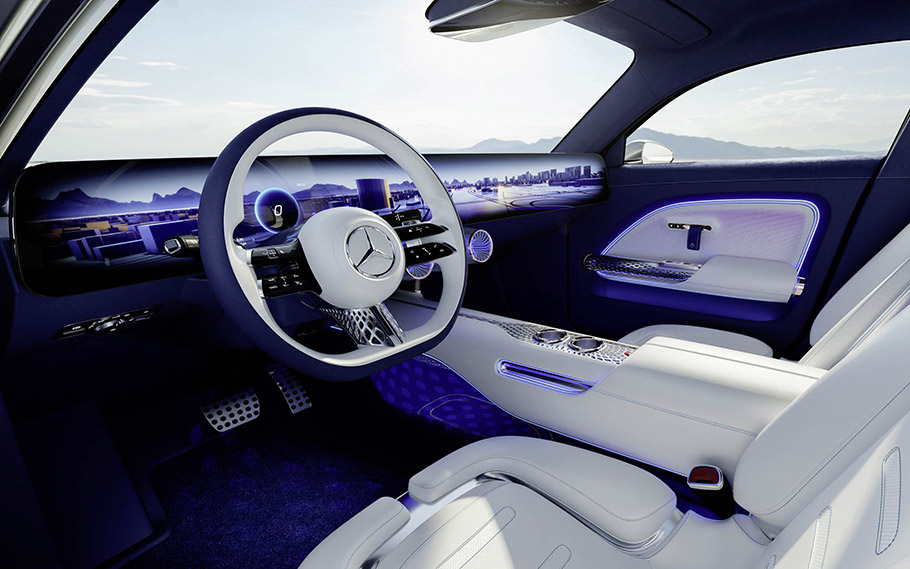
    2022 Mercedes-Benz Vision EQXX Concept Interior

    The one-piece display is also highly energy efficient. Its mini-LED backlight consists of more than 3000 local dimming zones, meaning it consumes power only as and when needed in specific parts of the screen.

    The 3D navigation screen adapts to the type of content being shown. For instance, if you’re driving in an urban area, abstract visualization of the surrounding buildings helps provide orientation amid densely packed streets. However, if you are traveling on the highway or open road, the level of detail diminishes to provide a clearer overview of the journey. This has the added efficiency benefit of reducing the energy consumption of the display.

    As well as providing seamless navigation, the intelligence in the VISION EQXX can mine for data based on the car’s route, with the avatar on hand to function as an intelligent tour guide. It can even help you manage your music library and offer local suggestions.

    There is also a system to help you drive more efficiently. From energy flow to terrain, battery status and even the direction and intensity of the wind and sun, the efficiency assistant curates all the available information and suggests the most efficient driving style. This actually enhances the driver’s own senses by providing input on external conditions that the driver themselves is unable to feel directly – in the way that, for instance, a cyclist can feel the force of the wind or the extra effort involved to pedal uphill. This sensorial support is further augmented by the ability of the VISION EQXX to use the map data to “see into the future”, anticipating what lies ahead to help the driver take advantage of it in a way that maximizes efficiency. A cool orb graphic in the display provides an instinctive overview, underpinned if desired by sound.

    And if more detailed information is what you want, a series of screens will tell you all you need to know with easy-to-follow visuals and infographics. The influence of current acceleration, gradient, wind and rolling resistance on energy consumption are shown in real time. If it’s a full analysis you want – you got it. Equally, if you’re someone who prefers to travel on a “need to know” basis, the VISION EQXX will remain silent.

    The simplicity of the interface is a further development of the Zero Layer concept first used in the EQS, which eases driver-vehicle interaction by removing submenus. The interface is efficient and effective, thanks to intelligence and personalization. Highly proactive, it shows you what you need when you need it, with an intuitive zoom feature providing access to all functions. Your human road trip sidekick has their own dedicated zoom feature and entertainment zone. And if you prefer to travel alone, this part of the display powers down to save energy.

    Weaving sound into the equation

    Lastly, the sound system in the VISION EQXX is interwoven into the UI/UX to deliver an impressive 4D experience with exceptional energy efficiency. A typical sound system can be a significant energy consumer, so Mercedes-Benz engineers looked closely at how to optimize the sound experience while minimizing energy consumption. This can be done by reducing the degradation that sound waves experience when they are absorbed by or bounce off interior surfaces.

    Reducing the overall number of speakers and positioning them very close to the individual occupants dramatically reduces the distance the sound travels. Two broadband speakers installed in each headrest are paired with a bass exciter in each seat. The VISION EQXX uses the exciters for regular audio output as well as for vehicle sounds, haptic feedback and auditory warning. The efficient pairing of sound and haptic feedback is a energy-efficient way of increasing perception and awareness through the use of more stimuli.

    As well as reducing energy consumption, the layout of sound system in the VISION EQXX also facilitates multiple different sound zones. The efficiency assistant takes advantage of the sound system to communicate its recommendations to the driver via a series of intuitive audio “cues”. These were inspired by the cues used by Formula E motor racing to help the drivers perform more efficiently.

    The development and testing process – a digital journey driven by software

    The global road trip to electric mobility is fueled by advanced software and digital processes. The highways and byways are many and varied, the attractions and connections along the way inspiring.

    Pulling together such a diverse array of expertise and innovative ideas from around the world to create the VISION EQXX in half the time was a masterclass in software management. The team made extensive use of open-source technology, augmented by elements created in-house. Agile working practices and monthly release planning ensured a continuous flow of end-to-end functions and early integration of solutions.

    The scale of the digital development work involved in designing and engineering the VISION EQXX is truly groundbreaking. Highly advanced digital tools such as augmented and virtual reality dispensed with the need for time-consuming physical mock-ups. It also facilitated simultaneous development work by remote teams working in different parts of the world – from Stuttgart (Germany) to Bangalore (India) and from Brixworth (UK) to Sunnyvale (California). This massive uplift in digital power slashed the time spent in the wind tunnel from more than 100 hours to just 32. It also meant more than 186,411 miles of test driving was covered virtually.

    The digital development made extensive use of Software in the Loop (SiL) systems. This kept the commissioning phases with the real hardware extremely short and enabled us to drive large-scale tests early on in the project. Using this approach, the team was able to install the drive unit, flash the software and get the wheels turning on the VISION EQXX within the space of just two hours. This extremely nimble, efficient and responsive teamwork was made possible by a combination of a motorsport mindset and intelligent use of the comprehensive testing options at Mercedes-Benz.

    This highly effective and efficient digital development approach means that many of the innovations in the VISION EQXX could be quickly adapted for production applications.

    DID YOU KNOW, THAT THE VISION EQXX…

    …achieves more with less

    Being efficient is all about cutting waste to an absolute minimum to make the most of what you have, be that energy, time or resources. In the Mercedes-Benz VISION EQXX, efficiency means more range from less energy, more tangible luxury and convenience with less impact on nature, and more electric mobility with less waste. It also means radically shorter development times through the application of advanced digital tools and cross-functional teamwork.

    …can get from Berlin to Paris on a single charge

    A single charge of the VISION EQXX would take you from Berlin to Paris, from New York City to Cincinnati, Ohio, or from Beijing to Nanjing. Not because it has a big battery, but because it’s highly efficient. Based on average distances driven per year, a driver in the U.S. or China would have to fully recharge the VISION EQXX only twice per month and in Europe just once per month

    …is the electric equivalent of a “1-litre car”

    The VISION EQXX uses less than 10 kWh of electrical energy to travel 100 km. That equates to traveling 6 miles on 1 kWh of electrical energy. But what does that mean? Translated into fossil-fuel consumption, this is around the golden figure of 1 liter per 100 kilometers (235 mpg).

    Here are a few examples of what 10 kWh of energy delivers in other areas of life:

    • Run a tumble dryer for just over 3 hours
    • Run an average domestic air conditioner for around 3 hours
    • Use an iron for 5 hours
    • Watch a 50-inch LED TV for 100 hours
    • Run the conventional (non-LED) floodlights at a major sports stadium for around 3 minutes

    …is more aerodynamic than a football

    On a long-distance journey, a typical EV uses around two-thirds of its energy just pushing its way through the air. At 0.17, the ground-breaking cd figure of the VISION EQXX can make a big difference at highway cruising speeds. A reduction of just 0.01 adds around 2.5% to the range. Let’s put that into context with a few other drag coefficients:

    1. Penguin – 0.05
    2. VISION EQXX – 0.17
    3. EQS – 0.20
    4. Football – 0.18 to 0.2
    5. Cyclist –0.6 to >0.8
    6. Person – 0.8 to 1.2
    7. Parachute – 1.1 to 1.3
  • Nissan Vision Gran Turismo Concept

    Nissan has published a new picture of Vision Gran Turismo Concept on Twitter. The Japan manufacturer didn’t release any further information, but the interesting sports car resembles a GT-R from the future.

    There is a strange V-motion front fascia and slender headlights. The huge air-intakes are going to deliver enough air for the expected extremely powerful engine, which will power the upcoming Nissan GT-R. It is rumored to have over 800HP (588 kW), which is considerably more than the current most powerful version – Nismo having 600HP.

    The drivetrain of the new Nissan GT-R will consist of the well-known VR38DETT 3.8 liter twin-turbo V6 engine and an electric motor. Of course, a KERS-like system will be installed thanks to Williams F1 Team.

    The Vision Gran Turismo Concept boasts a  double bubble roof flowing into the rear end. There are also aggressive side skirts and huge five-spoke alloy wheels probably measuring 20” or 21”.

    Nissan will unveil more information on June 16th as well as more pictures and details.

    Stay tuned!

    Source: Nissan

  • BMW Vision Future Luxury Concept

    BMW has officially unveiled the Vision Future Luxury Concept. The new vehicle stands for a forward-looking fusion of exclusivity and innovation. It boasts unique driving experience combining nice emotions and exclusivity. All this is conveyed through the outstanding exterior and interior design of the BMW Vision Future Luxury.

    The exterior boasts futuristic elements, a Liquid Platinum Bronze paint and a massive twin kidney grille that is flanked by laserlight headlights. There are also carbon fiber air deflectors, chrome trim elements, OLED taillights and a carbon strip, which means that the Vision Future Luxury Concept comes with carbon fiber and aluminum chassis.

    The interior is even more spectacular. There are three displays that use 3D technology – the left one shows vehicle data, while the center shows a programmable speedometer, rev counter and “context-adaptive supplementary data”.  The right display is for the infotainment system – music, maps, etc.

    There is also a contact-analogue BMW Vision Head Up Display. This display augments the driver’s view of the real world by projecting information directly in the driver’s line of sight onto the road. Buildings, traffic signs or hazards can be highlighted directly in the real-world environment, selectively directing the driver’s attention to specific information which is particularly important at any given time.

    “We use visionary concept vehicles like the BMW Vision Future Luxury to show where we may be going with these themes in the future, and to give us new inspiration and motivation. The BMW Vision Future Luxury – with its innovative technologies and with meticulous precision and quality in every detail – takes our thinking on modern luxury a logical stage further.”, commented BMW’s Senior Vice President of Design, Adrian van Hooydonk.

    Source: BMW

  • Honda Unveils Vision XS-1 Concept [VIDEO]

    Honda-Vision-XS-1-Concept-THUMB.An exciting new concept vehicle was presented by the Japanese brand Honda at the 12th Auto Expo 2014 held at India Expo Mart in Greater Noida. The vehicle is named Vision XS-1 and is a creative study model that exudes company’s vision for the future.

    In fact, this Honda is based on two original ideas we have seen in the past. The first one is the M/M concept. The initials stand for man maximum and machine minimum. This basically means that the Vision XS-1 includes two different values – sporty appearance and great spaciousness in the compact body.

    The second idea embodied in this vehicle is the “Exciting H Design”, which is Honda’s human-centered design concept. Some of the key features included in this concept model are the three rows of seats for a maximum of seven occupants, the combination of sportiness and versatile space and the sliding doors with large openings.

    Unfortunately, Honda does not plan a mass-production for Honda Vision XS-1.

    httpv://youtu.be/1MVohnXN8Eo

    Video Source: YouTube

    Source: Honda

  • MINI Vision – Design from the Future

    MINI Vision showcases various elements of future MINI design. There are a lot of interesting features like Driving Experience Control, full LED headlights and MINI Click System.

    MINI Vision is designed to preview the upcoming 2014 Cooper. The Vision boasts an aerodynamic bumper and a hexagonal grille that features integrated fog lights. Thea re also full-LED headlights with outer ring which works as DRL. Other highlights include organo metal accents, a tailgate-mounted spoiler and a center-mounted dual exhaust system.

    The interior boasts a symmetrical design and a lot of different colors and textures. The lounge-like seats seem very comfortable and Union Jack-inspired elastic straps on the doors that hold magazines, drinks or mobile phones are very useful.

    The unbeatable scope for personalisation and an extremely sporty and precise design make the MINI Vision the perfect partner for the road, tailored to the needs and preferences of the individual driver. This design vision demonstrates that MINI will continue to use intelligent variability, imagination-capturing technology and a compact sporting presence to deliver unrivalled driving fun over the years to come.

    Source: MINI