Hyundaihas revealed a JP Edition Veloster Concept at the 2012 SEMA Motor Show. The JP Edition concept debuts at the 2012 SEMA show under the Hyundai banner. Paint supplier BASF was consulted as the unique supplier of the Mint Green exterior finish for the concept.
“In creating the JP Edition Veloster, we were inspired to take the Veloster’s distinctive design cues and accentuate them with an iris-warping brilliant mint green exterior finish” commented John Pangilinan.
“The JP Edition Veloster concepttakes the production car into ultra-exclusive tuner-car territory.”, he added.
The special edition Velosteris powered by a direct-injected 1.6 liter petrol engine fitted with an ARK Performance exhaust. The car also comes with a sports suspension including KW coilovers, Whiteline sway bars, anti-lift caster kit and end links. The car rolls big 19” alloy wheels fitted with 265/30 R19 Toyo tires.
The interior boasts Recaro Cross Sportster CS seats upholstered by Infinite Auto Design. There are also Takata harnesses and premium audio system.
Powertrain
ARK Performance Exhaust
Lucas Oil
Exterior
TS Designs Metal Fender Flares designed by Jon Sibal
BASF Mint Green Paint painted by Auto Explosion
Chassis/Suspension
Brembo big brake kit
KW Coilovers with ARK Performance lowering springs
Whiteline sway bars, anti-lift caster kit and end links
Ray’s Gram Lights Xtreme57 Wheels – 19 x 9.5 inches
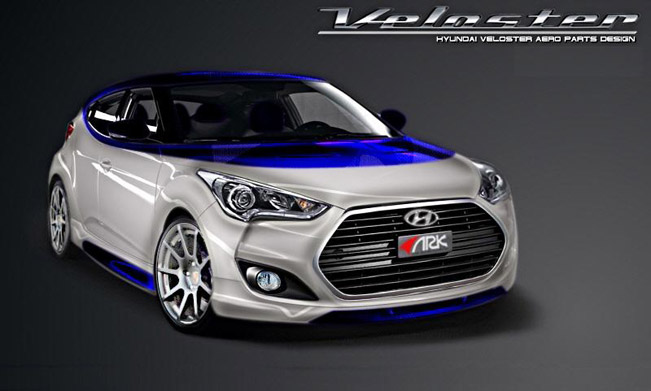
ARK Performance will present a special tuned version of Hyundai Veloster. The name of the project is Alpine Concept which includes upgrades to the exterior and the 1.6 liter engine.
Some of the goodies are an ARK oil cooler, a Nitrous Oxide system, &N intake system and BTRcc custom engine bay parts and tuning. All these upgrades lead to a power of 232HP (173 kW) at 5500RPM and 325Nm (240 lb-ft) of torque at 1700RPM.
The exterior features a complete ARK Performance body kit including a new front and rear bumpers, a new rear wing, modified fenders and a pair of side skirts. The rally wing is also new as well as the 180 Customs headlights and taillights.
The car is finished in custom pearl white paint created by Beyond Coachworks.
Powertrain
Custom Tuning by BTRcc
Horsepower: 232 HP @ 5500 RPM
Torque: 240 lb.-ft. @ 1700 RPM
ARK Performance Veloster Turbo DTS exhaust system, test pipe and turbo up-pipes
K&N Intake System
Nitrous Express Proton Kit
ARK Oil Cooler
BTRcc Custom Engine Bay parts
Koyo Radiator
NRG Oil Catch Tank
NRG Fuel Pressure Tank
NRG Washer Mods
Exterior
Custom Pearl White Paint by Beyond Coachworks
Custom soft-touch interior materials by HEXIS
2013 ARK / Adro body kit: bumpers, side skirts, rear wing, fenders
ARK CF Rally Wing
180 Customs Headlights and Taillights
Seibon Carbon hood and deck lid
NRG front and rear tow hooks
Exterior Accessories
ROME SDS Snowboard, bindings and boots
Reverb Rockers Snowboards
Gold Snowboards
Folsom Boots
Memphis Boots
Targa G3 Bindings
Strut G1 Bindings
Yakima Snowboard Rack and custom wind guard
Yakima Fatcat 6
Rally Armor Mudflaps
Interior
JPM Coachworks “Alpine Edition” interior
Custom Seats, Instrument Panel, Shift knob and boot, Armrest, Headliner, Visors and Steering Wheel
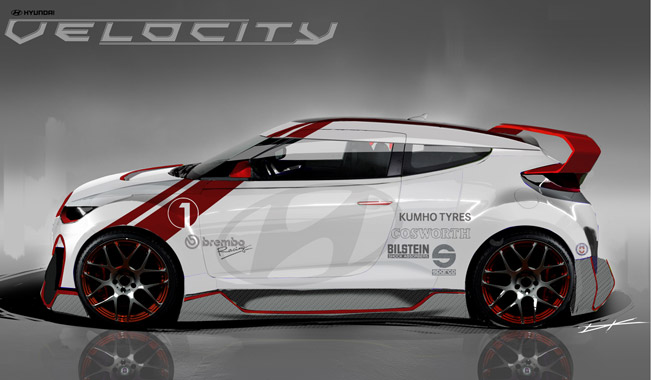
Hyundai Velocity Concept is a vehicle which is to proudly debut at 2012 SEMA show. Originally the car is a Veloster sport coupe, but being a tuning it adds more aggressiveness and exceptional design language.
This Hyundai runs on 19 x 9.0 inch, HRE lightweight satin-charcoal racing wheels. In addition, the special car is fitted with tarmac-scraping lower body kit with generous front and rear brake cooling ducts, lift-reducing rear diffuser, oversized rear wing, and number one racecar design graphic.
The concept keeps the original silhouette of the Veloster, however adding a note on exponential performance gains and functional design cues. Furthermore, the 1.6-liter, direct-injected engine underwent some transformations thanks to Cosworth, including performance pistons, rods, turbocharger, intercooler, intake manifold, intake-charging design, fuel system and engine management.
All this results in more than 400 horsepower (295 kW) and 350 lb.-ft. (475 Nm) of torque. In addition, Velocity’s suspension and braking modifications handle the acceleration capabilities under hood, with Brembo® 4-piston calipers and two-piece rotors, Bilstein® springs with monotube dampers, and Kumho Ecsta SPT 275/35R19 high performance summer tires.
httpv://youtu.be/ufKu7JY9BgA
The list of Velocity performance enhancements includes the following:
Powertrain
Cosworth engine upgrades: Pistons, Rods, Turbo, Intercooler, Intake Manifold, Intake charge design, Fuel system, and Engine Management system
CPR Fabrication: Custom Exhaust system
Interior
Sparco: A1 WTX 5H Helmets, gloves, shoes, and seat belts.
Race-keeper: Race-Keeper Video GPS data Acquisition System
Katzkin custom suede leather interior:
Raven and scarlet themed suede with red stitching
CPR Integrated Roll Bar
Exterior
Velocity HATCI Design Body Kit:
Front and rear braking airflow ducts
Lift-reducing rear diffuser
Integrated front splitter
Aero side skirt lip
Oversized rear wing spoiler
#1 racing number design motif
HRE P40 model 19 x 9.0″ lightweight satin-charcoal wheels
Brakes
Brembo: 350x28mm two-piece Rotors and 4-Piston Calipers
Suspension
Bilstein: Monotube dampers and spring kit
Kumho: Ecsta SPT 275/35R19 High Performance Summer Tires
The fun-cars have gone a long way. The swinging 60s created a demand for highly impractical yet beautiful cars. It was mainly Europe that latched onto the new fashion and the car acquired a whole-new purpose. Manufacturers like Fiat, MG and many others started concentrating on small cool two-seaters and coupes and the party lasted till the early 1970s when the fuel crisis put a new emphasis on the industry and the cars had to become practical (and boring) once again.
The times have changed, so has the technology. You no longer have to build a fuel-inefficient car for it to be fun to drive. As the modern car designers become braver and braver, we see a positive tendency in the automotive market with the concept of fun-cars resurrected. Small and quirky cars are the new craze – they seem to be getting a lot of love right now from everyone, both customers and motoring journalists.
The new generation of fun-cars is very distinctive. They are mostly small 3-door hatchbacks that may appear oddly-shaped to some, but very stylish to others. They are fun to drive because sporty features are often incorporated. They usually have a bold sporty look, excellent aerodynamics, sporty color and sporty wheels. Even with their small size, fun-cars can be roomy enough to fit in four adults comfortably.
To create fun in driving, they are often fitted with small but nippy 1.4 litre to 1.6 litre petrol engines depending on the model and variant. They are available in both 5 or 6-speed manual transmission or automatic transmission. There are many brands playing in the newly-born category but several vehicles stand out: the Hyundai Veloster, Nissan Juke, Alfa Romeo Mito, VW Beetle and the Mini One.
A car to watch is the Hyundai Veloster. It has aggressive contour lines and an excellent interior. Beneath the bonnet is a 138 horsepower, 1.6 litre GDI Double Overhead Cam 4-cylinder engine equipped with the latest Dual Continuous Variable Valve Timing (D-VVTi) technology. It is equipped with a 6-speed manual transmission or a 6-speed dual clutch transmission. Performance on the road is stellar; you can even get 40 miles to a gallon. When driving, it gives out a smooth, power-efficient force when you accelerate. Thanks to the ever increasing quality and low prices, Hyundai is one of the first choices for people looking for car finance.
The Alfa Romeo Mito is another cool little vehicle worth a look. It is a small car fitted with a patented Multiair 78 horsepower, 1.4 litre entry level petrol engine. Available in Italian racing colors (red, yellow and green), the Mito is quick and fast even with the entry level engine. However, if you want it to be a little quicker off the mark, you can get the 1.6 litre Distinctive S/S 3-door model. Driving and handling is good but the passenger leg room may not be comfortable for taller passengers.
Now, the VW Beetle of course is a legend. The design is classic and iconic, not to mention that it is equipped with the latest safety features. Although the VW is basically a 2-door car, it is included in the fun-car category because it is really fun to drive. The turbo-charged engine can accelerate fast enough but the fuel economy is not that good compared with the Alfa Romeo Mito. Now with the new model recently launched, the previous generation has slightly depreciated. At Creditplus car finance specialists we notice an increased demand for the previous model Beetle. We are sure you will agree when we say that this is probably one of the most fun cars you can purchase on today’s market; especially if you opt for the original Beetle.
Out of all the options, the Nissan Juke stands out as a very original and quirky car. It’s the styling that makes it so desirable. What is it really? A coupe or a 4×4? In fact, it’s classified as a crossover, which means it’s a hybrid of a utility vehicle and a sporty coupe. Although the engine size of 1.6 litres don’t suggest it’s particularly quick, the small Nissan is a very dynamic car. The 1.6 Dig-T version is the one to go for if you’re looking for good times behind the wheel.
Lastly, we have the Mini One – its predecessor experienced the previous reign of the fun-cars. It is a 3-door hatchback with entry level variants as well as a sport variant. The entry level version look almost as good as the sporty One. The difference is in the engine configuration. The entry level comes in a smaller engine while the sports variant comes in 1.6 Liter 4-cylinder DOHC engine. All in all the car looks great and drives very well – that’s why it remains one of the favourite.
These were the most popular models, however, other manufacturers like Fiat, Citroen and Renault are quickly catching up.
Kia has released first image (teaser) of the new Track’ster Concept car, which will make its official debut at the 2012 Chicago Auto Show. The vehicle is created by California Design Studio.
The concept car boasts LED taillights and aggressive dual exhaust system.
There are no further details about the car or its engine, but probably it will share the Veloster’s 1.6 liter turbocharged petrol with 211PS (155 kW) and 265Nm (196 lb-ft).
Full details and additional photography will be released on Wednesday 8th February. A design sketch was released on Thursday 2nd February.
Hyundai unveiled today the all-new 2013 Veloster Turbo at the North American International Auto Show (NAIAS). Veloster Turbo is armed with 201 horsepower (248 kW). The vehicle is powerful, high-tech and fuel-efficient and all this makes it the ultimate innovation in the sport coupe segment. The 2013 Veloster Turbo will be in dealerships in the summer of 2012 packed with unique sport-tuned steering and suspension hardware set.
The new Veloster Turbo is equipped with 1.6-liter turbocharged GDI four-cylinder engine in which produces 201 horsepower at 6000 rpm and 195 lb-ft (264 Nm) of torque from 1750 – 4500 rpm with regular fuel. More importantly the vehicle is estimated to deliver 27 mpg city and best-in-class 38 mpg highway for manual transmission models! The 1.6-liter Gamma turbocharged engine includes a twin-scroll turbocharger that when combined with the GDI system, results in instantaneous power delivery. Although twin-scroll turbochargers have traditionally been used on more expensive high performance engines, Hyundai has brought this technology down its line-up from the Sonata 2.0T. In particular, twin-scroll turbocharger designs have two exhaust gas inlets divided by split walls inside the turbine housing, with both gas passages controlled by a waste-gate. A twin-scroll turbo recovers even more energy from the exhaust than a single-scroll turbocharger, thanks to a divided manifold. The twin-scroll design separates the cylinders whose exhaust gas pulses interfere with each other, and thus resulting in improved pressure distribution in the exhaust ports and a more efficient delivery of exhaust gas energy to the turbocharger’s turbine. Another important result is the improved pressure distribution in the exhaust ports and a more efficient delivery of exhaust gas energy to the turbocharger’s turbine. This in turn allows greater valve overlap, resulting in an enhanced quality and quantity of the air charge entering each cylinder. Additionally the twin-scroll turbocharger design includes other benefits over traditional, single-scroll turbocharging systems, such as improved combustion efficiency, low engine-speed efficiency, kinetic exhaust gas energy is not wasted or trapped, cooler cylinder temperatures, lower exhaust temperatures, leaner air/fuel ratio, better pressure distribution in the exhaust ports and more efficient delivery of exhaust gas energy to the turbocharger’s turbine. Furthermore Veloster’s twin-scroll turbo has great handling of exhaust gas separation at the turbine leading to improved low-end torque and faster transient torque response. Thanks to the integrated stainless-steel turbine housing with the exhaust manifold, not only is the weight and cost of the casting reduced, but also is the durability of the turbine housing also improved. Moreover heat energy recovery and thus turbo efficiency is significantly improved based on the fact that a traditional two-piece design effectively insulates some of the heat energy at the joint/gasket area.
2012 Hyundai Veloster Turbo
Furthermore the specific GDI fuel delivery system contributes to improved fuel efficiency and lower emissions. The fuel is injected by a camshaft-driven, high pressure pump that operates at pressures up to 2175 psi. Direct injection also utilizes a higher-than-normal 9.5 compression ratios, while achieving a best-in-class 125.6 horsepower-per-liter. The piston heads are “dished” to increase combustion efficiency in the cylinder.
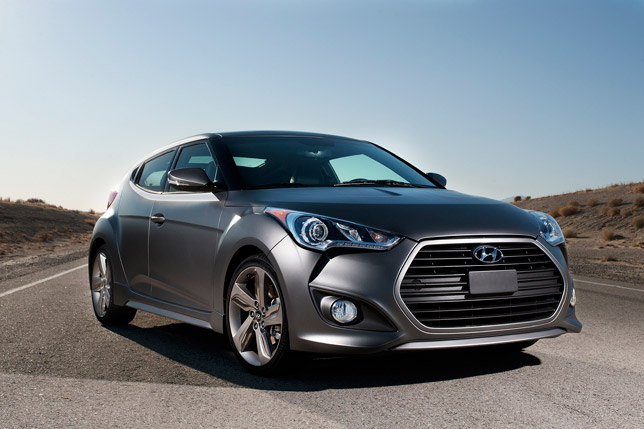
Veloster Turbo’s is uniquely designed. The inspiration was a custom high-performance sport bike. Moreover Hyundai designers have removed the Veloster’s trapezoidal center exhaust and replaced it with two larger free flowing circular pipes. These new pipes and the new intake manifold also allowed engineers to give the engine a more robust sound. Drivers will also appreciate that the Veloster Turbo will be available in a Hyundai first Matte Gray paint. In addition a set of 18-inch gray wheels with chrome inserts completes the Veloster Turbo’s classy style. Another important feature is that Veloster Turbo includes a quicker ratio steering rack and a revised steering calibration to match, which both give drivers precise cornering, feedback and control. All Veloster Turbo’s ride on Kumho Solus KH25 215/40R18 85V tires designed to extract the best performance out of the car without compromising the ride. Good news is that all Velosters are fitted with a McPherson strut front suspension, coil springs, gas shock absorbers and a 24 mm diameter front stabilizer. Additionally, the rear suspension is a light-weight V-torsion beam, a Hyundai-first with an integrated 23 mm stabilizer bar to allow bracing of the arms for greater stiffness and to further control body roll. In order to bring more comfort, the rear suspension also uses monotube shock absorbers. All Velosters feature electric power steering that adjusts assistance instantly to changing driving conditions while improving fuel economy over a conventional steering system. Veloster’s turning diameter of 34.1 feet is better than Mini’s 35.1 feet and Mini Clubman’s 36.1 feet.
And if you wonder about the interior, it features full leather seats with the word “Turbo” stitched into the seatbacks. An exclusive Supervision Cluster offers the driver information in a larger, clearer and more interactive format. This is due to the Supervision Cluster’s two TFT screens located between the tachometer and the speedometer. As a standard there are two heated front seats.
In order to handle the power enhancements Veloster Turbo is paired with a standard six-speed manual transmission or a six-speed automatic transmission. The manual features a wider gear ratio spread (5.71 vs. 5.25) to handle the additional torque output. The high-revving turbo helps during acceleration, especially at highway speeds. The Veloster Turbo is mated to a six-speed automatic transmission with steering wheel-mounted paddle-shifter and and Shiftronic® controls rather than the base Vesloster’s EcoShift DCT. This is due to the increased torque output from the 1.6-liter Turbocharged-GDI engine. The gear ratio spread on the automatic transmission is slightly narrower than the DCT (6.0 vs. 6.38). A narrower spread maintains the engine in the power band when going from one gear to the other. The base Veloster’s EcoShift DCT is tuned for fuel efficiency and not for the performance feel needed for the Veloster Turbo.
At just 2,800 pounds, Veloster sets priority on weight efficiency, whcih allows the car Turbo to deliver a great combination of agility, performance, and fuel efficiency. The overall dimensions of the vehicle are 104.3-inch wheelbase, 167.3 inches long and 71.1 inches wide.
Of course, all Velosters have an exceptional level of standard safety features for the sporty car segment highlighted by a Vehicle Stability Management (VSM) system, which optimally manages ESC (Electronic Stability Control) and the Motor-Driven electric Power Steering (MDPS). First of all, VSM works to control two effects. The first is when a driver accelerates or brakes on a split-mu surface (slippery on one side, dry pavement on the other) and the vehicle wants to pull in one direction. In addition VSM detects this condition and sends a signal to the MDPS to apply steering assist. It counters the pull and automatically provides up to eight Newton meters of counter steering and reacts the same way during sudden lane changes or fast cornering. Further advantages concerning the safety are the six airbags—including dual front, front seat-mounted side-impact, and front and rear side curtain airbags; a state-of-the-art braking package – the package includes four-wheel disc brakes and an Anti-Lock Braking System (ABS) including Brake Assist, which provides maximum braking force when a panic stop is detected; and Electronic Brake-force Distribution (EBD), to automatically adjust the braking force to front and rear axles based on vehicle loading conditions.
The vehicle also comes standard with a multifunction seven-inch touch-screen display, which now makes it more interactive and entertaining. In addition there is included Pandora internet radio , Gracenote MediaVOCS® technology, a standard 450-watt Dimension Premium Audio system with eight speakers including an eight-inch subwoofer, external amplifier and iPod®/USB/auxiliary input jacks; XM Satellite Radio interface; a Bluetooth hands-free phone system with voice recognition, address book download and audio streaming; onboard navigation. And at last but not least it also features the unique Hyundai Blue Link Technology. As part of the Blue Link launch, Hyundai also will provide Blue Link Assurance on Blue Link-equipped vehicles, which include core safety services for an introductory period. These key safety services include: Automatic Crash Notification (ACN) and Assistance, SOS Emergency Assistance, and Enhanced Roadside Assistance.
Eventually Veloster Turbo’s is painted in an exclusive Matte Gray. Later all 2013 Velosters will be available in colors that fit the cars “own-it” attitude and characteristics of a long-distance runner, including Elite White. There will also be interior color choices such as Graphite Black Graphite Black with Blue accents and headliner graphics for non-panoramic sunroof models.
The GOOD DESIGN awards (must be hard to be excellent) are annually given by The Chicago Athenaeum: Museum of Architecture and Design along with The European Centre for Architecture Art Design and Urban Studies. In terms of prestige, this event is the Oscars for designers. It values innovation, originality and quite frankly bravery when it comes to designing products of any kind. Interestingly enough there is also a “Transportation”category which, in 2011, was won by the Hyundai Veloster.
Here’s what the director of product planning in Hyundai Motor America, Scott Margason had to say: “With Veloster, we want to show consumers that high style, fuel efficiency and affordable pricing can all be found in one vehicle,” he continues: “Veloster stands out from the crowd with a stylish yet functional design. We’re honored that GOOD DESIGN is recognizing the beautiful design and unique personality of the car.”
2012 Hyundai Veloster
So what was it about the Veloster that impressed so much the jury at the American Institute of Architects in Los Angeles where the 2011 awards were held? Well, one might notice that the car is missing a door as there are two on the passenger side and only on on the other side (or it has a bonus door on the passenger side. Depends on how people see it.) One can tell that the overall design was inspired by a sports motorbike as there is a motorcycle helmet visor appearance around the cabin thanks to the black, barely visible A-pillars. Aggression is further added with the honeycomb front grille and the unique Hyundai-signature LED position lights. At the back there is a clever glass hatch and dual exhaust tips right in the middle of the black rear fascia. Inside the Veloster, the air vents look like bike exhaust pipes while the center console resembles a bike fuel tank which morphs into a bike seat on the way down to the floor console.
Hyundai has announced their line-up for 2011 SEMA Motor Show. It includes Performance ARK Hyundai Veloster, PM Lifestyle Hyundai Veloster, Hyundai Genesis Hurricane SC, RMR RM500 Hyundai Genesis Coupe, REMIX Hyundai Veloster Gaming, REMIX Hyundai Veloster Music and REMIX Hyundai Veloster Tech.
All vehicles are unique and the number of upgrades is endless. Adding even more Velosters to Hyundai’s modified pack, RIDES magazine, in association with Lux Motorwerks, also built three custom Velosters centered around the passion points of music, technology and gaming. Each of the three Velosters boasts its own style, top-of-the-line modifications and the most current gear available.
“Each year we bring our newest, most exciting cars to SEMA through a partnership with aftermarket specialists to create even more powerful options for Hyundai owners,” commented Mike O’Brien, vice president, Product and Corporate Planning, Hyundai Motor America.
“This year, we chose to bring back the tuner-friendly Genesis Coupe as well as debut modifications to our new and innovative three-door coupe, the 2012 Veloster.”, he finished.
ARK Performance Veloster
To showcase the performance capabilities and aftermarket potential of its three-door coupe, Hyundai teamed up with ARK Performance to transform Veloster into a sleek rally car. The ARK Performance Veloster will be unveiled with a custom twin-scroll turbocharger increasing its horsepower to 210-horsepower and a bright green and flat gray paint scheme to give enthusiasts a glimpse at Veloster’s potential. The Veloster will showcase mechanical, interior and exterior modifications including an open wheel concept with aggressive fenders and Nitto tires. ARK will also develop Veloster specific parts to showcase the tunability of the engine and vehicle exterior.
PM Lifestyle Veloster
Hyundai partnered with PM Lifestyle, a leader in creative innovation and digital media distribution in the automotive industry, and the Universal Technical Institute (UTI) to develop a powerful and interactive custom Veloster for this year’s SEMA Show. The bold, blue Veloster with a carbon-fiber hood, Konig Deception wheels and custom leather interior will make its debut on the SEMA Show floor and then take off on a three-year show tour with UTI, making appearances at over 120 autocross, supercross and school demonstration events. With an anticipated performance of 163-horsepower, PM Lifestyle’s custom Veloster will showcase many special modifications, making it a guaranteed highlight at this year’s SEMA Show.
Genesis Hurricane SC
Showcasing the extreme power of Hyundai’s most popular performance car, Hyundai America Technical Center Inc. (HATCI) teamed up with Magnuson Products, Rhys Millen Racing, Harman International and Torvec Inc. to develop and build a special edition prototype Genesis Coupe, the Genesis Hurricane SC. The Genesis Hurricane SC represents a two year development effort by HATCI, Hyundai’s design, technology and engineering branch, as its engineers worked to enhance all aspects of the vehicle including power, traction, braking, exterior and interior design and audio system. Highlighting the performance modifications, HATCI teamed up with Magnuson Products to supercharge Genesis Coupe’s 3.8L V-6 engine with a liquid to air intercooler, producing more than 450-horsepower.
In addition to the supercharged V-6, the Hurricane features an IsoTorque differential from Torvec Inc., exterior enhancements from Rhys Millen Racing and a Harman International high level Lexicon audio system.
Rhys Millen Racing RM500 Genesis Coupe
Making auto enthusiasts’ wishes come true at this year’s SEMA Show, RMR’s modified Genesis Coupe will showcase Hyundai’s most powerful engine under its hood – the award-winning 5.0-liter Tau V8. The RM500 Genesis Coupe is a 450-horsepower machine with a distinct, production-ready look. This marks the fourth year of the partnership between RMR and Hyundai creating show-stopping vehicles for tuners and consumers alike. In addition to the Tau V8, the all-black Genesis Coupe receives a custom RMR stainless exhaust with GReddy rear section muffler and titanium tips, oil cooler and rear differential cooler. These mechanical enhancements give Hyundai’s most powerful engine an extra 20 horsepower boost.
Rhys Millen Racing 2WD Global Rally Cross Veloster
Rhys Millen Racing (RMR) will also showcase his Two-Wheel Drive Veloster Rally Car. This production-based two-wheel drive racer has custom lightweight RMR body panels, improved aerodynamics, and rally-inspired suspension tuning for the rally enthusiast. The car features Hyundai’s 2.0-liter turbocharged four-cylinder engine and delivers 300-horsepower and 300 lb.-ft. of torque.
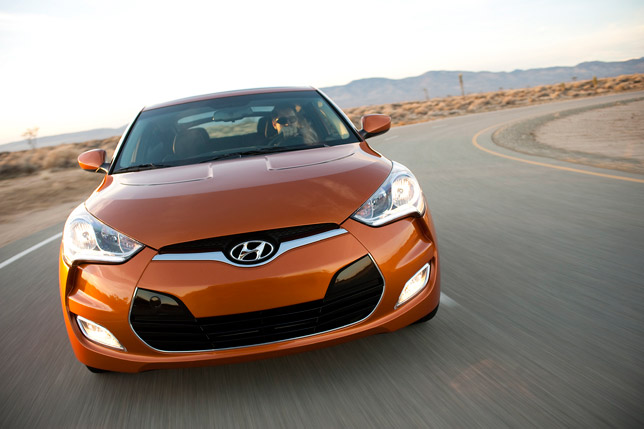
Hyundai has revealed the new 2012 Veloster Coupe, which is priced at just £17 995 on the road with an insurance group rating of 16E.
The Hyundai Veloster will be available in two trim levels and powered by an efficient 1.6-litre four-cylinder GDI petrol engine with 140PS. The option for transmission is either 6-speed manual or dual-clutch gearbox. Hyundai’s Blue drive technologies – incorporating Intelligent Stop & Go technology and low rolling resistance tyres – will feature in the Veloster line-up ensuring competitive CO2 emissions of 137g/km and a combined fuel economy of 47.9mpg.
Standard equipment includes 17” alloy wheels, a 7” Touch screen media centre with capability of playing games through consoles and films from smart phones, Bluetooth Connectivity with voice recognition, climate control air conditioning, reversing sensors, front and rear fog lights and striking LED daytime running lights. The Veloster also features a stereo RDS Radio/CD Player with MP3/WMA compatibility and an iPod connection, with the ability to control all functions on the leather steering wheel for added convenience.
The Veloster Sport benefits from 18” alloy wheels with colour inserts, black leather upholstery with heated front seats, a panoramic sunroof with tilt and slide function, cruise control, keyless entry with engine start/stop button and sporty alloy pedals.
A media pack – containing touch screen satellite navigation with rear view parking camera, Parking Guidance System and 7 speakers including Amp and subwoofer – and red leather interior are available as options on the Sport derivative only.
Hyundai will put the new 1.6 litre T-GDI turbo petrol engine in the 2012 Veloster and later it will also appear in the upcoming 2013 Hyundai ix30 and next-generation Kia ceed. The turbocharger will significantly improve the performance and the response of the engine.
The turbocharger also increases efficiency at low engine speeds, which lowers emissions and improves the fuel consumption.
The 1.6 litre turbocharged four-cylinder engine generates 211PS (155 kW) at 6000RPM and 265Nm (195 lb-ft) of torque between 1600RPM and 5000RPM. The 1.6L T-GDI direct-injection engine is a part of the manufacturer’s new initiative called Blue Drive which aims to lead the automobile industry in fuel efficiency and sustainability.
More details will be available after the official revealing of the engine at the 2011 New York Auto Show.
Hyundai has released another concept vehicle at the North American Auto Show in Detroit. The car will actually go on sale in 2012.
Hyundai Veloster is powered by 1.6 liter GDI Gamma engine with 138HP at 6300RPM and 166Nm (123 lb-ft) at 4850RPM. The power plant features Dual Continuously Variable Valve Timing (D-CVVT), Roller Timing Chain, Electronic Throttle Control and an innovative anti-friction coatings. (more…)
Hyundai has officially published another teaser of its all-new, sleek-styled 2012 Hyundai Veloster hatchback, which will make its first official appearance at the upcoming North American International Auto Show 2011 in Detroit. (more…)




 Hyundai Velocity Concept is a vehicle which is to proudly debut at 2012 SEMA show. Originally the car is a







 The GOOD DESIGN awards (must be hard to be excellent) are annually given by The Chicago Athenaeum: Museum of Architecture and Design along with The European Centre for Architecture Art Design and Urban Studies. In terms of prestige, this event is the Oscars for designers. It values innovation, originality and quite frankly bravery when it comes to designing products of any kind. Interestingly enough there is also a “Transportation”category which, in 2011, was won by the Hyundai Veloster.


 Hyundai has announced their line-up for 2011 SEMA Motor Show. It includes Performance ARK Hyundai Veloster, PM Lifestyle Hyundai Veloster, Hyundai Genesis Hurricane SC, RMR RM500 Hyundai Genesis Coupe, REMIX Hyundai Veloster Gaming, REMIX Hyundai Veloster Music and REMIX Hyundai Veloster Tech.


 Hyundai has revealed the new 2012 Veloster Coupe, which is priced at just £17 995 on the road with an insurance group rating of 16E.
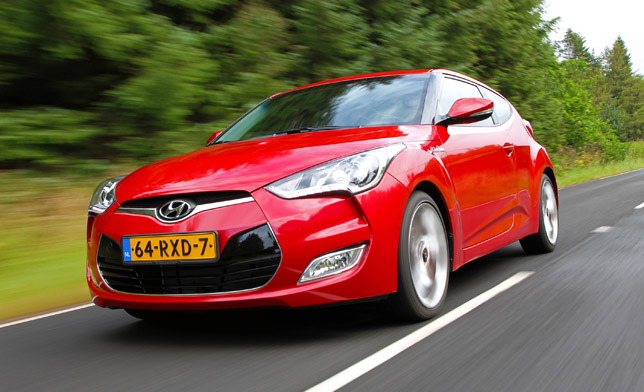


 Hyundai will put the new 1.6 litre T-GDI turbo petrol engine in the 2012 Veloster and later it will also appear in the upcoming 2013 Hyundai ix30 and next-generation Kia ceed. The turbocharger will significantly improve the performance and the response of the engine.


 Hyundai has released another concept vehicle at the North American Auto Show in Detroit. The car will actually go on sale in 2012.
 Hyundai has officially published another teaser of its all-new, sleek-styled 2012 Hyundai Veloster hatchback, which will make its first official appearance at the upcoming North American International Auto Show 2011 in Detroit.