
Tag: TwinPower

  • 2015 BMW 2 Series Active Tourer officially launched

    People looking for a vehicle that combines both mobility and style can now take a look at the all-new BMW 2 Series Active Tourer, freshly launched by the respected German auto maker. The new vehicle series offers users space, comfort, style, power and elegance and will surely be appreciated by customers who do not need a large car for every day needs yet they insist on having the BMW sign on their cars.

    We will not waste time so we’ll take you straight to the engines department as there is some interesting news – the BMW 2 Series Active Tourer is the first front-engine, front-wheel-drive layout vehicle sold under the BMW brand. Designed to compete directly with Mercedes-Benz B-Class vehicles, the BMW 2 Series Active Tourer comes with new turbocharged engines with three or four cylinders, BMW EfficientDynamics features and BMW ConnectedDrive technology. The total number of engines is three but they all come with transverse installation and BMW TwinPower Turbo Technology while at the same time they fully meet the latest EU6 emissions standard. There are two gasoline models installed in the BMW 218i Active Tourer and in the BMW 225i Active Tourer, and one diesel unit installed in the BMW 218d Active Tourer. The first gasoline engine comes with displacement of 1.5 liters and three cylinders that need 4.9-5.2 l/100 km (57.6-54.3 mpg UK) of fuel to deliver 100 kW (136 HP) of power under a six-speed gearbox. The BMW 225i comes with a more powerful 2.0-liter four-cylinder gasoline engine that delivers 170 kW (231 HP) of power with 5.8-6.0 l/100 km (48.7-47.1 mpg UK) of fuel consumption; this model comes with a standard eight-speed Steptronic gearbox. The four-cylinder diesel engine in the BMW 218d Active Tourer needs just 4.1-4.3 liters of fuel per 100 km (68.9-65.7 mpg UK) to deliver 110 kW (150 HP) of power to the wheels. This car has a standard six-speed transmission with an eight-speed gearbox available as an option.

    The BMW 2 Series Active Tourer has another feature worth noting – the cars in this series feature compact dimensions of 4342 x 1800 x 1555 mm (171 x 71 x 61 inches) but despite this they come with impressive internal levels of space. The driver and the front passenger enjoy a far higher seating position than in a sedan, which affords a commanding all-round view at the same time as making it easier to get in and out. The wealth of storage facilities and the option of a fold-flat passenger seat backrest are just two examples of the interior’s impressive flexibility and cleverly devised layout. The cabin has a light and spacious feel to it, with all surfaces horizontally structured in a layered look. There is also the option of a large panoramic roof that lets light flood into the interior. Add a luggage compartment that can be enlarged from 468 to 1510 liters and you do have a really spacious vehicle.

    People buying these cars will be treated with ultimate BMW quality on the inside that includes Radio Professional, including a hands-free telephone facility with a Bluetooth interface, the BMW iDrive control system with a controller on the centre console and a 6.5-inch Control Display, a rain sensor and automatic headlight activation, a sports leather steering wheel, the Intelligent Emergency Call system and the Collision Warning with City Braking function and more.

    Later this year the BMW 2 Series Active Tourer will also be available in the M Sport specification. This version will come with special M Sport suspension, 17-inch or 18-inch M light-alloy wheels, an M-leather steering wheel and sports seats. The M version will be available in Germany on September 27, 2014 starting from EUR 27 200.

    As to the other models there is no pricing information at the moment but given all the tech specs and the luxury that one will find inside, the new cars are not likely to be that cheap. Still you get what you pay for and this is also true for the BMW 2 Series Active Tourer.

    Source: BMW

  • Turbochargers Explained

    Turbocharged-badge-thumbEver wondered how WRC cars manage to deliver 300 bhp and above from an engine that, by rule, cannot exceed 2.0 liters of displacement? How on earth do the heavy, low-revving diesel engines in cars today stay competitive? Or what is it that makes it possible for the Bugatti Veyron to break the 1000 bhp threshold? Well, it certainly isn’t witchcraft. By means of “forced induction”, turbochargers today boost the automotive industry to a new direction of smaller, more-efficient and bloody good fun engines.
    Volkswagen like to brand their most successful turbo diesel range as TDI while Porsche, being more plain about it, call their turbocharged cars, Porsche (insert model here) Turbo. BMW, on the other hand, would never hesitate to utter their own terms like “bitrubo” or “TwinPower” whenever describing the latest M5 engine. The variety of depicting turbocharged cars is bountiful, but essentially the principles of work remain the same in every case.

    Beware reader, as I am now going to get technical:

    In order to understand how a centrifugal turbocharger works, one must also have some basic knowledge on how four-stroke, piston engines work. We have an engine block that contains the cylinders, right? Inside each cylinder, a piston moves up and down. Every movement made is a phase, a stroke. First we have intake – a mixture of fuel and air is sucked into the cylinder. Compression is the second stroke where the cylinder moves up and…well…compresses the molecules in the mixture. The next ignition stroke is downwards as the piston experiences pressure coming from the combustion of the mixture. The exhaust stroke has the job to expel the remaining gases through the exhaust valve. Then the intake valve lets in a new batch of fuel mixture and thus the process is repeated.

    However, as far as turbochargers are concerned, exhaust gases are not exactly throw-away material. Put simply, the turbocharger utilizes the energy of exhaust to compress the the newly arrived batch of air which is to be shoved in the cylinder. More air molecules means that more fuel can be injected into the mixture and more fuel means more power.

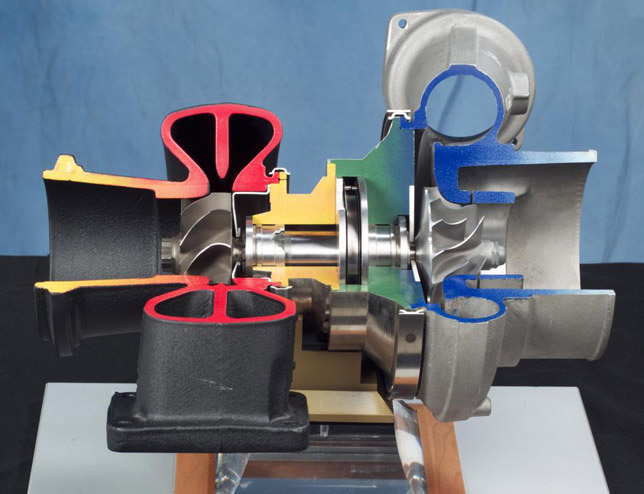
    Before those exhaust gasses reach the exhaust system they go trough a turbine connected to a shaft. The more exhaust that goes through the turbine blades, the faster they spin. On the other end of the shaft we find a compressor which welcomes fresh air from the atmosphere, compresses it using the force of the turbine and then feeds it into the engine. To further increase the efficiency of the turbocharging system, an intercooler is added – it looks much like a car radiator but instead of containing cooling fluid, it holds the compressed air from the compressor. Air is denser when cooler and that’s exactly what the intercooler does – it cools the incoming air.

    Cut-away view of a turbocharger held by a foil-bearing
    Cut-away view of a turbocharger held by a foil-bearing

    There are issues however. First of all, a turbine amidst the flow of exhaust is essentially an obstacle. The exhaust stroke has to deal with more back-pressure thus being slightly less efficient. A functional turboshaft has to handle extreme forces (speeds go up to 150 000 rpm within the turbocharger) so a special kind of baring is needed – liquid ones or state-of-the-art ball bearings. The latter is more efficient but more expensive. Then there’s the dreaded turbo lag. The problem here is that when you put your foot down, the response is far from electric. The turbine needs some time to kick off and start spinning the compressor blades. That’s why at low engine rpm one can’t really tell if the car has a turbo or not.

    There are various ways to tackle this nuisance. Make things smaller and lighter. Tiny turbochargers will grant you that off-the-line jolt but won’t be too good on the upper rpm range. Besides, if too much exhaust starts going through a relatively small turbine things may get hot and disbalanced. Usually however, there’s the wastegate in most turbines – a valve that knows how much exhaust passes through and regulates the flow by simply diverting some of the gases away from the turbine. Some companies have started putting more than one turbochargers in their cars. One small and the other, big. The small one guarantees a more immediate response while the big one takes over at higher speeds.

    Essentially, that’s the story with turbochargers. We can further dive into numbers and calculations about pressure and efficiency but this, I think, is already nerdy enough. Hopefully some of you learned something new while others refreshed their memory on how the turbocharger brings easy power to our everyday lives.

  • LUMMA Design BMW 650i

    Lumma-BMW-650i-thumbDesign House Lumma will take part in the 82nd Geneva Motor Show by showcasing a CLR 600 GT. You would be forgiven to think that such a name can only come after crossbreeding a Mercedes with a Ford  but the thing is, that underneath the branding and aerodynamic fitments we have a BMW 650i

    The Lumma people seem to be attracted to cabriolets as the 650i is the sixth open-top to come out from their works. The company has left its mark on the body with a subtle aerodynamic kit that consists of a front spiler with LED daytime running lights on it, some side skirts and a diffuser at the back. These additions are said to “give the BMW Cabriolet a sporty appearance…” but giving a sporty appearance to a BMW 6-series is like importing ice cubes to Antarctica. From underneath, four, stainless steel pipes (90 mm in diameter each) give away the custom flow muffler. But even if you do not catch a glimpse of the posterior, you will most certainly hear it roar. Four are also the Black Lumma GTB Monoblock alloy rims wrapped with Vredestein Ultra-High-Performance 255/35-20 tires at the front and 285/30-20 ones at the back. The dark finished racing spokes present, reveal contrasting yellow brake calipers for that extra daring feel.

    Lumma BMW 650i (CLR 600 GT)
    Lumma BMW 650i (CLR 600 GT)

    Speaking of daring, we cannot omit mentioning the Lumma tweaks on the BMW‘s power plant. The TwinPower V8 which usually produces 408 bhp has underwent some engine electronics overriding and now we have a 490 restless horses ready to go out. Torque has also been revamped and now it peaks at 720 Nm. This performance upgrade will benefit acceleration but in terms of top speed the limiter stays at 160 mph (5 mph more than standard).

    Inside there is enough leather and Alcantra to shock even a fashion designer. The pedals flash from down under with their aluminum shine while the floor and trunk mats are from velour. A “Lumma” inscription on the glove box lets you know that there are people out there who think for you and your dream to be an exclusive individual in an exceptional car.

    Source: Lumma Design