Tag: TS040 Hybrid

  • Toyota Shows its 30-Years History at Le Mans in Short Video

    Toyota once again bids to claim one of the biggest prizes in the world of motorsport: the Le Mans 24 Hours victory. And now, to mark the 30th anniversary of Toyota’s first appearance in the world’s toughest race, the brand released a short film, that tells the story of its campaigns.

    Since the 1980s with its involvement as a manufacturer as an engineer supplier for the Dome an TOM’s teams until today’s advanced TS040 Hybrid, Toyota has won its fame as an honorable competitor. The brand has numerous races in its history on the legendary track, but it has yet to mount the top step of the podium.

    SEE ALSO: Toyota Will Celebrate Numerous Successful Events at the Goodwood Festival of Speed

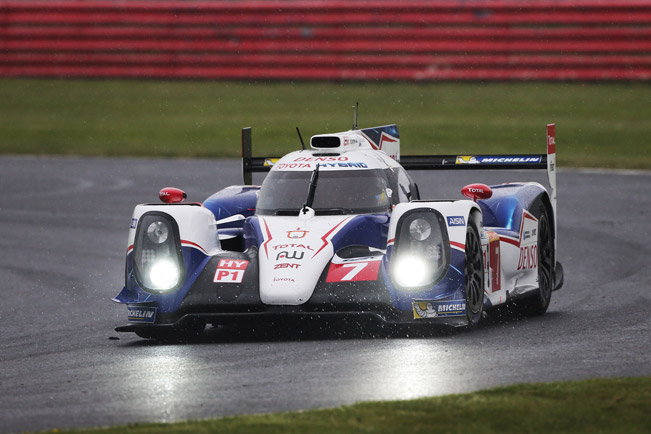
    In fact, as a current World Champions in the World Endurance Championship, Toyota Gazoo Racing has a big chances for success with the two TS040 Hybrid machines. The piloting team includes the British talent Anthony Davidson, the current joint World Champion and Briton Mike Conway

    https://www.youtube.com/watch?v=mBv87T_JFB8

    Toyota’s 30 years at Le Mans
    (Chassis name in brackets)

    • “1985    No36 (85C-L): qualifying 29th; Race 12th. No 38 (85C-L): qualifying 22nd; race DNF (mechanical).
    • 1986    No36 (86C-L): qualifying 40th; race DNF (mechanical). No38 (86C-L): qualifying 30th; race 20th.
    • 1987    No36 (87C-L): qualifying 14th; race DNF (mechanical). No37 (87C-L): qualifying 16th; race DNF (mechanical).
    • 1988    No36 (88C): qualifying 8th; race 12th. No37 (88C): qualifying 10th; race 24th.
    • 1989    No36 (89C-V): qualifying 24th; race DNF (mechanical). No37 (89C-V): qualifying 17th; race DNF (accident). No38 (88C): qualifying 25th; race DNF (accident).
    • 1990    No36 (90C-V): qualifying 10th; race 6th. No37 (90C-V): qualifying 14th; race DNF (accident). No38 (90C-V): qualifying 16th; race DNF (mechanical).
    • 1992    No7 (TS010): qualifying 3rd; race DNF (mechanical). No8 (TS010): qualifying 4th; race 8th. No33 (TS010): qualifying 5th; race 2nd. No34 (92C-V): qualifying 11th; race 9th. No35 (92C-V): qualifying 15th; race 5th.
    • 1993    No22 (93C-V): qualifying 10th; race 5th. No25 (93C-V); qualifying 12th; race 6th. No36 (TS010): qualifying 2nd; race 4th. No37 (TS010): qualifying 5th; race DNF (mechanical). No38 (TS010): qualifying 4th; race 8th.
    • 1994    No 1 (94 C-V): qualifying 4th; race 2nd. No4 (94 C-V): qualifying 8th; race 4th.
    • 1995    No27 (Supra LM): qualifying 30th; race 14th.
    • 1996    No57 (Supra LM): qualifying 36th; race DNF (accident).
    • 1998    No27 (TS020): qualifying 8th; race 9th. No28 (TS020): qualifying 2nd; race DNF (accident). No29 (TS020): qualifying 7th; race DNF (mechanical).
    • 1999    No1 (TS020): qualifying 1st; race DNF (accident). No2 (TS020): qualifying 2nd; race DNF (accident). No3 (TS020): qualifying 8th; race 2nd.
    • 2012    No7 (TS030 HYBRID): qualifying 5th; race DNF (mechanical). No8 (TS030 HYBRID): qualifying: 3rd; race DNF (accident).
    • 2013    No7 (TS030 HYBRID): qualifying 5th; race 4th. No8: qualifying (TS030 HYBRID): 4th; race 2nd.
    • 2014    No7 (TS040 HYBRID): qualifying 1st; race DNF (mechanical). No8 (TS040 HYBRID): qualifying: 3rd; race 3rd.”

    Source: Toyota

  • Toyota Racing to Defend Two World Titles at FIA World Endurance Championship

     Toyota TS040 Hybrid Under Wraps As you know, Toyota became the first Japanese company to claim the WEC championship last year. The successful season witnessed the share of the first place by two high-performance drivers Sébastien Buemi and Anthony Davidson. The champion winning car, TS040 Hybrid proved to be the hero of the day: the machine, in full harmony with the drivers, has won 5 out of 8 races.

    The Hybrid has been modified and improved for 2015 with redesigned suspension, optimized tyre wear, changed front design for even better aerodynamics and some weight-loss modifications. The art of consuming energy and saving is not unknown territory for the crew, that built the beast. They do know, that in modern age energy and performance efficiency is key feature to have in mind.

    The car itself comes with two packages for 2015 that have already been tested in France. The first package, so called “The Le Mans” is better suited and used for the well-known 24-hour race, while the second one, called “Spring” is specially built to bring high level of downforce.

    As said, the efficiency is well calculated by numerous tests and experiments, that started already on 13 January. The different tracks for experiment really let the team show their best, not only on the test road, but on the championship.

    Team members Davidson and Buemi will share one car. Davidson himself says, that he looks forward to winning the big race at Les Mans in June. He knows what real competiton and competitors mean and he confidently prepares for the race. We wish him luck and alot of occasions for celebrating.

    Source: Toyota

  • Toyota Makes Next Steps In Hybrid Power

    TS040-Hybrid-THUMBToyota is undertaking significant developments in the laboratory and on the race track. The aim – to make next steps in the evolution of hybrid power, which will be utilized in hybrid vehicles such as Prius and Camry. The company is targeting improvements in performance and fuel efficiency. The first step has been already made with the announcement of new generation of computer chips that have the potential to boost the fuel efficiency by 10 per cent. At the same time they also significantly reduce the size of the crucial power control unit (PCU).

    Toyota Racing division which is positioned in Germany focuses on practicing the hybrid know-how. This is made via its participation in the World Endurance Championship (WEC) sports-car racing, and will also be implemented in next month’s Le Mans 24-hour classic.

    The hybrid technology of the all-wheel-drive TS040 Hybrid race car, harvests more braking energy that can be stored and utilized under acceleration. This of course results in additional power boost. If we compare the new hybrid with last year’s race car, the maximum power of the TS040 Hybrid has been improved more than 18 per cent. In addition, the fuel consumption has been cut by 25 per cent.

    TS040 Hybrid made two victories in the two WEC races held this year. This also serves as a real-life test bench for Toyota’s latest hybrid concepts. The knowledge gained from the motorsport program and Toyota’s on-going research and development has already been utilized to enhance the company’s hybrid road cars. Since the launch of the first Prius in 1997, more than six million cars were sold around the globe.

    The latest laboratory achievement of Toyota’s includes new silicon carbide computer chips (power semi-conductors) that are more efficient than today’s chips made from silicon alone. They were designed to be used in the PCU of hybrid vehicles, thus enabling the company to improve fuel efficiency by up to 10 per cent while also reducing PCU size by up to 80 per cent.

    Precisely, the silicon carbide chips will undergo on-road testing in Japan within a year. They reduce the amount of current lost as heat, and switch the current flow on and off more efficiently. The result is the reduced size of the coil and capacitor, which account for approximately 40 per cent of the size of the PCU.

    PCU in hybrid vehicles delivers electric power from the battery to the motor in order to control vehicle’s speed. It also sends electricity generated through deceleration to the battery for storage. Nearly 20 per cent of the total power loss in hybrid vehicles is associated with the power semiconductors alone. This shows a need for an improvement of the semi-conductor in order to improve efficiency.

    Source: Toyota