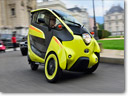
Tag: Toyota i-Road

  • Toyota i-ROAD Will Receive More Improvements

    2016 Toyota i-ROADToyota’s bold and futuristic i-ROAD short-range urban electric vehicle undergoes additional series of trials. The sweet three-wheeler will join the Open Road project that has been already running in Japan since July, as the single-seat model was unveiled.

    The i-ROAD model with the ability to carry more than one passenger is an idea that has already began its development. In fact, the nimble sweetie plays central role in a three-year connected public transport scheme in France. And with the certification from the Japanese government, the tests now can go to their further phase.

    SEE ALSO: Toyota Sets the Blackline with a Special 86 Edition

    The Japanese versions of the i-ROAD will be tested for a month and will be used to carry two people that have different purposes and goals. Furthermore, Toyota will deliver comprehensive feedback and data from the tests and will talk about for all the requirements and changes that need to be done.

    Now the i-ROAD is here with improvements and modifications some of which are changed reflextors and width indicators. The vehicles are also geared with advanced “approaching vehicle” audible warning. Cool.

    2016 Toyota i-ROAD

    The local authority in Shibuya, Tokyo, has also expressed interest in the vehicle and will also conduct further trials with Toyota team to look at the possibilities of using the i-ROAD for different community-based program. At the same time, in Silicon Valley in USA, the Toyota Onramp 2015 conference asked a team of innovators to come up with ideas for how i-ROAD could expand its influence in everyday use and in the whole Smart Mobility Challenge.

    Source: Toyota


  • 2015 i-Road Has Finally Reached Texas!

    North Texas residents met the i-Road, the three-wheeled electric vehicle and COMS, the compact electric vehicle last weekend at American Airlines in Dallas. All the people, who participated in the event spent some time answering questions and reviewing different technological trends and told the audience about the ultra-compact vehicles and the ways they will make our lives easier.

    Furthermore, there are numerous focus groups in Silicon Valley, California in February 2015, that received some positive feedback from numerous participants. In fact, there was also a guy, who presented a credit card and immediately purchased an i-Road vehicle. But the bad news is that he must wait a bit longer to receive it.

    In fact, the i-Road demonstration projects have already begun in France and Japan and the teams are working hard to test the vehicles in different city situations. For example, in Grenoble, France and Toyota City, Japan the demonstration units are positioned in car sharing applications, while the i-Roads in Tokyo, Japan come with an option to be loaned to individual customers. They will start taking orders next month.  On the other hand, COMS vehicles have already begun sales in Japan.

    There are no some specific plans and formulas for the US audience. All we know is, that the i-Road demonstration programs will be launhed in the near future. So, stay in tune and don’t forget to try out the vehicles of the future!

    Source: Toyota

  • Toyota i-Road Brings Zero-Emissions Motoring to Europe

    Toyota-i-Road-THUMBToyota i-ROAD is ready to transfer its credentials of being a purely concept vehicle to being one engaged in the real life. It is currently bringing the zero-emissions motoring to Europe’s crowded city centres. A fleet of its i-ROAD and COMS ultra-compact electric vehicles are set to prove how clean and easy urban motoring can be. The first city in which these three- and four-wheelers will appear by taking part in a major pilot programme, is the French city of Grenoble.

    The project, in which Toyota is taking participation, is a three-year low-carbon car sharing scheme, which is aims to transform the way people plan and make local journeys.  The company will supply 35 of each type of vehicle, thus contributing its harmonious mobility (Ha:Mo) system to manage the scheme day-to-day.

    Of course, the local authorities in Grenoble have also supported the project. Precisely, the French power supplier EDF manages and maintains electric charging points as well as the well-established local car-share operator Cité lib.

    From the beginning of next month, anyone who holds a valid driving licence can register with Cite Lib to gain access to the Toyota electric vehicles. The users have the opportunity to subscribe to the service and download an application on their devices to see the real-time location of vehicles that are charged and ready to use.

    After that, he or she will be able to pick up their car and drop it off at a different location: exactly one of 27 charging stations in the greater Grenoble area. Of course, when the vehicle is dropped off, it is plugged into the station, thus being recharged and ready for the next customer.

    This exclusive and innovative programme is a way of building a better-integrated public transport service. For instance, people can collect an electric vehicle from a location near their home or office and then drive to a local transport hub to continue their journey. At the same time, those who are arriving by bus or train can step into a car on arrival to complete their trip. The network of charging stations is connected to Grenoble’s transport network IT system, so the journey planning is even made easier.

    Toyota i-ROAD utilizes clever Active Lean technology, which steers in a similar way to the movements of a skier (take a look at the pictures in the gallery below). The vehicle is not much larger than a motorbike or scooter. However, it is equipped with a full canopy that protects the driver and gives them a secure feeling and comfort of a car.
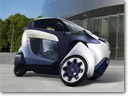
    At last, Toyota confirmed future plans for the program. The company will collect data on technical issues and user behaviour during the pilot the programme, thus helping shape future mobility initiatives.

    Source: Toyota

  • Toyota To Make Five Global Debuts At Tokyo Motor Show

    Toyota-FT86-Open-Concept-THUMBToyota is going to make five world-premieres of concept vehicles at this year’s Tokyo Motor Show, which will start on 20th of November in the Japanese city. All of the concepts were created under the slogan “Fun to Drive, Again” which conveys brand’s vision of a future mobility society that values the joy of driving.

    The concepts on display at the event are: Toyota FCV (Fuel Cell Vehicle) Concept, Toyota FV2 (Fun Vehicle 2), Toyota JPN Taxi Concept, Toyota Voxy Concept and Noah Concept, Toyota Aqua G Sports Compact Sports Hybrid, Toyota i-Road and at last but not least – Toyota FT-86 Open Concept.
    The first global debut is for Toyota FCV which is a practical concept of the fuel cell vehicle Toyota plans to launch around 2015. It is powered by hydrogen and has a driving range of at least 500 km and refueling times as low as three minutes.

    The vehicle’s exterior design is inspired by the transformation of air into water as the system produces electricity, as well as the powerful acceleration enabled by the electric drive motor. The bold front view includes pronounced air intakes.

    The car also has sleek sides that convey the air-to-water transformation with its flowing-liquid door profile and wave-motif fuel cap. The same theme is used for the creation of the rear, which conveys a catamaran’s stern and the flow of water behind.

    The vehicle can perfectly accommodate four persons thanks to the special design body beneath which are positioned the light-weight FC Stack and two 70 MPa high-pressure hydrogen tanks.
    The Toyota FC Stack has a power output density of 3 kW/L as well as an output of at least 136 hp (100 kW). The FC system is equipped with Toyota’s high-efficiency boost converter.
    Toyota FCV Concept Dimensions:

    Length(mm) Width (mm) Height (mm) Wheelbase (mm) Occupancy
    4,870 1,810 1,535 2,780 4


    The next world premiere is for Toyota FV2 which is a very special concept car that shows the brand’s vision for the future. It is interesting that this concept does not use a steering wheel, but operates by the driver shifting their body to intuitively move the vehicle forward and back, left and right.

    Furthermore, by the utilization of intelligent transport system technology to connect with other vehicles in the area and traffic infrastructure, Toyota FV2 provides the perfect safety driving. In such cases it signals with various advanced warnings about vehicles in blind spots at intersections.

    What is even more spectacular here is that Toyota envisions an ever-developing driver-vehicle relationship. This will happen via the incorporation of “Toyota Heart Project”. To be more precise, the vehicle uses voice and image recognition to determine the driver’s mood, accumulated driving history to suggest destinations, and driving skill information. In addition to an augmented reality (AR) display on the windshield, the body color and exterior display can be changed at will.

    Toyota FV2 Dimensions:

    Length(mm) Width(mm) Height(mm) Wheelbase(mm) Occupancy
    3,000 1,600 990 (sleep mode) 2,360 1
    1,780 (driving mode)


    The third concept vehicle is Toyota’s vision for a new Taxi: the JPN Taxi Concept. You can follow the highlighted link and read about it in details.
    Toyota JPN Taxi Concept Dimensions:

    Length(mm) Width(mm) Height(mm) Wheelbase(mm) Occupancy
    4,350 1,695 1,700 2,750 5


    The next premieres are for the Toyota Voxy Concept and Noah Concept which are the next-generation spacious minivans that offer a roomy interior needed demanded by families. To the vehicles has been added low-floor package which creates a class-leading roomy interior with outstanding ease of ingress and egress.

    Furthermore, these Toyota concepts are seven-seaters that include ultra-long sliding Captain Seats in the second row, providing a diverse range of seating arrangements. They are equipped with a 2.0-liter gasoline engine variant and a 1.8-liter hybrid variant with a full hybrid system.
    The front end of the Noah Concept is sophisticated while the Voxy Concept employs exclusive aerodynamic parts to emphasize the low center of gravity, impressive wide-body, and the overwhelming sense of presence. Market versions of the vehicles are planned for launch in the Japanese market in early 2014.
    Toyota Voxy Concept and Noah Concept Dimensions:

    Vehicle Length (mm) Width(mm) Height (mm) Wheelbase (mm) Occupancy
    Voxy Concept (as pictured) 4,710 1,730 1,825 2,850 7
    Noah Concept (as pictured) 4,695 1,695 1,825 2,850 7

    The fifth model in the line of concept vehicles is Aqua G Sports which has a powerful, sleek and inspiring design and excellent fuel efficiency. Moreover, the car has been fully tuned by GAZOO Racing and its market version will be launched in the Japanese market in late November.

    Toyota Aqua G Sports Dimensions:

    Length(mm) Width(mm) Height(mm) Wheelbase (mm) Occupancy
    4,055 1,695 1,420 2,550 5


    Toyota i-Road Concept is not an unfamiliar vehicle, because it made its debut at the Geneva Motor Show. Now, this ultra-compact mobility car is ready to conquer Japan.

    Toyota i-Road Dimensions:

    Length(mm) Width(mm) Height(mm) Wheelbase(mm) Occupancy
    2,350 850 1,445 1,700 2


    At last, Toyota FT-86 Open Concept is based on the rear-wheel-drive 86 sports car. It includes an electrically operated soft top, as well as a new “Flash Red” body color, which was used specifically for the Tokyo Motor Show.

    FT-86 Open Concept Dimensions:

    Length(mm) Width(mm) Height(mm) Wheelbase(mm) Occupancy
    4,240 1,775 1,270 2,570 4

    Source: Toyota

  • Toyota i-Road Concept With World Premiere In Geneva

    Toyota-i-Road-Concept-THUMBToyota i-Road Concept is a personal mobility vehicle (PMV) which is making a world debut at the Geneva Motor Show. It aims to bring more flexibility in the urban environment, efficiency and fewer emissions.

    i-Road is an electric vehicle with a range of up to 30 miles (50km) on a single charge. It utilizes “Active Lean” technology, and offers intuitive and enjoyable driving with no need for driver or passenger to wear a helmet.

    With this PMV, Toyota is paving the way for several types of eco vehicles which are to emerge in the near future, and will adapt brand’s Hybrid Synergy Drive technology. The latter is used in plug-in hybrid electric vehicles (PHEVs), electric vehicles (EVs) and fuel cell vehicles (FCVs).

    In fact, people who are using PMVs will be delighted with this model because it is more comfortable, offers better weather protection and is safer than a two-wheel vehicle. In addition, the i-Road has low running costs, easy parking and around-town manoeuvrability.

    The three-wheel i-Road is 2,350mm long and 1,445mm high and has a 1,700mm wheelbase. What is more surprisingly however is its width which is only 850mm. First of all this signifies that the vehicle isn’t wider than a conventional two-wheeler and secondly this makes it easier for manoeuvring through congested traffic. Additionally, it also means four can be parked in a single parking bay.

    Furthermore, this Toyota model has zero-emissions, thanks to its all-electric powertrain which utilizes a lithium-ion battery to power two 2kW motors mounted in the front wheels, giving brisk acceleration and near-silent running. The driving range here is around 30 miles, after which the battery can be fully recharged from a conventional domestic power supply in only three hours.

    The highlight here is the company’s new and entirely intuitive Active Lean technology. It brings to the vehicle high levels of stability, safety, comfort and fun-to-drive character. In particular, the system uses a lean actuator and gearing mounted above the front suspension member, linked via a yoke to the left and right front wheels.

    What is more, an ECU calculates the required degree of lean based on steering angle, gyro-sensor and vehicle speed information, with the system automatically moving the wheels up and down in opposite directions, applying lean angle to counteract the centrifugal force of cornering.

    The same system also manages when the PMV is being driven in a straight line over stepped surfaces. What happens is that the actuator automatically compensates the changes in the road to keep the body level. Here the minimum turning circle is measured at three meters.

    In addition, the i-Road can be equipped with a safer, weatherproof, closed body and so can be driven without wearing a helmet. Of course, this means that the driving experience is more car-like and this is reinforced by features such as lighting, heating, audio and Bluetooth.

    Toyota i-ROAD Concept has the goal and the beautiful vision for the future to play a significant role in reducing city traffic congestion and air pollution. Additionally, its compact size, manoeuvrability, easy parking, rapid charging and choice of an open or closed cabin make it the perfect urban vehicle, without compromising individual freedom of mobility.

    Source: Toyota