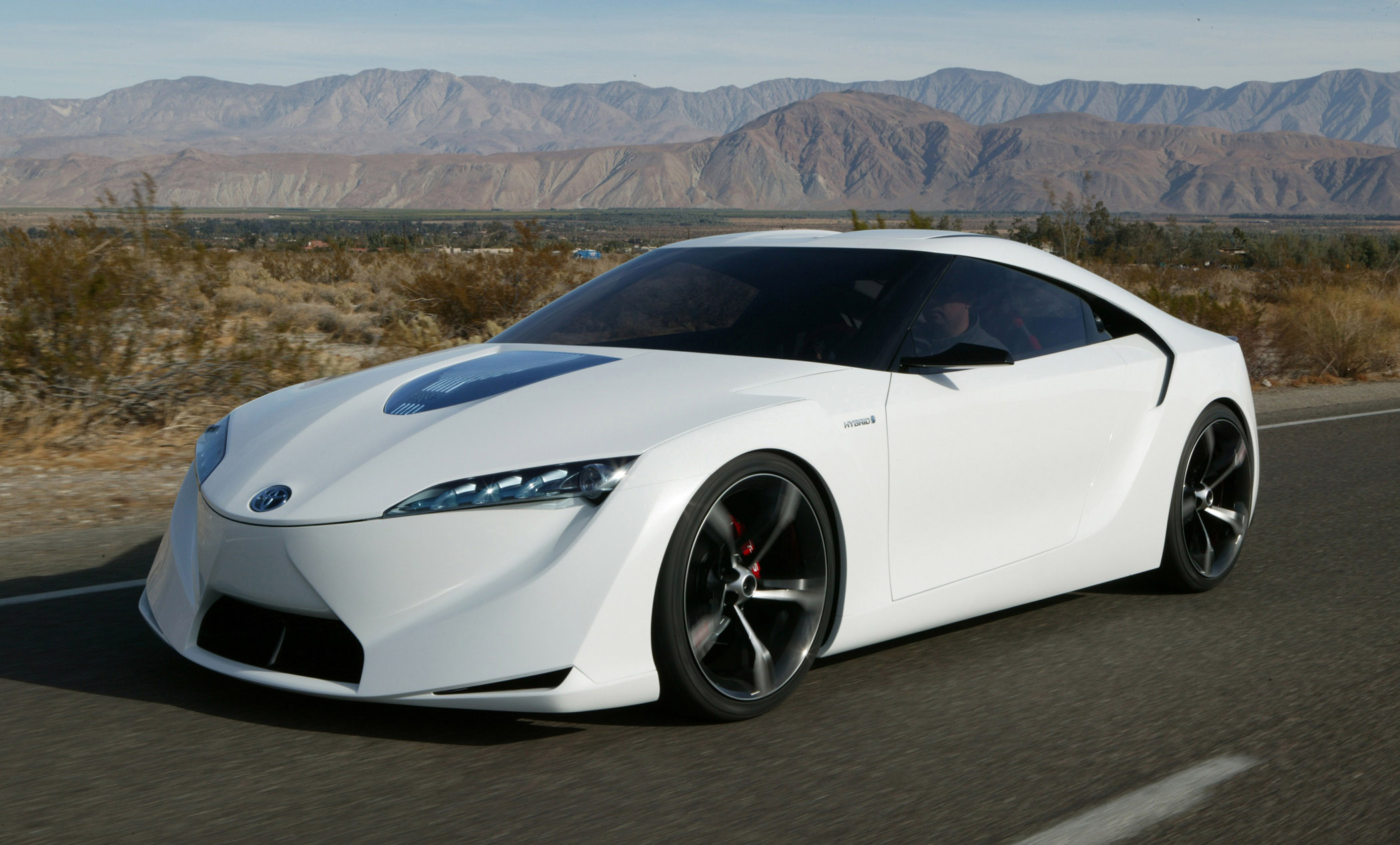
Tag: Toyota FT-HS Concept

  • Best looking 6 concepts that never reached the market

    Best looking 6 concepts thumbAs you know what you driving is a result of serious R&D, drafts and arguments. For many reasons your car was(is) available in the showroom. However there are many examples of cars that did not manage to go further than the draft or clay. Here are the best looking 6 concepts that never reached the market.

    Number 6

    Toyota FT-HS Concept

    This beauty was introduced in 2007 in North America. It was quite up to date with the current tendencies, so speed and power were not the only thing the car was focusing on. Safety and ecology have definitely been taken into consideration. That’s why the idea of the car is to have a hybrid powertrain. Despite this the car would still remain light and a great fun to drive.  Being a fast RWD car it takes Toyota back to the golden years of the AE86 Corolla and would definitely be a total hit both for teenagers and grown-up boys that once dreamed of having AE86 Corolla.


    Number 5

    Nissan Intima

    Nissan’s luxurious sedan concept was seen for the first time in 2007. Two things came into sight right away. First of all the rear doors were to be opened towards the back of the car instead of the conventional opening – parallel to the front door. Also the windshield would go all the way to the back of the roof creating incredible atmosphere for the passengers. Surprisingly for Nissan, the Intima is constructed to have an efficient, environmental friendly 6 cylinder diesel engine. Last but not least , the Intima is equipped with a 4-zone air conditioning system that would make sure all of the passengers feel comfortable.


    Number 4

    Honda Accord Coupe Concept

    In the beginning of 2007 Honda showed this coupe in Detroit and this was for a reason – Accord is the best-selling Honda in USA. The accent when presenting the car was the fuel economy and safety features. In terms of design, the Accord coupe looks aggressive due to the long hood and the headlamps that go deep behind to reach almost the middle of the fenders. The four exhaust pipes in the back promise to also touch the heart of the driver giving out the 6 cylinder engine at the touch of the throttle.


    Number 3

    BMW Concept CS

    This Gran Turismo masterpiece was first to be seen in Shanghai and it did look stunning. A 4-door coupe with sleek curves and very low profile. Definitely something Mercedes need to be careful with when developing the CSL. Looking at the car you almost feel Bangle’s shade in it. The return to the “shark shape” is obvious, magical and… I love it! Is this going to be the positioned above the 7th series and benefit from the 6.0 V12.


    Number 2

    Mazda Nagare

    This car definitely deserves its place here. It is undoubtedly something unique that cannot be seen every day. The name of the car means “Flow” and indeed even when standing still it looks like it’s moving. The “doors” are a flashback to the Mercedes Gull-wing – they open not sideways but from the roof and give an overview to the whole interior. The Recaro seats and the plane-like steering wheel finish the sporty feeling of the car. Despite the fact no details have been disclosed about engine or specifications, the Nagare is expected to use a rotary engine well known for it’s high revs and great response.


    Number 1

    Audi RSQ concept

    This car has been designed and created especially for the movie “I robot”, where Will Smith would use it to fight some “evil machines”. Indeed, it shares a lot with the TT, but it is so much different at the same time. The door are hinging back to open up like the wings of a butterfly. It is also mid-engined which is great prerequisite for it to be a pleasure to drive. Now the sweetest part – as this was Audi’s vision for the future, it definitely needed something indeed futuristic, and there it was, the wheels are… spheres and as you can figure, the side panels are shaped accordingly to make the car more and more resemble a sculpture. The interior of the car is really close to a plane cockpit. The steering wheel, the instrument cluster, all this aluminium and a windshield to go over the driver’s head create intoxicating atmosphere once you sit in the bucket seat. How likely is this car to show on the streets? Not really huge  it seems. However a lot of it could be used for the Audi TT.

  • Toyota FT-HS Concept

    Toyota FT-HS Concept 2007 - Side Angle
    The Toyota FT-HS hybrid sports concept will make its debut at the 2007 North American International Auto Show. Pairing a potent hybrid powertrain with essential sports car fundamentals, the FT-HS concept was a joint undertaking of Calty, Toyota’s North American-based, research and design center located in Newport Beach, Calif., and Toyota’s California-based Advanced Product Strategy Group. The design team was assigned the task of creating a mid-priced sports car that integrates ecology and emotion in a concept that addresses the question “What is a suitable sports car for the 21st Century?” “Drivers today are not satisfied with cars that are simply fast,” said Kevin Hunter, vice president, Calty Design Research. “In addition to driving enjoyment, today’s drivers are concerned about safety, ecology and social responsibility.”

    The FT-HS incorporates hybrid capability while maintaining sports car essentials, such as a sleek profile, lightweight aero-dynamic materials, and an advanced high-output powertrain for revolutionary acceleration and optimal performance. This 21st century sports car is fun-to-drive with eco-friendly benefits such as ultra-low emissions and fuel efficiency. The FT-HS appeals to an emerging buyer who grew up eco-conscious and perceives technology as a necessity, not a luxury.

    This two-plus-two concept is a front-engine, rear-drive sports car with a projected zero-to-60 acceleration in the four-second range. A powerful V6, 3.5L-engine is coupled with a 21st century sports hybrid system with a target power output of approximately 400-horsepower. At a mid-priced market position, FT-HS would be a true “attainable exotic” with 21st Century performance.

    FT-HS expresses the core values of a Toyota Brand design strategy that combines two key elements: J-Factor and Vibrant Clarity. J-Factor refers to the local and global acceptance of Japanese-inspired design and cultural sensibilities. Vibrant Clarity is the design language used to express the J-factor much in the same way that L-Finesse is the language of the Lexus Division. It is the combination of perfect imbalance, freeform geometrics and integrated component architecture. The result of these three elements is subtractive mass, a minimalist style that is not only lightweight, but also looks lightweight.

    The exterior design was led by Calty designer, Alex Shen. From a design perspective, the theme of the FT-HS achieves sleek, taut surfaces in its exterior features – especially in the doors and body style. The front and rear have been sculpted to remove mass around key functional components. Freeform geometrics define the integration of fluid surfaces contrasting hard-edge “Aero-Corners” which promote smooth airflow and reduce turbulence.

    The roof has a distinctive scooped-out section designed to reduce aerodynamic drag and provide head room at the key areas. Made from carbon fiber Kevlar, the roof retracts so that the roof panel and back window pivot fluidly in a downward motion to stow in the rear seat space.

    The vehicle’s triangular profile has a floating “C” pillar, aero corners, a full upper-body pan, and innovative open top. A hood features a scalloped channel, exposing the hybrid engine. Integrated component architecture can be seen in the aerospace-inspired lighting. The tail lamp unit spans the entire rear, and has an integrated retractable spoiler. Light-emitting diode (LED) clusters are located in the headlamps and the wing for energy-efficiency and decreased heat loss. Other exterior features include a speed-activated wing that elevates at high speed for additional stability and traction. The rear showcases a carbon fiber lower diffuser with integrated wide exhaust and carbon fiber wheels.

    The driver-oriented interior was created by Calty designer, William Chergosky and exudes sleekness, technology, and performance. The lean skeletal look is achieved with exposed cross-car architecture and high-tech materials such as carbon fiber, and titanium. FT-HS’ interior features create a dedicated driver’s cockpit which include subtractive mass expressions such as cross-car instrument panel structure and delta wing driver pod. The delta-wing driver’s pod integrates many useful functions into a lightweight structural unit. All of the important functions and details are presented almost exclusively to the driver. For example, touch-trace sensors which surround the driver and act as tactile guides for finger controls when traveling at high speeds.

    By eliminating the “B” pillar and creating a suspended “C” pillar, the minimalist style works in conjunction with subtractive mass. An integrated instrument panel surrounds the driver, creating an enclosed pod effect. Armrests flow seamlessly into the door and surrounding interior.

    Seating is optimized for a lightweight appearance and function: the seating accommodates four and then coverts to a two-seater when the roof retracts. The passenger-seat area is open with a simple exposed airbag on the cross-car beam.

    A telescoping hub-less steering wheel incorporates semi-automatic paddle shifters and allows the meter to be shifted forward in order to shorten the driver’s focus-time between the road and meter, and ultimately enhance driver focus.

    “FT-HS redefines the sports car experience not only with styling but also in function and performance,” said Hunter. “The FT-HS is Toyota’s answer to the question ‘What is a suitable sports car for the 21st Century?’”