2016 Geneva International Motor Show ( from 1st to 13th of March) will see many long-anticipated models and concept vehicles by Toyota as the long-awaited C-HR Concept, the fresh Proace Verso and new Hilux. All the models will be show during brand’s on-stand press conference in Hall 4 at 11:45 on March, 1st.
C-HR Concept
This one will give fresh and new presence to the whole C-segment with the stylish cabin with five doors, bold exterior looks and of course contemporary high-performance stats and capabilities. Hopefully this vehicle will be that good in reality, as it is by far on words.
Proace Verso
The spacious large-size MPV that can carry up to nine people and available in many body lengths will demonstrate new and advanced safety and utility features, enhanced driving capabilities and of course, that impeccable Toyota feel and quality. Just like C-HR Concept, this one is expected to expand the range in terms of possibilities and versatility.
Last, but not least, the new Hilux will make its European debut at the Geneva show and will show new and stronger ladder-frame chassis, advanced and more efficient 2.4-liter D-4D power unit and of course, tons of new gadgets and systems.
As always, we do expect the best from Toyota team and by far it looks like we will get it. So, what do you think will happen on the show? Which brand is expected to show the best vehicles and new technologies? And which one would disappoint? Stick with us for further information!
Toyota will showcase its latest and greatest concept vehicles and technologies at the International Consumer Electronics Show and visitors will have the unique chance to witness what Toyota plans for the not-so-distant future. Toyota’s exhibit will be located in the North Hall of the Las Vegas Convention Center and the team will make some big announcements.
So, what will be shown at the event? Let’s check out!
TOYOTA Smart Center
First of all, audience will witness the advanced Toyota Smart Center system that connects people, vehicles and technology units. It is powerful and capable system that collects valuable data, analyzes information from countless vehicles around the world and provides customers with special services.
Agent+
This is a next-gen connectivity service system that leverages numerous factors such as day, time, location and driving history only to predict the time of travel and aid the driver as his journey on the road begins.
The project that took Toyota more than 20 years to finish offers incredible approach towards automated driving: the system can build a sort of real relationship between people and vehicles in order to create the perfect ride for them. How cool is that?
Toyota FCV Plus Concept
This vehicle shows Toyota’s vision to the future with connected and sustainable hydrogen society. The concept demonstrates the potential fuel cell technology beyond just the car industry and also shows how we could gather electricity directly from hydrogen outside the vehicle. Incredible.
Translated as “machine”, the sweetie brings that unmistakable steampunk style and offers tons of beauty and exclusivity. Definitely one of the most interesting vehicles for 2015 this machine deserves its place among the other vehicles at the show.
Toyota has unveiled the sweet Noah G’s and VoxyG’s concept vehicles. The “souped-up minivans” proudly demonstrate straight and clean lines, aggressive stance and overall distinctive appearance. Surely, the additional body kit additions further contribute to that contemporary design with the mesh grille details, red brake calipers and alloy wheels. And with the ventilated hood, carbon-fiber plastic canards and big rear wing these sweeties do stand out from the crowd.
Definitely an interesting decision, provided that this is a minivan with sporty spirit and aggressive appearance. But this doesn’t mean that the sporty vans do suffer from lack of comfort. Toyota team claims just the opposite: in their words these two sweeties offer comfortable and refined ride. We all wonder if this is fully correct.
As we talk about the ride, we should also see what is under the bonnet. Both vehicles are geared with a 2.0-liter four-cylinder petrol power unit that provides a total of 150hp (112kW) of power output and 193Nm of torque. There is also a exclusive hybrid model that offers the aid of a 1.8-liter unit that produces 97hp (73kW) and 142Nm of torque.
So what do we have at the end? Distinctive and pleasantly looking minivans with some sporty character and massive stance. Surely Toyota knows how it’s done.
Toyota S-FR Made its global premiere at the Tokyo Motor Show in October and demonstrated old, but proved itself approach: functionality and superiority via simplicity. Along with its incredible capabilities, there will be numerous additions made thanks to GAZOO Racing team that plans to redesign the concept as a track-ready race vehicle. The final masterpiece will be demonstrated at the Tokyo Auto Salon 2016, running from January 15 through 17.
Toyota S-FR Racing Concept
This sweetie demonstrates wide flared fenders, neat hood vents and numerous carbon-fiber components. In fact, the model shown at the Tokyo Motor Show had that simple and recognizable appearance, but the S-FR Racing Concept comes with more aggressive and dynamic design.
Along with the S-FR Racing Concept, Toyota will display vehicles that participated in the 24 Hours Nürburgring endurance race since 2007 and some vehicles that took part in the FIA World Endurance Championship and the All-Japan Rally Championship in 2015.
In fact, Toyota recognizes Tokyo Auto Salon as a place where the brand can promote its latest vehicles, engage with fans and professionals and exchange ideas. This event will be held at Makuhari Messe, Chiba and will be followed by the public days on January 16 and 17.
The ever-seeking for perfection Toyota team recently renewed its passion and sense of beauty and technology with the numerous new stock and concept vehicles released. And when it comes to unique conceptual rides, Toyota is second to none. At the 2015 Tokyo Motor Show, the well-known manufacturer demonstrated some of its most notable vehicles. Among them was the S-FR sport concept and the next-gen Prius Hybrid: both machines demonstrate passion for beauty and versatility.
Other unique vehicle that made its global debut is the Kikai Concept, also known as the missing link between human and machine. This is also a vehicle that impresses with its advanced fuel cell technology, efficiency and driver-oriented technology.
The Tokyo audience also saw the special Land Cruiser 70 Series that takes part in the well-known 20,000km ride around Australia that involved both engineers and other employees.
Definitely motivated to bring us more and more powerful, contemporary and even futuristic vehicles Toyota team stays true to its nature of one of the best and most reliable vehicle manufacturers in the world. And with the recent demonstrations, along with the Tokyo Motor Show the well-known team strengthened its positions even more.
But we all still wonder: are these sweeties really that functional, or are just they only a part of a sci-fi movie?
Toyota S-FR is a special concept automobile which continues the heritage of brand’s comfort and flexible sports vehicles. Pitched as an entry-level model, this sweetie accents on responsiveness, dynamics and aims to make as much people as possible to fall in love with it. But will it succeed?
This concept comes with incredibly fit and light body and at the same time offers smooth and pleasurable ride. Although it is created as a sports vehicle, it also brings simple controls and generally bonds human and machine in a special way.
Pleasure of driving
The special vehicle also offers and numerous benefits: lightweight, smooth and responsive drivetrain system and accurate handling. Engineers made their best to bring optimal weight distribution and in addition the independent suspension feels like it is doing its job in perfect way. Also, the vehicle is geared with a six-speed manual gearbox which improves acceleration and responsiveness. Definitely Toyota team decided to accent on the communication between car and driver. And it looks like they have done their job pretty well, indeed.
Fresh design
S-FR demonstrate a long nose and wide muscular stance. But at the same time, it also has these sweet round lines that somehow give off warmness. And just these sweet lines contribute to a modern looks and sporty feeling. Sweet.
Definitely this is a vehicle that would make all the Toyota lovers out there fall in love with it.
Science says that compressed hydrogen has a higher energy density than electricity and can be generated from extended range of materials. Materials that are easy to store and easy to use. Clean generation of hydrogen from numerous primary energy sources will definitely make local and self-sufficient power generation reality and the fuel cell vehicles will eventually take the main role of rides with their inner sources of energy. And that’s why Toyota team decided to try out something different and something new. And it will incorporate this knowledge with its latest concept vehicle.
How is electricity generated?
Along with vehicle’s hydrogen tank, it will also generate electricity directly from hydrogen that is stored outside the concept. In fact, this sweetie can be further transformed into a versatile source of electric power for use at home or everywhere else. Cool, right?
Furthermore, the car’s fuel cell stack can be even reused as an electricity generator that powers up the usual functions and systems of the concept. And it gets even better when you understand that automobiles like this particular sweetie can contribute to local communities. It gets cooler, right?
The fuel cell unit is mounted between the front tires and the hydrogen tank just behind the rear seat. And together with the adoption of independent in-wheel motors in all the four wheels the whole elaborate system allows the driver to relish his smooth drive in spacious cabin. Yes, despite the overall compact size of the vehicle. And of course, this next-gen machine will offer incredible weight balance and flexibility.
On the other hand, the exterior adopts the idea of modern accents, blended with distinctive and sleek shape. Furthermore, all the frame structures ensure rigidity and safe ride. Definitely the design demonstrates how a vehicle can be technologically advanced, comfort and have incredible environmental performance at the same time.
Toyota C-HR Concept is a stylish and compact hybrid crossover that would be the core of soon-to-be-produced mass-market version. Now the five-door model is on display at the 2015 Frankfurt Motor Show.
The C-HR Concept was created to demonstrate new directions for the compact crossover segment in an increasingly homogenous marketplace and made its first appearance at the 2014 Paris Motor Show as a design study.
This vehicle is definitely distinctive with its looks, thanks to the diamond-inspired lines and the eye-catching details have been especially created and placed to represent the facetted surfaces of a precision-cut gemstone. The car is based on two main elements of Toyota’s design ideas: Keen Look and Under Priority. This means that the team went for bold and emphatic front profile, embracing the lower grille along with adding some better aerodynamic features, cooling and of course, safety measures.
And now the updated concept depicts the idea for a step forward to popularization with changes as going from three-door to a five-door formant. In addition, the roof color idea is also changed from a two-tone pattern to a sort of uniform with glossy black scheme.
Toyota C-HR Concept uses the Toyota New Global Architecture (TNGA) which is an intergrated development program for vehicle platforms and drivetrain components. TNGA will enable Toyota to create vehicles with further enhanced chassis rigidity, handling stability and of course, comfort. In fact, Toyota also aims for creating an engine with thermal efficiency of over 40% and improving the whole engine system with hybrid components.
The mass-produced vehicles are expected to be delivered in March 2016.
Three new concept vehicles have just been unveiled by Toyota on their stage at the 12th Beijing International Automotive Exhibition.
The first one comes in two variant- a compact sedan and hatchback, which carries proudly the name Toyota Dear Qin. This is a global-strategic vehicle which includes attractive design and offers exceptional style.
In particular, the word Qin means “dear” or “intimate”. In the name lies the aim of the brand to make this model cherished by many.
The Dear Qin concept versions have different front end. Although slightly different in appearance, they both share the same name. Maybe in the future we can expect development on the direction of the two design strategies, however under different name.
Toyota Dear Qin Concept Toyota Dear Qin Concept
The red version is standard four-door sedan which has a body design, very typical and familiar in China.
More importantly, both Dear Qin is said to be propelled by gasoline-electric hybrid engines.
The third world debut makes the second concept of Toyota, called Yundong Shuangqing. This is a China-only concept hybrid.
The model suggests “movement upon clouds” and its goal is to deliver innovation, dynamism and eco-friendliness to all customers of the brand.
In addition Shuangqing offers “dual support” and signifies the two power sources of the petrol-electric hybrid system.
The Toyota FT-Bh concept already did it’s premiere at the 82ndGeneva Motor Show but the talk is still on. Here’s a clip of Alain Uyttenhoven, Product Management Vice President of Toyota Europe, explaining the ideas behind this B segment thing of the future.
Apparantly, the FT-Bh started in life as a set of goals – make it compact…er, retain the Yaris-ness nevertheless, keep the CO2 emissions bellow 50g/km but somehow provide an entertaining ride and an agile performance. We’ll have to wait and see about that last bit. Oh, yes. There’s a hint that the FT-Bh is production ready.
What we find particularly interesting is that Mr. Uyttenhoven talks about five key concepts behind the FT-Bh. “Pillars” he calls them. Coincidentally (or is it?), the FT-Bh seems to have five structural Pillars that support the roof. He does get to explain only three of them – lightness (Standing at 785 kg, the concept weighs 25% less than the ongoing Yaris hybrid), slipperiness and smartness of the drivetrain works. Power will come from a 1.0-liter, 2-cylinder Atkinson cycle engine and a pack of Li-ion batteries that will charge an electric motor.
2012 Toyota FT-Bh Concept is making its debut at the 2012 Geneva Motor Show and will showcase its ultra-light body, weighing less than 800kg. This demonstrates what can be achieved in terms of fuel consumption and CO2 emissions in an affordable family supermini. Due to the exclusive low weight, the aerodynamic design and the highly efficient powertrain, the FT-Bh Concept can achieve average 134.5mpg fuel consumption and 49g/km CO2 emissions. Toyota’s aim was to achieve the best possible fuel economy and emissions. This was made through five key areas: reducing weight; driving resistance (including aerodynamic and tyre performance); powertrain efficiency; thermal energy management; and electricity savings.
Under the slogan “Ecomotion” went the work of the styling of the new FT-Bh, with its shape demonstrating a new approach to bodywork design. Key panels, such as the roof, are formed to represent the way fabric can be stretched taut between fastening points, to reflect their ultra-light weight. The front end of the car broadcasts Toyota’s current design philosophy. The ultra-slim A and C-pillars maximize the visibility and the sense of space in the cabin. The best possible aerodynamic performance and the drag coefficient of just 0.235, is possible thank to the uplifted rear bumper and chevron-shaped corner elements. The stretched fabric-look carries through to the minimalist interior, with a concave centre console creating a driver-focused cockpit.
The aim for the concept vehicle was to achieve 25 per cent saving on the 1.0-litre Yaris’s 1,030kg weight. Thank to the combination of high-tensile steel, aluminium and magnesium in the construction this lead to the weight of just 786kg. Although the hybrid powertrain is heavier than the three-cylinder 1.0-litre engine (weighing about 60kg), the combined mass of the bodyshell was further reduced. For instance the interior trim, chassis and electronics had to be reduced by around 340kg. These large saving in the weight of cabin parts has had a ripple effect in weight reduction in the rest of the vehicle, which allows the components to be downsized. And less weight means a smaller displacement engine can be used, further saving weight and thermal energy losses.
2012 Toyota FT-Bh Concept
FT-Bh’s full hybrid drive system is a masterpiece in terms of powertrain downsizing. With substantial weight savings in every driveline component, it is almost 90kg lighter than theHybrid Synergy Drivesystem used in today’s Prius for example. The engine is lightweight, namely: two-cylinder 1.0-litre Atkinson cycle petrol engine. It allows the combination of high efficiency with low thermal capacity and benefits with detailed measures to increase combustion efficiency and reduce friction. The result is fuel consumption of 134.5mpg and CO2 emissions of just 49g/km.
Further benefits from the car’s light weight is that it makes the vehicle agile and responsive to throttle and brakes, and thanks to its electric motor delivering maximum torque from standstill, it is nimble, too. In addition, the Toyota’s Hybrid Synergy Drivetechnology serves as a study for how even greater fuel efficiency might be achieved in the medium term by using two alternative powertrains: a compressed natural gas hybrid (CNG-HV), with 38g/km CO2 emissions; and a Plug-in hybrid (PHEV), emitting just 19g/km.
2012 Toyota FT-Bh Concept Interior
What is interesting here is that the concept represents a comprehensive study in next-generation aerodynamic techniques. For instance it features air curtain intakes on the frontal extremities of the bodywork; air-stream alloy wheels; the replacement of airflow-disrupting door mirrors with cameras; latches in place of handles to open the doors; a pagoda-style roof with a dropped rear section; and a sharply cut rear end that incorporates an air outlet slit and an underfloor spoiler to smooth the flow of air away from the vehicle. Together these measures bring the Cd down from a B-segment/supermini average of about 0.29 to just 0.235. Toyota FT-Bh has large diameter 145/55R18 low rolling resistance tyres, which make a significant contribution to bringing down the road load and driving resistance, with no loss of grip or traction.
More highlights about the FT-Bh are concerning the improvements in the recovery of thermal energy and a 50 per cent reduction in electricity consumption. This was achieved through thermally efficient components in the cabin. In addition, the air conditioning focuses only on parts of the car where people are sitting. The amount of electricity used by the LED headlamps, interior lighting and other electrical components has been significantly reduced, to the extent that power consumption is half that of conventional cars. The glazing has been designed for maximum thermal efficiency and even the matte paint has been chosen for its excellent heat insulation characteristics.
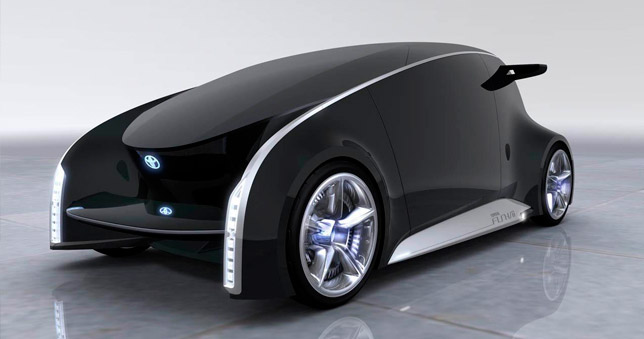
The innovations from Toyota Motor Corporation (TMC) can be seen at the 42nd Tokyo Motor Show 2011. The Corporation will present the futuristic “Toyota Fun-Vii”1, which is a vehicle concept, that heralds the close future, they assure us. In these times, people, cars and society will be all linked. If you are willing to witness those innovative ideas yourself, the show will take place from November 30 till December 11 at Tokyo Big Sight in Koto Ward. Everything will stand under the theme: “Mobility can change the world.”
Now let’s review what’s so impressive about this new concept from TMC.
VEHICLE FEATURES
If you have ever dreamed that you can easily alter the content displayed on the interior and exterior, then this car of the future offers you this ultimate in personalization function. What is the so fascinating, for example is that the whole vehicle body can be used as a display space, with the body color and display content changeable at will. The benefit of this is not only the exercise of your free will, but also this allows the entire vehicle to function as a mechanism for displaying messages or other information.
What is more interesting is that the entire interior of the vehicle can also function as a display space. Moreover – the interior is freely adjustable to match the mood of the moment. Further developments are made in the way the information is shown. For instance, the content such as navigation information is blended seamlessly into the interior through the use of augmented reality. Futuristic, isn’t it? In addition, only through a vocal interface, the vehicle’s “navigation concierge” can provide the passengers with driving information and guidance.
Furthermore here is presented the idea ensuring that the driver will have the latest network software versions for the vehicle’s drive, control and multimedia system. This will be made through a network update function.
Everything about The Fun-Vii is concentrated around connection. What I mean is that the ultra-futuristic vehicle will be able to link with surrounding vehicles and infrastructure, allowing it to detect other potentially hazardous vehicles-such as vehicles in blind spots-in advance. Even more – it will be able to connect with friends who are driving nearby.
Of course, vehicle’s functions will be easily accessible remotely via a smartphone or other mobile communication device.
Obviously TMC is offering a fresh proposal and is providing the dream and joy of motor vehicles to as many people as possible. And in addition to the Toyota Fun-Vii is absolutely and fully responding to TMC”s slogan: “Fun to Drive, Again.”
 2016 Geneva International Motor Show ( from 1st to 13th of March) will see many long-anticipated models and concept vehicles by Toyota as the long-awaited C-HR Concept, the fresh Proace Verso and new Hilux. All the models will be show during brand’s on-stand press conference in Hall 4 at 11:45 on March, 1st.


 Toyota will showcase its latest and greatest concept vehicles and technologies at the International Consumer Electronics Show and visitors will have the unique chance to witness what Toyota plans for the not-so-distant future. Toyota’s exhibit will be located in the North Hall of the Las Vegas Convention Center and the team will make some big announcements.


 Toyota has unveiled the sweet Noah G’s and VoxyG’s concept vehicles. The “souped-up minivans” proudly demonstrate straight and clean lines, aggressive stance and overall distinctive appearance. Surely, the additional body kit additions further contribute to that contemporary design with the mesh grille details, red brake calipers and alloy wheels. And with the ventilated hood, carbon-fiber plastic canards and big rear wing these sweeties do stand out from the crowd.

 Toyota S-FR Made its global premiere at the Tokyo Motor Show in October and demonstrated old, but proved itself approach: functionality and superiority via simplicity. Along with its incredible capabilities, there will be numerous additions made thanks to GAZOO Racing team that plans to redesign the concept as a track-ready race vehicle. The final masterpiece will be demonstrated at the Tokyo Auto Salon 2016, running from January 15 through 17.


 The ever-seeking for perfection Toyota team recently renewed its passion and sense of beauty and technology with the numerous new stock and concept vehicles released. And when it comes to unique conceptual rides, Toyota is second to none. At the 2015 Tokyo Motor Show, the well-known manufacturer demonstrated some of its most notable vehicles. Among them was the S-FR sport concept and the next-gen Prius Hybrid: both machines demonstrate passion for beauty and versatility.


 Toyota S-FR is a special concept automobile which continues the heritage of brand’s comfort and flexible sports vehicles. Pitched as an entry-level model, this sweetie accents on responsiveness, dynamics and aims to make as much people as possible to fall in love with it. But will it succeed?


 Science says that compressed hydrogen has a higher energy density than electricity and can be generated from extended range of materials. Materials that are easy to store and easy to use. Clean generation of hydrogen from numerous primary energy sources will definitely make local and self-sufficient power generation reality and the fuel cell vehicles will eventually take the main role of rides with their inner sources of energy. And that’s why Toyota team decided to try out something different and something new. And it will incorporate this knowledge with its latest concept vehicle.


 Toyota C-HR Concept is a stylish and compact hybrid crossover that would be the core of soon-to-be-produced mass-market version. Now the five-door model is on display at the 2015 Frankfurt Motor Show.


 Three new concept vehicles have just been unveiled by


 The