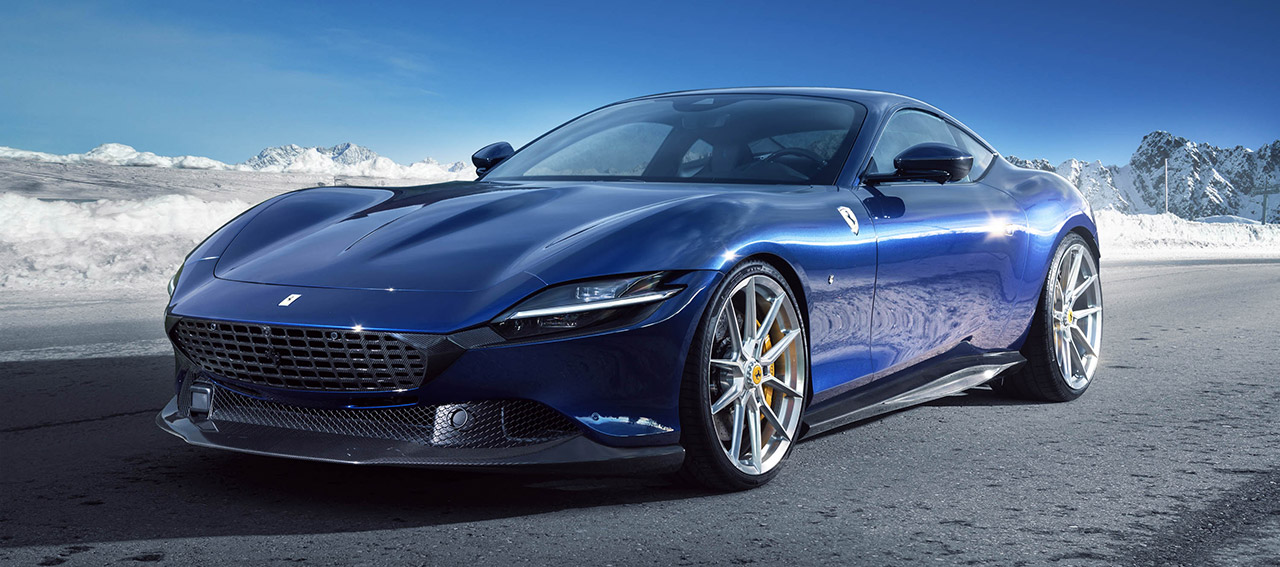
The Ferrari Roma Spider, the latest model from the Maranello marque, was presented to clients today at an exclusive event at the El Badi Palace in Marrakesh. This timelessly elegant, high-performance car is a contemporary take on the chic, pleasure-seeking Italian lifestyle of the 1950s and 60s. This spider carries over the proportions, volumes and specifications of the Ferrari Roma’s hugely successful V8 2+ concept, but what makes it so striking is the adoption of a soft top, a solution making a welcome return to the Prancing Horse range on a front-engined car 54 years after the 1969 365 GTS4.
There’s a novel and modern take on the soft-top design that underlines the Ferrari Roma Spider’s exuberant character, with extensive personalisation options that include sophisticated, bespoke fabrics and contrasting stitching. On a functional level, the soft top deploys in just 13.5 seconds and can be actioned at up to 60 km/h. The fact that it is so compact also yields a larger boot and boosts the car’s versatility. A new, patented wind deflector integrated into the backrest of the rear bench can be deployed by a button on the central tunnel, guaranteeing exceptional in-car occupant comfort without taking up any space in the car.
The Ferrari Roma Spider retains the Ferrari Roma’s excellent dynamic characteristics: it boasts a best-in-class weight/power ratio thanks not only to its soft top, but also to its all-aluminium chassis and 620 cv V8 from the engine family that was heralded as the International Engine of the Year on four consecutive occasions. The engine is coupled with Ferrari’s universally-acclaimed 8-speed DCT known for its incredibly fast shift times as well as excellent standards of comfort and mechanical efficiency.
The Ferrari Roma Spider is not just rewardingly easy to drive, it is also extremely dynamic and responsive: this makes it the perfect companion on out-of-town weekends and longer journeys alike. Always, of course, with the exhilarating Ferrari V8 soundtrack playing in the background. A number of features are designed to make this car superbly versatile, including a category-topping boot size which includes a hatch via the rear seat backrests to allow larger items to be carried, and standard wireless connectivity by Android Auto® and Apple CarPlay® Wi-Fi. Not forgetting, of course, 18-way-adjustable heated ergonomic seats that are also available with an optional neck warmer for colder days.
STYLE
Designed by the Ferrari Styling Centre headed by Flavio Manzoni, the Ferrari Roma Spider aims to move the “La Nuova Dolce Vita” concept beyond city limits for elegant, carefree driving ‘en plein air’. This 2+ spider boasts a sophisticated fabric soft top, which is designed not just to maintain, but to enhance the flawless proportions of the coupé on which it is based without modifying that car’s elegantly flowing silhouette.
Redesigning the coupé’s tapering, fastback roofline meant modifying the rear screen to incorporate it into the soft top so that it can fold below the tonneau cover when open. On the Ferrari Roma Spider, the original styling theme has become a body-colour band running across the base of the roof that divides the carbon-fibre active spoiler from the roof and rear screen, creating a seamlessly integrated tonneau cover. When the soft top is lowered, the active spoiler visually connects with the rear bench and head rests.
Unlike the more usual basic fabrics seen on most convertibles, a new material has been used for the Ferrari Roma Spider’s soft-top, giving it a sophisticated air. Special fabric weaves were selected and developed in colour combinations that highlight the car’s twin souls, one more elegant and the other sportier. The bespoke finish with two-tone weave draws on a palette of four colours highlighting the refined, haute couture nature of the fabric. The optional technical fabric developed specifically for this car gives it a sporty yet very sophisticated allure with an innovative weave creating an extremely striking iridescent red finish that further enhances the roof’s 3D surface.
EXTERIOR
The stylistic approach taken for the Ferrari Roma Spider’s exterior centres around a clean design and absolute symbiosis between its various elements. Its harmonious proportions and pure, elegant volumes are very much in line with Ferrari’s front-engined GT tradition. That said, the designers have created a modern take on those classic proportions, giving the car a sophisticated, contemporary stylishness.
The long front bonnet underscores the spare silhouette of the flanks, lending a sense of sleekness to the entire body and a dynamic look. The sober, spare front of the car looks as if it were sculpted from single block of metal, creating an overhanging, sharknose effect.
The bonnet and sinuous wings flow into one another yet also effortlessly harmonise with Ferrari’s traditional styling cues. The designers sought to preserve the minimalist elegance of the car’s forms by removing any vents or superfluous decorative features. In fact, the launch configuration does not even include the Scuderia Ferrari side shields, reflecting the approach taken with the road cars of the 1950s.
Engine cooling is guaranteed by the perforated surfaces, only where strictly necessary, creating a new interpretation of the grille concept: this distinctive solution is finished in the same colour as the bodywork, rendering it seamless with the styling. The edges of the front grille flow into two linear, full-LED headlights which lend the front of the car a distinctive character all of its own. They are traversed by a horizontal DRL strip that hints at the structure beneath the car’s skin, an element that brings a sense of tension to the entire circumference of the car.
The fastback cabin volume is compact and set back, ending in a subtle nolder beneath which the designers have created a modern take on the signature Ferrari tail. The Ferrari Roma Spider’s long rear overhang, which is a characteristic of the Ferraris of the 1950s and 60s, has been re-proportioned here, resulting in a low, compact volume which hugs the rear axle. The wraparound tail of the car is characterised by the purity and modernity of the transom styling. Technological advances made it possible to reduce the dimensions of the tail light assembly, resulting in a minimalist and iconic design. The rear is completed by a compact aerodynamic diffuser that incorporates the fence and exhaust tailpipes.
CABIN
For the Ferrari Roma Spider’s cabin, the Ferrari Styling Centre designers took the same approach to volumes and forms introduced on the Ferrari Roma. Two separate spaces, one each for driver and passenger, were created in an evolution of the dual cockpit concept, which has its roots deep in the marque’s history with cars from the 1970s. The innovative look of this dual cockpit was achieved by extending the philosophy applied to the dash to the entire cabin. Hence, the vision of two modules that wrap around driver and passenger and that extend and integrate with the two rear seats.
The Ferrari Roma Spider’s cabin has an almost symmetrical layout which produces a more organic distribution of both spaces and functional elements. The result is that the passenger will feel very involved in the driving experience – almost like a co-driver, in fact. The forms have been crafted to create a sculptural volume in which there is a sense of textural continuity between all the various cabin elements.
Created by paring back the volumes and underscored by piping along their edges, the two cockpits are cocooned in a wraparound volume and extend from the dashboard all the way back to the rear seats, organically incorporating the dash, doors, rear bench and tunnel. Thus, the cabin is not designed as a collection of separate sub-assemblies, but defined by elements that develop organically.
The technology adopted is derived from the Ferrari Roma: the digital instrument cluster is integrated with the volumes around it and protected by an anti-glare binnacle which extends out naturally from the dash. The passenger has an optional display that allows them to share the driving information. An 8.4” central display set between the two cockpits and partly floating between the dashboard and tunnel incorporates the other infotainment and climate control functions.
The F1 gearbox controls have been set into a modern metal plate which references the iconic gear lever gate. In the Ferrari Roma Spider, this is in the centre of the tunnel and inclined to make it easier for the driver to reach and see.
The steering wheel’s HMI is a further honed and refined version of that seen on the Ferrari Roma with touch controls on its spokes. The left-hand spoke has indents corresponding to the touch controls to ensure the driver can feel which one to use. The track pad on the right-hand spoke has been improved – there is now an indent that makes it easier to swipe. These solutions help the driver know where the controls are, in line with the “Eyes on the road, hands on the wheel” philosophy Ferrari has been adopting for quite some time. The Engine Start button is now also backlit in red to underscore the thrill of the moment the iconic Ferrari twin-turbo springs to life.
POWERTRAIN
The Ferrari Roma Spider is powered by an engine belonging to the V8 turbo family named “International Engine of the Year” for four consecutive years and also voted “Best Engine of the Last 20 Years” in 2018. The 3,855 cc power unit can punch out 620 cv at 7,500 rpm, the equivalent of 161 cv/l, which it combines with the flexibility of low-end pick-up, thanks to 80% of the torque being available at just 1900 rpm.
The Ferrari Roma Spider also sees the introduction of an important evolution of the oil pump which reduces time-to-pressure in cold starts by 70%, as well as increasing the flow rate at medium revs. The same modification has also been introduced on the Ferrari Roma, demonstrating the company’s commitment to continual research and development.
Like all Ferraris in the range, the Ferrari Roma Spider delivers instantaneous throttle response. This is the direct result of the adoption of specific solutions, such as a flat-plane crankshaft, which is more compact in size with lower rotating masses to improve fluid-dynamics; compact turbines which have a lower moment of inertia; twin-scroll technology that directs the exhaust gases from each cylinder through separate scrolls and increases the pressure of the exhaust pulses for maximum power; and a single-piece, cast exhaust manifold with equal length pipes to optimise pressure waves in the turbine and reduce losses.
The Ferrari Roma Spider boasts Variable Boost Management, a control software developed by Ferrari that adjusts torque delivery to suit the gear selected, delivering increasingly powerful pick-up as revs rise, whilst optimising fuel consumption. As the car goes up through the gears, the amount of torque delivered by the engine increases, continuing all the way up to 760 Nm in 7th and 8th gear. This allowed the use of longer gear ratios in the higher gears, which helps keep fuel consumption and emissions down, while adopting a steeper torque curve through the rev range in the lower gears for a feeling of smooth, consistent pick-up.
The gearbox is based on a dual-clutch oil bath architecture and is derived from the 8-speed gearbox first introduced on the SF90 Stradale. The main modifications made with respect to the latter are longer gear ratios and the introduction of a reverse gear. The new layout and component integration thus optimised the gearbox’s size and its installation in the car.
With eight gears and optimum transmission efficiency, fuel consumption in urban and motorway contexts has been reduced without compromising on performance. In fact, there is a noticeable improvement even in sporty driving. The main technical features that have guaranteed this result are the use of low-viscosity oil and a dry sump configuration to minimise fluid-dynamic efficiency losses (oil splashing) in addition to the use of a specially-designed differential (with the input pinion axis not offset to reduce slip speed.
The clutch module is 20% smaller than the previous 7-speed, but delivers 35% more torque, with up to a maximum 1,200 Nm of dynamic torque transmitted when gear shifting. The transmission software strategy has been evolved thanks to a more powerful ECU and better integration with the engine management software. Particular attention was also lavished on the strategies designed to reduce fuel consumption and emissions, particularly when the Start&Stop function is in use.
Every single Ferrari engine has its own particular soundtrack that makes it unique and, of course, the Ferrari Roma Spider is no exception to that rule. In addition to the flat-plane crankshaft, which synchronises engine firing, and equal-length exhaust headers, which equalise the sound, the spider adopted the Ferrari Roma’s entire exhaust line that eliminated the two rear silencers in favour of new geometry for the by-pass valves. The continuous and progressive by-pass valve control underscores the engine sound and performance depending on the driving situation.
AERODYNAMICS
The adoption of a fabric soft top and its indirect impact on the car’s bodywork geometries provided the starting point for the aero development. To retain the Ferrari Roma’s low drag, combined with the possibility of generating efficient downforce, the line of the roof and its curvature over the frontal section were subjected to in-depth numerical analysis and guided by the work of the Aerodynamic Department to ensure the project target was reached.
The modifications to the Ferrari Roma Spider’s bodywork also required new mobile spoiler geometry. In fact, the design of the latter has been meticulously honed to reflect the car’s styling and new roof line. Similar to the Ferrari Roma, this element is designed to extend and retract in a calibrated way specific to the spider as a function of the car’s speed, and the longitudinal and transverse acceleration acting on the body. This guarantees three different spoiler positions, specifically calibrated for top-down driving.
The result is that the Ferrari Roma Spider has downforce in handling situations and at high speeds comparable with the Ferrari Roma, ensuring the car is always aerodynamically balanced and able to deliver the same driving exhilaration. Huge attention was lavished on aerodynamic comfort on board with the top down, with particular focus on minimising both turbulence and wind noise in the cabin.
The solutions selected were driven by the need to simplify the transition from top-up to top-down driving, by introducing automatic movements for the surfaces tasked with creating an aerodynamic ‘bubble’ effect over the cockpit for comfort. The first was the addition of a 5mm nolder on the new windscreen header rail in the area of the flow separation. The second was the development of an automatic patented wind deflector that can be deployed by the driver without any need to stop the car. If the client wants to deploy the wind deflector, they simply press a button on the tunnel and the backrest of the rear seats (in the absence of rear passengers) will rotate into position behind the front occupants’ heads.
In this configuration, the air flow that would normally be drawn into the cabin from the rear of the car is deflected, creating an area of relatively still air around the occupants and reducing still further the turbulence around the heads of taller drivers by around 30% compared to previous 2+ spider applications. The deployable wind stop’s permeability was optimised by a transverse aperture at its centre which, thanks to its calibrated angle, acts as a real aerodynamic duct, while its shape in the plan view is tapered at the sides. These two geometric characteristics combine to deflect the most highly energised flow entering the cabin well away from the occupants.
The duct at the centre of the wind stop ensures that part of the flow entering the cabin is deflected downwards towards the rear seat, forcing it to mix with a slower flow. This means it loses most of its energy, effectively reducing turbulence in the cabin. The result is an extension of the bubble around the occupants and particularly their heads, guaranteeing unparalleled en plein air comfort. The shape, angle and permeability of the deployable wind stop are all crucial to achieving this objective, and were developed thanks to a combination of CFD simulation and many wind tunnel sessions.
There is no doubt that the most visually striking downforce generation feature is the active spoiler at the rear of the car’s upper body. A mobile spoiler is cleverly concealed in the rear lid, not interfering in the least the car’s line. However, thanks to a special mechanism, it can deploy into three different positions (Low drag – LD, Medium Downforce – MD, High Downforce – HD).
In low speed situations, when downforce has only a modest impact on the car’s performance, the spoiler goes into low drag position. This configuration is maintained until the car hits a speed of 100 km/h. At speeds of over 300 km/h, the spoiler is in MD mode. This choice was made because in these conditions, the preference is for a better balanced car, in part because of the minimal impact on drag. In speed ranges in which downforce plays a pivotal role in performance, the spoiler is in MD position and its movement to the HD position depends on the car’s longitudinal and lateral acceleration. The threshold value is variable and linked to the Manettino position.
In medium downforce mode (MD), the mobile element is at a 150-degree angle to the rear screen. In this configuration, it can generate around 30% of maximum downforce with an increase in drag of under 1%. In high-performance handling or braking situations, the mobile element automatically moves to HD configuration, generating maximum downforce and readying the car to provide the driving thrills that all Ferraris deliver. When deployed to its maximum height (HD), the mobile element creates a 135 degree angle with the surface of the rear screen, thus generating around 95 kg of downforce at 250 km/h, yet increasing drag by a mere 4%.
The increase in front downforce is due for the most part to a pair of vortex generators, which have been optimised for this particular model. They create a ground effect by introducing concentrated and coherent vortices into the area whilst simultaneously managing the wake from the front wheels with the ultimate aim of guaranteeing very efficient downforce generation.
VEHICLE DYNAMICS
The goal of the Ferrari Roma Spider’s vehicle dynamics development was to deliver superior driving thrills and handling precision on a par with the Ferrari Roma, thanks to the Side Slip Control concept which uses an algorithm developed by Ferrari that provides an instantaneous estimate of side slip to all the various on-board control systems. This data is then used to coordinate and implement interventions in a rapid, timely and accurate manner.
The Side Slip Control System (SSC), version 6.0 of which is used here, integrates all the car’s vehicle dynamics systems, most notably the Ferrari Dynamic Enhancer, active solely in the Manettino’s ‘Race’ position. The FDE is a lateral dynamics control system that rapidly adjusts the hydraulic brake pressure at the callipers on all four wheels consistent with the dynamic situation requiring control. It is designed to make the evolution of the car’s lateral dynamics more predictable through and exiting corners, ensuring the driver’s control of the steering wheel and throttle are simpler and more intuitive. The system flanks the traditional Electronic Stability Control system.
Like the Ferrari Roma, the Ferrari Roma Spider’s Manettino has five positions to make its handling and traction performance even more accessible with the introduction of the Race position. Supported by the introduction of the Ferrari Dynamic Enhancer, this position is designed to boost fun behind the wheel.
CHASSIS AND BODYWORK
The Ferrari Roma Spider’s chassis is derived from the Ferrari Roma, but features new components, with the rear section inspired by the solution used on the Ferrari Portofino M. The sill, a fundamentally important structural element, was developed specifically for the Ferrari Roma Spider, as were some elements required to install the soft top, and the A-pillar/windscreen surround.
The bodyshell retains the fundamental elements of the Ferrari Roma’s design: the modifications made focused mainly on the rear and on harmonising the Ferrari Roma Spider’s lines so that they retain their elegance with the top down. Exceptional torsional rigidity and beam stiffness figures for the bodyshell and chassis have been achieved despite an increase in weight of just 84 kg for a weight/power ratio of 2.5 kg/cv, which remains at the very top of the high-performance 2+ spider category. This impressive result also ensures that the Ferrari Roma Spider benefits from the same excellent handling and performance as the Ferrari Roma.
This increase was due in part to two factors. Firstly, the addition of the unique integrated wind deflector, which significantly improves occupant comfort. Secondly, the addition of headrests for the rear seats that visually integrate into the tonneau cover design.
The automatic fabric soft top guarantees occupant comfort on a par with the retractable hard top system equipping the other spider models in the range. The large rear glass screen is fully integrated into the soft-top geometry. The five-layer fabric dampens wind and road noise, making it quiet even at high speeds. During development, special attention was also paid to reducing the ballooning effect typical of soft tops. The technical solutions adopted by Ferrari’s engineers have thus guaranteed class-leading performance in these areas.
The soft-top mechanism was designed to be light yet resilient: it pushes technical performance limits to new heights thanks to a Z-shaped movement that folds the soft top away in a mere 13.5 seconds and up to a maximum speed of 60 km/h. When stowed, the roof occupies a height of just 220mm, which is the lowest in the category, and that, in turn, ensures a roomy boot (a class-leading 255 litres with the top up).
The gas springs used to extend the wind deflector were meticulously designed and developed to deliver controlled, smooth action at all stages of movement and in all conditions. The wind deflector can be opened at up to 170 km/h. The chance of opening the mechanism is automatically speed-limited to ensure that it can be deployed in safety. Once in place, the wind deflector can be used at any speed in open configuration.
The wind deflector retains all the features unique to a real backrest: the surface the rear occupants rest on is padded for comfort, while it is shaped to open even when the front seats are pushed back. The central duct compensates for the air pressure acting either side, improving the efficiency of its movement. The system’s kinematic points are the result of an in-depth study of the entire back seat and boot area, optimising their position in relation to movement and weight.
7 YEARS MAINTENANCE
Ferrari’s unparalleled quality standards and intense focus on client service underpin the extended seven-year maintenance programme offered with the Ferrari Roma Spider. Available across the entire range, it covers all regular maintenance for the first seven years of the car’s life. This scheduled maintenance programme for Ferraris is an exclusive service that gives clients the certainty that their car is being kept at peak performance and safety over the years. This very special service is also available to owners of pre-owned Ferraris.
Regular maintenance (at intervals of either 20,000 km, or once a year with no mileage restrictions), original spares and meticulous checks by staff trained directly at the Ferrari Training Centre in Maranello using the most modern diagnostic tools are just some of the advantages of the Genuine Maintenance Programme. The service is available on all markets worldwide and from all Dealerships on the Official Dealership Network.
The Genuine Maintenance programme further extends the vast range of after-sales services offered by Ferrari to meet the needs of clients wishing to preserve the performance and excellence that are the signatures of all cars built in Maranello.
FERRARI ROMA SPIDER – TECHNICAL SPECIFICATIONS
ENGINE
| Type |
V8 – 90° – twin turbo |
| Total displacement |
3855 cc |
| Bore and stroke |
86.5 mm x 82 mm |
| Max. power output* |
456 kW (620 cv) at 5750–7500 rpm |
| Max. torque |
760 Nm at 3000-5750 rpm |
| Max. revs |
7500 rpm |
| Compression ratio |
9.45:1 |
| Specific power output |
161 cv/l |
DIMENSIONS AND WEIGHTS
| Length |
4656 mm |
| Width |
1974 mm |
| Height |
1306 mm |
| Wheelbase |
2670 mm |
| Front track |
1652 mm |
| Rear track |
1679 mm |
| Dry weight** |
1556 kg |
| Dry weight/power ratio |
2.5 kg/cv |
| Weight distribution |
48% ant. / 52% post |
| Fuel tank capacity |
80 l |
| Boot capacity |
255 l |
TYRES AND WHEELS
| Front |
245/35 ZR 20 J8.0 |
| Rear |
285/35 ZR 20 J10.0 |
BRAKES
| Front |
390 x 34 mm |
| Rear |
360 x 32 mm |
TRANSMISSION AND GEARBOX
8-speed F1 DCT
ELECTRONIC CONTROLS
EPS, VDC, ABS with EBD, F1-TCS, E-Diff3, SSC 6.0, FDE, SCM-E Frs
PERFORMANCE
| Max. Speed |
> 320 km/h |
| 0-100 km/h |
3.4 s |
| 0-200 km/h |
9.7 s |
| 100-0 km/h |
32 m |
| 200-0 km/h |
130 m |
FUEL CONSUMPTION
Under homologation
CO2 EMISSIONS
Under homologation
* With 98 RON fuel
** With optional lightweight content