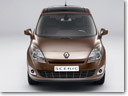
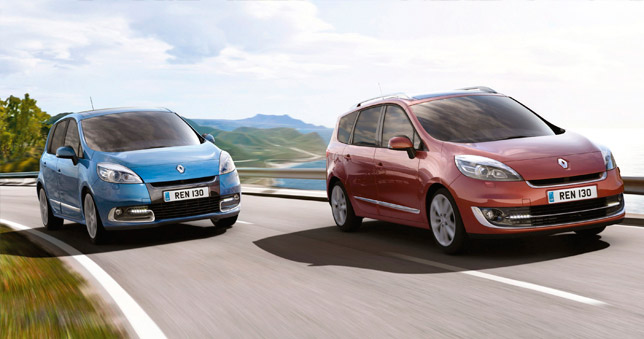
 Renault customers benefit from a choice of two MPVs which each have their own distinctive personalities. Scenic and Grand Scenic both feature taut, fluid lines that sweep across the generously-proportioned body panels to exude a sense of dynamism and robustness. Yet while the design of both versions shares an undeniable family likeness with the Megane’s other models, their profiles are quite different.
Like Megane Coupe, Scenic features a central grille flanked by satin-effect chrome finish air intakes. This sporty feel is reinforced by the headlamps which express the model’s assertive personality. The combination of squat proportions and a length of 4.34 metres points to Scenic‘s dynamism and manoeuvrability.
Grand Scenic’s proportions and extensive glazed area suggest similarly generous cabin space and the promise of a well-appointed interior. Its boomerang-shaped rear lights produce a lighting signature unique to Grand Scenic and an industry first for a production model. The lines of these clusters extend forward across the vehicle’s flanks via the waistline to convey an unmistakable sense of dynamism when the car is seen from the side. This impression is further emphasised by the sloping roofline and raked rear screen.
In addition to being a hallmark of the different models that make up the Megane family, these robust, dynamic lines are an eloquent sign of the range’s outstanding roadholding ability.
CAREFUL ATTENTION TO TRAVELLING COMFORT CABIN SPACE:
Scenic and Grand Scenic have been thought through carefully to ensure the highest possible standard of travelling comfort for all occupants. The driver and front passenger benefit from a wide field of vision thanks to wider spacing of the windscreen pillars which ensures enhanced visibility at roundabouts and junctions. The lateral field of vision has been extended by more than eight per cent and the vertical field of vision has been improved by more than 15 per cent. The longer wheelbase has led to improved comfort for second row occupants who will appreciate the best-in-class kneeroom of 235mm and 275mm provided by Scenic and Grand Scenic respectively. Occupants of the third row seats benefit from headroom of 842mm and kneeroom of 102mm. Indeed, Grand Scenic stands out as the roomiest compact seven-seat MPV on the market.
OCCUPANT FRIENDLY:
The wave-like forms of the dashboard, which are reminiscent of those of Megane, are fluid and uncluttered. The controls are intuitive and fall readily to hand, and the centre console houses the main controls (electric parking brake assist, cruise control and speed limiter), multimedia connections (MP3, USB key, iPod©) and a 12V power supply. The adjustable driver’s seat features a segment-leading range of 70mm for the height of the seat cushion, while lumbar-adjustment is now also available for entry level versions. The combination of the different adjustment options and the more vertical position of the steering wheel enables the drivers to find a combination which is more akin to that of a saloon car, without detracting from the high-up driving position that is particularly appreciated by MPV owners.
STOWAGE:
Scenic and Grand Scenic provide up to 92 litres of stowage space (the highest in the market), with a range of clever, practical solutions for all occupants:
- four underfloor compartments, two drawers underneath the front seats, plus two more drawers underneath the outer rear seats (except seven-seat Grand Scenic),
- an illuminated, chilled 11-litre glovebox,
- stowage in the centre console for small items such as mobile phones,
- the sliding centre console and sliding central armrest provide nine litres of stowage divided into two parts: fragile items can be stored away underneath the armrest, while the principal bin is ideal for holding larger objects, such as a 1.5-litre bottle,
- six map pockets on the front seatbacks (two small pockets for stashing items such as portable video players and soft toys, and larger map pockets located beneath the aviation-style tables),
- three separate 12V power supplies (one on the centre console at the front, one for second row occupants and a third in the boot) to run and charge portable electronic items such as game consoles, MP3 players and video players, or for an electric fridgebox (available as an accessory),
- two lidded stowage spaces underneath the third-row armrests.
The boot of Scenic is particularly practical, thanks not only its appreciable capacity of 522 litres (up to the parcel shelf) but also because of the vehicle’s low rear sill height and wide tailgate access. The boot capacity of the seven-seat Grand Scenic is 702 litres (in its five-seat layout), an increase of 10 per cent over Grand Scenic II. When carrying bulky loads, the baggage cover can be swiftly stored away in a bespoke compartment underneath the boot mat.
MODULAR LAYOUT:
Scenic and Grand Scenic both boast extremely modular interiors thanks to the forward-folding front passenger seat and second-row seatbacks. Carrying capacity can be further extended by removing the second row seats altogether. The boot space of seven-seat Grand Scenic can be increased thanks to the design of the third row seats which fold away into the floor. With the second row seats removed and the third row seats fully folded, the carrying capacity of seven-seat Grand Scenic exceeds two cubic metres.
To ease access for third row passengers, a handle located on the sides of the outer second row seats instantly folds the seatback. At the same time, a small hoist helps tip the seat forward to provide access to the rear seats with just one, quick, simple movement.
COMFORT:
Scenic and Grand Scenic are available with dual-zone automatic climate control with the same Soft-Auto-Fast mode functions as those first seen on Laguna and carried over since to the Megane range.
The adaptive headrests are for the segment and ensure outstanding support, comfort and safety thanks to their enveloping form, as well as to the range of positions to which they can be adjusted.
TECHNOLOGIES FOR SIMPLER DAY-TO-DAY MOTORING
Scenic and Grand Scenic benefit from numerous technological features designed to facilitate driving and enhance travelling comfort.
Scenic and Grand Scenic are the first vehicles at this level to employ a TFT (Thin Film Transistor) screen which provides a customisable, clear, high-resolution display of data such as vehicle speed, cruise control and speed limiter settings (on/off, selected speed) and door-open alert, as well as the image seen by the reversing camera (in addition to audible warning).
It takes drivers no time at all to adapt this interface to their individual taste thanks to the set-up menu which can be accessed thanks to a button located between the steering wheel and the display. This menu is derived from that of Laguna and permits the driver to activate or modify the parameters of certain functions, such as the volume of the audible parking proximity sensor warning, the language employed and the automatic headlamp activation.
Meanwhile, the contrast of the entry level monochrome LCD display (white on black background) is 30 times superior to that of preceding technology, while screen reflections and transparency are automatically corrected.
A choice of two navigation systems:
- The brand integrated Carminat TomTom® system is the fruit of an exclusive partnership with TomTom and costs less than ?500. Particularly easy to use, and ready to run as soon as the car starts, it provides all the functions expected of a top satnav system, including precise, detailed maps on a large 5.8-inch screen, birdview display and reliable navigation complete with traffic information, alternative routes, speed restrictions, speed camera location alerts (depending on country), a plethora of points of interest and a wide range of customisable parameters. The SD Card makes it easy for owners to update their Carminat TomTom® system to be sure of benefiting from the very latest navigation data and customisation options.
- Carminat Bluetooth® DVD is an upper-range integrated dashboard-mounted navigation system incorporating a seven-inch screen, centralised navigation controls and a six-CD multi-changer (MP3/WMA compatible), plus voice recognition for its navigation and Bluetooth® telephone functions.
Scenic and Grand Scenic are also the first MPVs to feature an audible rear parking proximity sensor plus reversing camera. To facilitate safe reversing and parking, the camera displays the image of the zone situated behind the vehicle on the screen of the navigation system. Meanwhile, the central TFT screen displays the vehicle and the proximity of obstacles using a colour code.
Like Megane Hatch and Megane Coupe, Scenic and Grand Scenic are available with the radio-CD/MP3 complete with Bluetooth® connectivity, TunePoint multimedia connections (USB and iPod sockets) and the upper-range 3D Sound by Arkamys® audio system.
RESPONSIVE, EFFICIENT, DYNAMIC HANDLING
Reassuring, predictable handling
Scenic and Grand Scenic ensure precise, agile cornering performance. Their chassis benefits from the same advances as those seen on Megane Hatch and Megane Coupe, and consequently delivers the same rigorous handling, without detracting from the high standard of comfort pioneered by their respective predecessors:
- MacPherson-type front suspension linked to a horned subframe which minimises lateral movement of the subframe to ensure perfect steering precision.
- the rear suspension employs a programmed deflection closed-section torsion beam for enhanced stiffness and less weight.
With this set-up, the specific roll angle (i.e. a vehicle’s angle of inclination when cornering, and consequently a pointer to its ability to corner ‘flat’) of Scenic and Grand Scenic is 0.40 degrees, the best of their segment. The average for this class of vehicle is 0.43 degrees.
Electric power steering system
Scenic’s electric power steering has been entirely revised and the result is greater steering precision plus enhanced driving comfort. Optimisation of the steering’s performance and components, plus modifications to its calibration have led to improved synchronisation of its response to instructions from the driver via the steering wheel. The feedback from the road is more accurate, while the combination of the stiffer front suspension and the closer ratio steering has also contributed to making the system more responsive.
The more precise steering and reduced body roll through corners ensures a level of driving pleasure and reassuring handling that puts the performance of Scenic and Grand Scenic on a par with that of a saloon car.
THE DCI AND TCE ENGINE RANGES: PERFORMANCE WITH RESPECT FOR THE ECONOMY
Scenic and Grand Scenic are available with a significantly renewed range of petrol and diesel engines which combine performance and respect for the environment.
Petrol engines
A choice of three petrol powertrains:
- the 1.6 16V 110hp
- the TCe 130 engine (TCe = Turbo Control efficiency),
- the 2.0 16V 140hp engine mated to a CVT (continuously variable transmission) gearbox.
TCe 130 engine, which will be available for Scenic and Grand Scenic this spring, is an eloquent showcase of the expertise Renault has acquired in the technique of downsizing. It is particularly fuel efficient and also respectful of the environment thanks to combined cycle fuel consumption of 39.8mpg, equivalent to CO2 emissions of less than 168g/km (Scenic). This engine figures among the best in its class in terms of running and maintenance costs. Its timing chain comes with a lifetime warranty and oil change intervals are every 18,000 miles (or every two years).
Diesel engines
The diesel engine range spotlights Renault’s ongoing quest to provide its customers with the market’s best trade-off between performance and fuel consumption.
The 1.5 dCi, which is widely acclaimed for its combination of performance and driving pleasure, is available in a choice of three power outputs: dCi 86 (Scenic only), dCi 106 and the dCi 110 with particulate filter. All three boast CO2 emissions of less than 140g/km.
The other diesel engines available for Scenic and Grand Scenic are:
- the dCi 130 first seen on Megane,
- the dCi 150 FAP mated to six-speed automatic transmission,
- the dCi 160 FAP coupled with a six-speed manual gearbox.
In terms of running and maintenance costs, these seven diesel powertrains stand out among the best in their class, with oil change intervals of 18,000 miles (or every two years) and a lifetime warranty for the diesel particulate filter.
MEGANE FAMILY FUNDAMENTAL STRENGTHS: ROBUSTNESS, QUALITY, SAFETY AND RESPECT FOR THE ENVIRONMENT
In addition to their inherent robustness, Scenic and Grand Scenic stand out through the high quality of the materials they employ, as well as through their form and fit and finish. Both models profit from the advances achieved across the Renault range regarding reliability and durability and, like Megane, benefit from a laser brazing technique for welding the roof to the body sides which eliminates the need for roof trimming. In addition to the advantages this represents in terms of aesthetics and protection against corrosion, this process also improves bodyshell rigidity and reduces wind noise.
Safety: a priority for Renault, and self-evident for Scenic and Grand Scenic
Renault places high priority on developing the most effective technologies when it comes to preventing accidents, taking corrective measures and protecting occupants. Its approach is founded on the result of research into real-life accidents and real-world safety (LAB1) with a view to promoting solutions that answer real traffic situations. Scenic and Grand Scenic have naturally benefitted from this ongoing work.
A comprehensive list of equipment is proposed to prevent risk situations occurring in the first place:
- automatic headlamp and windscreen wiper activation,
- cruise control
- speed limiter,
- bi-Xenon headlamps with cornering lights,
- seatbelt reminder for front seats, plus audible warning if a rear seatbelt is unbuckled.
In addition to the high standard of reassuring roadholding and braking performance to which both Renault Scenic and Renault Grand Scenic can justifiably lay claim, they are also equipped with driver aids designed to correct their line in difficult conditions or emergency situations:
- ABS with electronic brakeforce distribution,
- standard emergency brake assist,
- ESC (Electronic Stability Control) with CSV understeer control.
To protect occupants in a collision, Scenic and Grand Scenic both feature:
- the third-generation Renault System of Restraint and Protection, including protection against the phenomenon known as submarining (double pretensioners, load limiters, adaptive airbags),
- new-generation headrests for enhanced protection in low- or mid-speed rear-end impacts,
- twin side-impact sensors complete with dual-chamber, dual pressure thorax/groin/abdomen airbags first seen on Laguna III and now available across the Megane range,
- three-point Isofix child seat anchorage for all three second row seats,
- fastening of the front and rear seatbelts facilitated by the higher position of the more flexible seatbelt stalks.
Respectful of the environment
Renault Scenic and Grand Scenic range includes seven versions that comply with the criteria necessary to qualify for the Renault eco? signature. Renault eco? vehicles are ecological and economically affordable:
- they are manufactured in ISO 14001-certified factories, in this case Douai, France. ISO 14001 certification is a measure of a site’s efforts to reduce its impact on the environment,
- they are available with a choice of engines that either emit less than 140g of CO2/km or are biofuel-compatible,
- 95 per cent of their mass is recoverable at the end of their useful life, while almost 14 per cent of the plastics they contain is sourced from recycling (average weight of recycled plastics: 34kg).
1 LAB: the Accident Analysis, Biomechanics and Human Behaviour Laboratory of PSA Peugeot-Citroen and Renault.


 Finally Renault has announced the initial details for the freshly improved and remade Scénic and Grand Scénic models for 2012. Their UK launch will be next February. The brand new refreshed model will include sharper designs, numerous equipment enhancements and more importantly a debut of two impressive downsized engines.
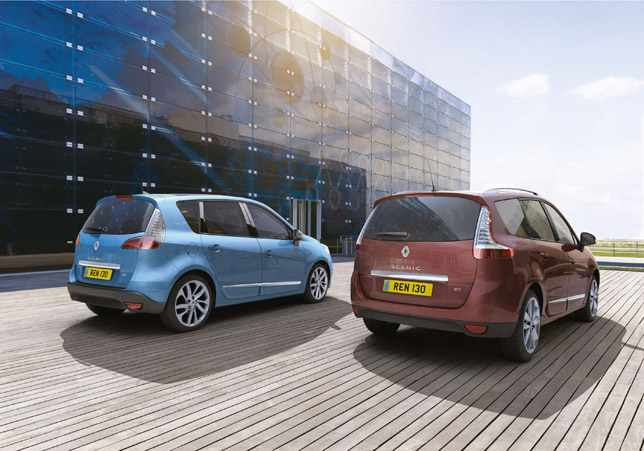


 Renault has announced a new state-of-the-art 1.6-litre 130hp “Energy” diesel engine with just awesome results. It powers the Scenic and Grand Scenic, pricing starts at just £20 900 OTR. The cars also come with Dynamique TomTom.


