Tag: rear wheel drive

  • Drag Racing – Times and Power [part 2]

    Let’s continue with the reaction time. With several words, it is the time between the green light signal and when the car passes the starting line. Normal reaction time is between 0.5 to 1 second and if it is under that, the driver is either lucky or trying to “cheat”.

    All this characteristics are connected and can explain everything that happens on the race track, even how the driver controls the car.

    The time and the terminal speed are the most important characteristics and normally the proportions are these: 15 to 14 seconds on ¼ mile – 150 to 160 km/h, 14 to 13 seconds – 160 km/h to 175 km/h, 13 to 12 seconds 175 km/h to 190 km/h, 12 to 11 seconds from 190 km/h to 210 km/h and all cars in the 10 second mark and below that have terminal speeds of more than 210 km/h.

    So, what happens, when the car have high terminal speed and bad ¼ mile. Usually, there are two reasons – bad start and low traction after that. The cars, which are not 4×4 and have a lot power like turbocharged BMWs, Porsches or Mercedeses. The conclusion is more wheel spin leads to bad ¼ mile time and high terminal speed.

    So, it turns that drag racing is not only a chase between two cars on a straight line and changing gears or waiting for the automatic transmission to do that. There are a lot for very important factors, which can work in your benefit, if you know them and try to improve not only your car, but yourself, too.

    More power, less weight and good, prepared driver – the formula of the success at ¼ mile races.

    Bugatti vs Porsche Drag
    Bugatti vs Porsche Drag


    [Part 1]

  • Drag Racing – Times and Power [part 1]

    Drag racing is one of the most interesting events in the automobile world, especially for the spectators. Essentially, it is a race between two vehicles on a special dragstrip, which is a long straight facility for conducting acceleration events. When we say vehicles, we mean everything that can run… fast! – motorcycles, cars, sports cars, “funny” cars and top fuellers.  This time we will talk about ¼ mile races – 402.33 meters.

    There are two main types of events – start-and-fast beat, which is very “easy” to do. Just step on the gas pedal, when the lights are green and change gears (if you drive manual). The second type is bracket racing, which is very popular, too. The contestants choose their fastest time that they think is possible and who finishes first is a winner, but if you beat your announced time of 14.20 with for example 14.05, you will lose. These rules give opportunity to slow cars to catch up with very fast ones.

    Now to say something about times just to have some idea for what’s really going on at the dragstrip. Usually, the normal cars around and under 200HP are in the range of 18 to 15 seconds. Those, which have sports nature, are from 14.9 to 13 seconds and the best of them are under 13 to 12 seconds. The cars with times under 15 seconds has at least 200HP and they are not very heavy like 1500kg (3306 lbs) or more. The cars around 13 seconds have 300 to 400HP and those under 13 seconds are extremely powerful – 500HP and more. Of course, there are a lot of exceptions, but normally this is the situation.

    Other very important thing is the terminal speed, which again can show you how powerful the car is and how it uses that power and puts in on the tarmac. Again, usually the normal cars have terminal speeds of 120-140 km/h. The sports ones – 140 to 160 km/h and the best 160 to 190 km/h. If you see a car with over 200 km/h, it is either very tuned or very powerful with poor driver.

    The start is extremely difficult, because the driver needs to know his car very well. Of course, a start with powerful car is more tricky and, but if you have launch control – congrats.

    The first 60 feet (20 m) usually take from 1.6 to 2.4 seconds or more, if the driver can’t drive his car very well. Once again, the normal cars (if driven perfectly) are between 2.8-2.4 seconds, the sports ones from 2.4 to 1.8 seconds and if the time is around 1.4-1.5 seconds, this is either very powerful 4×4 vehicles or a RWD with slick tires.

    To be continued…

    [Part 2]

  • Front Wheel Drive vs. Rear Wheel Drive

    It is very difficult to say which is better between a front wheel drive (FWD) and a rear wheel drive (RWD). The conception is quite different. Actually, both have nothing in common in road behavior. When you get at the limit of your car, the pros and cons appear the most.
    The FWD is famous with its understeer, while the RWD with its oversteer. Both understeer and oversteer are quite shocking in everyday or normal driving conditions and should be avoided. Often the electronic safety systems take care for this, but some old cars do not have them and even in a brand new one, there is always a possibility to get yourself in trouble.

    Simply put, understeer is when the car does not turn enough and leaves the road in straight line and the over steer is when the car turns sharper than intended and could get into a spin. For experienced drivers managing with oversteer is easier, because it is more predictable, especially when the car is equipped with limited slip differential (LSD). If the car goes understeering just release the throttle and apply some brakes, if needed. If the car goes oversteering you have two options. First is to powerslide the corner, if the car has enough power and the second option is the same like the understeering situation. Powersliding is extremely hard and should be done only at the racetrack and never on public roads. In a few words, it means to apply the throttle in a turn enough to make the rear wheels break traction and slide out. All this is made with a proper countersteering.

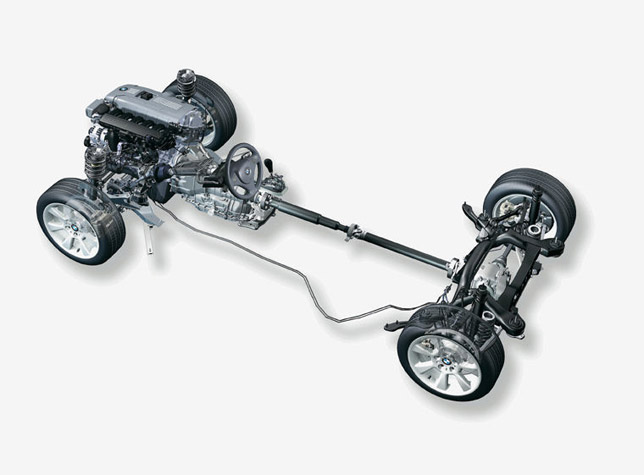
    Other very important thing is that the RWD has a lot more losses in power compared to the FWD mainly because of the more moving parts. The FWD layout is engine -> clutch -> gearbox -> differential -> axle shafts and the RWD layout is engine -> clutch -> gearbox -> joint -> driveshaft -> joint -> differential -> axle shafts. As you see, the torque should “go” more way to reach the rear tires, instead of reaching the front. Again, simply written is that you lose about 12% of your engine power, if you have FWD car and about 15%, if the car is RWD. That’s why you will see the notion – wheel horse power – WHP. For example often a 150HP FWD car is a lot faster than a 150HP RWD car because the second has a lot more losses in power through the drivetrain.

    Obviously the RWD cars are very fun to drive, because each axle has to do its own task – front to steer and rear to power. The FWD cars are safer for beginner drivers, especially in low traction conditions (rain or snow). They are also more economical, because they put more power on the road and often are lighter. Other important thing is that the manufacturers can’t make very small RWD cars or they shouldn’t because they are very unstable.

    So, next time you are seeking a new car be sure what you are searching for.

    Rear Wheel Drive
    Rear Wheel Drive
    Front Wheel Drive
    Front Wheel Drive
  • Toyota FT-86 Concept unveiled at 41st Tokyo Motor Show

    Toyota FT-86 Concept is shown for the first time at 41st Tokyo Motor Show this year. The car has been co-developed from Toyota and Subaru. Each company will produce its own version of the car, which will be put on sale in the end of 2011.
    (more…)