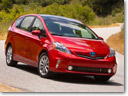
This summer a new example of Toyota‘s hybrid know-how is coming to town…or Europe. It’s the Prius+ – Europe’s first full hybrid seven-seat MPV. Two trim levels will be available, the base T4 and T Spirit.
One can imagine for example, that in the UK, the sub-100 g/km of CO2 T4 version will be hugely popular as this will be the only MPV out on the streets with zero road tax and it can go in and out of London without paying a congestion charge. The T Spirit, which is kind of more equipped (17-inch wheels, 8, instead of 6, JBL speakrs, leather seats) spews out 101 g/km. Official figures for the fuel economy equal to 68.9mpg for the T4 and 64.2mpg for the T Spirit.
A pack of li-ion batteries lays within the center console so that no passenger or luggage space is compromised. Five separate folding rear seats are provided and with all of these in place there is 200 litres of luggage space. Remove the third row and you get 505 liters.
Both of the models get various goodies such as rear-view camera, Smart Entry and Start, climate control, electric windows and heated folding mirrors, panoramic roof with aoutmatic shade, rain sensing wipers, LED daytime running lights and more.
Quite a bundle considering the projected starting price of $41,578 for the T4. The T Spirit stands at $46,814 and it does not sound like a bargain.
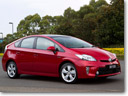
In a bid to attract even more buyers, Toyota have turned up, in Australia, with a bag of updates for the 2012 Prius. It now has a new face, some extra equipment, its suspension has been tweaked and is cheaper than ever.
Visually, the front lower end sees a new bumper and a larger, trapezoidal lower grille. LED daytime running lights find their place right beneath the indicators within the bumper while the fog lights have moved on the sides of the lower grille. Elsewhere, one would find that the taillight cluster has been changed, the mirrors are now heated and power-folding. The wheels remain 15 inches (17 for the i-Tech trim) but the design is new. Overall the 2012 Prius is 20 mm longer than the previous ones but that length seems to have gone to the overhangs as the wheelbase stays the same.
Inside we get new seats and more quality upholstery, the multi-information display is now more vivid than ever and even the entry level gets a rear view camera. There are some less useful features as well – an “ECO calculator” that apparently allows you to do math and estimate how much money you are dreadfully spending on fuel. Wasn’t it the whole purpose of buying a Prius to set yourself free from consumption worries? Why would I want to preoccupy my mind with that? Anyway, Toyota have also added a HUD readout on the screen and a touch pad sort of thing on the steering wheel so that you, or anyone else who might be driving, can remain focused on the road. In case you get lost however you can always refer to the HDD navigation system (i-Tech again). Other standard safety features include seven airbags, stability and traction control, active front head restraints and anti-skid brakes.
Sounds unimaginable when talking about a Prius, but, assuming you won’t be always driving around in ECO mode, performance and comfort may actually benefit from a now stiffer, better welded together body. The improve rigidity allows the installment of a softer and kinder suspension.
Underneath it all hides a hybrid system as usual – 100 kW of combined power coming from an 1.8-liter Atkinson cycle petrol unit and a 650-volt electric motor/generator powered by a 201.6-volt nickel-metal hydride battery pack. In return you get 89 g/km of CO2 emissions and 3.9 liters per 100 km of fuel economy. In EV mode, the Prius is capable of covering road stretches of 1-2 km solely on a battery charge.
For the whole package, you have to pay $33,990 – almost $6000 less than the price of the first ever Prius. The i-Teck on the other hand, sticks to its price tag – $45,990. What do you think? A good buy? 17,000 in Australia alone seem to approve.
Toyota has just announced the exclusive news about the official EU CO2 emissions and economy figures for the new 2012 Toyota Prius Plug-In Hybrid and they are exceptional. The vehicle emits 49g/km of CO2 on the combined cycle and travel 134.5 miles on one gallon of petrol. These numbers makes it the most efficient Toyota on the market. The engineers in addition have improved the car’s EV driving range to 15.5 miles. This is an improvement of 24% versus the customer trial vehicle. Another thing which makes it unique is that it takes only 90 minutes to recharge the car, using a conventional plug. When the EV battery is depleted, the 2012 Toyota Prius Plug-In Hybrid automatically switches into HV mode. In this mode, the vehicle delivers CO2 emissions of 85 g/km and economy of 76.4mpg. This is an improvement on the emissions and fuel economy of the standard Prius. This leading performance helps to deliver a total driving range of 769 miles. The car continues to offer the same interior space as the standard Prius, with seating for five and 443 litres of bootspace. 2012 Toyota Prius Plug-In Hybrid will be launched in the summer of 2012.
The J.D. Power Vehicle Dependability Studyis an annual research based on x amount of problems per 100 vehicles, reported by real life car owners. The lower the x, the higher the rank. It is common knowledge that if today one wants a car that can survive an apocalypse, Toyota is the brand for you. But this year, not only the Toyotas dominate the survey, but the whole Toyota group.
Toyota cars alone have four models ranked as the most dependable non-premium vehicles. The Corolla is ranked second behind The Prius in the compact-car segment while Corolla, Camry and Highlander (Kluger) are in the top three of their segments.
Lexus and Scion (Toyota subsidiaries) also preformed exceptionally well by each scoring two top rankings. Last year it was Lexus that led the J.D. Power Vehicle Dependability Study by winning the most awards than any other premium brand.
Other highlights coming from awards include the 11 awards that got swept by both Toyota and Lexus at the ‘IntelliChoice’ Best Overall Values of the Year ranking. Fifteen Toyota, Lexus and Scion vehicles were named 2012 “Top Safety Picks” by the Insurance Institute for Highway Safety – Camry, Corolla, Highlander (Kluger), Prius, Prius v, Yaris and Scion xB. Also the 2012 Camry, Camry Hybrid and Prius earned the maximum five stars for overall safety from the National Highway Traffic Safety Administration. All that portfolio of awards is just a drop in the sea of Toyota‘s achievements. We just hope they have a big enough trophy cabinet at the factory.
Australia will get a new seven-seater Toyota Prius v as an addition to the already established lineup that comprises of the Prius hatch and Prius c city car. Sales are expected to start in May this year with the idea to broaden the appeal of the hybrid family to the Australian public.
The seven-seat Prius v is 135mm longer, 30mm wider and 100mm higher than the Prius hatch. The wheelbase alone is 80mm lengthier in comparison, thus enabling the Prius to accommodate adults in all three rows.
“The Prius v is all about versatility – it is larger and roomier to meet the needs of growing families while retaining the Prius DNA of environmental performance and fuel economy,” said Australia’s sales and marketing executive director Matthew Callachor.
However, Toyota want to make it clear that this is not just a long-wheel base version of a former Prius. Design was made from scratch and all body panels are new. It will also be the first Toyota hybrid using Li-ion batteries in Australia. Spaced between the driver and passenger seat, under the center console, the battery pack is lighter and more efficient than the Nickel-metal Hydride one used in the past.
In order not to compromise luggage space, the third seat row can be folded for the sake of cargo space. If that doesn’t prove itself enough, the second row can also be contracted thus making the Prius v a versatile family hybrid.
Power will come from Toyota’s latest Hybrid Synergy Drive® powertrain which incorporates a 73kW 1.8-litre Atkinson Cycle petrol engine in combination with a 60kW electric motor.
In Australia, Toyota and Lexus have sold more than 35,000 hybrids, 17,000 of which are Prius models.
Toyota Prius v (seven seats version)Toyota Prius v (seven seats version)
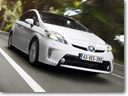
The new 2012 Toyota Prius is priced from £21 350 and it will be available in the UK showrooms from March. Later in the year Prius will grow, with the introduction of the ultra-efficient Prius Plug-in Hybrid and Prius+, the world’s first seven-seat full hybrid MPV.
The new model continues to emit just 89g/km CO2 emissions – the lowest level in its class – and combined cycle fuel economy of 72.4mpg.
The advanced Toyota Touch & Go Plus multimedia and navigation system is a standard feature on Prius T Spirit and an option onT3 & T4. This brings with it Bluetooth, a rear-view camera, USB port and an on-board connectivity feature that allows access to a raft of on-line information services sourced through Google Local Search using a compatible mobile phone.
The exterior comes with new front bumper, a larger lower grille, new clear-lens headlights and the LED daytime running lights have been relocated in the bumper beneath the turn indicators, while the foglights move to within the lower grille.
The styling changes add an extra 20mm the car’s length, but Prius’s wheelbase and its highly efficient aerodynamic performance (Cd 0.25) are unchanged.
The 2012 Prius is available in eight exterior colours, including new Dark Blue and Cabernet Red metallic.
The interior is also revised by adding new darker materials used for the dashboard and T4 and T Spirit models gains a new black seat trim. The front seats are new and offer wider adjustment, both fore and aft and in height range, making it easier for the most comfortable driving position to be achieved.
The model line-up includes – T3, T4 and T Spirit. The options list includes black leather upholstery, a Protection Pack, a Style Pack and the Technology Pack for T Spirit.
There is no doubt that the new Prius is better than the outgoing model and it will have huge success.
Toyota Motor Sales (TMS), U.S.A., Inc. have released their manufacturer’s suggested retail prices (MSRP) for the 2012 RAV4 and the Prius Liftback. They will both hit the showrooms today and on the in January 2012 respectively.
Toyota RAV4
The RAV4 SUVs can be ordered in three different trim levels – RAV 4 (base), Sport and top-of-the-range Limited. Whatever the class, all vehicles can carry a 2.5 four-cylinder engine or a 3.5 V6 which develops 269 hp. Even further, either engine can be paired with a front-wheel drive or an electronic on-demand four-wheel drive. That makes a total of 12 possible combinations and thus 12 price listings. When compared to the old model, the RAV4 MY 2012 differs little in price which will preserve Toyota’s rock-solid image on the market – the base and Sport editions get an overall 0.7% increase while the Limited RAVs actually get a decrease in price by 0.5%. The cheapest of all is the 2.5 liter, front-wheel drive, 4 ratio automatic gearbox base model standing at $22,650 as the Limited V6 4WD model with a five-speed automatic transmission receives a price tag of $28,650.
Toyota RAV4 (2010)
All models include as standard equipment hands-free phone capability, phone book access and music streaming via Bluetooth® wireless technology. RAVs from the Limited range get an extra Display Audio with Navigation and Entune™. Optional extras come in the form of a 6.1-inch touch-screen CD player with MP3/WMA compatibility, six speakers, SiriusXM Satellite Radio, HD Radio™ with iTunes ® Tagging, auxiliary audio jack, and USB port with iPod® connectivity and control.
Toyota Prius
The Toyota Prius segment has managed to stay on top of it’s competition in terms of hybrid technology mainly because of the midsized Prius Liftback. Up until know it has been shipped to over a million environmentally conscious customers. And now the 2012 MY has received a minor update – revised front fascia and tail lights, freshly styled 15 inch wheel covers and LED Daytime Running Lights with an on/off function.
There will be four available trim grades in the U.S. (the Two, Three, Four and Five) all of which have overall increased MSRP listings with around 3.3%. with the cheapest one standing at $24 000 while the Prius Five $29 805. You still get your money’s worth though because whatever you choose, it will be packed full of technology.
Toyota Prius (2012)
All models come with a 6.1-inch Display Audio system including a USB port for iPod® connectivity and control, Bluetooth® with phone book access for hands-free calling and a more advanced Multi-Information Display. Owners of the previous Prius model will be able to recognize some carryover technology as well. There’s a Touch Tracer Display, driver door Smart Key with Push Button Start and remote illuminated entry, Star Safety System and an adjustable steering wheel with controls on it for the audio and climate systems as well as controls for the phone.
The Prius Three has its Display Audio system enhanced by the EntuneTM and Navigation pack. It also gets an integrated backup camera and three-door Smart Key.
The Prius Four implements a more powerful audio system consisting of eight JBL® GreenEdge™ speakers and an amplifier. SofTex-trimmed seats, headlamps with auto on/off feature and an eight-way power adjustable driver’s seat with lumbar power support are also included.
As optional extras the Four and Five can be equipped with Toyota’s Premium HDD Navigation with EntuneTM and JBL®, which features an exclusive seven-inch touch-screen with split-screen capability. These two models are also the first of their kind to be offering a Head-up Display (HUD) which projects information such as speed, fuel etc. on the windscreen.
Here is the complete list of the manufacturer’s suggested retail prices in comparison to the previous 2011 model year counterparts:
TOYOTA 2012 MY
MODEL CODE
SERIES
DESCRIPTION
2011 MSRP
MSRP INCREASE ($)
MSRP INCREASE (%)
2012 NEW MSRP
2012
4430
RAV4
Base 2WD 4AT
$22,475
$175
0.8%
$22,650
2012
4431
RAV4
Base V6 2WD 5AT
$24,510
$175
0.7%
$24,685
2012
4440
RAV4
Sport 2WD 4AT
$24,175
$175
0.7%
$24,350
2012
4441
RAV4
Sport V6 2WD 5AT
$26,105
$175
0.7%
$26,280
2012
4450
RAV4
Limited 2WD 4AT
$25,465
($135)
-0.5%
$25,330
2012
4451
RAV4
Limited V6 2WD 5AT
$27,385
($135)
-0.5%
$27,250
2012
4432
RAV4
Base 4WD 4AT
$23,875
$175
0.7%
$24,050
2012
4433
RAV4
Base V6 4WD 5AT
$25,910
$175
0.7%
$26,085
2012
4442
RAV4
Sport 4WD 4AT
$25,575
$175
0.7%
$25,750
2012
4443
RAV4
Sport V6 4WD 5AT
$27,505
$175
0.6%
$27,680
2012
4452
RAV4
Limited 4WD 4AT
$26,855
($135)
-0.5%
$26,720
2012
4453
RAV4
Limited V6 4WD 5AT
$28,785
($135)
-0.5%
$28,650
TOYOTA 2012 MY
MODEL CODE
SERIES
DESCRIPTION
2011 MSRP
MSRP INCREASE ($)
MSRP INCREASE (%)
2012 NEW MSRP
2012
1221
Prius One (fleet only)
Five-door Liftback
$22,120
$895
4.0%
$23,015
2012
1223
Prius Two
Five-door Liftback
$23,520
$480
2.0%
$24,000
2012
1225
Prius Three
Five-door Liftback
$24,520
$1,045
4.3%
$25,565
2012
1227
Prius Four
Five-door Liftback
$27,320
$915
3.3%
$28,235
2012
1229
Prius Five
Five-door Liftback
$28,790
$1,015
3.5%
$29,805
*Prices do not include the delivery, processing and handling (DPH) fee on neither of the cars. The fee comes as an additional expense standing at $810 for the RAV and $760 for the Prius.
We have all heard the idiom “This … has the aerodynamics of a brick” at one time or another and it is not by accident that the expression has become universally popular among automotive enthusiasts. It turns out, in fact, that when it comes to aerodynamics (which in a car determines a number of characteristics, including but not limited to top speed, fuel consumption, and noise inside) you pretty much cannot do any worse. How do we know? Well, some really smart people invented the ‘drag coefficient’, which is a useful number to measure the frontal area resistance of a solid object in air or liquid. When this solid object is a brick, the number equals 2.
Back to cars, ever since people recognized that cars and carriages are not the same thing, car manufacturers started to pay more attention to aerodynamics as part of their efforts to make their cars go faster, be more stable, and look better (although the latter turned out to be way more than a function of wind resistance). All in all, in the last half a century aerodynamics has had a crucial role in shaping our concept about the attributes of a car’s exterior.
So what are the 5 cars of today, which are most brick-un-like in terms of their Cd (the accepted designation of drag coefficient)?
5. Opel Insignia
So it is not only beautiful but also efficient in the way it slips through the air. The 2009 European ‘Car of the Year’ award winner has been a total hit so far with its sales in Europe and is well-received on the US market, as well, where it appears with a Buick badge. Of course, the Insignia has its faults – the scarce rear passenger leg room is something the vast majority of automotive journalists who have tested the car agree on. Another thing they agree on, however, is its successful design, which is not only pleasing to the eye but also responsible for a Cd of only 0.27.
4. BMW E90 3 Series
In our minds, BMW’s have never won people over through their aerodynamic design – something which has been the reserved territory of brands, such as Citroen for example. Still, despite the fact that the little bimmer is quite different to look at when compared to the renaissance-like shapes of the Insignia, it has the same Cd value of 0.27 as the Opel. That is, only if it bears a 318i/320i badge – the reason is that larger wheels and fatter tires, as well as a few other exterior tweaks, increase the Cd number slightly in the name of better stability and driving security.
1-3. Japanese Wedges versus the Three-Pointed Star: A Three-Way Tie!
There are three cars, which occupy the top of this ranking: the Mercedes-Benz E-Class, the Toyota Prius, and the Honda Insight. They all share a drag coefficient of just 0.25 and two of them – the Prius and the Insight – also share a largely similar design concept. In fact, to use the word ‘share’ would not be entirely correct because the Insight came in 2008 in response to the Prius’ considerable market success and stole its silhouette in an attempt to steal its sales. Nowadays, however, we are all quite used to automotive anonymity and other such examples abound, so it is hardly scandalous. While the two cars have the same Cd value, the Honda needs it a bit more to compensate for the smaller gasoline engine it packs (1.5 vs. 1.8 liters).
Unlike the above two cars, whose hybrid nature and green marketing obligations force them to be as aerodynamic as possible, the E-Class Mercedes is built around the idea of comfort and luxury. It is the most prestigious and expensive car in this ranking and has the most conventional visual profile of the lot. Therefore, we consider it a small miracle that it manages to equal the achievement of the Japanese ‘eco-wedges’. Hat tip to Mercedes, therefore, as they have found a way to win in one more category without giving up any of their traditional qualities!
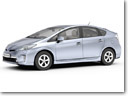
Toyota will exhibit the production version of the Prius Plug-in Hybrid Electric Vehicle (PHEV) at this year’s IAA Frankfurt on 15th September.
The new Prius Plug-in Hybrid comes with more compact lithium-ion battery. It offers extended range and enables the Prius PHEV to achieve 128.4mpg and CO2 emissions of just 49g/km.
The idea is simple – extended EV driving range for shorter destinations in town and efficient hybrid petrol engine for longer travelling. Still, the result of the new vehicle is just amazing, practically it is twice efficient than the normal Prius.
The Prius Plug-in Hybrid represents the latest development of Toyota’s Hybrid Synergy Drive (HSD) system. This trusted and reliable full hybrid technology has a track record earned through worldwide sales of over two million cars and billions of miles of driving.
In 2012 it will join an expanded Toyota hybrid range consisting of the Prius, the British-built Auris hybrid, the new, seven-seat Prius+ and the new Yaris hybrid, demonstrating Toyota’s commitment to introduce Hybrid Synergy Drive technology to the wider market.
Toyota Prius Plug-in Hybrid Electric Vehicle – PHEV
The UK airport taxi service company Checker Cars has taken delivery of the first of an order for 80 Toyota Prius cars. Just five units arrived at the company’s office in Essex, today. Checker Cars has 1000 drivers and is the official taxi operator not only at London Stansted but at Gatwick, Bristol, Cardiff and Southampton international airports. The company also services London Heathrow from an off-airport office.
“We will expect to replace the cars every couple of years,” commented Checker Cars’ Managing Director David Crouch.
“We’re initially using them at Stansted but we will then involve our other airports.”, he added.
“Our environmental policy is to reduce emissions wherever possible, and we’re also looking for greater economy in the operation of the fleet, because with fuel prices as they are that’s becoming more and more important. Congestion charge is also a factor.”, finished Mr. Crouch.
Toyota Prius T4 returns amazing 70.6 mpg and emits just 92 g/km, which is awesome, because we all know about the problem with the pollution, especially in the big cities.
Prius is a full hybrid, which means that it can go only on electricity at lower speeds. The result is zero fuel consumption and zero emissions.
Prius T4 includes Bluetooth, heads-up display, seven airbags, electric windows front and rear, 17-inch alloy wheels, rain-sensing wipers and cruise control.Checker Cars has also specified the leather option pack.
At the 2011 North American International Auto Show, Toyota has revealed its long anticipated additions to the Prius family, including the all-new Toyota Prius c Concept, where the letter “c” stands for city- centric vehicle. (more…)
Toyota Prius v made its official debut at the North American International Auto Show in Detroit. The vehicle is a full hybrid MPV featuring Toyota’s world-leading Hybrid Synergy to Drive.
Toyota Prius v boats a low, 0.29 coefficient of drag, which has been achieved without compromising its convenient packaging. (more…)
 This summer a new example of Toyota‘s hybrid know-how is coming to town…or Europe. It’s the Prius+ – Europe’s first full hybrid seven-seat MPV. Two trim levels will be available, the base T4 and T Spirit.


 In a bid to attract even more buyers,


 The
 Australia will get a new seven-seater Toyota Prius v as an addition to the already established lineup that comprises of the Prius hatch and Prius c city car. Sales are expected to start in May this year with the idea to broaden the appeal of the hybrid family to the Australian public.


 The new 2012 Toyota Prius is priced from £21 350 and it will be available in the UK showrooms from March. Later in the year Prius will grow, with the introduction of the ultra-efficient Prius Plug-in Hybrid and Prius+, the world’s first seven-seat full hybrid MPV.


 Toyota Motor Sales (TMS), U.S.A., Inc. have released their manufacturer’s suggested retail prices (MSRP) for the 2012 RAV4 and the Prius Liftback. They will both hit the showrooms today and on the in January 2012 respectively.


 Toyota will exhibit the production version of the Prius Plug-in Hybrid Electric Vehicle (PHEV) at this year’s IAA Frankfurt on 15th September.


 The UK airport taxi service company Checker Cars has taken delivery of the first of an order for 80 Toyota Prius cars. Just five units arrived at the company’s office in Essex, today. Checker Cars has 1000 drivers and is the official taxi operator not only at London Stansted but at Gatwick, Bristol, Cardiff and Southampton international airports. The company also services London Heathrow from an off-airport office.


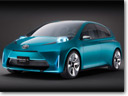 At the 2011 North American International Auto Show, Toyota has revealed its long anticipated additions to the Prius family, including the all-new Toyota Prius c Concept, where the letter “c” stands for city- centric vehicle.