There are some rare Porsche 911 models and then there is this 964 Turbo “Flatstone”. Hexagon Modern Classics proudly announces that one of just 12 right-hand-drive “Flatstone” models is offered for sale.
Back in August 1993, as the last 964 model was coming out off the production line, Porsche produced and the final and limited-run of 76 Exclusive Department-built Turbo Flachbau (Flatstone) vehicles.
The X84 body pack included front wings and pop-up headlights, especially created for the 986, while the modified front spoilers also had air intakers for additional cooling and the rear wheel housing had air intake shafts that were similar to those, seen in 959. Also, the upgraded X88 power unit is an option. This very same 385hp (287kW) 3.6-liter flat six-cylinder engine, as in the Turbo S, features enlarged turbocharger, modified camshafts, valve timing, cylinder heads, inlet manifolds and intermediate flangers, additional oil cooler and four-pipe exhaust system.
The vehicle at Hexagon’s new flagship Finchley showroom features both X86 and X88 packs. Finished in metallic black, the vehicle shows that well-known Porsche design with muscular stance and confident look. It also features black-leather interior and has covered just 630 miles. Aging as fine wine, this beauty has been a part of large private collection for many years and has never been offered for sale.
Ever wondered how WRC cars manage to deliver 300 bhp and above from an engine that, by rule, cannot exceed 2.0 liters of displacement? How on earth do the heavy, low-revving diesel engines in cars today stay competitive? Or what is it that makes it possible for the Bugatti Veyron to break the 1000 bhp threshold? Well, it certainly isn’t witchcraft. By means of “forced induction”, turbochargers today boost the automotive industry to a new direction of smaller, more-efficient and bloody good fun engines.
Volkswagen like to brand their most successful turbo diesel range as TDI while Porsche, being more plain about it, call their turbocharged cars, Porsche (insert model here) Turbo. BMW, on the other hand, would never hesitate to utter their own terms like “bitrubo” or “TwinPower” whenever describing the latest M5 engine. The variety of depicting turbocharged cars is bountiful, but essentially the principles of work remain the same in every case.
Beware reader, as I am now going to get technical:
In order to understand how a centrifugal turbocharger works, one must also have some basic knowledge on how four-stroke, piston engines work. We have an engine block that contains the cylinders, right? Inside each cylinder, a piston moves up and down. Every movement made is a phase, a stroke. First we have intake – a mixture of fuel and air is sucked into the cylinder. Compression is the second stroke where the cylinder moves up and…well…compresses the molecules in the mixture. The next ignition stroke is downwards as the piston experiences pressure coming from the combustion of the mixture. The exhaust stroke has the job to expel the remaining gases through the exhaust valve. Then the intake valve lets in a new batch of fuel mixture and thus the process is repeated.
However, as far as turbochargers are concerned, exhaust gases are not exactly throw-away material. Put simply, the turbocharger utilizes the energy of exhaust to compress the the newly arrived batch of air which is to be shoved in the cylinder. More air molecules means that more fuel can be injected into the mixture and more fuel means more power.
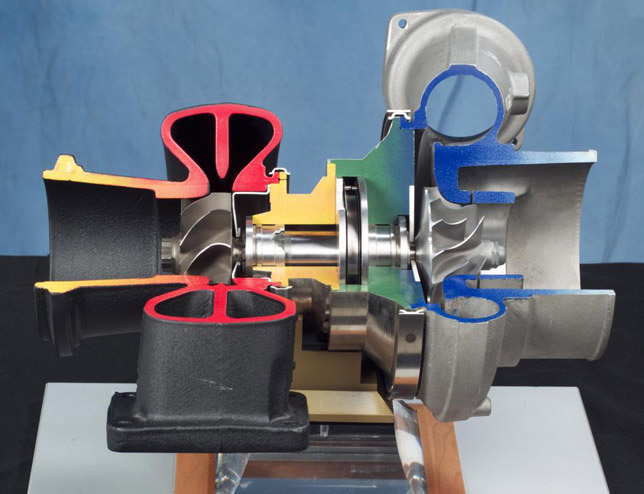
Before those exhaust gasses reach the exhaust system they go trough a turbine connected to a shaft. The more exhaust that goes through the turbine blades, the faster they spin. On the other end of the shaft we find a compressor which welcomes fresh air from the atmosphere, compresses it using the force of the turbine and then feeds it into the engine. To further increase the efficiency of the turbocharging system, an intercooler is added – it looks much like a car radiator but instead of containing cooling fluid, it holds the compressed air from the compressor. Air is denser when cooler and that’s exactly what the intercooler does – it cools the incoming air.
Cut-away view of a turbocharger held by a foil-bearing
There are issues however. First of all, a turbine amidst the flow of exhaust is essentially an obstacle. The exhaust stroke has to deal with more back-pressure thus being slightly less efficient. A functional turboshaft has to handle extreme forces (speeds go up to 150 000 rpm within the turbocharger) so a special kind of baring is needed – liquid ones or state-of-the-art ball bearings. The latter is more efficient but more expensive. Then there’s the dreaded turbo lag. The problem here is that when you put your foot down, the response is far from electric. The turbine needs some time to kick off and start spinning the compressor blades. That’s why at low engine rpm one can’t really tell if the car has a turbo or not.
There are various ways to tackle this nuisance. Make things smaller and lighter. Tiny turbochargers will grant you that off-the-line jolt but won’t be too good on the upper rpm range. Besides, if too much exhaust starts going through a relatively small turbine things may get hot and disbalanced. Usually however, there’s the wastegate in most turbines – a valve that knows how much exhaust passes through and regulates the flow by simply diverting some of the gases away from the turbine. Some companies have started putting more than one turbochargers in their cars. One small and the other, big. The small one guarantees a more immediate response while the big one takes over at higher speeds.
Essentially, that’s the story with turbochargers. We can further dive into numbers and calculations about pressure and efficiency but this, I think, is already nerdy enough. Hopefully some of you learned something new while others refreshed their memory on how the turbocharger brings easy power to our everyday lives.
Switzer Performance has introduced a new tuning package for the luxurious sports saloon Porsche Panamera Turbo. The project name is P680 and as you may suggest, the number means the horsepower.Switzer Panamera P680 boosts the mighty 4.8 liter twin-turbo V8 up to 680HP (507 kW) and staggering 970Nm (716 lb-ft) of torque. The power improvement is significant, because the stock variant of the car produces “just” 500PS. So, Switzer Porsche Panamera Turbo will be capable to chase the new BMW M5. Still, M5 F10 is expected to have tuning packages as well, because of its brutal 560PS twin-turbo V8.Switzer Panamera P680 accelerates from 0 to 60 mph in 3.5 seconds and the top speed is way over 200mph barrier – 346 km/h (215 mph). Nice!The price for this additional 189PS is not little – $22 000 as the performance package includes two new turbochargers, a custom intercooler and a revised ECU.Switzer Porsche Panamera Turbo
RENM is based in Melbourne, Australia. One of their latest projects is Porsche 997 Turbo RM580. The tuning package includes boosting the engine, interior upgrades and a set of enormous wheels.
The power output is increased with 16 per cent. The twin-turbo 3.8 liter flat-six engine now delivers 580PS and 800Nm of torque. The specific upgrades under the hood aren’t revealed. The result on the road is just 3.1 seconds from 0 to 100 km/h and a top speed of 325 km/h (202mph). (more…)
Porsche 911 Turbo is a fantastic car. It comes from the factory with 3.8 liter twin-turbo flat-six delivering staggering 500PS and 651Nm of torque between 1950 and 5000RPM and 700Nm at overboost 2100 to 4000RPM. This power is brutal, but when it is combined with perfectly adjusted suspension and enormous brakes, we have a state-of-art car.
However, Vorsteiner offers tuning package for 911 Turbo to improve its aerodynamics. It consists of a redesigned front fascia that comes with generous air intakes and only LED daytime running lights are offered . (more…)
TechArt now offers a new power kit for one of the most powerful sports cars on the market – Porsche 911 Turbo S. The additional power isn’t just a slight touch, but a serious boost. A plus of 90hp and 120Nm of torque is the added power from the tuning company.
The overall power of Porsche 911 Turbo S is increased to 620hp and maximum torque of 820Nm. On the road, this means a time from 0 to 62mph in 2.9 seconds and just 9.3 seconds to 200km/h. (more…)
Porsche Panamera was launched a year ago and since then it has more than 23 000 global sales. The car combines the appeal of a sports car and functionality of four-seater. Furthermore, there are recently-introduced V6-engined Panamera and Panamera 4, which is powered by a new 300HP six-cylinder engine.
The company will put on sale a new Powerkit, which raises the maximum output of Panamera Turbo from 500 to 540HP and the torque from 700 to 750Nm and ever over 800Nm in the over-boost mode. (more…)
BMW E92 M3 is originally powered by a monstrous naturally aspirated 4.0 liter V8 delivering 420hp. Obviously that is not enough to compete against mighty Porsche 997 Turbo.
The Manhart M3 Coupe is powered the powerful V10, which originally is developed by BMW AG for M5 and M6 cars. On the top of this, after a slight tuning the 5.0 liter develops 550 hp and the Coupe becomes not only more powerful than Porsche Turbo, but also by its larger brother, the GT2 with 530 hp.
All power of Manhart M3C is put on the road through the 7-speed SMG transmission and the differential with up to 100 percent lock, which are taken directly from M5.
The curb weight of M3C is only 1550kg and with all that power, the car accelerates from 0 to 100 km/h in 3.9 seconds and the top speed is a staggering 344 km/h ( almost 214 mph). This car is second after the fastest G-Power M6 Hurricane CS, which achieved 370 km/h.
The suspension comes from Manhart Racing and includes Bilstein PSS10-Coilovers in combination with the classically beautiful BBS Challenge R-wheels in dimensions 9Jx20” ET20 with 245/30 ZR20 at the front and 10.5Jx20” ET20 with 295/25 ZR20 at the rear.
M3 E92 received new front and rear spoiler, a diffuser, a roof spoiler, a Front sheet cover and an air collector. Of course, everything is made from Carbon for maximum strength and weight reduction.
The car is as exclusive inside as it is outside. Performance heated seats and steering wheel, carbon fiber trim and a lot of Alcantara and leather.
VEHICLE: BMW E92 M3
DISPLACEMENT: 5.0 liters
PERFORMANCE: 550 horsepower
0-100 km/h: 3.9 sec
top speed: 344 km/h
ENGINE: V10 E60 M5 5.0, conversion
with Kat & Conversion
DME-amended control
Repeal Vmax
Barrier
EXHAUST: Titanium Complete 4x
84 mm tailpipes
200 Zeller
HJS racing catalytic converters
TRANSMISSION: 7-speed SMG, M5 E60 Differential with 100% lock
SUSPENSION: Bilstein PSS10 Coilover Suspension
BRAKES: Front: BMW M5 E60 365 mm
Discs with floating caliper
HA: BMW M3 E92
345 mm discs with
Caliper
WHEEL / TYRE: BBS Challenge wheels in R Silver
front 9Jx20″ ET20 with 245/30 ZR20
rear 10.5 Jx20″ ET20 with 295/25 ZR20
Interior: BMW Performance Seats with heated seats
full leather upholstery with Alcantara Leather combination
carbon Interior
BMW Performance steering wheel with illuminated rocker switches, 1 / 4 mile & Display G acceleration
BODY
Carbon Air Intake
Carbon Front Sheets
Carbon Roof
Carbon Front and Rear Spoiler
Carbon Rear Diffuser
TechArt revealed the first renderings of its new GTstreet model based on the 911 Turbo of the latest 997 series. A direct inheritor of the 2001 TechArt GTstreet based on the Porsche911 Turbo of the 996 model series, the new beast boasts 630 hp / 463 kW at 6,800 rpm, up from standard 480 hp / 353 kW, the peak torque is increased to 820 Nm at 4,500 rpm.
 There are some rare Porsche 911 models and then there is this 964 Turbo “Flatstone”. Hexagon Modern Classics proudly announces that one of just 12 right-hand-drive “Flatstone” models is offered for sale.


 Ever wondered how WRC cars manage to deliver 300 bhp and above from an engine that, by rule, cannot exceed 2.0 liters of displacement? How on earth do the heavy, low-revving diesel engines in cars today stay competitive? Or what is it that makes it possible for the Bugatti Veyron to break the 1000 bhp threshold? Well, it certainly isn’t witchcraft. By means of “forced induction”, turbochargers today boost the automotive industry to a new direction of smaller, more-efficient and bloody good fun engines.
 Switzer Performance has introduced a new tuning package for the luxurious sports saloon Porsche Panamera Turbo. The project name is P680 and as you may suggest, the number means the horsepower.Switzer Panamera P680 boosts the mighty 4.8 liter twin-turbo V8 up to 680HP (507 kW) and staggering 970Nm (716 lb-ft) of torque. The power improvement is significant, because the stock variant of the car produces “just” 500PS. So, Switzer Porsche Panamera Turbo will be capable to chase the new BMW M5. Still, M5 F10 is expected to have tuning packages as well, because of its brutal 560PS twin-turbo V8.Switzer Panamera P680 accelerates from 0 to 60 mph in 3.5 seconds and the top speed is way over 200mph barrier – 346 km/h (215 mph). Nice!The price for this additional 189PS is not little – $22 000 as the performance package includes two new turbochargers, a custom intercooler and a revised ECU.


 Porsche 911 Turbo is a fantastic car. It comes from the factory with 3.8 liter twin-turbo flat-six delivering staggering 500PS and 651Nm of torque between 1950 and 5000RPM and 700Nm at overboost 2100 to 4000RPM. This power is brutal, but when it is combined with perfectly adjusted suspension and enormous brakes, we have a state-of-art car.
 TechArt now offers a new power kit for one of the most powerful sports cars on the market – Porsche 911 Turbo S. The additional power isn’t just a slight touch, but a serious boost. A plus of 90hp and 120Nm of torque is the added power from the tuning company.
 Porsche Panamera was launched a year ago and since then it has more than 23 000 global sales. The car combines the appeal of a sports car and functionality of four-seater. Furthermore, there are recently-introduced V6-engined Panamera and Panamera 4, which is powered by a new 300HP six-cylinder engine.