Tag: Porsche GT3

  • Porsche 911 GT3 RS Carrera RS 2.7 Tribute

    The 2023 Porsche 911 GT3 RS made its first in-person appearance today at The Quail, A Motorsports Gathering, only two days after its digital world premiere. The show car – customized by the GT Model Line and Style Porsche – is a tribute to the 1972 911 Carrera RS 2.7. Additionally, as announced by Kjell Gruner, President and CEO of Porsche Cars North America Inc. (PCNA), the car will serve as inspiration for a limited-availability Porsche Exclusive Manufaktur offering exclusive to U.S. customers: a Tribute to Carrera RS Package.

    “America is the second home of the 911 and a special tribute exclusive to the U.S. is the perfect way to celebrate the 50th anniversary of the 911 Carrera RS 2.7,” said Gruner. “So many of us idolized the original 1972 car. We want to create a special experience that combines exclusive options on the new GT3 RS with a one-of-a-kind list of accompanying items. Together, it will be an exciting and individual tribute to the RS lineage. This is a live project in its early stages, and is being created by enthusiasts, for enthusiasts as a joint effort between our colleagues in Zuffenhausen, Flacht and our team in America. The ideas and concepts are really exciting and we’re having a lot of fun developing it – all of us are looking forward to sharing more details with you soon.”

    Appropriately for Monterey Car Week, the model on display is extensively personalized. Finished in white with key areas in Python Green, the car is a direct reference to the iconic white and green color configuration offered in 1972 on the first 911 “RS” model as well as a new interpretation of it. In this instance, the body is finished in non-metallic white including side air intakes painted to match with model designation graphics on the sides and rear in Python Green, forged aluminum wheels in Python Green with white pinstripes. Exclusive Design taillights emphasize the green-on-white theme by eliminating the red color from the rear taillights and third brake light. Finally, the side plates on the left and right ends of the large rear wing are painted white with RS logos in Python Green.

    “Porsche Exclusive Manufaktur allows customers to personalize their car to a point where the vehicle is as much a reflection of them as it is of Porsche,” said Karl-Heinz Volz, Director of Exclusive Manufaktur Options. “Personalization is a Porsche tradition dating back to our first production model, the 356, when a customer requested a wiper be added to the rear window of their car. Today it is an incredibly extensive personalization program, offering options ranging from small changes to true one-off creations.”

    The headlights also feature a pinstripe ring in white, something that is not available via the normal list of factory-available options. The color combination continues inside the car with matching stitching, trim panels in white to match the exterior.

    “As a car enthusiast growing up, my walls were plastered with models that I was particularly fond of. One of the most influential was the 911 Carrera RS 2.7. As a young kid it captured me imagination and even today it puts a smile on my face,” said Andreas Preuninger, Director GT Model Lines. “That’s where the styling inspiration of the 996 GT3 RS came from, which was one of my first projects at Porsche. At the time, that car felt totally extreme so colors nodding to the forefather made sense. Today, it’s a very emotional moment for me to pay tribute to the first 911 RS model with our most extreme and capable 911 GT3 RS yet.”

    About the 2023 911 GT3 RS
    The 2023 Porsche 911 GT3 RS is the most extreme street-legal 911 model yet. Its 4.0-liter naturally aspirated boxer six-cylinder engine generates 518 hp, and revs to 9,000 rpm. That power is routed exclusively to the rear wheels via a seven-speed PDK dual-clutch automatic transmission. Making extensive use of motorsport-derived aerodynamics, it generates more than 900 lbs. of downforce at 124 mph and 1,895 lbs of downforce at 177 mph. This is also the first example of a 911 GT3 RS with active aerodynamics, a feature that is used to offer incredible levels of downforce, provide deceleration assistance by creating an air brake, and by offering a Drag Reduction System (DRS) that can reposition aerodynamic elements to cut drag at the driver’s command in certain conditions.

    About the 1972 / 1973 911 Carrera RS 2.7
    Fifty years ago, the world knew the 911 Carrera RS 2.7 as Germany’s fastest sports car. It began as a homologation special and featured many technological innovations. It was the most powerful version of the first-generation 911, generating 210 PS at 6,300 rpm and 188 lb.-ft. of torque at 5,100 rpm from its air-cooled flat-six developed by Hans Mezger and Valentin Schäffer.

    A more potent engine was only part of the success story. Much like the new 911 GT3 RS, wind tunnel testing and aerodynamic science introduced never-before-seen technology to the 911. The ducktail, now as much an icon of style as an element of function, was critical in achieving stability at high speeds. Not only did it unlock the ability to drive faster, but it did so without incurring additional drag. In fact, it reduced the drag coefficient.
  • Porsche 911 GT3 RS

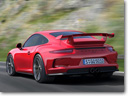
    The 2023 Porsche 911 GT3 RS is clear in its intentions: it is uncompromisingly designed for maximum performance. The 518 hp road-legal high-performance sports car takes full advantage of technology and concepts from motorsport. Even beyond the high-revving naturally aspirated engine with racing DNA and intelligent lightweight construction, it is, above all, the cooling and aerodynamic systems of the 911 GT3 RS that connect it most directly with its motorsport brother, the 911 GT3 R.

    Central-radiator inspired by motorsport – the foundation for active aerodynamics

    The basis for a significant performance boost is the concept of a central radiator – an idea that was first used in the Le Mans class-winning 911 RSR and subsequently in the 911 GT3 R. Instead of the three-radiator layout seen in previous cars, the new 911 GT3 RS relies on a large, angled center radiator in the car’s nose, positioned where the luggage compartment is located on other 911 models. This has made it possible to use the space freed up on the sides to integrate active aerodynamic elements. Continuously adjustable wing elements in the front and on the two-part rear wing, in combination with a number of other aerodynamic measures, provide more than 900 lbs. of downforce at approximately 124 mph, twice that of the 991.2-generation predecessor and three times as much as a current 911 GT3. At 177 mph, total downforce is 1,895 lbs, or the equivalent of a Porsche 356 A.

    A drag reduction system (DRS) is fitted in a production Porsche for the first time. To achieve low drag and higher speeds on straight sections of the track, the DRS allows the wings to be flattened out at the push of a button, within a specific operating range. During hard braking at high speeds, the airbrake function positions the wing elements at the front and rear to support deceleration by maximize aerodynamic drag.

    The purposeful look of the new 911 GT3 RS is characterized by the large number of functional aerodynamic elements. The most prominent feature of the GT sports car is the swan-neck-supported rear wing, which is significantly larger in all dimensions than the wing of its predecessor. The rear wing consists of a fixed main wing and a hydraulically adjustable upper blade. For the first time on a Porsche production vehicle, the upper edge of the rear wing is higher than the roof. A front splitter divides the air flowing over and underneath working in parallel with side blades on the front fascia that deflect air outwards. Front wheel-arch ventilation is provided via distinctive louvered openings in the front quarter panels. Inlets behind the front wheels inspired by the iconic Le Mans-winning 911 GT1 reduce the dynamic pressure in the wheel arches. Air from the centrally positioned radiator flows out of large nostrils on the front lid – further back, fins on the roof direct the air outwards, ensuring cooler intake temperatures in the rear. In the new 911 GT3 RS, the openings in the rear side panel are used exclusively to improve aerodynamics and not to draw in combustion air. The rear wheel arch also features an intake and a side blade for optimized airflow. The rear diffuser is a modified version of that fitted to the 911 GT3.

    Track suspension that can be adjusted from inside the car

    Even the suspension is modified for improved aerodynamics. Because the wheel arches of the new 911 GT3 RS are subject to powerful airflows, the components of the double-wishbone front axle are designed with teardrop-shaped profiles. These aerodynamically efficient links increase downforce on the front axle by around 88 lbs. at top track speed and are otherwise only used in high-end motorsport applications. Front track width increases by 1.14 inches (29 millimeters), necessitating longer double-wishbone front axle links.

    To ensure that the downforce balance between the front and rear axles is maintained even when braking from high speeds, the suspension engineers have significantly reduced pitching under braking. On the new 911 GT3 RS, the front ball joint of the lower trailing arm has been set lower on the front axle. The multi-link rear axle has also been adjusted, with modified spring rates. The driver assistance systems and rear-axle steering also have an even more dynamic set-up here.

    The 911 GT3 RS offers three driving modes: Normal, Sport and Track. In Track mode, the basic settings can be individually adjusted. Among other settings, the rebound and compression damping of the front and rear axles can be adjusted separately and in several stages. The rear differential can also be adjusted via rotary controls on the steering wheel. This is done quickly and intuitively with an operating and display concept also borrowed from endurance racing. Four individual rotary controls and a button for the Drag Reduction System (DRS) are located on the steering wheel. These rotary controls appear in the instrument cluster during the adjustment process. The 911 GT3 RS also features the track screen already familiar from the 911 GT3. At the touch of a button, the driver can reduce the two seven-inch side displays to essential information only. The gearshift indicator lights to the left and right of the analog tachometer have also been taken from the 911 GT3.

    High-revving four liter six-cylinder boxer engine

    The 4.0-liter high-revving naturally aspirated engine has been further optimized compared with the 911 GT3. The increase in power to 518 hp (911 GT3 – 502 hp) is achieved primarily via new camshafts with modified cam profiles. The single-throttle intake system and the rigid valvetrain are derived from motorsport. Like the 911 GT3, this engine also has six individual throttle bodies; one per cylinder. The seven-speed Porsche Doppelkupplung (PDK) has a shorter overall gear ratio than the 911 GT3 and is aided by air intakes on the underbody to ensure that the transmission can withstand even extreme loads during frequent use on track.

    The 911 GT3 RS accelerates from 0 to 60 mph in 3.0 seconds (911 GT3 – 3.2 seconds) and reaches a top speed of 184 mph in seventh gear. Six-piston aluminum monobloc fixed-caliper brakes and brake discs with a diameter of 408 mm are used on the front axle. Compared with the 911 GT3, the piston diameters have been increased from 30 to 32 mm. In addition, the thickness of the discs has been increased from 34 to 36 mm. The rear axle continues to be fitted with 380-mm brake discs and four-piston fixed-caliper brakes. The optionally available Porsche Ceramic Composite Brakes (PCCB) use 410-mm discs on the front axle and 390-mm discs on the rear axle. The new 911 GT3 RS also comes standard with forged light-alloy center-locking wheels. Street-legal Ultra High Performance tires measuring 275/35 R 20 at the front and 335/30 R21 at the rear provide a high level of mechanical grip.

    Lightweight construction all the way

    Intelligent lightweight construction has been a basic principle of all RS models ever since the legendary 911 Carrera RS 2.7. Thanks to an array of lightweight construction measures such as the extensive use of carbon fiber reinforced plastic (CFRP), the 911 GT3 RS weighs in at only 3,268 lbs.. The doors, front quarter panels, roof and hood, for example, are made from CFRP. Lightweight CFRP is also used in the interior, including the standard full bucket seats, trimmed in black leather and Race-Tex joining carbon fiber trim throughout the interior to characterize the pure, sporty ambience.

    Available with Weissach package

    The Weissach package, which is available at extra cost, includes a considerable number of changes to the standard vehicle. The hood, roof, parts of the rear wing and the upper portion of the side mirrors housing feature visible carbon fiber. The front and rear anti-roll bars, the rear coupling rods and the shear panel on the rear axle are made of CFRP and contribute to a further enhancement of the driving dynamics. Another highlight of the Weissach package is the PDK shift paddles with motorsport-derived magnet technology. This makes gear changes feel especially precise thanks to a pressure point and a clearly perceptible click. Forged magnesium wheels are included in the Weissach package and save 17.6 lbs of unspring weight compared to the standard wheels.

    The 2023 911 GT3 RS is expected to arrive at U.S. dealers by Spring, 2023. The starting MSRP is $223,800 excluding $1,450 for processing, delivery and handling.

    Exclusive Porsche Design Chronograph

    Inspired by the motorsport mindset – where maximum precision is paramount – Porsche’s own watchmaking operation in Solothurn, Switzerland, has developed the 911 GT3 RS chronograph. This mechanical watch is available as an option, and is reserved for owners of the car. It is based on a glass-bead blasted case, made from either natural or black titanium, and with a screw-down crown. Inside the watch is the mechanical Porsche Design chronograph caliber WERK 01.200, which has been COSC-certified for its high accuracy. Its flyback function allows the wearer to start, stop and reset the second hand with a single action. The chronograph pushers, which feature ”Start/Stop” and ”Next Lap” laser engravings, reveal that this chronograph is not just about telling the time. In addition to innovations, such as the pulsometer scale on the bezel, many design features and materials from the GT3 RS are also found.

  • Porsche 911 GT3 R

    The new Porsche 911 GT3 R will be unveiled to the public at this year’s 24 Hours of Spa-Francorchamps. From the 2023 season, Porsche customer teams can campaign the new racing vehicle in worldwide motorsport events that adhere to the GT3 regulations. The vehicle is based on the latest 992-generation 911. Compared to its predecessor, the new 911 GT3 R features a larger engine producing up to 416 kW (565 PS), a more constant aerodynamic performance and an optimised vehicle balance.

    With the latest generation of the 911 GT3 R, Porsche unveils a new customer racing car. The new challenger for GT3 series around the world is based on the current 992 generation and will be ready to race at the beginning of the 2023 season. Development began in 2019. Priority was given to further improving the driveability for professionals and so-called gentleman drivers, as well as tapping larger performance reserves for different Balance of Performance (BoP) classifications. Another focus was on streamlining the handling of the race car for the teams and reducing the running costs.

  • Porsche 911 GT3 – Feast for the Senses [video]

    Porsche has published a nice video clip highlighting the new 911 GT3. The sports car brings sensational feast for the senses. It offers an emotional driving experience, which you have to feel.

    2014 Porsche 911 GT3 is powered by a 3.8 liter flat-six with 475HP (349 kW) and 438Nm (324 lb-ft) of torque. It is connected to a dual-clutch 7-speed gearbox. 0-100 km/h in 3.5 seconds and a top speed of 315 km/h (195 mph).

    Other excellent innovation of the new GT3 is an active rear wheel steering system. It alloys steering in the same or opposite direction of the front wheels for achieving perfect traction and handling.

    The interior has an Alcantara steering wheel, leather/Alcantara seats, as well as red contrasting stitching.

    The Porsche 911 GT3 is currently on sale in Germany and pricing starts at €137,303.

    httpv://www.youtube.com/watch?v=Xfi__aUgfgE

    Source: Porsche

  • Porsche GT3 RS 9ff GT 1000 vs 911 Evotech, Nissan GT-R EcuTek and GT-R AMS

    It is time for some drag racing, but not any kind of, but the real deal. Dragtimesinfo has published a video showing a mighty Porsche GT3 RS 9ff GT 1000 making some starts against 911 Evotech, Nissan GT-R EcuTek and GT-R AMS. The GT3 RS 9ff GT 1000 has (as you may suggest) a thousand HP, while the 911 Evotech has “just” 620HP. Nissan GT-R EcuTek Stage 2 boasts 700HP and the GT-R AMS Stage 2 has only 650HP.

    The first start is against the 911 Evotech and after an awful start, the GT3 RS3 9ff GT 1000 managed to cross the finish line first with time of 28.160 seconds and terminal speed of 327 km/h.

    The second start is versus GT-R EcuTek, which won the race with time – 25.922 seconds and terminal speed of 313.58 km/h.

    The third start is versus the other Nissan – the GT-R AMS. It lost the battle win time of 26.967 seconds and speed of 314.68 km/h.

    The last start is again versus the 911 Evotech and again the GT3 RS3 9ff GT 1000 won, but with best time and terminal speed of all races – 26.276 seconds and speed of 337.07 km/h.

    Enjoy the video!

    httpv://www.youtube.com/watch?v=vVgBwS47jnA

    Source: Dragtimesinfo

  • 2012 Porsche GT3 Cup Challenge GB on April 7th and 8th

    Porsche GT3 Cup Challenge will be held this weekend – April 7th and 8th at Snetterton, Norfolk, UK.

    Lining up will be pre-season pace setter James Birch, who previously ran strongly in the Formula Renault BARC Championship. The 22 year-old racer from Amersham set the pace during the recent pre-season test day at Silverstone and his IN2 Racing entry should be right at the head of the action at Snetterton.

    Fresh from the opening races in the Carrera Cup GB at Brands Hatch, Team Parker Racing will field three cars at Snetterton for Steven Liquorish, Neil Houston and Justin Sherwood. Silverstone-based Scotsman Houston will make his Porsche racing debut after previously campaigning Ginettas, while Liquorish already has a year’s experience under his belt in these cars.

    Porsche GT3 Cup Challenge
    Porsche GT3 Cup Challenge

    Another team running in both the Carrera Cup GB and the GT3 Cup Challenge is Parr Motorsport and they will be supporting Peter Smallwood as he starts his third season of racing with his 997-model 911 GT3 Cup. Also racing in Class 1 for the 997-model cars is John Ferguson in one of the cars entered by Dublin-based Ask Racing.

    Mark Cowne contests Class 2 for the earlier 996-model cars with a car tended by Silverstone-based Fearn Sport.

    The GT3 Cup Challenge is open to any car from the 2009 model year or earlier. The race is designed to be a perfect stepping stone for drivers aiming to move up to the Porsche Carrera Cup GB in subsequent seasons. It is aimed to younger racers with some sponsorship backing, as well as competitors graduating from track days. The series is open to drivers with a National B race licence.

    In addition, the Class 2 Champion will win two places on the exclusive GT course at the Porsche Experience Centre at Silverstone.

    The awards are great, so be hurry and check how to participate in the challenge.

    Source: Porsche

  • 2012 Geneva Motor Show: Gemballa GT Porsche 991 Carrera

    Gemballa-GT-Porsche-991-Carrera-thumbGemballa do not think that the latest Porsche 991 Carrera needs a performance boost. After all, it has a 340hp 3.4 liter flat six power plant that provides an electric enough feel. And if there is anything that can get close to the mighty GT3, it’s the Carrera S version that has a 3.8 liter, 400hp engine. What I’m trying to say is that the latest “designpackage” from Gemballa for the Carrera is strictly visual. At this point we have a few aerodynamic features, new wheels and a sonorous arrangement (exhaust pipes).

    Gemballa CEO, Andreas Schwarz, explains: “Creating an even more individual appearance for this iconic sports car is a natural step for Gemballa, and we are proud to present our GT package for the new Carrera.”

    The body kit consists of “made in Germany” type carbon fitments – a front bumper, a rear one and some side skirts. Everything is designed to fit perfectly to the standard mounting points of the car. Installing them requires no cutting or grinding so the return to stock components is quite feasible.

    Gemballa have also provided four 21-inch wheels that are just a little bit lighter than the standard 19-inch ones on the Carrera and quite a lot lighter than the 20-inch set on the Carrera S.

    “Lowering the unsprung weight despite going up a wheel size was a priority,” said Schwarz.

    Eventually, we reach a point where we have to talk about pipes. About all six of them. The Gemballa exhaust system helps the engine with the breathing and the singing.

    Gemballa GT Porsche 991 Carrera
    Gemballa GT Porsche 991 Carrera

    Source: Gemballa

  • MAGNAT SNOWMOBILE Porsche GT3

    Porsche GT3 has received another tuning package, but this time from Magnat … and Wimmer.

    The mighty 3.8 liter flat-six received updated software and modified exhaust system including sport catalysts and suction tubes optimization. All coming from Wimmer racing sport techniques in Solingen, Germany, and is called RS step 3. The result is 462HP (340 kW) and 451Nm (334 lb-ft). The top speed is 317 km/h (197 mph).

    Snowmobile Porsche GT3 stands on Ultraleggera HLT CT by OZ in 8.5J x 19” and 12J x 19” fitted with 235/35 ZR19 and 305/30 ZR19 Yokohama Advan Sport tires.

    The interior gets even more attention. Magnat has re-engineered the whole internal space of the car in finest craftsmanship and highest quality. Leather, Alcantara and high gloss paintwork let the GT3 shine in its unique design, the dynamic diamond patterns setting sportive and, in the same time, exclusive accents.

    The audio system boasts 2100 WATTS – high performance voice coils and the 1” textile tweeters, down-fire subwoofer casing with 10” woofer and  Magnat Black Core 5 channel amplifier.

    MAGNAT SNOWMOBILE Porsche GT3
    MAGNAT SNOWMOBILE Porsche GT3

    Source: Magnat

  • Pikes Peak – Porsche GT3

    Jeff Zwart has just released a video of one of his shakedown runs prior to this year’s Pikes Peak event.

    The course is at the mountain in the middle of the California wilderness.

    The 12-mile Pikes Peak course starts at 9 440 feet and ends at an altitude of 14 110 feet. Its 156 turns, mixture of asphalt and gravel surfaces and the sheer drops of up to 6 000 feet make (more…)

  • Porsche 911 GTS at the Paris Motor Show

    Porsche has unveiled the 911 GTS at the Paris Motor Show. The car is produced to fulfil the empty space between Carrera S and GT3.

    The GTS model features a modified front bumper, revised side skirts, wider rear fenders, taken from the Carrera 4 and 19” RS Spyder wheels. The interior has slight changes – sport seats, a SportDesign steering wheel and acres of Alcantara.

    Porsche 911 GTS is powered by 3.8 liter with specially developed intake manifold with six vacuum-controlled tuning flaps and a sport exhaust system. (more…)

  • PD Porsche 996 PD3 – old form, new flavour

    Prior Design, the Kamp-Lintfort-based styling specialist has unwrapped its latest Porsche conversion – the Prior-Design Porsche 996 PD3. (more…)

  • 9ff GTurbo – a 1000hp boosted Porsche 997 GT3

    The well-known German tuner 9ff has released an extremely powerful refinement program, which fits perfectly the Porsche 997 GT and the 997 GT3. (more…)