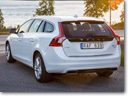
Polestar is now offering a power upgrade for Volvo V60 D6 Plug-in Hybrid. The super-economical touring car boasts impressive performance and extremely low fuel consumption.
The powertrain includes a 2.4 liter five-cylinder diesel and an electric motor – combined output of 302HP (222 kW) and 670Nm (494 lb-ft) of torque. This is an increase of 16HP (11 kW) and 30Nm (22 lb-ft) of torque compared to the normal version. The power is put on the road through a 6-speed automatic gearbox. This is the most powerful diesel-powered Volvo ever.
0-100 km/h in 6.0 seconds and a top speed of 230 km/h (143 mph) – electronically limited. The Polestar version is 0.1 seconds quicker than the normal model. The combined fuel consumption is just 1.8 liters / 100 km (130.6 mpg US or 157 mpg UK) with CO2 emissions of 48 g/km.
The electric motor is powered by a 11.2 kWh lithium-ion battery pack installed under the floor of the load compartment.
The power upgrade is offered with warranty and can be purchased in Sweden, UK and The Netherlands. The price is available upon request and installation should be made through official dealer.
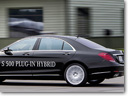
Mercedes-Benz has published a new promo video featuring the new S500 Plug-in Hybrid. The super-efficient luxurious saloon boasts F1 technology fitted in a road going model. The video also features Nico Rosberg and Lewis Hamilton who argue on topic: who is the best driver.
Mercedes-Benz S500 Plug-in Hybrid is powered by a 3.0 liter twin-turbocharged V6 engine and an electric motor with an 8.7 kWh battery pack. The petrol engine develops 333HP (245 kW) and 480Nm (354 lb-ft). The combined output is 435HP (325 kW) and 650Nm (479 lb-ft) of torque. 0-100 km/h in just 5.2 seconds and a top speed of 250 km/h (155 mph). The average fuel consumption is sensational – 2.8 liters / 100 km (84 mpg US or 100.8 mpg UK). The car can go up to 33 km (20.5 miles) only on electricity.
The Mercedes-Benz hybrid system is modular and scalable in design, and can be applied to numerous model series including E-Class, C-Class, CLS, etc. In the coming years, there will be numerous new hybrid models. The modular hybrid system also shows its strengths in conjunction with the different drive systems. In-line four-cylinder engines (petrol and diesel) can be hybridised just as well as a V6 petrol engine.
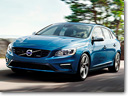
Volvois going to offer V60 Plug-in Hybrid R-Design, so even the most greedy customers will be satisfied with efficiency. Essentially, with Volvo V60 Plug-in Hybrid R-Design you get not a “wolf in sheep’s clothing”, but a “sheep in wolf’s clothing”.
“We sold almost 8,000 plug-in hybrids in 2013. Adding the R-Design dynamic attributes to the V60 Plug-in Hybrid – the world’s first diesel plug-in hybrid – will give its attractiveness another boost. The customer gets segment-topping performance combined with outstanding efficiency,” commented Alain Visser, Senior Vice President Marketing, Sales and Customer Service at Volvo Car Group.
Obviously, Mr. Visser thinks that the model will be even more popular, if offered with R-Design trim.
The V60 Plug-in Hybrid R-Design comes with new front bumper, a new rear diffusor and 18” Ixion wheels. The interior features sport seats wrapped in black nubuck textile and perforated leather. There is also a black headliner as well as special plug-in hybrid instrumentation and information.
V60 Plug-in Hybrid is powered by a five-cylidner 2.4 liter turbodiesel with 215HP (158 kW) and 440Nm (326 lb-ft) of torque. The power is put on the road through a 6-speed automatic gearbox sending it to the front wheels. The rear wheels are powered by an electric motor producing 68HP (50 kW) and 200Nm (148 lb-ft) supplied with power from an 11.2 kWh lithium-ion battery pack installed under the floor of the load compartment.
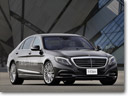
Mercedes-Benz S 500 Plug-In Hybrid is the third hybrid model of the new S-Class. It comes to new standards in terms of efficiency, drive-system and climate comfort. The new Mercedes-Benz hybrid vehicle emits only 69 g/km of CO2 and returns 94.2 mpg.
In fact, the new S-Calss can cover 100 kilometres with just three litres of fuel. It is equipped with 80-kW electric drive with externally rechargeable battery which contributes towards emission-free driving for about 18 miles. The electric motor is coupled 3.0-litre V6 turbocharged engine.
Some additional features included in the new model are the second-generation recuperative braking system and the anticipatory Intelligent HYBRID energy management system. What is more, the high-voltage lithium-ion battery of the car offers the option of being recharged from an external source with a charging socket located on the right side of the rear bumper.
Four hybrid operating modes can be selected at the push of a button, these are HYBRID, E-MODE (electric power only), E-SAVE (fully charged battery is reserved to be able to drive on electric power alone later), CHARGE (battery is charged while driving).
However, the most important highlight of the S 500 Plug-In Hybrid is its power output of 333 hp (245 kW) of the combustion engine plus 109 hp (80 kW) electric motor and torque of 480 Nm (354 lb-ft) of the combustion engine plus 340 Nm (250 lb-ft) of the electric motor.
These figures make it possible for the vehicle to accelerate from 0 to 100 km/h for only 5.5 seconds. The top speed here is 155 mph.
The second-generation S-Class hybrids include an anticipatory energy management system which serves in terms of enhancing the energy efficiency. The operating strategy of the hybrid drive system accounts for the current driving condition and driver input. Additionally, it also adjusts to the likely route for the next five miles.
Moreover, the new S-Class is the first to use a recuperative braking system (RBS) of the second generation. It basically ensures an unnoticeable overlapping of the conventional mechanical brakes and the electric braking performance of the electric motor in alternator mode.
Mercedes-Benz S 500 Plug-In Hybrid will make its official debut in Frankfurt next month, while the market launch of the car will in 2014.
Mercedes-Benz has confirmed the S 500 Plug-in Hybrid for 2014. The luxurious saloon demonstrates how luxury and sustainability can be combined at a previously unprecedented level.
The S 500 Plug-in Hybrid will set new standards in the luxury class with a fuel consumption of less than 4 liters per 100 km. While the S 400 Hybrid meets the criteria for efficiency class A, the S 300 BlueTEC Hybrid is the only luxury saloon to be classified as A+. The S 500 Plug-in Hybrid is going to feature an electric motor, an 8.7 kWh battery and a six-cylinder petrol engine that develops 333 HP (245 kW) and 480 Nm (354 lb-ft) of torque.
The Mercedes-Benz hybrid system is modular and scalable in design, and can be applied to numerous model series. In the coming years, in line with the timing of new model introductions, there will be numerous new hybrid models. The modular hybrid system also shows its strengths in conjunction with the different drive systems. In-line four-cylinder engines (petrol and diesel) can be hybridised just as well as e.g. a V6 petrol engine.
Which is the most technically advanced Volvo model ever created? The answer is the new 2012 Volvo V60 Plug-in Hybrid, which now is available for order. As a matter of fact this is the world’s first diesel plug-in hybrid vehicle.
2012 Volvo V60 Plug-in Hybrid is an innovative car, which represents a big bold step in the evolution of electrification. And in addition it also proves for the brands philosophy, which is not only ahead in time but embodies a lot of environmental issues into practical resolution.
For launch of the first 1000 units of the car, Volvo Car Corporation decided to release today series of witty “unboxing webisodes”, first of which you can watch below.
httpv://youtu.be/J82oWPv4xmo
Basically, for this launch Volvo shows the importance of the car as being a technological booster for the brand. Indeed, it is a technological innovation, worth putting attention on. This is why the series of those entertaining webisodes were created. Their title “Unboxing” stands for the revealing of the revolutionary technical innovations of the world’s first diesel plug-in hybrid.
In particular, 2012 Volvo V60 Plug-in Hybrid can be recharged from a regular power outlet (230V/6A, 10A or 16A), and it drives up to 50 km on Pure mode (battery) with zero tailpipe emissions. When the driver switches to hybrid mode, the diesel engine and electric motor cooperate together, ensuring the optimal balance between driving pleasure and environmental contribution.
What has to be highlighted here is that the CO2 emissions in Hybrid mode are as low as 49g/km, and they are corresponding to diesel consumption of 1.9l/100 km.
The car has a total range of up to 1,000 km. And when the driver selects the Power mode, the V60 develops its maximum power up to 280 horsepower (206 kW). Then the acceleration from 0 to 100km/h can happen in just 6.2 seconds.
Toyota has just announced the exclusive news about the official EU CO2 emissions and economy figures for the new 2012 Toyota Prius Plug-In Hybrid and they are exceptional. The vehicle emits 49g/km of CO2 on the combined cycle and travel 134.5 miles on one gallon of petrol. These numbers makes it the most efficient Toyota on the market. The engineers in addition have improved the car’s EV driving range to 15.5 miles. This is an improvement of 24% versus the customer trial vehicle. Another thing which makes it unique is that it takes only 90 minutes to recharge the car, using a conventional plug. When the EV battery is depleted, the 2012 Toyota Prius Plug-In Hybrid automatically switches into HV mode. In this mode, the vehicle delivers CO2 emissions of 85 g/km and economy of 76.4mpg. This is an improvement on the emissions and fuel economy of the standard Prius. This leading performance helps to deliver a total driving range of 769 miles. The car continues to offer the same interior space as the standard Prius, with seating for five and 443 litres of bootspace. 2012 Toyota Prius Plug-In Hybrid will be launched in the summer of 2012.
The 2012 Geneva Motor Show is as close as ever and to build up the hype, manufacturers are revealing and teasing what to expect during those few days of motoring nirvana (from 8 to 18 March). Toyota has offered a quick summary of what their booth will look like with some clever machines and European firsts – four concepts, a production hybrid and a grand tourer – the Toyota GT 86. It is an almost identical car to the Subaru BRZ which also will be making its own premiere in Europe. It would be interesting to see which one gets more favor. News news from one of the world’s largest vehicle conventions – the Geneva Motor Show which starts early in March and will last for more than 10 days.
To start off we have a nice little Yaris Hybrid which will be a completely new addition to the European public. Here we go:
Yaris Hybrid
TheYaris Hybrid will make an appearance as a production car ahead of its production schedule. Sales in Europe are expected to start in June and at that time the Yaris would be the first full hybrid supermini in Europe. That means that Toyota are aiming to create a whole new customer group that might be interested in absolute efficiency in small, practical and nimble packages.
Toyota GT 86
Toyota GT 86 (2012)
The critically acclaimedToyota GT 86 sports coupe will be ready for sale this summer. With its RWD, flat-engined layout, this grand tourer is sure to induce much excitement, adrenaline and smiles upon its arrival. And it’s pretty cheap too.
Toyota FT-Bh
Toyota FT-Bh Concept sketch
The FT-Bh will be a concept of an ultralight full hybrid city car designed to be efficient in every way. Toyota has gone for the inexpensive way of making it by using commonplace methods of production instead of some grand new materials that are costly to research and develop.
NS4 and FCV-R concepts
Toyota NS4 ConceptToyota FCV-R Concept
Those two concepts will be also shown for the first time in Europe. TheNS4 is a value-perfect, plug-inhybrid focused on driving experience without compromises. The FCV-R concept will be the big one though. It will pave the way for Toyota towards mass production hydrogen cell powered vehicles. A saloon-type car might be on the way for 2015.
Toyota diji
Toyota diji Concept
The diji concept is a weird looking thing. Imagine those digital frames on which you can upload photos from your computer and then it does slide shows for you. That’s what the diji is – an inside and outside environment made up of a screen. It can change it’s color and can be virtually infinitely personalized with all kinds of interfaces and applications. An interactive future of motoring or a visionary and ambitious idea?
A new generation of Outlanders is on its way, was the announcement made today by Mitsubishi. The now third Outlander will be a greener, safer, more clever and comfortable version of its previous crossover incarnations. The 2012 Geneva Motor Show is expected to be the debut site and hopefully reception will be positive.
Dimensions are pretty much the same as the ones the previous Outlanders have and the design is kept simple and clean in tune with a motto that goes: “Solid–Safe–Simple”. Inside it is also function/driving oriented. Sure, there are some “high grade materials” to ornament the cabin but the more prominent stuff includes the ergonomic steering wheel controls and the high-resolution and easy-to-read instrument displays.
Some features bound to make your life easier include: dual zone climate climate control, a third full row of seats, flat-floored cargo area, a tilt & telescopic steering column and a multitude of safety systems that make sure you don’t crash (or at least inform you that you are crashing).
The Outlanders will be available with a 2WD or a 4WD setup while engine lineup initially, in Europe, will consist of two diesel engines: 2.0 l MIVEC petrol and 2.2 l MIVEC Clean Diesel. Depending on market, model, engine and specifications, Auto Stop & Go will be available, as well as an all-new 6-speed automatic gearbox. The eco-conscious customers can rest assured that there will also be a system that monitors the driving style (more precisely – are you getting the maximum efficiency out of the engine). In fact, Mitsubishi say that the new crossovers have target emissions below 130 g/km at best
Since the Outlander’s frame seems ideal enough for experimenting, Mitsubishi are planning to put an EV-based plug-In hybrid powertrain based on the existing EV technology portfolio of the company. It would be nice to see though, how that technology fares when mated to a 4WD system.
Toyota has revealed the NS4 advanced plug-in hybrid concept at the 2012 North American International Auto Show (NAIAS) in Detroit. The new vehicle exemplifies Toyota’s vision for future mobility, with a focus on next generation connectivity and safety.
“In this digital age, cars are becoming another spoke in the wheel of our electronic connectivity. NS4 demonstrates Toyota’s take on the human connection to the car with technology that considers both emotional and rational relationships, person-to-car and car-to-society.”, commented Jim Lentz, president and chief executive officer of Toyota Motor Sales US (Inc.).
The NS4 boasts advanced in-car connectivity, next evolution of Toyota safety systems and Glass Technology.
The NS4 concept’s human-machine interface (HMI) is centred around a multi-touch screen with the look and feel of a smartphone. The simple, intuitive operation conveys information quickly while minimizing distractions and maximizing driver awareness. The multimedia and vehicle-controls enhancement will also direct air conditioning, audio, battery-charge and navigation functions. The HMI system is even capable of “learning” driver preferences to anticipate driver responses in specific environments and situations.
Toyota NS4 Advanced Plug-in Hybrid Concept
The NS4 features Toyota’s latest safety system developments, including next generation pre-collision system (PCS), adaptive driving beam (ADB) headlights, and blind spot monitor (BSM). PCS features lane departure and pedestrian collision avoidance technologies designed to predict collisions under certain circumstances and help avoid them. Adaptive Driving Beam (ADB) headlights help to prevent vision-impairing glare to oncoming drivers and pedestrians. Using sub-millimeter wave radar, the Blind Spot Monitor (BSM) detects a vehicle in the adjacent lane and visually alerts the driver using visual indicators placed in the upper dash.
Four new glass technologies are integrated into the windscreen, front and rear windows to improve driver visibility, fuel economy and electric driving mode mileage efficiency:
• Rain-resistant ‘hydrophobic’ coating – Fluorine coated glass causes rain drops to form intosemispherical shapes for improved visibility and rain drop elimination.
• ‘Anti-fog’ coating – High performance resin material with anti-fogging characteristics and increased durability.
• High ultraviolet (UV) absorbing inner-layer – Removes 99 percent of harmful UVA and UVB rays
• Anti-solar film with radio-wave transparency – Reduces the internal vehicle temperature and improves electronic device functionality
At the 2012 North American International Auto Show in Detroit, Volvo Car Corporation will reveal an innovative petrol plug-in hybrid, which is going to be a unique blend of petrol and electric power. The project is called Volvo XC60 Plug-in Hybrid Concept and it is an electric car, a highly economical hybrid and a powerful high-performance car. All this comes in one package! The great news is that the driver can choose which one of the options they want to drive, with only one touch: there is a button, with which the driver decides how the available power from the combination of the high-performance petrol engine and the electric motor is to be used.
This is undeniably world-class petrol plug-in hybrid technology. Moreover it features a state-of-the-art four-cylinder engine from the upcoming Volvo Environmental Architecture engine family. However we will have to wait a couple of years to see it reaching the American showrooms. As we have already stated, the driver chooses the driving mode via three buttons on the instrument panel. Through these buttons the car “receives” three different modes: Pure, Hybrid or Power. In the first one, the vehicle is powered solely by its electric motor. The range according to the European certification driving cycle NEDC is 28 miles. In the next, Hybrid mode (which by the way is the standard setting whenever the car is started), the petrol engine and electric motor co-operate to provide maximum driving pleasure with minimum environmental impact. According to the European certification driving cycle NEDC, CO2 emissions are 53 g/km (2.3 l/100 km) – which translates into fuel economy of over 100 mpg. The car has a total operating range of up to 600 miles (960 km). The last mode is a technological optimization which creates the optimum possible power. Here the petrol engine with 280 hp (206 kW) and 380 Nm (280 lb.-ft.) is combined with the electric motor with 70 hp (52 kW) and 200 Nm (148 lb.-ft.). This results in car’s acceleration from 0 to 100 km/h 6.1 seconds.
Volvo XC60 Plug-in Hybrid Concept features three Modes
In addition the front wheels of the XC60 Plug-in Hybrid Concept are powered by a four-cylinder turbocharged petrol engine from the forthcoming VEA (Volvo Environmental Architecture) engine family. This is the engine which produces 280 horsepower (206 kW) and maximum torque of 380 Nm (280 lb.-ft.). Power delivery to the wheels comes via a newly developed eight-speed automatic transmission. Moreover the concept car carries a “T8” badge, which emphasises the combined 350 horsepower of the high-performance four-cylinder engine and the electric motor. The highlight here is that this moves the car into a range previously occupied solely by eight-cylinder engines.
Volvo XC60 Plug-in Hybrid Concept
In details, VEA is a modular range of diesel and petrol engines. To be more precise, the petrol versions come with direct injection, minimised internal losses and balance shafts for maximised comfort. Several levels of turbocharging open up for flexibility that encompasses the whole range from high power and torque variants to extremely fuel-efficient derivatives. In addition certain engines will have added performance via hybrid drive or other spearhead technology. The modular format is based on a standard of 500cc (30 cubic inches) per cylinder for optimum thermodynamics. Additionally, it could also be used to develop three-cylinder engines. What is more important here is that VEA offers several advantages. The first thing to be mentioned is that the number of unique parts is reduced. Therefore this promotes manufacturing efficiency, quality assurance and efficiency of new development projects. Secondly, the new powertrains are considerably lighter weight than the present engines with similar performance. Next, the fuel economy is improved by up to 35 percent, again in comparison to the engines with similar performance. And at last, the modularity and compact transverse design are also ideal for future electrification developments.
In addition the engine in the XC60 Plug-in Hybrid Concept has no conventional starter motor or alternator. On its place there is an Integrated Starter motor and Generator (ISG) connected to the crankshaft, which is located between the engine and the transmission. In details, the ISG is capable of delivering the additional 34 kW (45 hp) during acceleration. Moreover it also charges the battery during braking. Furthermore the rear axle of the XC60 Plug-in Hybrid Concept is driven by an electric motor which produces 70 horsepower (52 kW). It is supplied with power from a 12 kWh lithium-ion battery pack installed under the floor of the load compartment.
Volvo XC60 Plug-in Hybrid Concept
The battery pack can recharged from a regular power outlet, at home or at a parking place. The recharging time varies with the current. If 220V is available, a full charge with 12A takes just 3.5 hours. On the other hand, with the 110V/12A a full charge takes 7.5 hours. In addition it is also possible while recharging the car to heat or cool the passenger compartment. Therefore this also means that more battery power is available to propel the car.
There is no doubt that the car will feature an infotainment system, called Volvo Sensus. It will keep the driver constantly updated on everything that makes the journey simpler, more efficient and more entertaining. For example it can show the best route to a destination depending on whether the driver prioritises low energy consumption, the fastest route or the shortest distance. Moreover it can also show Low Emission Zones where sufficient capacity is needed for running on pure electricity. Next instance is that it provides information about charging stations with access to renewable electricity or locations along the route with access to quick-charging facilities. The driver can also connect to the car via a mobile phone application. Thus way making it possible for the driver to see remotely the battery’s charge level, remaining range, and the location and capacity of the nearest recharging station. Moreover via the app, it is also possible to verify if the charger cable is hooked up and it is also possible to pre-program the car’s interior climate.
The exterior of the Volvo XC60 Plug-in Hybrid Concept is painted in white colour and the 21-inch wheels enhance the muscular appearance. On the other hand the interior includes unique detailing and colours, such as sober dark-blue leather upholstery and inlays of blue-grey wood. The instruments have been tailored to give the driver all the necessary information about petrol and electricity consumption, battery charge level, remaining range and so on.
Volvo XC60 Plug-in Hybrid Concept
Moreover the electric four-wheel drive in this exceptional concept is activated by pressing the AWD (All Wheel Drive) button. Instead of the mechanical power transfer of conventional four-wheel drive, the central control unit distributes power between the petrol-driven front wheels and the electrically driven rear axle. This electric four-wheel drive system has been designed to provide better traction when starting and when driving on slippery roads. The car will be designed in order to give the driver the option to choose to save battery power for later in order to drive on pure electricity later in. For instance while driving in an urban green zone or in the heart of a city. When Save is activated, the generator charges and tops up the battery pack if necessary. The goal is to ensure sufficient battery power for about 12 miles (20 km) of driving on electricity.
Probably the new 2012 Volvo V60 Diesel Plug-in Hybrid is the most technically advanced Volvo model ever! And not only comparing to Volvo, but also it is extremely more advanced compared to other hybrids on the market! If you ask why, well the reasons for this are numerous. Firstly, the Volvo V60 Plug-in Hybrid is the world’s first diesel plug-in hybrid. It is a technical achievement because it is an electric car, hybrid car and muscle-car all rolled into one. And here’s the catch: at the mere touch of a button you can choose which of your three cars you want to drive at any given moment in time! Isn’t that almost magical!
The manufacturers have decided that this car will be offered just production in just one colour, which is Electric Silver. If you plan to order this unique Hybrid, you can do it in the start of 2012, and the first cars will be built in the autumn of that year. The hybrid was firstly unveiled at the Geneva Motor Show in 2011, and since then received a lot of attention, due to its spectacular silver colour, exclusive interior and generous standard equipment!
2012 Volvo V60 Plug-in Hybrid
For example the first 1,000 units of the Volvo V60 Plug-in Hybrid are only available in Electric Silver. The vehicle is also distinguished by aero-designed 17-inch wheels, integrated exhaust tailpipes and a number of bodywork features in glossy black, such as the grille and the aerodynamic front spoiler. Moeover, the chromed “Plug-in Hybrid” emblem is found both on the lower part of the tailgate and in a smaller version on the front wings.
To go further into details, the interior of the V60 Plug-in Hybrid is exclusively designed! It features black leather upholstery with contrasting stitching and inlays of blue-grey wood. In addition to make it more distinctive, the interior includes details of a leather-covered steering wheel, specially designed mats and a gear lever knob with integrated indicator. Furthermore in the list of standard equipment have been included features such as speed-dependent power steering, electrically adjustable driver’s seat, parking sensors front and rear, Bluetooth phone link and Volvo on Call. As standard equipment you will also get the High Performance Multimedia DVD audio system with its 4×40 W amplifier, eight loudspeakers and seven-inch screen! And all this in order to have the best drive!
Next to be mentioned is that the V60 Plug-in Hybrid is the first model to be launched with an entirely digital Driver Information Monitor (DIM). Here the conventional analogue gauges have been replaced by a one-piece LED screen with large number of display options. Therefore the driver can choose which information to show via the car’s menu setup. Further innovation is that the driver can communicate with the car via a mobile app, thus giving the owner access to a number of smart functions such as air conditioning, pre-cooling and after-cooling, and a reminder to connect the charge cable if this has not been done by a predetermined time.
Moreover this Volvo is also the first to be “wearing” the D6 badge on its tailgate. The reason is that the combined performance of the five-cylinder turbodiesel and electric motor puts the car firmly within the same horsepower range as the petrol powered T6. In addition the front wheels of the V60 Plug-in Hybrid are powered by a five-cylinder 2.4-litre turbodiesel producing 158 kW (215 hp) and maximum torque is 440 Nm (325 lb-ft). Another detail is that the car has a six-speed automatic transmission. Next o be highlighted about the hybrid is the rear axle, which is powered by an electric motor producing 70 horsepower. Additionally the electric motor is supplied with power from an 11.2 kWh lithium-ion battery pack installed under the floor of the load compartment. To be more precise the sophisticated and exceptionally compact battery pack consists of 10 modules each containing 20 cells. Moreover, an integrated computer monitors the system and compares temperature and charge level in each of the 200 cells. The battery pack also has an integrated water-cooling system driven by the car’s climate unit.
What is very special about the new V60 Plug-in Hybrid is that it offers three driving modes, which makes possible the car to “include” three other cars in itself. This happens when the driver selects the required driving mode via three buttons that give the car three entirely different temperaments: Pure, Hybrid or Power. Through the first mode, the Vehicle is powered solely by its electric motor as much as possible. Note that if the battery pack has been recharged with electricity from renewable sources, its range is up to 50 kilometers! You’ll also go “eco” all the way because of the carbon dioxide emissions which are zero. The electric range varies with terrain, climate and driving style. In the next “Hybrid” mode, which is also the standard setting whenever the car is started, the diesel engine works along with the electric motor and thus way ensuring optimal balance between driving pleasure and environmental footprint. Here CO2 emission (NEDC, mixed driving cycle for certification) is 49g/km, corresponding to diesel consumption of 1.9l/100km. This time the car has a total range of up to 1,000km. The last mode named “Power” is the technological optimization utilized by the manufacturers. The aim was to provide the car with the maximum possible power. Here the diesel engine and electric motor have a total power output of 215+70 horsepower and maximum torque of 440+200Nm. The electric motor’s lightning-quick torque delivery contributes to the car’s acceleration from 0 to 100km/h in 6.2 seconds.
Additional option in the Hybrid concerns the battery, in which the driver can choose to save its power in order to drive on pure electricity later on. For example this is a good idea when one is in an urban green zone or in the heart of a city. When Save is activated, the on-board system ensures that there is always sufficient charge for driving later in “Pure” mode. And of course if it is necessary, the high-tension generator will charge the battery pack so there is sufficient capacity for driving in “Pure” mode. The goal is ensure there is sufficient battery power for about 20 kilometers of driving on electricity alone.
Great news about the V60 Plug-in Hybrid is that it can be recharged from a regular power outlet (230V/6A, 10A or 16A). This can happen at home or in a parking lot, where the recharging time varies with the amperage. For example a full charge with 10A takes 4.5 hours, or 3.5 hours with 16A, while a 6A charge takes 7.5 hours.
Additionally of you want to feel more comfortable, there is an option which is heating or cooling the passenger compartment while recharging the car. This also means that more battery power is used for actually propelling the car. The pre-conditioning function can also cool the batteries. The perfect temperature for the battery pack is 20-30°C. This means that cooling prior to driving is very important in order to maximize battery charge and thus also range. The V60 Plug-in Hybrid has two heating systems: in electric mode the car uses a PTC (Positive Temperature Coefficient) air heater, and on the other hand it also has a diesel-powered heater.
The vehicle has a special AWD button, which activates the electrical four-wheel drive. Instead of the mechanical power transfer of conventional four-wheel drive, the central control unit distributes power between the diesel-driven front wheels and the electrically-driven rear axle. The aim is to be provided a better grip when starting and when driving on slippery roads. Nevertheless, owing to the electric motor’s lower power, torque to the rear wheels is limited and four-wheel drive is active up to 120 km/h. When four-wheel drive is activated, the diesel engine operates continuously and the generator ensures that the charge level in the battery pack is sufficient to supply the rear axle with the necessary power. The electric four-wheel drive is more economically efficient because it is an option which is being activated by the driver when necessary.
At last in the vehicle is included a two-stage braking system. This is another smart feature of the Volvo Plug-in Hybrid. The reason for this is because when the driver presses the brake pedal, the system starts breaking the rear axle’s electric motor. This braking energy is then used to recharge the car’s battery pack. Hence the mechanical brakes are activated only when the situation requires more braking power than the rear axle can provide.






 Mercedes-Benz S 500 Plug-In Hybrid is the third hybrid model of the new S-Class. It comes to new standards in terms of efficiency, drive-system and climate comfort. The new



 The 2012 Geneva Motor Show is as close as ever and to build up the hype, manufacturers are revealing and teasing what to expect during those few days of motoring nirvana (from


 A new generation of Outlanders is on its way, was the announcement made today by Mitsubishi. The now third Outlander will be a greener, safer, more clever and comfortable version of its previous crossover incarnations. The 2012 Geneva Motor Show is expected to be the debut site and hopefully reception will be positive.

 Toyota has revealed the NS4 advanced plug-in hybrid concept at the 2012 North American International Auto Show (NAIAS) in Detroit. The new vehicle exemplifies Toyota’s vision for future mobility, with a focus on next generation connectivity and safety.


 Probably the new 2012 Volvo V60 Diesel Plug-in Hybrid is the most technically advanced Volvo model ever! And not only comparing to Volvo, but also it is extremely more advanced compared to other hybrids on the market! If you ask why, well the reasons for this are numerous. Firstly, the Volvo V60 Plug-in Hybrid is the world’s first diesel plug-in hybrid. It is a technical achievement because it is an electric car, hybrid car and muscle-car all rolled into one. And here’s the catch: at the mere touch of a button you can choose which of your three cars you want to drive at any given moment in time! Isn’t that almost magical!
