Tag: Pagani

  • Pagani Utopia

    Horacio Pagani’s company is now in its third decade, and here is its third creation. The C8 project, the Zonda, began to establish the legend. The C9 project, the Huayra, built upon this on a global scale, integrating the use of active aerodynamics and Carbo-Titanium. What then, could its third model, codenamed C10, add? More power, increased performance, a better structure and aerodynamics? Absolutely, but what else? Above all, you need a goal.

    AIMS AND AMBITIONS

    The alchemy of pleasure, the equation of beauty … What would be important for the next Pagani hypercar? Horacio Pagani certainly had his own ideas, but he asked his closest clients, those who eagerly await each of his creations, to express their wishes. They already had exceptionally fast and beautiful cars, what were they still missing? Three terms stood out almost each time they replied: simplicity, lightness and the pleasure of driving. In its development, the C10 project therefore went against the main trends of the time. No heavy batteries, no hybrid power, just a wonderful V12; no dual-clutch system, just a pure seven-speed manual or automated transmission. All this to ensure that the car would respond better than ever to its driver’s every action and work with them to be the purest form of driving, a ‘classic’ experience defined in new ways.

    With a brief like this and such high ambitions, what name could be chosen for the car that would embody these principles? Utopia… For the philosopher Thomas More in 1516, Utopia was a place that did not exist, and ever since the name has been given to the idealized places of which we dream. But for those who make their own future, for creators, utopia exists, it is ‘merely’ a case of finding it!

    WHAT WE SEE

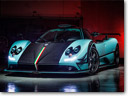
    Every Pagani begins with an aesthetic shock. Utopia radiates simplicity. It asserts itself straightaway, affirms and imposes its lines, which are so typical of Pagani but at the same time it is so different from anything they have offered us before. A shape that is more flowing and curvaceous. From the windscreen, with its rounded upper edges, to the details of its wings and bonnet, its softer contours give it a new expression, a new outline. A shape smoothed and refined over a long time, but which sticks in your memory from the first time you see it. The most difficult part of the process for Pagani has been to follow as closely as possible the original intention of creating a timeless design object, instead of one that follows the fashion of the period.

    The new car has very few aerodynamic add-ons yet is more efficient than ever. Where some hypercars have a multitude of spoilers, Utopia incorporates the function of these appendices into its overall shape, achieving greater downforce and reduced drag solely by means of its design.

    The details of its styling are few in number, but each is so carefully executed that it can be admired in its own right: technologically advanced, their shape is inspired by objects from the 1950s like the streamlined headlamps of Vespa scooters or the fittings of Riva speedboats. The forged wheels have a turbine-shaped carbon fiber extractor which draws hot air away from the brakes and reduces turbulence under the body. Mounted on carbon-ceramic discs, the brake calipers have a new, lightened design.

    The role of Pirelli tires is to transfer the exuberant torque to the ground efficiently and bring the finishing touches to the car’s exceptional road feel, thanks to the unusually large 21” wheels in the front and 22” wheels in the rear, which triggered new creativity and distinguishing design freedom on the surrounding bodywork. The silhouette of Utopia can be seen on their sidewalls, demonstrating just how much they have been specially developed for this car.

    The side mirrors, as if suspended in mid-air, thanks to the airfoil-shaped support are set apart from the body for better aerodynamic penetration, showing the meticulous optimization that was carried out on them in the wind tunnel. The rear lights float at the sides of the rear wings, set into the air extractors. Each part of them, so beautifully crafted, could be displayed in the window of a jeweler’s shop.

    The titanium quad exhaust, a personal monument and signature of the brand, is still present. It has a ceramic coating, in order to dissipate the heat efficiently, but still sets the weight just above 6 kilograms for the complete system.

    A GLANCE TO THE FUTURE, A TRIBUTE TO THE PAST

    A car may be compared to a sculpture, but opening the door changes everything; a sculpture, yes, but one you can sit in. The interior of Utopia is even more original, if that is possible, than its exterior shape.

    Neither modern nor retro, it is timeless. There are no screens apart from the minimal display in front of the driver; big screens would have been easier to fit and would have saved a lot of effort in the design, but it would have taken away much of the beauty. All the instruments are purely analog and each of the easy-to-read dials subtly reveals part of its mechanism as if it were revealing the skeleton movement.

    For Pagani, every component needed for the car to function is an opportunity to be creative. Even the steering wheel has been reinvented: it is fashioned from a solid aluminum block, from the spokes and hollow rim to the steering column boss, which contains the airbag. The pedals are also made from a single block of metal, while the gear lever mechanism is still exposed but more sophisticated than ever. All this with proper obsession paid to ergonomics, efficiency and ease of access.

    WHAT MAKES IT WHAT IT IS

    To reach this very simple final shape, the process has never been as complex. For six years, from the first sketches and computer calculations until the definitive shape was frozen for the carbon fiber molds, its internal airflows were perfected through endless hours of research in the wind tunnel and countless changes, one touch at a time. Utopia takes advantage of the mysteries of aerodynamics to maximize sure-footed handling and stability at any speed, however high. Its active aerodynamics, combined with the electronically controlled shock absorbers, ensure the optimum dynamic behavior in all driving conditions. The double-wishbone suspension, made from aerospace aluminum alloy, benefits from the lengthy development work carried out on the R, the track-only version of the Huayra. But Utopia, a car designed for road use, can cope with surfaces for daily use.

    The carbon monocoque used on previous Pagani models sets the standard in terms of its strength, lightness and build quality. Pagani has chosen to consolidate its existing strengths, to improve how its fibers are woven and to constantly invent new composite materials such as Carbo-Titanium and Carbo-Triax. On top of that, a new type of A-class carbon fiber has been developed specifically for aesthetic applications such as the bodywork, providing 38% of additional stiffness with the same density.

    A high-performance car must not only please its buyer, but support them and provide all the safety they require, without their need to ask or worry about it. Many exemptions are granted to very low-volume manufacturers, but Pagani made it a point of honor – once again – to build its cars and meet the most stringent regulations in the world, in every respect, starting with safety. Utopia passed more than 50 severe crash tests, from development to pre-tests and homologation approval, to reach its global certification.

    AT YOUR SERVICE

    The Pagani V12 engine, a 6-liter biturbo specially built by Mercedes-AMG for Pagani, is the result of an enormous development work: it delivers 864 bhp and, above all, a prodigious 1100 Nm of torque. It revs higher and is both more flexible and more powerful while meeting the most stringent emissions regulations, including those in force in California.

    For the transmission the choice was a philosophical one. It would not be a dual-clutch transmission which is efficient, but heavy and robs the driver of the ability to set the pace of the car’s acceleration. Instead, Pagani turned to the most prestigious motorsport and high performance automotive transmission manufacturer, Xtrac, to develop the quickest shifting gearbox with helical gears possible. It is compact, light and transversely mounted for an optimized center of gravity.

    Moreover, in order to best match the wishes expressed by Pagani enthusiasts, its aficionados, a virtual manual would not be acceptable so a real seven-speed manual transmission has been developed. It was not an easy task to design such a gearbox with synchronizer rings and a mechanism able to handle 1100 Nm of torque adequate for a pure manual application, but it was an essential requirement for Utopia.

    However intelligent automatic transmissions may have become, nothing can replace the driver’s own mastery of the gearchanges: the prevailing logic is his alone, each change up or down is totally unique and depends solely on his decision and good judgment, the exact combination of circumstances, the nature of the road and the mood of the moment.

    THE STARTING POINT

    As we discover his latest work, it is the path taken by its creator that fascinates us. Horacio Pagani builds the cars he has dreamt of. And it is to fulfill his highest aspirations, those closest to the impossible, that, as a very conscientious engineer, he seeks to serve the dreamer. In the land of dreams, you need a guide: the great Leonardo da Vinci has always been a crucial figure for Pagani. It is under Leonardo’s aegis that he has always believed that it is possible to combine art and technology.

    Can you think of any more demanding mentor? An artist and an inventor, Leonardo, one of the greatest portrait painters of all time, was also interested in anatomy. It is not the case for Horacio to compare himself to the Florentine genius but of following his path: Leonardo constantly combined technical inspiration with his love of beautiful shapes.

    Horacio Pagani is an artist, the car is his preferred way of expressing himself. When he draws something, however beautiful it is, the shape he creates is the result of the function it will perform. For him, a shape cannot be elegant if it is technically incorrect. And when the technical difficulty has been overcome, its beauty can be found in its solution.

    Horacio has always gone about things in the same way, that is just how he is: the creativity and the act of solving real problems, take the shape in him of an expression of painting or poetic harmony. He has always been a composer, and for a long time as a designer he was a soloist, but now he has become a conductor and has learned to see his ideas carried out by his team – young men and women who will then contribute with their own ideas to the common masterpiece, and on which he can put his signature with pride.

    NEW STRENGTHS

    From its origin, the situation has changed considerably; the firm was self-sufficient in 1999, with just 25 employees in total and so much to be done; but this is no longer appropriate. Pagani, a function-focused company, remains essentially a family-sized business but today employs 180 staff. Engineers specializing in all fields, designers and highly qualified technicians occupy the Art & Science Research Center, where the Zondas originally came into being, whereas the new facility is home to the production process. Turning out 50 cars a year, it is closer to a sartorial atelier than an assembly line.

    Nearly 25 years ago, the Zonda was designed and built by a very small team with few resources. Imagine what an intuition can grow into, nurtured and developed by the new strengths Pagani Automobili now possesses. Whatever the decision, whatever the direction its creative ideas may take, this little company is capable of realizing them, quickly and well, with an unrivaled standard of quality. Its design, prototyping, development and production work is worthy of the top racing teams, but at the service of limited-production cars. The first series of Utopia coupés, which have already been assigned to privileged enthusiasts, will be built in 99 units.

    TECHNICAL SPECIFICATIONS

    DRY WEIGHT 1.280 Kg (2822 lb)
    POWER 864 HP (635 kW) at 6000 RPM at 18 °C
    TORQUE 1100 Nm from 2800 RPM to 5900 RPM
    ENGINE Pagani V12 60° 5980 cc twin turbochargers, developed on a bespoke basis by Mercedes-AMG
    GEARBOX Pagani by Xtrac 7-speed transversal AMT (Automated Manual Transmission) or pure manual, with electro-mechanical differential
    CHASSIS Monocoque in Pagani Carbo-Titanium HP62 G2 and Carbo-Triax HP62 with front and rear tubular subframes in CrMo alloy steel
    SUSPENSIONS Forged aluminum alloy independent double wishbone with helical springs and electronically controlled shock absorbers
    BRAKES Pagani by Brembo 4 ventilated carbon-ceramic discs brake unit, 410×38 mm with 6 pistons monolithic calipers at the front
    and 390×34 mm with 4 pistons monolithic calipers at the rear
    WHEELS APP forged monolithic aluminum alloy, 21” at the front and 22” at the rear
    TYRES Pirelli PZero Corsa 265/35 R21 at the front and 325/30 R22 at the rear; Pirelli SottoZero for driving in low temperatures

    Engine

    • New Pagani V12 60° 5980 cc twin turbochargers, developed on a bespoke basis exclusively for Pagani by Mercedes-AMG
    • 864 HP / 852 BHP (635 kW) at 6000 RPM
    • Max torque of 1100 Nm from 2800 RPM to 5900 RPM
    • New valvetrain system to take the limiter to 6700 RPM
    • Dry weight: 262 kg / 577 lb
    • 3 vehicle prototypes dedicated to the engine development for almost 2 years
    • Compliant to all global emissions regulations

    Trasmission

    • Pagani by Xtrac 7-speed transversal gearbox, to transfer all the power and the exceptional responsiveness of the Pagani V12 to the road
    • Specific gear ratios for the driving dynamics of Utopia
    • New triple plate clutch system with increased diameter for a better torque transfer, an electronically managed differential and a racing derived tripod- axis drive shaft system
    • The transversal architecture contributes both to the overall weight reduction, as well as to the reduction of the polar inertia to significantly limit the unwanted oversteer, a dangerous behavior typical of mid-engine cars
    • Also available in a manual version for a driving experience in the name of mechanical purity

    Aerodynamics

    • Preliminary evaluations, both overall as well as in detail via CFD analysis, getting to analyze hundreds of numerical configurations
    • Wind tunnel model with fully working suspension, consisting of almost 700 individual components
    • Numerous wind tunnel sessions to acquire and validate CFD data, in order to optimize the handling of the car in various set-up conditions
    • Without the need for aerodynamic add-ons, Utopia incorporates the function of these typical appendices into its overall shape for greater downforce and a reduced aerodynamic drag coefficient
    • Aerodynamic balance of 46-54% throughout the entire speed envelope
    • Front splitter developed to generate downforce through a dedicated airfoil profile
    • Aerodynamic ducts perfectly integrated within the bodywork components
    • Cooling solutions for the highly energized flow braking system for discs, calipers and pads, hence allowing repeatability of braking performance for an extended period of time
    • Rear extractor to generate downforce with minimum resistance
    • Active suspended aero on the rear, integrated within the elliptical design of the bonnet and combined with the electronically controlled suspension, to gain maximum stability in every driving condition
    • Goal to achieve a predictive handling, by reducing the sensitivity to the ground clearance in order to increase driving safety

    Chassis

    • Monocoque chassis made with the latest generation of composite materials including Carbo-Titanium HP62 G2 and Carbo-Triax HP62, complete with a perfectly integrated rollover bar imbedded within the roof structure
    • Unique design to provide a spacious environment and integrate the dashboard
    • Torsional rigidity increased by +10,5% compared to previous Pagani road legal vehicles
    • Front and rear tubular subframes in Chromium- Molybdenum alloy steel (CrMo)

    Suspension

    • Developed with optimized elasto-kinematic for the road and intensively tested thanks to the laboratory that is the Huayra R, to ensure the maximum driving stability
    • Made of forged aluminum alloy, with independent double wishbone with helical springs and coaxial shock absorbers
    • Semi-active shock absorbers designed to attack curbs and be rigid under braking conditions on the circuit, but at the same time comfortable when driving on the road thanks to the different driving modes
    • Integrated vehicle dynamic control unit for the simultaneous management of all active controls, including the electro-assisted steering box

    Brakes

    • Braking excellence guaranteed by the newly developed ventilated carbon-ceramic discs system by Brembo
    • Cooling with highly energized air flow for the discs, calipers and pads, so as to allow repeatability of braking for an extended period of time
    • Diameter 410 x 38 mm with 6-piston monolithic caliper at the front
    • Diameter 390 x 34 mm with 4-piston monolithic caliper at the rear
    • Combined with the latest generation ESP 9.3 system developed with Bosch

    Wheels and Tires

    • APP Tech monolithic rims made from forged aluminum alloy, with dimensions 21’’ on the front and 22’’ on the rear
    • Unique dimensions, which triggered a distinguishing design freedom on the surrounding bodywork
    • Exclusive tires developed with Pirelli, through state of the art simulation and construction processes to transfer the exuberant torque output to the ground efficiently
    • Pirelli PZero Corsa 265/35 R21 on the front and 325/30 R22 on the rear, to offer the comfort of a driving on the road and a balanced grip for high performance conditions at the same time
    • Pirelli SottoZero 265/35 R21 on the front and 325/30 R22 on the rear for driving in winter conditions

    Interior

    • Meticulousness of details inversely proportional to the size of the elements; large simple pieces, small pieces full of refinements to be discovered over time
    • A philosophy that goes against the main trends of the time, there are no digital screens apart from the minimal display in front of the driver
    • Instruments purely analog and each of the easy-to- read dials subtly reveals part of its mechanism as if it were revealing the skeleton movement
    • Steering wheel machined from a single block of aluminum: simplification and reduction of components, with a display of construction technologies and uniqueness
    • References to technical and aesthetic solutions of the ‘50s and ‘60s, both from the world of leather goods and horology
    • Integration of a luminous aura that creates a pleasant and relaxing environment, while at the same time, emphasizes the components as works of art
  • Pagani Huayra Codalunga, Grandi Complicazioni On Wheels

    2022 Pagani Huayra Codalunga - Front View

    Automobili is delighted to present the latest bespoke creation from Horacio Pagani: the Huayra Codalunga, a limited edition of just five vehicles, produced in close collaboration with clients. Beneath the elegant and sinuous shape lies state-of-the-art Pagani mechanical engineering. Approved for road use all over the world, the price of this new hypercar starts from € 7 million.

    A collaborative project, bringing together many hearts and minds…

    “A client is not someone who only buys from you once. A real client comes back again and again” – Horacio Pagani, Founder & Chief Designer, Pagani Automobili.

    In 2018, two Pagani collectors asked Horacio to produce a long-tail version of the Pagani Huayra Coupé, with the idea of creating an elegant hypercar with a clean and streamlined design, a model which would feel at home on the roads as well as on display at international Concours events.

    The clients, who had been actively involved in the development of the project, liaised directly with Pagani Grandi Complicazioni, the re-branded Special Projects division, that focuses on creating one-offs and few-offs vehicles.

    “There are virtually infinite possibilities for designing and customizing these vehicles. Each project is the culmination of a long and thorough journey, working with the client to interpret their preferences and desires, with a shared ambition and combined effort from everyone to create a work of art befitting the Pagani name. A cross-functional team has supported the project meticulously from creation through design and development, to help us realize our clients’ vision.” Lorenzo Kerkoc – Head of Pagani Grandi Complicazioni.

    A considerable undertaking

    Even though the project is limited to just five units, significant resources have been deployed to create a hypercar that would comply with global regulatory requirements and be fully certified.

    In line with the Pagani philosophy, the Huayra Codalunga was designed down to the smallest detail in accordance with the creative principles of the great polymath Leonardo da Vinci, an inexhaustible source of inspiration, according to which Art and Science can exist in perfect harmony.

    It took two years of working closely with the client to finalize the styling concept. Two models were built, one at 1:4 scale and the other full size, used for the latest considerations with clients and last refinements before starting production of all necessary components.

    “All Pagani projects are born from visions and dreams, and some of the most iconic and exclusive Pagani cars stem from the vision and dreams of clients. In 2009, this led to one of the most iconic Zonda models, the Zonda Cinque. Pagani Automobili is capable of developing these bespoke projects for single clients, much like the Coachbuilders in the ‘60s, but in compliance with today’s international homologation requirements. Specifically, one of the five cars will be certified for the U.S. market*. Pagani Grandi Complicazioni is able to deliver series production quality for ultra-exclusive pieces.” Hannes Zanon – Commercial Director

    “Less is more”

    “We decided to use the simple linear style of the Huayra Coupé as the starting point. We made the Huayra Codalunga longer and smoother, as if it had been caressed and molded by the wind, to design lines that were even more elegant than the coupe. We drew inspiration from the long tails of the 1960s that raced at Le Mans, which had very clean lines. The Huayra Codalunga comprises very few essential elements; we have taken away rather than added. Simplifying is not at all straightforward, and this vehicle is, above all, the result of a complex pursuit of simple ideas.” – Horacio Pagani.

    The coachbuilders of the ‘60s were inspired by aircraft designs and, in a relentless quest for speed and low drag, created some of the most iconic shapes in the automotive history. At the time, large body panels created by hand in aluminum alloy were the result. Today, Pagani uses its know-how in advanced composite materials to create a bodywork that follows this inspiration.

    The rear engine cover, which has a footprint of more than 3.7 m2, and is 360 mm longer than the one of the Huayra Coupé, conceals a mechanical prodigy: the Pagani V12, which, on this series, is capable of developing 840 HP with 1,100 Nm of torque.

    The lack of rear grilles makes space for an unobstructed view of the Codalunga’s exhaust system, which is made from titanium and weighs only 4.4 kg (9.7 lb). The special ceramic coating completes the homage to the racing cars of Le Mans and the symphony that emanates from the signature four tailpipes is a tribute to automotive passion.

    The work “to take away rather than add” resulted in a record weight of just 1,280 kg  (2,822 lb) and extremely high aerodynamic efficiency, helped by the car’s shape and extra length. The four flaps with variable profiles represent the very latest in active aerodynamics, a feature which had its world preview in 2011 and which has been subsequently refined with each model.

    Trim

    “The colors and materials also recall the cars of the 1960s. The paint on the outside blends into elements of the cockpit while structural parts retain their exposed carbon fiber finish. The artisan touch can also be seen on the internal finishes with woven aged suede leathers.” – Alberto Piccolo, Concept and Interior Designer, Pagani Automobili.

    On this special model, the choice was made to use neutral colors and semi-matte or fully matte paints, to evoke the shades of the past and to bring out the simplicity of the car’s design. This concept also plays a fundamental role on the inside, where the seats are finished with a woven leather/nubuck upholstery and aluminum components are machined from a single block. This recalls the manual techniques of the past, when the artisan would polish each element by hand. Work which is still performed today, a tradition kept alive by the experts in the center of the world sports car industry, Italy’s Motor Valley.

    https://www.youtube.com/watch?v=TtbQxdghrvw

    Technical Specifications

    ENGINE Pagani V12 60° 36 valves 5,980 CC, twin turbo
    POWER 840 CV (618 kW) at 5,900 rpm
    TORQUE 1,100 Nm from 2,000 rpm to 5,600 rpm
    TRANSMISSION Pagani by Xtrac, transverse mounted 7-speed sequential
    BRAKES Pagani by Brembo carbon-ceramic self-ventilated disc brakes: diameter 410 x 38 mm with 6-piston one-piece calliper at the front; diameter 390 x 34 mm with 4-piston one-piece calliper at the rear
    WHEELS One-piece APP Tech in forged Avional, 20” at the front and 21” at the rear
    TYRES Pirelli PZero Corsa 265/30 R20 at the front and 355/25 R21 at the rear; Pirelli SottoZero for driving in low temperatures
    SUSPENSION Active forged aluminium alloy, independent double wishbone with variable-pitch helical springs and coaxial dampers
    CHASSIS Carbon-Titanium HP62 G2 and Carbon-Triax HP62 monocoque
    DRY WEIGHT 1,280 kg (2,822 lb)
  • SS Customs Releases One-Off Pagani Huayra

    SS Customs Pagani Huayra Rear Angle2015 SS Customs Pagani Huayra is definitely one-off. Why I am sure of this? First, it is a Huayra and we don’t see these rolling on the streets very often. Secondly its exterior has been updated by the specialists at SS Customs. Lately, they have become popular with their TeslaVets Model S car, which has received unique treatment and looks like no other second car in the world.

    With this Pagani the situation is the same and therefore the tuning studio was obliged to make a photoshoot to remember. As a result, they contacted the well-known Richard Le Photography & Desing studio. In fact, the TeslaVets was also shot by this photographer.

    SEE ALSO: TeslaVets by SS Customs Receives One-Off Photoshoot

    So, what’s the “thing” about this Huayra. We have to disappoint you by saying that there are any modifications or any aero kit added. There is nothing touched in terms of mechanics or upgrades for the output of the engine.

    SS Customs Pagani Huayra front

    However, the exterior of the supercar looks much different from what it used to be. The SS Customs experts have wrapped many parts of car’s body in a satin black chrome foil and have then accented it with red striping. The one-off design of the car has been rounded out by the many carbon fiber elements and the black seven double-spoke alloy wheels.

    The Huayra is powered by a 6.0 liter bi-turbo V12 engine, producing 710PS (522 kW) and 1000Nm (737 lb-ft) of torque. The engine is mated to an XTRAC 7-speed sequential transmission. The overall weight of the original Huayra is 1 350 kg (2 975 lb), so it is no surprise that it covers the 0-100 km/h acceleration sprint in 3.3 seconds on its way to a top speed of 370 km/h (230 mph).

    Source: SS Customs & Richard Le Photography via Facebook 

  • Pagani Reveals One-Off Zonda 760RSJX

    Pagani-Zonda-THUMBPagani Zonda is not only still alive but it obviously prospers in China. In particularly – in Hong Kong. The absolutely one-off 760RSJX model has just been revealed through the facebook site or the photographer Ron Alder W Photography. Previously dubbed as Pagani 760X, this new and extreme sportscar was specifically made for a customer living in the megapolice. The car is based on the 760 series, which means that it is powered by the mighty V12 7.3-liter engine.

    The output of the unit is estimated at 760 horsepower (559 kW) and 1,000Nm (737 lb-ft) of torque. The engine is mated to an XTRAC 7-speed sequential transmission. Acceleration is staggering: 3.3 seconds for the sprint from 0 to 100 km/h. The top speed is of 370 km/h (230 mph).

    This car is unique due to the one-of-a-kind paint finish it has called “pastel green”. Of course, the same design and color theme is applied inside where there have been implemented an extensive use of carbon fiber. The same hue is used for the brake calipers.

    We have mentioned carbon fiber but we forgot to mention (if you haven’t seen it yet) that it has been also used in large amount through out the exterior.  Just take a look at the front end, the reat and the spoiler above the rear diffuser.

    Source: Pagani via Ron Alder W Photography Official Facebook Page

  • Pagani Huayra La Monza Lisa

    Pagani has presented Huayra La Monza Lisa Special Edition. The model is produced exclusively for an American customer, who obviously wants his vehicle to be unique. This is the first time then Italian manufacturer builds a special model. The Huayra La Monza Lisa Special Edition is prepared for Kris Singh, a wealthy businessman and a car collector from Miami Beach, Florida, USA.

    The exterior boasts a unique bodywork in a fully-exposed carbon fiber. There is also Italian flag livery similar to that of Zonda Revolucion. There are also polished alloy wheels with detailed Pirelli word on the tyres. The owner also get a second set of black Zonda R wheels.

    The original Huayra is powered by an AMG 6.0 liter twin-turbo V12 with 710HP (522 kW) and 1,000Nm (737 lb-ft) of torque. The engine is mated to an XTRAC 7-speed sequential transmission. Acceleration – 0-100 km/h in 3.3 seconds and a top speed of 370 km/h (230 mph). However, this one has some modifications, but no official figures has been unveiled.

    The most unique feature of Huayra La Monza Lisa is that the car is signed by the whole Pagani team who worked on it, including Mr. Horacio Pagani.

    Pagani Huayra La Monza Lisa picture 01

    Pagani Huayra La Monza Lisa picture 02

    Pagani Huayra La Monza Lisa picture 03

    Pagani Huayra La Monza Lisa picture 04

    Source:Lovecars

  • Pagani Zonda S 7.3: Taking a Drive with Horacio Pagani [video]

    XCAR has published an awesome video featuring Horacio Pagani, who drove Zonda S 7.3. This particular car is the 6th Zonda ever made by Pagani and the first ever to be exhibited at the Geneva Motor Show. Mr. Pagani explains that even though the hyper car is extremely powerful, it is very nice and easy to drive.

    The engine is an AMG-sourced 7.3 liter V12 – 555HP (408 kW) at 5,900RPM and 750Nm (553 lb-ft) of torque at 4,050RPM. The dry weight is just 1,280 kg, so the power to weight ratio stands at 2.3 kg/HP. 0-100 km/h in 3.7 seconds and a top speed of 354 km/h (220 mph).

    Pagani has officially ended the production of Zonda and now the manufacturer is focusing on the sensational Huayra.

    Enjoy!

    httpv://www.youtube.com/watch?v=-TZDObzHRc4

    Source: XCAR via Youtube

  • Top 10 Naturally Aspirated Engines

    Let’s check out the highest specific engine output or in other words power / unit displacement. Of course, we will take a closer look only for series production cars powered by naturally aspirated engines.

    10th Place: Audi R8 GT – 5.2 liter V10 FSI – 560HP (412 kW) and 540Nm (400 lb-ft). 0-100 km/h in 3.6 seconds, 0-200 km/h in 12.3 seconds and a top speed of 320 km/h (199 mph). The specific power / unit displacement is 108HP / liter.


    9th Place: Lamborghini Gallardo LP570-4 Superleggera – 5.2 liter V10 – 570HP (419 kW) and 540Nm (400 lb-ft). 0-100 km/h in 3.4 seconds, 0-200 km/h in 12.0 seconds and top speed of 324 km/h (201 mph). The specific power / unit displacement is 110HP / liter.

    8th Place: Ferrari 599 GTO – 6.0 liter V12 – 670HP (493 kW) and 620Nm (459 lb-ft). 0-100 km/h in 3.4 seconds and a top speed of 335 km/h (208 mph). The specific power / unit displacement is 112HP / liter.

    7th Place: Lexus LFA – 4.8 liter V10 –  560HP (412 kW) and 480Nm (356 lb-ft) of torque. 0-100 km/h in 3.7 seconds and a top speed of 325 km/h (202 mph). The specific power / unit displacement is 117HP / liter.

    6th Place: Porsche 911 GT3 RS – 3.8 liter flat-six – 450HP (331 kW). 0-100 km/h in 3.6 seconds, 0-200 km/h in 13.3 seconds. Top speed 310 km/h (193 mph).  The specific power / unit displacement is 118HP / liter.

    5th Place: Ferrari F12 Berlinetta – a 6.3 liter V12 engine – 740HP (544 kW) and 690Nm (509 lb-ft). 0-100 km/h – 3.1 seconds and 0-200 km/h in 8.5 seconds. The top speed is over 340 km/h (211 mph). The specific power / unit displacement is 123HP / liter.

    3rd Place: Pagani Zonda R – 6.0 liter V12 – 750HP (551kW) and 710Nm (526 lb-ft).0-100km/h in 2.7 seconds and the top speed is over 350km/h (218 mph). The specific power / unit displacement is 125HP / liter.

    3rd Place: Honda S2000 – 2.0 liter I4 – 250HP () and 218Nm (161 lb-ft). 0-100 km/h in 6.2 seconds and a top speed of 240 km/h (149 mph). The specific power / unit displacement is 125HP / liter.

    2nd Place: Ferrari 458 Italia – 4.5 liter V8 – 570HP (419 kW) and 540Nm (399 lb-ft). 0-100 km/h in 3.4 seconds a top speed of 325 km/h (202 mph). The specific power / unit displacement is 127HP / liter.

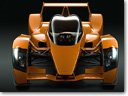
    1st Place: Caparo T1 – 3.5 liter V8 – 575HP (423 kW) and 420Nm (311 lb-ft).0-100 km/h in 2.5 seconds and a top speed of 330 km/h (205 mph). The specific power / unit displacement is 164HP / liter.

  • BAC MONO isn’t Faster Than Pagani Huayra at Top Gear’s Race Track

    Briggs Automotive Company (BAC) almost break the record for lapping BBC Top Gear’s test track at Dunsfold, Surrey with their MONO.

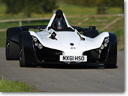
    BAC MONO managed to lap the circuit in just 1 minute and 14.3 seconds, which is faster than everything except the mighty Pagani Huayra, which did the lap in 1 minute and 13.8 seconds. The MONO is powered by a 2.3 liter naturally aspirated Cosworth engine with 285HP (209 kW) mated to a 6-speed sequential gearbox from Hewland. The power is transmitted to the road through an LSD (limited-slip differential) on the rear wheels. 0-100 km/h in 2.8 seconds, 0-160 km/h in 6.7 seconds and a top speed of 273 km/h (170 mph). All this numbers are thanks to the staggering power to weight ratio – 520BHP per ton.

    The tires of the performance machine are coming from KUMHO. The version is a street-legal V70A competition tyre especially developed for the BAC, which rides on 205/40 R17 at the front and 245/40 R17 on the rear.

    The price is €91 998.

    Bonus: Sabine Schmitz vs Ron Simons

    http://www.youtube.com/watch?v=IZMSoQJlSSw#at=594

    Source: BAC

  • Pagani Zonda Revolucion – Price €2,200,000

    Pagani has announced the Zonda Revolucion Special Edition, which will be the last Zonda ever produced. As such, it has a price tag of whopping €2.2 million.

    The Pagani Zonda Revolucion is the apex of the celebration of performance, technology and art applied to a track car. Horacio Pagani and his team have created a car designed to amaze both on the track and in a car collection.

    The hyper-car is powered by the well-known 6.0 liter V12 from AMG – 800HP (596 kW) and 730Nm (538 lb-ft) of torque. The curb weight is just 1,070 kg (2,359 lbs), which means a power-to-weight ratio of 748 HP/ton.

    The 6 speed magnesium transversal and sequential gearbox changes gears in 20ms. The traction control developed by Bosch with 12 different settings and the renewed ABS system, allows the driver to adapt the behavior of the car to his driving style.

    Other special features include new deflectors on the front hood and a vertical stabilizer on the rear hood. There is also a special rear wing with an F1-inspired Drag Reduction System (DRS) with two operating mods.

    The brakes are Brembo with F1 tech-derived CCMR discs that are 15% lighter than the previous. They also provide increased stiffness and lower operating temperatures. The manufacturer says that these discs can last up to four times longer than their predecessors and provide stronger braking power.

    We are expecting soon a hot lap around the Nurburgring, so stay tuned!


    Source: Pagani

  • Pagani and Sonus Faber Create High-End Huayra Audio System

    paganihuayrasonus-faber-THUMBAt this year’s Geneva Motor Show was made a very interesting announcement of a collaboration between the high-end luxury audio speaker manufacturer Sonus Faber and sports car manufacturer and design atelier Pagani. Both companies have joined forces and have created in co-design an exclusive premium high-end audio system for the Pagani Huayra.

    This was the first step of the beginning of a partnership between two iconic Italian brands. Furthermore, the vehicle – Pagani Huayra, has been adored so far because of its exceptional attributes. For instance it delivers smooth supple ride, has light cabin interior and confident and inspiring handling.

    Therefore, the new high-end audio system only enhances the unique nature of the car. Sonus Faber stepped in and gave all of its music reproduction skills for this supercar challenge: from the immutable harmony of interiors to the rhythm “on the road”.

    The leading leitmotiv in the working process was “power versus featherweight”. Yes, this basically means that carbon fibre is involved. In fact, carbon cones have been developed, marrying extreme rigidity to lowest weight, inspired by the Carbo-Titanium nature of Huayra.

    Neodymium magnets were also utilized in order to bring about highest performance and lightest weight possible. In addition, Sonus faber audio system provides an amplifiers’ structure which offers a total amount of 1.200 Watt power output.

    What is more, when the AMG V12 engine under the hood of this Pagani isn’t working, a Digital Sound Processor creates a refined atmosphere where both driver and passenger can enjoy hearing a rich sound experience. There is even more to that, the same system – the DSP, allows the whole sound to be uniquely customized according to customer’s own musical taste. He or she for example can transcendent the Huayra cabin into a concert hall, stadium, or whatever environment they seek.

    The baskets of the bespoke speaker units is made like the technology developed for the most extreme Sonus fabers loudspeaker systems, such as the Aida and “The Sonus Faber” itself. This means that it includes a vibration-free CNC made hybrid avional/gunmetal structure. Speakers on the other hand have diaphragms made in a special ultra light carbon fibre, which was enhanced for acoustic applications.

    Source: Pagani

  • Pagani Zonda 764 Passione – Powerful than Zonda R

    Zonda has presented the new 764 Passione in the company’s showroom. The car will be probably the last Zonda, which the manufacturer will ever produces, because there are no more AMG source engines for these hyper cars.The 764 Passione has a grey carbon fiber finish with light grey tailpipes. The car has the same body kit, unlike the two previous 760 Zonda models. The Passione has a set of black wheels and comes with a purple-pink interior cabin.All special features complete the nice and aggressive look of the vehicle.The engine is the well-known 7.3 liter naturally aspirated V12 with 760HP (558 kW), which is 20HP (15 kW) more than the Zonda R and whole 90HP more than the Cinque model. The engine is coupled to the same manual transmission as the one in the Zonda 760LH – Lewis Hamilton.Nothing is mentioned about the pricing.

  • Pagani Huayra will hit the US market in 2013

    Pagani will sell their hyper car – the Huayra in the US in few months. The astonishing vehicle is expected to hit the US market in June 2013 priced from whopping $1 368 800. The manufacturer will spend an additional $5 100 000 to install smart airbags that satisfy U.S. regulations.

    Pagani Huayra is powered by AMG 6.0 liter twin-turbo V12 with 710PS (522 kW) and 1000Nm (737 lb-ft) of torque. The engine is mated to an XTRAC 7-speed sequential transmission. Acceleration – 0-100 km/h in 3.3 seconds and a top speed of 370 km/h (230 mph).

    Pagani will produce only 15 unit for the US market, which is hardly cover the investment for the airbags, but probably the manufacturers have something in mind.

    So, if you have a spare $1.5 million be hurry and order one of this masterpieces.


    Source: Motor Authority