Tag: MultiAir

  • Alfa Romeo Giulietta with TCT Transmission

    Alfa Romeo UK has announced the full specs and price list for the 2012 Giulietta TCT.

    The Alfa Giulietta is a 5-door hatchback offering cheap and stylish ride. The car is the safest car in its class. It also features award winning MultiAir engine technology, five star Euro-NCAP safety ratings, Alfa Romeo’s unique D.N.A system, and now, in 2012, the technologically advanced ALFA TCT semi-automatic transmission becomes available in the Giulietta range. 2012 Alfa Romeo Giulietta TCT starts at £21 855 OTR.

    There are two trim levels – Lusso or Veloce, and two engines: 1.4 TB MultiAir 170HP and 2.0 JTDM-2 170HP diesel.

    The TCT transmission offers sporty driving pleasure and reduces the fuel consumption a lot. The transmission works in either all-automatic or sequential mode, as required by the driver. The user can manually manage the up and down position of the accurate, ergonomic shifter, with which steering wheel shift paddles may be combined. In addition, the driver can customise the car’s dynamics using the Alfa D.N.A. driving selector to enhance its features of comfort, performance, safety and efficiency.

    The 1.4 liter TB MultiAir engine has 170HP enabling the car to accelerate from 0 to 100 km/h in 7.7 seconds and a top speed of 184 km/h (135 mph). The fuel consumption is great – 54.3 mpg UK with 121 g/km CO2.

    The 2.0 liter JTDM-2 diesel with 170HP is slightly slower – 7.9 seconds to 100 km/h, but the fuel consumption is better – 62.8 mpg UK with 119 g/km CO2.

    Alfa TCT uses dry clutches allowing, in addition to other advantages, natural integration with Start&Stop, a function which is not always available with traditional automatic transmissions, and which guarantees a further benefit in terms of fuel consumption, particularly around town.

    Lastly, a Wet automatic transmission requires approximately 4.8 litres more gearbox oil than a Dry version, again for reasons of clutch cooling. In this way, weight is added and losses are incurred due to an increase in splashing caused by the gears. When all these effects are combined, a Dry transmission, like the Alfa TCT, is found to be approximately 6% more efficient than the corresponding Wet one in terms of consumption.

    Check out the full pricing and specifications below.

    2012 Alfa Romeo Giulietta TCT
    2012 Alfa Romeo Giulietta TCT

    PRICING:

    Basic Price VAT Retail Price OTR Charges Total
    OTR
    BIK
    1.4 TB MultiAir 170 bhp
    ALFA TCT Lusso
    £17,707.89 £3,541.58 £21,249.47 £605.53 £21,855.00 15%
    1.4 TB MultiAir 170 bhp
    ALFA TCT Veloce
    £18,791.23 £3,758.25 £22,549.47 £605.53 £23,155.00 15%
    2.0 JTDM-2 170 bhp
    ALFA TCT Lusso
    £19,120.39 £3,824.08 £22,944.47 £605.53 £23,550.00 17%
    2.0 JTDM-2 170 bhp
    ALFA TCT Veloce
    £20,162.06 £4,032.41 £24,194.47 £605.53 £24,800.00 17%

    TECHNICAL DATA:

    1.4 TB MultiAir
    170 bhp
    ALFA TCT
    2.0 JTDM-2170 bhp
    ALFA TCT
    DIMENSIONS Seats 5 5
    Doors 5 5
    Length/width (mm) 4350/1798 4350/1798
    Height (mm) 1465 1465
    Wheelbase (mm) 2634 2634
    Front/rear track (mm) 1554/1554 1554/1554
    Boot capacity (dm3) 350 350
    Drag 0.31 0.31
    ENGINE Petrol Diesel
    No. of cylinders, arrangement 4 in line 4 in line
    Bore x stroke (mm) 72 x 84 83 x 90.4
    Displacement (cm3) 1368 1956
    Compression ratio 9.8:1 16.5:1
    Max power output: bhp (kW-EC) at rpm 170 (125) 5500 170 (125) 4000
    Peak torque: Nm (kgm-EC) at rpm (NATURAL mode) 230 (23.4) 2250 320 (32.5) 1500
    Peak torque: Nm (kgm-EC) at rpm (DYNAMIC mode) 250 (25.4) 2500 350 (35.6) 1750
    Timing Single overhead camshaft, 16 valves, toothed belt with hydraulic tappets and MultiAir direct lift/timing adjustment system Dual overhead camshafts,
    16 valves, toothed belt with hydraulic tappets
    Supply Electronic multipoint injection, turbocharger
    with intercooler
    MultiJet direct injection
    at 1,600 bar, variable geometry
    turbocharger with intercooler
    Stop&Start system for automatic engine stopping/starting for short stops, to optimise consumption and emissions of CO2 Standard Standard
    ELECTRICAL SYSTEM (12V) Battery: capacity (Ah) / Generator (A) 63 / 450 72 / 600
    TRANSMISSION Drive Front Front
    Gearbox Automatic/sequential with dry dual clutch Automatic/sequential with dry dual clutch
    First 1:4.154 1:4.154
    Second 1:2.269 1:2.118
    Third 1:1.435 1:1.361
    Fourth 1:0.978 1:0.978
    Fifth 1:0.754 1:0.756
    Sixth 1:0.622 1:0.622
    Reverse 1:4.000 1:4.000
    Final drive torque 1:4.118 1:3.579
    WHEELS Standard tyre size 205/55 R16 205/55 R16
    Standard rim size 7J x 16 7J x 16
    STEERING Steering system Rack and pinion with electro-mechanical power steering (Dual Pinion) Rack and pinion with electro-mechanical power steering (Dual Pinion)
    Turning circle (m) 10.9 10.9
    SUSPENSION Front MacPherson independent with anti-roll bar
    Rear Multilink system
    BRAKES – (DISCS) Front (mm) 305 305
    Rear (mm) 264 264
    WEIGHTS –TANK CAPACITY Fuel tank capacity (litres) 60 60
    Kerb weight DIN (kg) 1305 1335
    Max towable weight – Non-braked (kg) 500 500
    Max towable weight – Braked (kg) 1300 1300
    PERFORMANCE Top speed mph (kh/h) 135 (218) 135 (218)
    Acceleration 0-62 mph (s) 7.7 7.9
    Pick-up in top gear from 50 to 75 mph (s) 6.5 6.4
    FUEL CONSUMPTION – EMISSIONS (in accordance with 1999/100EC                                          directive) Urban cycle mpg (l/100km) 42.2 (6.7) 53.3 (5.3)
    Extra-urban cycle mpg (l/100km) 65.7 (4.3) 70.6 (4.0)
    Combined cycle mpg (l/100km) 54.3 (5.2) 62.8 (4.5)
    Exhaust emissions – CO2 (g/km) 121 119
    Emissions standard EURO 5 EURO 5
    Service (miles) 18,000 21,000

    Source: Alfa Romeo

  • Alfa Romeo at Geneva

    Alfa-Romeo-GiuliettaQV-thumbAlfa Romeo might not have much cars to show on the 2012 Geneva Auto Show (they have only two production vehicles at the moment) but they are betting on technology and choice. There will be four Giulietta models and three Mitto cars taking the stand. Some of them will feature the Fiat group 0.9 TwinAir Turbo “International engine of the year 2011”, many will be coupled with the Alfa TCT (double clutched transmission) and will also feature Distinctive and Quadrifoglio Verde trim levels.

    Alfa Giulietta

    Thanks to the TCT feature, a 1.4 TB MultiAir 170 HP Giulietta has the best efficiency-performance ratio in its category. It is basically a twin clutch automatic gearbox setup which allows downshifting or upshifting with either a gear lever or paddles behind the wheel. On top of that, one can further optimize the Giulietta’s road manners with Alfa’s DNA dynamic selector – a master switch of all the systems in the car. Have it on Dynamic and get ready to cut some apexes with vigor. Normal mode on the other hand provides you with an everyday driving set up and All-weather mode is for rainy or snowy surfaces with poor grip. Despite being capable of reaching 100km/h in 7.7 seconds, the Giulietta TCT MultiAir returns 5.2 l/100km in the combined cycle and emits 121 g/km of CO2

    Props also go to another Giulietta TCT which harbors a 170 HP 2.0 JTDM diesel engine. It does the 100km/h sprint in 7.9 seconds but offers even more economy – 4.5 l/100 km and 119 g/km of carbon dioxide emissions. To prove highlight the role of the TCT in these figures, Alfa say that the same car with a manual does 4.7 l/100 km and 125 g/km.

    A somewhat less powerful 120 HP Giulietta Distinctive 1.4 Turbo will also be present to restore equilibrium after the fury that will be the fourth Giulietta – 235 HP 1750 TBi Quadrifoglio Verde. That flagship trooper can shred its own tires with 340 Nm of torque as early as 1,900 rpm.

    Alfa Romeo Giulietta (QV)
    Alfa Romeo Giulietta (QV)

    Alfa Mitto

    The Mitto niche will be represented by three member – the 0.9 TwinAir Turbo that has only two cylinders yet delivers a maximum of 85 HP at 5,500 rpm and a torque of 145 Nm at 2,000 rpm. Basically this drivetrain, thanks to its cleverness, is capable of producing more torque and be cleaner and less thirstier than any other engine rated with that same power. This little bumble bee also comes with the Alfa DNA system and a Stop & Start function which helps with the urban frugality.

    The not-so-conscious about fuel economy can find paradise somewhere else. Why not start with the Mitto Quadrifoglio Verde with Alfa Active Suspension? It is all very complicated underneath – The suspension interacts with the braking system and steering to obtain more effective control of the dynamics of the vehicle or in other words it is a damn good fun this car. Only Alfas capable putting a smile on one’s face go under the Quadrifoglio Verde name. Noticeable differences from a stock model hide in and out. For example the rear-view mirror covers, the headlight and light cluster frames and the handles come with an exclusive satinised chrome material; a new sporty seat with a central part made of Alcantara. Things on the options list include 18” alloy wheels and sporty Sabelt seats with carbon fiber woven backrests.

    Under the hood, a 170 HP 1.4 MultiAir Turbo works its magic while we need to remember that this is the light and nimble Mitto we are talking about – 6.7 kg per a single horsepower, 0 to 100 km/h is done in just over 7 seconds.

    Last but not least, there will be a Mitto fitted with the same TCT equipment that comes with the Giulietta models. The engine is still 1.4 but with reduced power output and a Stop & Start system – a well rounded mid-range car with some extraordinary technology inside.

    Alfa Romeo Mitto (QV)
    Alfa Romeo Mitto (QV)

    Source: Alfa Romeo

  • Fiat Punto MY2012

    Fiat-Punto-MY2012-thumbThe MY2012 Fiat Punto range offers unrivaled diversity that is intended to fit every need a customer might have. New trim levels, exterior revisions, paint finishes and ten engine choices among which the brilliant TwinAir “International Engine of the Year 2011” are all in store for us in the coming year.

    Yes, the legendary 2 cylinder TwinAir drivetrain is set to join the lineup that Spring. Despite being only 0.9L big it develops 85 hp (supercharged) and 145 Nm of torque. The cost in carbon dioxide emissions for all of that stands at 98 g/km. But it’s not green just because it’s small. A clever button on the dashboard (it says Eco on it, It must be clever) allows the driver to change the switch the engine’s mode of working between normal and Eco with the latter one restricting torque output and thus becoming super economical. Stop&Start with Gear Shift Indicator technology is used in every single EURO5 engine throughout the Punto range. With it one can save up to 15% fuel in an urban area. Even more feats of greenness can be seen in the 85 HP 1.3 MultiJet 2 unit where two innovative systems (Intelligent Alternator and Intelligent Flow) work together along with the use of low-viscosity transmission oil to achieve stunning emission figures ( 90 g/km of Carbon Dioxide). The Intelligent Alternator system optimises the battery recharging strategy during the “engine cut-off” phases, while the Intelligent Flow represents an oil pump with variable displacement and it also does optimisation of the cooling circuit. Other than these, the list of engines goes on and one is unlikely to make a mistake no matter the choice:

    Petrol

    69 HP 1.2 8v E5 (with and without Start&Stop)

    77 HP 1.4 8v E5 Start&Stop (mechanical or Dualogic gearbox)

    105 HP 1.4 MultiAir 16v E5 Start&Stop

    135 HP 1.4 MultiAir Turbo 16v E5 Start&Stop

    Diesel

    75 HP 1.3 MultiJet 2 16v E5 (with and without Start&Stop)

    95 HP 1.3 MultiJet 2 16v E5 Start&Stop

    Bi-Fuel

    70 HP 1.4 8v petrol-methane E5

    77 HP 1.4 8v petrol-LPG E5

    In Italy, the Fiat Punto is sold in three lines: Comfort, Sport and Fun to Drive. Those lines have sub-levels. The Comfort splits into Pop, Easy and Lounge trim levels – dedicated to the traditional customer focused on comfort and style. The Sport line has the Racing and Sport trim levels – the Puntos are more dynamic and performance oriented. Then there’s the Fun to Drive which has the TwinAir trim level that is a sort of a tribute to the TwinAir engine. The trim is distinguishable by the glossy black pillars and mirror covers, special alloy wheels, 13 exterior colours, one of which is dedicated, Energetico Green, the exclusive glossy black roof option and special “Sportex” seat fabrics.

    Further on, throw in some revised front and rear bumpers with body coordinated finishes. Reposition the turning signals, refurbish the interior in some new upholstery and add to that two pairs of 15” alloy wheels and you have a MY2012. It still gets the heart pumping as if it is an absolute debut. We want one please.

    Fiat-Punto (2012)
    Fiat-Punto (2012)

    Source: Fiat

  • 2012 Fiat 500C

    Fiat has introduced the new 2012 500C (Cabrio) at the 2011 New York International Auto Show (NAIAS). The vehicle is based on the US version 500 Coupe and features a roof-mounted spoiler and a power-retractable soft top that can be lowered at speeds up to 60 mph (97 km/h).

    “Perfectly timed with the warm weather and excitement of spring, the new 2012 Fiat 500 Cabrio expands our product lineup while paying homage to the brand’s rich heritage of open-air cabrios that deliver style, value and driving enjoyment,” said Laura Soave, Head of FIAT Brand North America.

    “The new Fiat 500c has been intelligently tailored for our market – now with an added dose of sunshine and panoramic views at the push of a button.”, she added.

    2012 Fiat 500C US is powered by a 1.4 liter MultiAir engine with 102PS (75 kW) and 133Nm (98 lb-ft) of torque. The engine is available either with 5-speed manual or an optional 6-speed automatic gearbox. The all-new 6-speed automatic transmission has “Sport” mode, which enables quicker gear changes, a unique throttle map for improved engine responsiveness and allows each gear to be held for longer periods near the redline.

    The interior boasts air conditioning (AC), power windows and locks, a leather-upholstered steering wheel and Bluetooth/USB connectivity. The TomTom Navigation with BLUE&ME Handsfree Communication system has an innovative 4.3” (10.9 cm) screen on top of the new 2012 Fiat 500c’s instrument panel.

    500C is a small city car, so it has just 153 liters of luggage compartment, but it can be expanded to 663 liters with the rear seats folded down.

    2012 Fiat 500C will hit the US market this spring with a price tag of $19 500.

    2012 Fiat 500 Cabrio

    Source: Fiat

  • Abarth Punto Evo – True hot hatchback

    Abarth Punto Evo is powered by award-winning MultiAir 1.4 litre turbo engine featuring cutting edge technologies. The power unit combines performance and eco-friendliness. The numbers are astonishing – 0 to 62 mph in 7.9 seconds and still the car returns 47.1mpg on the combined cycle. And by employing Start&Stop and an in-cockpit Gear Shift Indicator (GSI) this Abarth both conforms to Euro 5 emissions regulations and emits a very un-performance car-like 142g/km of CO2.

    The sports package includes 17″ alloys, body coloured rear spoiler and side skirts, specially tuned race suspension and satin finish twin tailpipes. (more…)

  • International premiere for Alfa Romeo Giulietta hatchback at Geneva

    In Alfa Romeo’s Centenary year, the new Alfa Giulietta is the undisputed star of the Alfa Romeo stand at the upcoming Geneva Motor Show (4-14 March).  With the new car – capable of demonstrating great agility over the most demanding routes, and providing comfort on everyday roads – Alfa Romeo continues its custom of presenting new products and features in a world preview context.

    Designed by the Alfa Romeo Style Centre, new Giulietta is a five-door hatchback, with strong Alfa Romeo design cues, equipped with impressive dynamic capability for the most demanding routes, while providing comfort on everyday journeys. This is thanks to its new Compact platform which, in conjunction with the refined technical solutions employed for the suspension, the dual pinion active steering, and high quality materials and manufacturing technologies implemented, allows the Giulietta to achieve excellent performance both in terms of on-board comfort as well as dynamic and safety features (active and passive). (more…)

  • Fiat Punto Evo – Evolution Of The Species

    Think small cars and a string of super-successful Fiats should spring to mind: the ground-breaking 600, the trend-setting 127, the innovative Uno, and progressive Punto.

    The Fiat 127, first of the ‘superminis’, was voted Car of the Year 1972 and was destined to become Europe’s best-selling car, continuing in production until the introduction of the Fiat Uno in 1983, by which time a total of 5.6 million had been built.

    Compared with the 127, the Uno was some 6cm shorter and a similar amount taller. Voted Car of the Year 1984, it was also destined to be Europe’s best-seller, with no less than 2.5 million sold in just four years, and a total production run of more than six million. (more…)

  • Fiat Punto Evo to debut at the Frankfurt Motor Show

    Fiat Punto Evo will make its world debut at the forthcoming Frankfurt Motor Show, a debut destination for many car makers. The Punto Evo represents the evolution of the Grande Punto. With more style, safety and innovative features that ever, the new Fiat Punto Evo is destined to repeat the success of its predecessor. (more…)
  • New Multiair Technology: More Power, Less Fuel, Lower Emissions


    Multiair Technology

    Already a world leader in advanced diesel engine technology, Fiat Group has just launched MultiAir, a fundamental breakthrough in petrol engine design that will dramatically cut fuel consumption, as well as significantly boosting power and torque, cutting carbon dioxide emissions by between 10 and 25 per cent, and up to a 60 per cent reduction in other engine pollutants.

    With two generations of common rail direct injection diesel engine technology, UniJet and MultiJet, to its credit, Fiat has dramatically improved diesel engine performance, economy and emissions. Now, with MultiAir, Fiat has brought together the company’s enviable expertise and technology to make one of the single largest leaps forward for petrol engine design in recent times.

    In short, an engine equipped with Fiat MultiAir technology is more powerful, more responsive across the entire engine speed range, uses considerably less fuel, and reduces all types of exhaust emissions by a substantial amount. It will also assist in enabling Fiat to maintain its lead in low emissions and low fuel consumption technology, which has seen Fiat crowned for the past two years as the number one car maker for the lowest range-wide CO2 emissions.

    The first new engine to be equipped with MultiAir will be the 16-valve 1.4 litre family of naturally aspirated and turbocharged engines, and the first car to go on sale with MultiAir installed will be the Alfa MiTo at the end of 2009. Its second application will be as an integral part of a new two cylinder engine family.

    Development of the Fiat MultiAir system

    In the last decade, the development of Common Rail technology for diesel engines marked a breakthrough in the passenger car market. To be equally competitive in the field of petrol engines, Fiat Group decided to follow the same approach and focus on breakthrough technologies.

    The aim was to provide customers with substantial benefits in terms of fuel economy and driving pleasure, while maintaining the engine’s intrinsic refinement, based on a smooth combustion process and on light structures and components.

    The key parameter to control diesel engine combustion and therefore performance, emissions and fuel consumption, is the quantity and characteristics of the fuel injected into the cylinders. That is the reason why the Common Rail electronic diesel fuel injection system was such a fundamental breakthrough in direct injection diesel engine technology.

    However, the key to controlling petrol engine combustion, and therefore performance, emissions and fuel consumption, is the quantity and characteristics of the fresh air charge in the cylinders. In conventional petrol engines the air mass trapped in the cylinders is controlled by keeping the intake valve opening constant and adjusting upstream pressure through a throttle valve. One of the drawbacks of this simple conventional mechanical control is that the engine wastes about 10 per cent of the input energy in pumping the air charge from a lower intake pressure to the atmospheric exhaust pressure.

    A fundamental breakthrough in air mass control, and therefore in petrol engine technology, is based on direct air charge metering at the cylinder inlet ports by means of advanced electronic actuation and control of the intake valves, while maintaining a constant natural upstream pressure.

    Research on this key technology started in the ’80s, when engine electronic control reached the stage of a mature technology.

    At the outset, world-wide research efforts were focused on the electromagnetic actuation concept, by which valve opening and closing is obtained by alternatively energising upper and lower magnets with an armature connected to the valve. This actuating principle had the intrinsic appeal of maximum flexibility and dynamic response in valve control, but despite a decade of significant development efforts, the main drawbacks of the concept – it being intrinsically not fail-safe and its high energy absorption – could not be fully overcome.

    At this point most automotive companies fell back on the development of the simpler, robust and well-known electromechanical concepts, based on valve lift variation through dedicated mechanisms, usually combined with camshaft phasers to allow control of both valve lift and phase.

    The main limitation of these systems is low flexibility in valve opening schedules and a much lower dynamic response; for example, all the cylinders of an engine bank are actuated simultaneously, thereby excluding any cylinder selective actions. Many similar electromechanical valve control systems were subsequently introduced over the past decade.

    In the mid ’90s, Fiat Group research efforts switched to electro-hydraulic actuation, leveraging on the know-how gained during its Common Rail development. The goal was to reach the desired flexibility of valve opening schedule air mass control on a cylinder-by-cylinder and stroke-by-stroke basis.

    The electro-hydraulic variable valve actuation technology developed by Fiat was selected for its relative simplicity, low power requirements, intrinsic fail-safe nature and low cost potential.

    Fiat MultiAir Technology: how it works

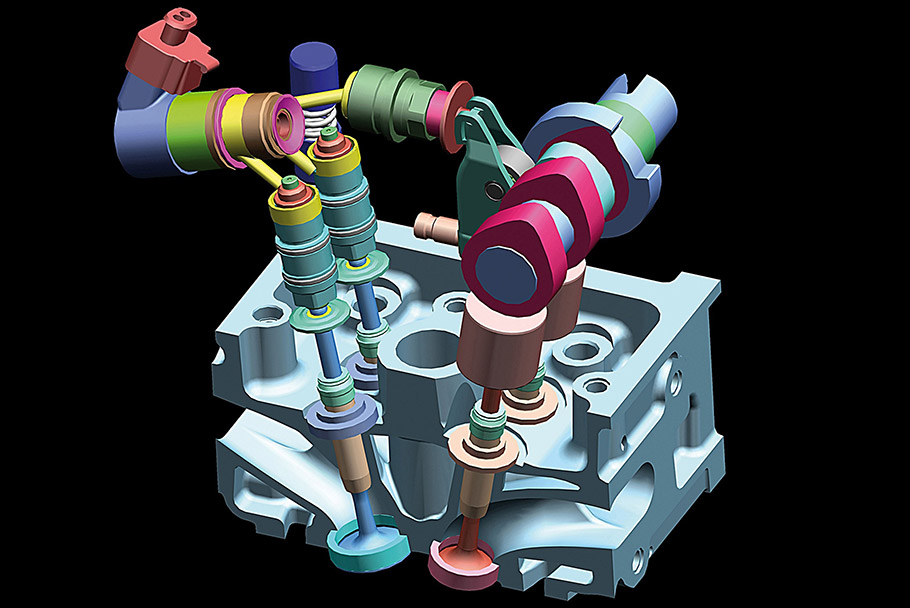
    The operating principle of the system, applied to intake valves, is the following: a piston, moved by a mechanical intake camshaft, is connected to the intake valve through a hydraulic chamber, which is controlled by a normally open on/off solenoid valve.

    When the solenoid valve is closed, the oil in the hydraulic chamber behaves like a solid body and transmits to the intake valves the lift schedule imposed by the mechanical intake camshaft.

    When the solenoid valve is open, the hydraulic chamber and the intake valves are de-coupled; the intake valves do not follow the intake camshaft anymore and close under the valve spring action.

    The final part of the valve closing stroke is controlled by a dedicated hydraulic brake, to ensure a soft and regular landing phase in any engine operating conditions.

    Through solenoid valve opening and closing time control, a wide range of optimum intake valve opening schedules can be easily obtained.

    For maximum power, the solenoid valve is always closed and full valve opening is achieved following completely the mechanical camshaft, which is specifically designed to maximise power at high engine speed (long opening time).

    For low-rpm torque, the solenoid valve is opened near the end of the camshaft profile, leading to early intake valve closing. This eliminates unwanted backflow into the manifold and maximises the air mass trapped in the cylinders.

    In engine part-load, the solenoid valve is opened earlier, causing partial valve openings to control the trapped air mass as a function of the required torque.

    Alternatively the intake valves can be partially opened by closing the solenoid valve once the mechanical camshaft action has already started. In this case the air stream into the cylinder is faster and results in higher in-cylinder turbulence.

    The last two actuation modes can be combined in the same intake stroke, generating a so-called Multilift mode that enhances turbulence and combustion rate at very low loads.

    Further Potential of MultiAir Technology

    All breakthrough technologies open a new world of further potential benefits, which are usually not fully exploited in the first generation.

    Common Rail technology, a Fiat Group worldwide premiere in 1997, paved the way to more than a decade of further technological evolutions such as MultiJet for multiple injections, small diesel engines, and the recent Modular Injection technology, soon to be launched on the market.

    Similarly, MultiAir technology, a Fiat worldwide premiere at this month’s Geneva Motor Show, (March 2009), will pave the way to further technological evolutions for petrol engines:

    • Integration of the MultiAir Direct air mass control with Direct petrol Injection to further improve transient response and fuel economy.
    • Introduction of more advanced multiple valve opening strategies to further reduce emissions.
    • Innovative engine-turbocharger matching to control trapped air mass through a combination of optimum boost pressure and valve opening strategies.

    While electronic petrol injection developed in the ’70s and Common Rail developed in the ’90s were fuel-specific breakthrough technologies, MultiAir Electronic Valve Control technology can be applied to all internal combustion engines whatever fuel they burn.

    MultiAir, initially developed for spark ignition engines burning light fuel ranging from petrol to natural gas and hydrogen, also has wide potential for diesel engine emission reduction.

    Intrinsic NOx reduction of up to 60 per cent can be obtained by internal exhaust gas recirculation (iEGR) realised with intake valves reopening during the exhaust stroke, while optimal valve control strategies during cold start and warm-up bring up to 40 per cent HC and CO reduction of emissions. Further substantial reductions come from the more efficient management and regeneration of the diesel particulate filter and NOx storage catalyst, thanks to the highly dynamic air mass flow control during transient engine operation.

    Diesel engine performance improvement is similar to that of the petrol engine and is based on the same physical principles. Instead, fuel consumption benefits are limited to few percentage points because of the low pumping losses of diesel engines, one of the reasons for their superior fuel economy.

    In the future, powertrain technical evolution might benefit from a progressive unification of petrol and diesel engine designs.

    A MultiAir engine cylinder head can therefore be conceived and developed, where both combustion systems can be fully optimised without compromise. The MultiAir electro-hydraulic actuator is physically the same, with minor machining differences, while internal sub-components are all carried over from Fiat’s FIRE and SGE applications.