A brand new MINI model is going to be unveiled on 18th of November 2013. On this date will be celebrated 107 years since the birth of the man who started an automobile revolution, Sir Alec Issigonis.
The premiere will be hosted at MINI Plant Oxford and then the new model will be showcased in front of international audiences that same week, with an almost simultaneous reveal in Los Angeles and Tokyo.
The car will make its debut in Tokyo on 20th of November 2013, followed just hours later by the Los Angeles Motor Show in California. The new MINI will go on sale in the first quarter of 2014.
Similarly as its predecessor, the new MINI model will be produced in Oxford. The start of its production and the world premiere highlight additionally the jubilee year for the MINI Plant. In fact, in it automobiles have been built for more than 100 years.
Moreover, the world premiere will pay homage to MINI’s origins and to the father of the iconical vehicle. The first MINI was introduced back in the 1959. With this act Sir Alec Issigonis revolutionized the automobile industry. The car featured transversely mounted engine, front wheel drive, wheels set in all four corners and an advanced undercarriage.
The concepts Issigonis have created were later used as a foundation for many generations of small and compact cars. In their most modern form, those principals are still being utilized. However, the today’s models include new engines and chassis technologies, MINI Connected innovations and refined premium quality. They all contribute towards the continuation of the emblematic position that the car has in the automotive industry.
Another iconic car which deserves a thorough examination is the legendary MINI. This vehicle, since day one till now, is absolutely groundbreaking subcompact coupe. It was born in the United Kingdom and achieved astonishing success around the world. The reasons for this are numerous, but it gained popularity mostly because its affordable price, compact exterior dimensions with surprisingly amount of interior space, and at last, but not least – because its unique design bringing the British style to life. With this car every customer experiences the true fun of exciting driving, and moreover he or she could easily park it literally anywhere. But let’s see where it all began.
The Beginning – creation of a masterpiece
The creator of the MINI is Sir Alec Issigonis who undoubtedly was a genius. One beautiful day he had this great idea for cheep, small and fuel-efficient car, which in addition had a safe handling. Issigonis had the ability to visualize the whole process, starting from draft … literally! He first drafted the simple lines of the future MINI on a restaurant table cloth and everything else later fell into place. It is interesting that the car was entirely his work, because he had this unique ability of visualizing the whole process of creation. He had a vision, which later became manifestation of success. Another interesting fact is that his sketches were used for the initial assembly of the first models of the car. Who does this nowadays?
Sir Alec Issigonis and MARK I MINI (1959)
Issigonis with his design fellows continued the work on the vision of making the smallest car on the market. His goal was provocative too, because not only had it to be a real mini car, but also it got to accommodate four adults and some luggage. First he started by figuring out the basic dimensions this car. His design requirements were the car to be contained within a box that measured 10×4×4 ft (3×1.2×1.2 m). Moreover, the passenger accommodation should occupy 6 ft (1.8 m) of the 10 ft (3 m) length. Then on the verge came the question about the engine which is going to fit these sizes. In addition, it had to be an existing one. Before leaving Morris in 1952, Issigonis has created and built the Morris Minor, which was a front-wheel drive with transverse engine. This was the perfect idea to be featured in the new prototype. More importantly, the engine was mounted thank to the idea of putting the gearbox in the sump of the engine. This resulted in terms of saving more space. In addition, the tiny 10 inch wheels. The suspension system, designed by Issigonis’s friend Dr. Alex Moulton at Moulton Developments Limited, used compact rubber cones instead of conventional springs. This also resulted in space-saving. In addition, it included rising progressive-rate springing of the cones, and provided some natural damping. The prototype was built into the subframes. Moreover, the rubber cone system gave a raw and bumpy ride. The seats were with woven-webbing. However, but the rigidity of the rubber cones combined with the wheels being pushed out to the corners of the car, gave the vehicle kart-like handling. Little did they know back then that this handling will become famous. And eventually in October 1957 was born the first prototype, which carried the name “The Orange Box” due to its colour.
1959 MINI Original1959 MINI Original Interior
And there it was, on 26th of August 1959 the modern MINI as born. Actually this is the exact date, when BMC (British Motor Corporation) launched the MINI. The production version of the Mini was shown to the press earlier in April. The iconic now name MINI, wasn’t put on the first vehicle produced. The first models carried the name Austin Seven (sometimes written as SE7EN) and the name Morris Mini-Minor. However, they later became famous under the name MARK I MINI. The modles were characterised by its sliding windows, external door hinges and “moustache” grille. In the United Kingdom the Mark I was produced between 1959 and 1967, with production in Australia continuing until 1970. Furthermore it developed a top speed of 72.4 mph (116.5 km/h) and could accelerate from 0–60 mph (97 km/h) in 27.1 seconds. The fuel consumption was at that time really impressive and unmatchable in numbers: Mark I MINI had 43.5 miles per imperial gallon (6.49 L/100 km; 36.2 mpg). In addition to all these technological advantages, the price of the car cost only £537.
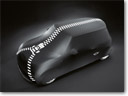
 A brand new MINI model is going to be unveiled on 18th of November 2013. On this date will be celebrated 107 years since the birth of the man who started an automobile revolution, Sir Alec Issigonis.


