 Today we have very special and „ecological“ news from one of the most famous luxury brands. Mercedes-Benz launches hybrid offensive, starting with a world’s most economical luxury-class model. Mercedes-Benz is beginning a new chapter in its brand’s core segment, while at the same time making new standards for luxury-class business vehicles. Firstly, there is the E 300 BlueTEC HYBRID, which will be available as a Saloon and Estate. More importantly it impresses with new record values concerning the efficiency. Its consumption levels are 4.2 l/100 km, thank to the impressive performance of the 4-cylinder diesel engine. The engine has 150 kW (204 hp) and 500 Nm (369 lb-ft). In addition it works along with an electric motor producing 20 kW and 250 Nm. Hence this results in a coherent overall concept: the E 300 BlueTEC HYBRID – the most economical luxury-class vehicle in the world!
On the other hand the V6-cylinder petrol engine in the E 400 HYBRID produces 225 kW (306 hp) and 370 Nm (273 lb-ft). Additionally it is enhanced by a further 20 kW and 250 Nm from the electric motor. The consumption figures based on the American CAFE standard are: City 24 mpg, Highway 31 mpg, Combined 27 mpg.
As usual and having in mind that the new vehicles are Mercedes-Benz brand, they offer great comfort for both passengers and driver. There is enough space in terms of the interior or luggage compartment. Moreover there are additional benefits to the intelligent modular hybrid concept, which represents a comprehensive enhancement of the Mercedes-Benz S 400 HYBRID. It has advanced to the position of clear market leader since 2009. In this hybrid model no changes to the vehicle body are required, and the hybrid module is both flexible and modular. Hence, this allows its use in other model series, and in addition to diesel and petrol variants there will also be right-hand drive variants.
The new hybrid models debut at the Detroit Motor Show, which will take place between 14th and 22d of January 2012. Their appearance on the market will be over the course of the year. An important detail here is that the E 300 BlueTEC HYBRID is initially planned to be launched on the European market, while the E 400 HYBRID will be made available on the American market first, followed by other countries such as Japan and China later.
E 300 BlueTEC HYBRID at a glance:
- Compact, intelligent and modular hybrid concept: no changes to the body of the base vehicle are necessary
- Also available as an Estate
- Space, safety and comfort remain unchanged
- No compromises in terms of space, safety and comfort
- Significant increase in comfort with start/stop operation; noiseless start, complete climatic comfort
- Top marks for consumption in the luxury-class business vehicle segment: 4.2 litres/100 km, 109 g CO2/km
- Part of the intelligent downsizing strategy of Mercedes-Benz: increase in the engine output of the E 300 BlueTEC HYBRID with 150 kW + 20 kW electric motor/500 Nm + 250 Nm, compared with the E 250 CDI (150 kW/500 Nm), positioning it at the same level as the E 300 CDI (170 kW/540 Nm)
- Fuel savings of around 15 percent compared with the E 250 CDI – even in actual road traffic conditions
- Impressive hybrid driving experience (start/stop function, regenerative braking, boost effect, purely electric motoring and “sailing” function)

E 400 HYBRID at a glance:
- Compact, intelligent and modular hybrid concept: no changes to the body of the base vehicle are necessary
- No compromises in terms of space, safety and comfort
- Significant increase in comfort with start/stop operation; noiseless start, complete climatic comfort
- Consumption combined (CAFE): 27 mpg
- Part of the intelligent downsizing strategy of Mercedes-Benz: increase in the engine output of the E 400 HYBRID by some 20 kW and 250 Nm thanks to the electric motor
- Impressive hybrid driving experience (start/stop function, regenerative braking, boost effect, purely electric motoring and “sailing” function)


Source: Mercedes-Benz
 Mercedes-Benz has released the latest version of the classic G-Class off-roader, which is now fitted with the state-of-the-art BlueTEC technology. This technology is specially developed to reduce exclusively the diesel vehicle’s emissions, especially nitrogen oxide (NOx).
 BlueTEC technology developed by Mercedes-Benz for diesel vehicles is the most outstanding environmental innovation in the automotive sector and offers a sustained reduction in the burden on the environment. In recognition of this achievement, Bild am Sonntag [Germany’s top-selling Sunday newspaper] has awarded the Stuttgart-based premium manufacturer the “Green Steering Wheel”.

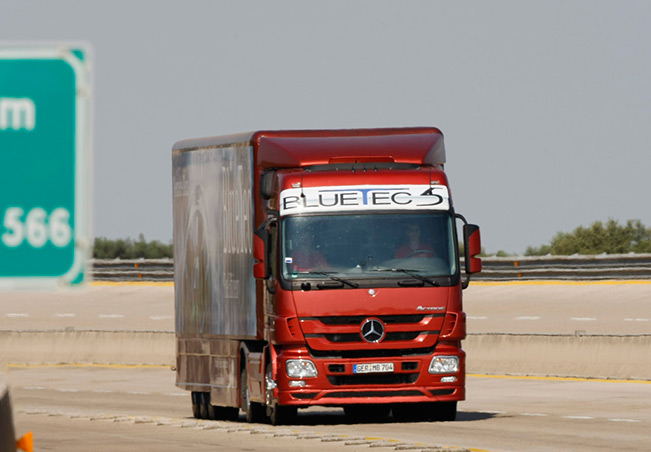 A 40-tonne truck has turned the dream of a ‘one-litre car’ into reality: as the result of a test drive at Nardo in southern Italy, the new Actros tractor-trailer from Mercedes-Benz has set a world record as the most fuel-efficient truck in its category. The Actros was driven around the clock for seven days hauling a 25-tonne payload at an average speed of 80 km/hr for a total distance of nearly 13,000 km.


 Mercedes-Benz is continuing its US diesel initiative with the presentation of another concept vehicle at the Detroit Auto Show. The Vision GL 420 BLUETEC demonstrates that, thanks to BLUETEC® technology, even large, high-performance SUVs can offer economical fuel consumption and extremely low emissions. Boasting a powerful V8 diesel engine, which develops 216 kW (290 hp) and 700 Nm (515 lb ft) of torque, the anticipated fuel efficiency for the new SUV is just 9.8 litres per 100 kilometres (24 mpg). This impressive combination of high power, torque, fuel economy and operating range ensures that ® vehicles offer an ideal drive concept for the American market.