Tag: Mercedes-AMG

  • BRABUS P 900 ROCKET EDITION One of Ten

    The broad range of BRABUS supercars now has a new and particularly special attraction: The German company accredited with the Federal Motor Transport Authority in Flensburg as a vehicle manufacturer presents a high-performance pickup in a class of its own with an output of 662 kW / 900 hp (888 bhp) and a top speed of 280 km/h (174 mph) – the BRABUS P 900 ROCKET EDITION “One of Ten.”

    The basis is provided by a Mercedes-AMG G 63 fresh from the factory, which BRABUS transforms into an equally exclusive, extremely powerful and fast all-wheel drive vehicle with truck bed. The tailor-made rear-end module behind the four-seat cab has bedsides made from high-strength, ultra-light carbon.

    The BRABUS WIDESTAR ROCKET EDITION widebody version with specially designed BRABUS Monoblock Z 24-inch hi-tech forged wheels featuring BRABUS Aero-Discs made from exposed carbon further amplify the spectacular looks. Technology partner Continental developed the fitting high-performance street tires for the pickup up to size 355/25 R 24 on the rear axle.

    The BRABUS RideControl aluminum coilover suspension is another custom development. Thanks to the lowered center of gravity and the different levels of the damping selectable from the cockpit, it makes the handling significantly sportier and safer than one would expect of a pickup.

    This enables the BRABUS P 900 ROCKET EDITION “One of Ten” to safely translate the superior power of its high-performance engine into driving fun par excellence at any time. The power is provided by the currently most potent engine from the world’s largest manufacturer-independent automotive tuner. The BRABUS ROCKET 900 V8 increased-displacement engine originates in the hi-tech engine shop of the company. After increasing the displacement to 4.5 liters, upgrading the twin-turbo system with specially developed high-end components, and calibrating of the electronic engine management system with custom maps, this powerplant puts out 662 kW / 900 hp (888 bhp) and produces a peak torque of 1,250 Nm (922 lb-ft), which is capped at 1,050 Nm (774 lb-ft) in the car.

    Despite a curb weight of 2,720 kilograms (5,997 lbs.), the exclusive pickup’s performance on the road equals that of many sports cars. From rest, the BRABUS P 900 ROCKET EDITION “One of Ten” shoots to 100 km/h in a mere 3.7 seconds. The electronic speed governor does not stop the forward thrust before a speed of 280 km/h (174 mph) is reached.

    The supercar of the “One of Ten” edition pictured here sports a “Rocket Grey” special paint finish. The BRABUS MASTERPIECE interior, crafted with maximum precision in the company upholstery shop, presents itself in the finest, royal black leather. In addition, there are contrasting elements in that same bright red color that also adds striking highlights on the bodywork and wheels. Furthermore, the exclusive interior appointments include sporty carbon inlays and bucket seats in the rear, complete with tailor-made center console and retractable tables.

    The variant of the BRABUS P 900 ROCKET EDITION “One of Ten” presented here sells for exactly 649,638 euros (export price in Germany excluding 19 percent VAT).

    Since its presentation, the BRABUS XLP pickup based on the Mercedes-AMG G 63 has found many proud owners around the world. The use of specially developed portal axles and the tremendous ground clearance of 49 centimeters (19.2 in) achieved as a result trim these BRABUS supercars for maximum off-road capabilities. However, BRABUS also received requests for a spectacular, high-performance road-going version of the pickup from Bottrop at the same time. A wish that now comes true with the BRABUS P 900 ROCKET EDITION “One of Ten.”

    The bodywork refit of this variant of the pickup likewise includes stretching the wheelbase by 50 centimeters (19.7 in), which entails moving the rear suspension further aft. The special module required for the steel ladder-type frame of the G-Class is the result of the use of state-of-the-art design and construction software, as well as productionaccording to the most stringent quality standards. This fully preserves the torsional rigidity of the frame despite the lengthening. The roomy passenger cab also remains as robust as ever. It is separated from the new truck bed by a new sheet steel component with integral heated rear window, which is installed behind the rear seats. The bed is an all-new design, whose bedsides are produced from carbon using the complex pre-preg process.

    Sheet steel is used to manufacture the side-swing tailgate and the robust bed floor. The latter is enhanced with soft teak paneling. The dual steel bed bar with matt black coating installed behind the cab adds to the thrilling pickup look of this supercar and allows safely tying down bulky and heavy cargo. The BRABUS P 900 ROCKET EDITION “One of Ten” is 5.38 meters (212 in) long. A stock G 63 without spare wheel at the rear is precisely 68.9 centimeters (27.1 in) shorter.

    The complex pickup bodywork refit is made even more spectacular by a tailor-made variant of the BRABUS WIDESTAR widebody version with additional ROCKET EDITION exposed-carbon accents. The front fascia seamlessly merges with the fender flares and was fitted with air intakes with integral daytime running lights and an additional front spoiler that features bright red side flaps.

    Just as essential for the awe-inspiring front view of the P 900 is the BRABUS exposed-carbon radiator grille. It has integral ram-air intakes with red ROCKET Launch Ambience Light and a similarly illuminated BRABUS logo. The BRABUS “PowerView” hood with its integrated glass pane offers a view of the V8 engine.

    The ROCKET EDITION style also includes upgrading the front and rear fender flares with carbon elements and air outlets. The custom fenders offer space for the currently largest hi-tech wheels in the BRABUS range. The BRABUS Monoblock Z “PLATINUM EDITION” rims with a diameter of 24 inches are manufactured using high-end forging and machining technology, resulting in maximum strength. They were painted black for this high-performance pickup and adorned with red pinstriping on the outer flange. The exposed-carbon BRABUS ROCKET 900 Aero-Discs give the ten-spoke design a markedly sporty upgrade.

    In line with the beefy appearance of the high-performance pickup truck, these wheels perfectly fill out the space created by the flares. Technology partner Continental developed high-performance street tires specifically for this BRABUS supercar. Despite the high weight, they make sporty handling and a top speed of 280 km/h (174 mph) possible. The rims at the front are ten inches wide and fitted with tires of size 295/30 ZR 24. Wheels of size 12Jx24 with 355/25 ZR 24 tires turn under the rear fender flares.

    The BRABUS RideControl aluminum coilover suspension with billet-aluminum front struts and shock absorbers with integral heat sinks at the rear axle was calibrated specifically to the low-profile tires, the vehicle weight and the long wheelbase. It allows lowering the ride height of the pickup by up to 45 millimeters (1.8 in) compared to the production car. The firmness of the damping can be selected with the standard DYNAMIC SELECT switch in the cockpit.

    The extravagant view from the sides is also characterized by the running boards, which were adapted to the longer wheelbase. A BRABUS Light Carpet in their underside comes on when the central locking system is activated or a door handle is pulled and illuminates the ground next to the vehicle on both sides to facilitate getting in and out safely. Two chrome tailpipes of the BRABUS high-performance exhaust system exit in front of the rear wheels on both sides of the vehicle. They are framed by an exposed-carbon surround with integrated red ROCKET Launch Ambience Light. The exposed-carbon exterior mirror housings and door handles are further extravagant design elements. The roof-mounted carbon wing with its red side sections at the rear end of the cab is yet another eye-catcher.

    An exposed-carbon panel with inlaid BRABUS logotype at the rear documents the noble origin of this supercar. The WIDESTAR fascia with integral carbon diffuser highlights the sporting talents of this supercar, as do the red flaps at the rear of the left and right wheel arches.

    In keeping with the tried-and-true tradition established during the 45 years the company has now been in existence, what is under the hood indeed delivers on the promises made by the thrilling, sporty looks of the BRABUS P 900 ROCKET EDITION “One of Ten.”. The red engine cover manufactured from exposed carbon immediately catches the eye. The 900 label reveals that this is the most powerful powerplant the BRABUS hi-tech engine shop currently builds.

    That is where the eight-cylinder engine of the G 63 is first disassembled completely and then subjected to a comprehensive performance upgrade to BRABUS 900 ROCKET V8 Biturbo specifications. The road to the targeted 900 horsepower, 315 more than in stock configuration, starts with increasing the displacement from standard 3,982 cc to 4,407 cc (243 to 269 cu in). This operation comprises more than simply increasing the cylinder bore to 84 millimeters (3.3 in) using state-of-the-art machinery. The BRABUS increased-displacement engine also includes eight forged pistons with this larger diameter and special profile, as well as a special, precision-balanced crankshaft milled from a single solid piece with a stroke increased to 100 millimeters (3.9 in) and the likewise precision-balanced high-performance connecting rods. Afterwards, each engine is reassembled with meticulous precision by an engine specialist.

    However, this redesign of the inner workings alone would not produce the desired performance increase. Thus, the turbocharging system of the V8 was completely revised as well. The production turbos have to give way to two BRABUS special turbochargers with larger compressor unit and custom core assembly with reinforced axial bearings. They increase the boost pressure to 1.4 bar. Two BRABUS BoostXtra valves produce a thrilling blow-off noise when the driver lifts off the gas.

    Special high-pressure pumps optimize the fuel supply. In order to let the engine exhale more freely, the exhaust side was also thoroughly revised. This includes downpipes with a diameter of 76 millimeters (3 in), metal catalysts and the BRABUS stainless high-performance exhaust system with actively controlled butterfly valves. At the touch of a button on the center console, drivers can choose between an extremely powerful V8 exhaust note in “Sport” mode and a subtle whisper in “Coming Home” mode.

    BRABUS programmed new maps for injection, ignition and boost pressure control to coordinate the high-performance components perfectly. The BRABUS power unit engineers and electronics specialists used not only the company’s hi-tech test benches to do so, but also conducted extensive test drives. The result is superior power delivery paired with durability beyond reproach. BRABUS recommends quality lubricants from MOTUL.

    The BRABUS 900 ROCKET V8 Biturbo increased-displacement engine establishes the exclusive pickup among the most powerful members of its species. The engine produces its peak power of 662 kW / 900 hp (888 bhp) at a low 6,200 rpm. The massive peak torque of 1,250 Nm (922 lb-ft) is already on tap at 2,900 rpm. To protect the power transmission components, the torque is electronically limited to 1,050 Nm (774 lb-ft) in the vehicle.

    As a result, the BRABUS P 900 ROCKET EDITION “One of Ten” can keep up with many full-blooded sports cars. In perfect interplay with the nine-speed automatic transmission and permanent all-wheel drive, the sprint from zero to 100 km/h (62 mph) takes a mere 3.7 seconds, despite the high vehicle weight. The top speed is electronically limited to 280 km/h (174 mph) to protect the tires. The BRABUS supercar is therefore equipped with a speedometer with 300-km/h (186 mph) scale.

    However, BRABUS supercars captivate not only with superior performance, but also with maximum individuality, a fact also documented by the “Rocket Grey” special paint finish on the vehicle pictured here. Just like customers can order their vehicle in any color they like, BRABUS can also tailor the interior to their personal wishes in every detail.

    That is the specialty of the experts in the BRABUS upholstery shop. To provide contrast to the exterior color, they used especially soft, royal black leather to create a BRABUS MASTERPIECE interior for this pickup with consummate craftsmanship. The particularly exclusive appointments compel with their perfect finish that features precisely applied, crest-shaped quilting on seats, trim panels and in the footwells. The latter also are covered with leather. In addition, the stitching incorporates the bright red of the bodywork components for contrast. All in all, 206 cockpit elements from switches and speaker grills to air vents and every trim piece were glazed in “ROCKET RED.” Another BRABUS specialty is the ambient lighting for the air vents.

    Carbon elements with high-gloss sealer add decidedly sporty highlights in the cockpit. These also include the BRABUS RACE paddle shifters on the steering wheel, which allow manual shifting of the automatic transmission, and the grab handles in the interior. Also part of the pickup interior are carbon scuff plates with backlit BRABUS logo that changes colors in sync with the ambient lighting, as well as aluminum pedals and door lock pins.

    In the rear, the passengers can relax on two bucket seats with a host of comfort functions such as multicontour adjustment, memory and integral seat ventilation and heating. The BRABUS center console made from black leather and carbon sits between them and perfectly blends in with the luxury interior appointments. Its retractable tables are perfect for working on a tablet or notebook computer and for reading a book or magazine.

    The console also houses an integrated 4.3-inch BRABUS Touch Control Panel, which in standby mode shows an analog clock dial with BRABUS P 900 illustration. It allows to operate the seat adjustment and also to control the COMAND system, making it possible, for example, to turn the sound system up or down or mute it from the rear compartment. The rear reading spots are also turned on or off the same way. The integrated USB multimedia interface connects a smartphone or tablet to the COMAND system and charges the device at the same time. In addition, the center console houses two cup holders with heating and cooling function, as well as an integral small refrigerator to cater to the occupants’ physical well-being. It is accessible from both rear seats.

    The BRABUS instrument panel harmoniously integrated into the headliner has two round touchscreen displays on which the passengers can see the vehicle and engine speed, outside temperature, G-forces, time and date.

    The BRABUS P 900 ROCKET EDITION “One of Ten” is built in a limited edition of just ten vehicles.

    Fuel economy, CO2 emissions and efficiency class:

    BRABUS P 900 ROCKET EDITION “One of Ten” based on the Mercedes-AMG G 63: city 17.1 l/100 km (13.8 mpg), highway 12.9 l/100 km (18.2 mpg), combined: 14.4 l/100 km (16.3 mpg). Combined CO2 emissions: 330 g/km, efficiency class G. 

    Technical Data

    BRABUS P 900 ROCKET EDITION “One of Ten”

    Bodywork

    4-door pickup based on the Mercedes-AMG G 63 of the G 463 A series.

    Limited edition of ten vehicles.

    BRABUS bodywork refit into pickup.

    All-steel cab and steel/carbon truck bed on steel frame.

    BRABUS WIDESTAR ROCKET EDITION widebody version with exposed-carbon components, 100 mm (3.9 in) wider than in standard specification.

    Consisting of front fascia with integrated front spoiler, radiator grille with integral air intakes for ram-air intake system, hood cowl, fender flares front and rear, air outlets on the back of all flares, running board corners with LED lights front and rear, roof-mounted wing and rear fascia with diffuser.

    Dimensions:

    • Length: 5,385 mm        (212 in)
    • Width: 2,063 mm        (81.2 in)
    • Height: 2,055 mm        (80.9 in)
    • Curb weight: 2,720 kg  – (5,997 lbs.)
    • Gross vehicle weight rating: 3,200 kg  – (7,055 lbs.)
    • Tank capacity/reserve: 100 l / 12 l – (26.4 gal. / 3.2 gal.)

    Engine

    BRABUS 900 V8 Biturboincreased-displacement engine based on Mercedes-AMG G 63.

    BRABUS 900 V8 Biturbo engine modification comprising:

    Displacement increase to 4.5 liters by means of custom billet crankshaft with longer stroke and enlarged cylinder bores in conjunction with corresponding pistons and connecting rods.

    BRABUS 900 V8 Biturbo system with two high-performance turbochargers with larger compressor unit and special core assembly with reinforced axial bearings. Ram-air intake system. Maximum boost pressure 1.4 bar.

    BRABUS stainless high-performance exhaust system with free-flow metal catalysts and actively controlled butterfly valves.

    Newly programmed maps for injection, ignition and boost pressure control of the electronic engine management system.


    V8-cylinder, 4-valve aluminum alloy engine with two turbochargers.

    • Displacement:  4,407 cc (269 cu in)
    • Bore: 84 mm (3.3 in)
    • Stroke: 100 mm (3.9 in)
    • Compression: 8.6 : 1
    • Rated power: 662 kW / 900 hp (888 bhp) at 6,200 rpm
    • Peak torque: 1,250 Nm (922 lb-ft) at 2,900 rpm (electronically limited to 1,050 Nm (774 lb-ft))
    • Fuel type : Super plus (102 RON)
    • Motor oil: MOTUL

    Power transmission

    Permanent all-wheel drive with electronically controlled locking differentials, ESP.

    W9T 900 9G-TRONIC 9-speed automatic transmission.

    Chassis

    Front axle with double wishbones, coil springs and tubular torsion bars.

    Rigid axle at rear with trailing arms, coil springs and solid torsion bars.

    Damping: BRABUS RideControl aluminum coilover suspension. Front axle struts and rear axle shock absorbers with integral heat sinks, milled from a single solid piece. Material: aluminum 6082.Ride-height lowering: 0 – 45 mm (0 – 1.8 in), adjustment range: 30 mm (1.2 in), plug-and-play adaptation to automatic damper adjustment. Selection of damper settings with standard Dynamic Select switch on the center console, proportional valves for rebound and compression.

    Wheels and tires:

    Wheels: One-piece BRABUS Monoblock Z “PLATINUM EDITION” ten-spoke forged wheels with exposed-carbon BRABUS Aero-Discs

    Dimensions:

    • Front: 10Jx24 with 295/30 ZR 24 tires
    • Rear: 12Jx24 with 355/25 ZR 24 tires

    Brake system

    Dual-circuit brake system with vented and cross-drilled steel brake discs, ABS. Electrical parking brake, automatic & manual.

    • Front: Brake rotors with 400 mm (15.7 in) diameter and fixed calipers
    • Rear: Brake rotors with 370 mm (14.5 in) diameter and floating calipers

    Performance

    • 0 – 100 km/h (62 mph): 3.7 s
    • Top speed: 280 km/h/174 mph (electronically limited)

    Price

    • € 649,638
  • The new Mercedes-AMG ONE: Formula 1 technology for the road

    2023 Mercedes-Benz AMG ONE - Front View

    Highly exclusive hypercar with E PERFORMANCE hybrid drive and system performance of more than 1000 hp

    Affalterbach.  AMG’s foundation stone was laid back on 1st of June 1967. To mark the 55th anniversary of the performance and sports car brand, the production version of the Mercedes-AMG ONE (combined weighted fuel consumption: 8.7 l/100 km; combined weighted CO2 emissions: 198 g/km; combined weighted electrical consumption: 32 kWh/100 km)[1] is celebrating its world premiere. The two-seater super sports car brings the world’s most modern and efficient Formula 1 hybrid drive technology from the race track to the road for the first time. The performance hybrid produces a total output of 782 kW (1063 hp) from one combustion engine and four electric motors, with a top speed capped at 352 km/h. The extremely complex development was carried out in close cooperation with the Formula 1 experts at Mercedes-AMG High Performance Powertrains in Brixworth. The Mercedes-AMG ONE will also officially be seen in action for the first time in the UK, as part of the Festival of Speed at Goodwood (23 to 26 June 2022).

    The unique hypercar inspires not only with its E PERFORMANCE Formula 1 hybrid drive, but also with further motorsport technology. This ranges from the carbon-fibre monocoque and carbon-fibre body to the load‑bearing engine/transmission unit, active aerodynamics and the push-rod suspension. With its complex technology, the two-seater Mercedes-AMG ONE offers even more than a Formula 1 racing car in some cases. It features the AMG Performance 4MATIC+ fully variable all-wheel drive with hybrid-driven rear axle and electrically driven front axle with torque vectoring. It can also drive purely electrically.

    “With the Mercedes-AMG ONE, we have more than pushed the envelope. The immense technical challenges of making a modern Formula 1 powertrain suitable for everyday road use have undoubtedly pushed us to our limits. Over the duration of the development period, many may have thought that the project would be impossible to implement. Nevertheless, the teams in Affalterbach and the UK never gave up and believed in themselves. I have the highest respect for all those involved and am proud of this team achievement. To put such a hypercar on wheels is certainly unique. This applies to us as Mercedes-AMG not only from a technical point of view, but also in terms of the close exchange with our loyal customers. Together with us, they have gone through ups but also downs in the course of development. They were an integral part of Project One from the very beginning and can now look forward to the highly exclusive and unique Mercedes-AMG ONE, which has now also been able to clear the next hurdle and passed all ECE certification tests”, says Philipp Schiemer, Chairman of the Board of Management of Mercedes-AMG GmbH.

    “The performance data of the Mercedes-AMG ONE are ultimately only a small excerpt of what technology is in this vehicle. Apart from a Formula 1 powertrain that generates 1063 hp from a relatively small, highly efficient internal combustion engine in combination with four electric motors, the monumental task was above all the exhaust gas aftertreatment. The Mercedes-AMG and Mercedes-AMG High Performance Powertrains teams have really done a great job here. This project was partly a curse and a blessing at the same time. But we have walked the stony path, and as a technician you naturally get carried away with all the details. From the materials used, the exceptional chassis components to the aerodynamic refinements – in terms of complexity, the Mercedes-AMG ONE is hard to beat. In a Formula 1 car, a team of engineers with laptops makes sure that the powertrain starts. With our hypercar, all it takes is the push of a button. This also illustrates the immense software know-how that has gone into this vehicle”, says Jochen Hermann, Technical Managing Director of Mercedes-AMG GmbH.

    Exceptional E PERFORMANCE hybrid drive with 1.6-litre V6 engine and four electric motors

    The E PERFORMANCE hybrid drive of the Mercedes-AMG ONE comes directly from Formula 1 and has been realised in close cooperation with the experts at Mercedes-AMG High Performance Powertrains in Brixworth. It consists of a highly integrated and intelligently networked unit comprising one hybrid, turbocharged combustion engine with a total of four electric motors. One has been integrated into the turbocharger, another has been installed directly on the combustion engine with a link to the crankcase and the two remaining motors drive the front wheels.

    The 1.6-litre V6 hybrid petrol engine with electrically assisted single-turbocharging corresponds in its technology to the current Formula 1 power unit. The four overhead camshafts are driven by spur gears. To achieve high engine speeds, the mechanical valve springs have been replaced by pneumatic valve springs. The engine, mounted in mid-engine position in front of the rear axle, revs up to 11,000 rpm. However, for longer durability and the use of commercial super plus petrol, it deliberately stays below the F1 rev limit.

    The high-revving power unit is boosted by a high-tech turbocharger. The exhaust gas turbine and compressor turbine are positioned at a distance from each other and connected by a shaft. This allows a lower installation position for the turbocharger. On the shaft is an approx. 90 kW electric motor. Electronically controlled, this drives the turbocharger shaft directly, accelerating the compressor wheel up to 100,000 rpm before the exhaust gas flow takes over. The Formula 1 designation for this unit is MGU-H (Motor Generator Unit Heat).

    Lightning-quick response, faster than a naturally aspirated V8 engine

    The major advantage: the response improves significantly, immediately from idle speed (when the exhaust flow is still weak) across the entire rev range. The 1.6-litre V6 engine responds even more spontaneously to accelerator pedal commands, while the overall driving experience is highly dynamic. In addition, the electrification of the exhaust gas turbocharger enables higher torque at low engine speeds. This also increases agility and optimises acceleration. Even when the driver takes their foot off the accelerator or brakes, the technology is able to maintain boost pressure at all times. This ensures a continuously direct response.

    The electric exhaust gas turbocharger in the Mercedes-AMG ONE has yet another advantage: it uses part of the surplus energy from the exhaust gas flow to generate electrical energy as a generator. This is either stored in the high-voltage lithium-ion battery or fed to the electric front axle or the electric motor (MGU-K = Motor Generator Unit Kinetic) on the combustion engine. The MGU-K has an output of 120 kW, is positioned directly on the combustion engine and is connected to the crankshaft via a spur gear system – another technology that ensures maximum efficiency and performance in Formula 1.

    Turbocharging and direct injection with spray-guided combustion not only enable high power output, but also increase thermodynamic efficiency, thus reducing fuel consumption and exhaust emissions. The high‑performance six-cylinder engine has two injection systems. Direct injection delivers the fuel into the combustion chambers at up to 270 bar pressure. This is a multiple process at times, and is controlled by the engine management system as required. The additional port injection is needed to achieve the high specific power of the engine and at the same time comply with the exhaust emission limits.

    Added to this is the very complex and effective exhaust gas cleaning system with four preheated metal catalytic converters, two ceramic catalytic converters and two petrol particulate filters. The four heating elements with a combined output of 16 kW make it possible to comply with the EU6 exhaust emission limits under real driving conditions (RDE). The exhaust gas cleaning system is also backpressure-optimised to avoid power losses. This also applies to the large rear silencer made of lightweight titanium.

    Technical data – powertrain

    Bore x stroke 80.0 x 53.03 mm
    Displacement 1599 cc
    Max. system output 782 kW (1063 hp)
    Max. speed, combustion engine 11,000 rpm
    Max. output, combustion engine 422 kW (574 hp) at 9000 rpm
    Specific output, combustion engine 359 hp/l
    MGU-K (electric motor on the crankshaft) 120 kW (163 hp)
    MGU-FL/MGU-FR (electric motors on the front axle) 2 x 120 kW = 240 kW (326 hp)
    MGU-H (electric motor of the electric exhaust gas turbocharger) 90 kW (122 hp)
    Max. turbocharger boost pressure 3.5 bar

    New all-wheel drive with purely electrically driven front axle

    The two 120 kW electric motors on the front axle reach rotor speeds of up to 50,000 rpm. They are each connected to the front wheels via a reduction gear. The front axle, which is thus driven purely electrically, operates wheel-selectively in each case and thus enables individual torque distribution for particularly high driving dynamics (“torque vectoring”). In addition, the two electric motors also allow the braking energy to be optimally used for recuperation – up to 80 percent under everyday driving conditions. This energy is stored in the battery and is available for a longer electric range or for more drive performance. Each electric motor is controlled by its own power electronics located in close proximity to the electric motors in the floor assembly.

    High Performance Battery with Formula 1 technology

    The lithium-ion energy storage system is also a special Mercedes-AMG development. Its technology has already proven itself in the Mercedes-AMG Petronas F1 Team’s Formula 1 hybrid racing cars under the toughest conditions and can also be found in the battery of the Mercedes-AMG GT 63 S E PERFORMANCE. The AMG High Performance Battery combines high power that can be called up frequently in succession with low weight to increase overall performance. Added to this are the fast energy draw and the high power density. This means that during a brisk drive in hilly terrain, for example, drivers can immediately call on the full power potential on uphill stretches, while recuperation is strong when driving downhill.

    The arrangement of the battery cells and the cell cooling mirror the Mercedes-AMG Formula 1 racing car. For everyday use, however, their number is many times greater in the Mercedes-AMG ONE. The capacity of 8.4 kWh is sufficient for a purely electric range of 18.1 kilometres. Charging is via alternating current and the integrated 3.7 kW on-board charger. In addition, the battery can be supplied with fresh energy via recuperation or from the combustion engine. The lithium-ion, high-voltage battery and the DC/DC converter supporting and charging the 12 V onboard electrical system are accommodated in space-saving configuration in the vehicle floor behind the front axle.

    Innovative direct cooling of the high-voltage battery

    The basis for the high performance of the battery is the innovative direct cooling: A high-tech coolant flows around all the cells and cools them individually. Background: Every battery needs a defined temperature for optimum power delivery. If the battery becomes too cold or too hot, it noticeably loses power at times, or has to be regulated to avoid damage if the heat becomes excessive. The even temperature of the battery therefore has a decisive influence on its performance, service life and safety.

    The coolant circulates from top to bottom through the entire battery past each cell with the help of a high‑performance electric pump and also flows through a heat exchanger attached directly to the battery. The system is designed to ensure even heat distribution in the battery. The result is that the battery is always in a consistent, optimal operating temperature window of 45 degrees Celsius on average – no matter how often it is charged or discharged. It may well be that the average temperature is exceeded when driving at high speeds. The protection mechanisms are therefore configured so that the maximum performance can be obtained from the battery, with the temperature level subsequently lowered by direct cooling.

    Only direct cooling makes it possible to use cells with very high power density. Thanks to this individual solution, the battery system is particularly light and compact. The low weight is also due to the material‑saving busbar concept, and the lightweight yet strong crash structure of the aluminium housing. It ensures the highest level of safety. Another feature is the high voltage of the drive system, which operates at 800 volts instead of the usual 400 volts. Thanks to the higher voltage levels it is possible to significantly reducing the cable diameters, for example, thereby saving design space and weight.

    Intelligent operating strategies for optimum output and efficiency

    All in all, the High Performance Plug-in Hybrid Drive System offers numerous intelligent operating strategies that are optimally adapted to different application scenarios. The drive programs range from purely electric operation to a highly dynamic mode (Strat 2), which corresponds to a setting used in Formula 1 qualifying for the best possible lap times. Despite the high system complexity, the driver will always receive the optimal combination of performance and efficiency – depending on the current requirement.

    Six drive programs – from purely electric driving to race track mode

    The Mercedes-AMG ONE starts silently at first by switching on the electric motors on the front axle. In parallel, the catalytic converters are preheated. The combustion engine will not start until the correct catalytic converter temperature is reached.

    • Race Safe: standard program with on-demand hybrid driving mode and all-electric start-up. Only when higher power is required does the combustion engine switch on.
    • Race: hybrid driving mode with special charging strategy. The combustion engine runs continuously and can charge the high-voltage battery more so that full electric power is always available.
    • EV: all-electric driving.
    • Race Plus (race track only): active aerodynamics, chassis lowering by 37 mm (front)/30 mm (rear), firmer chassis tuning, special performance management.
    • Strat 2 (race track only): active aerodynamics, even firmer suspension tuning and vehicle lowering by 37 mm (front)/30 mm (rear). Full power from all motors as in Formula 1 qualifying.
    • Individual: settings according to personal preferences for the road modes.

    Impressive acceleration values are possible with the RACE START function in the Race, Race Plus and Strat 2 drive programs: the sprint from a standstill to 200 km/h is completed in just 7.0 seconds.

    Completely new, automated 7-speed manual transmission

    Power is transmitted to the rear wheels by means of a 7-speed manual transmission completely newly developed for the Mercedes-AMG ONE. The lightweight transmission design saves weight, while integration into the body-in-white enhances rigidity and takes up little space. It is specifically designed for the high torque and speed capacity of the powerful Formula 1 hybrid powertrain. Shift rods and the 4-disc carbon‑fibre clutch are hydraulically controlled. The gear ratios are designed to minimise the power difference after upshifting and keep the combustion engine at high revs. The locking differential is integrated into the transmission.

    Multi-link suspension with innovative push-rod suspension

    The basis for the outstanding driving characteristics of the Mercedes-AMG ONE is the lightweight and high‑strength carbon-fibre monocoque, the technology of which also originates from Formula 1. The same applies to integration of the engine and transmission: both fulfil load-bearing functions and completely support the rear suspension.

    The chassis is an aluminium construction at the front and rear, each with five links and two adjustable suspension struts. The coil-over suspension has several special features: both push-rod spring struts have been installed across the direction of travel. The innovative arrangement of the spring and damper unit replaces the function and use of a conventional tubular cross stabiliser. This solution reliably prevents rolling movements, even during very rapid directional changes, without being uncomfortable. Roll stiffness and roll damping are completely independent of lift stiffness and lift damping. Wheel bearings with ceramic ball bearings for less friction reflect the attention to technical detail.

    The adaptive damping adjustment can be adapted via the drive program: the C (Comfort) and S (Sport) suspension settings are available in the EV, Race Safe, Race and Individual drive programs; the S (Sport) and S+ (Sport+) suspension settings are available in the Race Plus and Strat 2 drive programs. As part of the active aerodynamics, the chassis can be lowered hydraulically: by 37 millimetres on the front axle and by 30 millimetres on the rear axle. In addition, a lifter for the front axle (can only be activated in the road drive programs) prevents the Mercedes-AMG ONE from touching down on underground parking ramps, for example.

    The overall tuning of springs and dampers has been designed for perfectly balanced, easily controllable and highly dynamic handling. This is also assisted by the all-wheel drive and torque vectoring. Unlike in Formula 1, ABS is on board as standard, while ESP® can be regulated in three stages, as is customary at Mercedes-AMG. ESP® ON stands for high safety and is always activated in “Highway” mode. ESP® SPORT HANDLING MODE allows higher yaw angles before system intervention for sporty driving. ESP® OFF switches the system off for extremely dynamic driving on closed-off circuits. All three settings are possible in “Track” mode.

    Exclusive forged wheel with carbon-fibre partial cover

    A new development is the 10-spoke forged aluminium wheel with centre lock, which is exclusive to the Mercedes-AMG ONE. This has a radial carbon-fibre partial cover with an aerodynamically sophisticated shape: it improves the aerodynamic efficiency of the vehicle by enhancing the flow around the wheel. This is another example of how the AMG development team has paid the utmost attention to even the smallest aspects, so as to improve the efficiency of the hypercar.

    Newly developed 9-spoke magnesium forged wheels designed exclusively for the Mercedes-AMG ONE are also available as an option. In addition to the centre-lock technology, they feature a patented bionic design to maximise lightweight construction and rigidity. The aerodynamically designed carbon-fibre partial cover is a good example of the combination of low weight, optimised brake cooling and aerodynamic efficiency. At the same time, nine air vanes per wheel ensure active ventilation of the wheel arch and thus improved heat dissipation from the brakes.

    At the front, the Mercedes-AMG ONE runs on 10.0 J x 19 wheels with 285/35 ZR 19 Michelin Pilot Sport Cup 2R M01 tyres, which were developed exclusively for the hypercar, and at the rear on 12.0 J x 20 wheels, with Michelin Pilot Sport Cup 2R M01 tyres in size 335/30 ZR 20. The exclusivity of the tyres is reflected in the design of the sidewall, which incorporates the vehicle silhouette and the number 1.

    A special, weight-optimised AMG carbon-fibre ceramic high-performance composite brake system is used for deceleration. The front axle sports 6-piston fixed callipers and also internally ventilated and perforated brake discs measuring 398 x 38 millimetres. The rear axle is fitted with 4-piston fixed callipers. In addition, it has internally ventilated and perforated brake discs measuring 380 x 34 millimetres. The low weight of the system reduces the unsprung masses and thus increases driving dynamics and agility. Furthermore, the ceramic brake features a longer service life, higher corrosion resistance and higher thermal stability. The “AMG Carbon Ceramic” lettering and the specially painted brake callipers visually distinguish this unique brake system.

    Exterior design: fascination and function

    The design of the carbon-fibre body is inspired by the top class of motorsport. But above all, it embodies the Mercedes-AMG principle that fascination is always linked with function. Each component fulfils a task. The mid-engine concept based on a carbon-fibre monocoque plus a load-bearing engine/transmission unit provides the extremely muscular proportions: the cockpit is positioned far forward, as is typical for racing, combined with voluminous wheel arches, a wasp waist and a wide tail.

    Designers and aerodynamics experts worked closely together on the design. Even the basic body has been aerodynamically designed for maximum downforce and balance. And this move has been a successful one: the Mercedes-AMG ONE generates downforce from as low as 50 km/h, which becomes increasingly stronger as the speed increases.

    Front view: powerful and functional

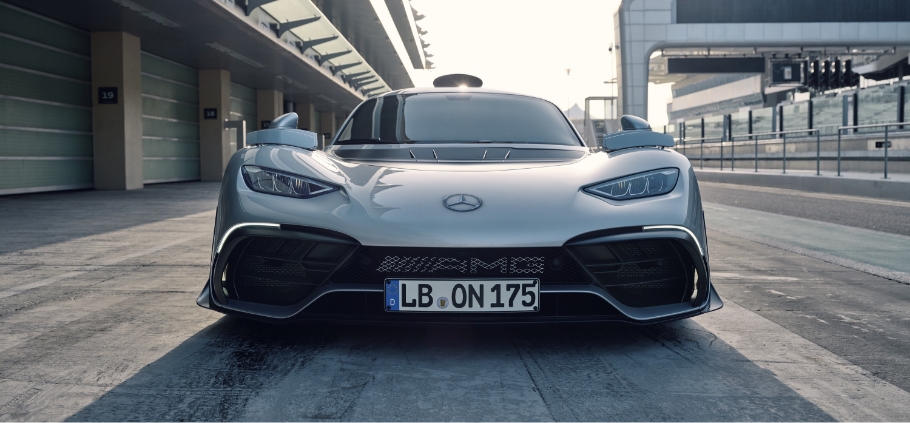
    The front view is characterised by the large front apron, the various air intakes of which extend across the entire vehicle width. The trapezoidal centre section bears a large, white AMG logo. Above it, on the vehicle body, is the Mercedes star. It is designed in the form of an artistically and technically perfect airbrush motif – by a specialist in the UK. The AMG-typical A-wing under the centre section adds another characteristic highlight and merges seamlessly into the wings.

    Large air intakes dominate on the left and right, framed by U-shaped air deflectors and each divided by two black transverse fins. Flat LED headlamps blend seamlessly into the body contours. The black air outlets in the bonnet guide the hot airflow around the sides of the driver compartment. This allows the flow of fresh air to pass unhindered across the driver compartment and into the intake tract on the roof. The active flaps on the front diffuser influence the aerodynamic performance at the front axle and ensure excellent aerodynamic balance. The active air vents (so-called louvres) in the front wheel arches also increase the downforce on the front axle.

    Taut flanks, voluminous wheel arches

    The low, dynamic greenhouse has an unmistakable, spherical architecture with a distinctive window pattern. The large, dark area stands for important technical functions. These technical components form a visual contrast to the clean overall lines of the vehicle.

    The roof is dominated by the air intake derived from Formula 1, through which the engine draws in fresh air as needed. The black intake transitions elegantly into the black, vertical shark fin: it prevents cross-flow and/or a breakaway of airflow at the rear and thus improves cornering stability. Overall, this also means more performance and safety at high speeds. The power unit is hidden under two removable carbon-fibre covers. Large NACA air intakes are integrated into each of these, guaranteeing optimum guidance of the airflow for the radiators placed below.

    The side view shows a sensual and clear surface design, equally combined with functional features. The vehicle flanks are tautly recessed, with black carbon-fibre surfaces redirecting the airflow around the vehicle body as in motorsport. The airbrush design on the flanks was created by the same artist who designed the paintwork for the Formula 1 racing cars. Tight-fitting wheel arches stretch over all four wheels like muscles, ready to leap into action.

    The doors open diagonally forwards and upwards. The fuel filler flap is at the rear right, and the charging socket for the plug-in hybrid battery is at the rear left.

    Rear end: fascination and function

    The sharp spoiler lip and the two-part rear diffuser bring aerodynamic efficiency and performance advantages at high speeds. This also applies to the specially shaped underbody with longitudinal fins and openings for cooling ducts. The rear wing is a two-piece retractable blade plus integrated adjustable flap. The design of the exhaust tailpipe with its large, round outlet and two further small, round apertures has been adopted directly from the Formula 1 cars. The muscular appearance is further enhanced by the rear apron with its large, black mesh and carbon-fibre components. The tail lights each feature three diamond-shaped lighting elements to echo the graphic design of the AMG brand logo, and therefore also the design of the headlamps.

    The high-tech materials and colour combinations of the outer skin are transferred directly from racing. Functional exterior components are presented in exposed carbon fibre and contrasted with sculpturally sensual paint surfaces.

    Active aerodynamics: three interpretations to choose from

    The active, hydraulically controlled aerodynamics increase downforce on the front and rear axles and also improve aerodynamic efficiency. Depending on the driver’s preference and the selected drive program, three different aerodynamic setups are available:

    • “Highway” in the “Race Safe”, “Race”, “EV” and “Individual” drive programs:
      the louvres are closed, the active flaps on the front diffuser are extended and the rear wing including flap is retracted.
    • “Track” in the drive programs “Race Plus” and “Strat 2” (both only allowed on the race track):
      the front diffuser flaps fold up to shape the front diffuser contour to maximum efficiency. The rear wing extends fully, as does the rear wing flap. The louvres are opened to increase the downforce on the front axle and to increase the negative pressure in the wheel arches. The vehicle is lowered by 37 millimetres at the front axle and 30 millimetres at the rear axle. The consequence of all these measures: the total downforce increases up to five times compared with the road drive programs, depending on the speed.
    • “Race DRS” (Drag Reduction System), can be activated at the touch of a button as in Formula 1, in the race track drive programs:
      the rear wing flap retracts completely and the louvres are closed. Although this reduces downforce by around 20 percent, the Mercedes-AMG ONE reaches high speeds even faster. DRS can be deactivated manually or is automatically deactivated as soon as the driver brakes or lateral acceleration is measured.

    Interior: Formula 1 for two

    The interior design concept follows function on the racetrack and is expressed in the radical design idiom. In this way, Formula 1 technology can be experienced authentically on the race track and on the road. Here, too, every detail has a function. “No styling” is the design consequence resulting from the requirements for this driving machine. The design is a synthesis of sculptural form language and uncompromising racing design. In the bold minimalism of the monocoque interior, the reduced components are emphasised and showcased in terms of design and function.

    The ergonomically contoured interior has room for two occupants. The firmly fixed racing seat-pan sculpture combines aesthetically with the footwell to form a single unit. It also merges smoothly into the sill area at the side and becomes an integral part of the highly sculptural monocoque landscape. The backrests of the AMG Motorsport seat pans can be adjusted to two positions: 25o and 30o. The steering wheel is electrically adjustable and the pedal box mechanically adjustable (in eleven steps) so that the driver can adopt an optimal driving position. The passenger footrest is also individually adjustable.

    The centre tunnel is also a functional part of the carbon-fibre support structure. It blends fully into the seat sculpture and follows the principle of minimalism with its gently rising contour. A high-quality stowage compartment, a reduced switch panel and the Engine Start button form a single unit. The compartment is designed with a transparent lid. Two mini-USB ports for external audio devices enhance everyday usability. The Start/Stop button is prominently positioned on the tunnel and forms the end of the controls towards the front. The cylindrical housing body, made of real metal, is held laterally by two lugs that protrude organically from the basic volume of the tunnel.

    Interior with functional structural parts

    The slim wing profile of the instrument panel appears light as if floating. As a functional structural component, it also stiffens the monocoque of the hypercar. The two high-resolution, free-standing 10-inch displays with individual Mercedes-AMG ONE graphics are finished with high-quality real-metal parts and adapted to the instrument panel. The instrument cluster display is in a slightly raised position in front of the driver. The multimedia monitor on the right of the centre console is tilted towards the driver. The double-nozzle ventilation unit is suspended under the centre screen like a gondola. Screen and nozzles merge into one unit and underline the purist design concept. The ventilation nozzles repeat the basic rectangular shape of the displays.

    The door panels are in functional, high-grade carbon fibre, and integrate smoothly into the sporty interior. A cassette of solid metal combines the air vents and power window switches, which are integrated as deeply recessed rectangles. Like a muscle, a contour drawn far forward in the door runs out to the rear and creates space for the characteristic course of the exterior window line.

    Formula 1-style steering wheel

    In the radically designed and high-quality race steering wheel, operating and functional elements are combined with original race car components to ensure safe operation in extreme driving situations. The “shift light” is displayed at the top of the steering wheel rim, as is usual in racing cars. The steering wheel, which is flattened at the top and bottom and has an integrated airbag, offers further motorsport trim elements: the two integrated AMG steering wheel buttons can be used to activate various functions without having to take your hands off the wheel. For example, the drive programs, the nine-stage AMG Traction Control, the activation of the DRS or the suspension settings.

    Screen instead of interior mirror, colours and materials from the racing car

    The Mercedes-AMG developers have also thought about suitability for everyday use and further ease of operation: air conditioning and electric windows are on board as standard, and the infotainment system ensures seamless connectivity. The user interface is integrated as an autonomous concept. The most important information is displayed on the road in the line of vision above the steering wheel, so that the driver is not distracted. To ensure optimal rearward visibility despite the vertical wing on the rear, the interior mirror is replaced by a screen. It shows real-time footage from a MirrorCam integrated into the rear. The screen housing is fully integrated into the roof and accommodates further controls.

    Inspired by the Formula 1 racing car, the material contrasts are also consistently and authentically continued in the interior. Here, too, the exposed carbon fibre of the monocoque forms a delightful contrast with the material/colour combination of the seat pans in magma grey nappa leather and black DINAMICA microfibre. With their special design, the seat inlays support air circulation at the driver’s back. Yellow contrasting topstitching adds further highlights as standard, but other colours are also available.

    Material-appropriate and high-quality details, such as the ventilation nozzles in silver shadow and dark chrome, create further individual highlights. The seat belt straps and contrasting topstitching in the typical AMG yellow underscore the performance claim. Customers also have extensive options for very personal individualisation, which can be specified in close consultation with the experts at Mercedes-AMG.

    Technical data

    Mercedes-AMG ONE.

    Engine
    Number of cylinders/arrangement 6/V
    Displacement cc 1599
    Max. system output kW/hp 782/1063
    Max system torque Nm Specification not possible due to complex drive train
    Max. output, combustion engine kW/hp 422/574 at 9000 rpm
    Max. speed, combustion engine rpm 11,000
    Mixture formation Microprocessor-controlled petrol injection, combination of direct and intake manifold injection
    Combined output, electric motors kW/hp 450/611
    Power transmission
    Drive system AMG Performance 4MATIC+ fully variable all-wheel drive with hybrid-driven rear axle, electrically driven front axle and torque vectoring
    Transmission 7-speed automated manual gearbox
    Gear ratios
    1st/2nd/3rd/4th/5th/6th/7th gear 12.803 / 9.267 / 7.058 / 5.581 / 4.562 / 3.878 / 3.435
    Reverse 14.599
    Suspension
    Front axle Five-link aluminium coil-over suspension with two transverse adjustable push-rod spring struts and adaptive damping adjustment
    Rear axle Five-link aluminium coil-over suspension with two transverse adjustable push-rod spring struts and adaptive damping adjustment Aerodynamically shaped lower links
    Brake system Hydraulic AMG carbon-fibre ceramic high-performance composite brake system, front 398 x 38 mm composite brake discs, internally ventilated and perforated, 6-piston aluminium fixed callipers; rear 380 x 34 mm composite brake discs, internally ventilated and perforated, 4-piston aluminium fixed callipers; electric parking brake, ABS, Brake Assist, 3-stage ESP®
    Steering not specified
    Wheels front: 10 J x 19 H2; rear: 12 J x 20 H2
    Tyres front: 285/35 ZR 19; rear: 335/30 ZR 20
    Dimensions and weights
    Wheelbase mm 2720
    Front/rear track mm 1721/1669
    Length/height/width mm 4756/1261/2010
    Turning circle m not specified
    Boot capacity l not specified
    Kerb weight according to DIN kg 1695
    Payload kg not specified
    Tank capacity l 55
    Performance, consumption, emissions
    Acceleration 0-100 km/h s 2.9
    Acceleration 0-200 km/h s 7.0
    Acceleration 0-300 km/h s 15.6
    Top speed km/h 352
    Fuel consumption, weighted,comb.1 l/100 km 8.7
    CO2 emissions, weighted, comb.1 g/km 198
    Electrical consumption, weighted, comb. 1 kWh 32
    Electrical range km 18.1

    [1] The figures for fuel consumption and CO2 emissions are provisional and were determined internally in accordance with the “WLTP test procedure” certification method. Confirmed values from the technical service or an EC type approval or certificate of conformity with official values are not yet available. Differences between the stated figures and the official figures are possible.

  • Vision AMG show car offers glimpse of all-electric future of Mercedes-AMG

    2022 Mercedes-Benz Vision AMG Concept

    Spectacular proportions defined by a long wheelbase and emphasised by short overhangs, powerful shoulders, large wheels, a distinctive rear spoiler and star-shaped headlamp signature – the Vision AMG makes an emotional statement from every perspective. This extraordinary show car from Mercedes-AMG offers a glimpse of the all-electric future of AMG Driving Performance. Beneath the breath-taking exterior design of the four-door coupé is the equally extraordinary dedicated AMG.EA platform, which is currently under development in Affalterbach for all-electric performance models.

    “AMG is reinventing itself. As was once the case with our founding fathers, there has been an amazing feeling of new beginnings here in Affalterbach for quite some time now. The course has been well and truly set for an electrified future, and we’ve set the bar high. That’s because our customers expect something very special from all-electric cars. We have already well and truly proven our expertise in this regard with the SLS AMG Electric Drive, our own E PERFORMANCE hybrid technology and the first Mercedes-EQ derivatives. With this study, we are now offering a first glimpse of how we are transferring the AMG DNA into the all-electric future, starting in 2025. Gorden and his team are pointing the way from a visual perspective with this extraordinary design. At AMG, we have always stood for that extra shot of emotion, driving fun, handling, ingenious aerodynamic features and other innovative solutions. And that’s what we continue to stand for with our first BEV developed entirely in Affalterbach. We’re developing everything from scratch, from the dedicated AMG.EA platform to the revolutionary drivetrain technology with which we will take performance electric mobility to a whole new level,” says Philipp Schiemer, CEO of Mercedes-AMG GmbH.

    “The Vision AMG shows in spectacular style what electrification could look like at Mercedes-AMG, while staying true to the brand aesthetic. The study’s extreme proportions create fascination and passion for performance – that’s what AMG is all about. The Vision AMG is an impressive embodiment of the brand’s dual polarity – the interplay of beauty and the extraordinary. At the same time, elements from the future, such as the light signatures with the illuminated high-tech grille, underscore the progressive evolution of our design language of Sensual Purity,” says Gorden Wagener, Chief Design Officer of Mercedes-Benz Group AG. “With its contrasting modern surfacing and radical proportions, this car showcases the next design step, building on the VISION EQXX and moving further towards performance luxury. The seamless flow of beautifully formed surfaces and the monolithic sculpture complete the powerful aesthetic of the Vision AMG. The result is an electric supercar, a style icon that stimulates desire – and that’s exactly what sets a luxury sports car apart.”

    Monolithic sculpture and radical proportions

    The concept car is characterised by flowing, beautifully formed surfaces. Joints and shut lines are reduced to a minimum, and the rear and side windows are painted in the same Alubeam silver as the car itself. The result is an overall look that reinforces the impression of a monolithic sculpture.

    The sporty proportions are particularly evident from the side, and are defined by the technical layout – long wheelbase, sharply raked A-pillar positioned far forward, short front overhang and slightly longer, aerodynamically optimised rear overhang. It clearly expresses the design language of Sensual Purity with distinctive sports car cues such as the widely flared wheel arches and broad, muscular shoulders at the rear.

    The graceful greenhouse is integrated into the flowing overall form and blends seamlessly into the low-lying silhouette. The roof tapers as its line drops elegantly towards the rear, flowing directly into the rear spoiler. The overall effect is a visually fascinating and aerodynamically advantageous teardrop form, not unlike that of the VISION EQXX. The sensual surfacing and the powerfully defined sculpture are representative of the hallmark Mercedes design language. Similarly, the brand’s aspiration to the extraordinary is realised through the radical proportions and sharply chiselled shark nose. The Vision AMG is thus an impressive example of the dual polarity of the brand’s design approach embracing “Beauty & the Extraordinary”.

    The sharply angled tear-off edge at the rear incorporates an active spoiler, elongating the side view while at the same time improving the aerodynamics. It is framed by a precisely cut band of light that accommodates a variety of different light installations, providing an effective contrast with the large black AMG logo on the rear of the car.

    Breathtaking technology for hallmark performance

    The technology of the Vision AMG tributes the spectacular design in many ways. All of its drivetrain components are developed entirely from scratch: not only the AMG.EA platform itself, but also the dedicated high-performance high-voltage battery and the revolutionary drive technology. The powerful heart of the Vision AMG is its innovative Axial Flux Motor developed by Mercedes-Benz’ wholly owned subsidiary YASA. With its compact and lightweight design it delivers substantially more power than conventional electric motors.

    Closed-off AMG grille with illuminated bars

    The AMG-specific grille with vertical bars is retained as a distinctive brand feature – despite the fact that an all-electric drivetrain does not require a classic radiator at the front. The high-tech development of the grille is therefore closed off, painted in body colour and fully integrated into the front end. As the visual focal point, the grille emphasises the futuristic look of the Vision AMG with its illuminated bars and three-dimensional exterior contour. The three-pointed star is positioned prominently on the bonnet – as on the Mercedes-AMG Project ONE.

    Extraordinary star-shaped light signature

    The headlamp light signature points directly into the future. Three LED elements form a stylised, three-dimensional Mercedes star, ensuring the Mercedes and AMG branding is immediately apparent and unmistakable by night and day. The two headlamps are visually connected via the horizontal band of light above the grille. This light band can display a variety of animations – ranging from a welcome signature to constant light.

    The round lights at the rear have a light design that is new yet familiar. On each side, three LED rings are positioned in cylindrical tubes. Here, too, small stars offer a nod to the Mercedes brand. By way of contrast, the expressive rear diffuser is painted deep black.

    Connection to Formula 1 through form and colour cues

    The direct connection to the successful Mercedes-AMG Petronas F1 team is evident in further visual details. These include the silver paintwork with a large-format star pattern across the shoulders and rear wings, functional elements in exposed carbon-fibre, the aerodynamic design of the 22-inch wheels with aero claddings, the AMG logo and elements on the sills and diffuser in the Petronas colours.

    The sporty high-tech seamless design and the breath-taking proportions give the Vision AMG a futuristic character. The four-door configuration also makes clear that the show car offers a taste of a functional all-Mercedes-Benz Vision AMG Conceptelectric sports car of the future. Despite the battery pack in the floor of the car between the axles, the study sits considerably lower than the EQS and, thanks to its intelligently designed interior floor, offers plenty of space for four.

  • Mercedes-AMG C 43 4MATIC: more power and efficiency for Saloon and Estate models

    2023 Mercedes-AMG C 43 4MATIC - Front Angle View

    With technology derived directly from Formula 1, the latest generation of the Mercedes-AMG C 43 4MATIC sets new standards for innovative drive solutions both as a Saloon (combined fuel consumption 9.1-8.7 l/100 km, combined CO2 emissions 206-196 g/km)[1] and as an Estate (combined fuel consumption 9.2-8.8 l/100km, combined CO2 emissions 209-199 g/km). Following its premiere in the Mercedes-AMG SL 43, the AMG 2.0-litre four-cylinder engine, the world’s first series-production unit to feature an electric exhaust gas turbocharger, is now also being used in the C-Class. The new form of turbocharging guarantees particularly spontaneous response across the entire rev range and thus offers an even more dynamic driving experience. The turbocharger is operated via the 48-volt electrical system, which also feeds the belt-driven starter-generator (RSG). In the Mercedes-AMG C 43 4MATIC the unit produces 300 kW (408 hp) and, in certain driving situations, is able to call upon a brief additional boost of 10 kW (14 hp) from the RSG. The standard rear-axle steering, the AMG Performance 4MATIC permanent all-wheel drive with rear-biased torque distribution, the AMG SPEEDSHIFT MCT 9G transmission with wet start-off clutch and the AMG RIDE CONTROL suspension with Adaptive Damping System also contribute to the dynamic driving experience. In keeping with this, brand-specific features in the equipment and appointments as well as in the exterior and interior design emphasise the performance-oriented character of the new Mercedes-AMG C 43 4MATIC.

    “The C-Class has always been an absolute success story for Mercedes-AMG. With the innovative technology of the electric exhaust gas turbocharger, we are once again significantly increasing the attractiveness of this latest generation. The new turbocharging system and the 48-volt on-board electrical system not only contribute to the outstanding driving dynamics of the C 43 4MATIC, but also improve its efficiency. In this way, we are demonstrating the tremendous potential that lies in electrified combustion engines. The standard all-wheel drive, the active rear-axle steering and the quick-shifting transmission all serve to enhance the Driving Performance that is the hallmark of AMG”, says Philipp Schiemer, Chairman of the Board of Management of Mercedes-AMG GmbH.

    At the heart of the new Mercedes-AMG C 43 4MATIC is the AMG 2.0-litre four-cylinder engine, which combines innovative technologies and high performance with exemplary efficiency. At the same time, it remains true to a tradition typical of the brand: not only was it developed entirely at the company’s site in Affalterbach, but it is also manufactured there in accordance with the principle of “One Man, One Engine”. In this process, Mercedes-AMG combines the craftsmanship of its highly qualified employees with the latest production methods of Industry 4.0 and a high degree of digitalisation.

    The internally named M139l engine (l for longitudinal installation) is the world’s first series-production engine to be turbocharged with an electric exhaust gas turbocharger. The innovative system is a direct derivative of the technology that the Mercedes-AMG Petronas F1 Team has been using so successfully in the premier class of motorsport for many years. The new form of turbocharging guarantees particularly spontaneous response across the entire rev range. This leads to an even more dynamic driving experience, while at the same time increasing efficiency.

    The functional principle of the electric exhaust gas turbocharger in detail

    An electric motor around four centimetres thin is integrated directly on the turbocharger shaft between the turbine wheel on the exhaust side and the compressor wheel on the intake side. Electronically controlled, this drives the shaft of the turbocharger directly and thus accelerates the compressor wheel, before the exhaust gas flow takes over the drive in the conventional way.

    This significantly improves the response directly from idle speed and across the entire rev range. The combustion engine responds even more spontaneously to accelerator pedal input, while the entire driving feel is significantly more dynamic. In addition, the electrification of the turbocharger enables higher torque at low revs. This also increases agility and optimises acceleration from a standstill. Even when the driver takes his foot off the accelerator or brakes, the technology is able to maintain boost pressure at all times, so ensuring a continuously direct response.

    Powered by the 48-volt on-board electrical system, the electric exhaust gas turbocharger operates at speeds of up to 175,000 rpm, which enables a very high air flow rate. The turbocharger, electric motor and power electronics are connected to the combustion engine’s cooling circuit to create an optimal temperature environment at all times.

    The closed-deck design of the M139 – adopted from the world of motorsport – ensures maximum rigidity in conjunction with low weight and allows peak combustion pressures of up to 160 bar. The areas around the cylinders are mostly solid, and the cover plate is penetrated only by smaller ducts for the coolant and engine oil. Other design highlights of the engine include NANOSLIDE technology, with which the linings are coated so as to reduce the friction between piston and cylinder. This gives the linings a mirror-like surface for minimal friction, is twice as hard as conventional grey cast-iron liners and therefore makes them much more durable. The coating made its debut in the AMG V8 engine M156, has been used to refine other AMG engines for many years and can also be found in the Formula 1™ engine of the Mercedes-AMG Petronas Formula 1 Team.

    Another outstanding feature is the two-stage petrol injection. In the first stage, particularly fast and precise piezo injectors deliver the fuel into the combustion chambers at pressures of up to 200 bar. The second stage adds intake manifold duct injection with solenoid valves, which is needed to achieve the engine’s high specific power output.

    The high output also necessitates a sophisticated cooling system that can cool the cylinder head and crankcase to different temperature levels. This measure makes it possible to maintain a cold cylinder head for maximum power with efficient ignition timing, along with a warm crankcase to reduce internal engine friction. The cylinder head is cooled by a mechanical high-performance water pump; the crankcase is cooled by a second, electrically driven water pump. After a cold start, this pump remains passive until the engine has warmed up. In operation it is regulated by the engine control unit so that the crankcase is always cooled according to need.

    300 kW (408 hp) and 500 Nm enable sporty driving performance

    In the 2.0-litre four-cylinder in-line engine, innovative technology helps the Mercedes-AMG C 43 4MATIC to achieve a rated output of 300 kW (408 hp) at 6750 rpm. The maximum torque of 500 Nm is available at 5000 rpm. Depending on the situation, the system also briefly provides an additional boost of 10 kW (14 hp) through the belt-driven starter generator (RSG). The second-generation RSG acts as a mild hybrid, providing this temporary power boost as well as functions such as gliding and recuperation for maximum efficiency. At the same time, the 48-volt technology also increases comfort, as the transitions between the start-stop function and the gliding mode function are almost imperceptible.

    The C 43 4MATIC Saloon accelerates from a standstill to 100 km/h in just 4.6 seconds, while the C 43 Estate takes only slightly longer for the same exercise, at 4.7 seconds. The top speed is electronically limited at 250 km/h in both models. By adding the optional AMG Driver’s Package, it can be raised to 265 km/h in each case. The great efficiency potential of the innovative turbo technology is revealed by the combined consumption figures according to WLTP of 9.1-8.7 l/100 km for the Saloon and 9.2-8.8 l/100 km for the Estate.

    AMG SPEEDSHIFT MCT 9G transmission with wet start-off clutch and AMG Performance 4MATIC

    Power is transmitted via the AMG SPEEDSHIFT MCT 9G transmission (MCT = Multi-Clutch Transmission), in which a wet start-off clutch replaces the torque converter. It reduces weight and, thanks to its lower inertia, optimises response to accelerator pedal input, especially during spurts and load changes. The elaborately calibrated software ensures extremely short shift times as well as fast multiple downshifts if required. In addition, the intermediate throttle function in the “Sport” and “Sport+” driving modes delivers a particularly emotionally appealing gearshift experience. There is also the RACE START function, which ensures optimal acceleration from a standstill. The ECO start/stop function is automatically activated in the “Comfort” drive program; the “Glide” function can be activated in “Individual”.

    The AMG Performance 4MATIC permanent all-wheel drive features an AMG-specific torque distribution between the front and rear axles of 31 to 69 percent. The rear-biased configuration provides for enhanced dynamic handling, including higher lateral acceleration and improved traction when accelerating.

    AMG DYNAMICS standard component of the AMG DYNAMIC SELECT drive program selection

    The five AMG DYNAMIC SELECT drive programs “Slippery”, “Comfort”, “Sport”, “Sport +” and “Individual” permit a wide range of vehicle characteristics, from comfortable to dynamic. The distinct driving modes offer an individual driving experience, precisely tailored to different driving conditions. In the “Sport” and “Sport+” programs, the engine’s responsiveness, the transmission’s shifting behaviour and the suspension and steering are tuned to be particularly agile.

    The C 43 4MATIC also features the integrated “AMG DYNAMICS” driving dynamic control system as a component of the AMG DYNAMIC SELECT drive programs. This enhances the stabilising functions of the Electronic Stability Program ESP® with interventions to add agility to the steering characteristics and additional ESP® functions. When cornering at speed, for example, brief braking intervention at the inner rear wheel generates a defined yawing moment around the vertical axis for responsive and precise turn-in.

    The extent and effectiveness of these interventions depend on the AMG DYNAMIC SELECT program selected, whereby drivers using “Individual” mode can determine the settings for the AMG DYNAMICS levels “Basic”, “Advanced” and “Pro” for themselves. The ESP® can be adjusted in three stages. “On” is the standard selection that offers high safety, adapted to the sporty character of the overall vehicle. “Sport”, on the other hand, allows higher drift angles, while “Off” allows the system to be switched off completely for a particularly sporty driving style on closed-off race tracks.

    AMG RIDE CONTROL suspension with Adaptive Damping System

    The AMG RIDE CONTROL steel-spring suspension with Adaptive Damping System, which is standard on the C 43 4MATIC, combines decidedly sporty driving dynamics with the long-distance comfort typical of the brand. The basis for this is provided by the front axle, with specially developed steering knuckles and suspension joints on the spring control arm, and by the rear axle, which also features elastokinematics designed for driving dynamics. Complementing this, the Adaptive Damping System continuously adapts the damping at each individual wheel to the current demand – always taking into account the preselected suspension level, the driving style and the condition of the road surface. In addition to an improvement in ride quality and comfort, this leads, above all, to an increase in driving safety. There is a choice of three different damping maps (“Comfort”, “Sport” and “Sport+”).

    Three-stage AMG parameter steering and standard rear-axle steering

    The steering layout of the C 43 4MATIC contributes to the improvement in both dynamics and comfort. The three-stage AMG parameter steering system, for example, features a variable steering geometry ratio that adapts to the selected drive program. At high speeds, the steering power assistance decreases; at low speeds it is steadily increased. As a result, comparatively little steering effort is required at low speeds, as well as when manoeuvring and parking, while the best possible control over the vehicle is maintained when driving faster. In the “Sport” and “Sport+” suspension settings, the driver also experiences significantly more feedback about the driving condition via the steering wheel.

    The new Mercedes-AMG C 43 4MATIC brings rear-axle steering to the best-selling model series from Affalterbach as standard. It operates with a maximum steering angle of 2.5 degrees. Up to this point, the rear wheels turn in the opposite direction to the front wheels at speeds of up to 100 km/h (variable depending on the AMG DYNAMICS setting). This leads to a virtual shortening of the wheelbase, which in turn results in significantly more agile turn-in, less steering effort and improved manoeuvrability. For example, the turning circle is noticeably reduced when turning or parking. At speeds above 100 km/h (variable depending on the AMG DYNAMICS setting), on the other hand, the rear wheels turn in parallel to the front wheels – up to a maximum of 0.7 degrees. This virtual extension of the wheelbase has a positive effect on driving stability, leads to a faster build-up of lateral force when changing direction and thus to a more direct reaction of the vehicle to steering commands. The response of the rear-axle steering depends on the selected AMG DYNAMIC SELECT drive program.

    AMG sports braking system and AMG exhaust system with sporty engine sound

    The AMG sports braking system with silver-painted brake callipers and black “AMG” lettering guarantees outstanding deceleration values and optimum control. On the C 43 4MATIC, internally ventilated and perforated brake discs measuring 370 x 36 millimetres with 4-piston fixed callipers are fitted at the front axle, and discs measuring 320 x 24 millimetres with 1-piston floating callipers at the rear.

    The AMG exhaust system with its sporty engine sound provides the appropriate acoustic background. Depending on the drive program selected, the noise level ranges from balanced and discreet to emotionally sporty. The sound characteristics are controlled via an exhaust gas flap, depending on engine speed and load. For the occupants, the listening pleasure can be further enhanced by the addition of the option AMG Real Performance Sound. The actual engine sound is picked up by a sensor in the exhaust system and fed into the interior for a particularly emotive sound experience.

    Characteristic AMG elements for the exterior and interior ensure a sporty, refined appearance

    Outside as well as inside, numerous AMG-specific details underscore both the dynamic and the luxurious character of the C 43 4MATIC. In terms of exterior design, these include the AMG-specific radiator grille with vertical struts in chrome, the AMG front apron with flics, sporty air intakes and chrome-plated trim element, the matching side sill panels, the diffuser-look rear apron and the two round twin-tailpipe trim elements. The C 43 4MATIC is fitted with AMG light-alloy wheels and 18-inch tyres as standard, with 19- and 20-inch tyres available as options.

    In the interior, such features as AMG seats with a distinctive upholstery layout and seat covers in ARTICO man-made leather/MICROCUT microfibre in black with red contrasting stitching and red seat belts provide a particularly sporty touch. Further options include leather and nappa leather seat covers. Added to this is the AMG Performance steering wheel in nappa leather, with flattened bottom section, perforated in the grip area and with silver-coloured aluminium gearshift paddles. The two round AMG steering wheel buttons allow fast and unerring operation of various dynamic driving functions and of the AMG DYNAMIC SELECT drive programs. The instrument panel and the beltlines are upholstered in ARTICO man-made leather with red topstitching. The sporty-luxurious atmosphere is rounded off by AMG sports pedals, AMG floor mats and illuminated door sill trims with AMG lettering.

    The MBUX infotainment system includes various AMG-specific displays and functions. These include special displays in the instrument cluster, in the portrait-format multimedia central display in the centre console and in the optional head-up display. Added to this is the shortcut button for the AMG DYNAMIC SELECT drive programs. AMG TRACK PACE, the data logger for use on the race track, is also integrated. The software records more than 80 vehicle-specific data such as speed, acceleration, steering angle and brake pedal actuation ten times per second while the car is being driving around a race track. In addition, there is a display of lap and sector times as well as additional training and analysis tools.

    Technical data

    Mercedes-AMG C 43 4MATIC

    Engine
    Number of cylinders/arrangement 4/in-line
    Displacement cc 1991
    Rated output kW/hp 300/408
    at engine speed rpm 6750
    Additional output (Boost) kW/hp 10/14
    Rated torque Nm 500
    at engine speed rpm 5000
    Compression ratio 10.0
    Mixture formation combined direct petrol injection and intake manifold injection, turbocharging by means of electrically assisted exhaust gas turbocharger
    Power transmission
    Drive system All-wheel drive with rear-biased torque distribution
    (31:69 percent)
    Transmission AMG SPEEDSHIFT MCT 9G (automatic transmission with wet multi-disc start-off clutch)
    Gear ratios
    1st/2nd/3rd/4th/5th/6th/7th/8th/9th gear 5.35/3.24/2.25/1.64/1.21/1.00/0.87/0.72/0.60
    Reverse 4.80
    Suspension
    Front axle AMG RIDE CONTROL suspension with aluminium double wishbones, anti-squat and anti-dive control, lightweight coil springs and stabiliser bar as well as Adaptive Damping System
    Rear axle AMG RIDE CONTROL suspension with aluminium double wishbones, anti-squat and anti-dive control, lightweight coil springs and stabiliser bar as well as Adaptive Damping System
    Braking system Hydraulic dual-circuit brake system; 370 mm brake discs at front, internally ventilated and perforated, 6-piston aluminium fixed calliper; 320 mm brake discs at rear, internally ventilated and perforated, 1-piston aluminium floating calliper; electric parking brake, ABS, Brake Assist, 3-stage ESP®
    Steering Electromechanical speed-sensitive power steering with rack and pinion, variable steering ratio (12.8:1 at dead centre) and variable power assistance
    Wheels front: 8.0 J x 18; rear: 8.0 J x 18
    Tyres front: 245/45 ZR 18; rear: 245/45 ZR 18
    Dimensions and weights
    Wheelbase mm 2865
    Front/rear track mm 1.591/1.602
    Length/width/height mm 4.791/1.824/1.450
    Turning circle m 11,98
    Boot capacity l 455
    Kerb weight acc. to EC kg 1765
    Payload kg 515
    Tank capacity/of which reserve l 50/7
    Performance, consumption, emissions
    Acceleration 0-100 km/h sec. 4.6
    Top speed km/h 250 (electronically limited; 265 km/h with opt. Vmax increase)
    Combined fuel consumption l/100 km 9.1-8.71
    Combined CO2 emissions g/km 206-196

    [1] The stated figures are the measured “WLTP CO₂ figures” in accordance with Article 2 No 3 Implementing Regulation (EU) 2017/1153. The fuel consumption figures were calculated on the basis of these figures.

    Mercedes-AMG C 43 4MATIC Estate

    Engine
    Number of cylinders/arrangement 4/in-line
    Displacement cc 1991
    Rated output kW/hp 300/408
    at engine speed rpm 6750
    Additional output (Boost) kW/hp 10/14
    Rated torque Nm 500
    at engine speed rpm 5000
    Compression ratio 10.0
    Mixture formation combined direct petrol injection and intake manifold injection, turbocharging by means of electrically assisted exhaust gas turbocharger
    Power transmission
    Drive system All-wheel drive with rear-biased torque distribution
    (31:69 percent)
    Transmission AMG SPEEDSHIFT MCT 9G (automatic transmission with wet multi-disc start-off clutch)
    Gear ratios
    1st/2nd/3rd/4th/5th/6th/7th/8th/9th gear 5.35/3.24/2.25/1.64/1.21/1.00/0.87/0.72/0.60
    Reverse 4.80
    Suspension
    Front axle AMG RIDE CONTROL suspension with aluminium double wishbones, anti-squat and anti-dive control, lightweight coil springs and stabiliser bar as well as Adaptive Damping System
    Rear axle AMG RIDE CONTROL suspension with aluminium double wishbones, anti-squat and anti-dive control, lightweight coil springs and stabiliser bar as well as Adaptive Damping System
    Braking system Hydraulic dual-circuit brake system; 370 mm brake discs at front, internally ventilated and perforated, 6-piston aluminium fixed calliper; 320 mm brake discs at rear, internally ventilated and perforated, 1-piston aluminium floating calliper; electric parking brake, ABS, Brake Assist, 3-stage ESP®
    Steering Electromechanical speed-sensitive power steering with rack and pinion, variable steering ratio (12.8:1 at dead centre) and variable power assistance
    Wheels front: 8.0 J x 18; rear: 8.0 J x 18
    Tyres front: 245/45 ZR 18; rear: 245/45 ZR 18
    Dimensions and weights
    Wheelbase mm 2.865
    Front/rear track mm 1.591/1.602
    Length/width/height mm 4.791/1.824/1.466
    Turning circle m 11,98
    Boot capacity l 490-1.510
    Kerb weight acc. to EC kg 1.810
    Payload kg 515
    Tank capacity/of which reserve l 50/7
    Performance, consumption, emissions
    Acceleration 0-100 km/h sec. 4.7
    Top speed km/h 250 (electr. limited; optional: 265 km/h)
    Combined fuel consumption l/100 km 9.2-8.81
    Combined CO2 emissions g/km 209-199

    [1] The stated figures are the measured “WLTP CO₂ figures” in accordance with Article 2 No 3 Implementing Regulation (EU) 2017/1153. The fuel consumption figures were calculated on the basis of these figures.

  • The EQE: the new business avant-garde

    2023 Mercedes-Benz EQE - Front

    Hot on the heels of the EQS, Mercedes-EQ is already presenting the next model series to be based on the electric architecture developed specifically for electric vehicles, the new EQE. The sporty business saloon offers all the essential functions of the EQS in a slightly more compact format. At market launch in late April 2022, the model line-up will initially comprise two variants: the EQE 350+ (WLTP: combined electrical consumption: 18.7-15.9 kWh/100 km; combined CO2 emissions: 0 g/km)[1] with 215 kW and the Mercedes-AMG EQE 43 4MATIC (WLTP: combined electrical consumption: 22.5-19.7 kWh/100 km; combined CO2 emissions: 0 g/km)[1]. With 350 kW, this is the entry-level model for electric Driving Performance from Mercedes-AMG. The EQE 500 4MATIC (provisional figures WLTP: combined electrical consumption: 21.1-17.8 kWh/100 km; combined CO2 emissions: 0 g/km) [2] and Mercedes-AMG EQE 53 4MATIC+ (provisional figures WLTP: combined electrical consumption: 23.2 – 20.3 kWh/100 km; combined CO2 emissions: 0 g/km) will follow. Production of the EQE takes place at two locations of the Mercedes-Benz Cars global production network: at the German Mercedes-Benz plant in Bremen for the global market and at the German-Chinese joint venture BBAC in Beijing for the local market.

    Compared to the luxury liner EQS, the EQE is even more streamlined, with a slightly shorter wheelbase, shorter overhangs and more recessed flanks – it carries the concept of the business saloon into the future. Sensual Purity is reflected in generously modelled surfaces, reduced joints and seamless transitions (seamless design). The overhangs and the front end are kept short, the rear provides the dynamic accent with a sharp rear spoiler. Flush with the outer edge of the body, the 19- to 21-inch wheels, together with a pronounced muscular shoulder section, give the EQE an athletic character.

    In its outer dimensions (length/width/height: 4946/1961/1512 millimetres), the EQE is comparable to the CLS. Like the latter, it has a fixed rear window and a boot lid. The interior dimensions even exceed those of today’s E-Class (213 model series) quite significantly, e.g. in terms of the shoulder room in the front (plus 27 mm) or the interior length (plus 80 mm).

    Unconventional interior design and high operating convenience

    With the optionally available MBUX Hyperscreen, the entire instrument panel is a single, ultimate widescreen. This determines the aesthetics of the entire cockpit and interior. The high-resolution screens merge seemingly seamlessly under the shared glass cover. The graphic appearance of their MBUX content is perfectly coordinated. The MBUX Hyperscreen is integrated into the instrument panel in minimalist fashion.

    The 12.3-inch OLED display for the front passenger gives them their own display and control area. In Europe and in a growing number of countries, the passenger is allowed to watch dynamic content such as videos, TV or the internet even while on the move. This is because Mercedes-EQ is able to rely on an intelligent, camera-based blocking logic: if the camera detects that the driver is looking at the front passenger display, this is automatically dimmed for certain content.

    The vent band spans across the entire width at the top and is very slim at the same time. These extreme proportions, together with the glass wave of the MBUX Hyperscreen, create the avant-garde architecture of the cockpit. The outer nozzles feature a turbine design. They play on the theme hyperanalogue through the contrast between high-tech precision mechanics and digital, glass display world.

    The latest MBUX generation, recently introduced in the EQS, is also on board the EQE. With adaptive software, the control and display concept completely adapts to its user and makes personalised suggestions for numerous infotainment, comfort and vehicle functions. With the zero-layer design, the user does not have to scroll through submenus or give voice commands. The most important applications are offered situationally and contextually on the top level in the field of view. In this way the EQE driver is relieved of certain operating steps.

    Efficient drive system

    The first models to come onto the market at the end of April 2022 will be the EQE 350+ with 215 kW and the Mercedes-AMG EQE 43 4MATIC with 350 kW. The EQE 500 4MATIC with 300 kW and the Mercedes-AMG EQE 53 4MATIC+ with up to 505 kW will follow. All EQE models have an electric drivetrain (eATS) on the rear axle. The versions with 4MATIC are also equipped with an eATS at the front axle. The electric motors are permanently excited synchronous motors (PSM). With the PSM, the rotor of the AC motor is fitted with permanent magnets and therefore does not need to be supplied with power. The advantages of this design include high power density, high efficiency and high power constancy. The motor on the rear axle is particularly powerful due to its six-phase design: it has two windings with three phases each.

    In the EQE 350+, the lithium-ion battery is made up of ten modules and has a usable energy content of 90 kWh. The innovative battery management software, developed in-house, allows updates over the air (OTA). In this way, the energy management of the EQE remains up-to-date throughout the life cycle.

    With this generation of batteries, a major step has been achieved in terms of the sustainability of the cell chemistry: The optimised active material consists of nickel, cobalt and manganese in a ratio of 8:1:1. This reduces the cobalt content to less than ten percent. The continuous optimisation of recyclability is part of Mercedes-Benz’s holistic battery strategy.

    Key technical data

    EQE 350+[3] EQE 500 4MATIC[4]
    Drive system
    Electric motor Type Permanently excited synchronous motor Permanently excited synchronous motor
    Output kW 215 300
    torque Nm 565 858
    Rated voltage Volts 328.5 328.5
    On-board charger (standard/optional) kW 11/22 11/22
    AC charging time, three-phase (11/22 kW) h 8,25/4,25 8,25/4,25
    DC charging capacity, max. kW 170 170
    DC charging time at quick-charging station[5] min 32 32
    DC charging: max. range after15 minutes[6] (WLTP) km 250 230 (provisional)
    Vehicle
    Length/width/height mm 4.946/1.961/1.510 4.946/1.961/1.510
    Length/width/height (USA) mm 4.995/1.961/1.511 4.995/1.961/1.511
    Wheelbase mm 3120 3120
    Turning circle (without/with rear-axle steering 4.5°/10°) m 12.5/11.6/10.7 12.5/11.6/10.7
    Boot capacity, VDA l 430 430
    Power consumption and range
    Power consumption (WLTP) kWh/100 km 18.7-15.9 21.1-17.8 (provisional)
    CO2 emissions (WLTP) g/km 0 0
    Range (WLTP) km 567-654 503-590 (provisional)

    Consistently high performance and multiple accelerations without a drop in power characterise the EQE’s drive philosophy. This includes a sophisticated thermal concept and several variants of energy recovery by means of recuperation. In this process, the high-voltage battery is charged by converting the mechanical rotary motion into electrical energy during overrun or braking mode. The driver can manually select the deceleration in three stages (D+, D, D-) as well as the gliding function via shift paddles behind the steering wheel. Also available: DAuto.

    ECO Assist also offers situation-optimised recuperation – deceleration is so strong or weak that it ultimately results in the most efficient driving style. If possible, recuperative deceleration is also used for vehicles detected ahead. This even occurs until they come to a standstill, for example at traffic lights. The driver does not need to press the brake pedal for this – literally one-pedal driving.

    Navigation with Electric Intelligence plans the fastest and most convenient route, including charging stops, based on numerous factors and reacts dynamically to traffic jams or a change in driving style, for example. This includes a visualisation in the MBUX infotainment system as to whether the available battery capacity is sufficient to return to the starting point without charging.

    High noise and vibration comfort, Sound Experiences as a contrast

    As a saloon with a boot lid, the EQE’s concept is well equipped to offer a high level of NVH comfort Noise, Vibration, Harshness) into account. Numerous measures contribute to this. In the electric drivetrains (eATS), the magnets are arranged inside the rotors in an NVH-optimised way (known as ‘sheet metal cut’). In addition, the eATS have a special foam mat all around as an NVH cover. The inverter cover is a sandwich construction. The eATS are double-decoupled from the body via elastomeric bearings:

    Highly effective spring/mass components provide continuous sound insulation from the crossmember under the windscreen to the floor of the boot. Acoustic foams are inserted into many carriers during body-in-white construction.

    If desired, the ride in the EQE nevertheless becomes an acoustic experience: if the Burmester® 3D surround sound system is fitted, the EQE features the two soundscapes Silver Waves and Vivid Flux. Silver Waves is a sensuous and clean sound. Aimed at EV enthusiasts, Vivid Flux is crystalline, synthetic yet humanly warm. They can be selected or switched off as sound experiences on the central display. The additional soundscape Roaring Pulse can be activated as an over-the-air update. This sound experience is reminiscent of powerful machines, and is sonorous and extroverted.

    Air suspension and rear-axle steering as options

    The suspension of the new EQE, with four-link front suspension and multilink rear suspension, is closely related in design to the new S-Class. As an option, the EQE is available with AIRMATIC air suspension with ADS+ adaptive damping system. With rear-axle steering (optional extra), the EQE feels as manoeuvrable as a compact car in the city. The steering angle at the rear axle is up to ten degrees. The turning circle is reduced from 12.5 to 10.7 metres with rear-axle steering.

    New vehicle functions can be activated via over-the-air technology (OTA). Available from launch: the additional sound experience “Roaring Pulse”, two special driving modes for young drivers and service personnel, small games, the highlight mode as well as DIGITAL LIGHT with projection function and DIGITAL LIGHT individualisation. In Highlight mode the vehicle presents itself and its equipment highlights – this can be activated via the “Hey Mercedes” voice assistant. In addition to the light animation “Digital Rain”, DIGITAL LIGHT individualisation includes other coming-home/leaving animations such as “Brand World”. The OTA functions are available in the Mercedes me Store, and the range will be successively expanded.

    Convenient charging in a large charging network

    With the new Mercedes me Charge Plug & Charge function, the EQE can be charged even more conveniently at Plug & Charge-enabled public charging points: when the charging cable is plugged in, the charging process starts automatically; no further authentication by the customer is required. The vehicle and the charging station communicate directly via the charging cable.

    What’s more, Mercedes me Charge customers continue to benefit from the integrated payment function with automatic payment. The customer chooses the preferred payment method only once. Every charging process is then automatically debited – including abroad. The individual charging processes are clearly listed in a monthly invoice.

    Mercedes me Charge is one of the largest charging networks worldwide: it currently comprises around 700,000 AC and DC charging points worldwide, of which more than 300,000 are in Europe. By means of high-quality certificates of origin, Mercedes-Benz guarantees that energy from renewable energy sources is fed into the grid for charging current sourced via Mercedes me Charge.

    High level of passive and active safety

    The principles of Integral Safety, in particular accident safety, apply regardless of the platform. Like all other Mercedes-Benz models, the EQE therefore has a rigid passenger cell, special deformation zones and modern restraint systems with PRE-SAFE®.

    The fact that the EQE is based on an all-electric architecture also opened up new design possibilities for its safety concept. It meant, for example, that a favourable location could be chosen for the installation of the battery, in a crash-protected area in the underbody. And because there is no large crankcase on board, the behaviour in a frontal crash could be modelled even better. In addition to the standard crash tests, the car’s performance in various additional load situations was verified and extensive component tests carried out at the Vehicle Safety Technology Centre (TFS).

    The latest generation of driving assistance systems includes numerous driver support functions. One new function is the additional microsleep warning from ATTENTION ASSIST (in conjunction with MBUX Hyperscreen). It analyses the driver’s eyelid movements using a camera in the driver display. The assistance display within the driver’s display shows the operation of the driving assistance systems in a comprehensible full-screen view.

    Mercedes management on the EQE

    “After the EQS, the EQE is already the second model to be built on our new platform for electric vehicles. This speed of innovation shows the advantages of the scalable architecture: With the new EQE, we can quickly make the high-tech solutions of our electric flagship EQS available to a wider group of buyers. And our production flexibility reaches new heights with the EQE: at the Bremen plant, where the versions for the world market roll off the production line, ten other models are already in production.“
    Markus Schäfer, Member of the Board of Management of Mercedes-Benz Group AG and COO of Mercedes-Benz Cars

    “With its dynamic driving experience and comprehensive range of Connected Services, the EQE is a perfect fit for the desires of a modern generation of customers. We reconcile innovation and emotionality with sustainability: with Green Charging, we are actively contributing to the reduction of CO2 emissions. In addition, there are numerous intelligent functions that make everyday life easier for our customers. This includes Plug & Charge, for example – plug in and the EQE is charged without further authentication or registration.”
    Britta Seeger, Member of the Board of Management of Mercedes-Benz Group AG and Mercedes-Benz AG, responsible for Mercedes-Benz Cars Marketing and Sales

    “The Mercedes EQE is the next electric luxury saloon. The hallmark one-bow design, finely sculpted lines and silhouette together create a very aerodynamic and futuristic look. It all adds up to make the EQE a more extravagant, more entertaining and more exceptional car, while at the same time defining the next luxury class for the Mercedes-EQ brand.“
    Gorden Wagener, Chief Design Officer Mercedes-Benz AG

    “The Mercedes-EQ brand is pursuing an ambitious and equally clear goal: We want to build the most sustainable and technically most advanced cars in the world. By bringing responsible innovations onto the road, we are driving forward this process of transition. The EQE is the latest example of this – and its contribution will be significant.”
    Christoph Starzynski, Vice President Electric Vehicle Architecture & Head of Mercedes-EQ

    [1] Range and electrical consumption have been determined on the basis of Commission Regulation (EC) No. 2017/1151/EU.

    [2] Data on electrical consumption and range are provisional and were determined internally in accordance with the “WLTP test procedure” certification method. Confirmed TÜV figures, EC type approval and certificate of conformity with official figures are not yet available. Differences between the stated figures and the official figures are possible.

    [3] Range and electrical consumption have been determined on the basis of Commission Regulation (EC) No. 2017/1151/EU.

    [4] Data on electrical consumption and range are provisional and were determined internally in accordance with the “WLTP test procedure” certification method. Confirmed TÜV figures, EC type approval and certificate of conformity with official figures are not yet available. Differences between the stated figures and the official figures are possible.

    [5] The charging times are for a 10-80% charge at a DC fast charging station of category “K” or “L” pursuant to EN17186 with 500 A charging current

    [6] At DC fast charging stations with 500 amps based on provisional WLTP range

  • Mercedes-AMG SL 43: Attractive entry-level model with innovative engine technology

    Mercedes-AMG SL 43 - Front View

    Following the two variants with V8 engines, Mercedes-AMG presents the SL 43 (combined fuel consumption 9.4-8.9 l/100 km, combined CO2 emissions 214-201 g/km),[1]a technically innovative entry-level model of the newly developedroadster icon. Under the bonnet of the open-top 2+2-seater with fabric soft top is an in-line four-cylinder petrol engine with two litres displacement that provides the befitting propulsion. This is the first time in the world that an electric exhaust gas turbocharger is being used in a production vehicle. This technology comes from Formula 1™. The system in the SL 43 is a direct derivative of the development successfully used by the Mercedes-AMG Petronas F1 Team for many years in the premier class of motorsport. The new form of turbocharging guarantees particularly spontaneous throttle response across the entire rev range, thereby offering an even more dynamic driving experience while increasing efficiency at the same time. The turbocharger is operated via the 48-volt electrical system, which also feeds the belt-driven starter-generator (RSG). As a result, the Mercedes-AMG SL 43 has an output of 280 kW (381 hp) and a maximum torque of 480 Nm, plus an additional short-term boost of 10 kW (14 hp) from the RSG in certain driving situations. The new entry-level model in the SL family also shines with extensive standard equipment. In addition, numerous options that enhance comfort and safety offer a wide range of possibilities for individualisation.

    In the 70 years of its development history, the SL experienced the transformation from a thoroughbred racing car to an open-top luxury sports car – and has long enjoyed legend status, not least for this reason. The new Mercedes-AMG SL now marks another milestone in the model’s history. It combines the distinct sportiness of the original SL with the unique luxury and technological excellence of the modern Mercedes-AMG models. As the new entry-level model in the series, the SL 43 is a particularly good example of this. It is the world’s first series-produced vehicle to feature an electric exhaust gas turbocharger. This technology comes directly from Formula 1™ and solves the trade-off between a small, fast responding supercharger that nevertheless achieves comparatively low peak power and a large supercharger with high peak power that only responds delayed. With its innovative engine concept, the new entry-level model of the 2+2-seater roadster is aimed more at particularly tech-savvy buyers. With its combination of a comparatively light four-cylinder engine on the front axle and rear-wheel drive, the SL 43 also displays distinctly discrete handling characteristics.

    “In its long history, the SL has repeatedly set technological milestones. For example, while the legendary 300 SL Gullwing in 1954 was the world’s first series-produced passenger car with direct petrol injection, the new Mercedes-AMG SL 43 is now the very first series-produced vehicle with an electric exhaust gas turbocharger. With this technology, the SL also has an outstanding performance range in its entry-level version. This means that our seemingly smallest SL combines the typical AMG Driving Performance with luxury and comfort at the absolute top level. What’s more, with this innovative engine we are undoubtedly also appealing to a wider clientèle”, says Philipp Schiemer, Chairman of the Board of Management of Mercedes-AMG GmbH.

    “The electric exhaust gas turbocharger is a fascinating example of the extensive transfer between Formula 1 technology and the development of production vehicles. In implementing this in conjunction with our powerful M139 four-cylinder, we were also able to draw on the enormous wealth of experience of our colleagues at Mercedes-AMG High Performance Powertrains. The technology increases agility and thus driving fun, while at the same time improving the efficiency of the drive system. We are pursuing ambitious goals with a view to our electrified future. Innovative components such as the electric exhaust gas turbocharger help us to achieve this”, says Jochen Hermann, Chief Technical Officer of Mercedes-AMG GmbH.

    Electric exhaust gas turbocharger improves engine responsiveness

    The operating principle of the electric exhaust gas turbocharger is based on the same technology used by the Mercedes-AMG Petronas F1 Team. An electric motor around four centimetres thin is integrated directly on the turbocharger shaft between the turbine wheel on the exhaust side and the compressor wheel on the intake side. Electronically controlled, this drives the shaft of the turbocharger directly and thus accelerates the compressor wheel before the exhaust gas stream starts to drive it conventionally.

    This significantly improves immediate response from idle speed and across the entire engine speed range. The combustion engine responds even more spontaneously to accelerator pedal input, while the overall driving experience is more dynamic. In addition, the electrification of the turbocharger enables higher torque at low revs. This also increases agility and optimises acceleration from a standstill. Even when the driver takes their foot off the accelerator or applies the brakes, the technology of the electric turbocharger is able to maintain the boost pressure at all times. This ensures so that a continuous immediate response.

    The turbocharger, which is operated via the 48-volt on-board electrical system, works at speeds of up to 170,000 rpm, which enables a very high airflow rate. The turbocharger, electric motor and power electronics are connected to the combustion engine’s cooling circuit to create an optimal temperature environment at all times. In combination with the internally named M139 two-litre, in-line four-cylinder engine, the innovative technology in the SL 43 produces a rated output of 280 kW (381 hp) at 6750 rpm. The maximum torque of 480 Nm is available between 3250 rpm and 5000 rpm. Depending on the situation, the system also guarantees an additional boost of 10 kW (14 hp) for a short time from the belt-driven starter generator (RSG).

    The second-generation RSG also functions as a mild hybrid in the 48-volt on-board electrical system, which in addition to the temporary power boost enables functions such as gliding mode and energy recovery for maximum efficiency. At the same time, the 48-volt technology also increases comfort, as the transitions between the start-stop function and the gliding mode function are almost imperceptible.

    AMG SPEEDSHIFT MCT 9G transmission with wet start-off clutch and rear-wheel drive

    The four-cylinder engine known as the M139, which has long been used transversely in Mercedes‑AMG compact models without an electric exhaust turbocharger, is positioned longitudinally in the SL 43. In the entry-level model in the SL series, which always features rear-wheel drive, it is also combined with the AMG SPEEDSHIFT MCT 9G transmission (MCT = Multi-Clutch Transmission) for the first time. A wet start-off clutch replaces the torque converter. It reduces weight and, thanks to its lower inertia, optimises response to accelerator pedal input, especially during spurts and load changes. The elaborately calibrated software ensures extremely short shift times as well as fast multiple downshifts if required. In addition, the intermediate throttle function in the “Sport” and “Sport+” driving modes delivers a particularly emotionally appealing gearshift experience. There is also the RACE START function, which ensures optimal acceleration from a standstill.

    The driving performance is up to par: from a standstill, the SL 43 accelerates to 100 km/h in just 4.9 seconds if required, and the top speed is 275 km/h. In addition to the performance it offers, the entry-level model of the series is also distinguished by comparatively low consumption and emission figures.

    Roadster architecture with aluminium composite structure for typical AMG Driving Performance

    The new SL of the R232 series is based on a completely new vehicle architecture developed by Mercedes‑AMG. The new dimensional concept allows a 2+2 seating configuration for the first time since 1989 (Mercedes SL model series R129). This makes the new SL even more versatile. The rear seats increase daily practicality and offer space for people up to 1.50 metres tall (up to 1.35 metres with a child seat). If the extra seating is not needed, an insertable draft stop behind the rear seats can protect front-seat occupants from draughts on the back of their necks. Or the second row of seats can be used as additional stowage space and accommodate a golf bag, for example.

    Constructed from lightweight aluminium composite, the chassis consists of an aluminium space frame with a self-supporting structure. The design guarantees maximum rigidity and is thus the perfect basis for precise driving dynamics, high comfort, optimal packaging and sporty body proportions. The aim of the body shell architecture is to realise the typical AMG Driving Performance with a focus on lateral and longitudinal dynamics, while at the same time meeting the high standards on comfort and safety.

    In the new SL, the intelligent material mix enables the highest possible rigidity at a low weight. The materials used include aluminium, magnesium, fibre composites and steel, from which the windscreen frame is made, for example. This serves as roll-over protection in conjunction with the roll bar system behind the rear seats, which pops up at lightning speed when needed.

    Compared to the previous model series, the torsional rigidity of the body shell structure was increased by 18 percent. The transverse rigidity is 50 percent higher than the already outstanding value of the AMG GT Roadster. The longitudinal rigidity is 40 percent higher. The weight of the body shell per se is only around 270 kilograms. Together with the low centre of gravity, the systematic lightweight construction ensures optimal driving dynamics.

    Entry-level model with subtle distinguishing features in the exterior design

    The exterior design of the SL 43 differs in individual details from the two eight-cylinder models. For example, it has differentiated front and rear aprons as well as round instead of angular double tailpipe trim. The defining features of the SL body design include the long wheelbase, the short overhangs, the long bonnet, the passenger compartment set further back with steeply raked windscreen, and the powerful rear end. This results in the typical SL proportions. They give the roadster its powerful, dynamic appearance – together with the voluminously modelled wheel arches and the large light-alloy wheels that are flush with the outer skin. The SL 43 runs on 19-inch light-alloy wheels as standard. In addition, the same range as for the eight-cylinder models is available as an option: aerodynamically optimised light-alloy wheels with diameters of 20 or 21 inches, which reduce air resistance through low turbulence. Particularly sophisticated are 20-inch wheels with plastic aero rings that save additional weight.

    Active aerodynamics to increase dynamics and efficiency

    A technical highlight for improving aerodynamics is the AIRPANEL active air control system. The horizontal louvres behind the upper air intake are electronically controlled and can be opened and closed with actuator motors. In this way, the airflow is directed according to demand, thus improving aerodynamic performance.

    Normally the louvres are closed – even at top speed. This position reduces air resistance. Only once predefined components have reached certain temperatures and the demand for cooling air is particularly high do the louvres open and allow the maximum amount of cooling air to flow to the heat exchangers. This calls for highly intelligent and fast control.

    The same applies to another active component of the aerodynamics: the retractable rear spoiler seamlessly integrated into the vehicle profile. It changes its position depending on the driving status. In doing so, the control software takes into account numerous parameters: It factors the driving speed, the longitudinal and lateral acceleration and the steering speed into the calculation. The spoiler assumes five different angle settings from 80 km/h to either optimise the handling stability or reduce drag.

    The optional Aerodynamics Package for the Mercedes-AMG SL 43 includes larger flics on the front and rear bumpers and a larger rear diffuser. This improves both downforce and aerodynamic drag even further. The modified speed thresholds of the rear spoiler and its steeper angle of attack of 26.5 degrees (instead of 22 degrees) in the Dynamic position also contribute to this.

    Fabric soft top for less weight and lower centre of gravity

    The sportier positioning of the new SL also suggested the decision for an electric soft top instead of the previous metal vario-roof. The 21-kilogram reduction in weight and the resulting lower centre of gravity have a positive effect on driving dynamics and handling. The Z-fold saves space and weight, and makes it possible to dispense with a conventional soft-top compartment cover. The front header bow ensures that the open soft top is flush in its final position. At the same time, the developers were faced with the task of maintaining the high suitability for everyday use and the exemplary quiet-running. The three-layer design consists of a tightly stretched outer shell, a precisely finished roof liner and an acoustic mat made of high-quality 450 g/m² PES fleece inserted in between.

    Opening and closing takes only about 15 seconds and is possible up to a speed of 60 km/h. The soft top is operated using the switch panel in the centre console or the multimedia touch screen, on which an animation shows how the process is progressing.

    Interior with “hyperanalogue” cockpit and standard luxury seats

    The interior of the Mercedes-AMG SL 43 also features an exciting combination of analogue geometry and the digital world – known as “hyperanalogue”. This is exemplified by the fully digital instrument cluster, which is integrated into a three-dimensional visor. The standard MBUX infotainment system offers a choice of several specific display styles and different modes. The symmetrical instrument panel is designed as a powerful wing and structured into an upper and lower section. The highlight are the four galvanised turbine nozzles. Their surfaces merge into the instrument panel in the form of powerful power domes. The lower section of the instrument panel evolves fluidly from the centre console, seamlessly connecting the two elements.

    Despite symmetry, the cockpit design creates a clear focus on the driver: The high-resolution 12.3-inch LCD screen of the instrument cluster is not designed to be free-standing, but integrated into a high-tech visor that prevents reflections caused by sunlight. In order to avoid disturbing light reflections caused by different sun positions when the soft top is open, the tilt of the touch screen on the centre console can also be electrically adjusted from 12 degrees to 32 degrees.

    2023 Mercedes-Benz SL 43 AMG Interior

    The latest generation MBUX (Mercedes-Benz User Experience) is intuitive to operate and capable of learning. It offers a host of functional content and the operating structure of the second-generation MBUX system, which debuted in the new Mercedes-Benz S-Class. In the SL, extensive AMG-specific content in five display styles is added. Exclusive menu items such as “AMG Performance” or “AMG TRACK PACE” also emphasise the sporty character.

    The SL 43 is equipped as standard with a wide range of electrically and manually adjustable luxury seats in a combination of ARTICO man-made leather and fabric. Seat covers in leather, NAPPA leather and NAPPA AMG leather are optionally available, as are AMG sports seats and AMG Performance seats with their sculptural design. The optionally available upholstery in MANUFAKTUR macchiato beige/titanium grey or in MANUFAKTUR truffle brown/black ensures a particularly exclusive touch. The AMG Performance seats can also be upholstered in a combination of nappa leather and DINAMICA microfibre with yellow or red decorative topstitching.

    In addition to the standard high-gloss black, the trim elements and centre console are also available in aluminium or carbon and in MANUFAKTUR chrome black. The AMG Performance steering wheel with optional steering wheel heater is available in nappa leather and nappa leather/MICROCUT microfibre.

    Newly developed chassis with multi-link front axle and innovative lightweight construction measures

    As standard, the SL 43 is equipped with a newly developed AMG RIDE CONTROL steel suspension with particularly powerful aluminium shock absorbers and lightweight coil springs. The new SL is the first production vehicle ever from Mercedes-AMG to feature a multi-link front axle with five links arranged entirely within the rim. This significantly improves the kinematics. At the rear axle, a 5-link design likewise controls the wheels.

    To reduce unsprung masses, all suspension links, steering knuckles and wheel carriers on the front and rear axles of the new SL are made of forged aluminium. The multi-link concept controls each wheel with the least amount of elastic movement. The high camber and track stability not only enables high cornering speeds, it also provides the driver with optimal road contact at the high cornering limit. This is reflected in excellent lateral dynamics and driving stability at high speeds as well as in the good-natured reaction to external influences such as crosswinds, bumps or jumps in friction coefficients.

    The lightweight coil springs are a new development: special tempering allowed their weight to be lowered without reducing their performance. In the manufacturing process, the spring pad is glued onto the spring for the first time. This firm connection prevents wear and tear caused by dirt such as sand over the course of a vehicle’s life. The spring does not corrode over the life cycle, and the maximum component load can consequently be increased at less weight. This saves around 0.2 kilograms per spring.

    Another lightweight construction measure concerns the torsion bar stabilisers on the front and rear axles of the SL 43. Thanks to a variable wall thickness, their weight can be reduced. The maximum wall thickness is now only used where it is required due to the maximum load, in this case in the area of the rubber mounts.

    The latest generation of AMG adaptive adjustable damping is available as an option for the SL 43. The suspension control unit uses data analysis – including acceleration and wheel travel sensors – to adjust the damping force for each wheel in a few milliseconds to suit the situation. The driver can pre-select the basic set-up via the AMG DYNAMIC SELECT driving modes: at the touch of a button, the handling characteristics change, for example, from full dynamics in “Sport+” mode to smooth cruising in the “Comfort” setting. In addition, the tuning can be adjusted in three stages independently of the driving modes via a dedicated button.

    AMG high-performance composite brake system for short braking distances

    The newly developed AMG high-performance composite brake system guarantees excellent deceleration values and precise control. It impresses with short braking distances, sensitive response and last but not least with high stability and durability – even under extreme stress. Comfort functions include Hill Start Assist as well as pre-filling and dry braking in wet conditions. When the ignition is switched off and the vehicle is stationary, the parking position “P” is also activated. When starting off, the electric parking brake is released automatically.

    The composite brake discs are particularly light: Driving dynamics and turn-in behaviour benefit from the reduced unsprung masses. Brake disc (made of cast steel) and brake disc pot (made of aluminium) are now connected with special pins. This design saves space, which is used for even better brake cooling. The directional perforation is also new: In addition to the weight saving and better heat dissipation, this solution scores points with a faster response in wet conditions as well as better pad cleaning after braking.

    Optional rear-axle steering combines agility and stability

    The Mercedes-AMG SL 43 can be equipped with active rear-axle steering (HAL) as an option. Depending on the speed, the rear wheels steer either in the opposite direction (up to 100 km/h) or in the same direction (faster than 100 km/h) as the front wheels. The system thus enables both agile and stable driving characteristics. The front-wheel steering ratio is more direct, making it easier to steer the vehicle at the limit with less steering effort.

    Six driving modes and AMG DYNAMICS: from comfortable to dynamic

    The five AMG DYNAMIC SELECT driving modes “Slippery”, “Comfort”, “Sport”, “Sport +” and “Individual”, as well as the “RACE” mode included in the optional AMG DYNAMIC PLUS Package, enable a wide spread of vehicle characteristics from comfortable to dynamic. The distinct driving modes offer an individual driving experience, precisely tailored to different driving conditions. As a feature of the AMG DYNAMIC SELECT driving modes, the SL models also feature AMG DYNAMICS. This integrated vehicle dynamics control expands the stabilising functions of ESP® with interventions that enhance agility in the steering characteristic and in ESP® additional functions. When cornering at speed, for example, brief braking intervention at the inner rear wheel generates a defined yawing moment around the vertical axis for responsive and precise turn-in.

    SL equipment programme: great variety for an individual look

    With the details of its extensive standard equipment as well as many additional options available, the Mercedes-AMG SL 43 offers a broad individualisation spectrum for a wide range of customer wishes – from sporty and dynamic to luxuriously elegant. This includes twelve paint finishes including the two exclusive SL colours hyper blue metallic and MANUFAKTUR monza grey magno, three roof colour variants and several new wheel designs.

    Three exterior design packages are available to sharpen the look further and make it more elegant or more dynamic.

    • The AMG Exterior Chrome Package contains elegant high-gloss chrome accents on the front apron, the side sill trim and the rear.
    • In the AMG Night Package, selected exterior elements are finished in high-gloss black, such as the front splitter, the side sill trims, the mirror caps and the trim element in the rear diffuser. Added to this are darkened tailpipe trims. Depending on the chosen paint finish, this results in striking contrasts or flowing transitions.
    • The AMG Night Package II includes additional elements in high-gloss black, including radiator grille, typography and Mercedes star at the rear.
    • With the AMG Exterior Carbon Package, lightweight components made of carbon fibre evoke the SL’s motorsport history. The carbon parts include the front splitter and the flics in the front bumper as well as the trim strip in the side member trim. Furthermore, there are tailpipe trims in high-gloss black and the trim strip in the diffuser in carbon or high-gloss black.

    AMG DYNAMIC PLUS Package for maximum driving pleasure

    The AMG DYNAMIC PLUS Package, which combines numerous high-performance components, is optionally available for the SL 43:

    • Dynamic AMG engine mounts connect the engine more rigidly or more flexibly to the body, depending on the driving situation. In every driving situation, this results in the best possible balance between driving dynamics and comfort.
    • The electronically controlled AMG limited-slip rear differential distributes the required power to the wheels even more promptly and precisely during dynamic cornering and rapid acceleration, thus guaranteeing maximum traction.
    • The “RACE” driving mode delivers race track performance at the touch of a button with even more spontaneous engine response and a more direct accelerator pedal characteristic. Selectable as an additional driving mode via the AMG steering wheel buttons.
    • The lowering by ten millimetres lowers the vehicle’s centre of gravity and additionally stabilises the vehicle.
    • The yellow-painted AMG brake callipers visually underline the increased driving dynamics potential.

    Driving assistance systems and MBUX: intelligent helpers in the background

    With the aid of numerous sensors, cameras and radar, the driving assistance systems, some of which are optional, monitor the traffic and surroundings of the new SL 43. If necessary, the intelligent helpers can intervene at lightning speed. As in the current generations of the Mercedes C-Class and S-Class, the driver is supported by several new and enhanced systems. This is done in everyday situations, for example, by helping with speed adaptation, distance control, steering and lane changes. This makes it easier to react to impending collisions. The functioning of the systems is visualised by a new display concept in the instrument cluster.

    The new assistance display in the instrument cluster shows comprehensibly and transparently how the driving assistance systems work in a full-screen view. The driver can see their car, lanes, lane markings and other road users such as cars, trucks and two-wheelers in an abstracted 3D way there. The system status and operation of the assistants are visualised in this depiction of the surroundings. The new, animated assistance display is based on a 3D scene generated in real time. This dynamic, high-quality representation makes the operation of the driving assistance systems transparent as an augmented reality driving experience.

    Numerous connectivity services available

    The MBUX (Mercedes-Benz User Experience) infotainment system enables extensive operating options and many digital services from Mercedes me connect. The strengths include the intuitive operating concept via touch screen or touch control buttons on the steering wheel, Smartphone Integration of Apple CarPlay and Android Auto as well as hands-free operation via Bluetooth connection and Digital Radio (DAB and DAB+). In conjunction with MBUX, customers already have access to connectivity services such as Live Traffic Information. Mercedes me connect makes the new SL altogether more intelligent: Additional functions can be used before and after the journey or while on the road. All that is required is to link the roadster to a Mercedes me account in the Mercedes me Portal and accept the Terms of Use. Thanks to navigation with Live Traffic Information and Car-to-X communication, the customer drives with real-time traffic data. This way, traffic jams can be avoided efficiently and valuable time can be saved. Networked vehicles exchange information about traffic events by means of car-to-x communication.

    Technical data1

    Mercedes-AMG SL 43

    Engine
    Number of cylinders/arrangement 4/in-line
    Displacement cc 1991
    Rated output kW/hp 280/381
    at engine speed rpm 6750
    Additional output (Boost) kW/hp 10/14
    Rated torque Nm 480
    at engine speed rpm 3250-5000
    Compression ratio 10.0
    Mixture formation combined direct petrol injection and intake manifold injection, turbocharging by means of electrically assisted exhaust gas turbocharger
    Power transmission
    Drive system layout Rear-wheel drive
    Transmission AMG SPEEDSHIFT MCT 9G (automatic transmission with wet multi-disc start-off clutch)
    Gear ratios
    1st/2nd/3rd/4th/5th/6th/7th/8th/9th gear 5.35/3.24/2.25/1.64/1.21/1.00/0.87/0.72/0.60
    Reverse 4.80
    Chassis
    Front axle AMG RIDE CONTROL suspension with aluminium double wishbones, anti-squat and anti-dive geometry, lightweight coil springs and stabiliser bar
    Rear axle AMG RIDE CONTROL suspension with aluminium double wishbones, anti-squat and anti-dive geometry, lightweight coil springs and stabiliser bar
    Brake system Hydraulic dual-circuit brake system; 390 mm composite brake discs at front, vented and perforated, 6-piston aluminium fixed calliper; 360 mm composite brake discs at rear, vented and perforated, 1-piston aluminium floating calliper; electric parking brake, ABS, Brake Assist, 3-stage ESP®
    Steering Electromechanical speed-sensitive power steering with rack and pinion, variable steering ratio (12.8:1 at dead centre) and variable power assistance
    Wheels front: 9.5 J x 19; rear: 11 J x 19
    Tyres front: 255/45 ZR 19; rear: 285/40 ZR 19
    Dimensions and weights
    Wheelbase mm 2700
    Front/rear track mm 1665/1629
    Length/height/width mm 4705/1359/1915
    Turning circle m 12.84
    Boot capacity l 213-240
    Kerb weight acc. to EC kg 1810
    Payload kg 335
    Tank capacity/of which reserve l 70/10
    Performance, consumption, emissions
    Acceleration 0-100 km/h 4.9
    Top speed km/h 275 (electronically limited)
    Combined fuel consumption, WLTP l/100 km 9.4-8.9
    Combined CO2 emissions, WLTP g/km 214-201

    [1] The stated figures are the measured “WLTP CO₂ figures” in accordance with Article 2 No 3 Implementing Regulation (EU) 2017/1153. The fuel consumption figures were calculated on the basis of these figures.

    [1] The stated figures are the measured “WLTP CO₂ figures” in accordance with Article 2 No 3 Implementing Regulation (EU) 2017/1153. The fuel consumption figures were calculated on the basis of these figures.


  • New Mercedes-AMG GT Coupe comes with revised drivetrain system

    2022 Mercedes AMG GT CoupeThe successful AMG GT 4-Door Coupe is now even more customizable and offers further updates and changes that contribute to the overall refinement of the vehicle. There’s a new MANUFAKTUR Exclusive Edition that further underlines the distinctive character of the four-door sports vehicle. Also, there’s an extended choice of wheels, upholstery, trim, exterior colors, and numerous more goodies.

    The AMG GT 4-Door Coupe continues the success story and presents a neat combination of driving dynamics, thanks to the new air suspension, active rear-axle steering, and the fully variable AWD system.

    2022 Mercedes AMG GT Coupe

    The suspension system is based on a multi-chamber air suspension system and is mated to an adaptive and electronically controlled adjustable damping system. This combination allows the vehicle to allow the damping force to be adjusted more precisely.

    SEE ALSO: Volkswagen reveals further details about the new Golf GTI

    Also, there are some neat attractive choices that have been added. These include new exterior colors, Starling Blue Metallic, MANUFAKTUR Starling Blue Magno (matte finish) and MANUFAKTUR Cashmere White Magno (matte finish), a new AMG Night Package II that provides an AMG-specific radiator grille with dark chrome and neat black accents across the body. The neat exterior design is finished off with exclusive 20-inch light-alloy 10-twin-spoke wheels.

    Interior design

    2022 Mercedes AMG GT Coupe

    There are also numerous interior updates included into the new vehicle. First, there are new colors that emphasize the sporty and yet luxurious ambiance. There’s also extended use of Nappa leather – customers can specify their AMG GT 4-Door Coupe with either a combination of Exclusive Nappa Leather in Titanium Grey Pearl / Black with contrasting stitching in Yellow or fine Exclusive Nappa Leather in Auburn Brown / Black in the STYLE finish.


  • OPUS reveals more details about its Mercedes-AMG tuning project

    2021 OPUS Mercedes-AMG Black EditionsSome time ago, OPUS Automative GmbH became the first tuner to upgrade a Mercedes-AMG GT Black Series vehicle and boost its overall power output to 1111hp.

    There haven’t been any track tests, but we should note that this will be one of the fastest and most agile street-legal unmodded vehicles on the Nurburgring Nordschleife.

    There are two editions, called “OPUS Binary Editions” with 1111 and 1001hp and will be released for sale after some more demanding tests and then they will hit the famous track in order to prove their capabilities in a real-world setting. At the moment, the expected release date is in June, 2021.

    2021 OPUS Mercedes-AMG Black Editions

    What is interesting in this project in terms of technology, is that OPUS team will keep the torque output to the “bare minimum” in order to ensure the best traction and some extended engine longevity. In combination with the ex-works advanced dynamics, the performance remains an extraordinary one. In fact, OPUS also promises some similar characteristics to the NA engine with a linear performance curve and increasing power in parallel to the rpms.

    SEE ALSO: New Rimac C_Two undergoes an extreme temperature testing

    The team has also done some software remapping of the engine and transmission control unit, and has ensured some extensive changes to the hardware. These changes include modified turbochargers and a gearbox reinforcement set with forged pistons, reinforced connecting rods, machined cylinder heads and a new fuel system.

    2021 OPUS Mercedes-AMG Black Editions

  • Mercedes-AMG GT black series is fastest production car on the Nurburgring-Nordschleife

    Mercedes-AMG GT Black Series, 2020

    How close the new Mercedes-AMG GT Black Series (fuel consumption combined: 12.8 l/100 km; CO2 emissions combined: 292 g/km)[1] actually is to motorsport has now been impressively demonstrated by GT3 racer Maro Engel on the Nordschleife of the Nürburgring. With an officially measured and notarized certified time of 6:43,616 min for the 20,6 kilometre-long track (measured without the straight at track section T13) and 6:48,047 min for the 20,832 kilometre-long total track (measured with the straight at track section T13), the new V8 meteor is placed in the top group of the street-legal “sports cars” category and number one among the fully standard, unmodified models.

    Maro Engel made full use of all the possibilities offered by the new Mercedes-AMG GT Black Series as standard: such as the most powerful AMG V8 series engine ever with 537 kW (730 hp), the sophisticated aerodynamics and extensive suspension adjustment options. For example, the front splitter made of visible carbon fibre was extended to the “Race” position, and the lower and upper wing blades of the rear spoiler were each adjusted in the middle position. The adjustable AMG coilover suspension with adaptive adjustment damping was lowered by five millimetres at the front and three millimetres at the rear to further enhance the venturi effect of the front diffuser. The camber was adjusted to the maximum possible values of negative 3.8 degrees at the front axle and negative 3.0 degrees at the rear. In the case of the adjustable anti-roll bars, racing professional Engel opted for the hardest of the three possible settings, and the 35-year-old adjusted the nine-stage AMG traction control between positions six and seven -depending on the section of the track. AMG GT Black Series customers can also take advantage of all these settings and variations.

    This also applies to the MICHELIN Pilot Sport Cup 2 R MO tyres with “soft compound,” which are completely standard equipment and were developed in collaboration with development partner Michelin especially for the top sports car in the AMG GT series. The highest possible level of safety was ensured not only by the standard AMG ceramic high-performance composite brake system, but also by the Track Package with rollover protection system and four-point safety belts offered as standard equipment.

    “That was a really impressive ride,” said Maro Engel after completing the record lap. “With speeds of up to almost
    270 km/h in the Kesselchen section of the track or well over 300 km/h on the long Döttinger Höhe straight, the
    AMG GT Black Series is significantly faster than my GT3 race car. To finally drive around the Nordschleife in 6:48.047 minutes with a production road car in these track conditions is really awesome. Like my GT3 race car, the AMG GT Black Series offers a lot of adjustment possibilities, all of which enabled me to create a setup that was tailor-made for me.”

    Also in terms of aerodynamic efficiency, the Mercedes-AMG GT Black Series takes a great deal from the race car.
    A direct derivation from motorsport, for example, is the carbon-fibre hood with two large exhaust outlets. These specifically guide the warm air that flows from the slanted radiator setup out of the engine compartment. This increases overall downforce, as does the sophisticated rear wing concept and the largely enclosed underbody.

    “It’s really impressive how much downforce the Black Series generates and how confident and reliable it can be driven, even at the absolute limit. My hat is off to the developers from Affalterbach for what they have put on wheels here. And I’m very pleased that I was able to demonstrate these fascinating engineering skills with this great lap time,” said Engel.

    Just as they were for AMG development engineer Demian Schaffert, who set a new lap record with the Mercedes-AMG GT 63 S 4MATIC+ (fuel consumption combined: 12.5 l/100 km; CO2 emissions combined: 286 g/km)1 on the same day, the conditions were not quite ideal for Maro Engel either. Because when the GT3 professional drove through the light gate of the timing system on November 4, 2020 at 5:02 p.m., not only were 20.832 kilometres of Green Hell behind him in the dim light – the GT3 professional also set the fastest time at an outside temperature of seven degrees Celsius and ten degrees Celsius on the asphalt. In addition, some passages of the extremely demanding track were not yet totally dry.

  • Mercedes-AMG GT 63 s 4matic+ is the fastest luxury class vehicle on the Nordschleife

    Mercedes-AMG GT 63 S 4MATIC+, 2020

    With the 2021 model year, in production since September 2020, the Mercedes-AMG
    GT 63 S 4MATIC+ (fuel consumption combined: 12.5 l/100 km; CO2 emissions combined: 286 g/km) is even faster on the legendary Nordschleife of the Nürburgring. Thanks to newly tuned elastokinematics and other fine-tuning measures, AMG development engineer Demian Schaffert set a new record time, putting the four-door coupé from Affalterbach impressively in first place on the official list of best cars in the “luxury class” category. The former racing driver beat his own previous lap record set in the fall of 2018 by 2.3 seconds. The officially measured and notary-certified values are: 7:23,009 min for the 20.6-kilometre-long version (without straight-line measurement for track section T13) and 7:27,800 min for the 20.832-kilometre-long complete track (with straight-line measurement for track section T13). Exactly this variant and this lap time is officially listed by Nürburgring GmbH on their homepage. Mercedes-AMG has thus impressively regained the crown in this class after only three months.

    The 470 kW (639 hp) Mercedes-AMG GT 63 S 4MATIC+ looked to set a new record in its completely standard form, and it is outfitted particularly well for this: Its equipment includes dynamic driving highlights such as the fully variable AMG Performance 4MATIC+ all-wheel drive, active rear-axle steering, an electronically controlled rear-axle limited-slip differential and the AMG DYNAMICS agility programme. The Michelin Pilot Sport Cup2 tyres fitted during the record-breaking drive, which every customer can also order as an option, provided the final bit of grip for optimum traction and powerful acceleration out of the total of 73 curves in the “Green Hell”. The aero package, which is also optionally available and mounted on the record-breaking vehicle, also increases stability at higher speeds and reduces the cd value.

    “Even though I’ve been accompanying our GT 63 through its development for several years now, it’s always impressive to see the wide spread we have been able to achieve with this exclusive vehicle. This is especially true after the recent slight revision. On the one hand, the four-door coupé is comfortable and equipped with many intelligent safety features for everyday driving, and on the other hand it offers this extremely high level of driving dynamics and precision, which we have now been able to demonstrate once again on the demanding Nordschleife,” said Demian Schaffert.

    The conditions on the extremely demanding course in the Eifel were anything but optimal, as some sections of the course even had wet spots. At outside temperatures of seven and asphalt temperatures of ten degrees Celsius, Schaffert made optimum use of the full potential of the top model in the AMG GT four-door vehicle family. In the RACE driving programme, the AMG RIDE CONTROL+ suspension specifically tightens the damper characteristics, and the steering characteristic curve becomes more direct. In the “Master” position, the AMG DYNAMICS agility programme also utilises all the possibilities of the fully variable all-wheel drive system – as well as the rapid-response control of the electronic limited-slip differential – to ensure the highest possible dynamic response. As an additional safety measure for the driver, the vehicle was equipped with a bucket seat and four-point seat belts.

    The record lap was precisely measured by the neutral experts of “wige SOLUTIONS”. An independent notary also certified the conditions of the vehicle and the lap time. You can watch the record drive via a video here: http://amg4.me/GT_63_ring_lap

    Background: Why there are two differently timed laps on the Nürburgring-Nordschleife

    The Nürburgring-Nordschleife is regarded as the most difficult racetrack in the world and is included in every new development by Mercedes-AMG. A record lap is therefore the most demanding test of the qualities of a sports car. The times are determined for two track alternatives – 20.6 and 20.832 kilometres long.

    Since 1997, the 20.6-kilometre circuit has been the measure of all things. The specialist magazine sport auto from the Motor Presse Stuttgart publishing house drives this circuit as part of their so-called “Supertest”. For historical reasons, the short straight at the T13 grandstand – from the turnoff from the Nordschleife to the Grand Prix circuit to the exit of the Grand Prix circuit onto the Nordschleife – was not included in the timing. The starting line is therefore at the end of the T13 grandstand in a northerly direction and the finish line is at the beginning of the T13 grandstand in a southerly direction. Therefore, no complete lap is measured after the flying start. The total length of the course is exactly 20.6 kilometres.

    In 2019 the official Nürburgring lap was added. It was organised by the operating company “Nürburgring 1927 GmbH & Co. KG” and is 232 metres longer, because the start and finish line are identical here, also on the T13 section, so a full Nordschleife lap of 20.832 kilometres is driven and measured with a flying start.

    Numerous conditions must be met for both record times to be recognised: In addition to timekeeping with calibrated photoelectric sensor technology, official record attempts and attempts to achieve a lap time are always accompanied by a notary. In addition to monitoring the timekeeping, the vehicles and the tires are also inspected and approved by the notary. The classification of the vehicle classes is based on the official categories of the German Federal Motor Transport Authority (“Kraftfahrtbundesamt” KBA).

  • AMG reveals new E 53 Coupe and Cabriolet family members! Check ’em out!

    2021 Mercedes-AMG E 53 Mercedes-AMG continues to expand its distinctive range. Now, the team reveals new E 53 Coupe and Cabriolet models. Both of these feature the iconic AMG radiator grille, A-shaped design, and new, flatter all-LED headlamps. Furthermore, the vehicle features an entirely revised interior and showcases large displays, AMG Performance steering wheel, and a revolutionary MBUX infotainment system with AMG-specific functions.

    Exterior design

    The front-end design is completely revised and now resembles the AMG DNA more strongly. As mentioned, the key feature here is the AMG-specific radiator grille, which both new vehicles receive. Additionally, the A-shaped design of the front is now broader towards the bottom and somehow flatter, makes an extremely strong impression when accompanied by the all-LED headlamps.

    At the rear, key features are the round twin tailpipe trim elements, which are available in silver chrome or high-gloss black finish. These pipes are neatly integrated into the revised rear bumper. Also, there’s a set of new wheel arches which improve the overall aerodynamic features of the vehicles: the result is improved airflow around the wheel arches. Neat! Also, the spoiler lip on the trunk lid is painted to match the vehicle color, but can optionally be replaced with a carbon-fiber one.

    As for the sides, there’s a set of standard 19-inch light-alloy wheels in an aerodynamically optimized 5-twin-spoke design. As an option, customers can specify their AMG E 53 with larger 20-inch alloys in a 5-twin-spoke design.

    Interior design

    2021 Mercedes-AMG E 53

    The cabin welcomes everyone to a place with luxurious materials and advanced technologies. The standard seats upholstered in MB-Tex with DINAMICA microfiber in an exclusive AMG design and with red contrasting stitching and AMG badges are a new notable characteristic for the new models, and blend sporty design with strong lateral support and comfort for long journeys.

    With a futuristic design and seamlessly integrated buttons, the new AMG Performance steering wheel is specially designed to create an even closer connection between driver and machine. The wheel can be specified in leather, in DICAMICA microfiber or in a blend between the two. Also, the steering wheel also features a new sensor mat, which recognizes the “hands-on” feel on the wheel. This new technology is especially incorporated in order to prompt drivers to hold their hands on the wheel. If they manage to do something else, a warning beep sequence is started, which, if continues for a certain period of time, autonomously activates the Emergency Brake Assist system.

    Drivetrain system

    2021 Mercedes-AMG E 53

    As expected, new AMG E 53 Coupe and Cabriolet machines are geared with the most advanced and refined engineering systems that both Mercedes-Benz and AMG can deliver. The choice for the new family members is an AMG-revised 3.0-liter inline-6 power unit with an electric auxiliary compressor. This setup allows for both vehicles to generate a total of 429hp and a peak torque of 384lb-ft. The setup also features an EQ Boost starter-generator, which provides an additional 21hp and 184lb-ft of torque, while also feeding the 48V onboard electrical system. The AMG SPEEDSHIFT TCT 9-speed is the gearbox choice for these particular models. This transmission can be operated by hand, via the galvanized shift paddles.

    In terms of brakes, engineers have included a dedicated AMG brake system, which is further fine-tuned for enhanced sporty performance. The front axle features cross-drilled and internally vented discs, sized 14.6×1.4 in, with four-piston fixed calipers and AMG lettering, while the rear axle features internally vented discs sized 14.2 x 1.0 in with single-piston floating calipers.

    SEE ALSO: Acura shares further details for new TLX prior to the unveiling date

    As it comes to the suspension system, AMG engineers have managed to achieve enhanced agility, neutral cornering performance, and greater traction by incorporating the AMG RIDE CONTROL PLUS air suspension by Affalterbach. This multi-chamber suspension comes with adjustable damping Adaptive Damping System and blends outstanding driving dynamics and high levels of comfort.

    Additionally, the standard equipment blends the optimized traction for dynamic driving with a high level of safety in a variety of conditions: dry surface, wet and slippery roads, and numerous more.

    2021 Mercedes-AMG E 53

    Source: AMG

  • HOFELE-Design reveals premium upgrades for Mercedes-AMG G 63

    2020 HOFELE Design Mercedes-AMG G-63HOFELE-Design GmbH, the Stuttgart-based automotive design and engineering team specializing in manufacturer-approved upgrades of Mercedes-Benz machines, has launched an enhancement pack for the Mercedes-AMG G 63. Let’s check it out!

    Exterior upgrades and features

    The most notable changes are the new front bumper, which incorporates carbon-fiber and “dark shadow” chrome elements. Additionally, the original front grille and the Mercedes-Benz three-pointed star was replaced with a HOFELE-Design signature grille in chrome and carbon-fiber components. There are also low-profile roof-mounted LED projector lights, located above the header rail at each corner that contributes to that visual impact and also increases night-time visibility for the driver.

    Furthermore, the sides of the AMG G 63 are distinguished by deployable “Full-Length Side Steps”, an exclusive feature by HOFELE-Design. Key to the revised exterior design is the exhaust that exits from the sills on both sides of the vehicle, just ahead of the rear wheels. This approach not only contributes to visual aesthetics but also interferes with the placement of the side-steps. Also, HOFELE-Design’s novel solution is a full-length deployable step that incorporates exhaust tips.

    At the rear, there are numerous carbon-fiber components, most notably seen on the rear bumper and also there’s this new and eye-catching multi-spoke-effect HOFELE-Design cover for the rear door-mounted spare wheel.

    Interior changes and upgrades

    2020 HOFELE Design Mercedes-AMG G-63

    For the cabin, HOFELE-Design team has included completely retrimmed seats, dashboard, central console, door cards, pillars, and headlining. Also, customers can specify their G 63 model with different types of Alcantara and leather. What is also notable about the interior of the revised vehicle is the meticulous attention to detail – designers and engineers have included numerous ornaments and have added perforation and stitching in an exclusive HOFELE-Design manner, which further adds up to the exclusivity of the AMG G-Class machine.

    SEE ALSO: Bentley Styling Specification upgrades are coming our way!

    Drivetrain system remains untouched

    2020 HOFELE Design Mercedes-AMG G-63

    The mechanical components of the G 63, including engine and chassis, remain completely original and haven’t been modified in any way by HOFELE-Design. By doing so, engineers have preserved the integrity of the manufacturer and dealer warranties. Besides, the Mercedes-AMG machines already feature advanced and fine-tuned premium systems that do not need further modifications.

    Enjoy!

    Source: HOFELE-Design