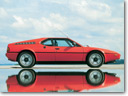
Throughout the years, besides being utterly magnificent, M BMW cars have always been a statement. “I am the kind of person which has a an impressive annual income, a family, clout and an insatiable thirst for sideway buffoonery”. Whichever M car one might choose, the perks are always going to be the same – practicality and sensibility get you trough the mazes of society while sheer power and playfulness make for a great time at the countryside. Small wonder then, that today many well dressed men consider the M batch of BMW’s as a really, really good investment. But few people ask themselves, how and when did it all begin? Let’s just say, that the whole practical performance, 5-door saloonishness was definitely not the case at the beginning of the M odyssey. Enter the 1978 M1 – BMW’s first and only mid-engined road car.
BMW M1 (1978-1981)
Its birth hadn’t been easy. The company had to act quickly as, at the time, the Porsche 911 was becoming increasingly dominant in the field of motor sports. Believe it or not, BMW needed help. And that help came from Lamborghini. Sort of. The Italian company was assigned to do the design, engineering and production work. Without a doubt, that sounds like a recipe for success – BMW overseering the company that brought to the world the Lamborghini Miura and the Countasch. Probably one of the most talented designers ever, Giorgetto Giugiaro, sketched the lines of the M1 with a particular signature that can be seen in other works of his, such as the Lotus Esprit. Sadly, the times were tough, an oil crisis swept the world and Lamborghini went bust. That meant that BMW had to turn to someone else to finish the job. It was a painstaking process that consumed both time and money. The end result was an overpriced, plastic car of a thing that spawned only 455 times. On top of that, by the time everything was sorted out, most of the motor sport regulations moved on and the Bavarian was left trailing behind.
Lotus Esprit S2 (1978-1981)
The real tragedy however, is that, for its time, the M1 was a really decent car. It had the looks, it had the quintessential supercar setup (2 seats, mid-engined, rear-wheel drive), it weighed like a super car (1400 kg) and it had a wonderful 3.5 liter straight six engine that developed 273 bhp. And it wasn’t some sort of an experiment power plant, but a proper one with a Kugelfischer mechanical fuel injection system and DOHC operating 24 valves in total. Later on the M635Csi and the first-generation M5 would get pretty much the same engine.
And that’s the thing about the M1. It died off quickly for a novel cause. Mercifully, the M badge stuck on, but now the BMW people were caught thinking – “Why don’t we shove such an engine in one of our own pefectly good saloons, beef up the brakes and suspensions and see what happens?” Today the results are evident. Almost every BMW car in the conteporary line up has an M counterpart which is hugely successful on the market and almost always highly valued by critics and automotive journalists.
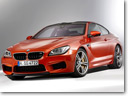
The latest from the M division comes in the form of an M6 – Coupe and Convertible. It has retained its characteristic body line and still is the ultimate in gran touring thanks to its V8 M TwinPower Turbo engine and clever design. BMW‘s EfficientDynamics on the other hand keep it frugal and refined.
The profile is familiar but there are bodily innovations – a new front apron has been introduced with massive, honeycombed air-intake patches. No matter how massive however, they are unable to steal away the headlamp department which features the characteristic BMW Corona rings that make use of the latest Adaptive LED headlight technology. A 30 mm increase of the front track has resulted in a noticeable swelling of the wheel arches which are as ever complemented by the indicator and M badge housing gills behind them. At the back we have quad tail pipes separated into two pairs, flanking the clever diffuser. The M6 sits on 19-inch alloy wheels in a star-spoke (seven double spokes) design that come in two finishes. Alternatively, as an option one can go with the 20-inch ones that have five double spokes for the sake of lighness. As always, lightness for the Coupe is also guaranteed by the carbon-fibre reinforced plastic roof panel which lowers the center of gravity significantly with improved agility and handling as an end result. In the mean time, the Convertible M6 gets the standard 6 Series Convertible retractable roof with its independent retractable rear window. The party piece is the fact that you can operate it while in motion of up to 25 mph.
BMW M6 Coupe (2013)
Inside, the M6 is a blend of luxury and sportiness – Merino leather everywhere while an instrument fascia featuring a Black Panel technology, dials with red needles and white backgrounds adorn the dashboard. The windscreen is also affected as a HUD display provides speed readout and speed limit identification, gear and rev counter and shift lights to the driver. It’s not all flash and glam though. The new M6 has more space inside and a luggage capacity of 460 litres (300-350 litres for the M6 Convertible). The M Sport seats are more complicated than a smartphone with their electric pneumatic adjustments and the manually adjustable under thigh support.
The power plant for the new M’s is the same one found in the M5 – a mighty 560 hp V8 M TwinPower Turbo 4.4 petrol unit. That’s 53 more hp than the V10 predecessor. Put your foot down behind one of these V8‘s and you’ll be greeted by a maximum torque of 680Nm as early as 1500 rpm and will be escorted by it up until 5,750rpm. That is a lot of power at your disposal ready to thrust you back into your seat when pressed. Deep down in the confounds of the engine one would find the reason for all of that grunt – twin turbochargers built in to the twin scroll principle and direct fuel injection plus a Valvetronic variable valve timing and Double VANOS continuously variable camshaft control – that translates into 0-62mph sprint of just 4.2 seconds for the M6 Coupé, with the M6 Convertible following at 4.3 seconds. The top speed limiter starts screaming at the 155 mph mark. It’s not all muscle and grease though. Thanks to BMW’s EfficientDynamics technology, the M6 has a Stop/Start function, Brake Energy Regeneration and Active Aerodynamics – all of which help reduce consumption up to 30% in comparison to previous models: The M6 Coupé has a combined fuel consumption of 28.5mpg(Convertible 27.4mpg) with CO2 emissions of 232g/km (Convertible 239g/km).
As standard, all that power coming from the engine is digested trough a seven-speed Double Clutch Transmission (M DCT) with DRIVELOGIC. It is a uniquely complex and high-tech gearbox that has three modes of shifting (thanks to the logic thing) so that the driver has the freedom to chose a style from sportiness to comfort. It also allows manual shifting trough the paddles behind the wheel or the gearstick.
BMW M6 Convertible (2013)
Surely, with that kind of power, one needs some stability feedback from the chassis. That is why M engineers have fiddled in that area as well – The rear axle subframe has been bolted directly to the body while the front axle kinematics have been redesigned with M-specific settings, and a number of 6 Series suspension components replaced with forged aluminum items. The shock absorbers are electro-hydraulically operated trough the car’s Variable Damper Control (VDC) again with three settings. Driver aids come in many abbreviations such as DSC, ABS, CBC and DBC but thankfully all can be overridden with the very important M Dynamic Mode (MDM) which allows you to do what one must do with an M car – wheel spinning, oversteer and other tire-destructive activities. For the braking power, the M6 comes as standard with 400mm front discs and 396mm rear discs clamped by six-piston calipers (at the front at least). Novice or trackday drivers can opt for the Ceramic Brakes which are more heat resistant and counter fading after much abuse.
It all sounds really wonderful but will it be a better value from the M5? There is no answer to that question as both cars have target groups: The M6 is for the hardcore performance bachelors while the M5 is for the hardcore performance family men.
With the North American International Auto Show (NAIAS) in Detroit dangerously close, BMW have kindly offered a glimpse of what their exhibit will look like. So here is a quick summary of what you should be excited about.
BMW 3-Series Sedan – The sixth generation of the compact executive vehicle will be showcased there with an improved design and a new engine lineup. The company is eager to announce that now the new 3 series is around 45 mm wider and 93 mm longer than its predecessor. Despite these stretchy dimensions the sedan has actually managed to lose some weight (40 kg lighter). The trim and equipment level comes in three different categories: Sport Line, Luxury Line and Modern Line.
Initially, customers will have the opportunity to chose from two petrol engines with two diesels coming later the same year. It is important to mention that all power plants will utilize the latest BMW TwinPower Turbo technology
The BMW 328i will carry the new generation 2.0 liter, four-cylinder petrol engine. It will produce 180kW/245 hp and a peak torque of 350Nm (258lb-ft) from as early as 1.250 rpm. That sort of power will give the luxury sedan a 0 to 100km/h (62mph) sprint time of just bellow six seconds. Amazingly enough the stated fuel economy is a generous 44 mpg figure. Keep in mind that all of the trim levels will come with an Auto Start-Stop system as standard.
BMW 3-Series Sedan F30 (2012)
The more power hungry can go for the BMW 335i. It will house a renown 3.0 liter straight-six which develops 225 kW/306 hp and a maximum torque of 400 Nm (295 lb-ft) at just 1,200 rpm. Thus in every single respect the 3 series will outperform their predecessors.
Upon request an 8 gear automatic box can be paired to whichever engine you might chose. This option is claimed to bring benefits in terms of economy and driving experience.
In true BMW spirit the cabin is full with neat gadgets such as a sharp Head-up Display, Active Cruise Control, the Lane Change Warning System and Lane Departure Warning System. A new Driving Experience Control switch not only offers Comfort, Sport and Sport + options, but also ECO PRO mode which will allow drivers to fully optimize their driving in order to achieve stunning fuel economy.
BMW ActiveHybrid 5 – This is something that will make it’s debut on the NAIAS as
the most powerful and efficient full hybrid in its segment. Fuel efficiency and power output are targeted
To provide power, the same engine which can be found in the 335i and 535i is used. However, here it has a co-worker: a 40 kW/55 hp electric motor supplied with energy by a high-performance lithium-ion battery integrated into the luggage area. So that is 250 kW/340 hp overall power which thrusts the ActiveHybrid from 0 to 100 km/h (62 mph) in 5.9 seconds, limits average fuel consumption to between 6.4 and 7.0 litres per 100 kilometres (44 – 40 mpg imp) and puffs CO2 emissions of just 149 – 163 g/km.
BMW Active Hybrid 5 (2012)
Not surprisingly, it is a very clever this hybrid. When the car is coasting or braking, the motor acts like a generator which in turn charges the high-performance battery pack. However, if you put your foot down, the motor will assist the straight-six petrol powerhouse to give the sort of dynamic boost you do not experience in ordinary cars. Then when you have reached a respectable amount of speed (up to 100 mph) what you can do is to shut down the engine and disengage it from the wheels so that you are back to coasting, using that gathered potential energy as efficiently as possible. You’ll be able to do that with no regrets as all safety features will be fully operational.
BMW M5 – Yes, this sensational performance miracle will also be there. BMW boast about how their new engine (as opposed to the old one) has a 10 percent increase in power and 30 percent increase in torque and that consumption has dropped by 30 percent. This is the first time the company gives a chance to the turbo technology to prove itself better than the pure, naturally-aspired, brute force that was in the previous generations of M5s. As a result now the engine is a V8 rather than a V10 and the displacement is only 4.4 liters but the power is up – 412 kW/560 hp at 6,000 – 7,000 rpm, while its maximum torque of 680 Newton meters (502 lb-ft).
BMW M5 F10 (2012)
To handle that massive lump of power, the M5 makes use of a very clever rear axle differential with a variable locking function. It works alongside with the DSC (Dynamic Stability Control) system to ensure the best rear-wheel drive experience there is. The suspension is also notable for its electronically controlled dampers. Dynamic Damper Control uses electro-hydraulic damping force adjustment to provide a set-up suited to the driving situation or the wishes of the driver.
Here is a full list of it’s specifications:
V8 petrol engine, M TwinPower Turbo technology with Twin Scroll Twin Turbo, cross-bank exhaust manifold, High Precision Direct Injection and VALVETRONIC variable valve control.
Acceleration 0–100 km/h (62 mph): 4.4 seconds, acceleration 0–200 km/h (124 mph): 13.0 seconds
Top speed: 250 km/h / 155 mph (305 km/h / 190 mph with M Driver’s Package)
Average fuel consumption: 9.9 litres/100 kilometres (28.5 mpg imp)
CO2 emissions: 232 g/km, exhaust standard: EU5
The i3 and the i8 – No, those are not the latest Apple products although they do have similar visionary ambitions. We are talking about two new concepts which will embody the BMW technological know-how.
The i3 is a fully electric vehicle which is a result of BMW’s commitment to the environment. Suitable for the urban area, the i3 sets new standards for efficient use of materials, light weight technology and long-distance electricity runs. It has a 125 kW/170 hp electric motor which delivers an impressive amount of torque (250 Nm (184 lb-ft) to the rear wheels. It will take you under four seconds to reach 60km/h (37mph) from a standsill and around 8 seconds to reach 100km/h (62mph).
BMW i3 Concept
BMW say it will be spacious and practical too with a boot capacity of 200 liters, and enough space to breathe freely in the cabin.
The more driver oriented i8 is a daring one with some innovative plug-in hybrid technology inside. Along with the electric wizardry that can be find in the i3, the i8 has a rear-mounted, high-performance three-cylinder combustion engine producing 164 kW/220 hp which delivers 300 Nm (221 lb-ft) of torque. Acceleration from 0 to 100 km/h (62 mph) is under five seconds while economy is stated to be three liters per 100 km (approx. 94 mpg imp). It can travel up to 35 kilometres (approx. 20 miles) on electricity alone and it has seating for four. Because of the two motors (the electric one at the front and the petrol one at the back) it has perfect weight distribution and a low center of gravity which is all beneficial to the driving experience.
BMW i8 Concept
For more technological nirvana, be careful not to miss out on anything at NAIAS in Detroit which starts next year, January the 9th.
BMW will exhibit several legendary ///M models at the 42nd Tokyo Motor Show held from 3rd to 11th December, this year.
The Motor Show is hosted by the Japanese capital’s International Exhibition Center, where BMW will showcase the latest F10 M5, E90 M3 as well as X6 M.
The fifth-generation of BMW M5 is powered by a hi-revving 4.4 liter twin-turbo V8 with 560PS (412 kW) at 5750RPM and 680Nm(502 lb-ft) at just 1500RPM. The most powerful ///M engine boasts twin-scroll turbochargers, high-precision direct fuel injection, VALVETRONIC variable valve control and a cross-bank exhaust manifold.
The performance is overwhelming – 4.4 seconds to 100 km/h and just 13 seconds to 200 km/h. The top speed is limited to 250 km/h (155 mph).
Despite the brutal performance, the engine needs just 9.9 liters per 100 km on combined cycle (28.5 mpg) and CO2 emissions of 232 g/km.
The engine is mated to a new 7-speed M Double Clutch Transmission Drivelogic and Efficient Dynamics technology, including engine Auto Start-Stop and Brake Energy Regeneration.
The E92 M3 has also hi-revving V8, but it is naturally aspirated developing 420PS (309 kW) and 400Nm (295 lb-ft). It is mated to a 7-speed M-DCT (M Double Clutch Transmission). The acceleration to 60 mph is in 4.5 seconds and top speed is electronically limited to 250 km/h (155 mph).
Finally, BMW will exhibit the X6 M, which also features the same hi-revving 4.4 liter twin-turbo V8 as the F10 M5, but it is slightly underpowered – 555PS (408 kW) at 6000RPM and 680Nm (500 lb-ft) between 1500RPM and 5650RPM.
The power is put on the road through 6-speed M Sports Automatic transmission with aluminum paddleshifters on steering wheel. 0 to 100 km/h in 5.0 seconds and top speed of 250 km/h (155 mph) – electronically limited.
X6 M also comes with 10 mm lower Adaptive Drive suspension, 4-piston calipers at the front with huge 396mm brake discs.
The vehicle stands on 20” alloy wheels with fitted with 275/40 R20 at the front and 315/35 R20 at the rear run-on-flat tires.
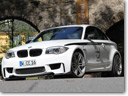
M3, M5, M6 … What was really lacking in this sequence was a smaller M1, which – with due respect to its famous predecessor of the same name – has now been officially called “1 Series M Coupe” by BMW. The engineers at BMW M GmbH are mighty proud of their smallest M-Racer, which thanks to an in-line six cylinder engine with TwinPower Turbo-charging and direct fuel injection, sends out a whopping 340 hp on the crankshaft. Alongside so much power, even a Porsche Cayman R must back off.
As one of the foremost engine tuners in Germany, the Manhart Racing Company, led by the engine tuning icon, Günter Manhart, will offer from now on a completely remodelled 1 Series M Coupe. The Manhart MH1 Biturbo stands out with its standard consistent increase in power to 415 hp, which catapults it directly into the same league as the M3 Coupe and the Porsche 997 Carrera GTS. The in-house sports exhaust system, including down pipes and stainless steel silencers, ensures not only a few extra horsepower, but also an aggressive sound.
Manhart MH1 Biturbo
This is of course still by no means the end, for, so that high performance can also be efficiently reached without large losses in traction propulsion, Manhart Racing built an in-house specially tuned coilover suspension and a magnificent Concave One wheel-set. The exclusive MHR forged wheels rotates with 9×20 inch turn forward, on the drive axle in 10.5 x20 inch turns, in combination with a 245 and 295 Continental Sport contact 5 set of tyres. For more down-force on the front axle, there is also a fine, handmade carbon-fibre front splitter, including a central bar. In the rear section, Manhart has built in a diffuser on the 1M Coupe, made also of course from high-quality carbon fibre fabrics. A set of quality carbon mirror covers completes perfectly the changes to the exterior.
For the interior of the MH1 Coupe, the experts form Geilenkirchen offer sports performance seats in the front and an Alcantara rear seat at the back, both enhanced with red stitching.
Prices:
MHR full carbon fibre front splitter
1,990 Euro
MHR full carbon rear diffuser
1,820 Euro
MHR coilover suspension
2,580 Euro
MHR Concave One forged wheels in 9×20 and 10.5×20 with 245 and 295 tyres
Brabus was founded back in 1977 and specializes in tuning for prestigious vehicles from Mercedes-Benz, Smart and Maybach. The tuning company is famous with the performance upgrades offered for the most powerful Mercedes’ engines. Furthermore, Brabus offers entire aerodynamics packages for almost every available model as well as a number of interior modifications.
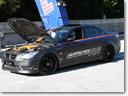
G-Power was founded 6 years later than Brabus. The specialists from G-Power specializes in tuning BMW cars. The tuning company became very famous recently with their several world records like that one for fastest saloon car in production – M5 Hurricane RR.
It is difficult to say, which tuning company is better, but one thing is for sure – both are just brutal. They fit extremely powerful engines to production cars, enormous rims with ultra-performance tires, huge brakes and proper suspensions. The exterior and interior customization is also at decent level.
To make things more interesting, we can check G-Power BMW M5 Hurricane RR and Brabus Rocket Mercedes-Benz CLS.
Firstly, Brabus Rocket is powered by a 6.2 liter twin-turbo V12 with staggering 730PS (540kW) at 5100RPM and 1320Nm (970 lb-ft) at 2100RPM. Because of safety reasons for the gearbox, the torque is limited to “just” 1100Nm (810 lb-ft). The engine was modified from a 5.5L V12 engine block -M275.
The performance is superb – 0 to 100 km/h in 4.0 seconds flat, to 200 km/h in 10.5 seconds and to 300 km/h in 29.5 seconds. The top speed is 365.7 km/h as this is a world record for fastest street-legal saloon.
The price for this pleasure is 348 000 EURO.
The opponent is G-Power BMW M5 Hurricane RR having twin-supercharged 5.0 liter V10 with 800PS (588 kW) at 7500RPM and 800Nm (593 lb-ft) at 5000RPM.
The hurricane is slightly slower to 100 km/h – 4.35 seconds, but a lot faster to 200 and 300 km/h – 9.5 seconds and 25.8 seconds, respectively. The top speed is 372 km/h, which is 6.3 km/h faster than the rocket.
G-POWER Hurricane RR stands on 255/35 ZR 19 at the front and 305/30 ZR 19 at the rear high-performance Michelin Pilot Sport tires.
Hurricane RR is priced at 251 100 EURO.
So, Hurricane RR is the fastest street legal saloon on the planet … for now!
Edo Competition has announced BMW M5 E60 Dark Edition. The tuned vehicle comes with styling and performance upgrades.
The exterior package includes new rear skirt housing four chromed exhaust tips. There are also rear wing and new 20” light alloy wheels with painted centers and Dunlop tires in dimensions 255/35 R20 front and 285/30 R20 rear.
The performance upgrade consists of a sport exhaust system, ECU re-map, high-flow air filters and catalytic converters. The overall power is boosted to 555PS (408 kW) and 560Nm (413 lb-ft). Furthermore, the top speed limiter has been removed, so the new top speed is 305 km/h (190 mph). 0 to 100 km/h takes 4.2 seconds and 100 to 200 km/h takes just 10 seconds. Very good results for a family touring car.
The interior boasts a lot of carbon fiber and precious leather. The high-performance wagon had its speedometer extended to 360 km/h and white dials with a backlit logo were installed as a finishing touch.
All modifications are carried out exclusively at edo competition Motorsport GmbH in Ahlen.
Edo BMW M5 E60 Dark EditionEdo BMW M5 E60 Dark Edition Speedometer
BMW has finally revealed the new M5 F10, which is exactly the same as the M5 Concept.
The new BMW M5 includes an aggressive front bumper, aerodynamic side skirts and a new rear diffuser. It also features front fenders, a unique grille with black slates, adaptive xenon headlights with LED angel-eyes, a four-tailpipe sports exhaust system and huge 19” light alloy wheels.
The interior boasts Merino leather sport seats, a new instrument cluster and a multifunctional ///M steering wheel. There are two ///M buttons with pre-selected engine, transmission and suspension setups, so the driver is able to choose the settings immediately. Inside, there are also aluminium trace trim, an Anthracite headliner and a 10.2” iDrive display.
2012 BMW M5 F10 Interior
The M5 F10 also comes with a head-up display, night vision technology with pedestrian recognition, a lane change and departure warning system, a surround view camera and internet connectivity. All these features make the driving real pleasure and guarantees the safety of the passengers.
The power as you may suggest is staggering. A twin-turbo 4.4-liter V8 with 560PS (412 kW) at 5750RPM and 680Nm(502 lb-ft) at just 1500RPM. It features M TwinPower Turbo technology, twin-scroll turbochargers, high-precision direct fuel injection, VALVETRONIC variable valve control and a cross-bank exhaust manifold. 0 to 100 km/h in 4.4 seconds, 0 to 200 km/h in 13 seconds and top speed of 250 km/h (155 mph) electronically limited and 305 km/h (190 mph) with M Driver’s Package. However, the fuel consumption is also amazing – 9.9 liters per 100 km on combined cycle (28.5 mpg) and CO2 emissions of 232 g/km.
2012 BMW M5 F10 Engine
The M5 F10 offers electronically controlled dampers with three modes – Comfort, Sport and Sport Plus. The M-specific Servotronic steering system, high-performance compound brakes and an Active M Differential make the driving a real pleasure.
The safety is provided by the DSC (Dynamic Stability Control) system, which operates via FlexRay high-speed data transfer technology, and constantly cross-checks the data collected by its sensors with the feedback from DSC. In other words, the car won’t allow to suicide yourself.
Finally, the 2012 BMW F10 M5 Concept is revealed. The coverage of the car started back in 2007 with some spy photos and little information. However, BMW has recently launched several video clips with some winter testing of the new M5. Still, the car was partly covered and no information about the drive train was released.
Here are some pictures of 2012 F10 M5, but there are no official information for the performance characteristics of the sport sedan. The media release is expected on April 7th and the car will make its official debut at the Auto Shanghai on 19th, this month.
F10 M5 is expected to be powered by the well-know 4.4 liter twin-turbo V8, which is used in X5M and X6M, where it delivers 555PS. However, the sport saloon will have at least 600PS to match the competition – Audi RS6 and Mercedes E63 AMG.
Stay tuned for more information and until then, enjoy the pictures of the new BMW F10 M5 Concept. The car looks just brutal and we don’t doubt that it will be superbly faster than 99 percent of the cars on the public roads.
BMW M5 G-POWER HURRICANE RS Touring is powered by twin-supercharged V10 with 750PS (551 kW). It is built for one and only reason to be the fastest estate car on the planet and it did it – 360 km/h. This is enough to beat the existing record of 344.2 km/h set by MTM Audi RS6 R from 2009.
Here is the video, where HURRICANE RS Touring does 224 mph.
The staggering results are thanks to a number of upgrades. (more…)
G-POWER M5 HURRICANE GS is the world’s fastest LPG-powered ride, topping the extraordinary speed of 333 km/h. As the name suggests, the G-POWER’s ultra-fast conversion is based on the Bavarian athlete BMW M5, but instead of producing the stock output of 507 horsepower and 520 Nm with its 5.0-liters V10 powerplant, the M5 HURRICANE GS delivers the remarkable 660 horsepower and 650 Nm of peak torque. These uncompromising figures are achieved via the G-POWER SK II bi-supercharger system with low-pressure forced induction with relative charge pressure of 0.6 bar.
In addition to its LPG-converted power unit, the G-POWER M5 HURRICANE GS is further packed with a SPEED-Flow exhaust system and a set of sleek matt-black 20-inch forged alloy wheels SILVERSTONE CLUBSPORT wrapped in high-performance Michelin tires in the dimensions 255/35 ZR 20 and 285/30 ZR 20.
G-POWER M5 HURRICANE GS covers the classic zero to 100 km/h acceleration sprint in 4.6 seconds flat, while the 200 km/h mark takes only 11.4 seconds.
More G-POWER equipment enhancements on the M5 HURRICANE GS include high-performance braking system and G-POWER RS coil-over sports suspension, with 9-way adjustability for compression and rebound plus infinitely variable height adjustment.
Rossin-Bertin Vorax sounds like… Actually, it sounds like a science fiction and it IS! The vehicles is a combination between Nissan Juke and Mazda RX-8. The Vorax features a carbon fibre body and aluminium chassis as you may suggest for extra strength and lightweight. It is supposed to weigh just 1.3 tonne (2 866 lbs).
The „thing” is powered by 5.0 liter V10 from BMW M5 with 570hp. The sprint from 0 to 100 km/h is covered in 3.8 seconds and the top speed is 330km/h. However, the company plans to release a 750hp supercharged version with 3.6 seconds to 100 km/h and Vmax of 372 km/h. (more…)
 Throughout the years, besides being utterly magnificent, M BMW cars have always been a statement. “I am the kind of person which has a an impressive annual income, a family, clout and an insatiable thirst for sideway buffoonery”. Whichever M car one might choose, the perks are always going to be the same – practicality and sensibility get you trough the mazes of society while sheer power and playfulness make for a great time at the countryside. Small wonder then, that today many well dressed men consider the M batch of BMW’s as a really, really good investment. But few people ask themselves, how and when did it all begin? Let’s just say, that the whole practical performance, 5-door saloonishness was definitely not the case at the beginning of the M odyssey. Enter the 1978 M1 – BMW’s first and only mid-engined road car.


 The latest from the M division comes in the form of an M6 – Coupe and Convertible. It has retained its characteristic body line and still is the ultimate in gran touring thanks to its V8 M TwinPower Turbo engine and clever design. BMW‘s EfficientDynamics on the other hand keep it frugal and refined.


 With the North American International Auto Show (NAIAS) in Detroit dangerously close, BMW have kindly offered a glimpse of what their exhibit will look like. So here is a quick summary of what you should be excited about.


 BMW will exhibit several legendary ///M models at the 42nd Tokyo Motor Show held from 3rd to 11th December, this year.


 M3, M5, M6 … What was really lacking in this sequence was a smaller M1, which – with due respect to its famous predecessor of the same name – has now been officially called “1 Series M Coupe” by BMW. The engineers at BMW M GmbH are mighty proud of their smallest M-Racer, which thanks to an in-line six cylinder engine with TwinPower Turbo-charging and direct fuel injection, sends out a whopping 340 hp on the crankshaft. Alongside so much power, even a Porsche Cayman R must back off.


 Brabus was founded back in 1977 and specializes in tuning for prestigious vehicles from Mercedes-Benz, Smart and Maybach. The tuning company is famous with the performance upgrades offered for the most powerful Mercedes’ engines. Furthermore, Brabus offers entire aerodynamics packages for almost every available model as well as a number of interior modifications.


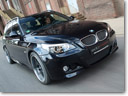 Edo Competition has announced BMW M5 E60 Dark Edition. The tuned vehicle comes with styling and performance upgrades.


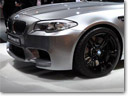 Finally, the 2012 BMW F10 M5 Concept is revealed. The coverage of the car started back in 2007 with some spy photos and little information. However, BMW has recently launched several video clips with some winter testing of the new M5. Still, the car was partly covered and no information about the drive train was released.


 BMW M5 G-POWER HURRICANE RS Touring is powered by twin-supercharged V10 with 750PS (551 kW). It is built for one and only reason to be the fastest estate car on the planet and it did it – 360 km/h. This is enough to beat the existing record of 344.2 km/h set by MTM Audi RS6 R from 2009.


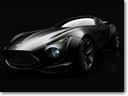 Rossin-Bertin Vorax sounds like… Actually, it sounds like a science fiction and it IS! The vehicles is a combination between Nissan Juke and Mazda RX-8. The Vorax features a carbon fibre body and aluminium chassis as you may suggest for extra strength and lightweight. It is supposed to weigh just 1.3 tonne (2 866 lbs).