Tag: low emissions

  • 2012 Hyundai i-oniq concept unveiled in Geneva

    Hyundai finally unveiled its latest European concept car, which carries the name i-oniq. The debut took place at the 2012 Geneva Motor Show, and included a showcase of new technology and design which present an impression of the company’s future thinking. The concept vehicle is 4,4 meters long and is an electric sports hatchback with a range-extending petrol engine. The design of the car is an evolution of the company’s fluidic sculpture form language. The car has dynamic proportions which create aesthetic and functional body shape. In addition the design conveys premium and athletic qualities evident in both the exterior and interior of the car. Furthermore, unique design elements were included in the car, for instance the “penthouse roof” and LED headlights, which emphasize the advanced technology encased within i-oniq. What is so special about the roof is that it is significant solution which delivers great space for rear passengers and contributes to the overall dynamic appearance. Other fascinating features of the 2012 Hyundai i-oniq are the doors. They open up to the side, thank to weight-optimization. In addition the featured seat kinematics make entering the car’s front and rear seats a simple maneuver. Moreover, the headlights contained in uniquely-shaped polished aluminium frame which forms unique signature light element.

    2012 Hyundai i-oniq concept
    2012 Hyundai i-oniq concept

    And what about the interior of the concept car: the cabin layout is driver-oriented, with the dashboard and centre-console geometry based around the driver. In addition, the user-interface components reflect contemporary and future consumer electronics technology. What we can find here is the movement control mounted on the steering wheel, floating instrument cluster with multi-layered projection, and a large background display for navigation, entertainment and other information. At the rear of the cabin has been designed unique lounge area, which ensures maximum occupant comfort. It creates positive contrast to the sports-orientated front area. Of course, the comfort in the car is additionally complemented through the use of luxurious interior materials, as well as futuristic interface components.

    To go even further into details, the 2012 Hyundai i-oniq concept vehicle is powered by an innovative 1,0-litre, 3-cylinder petrol engine, which delivers a maximum of 45 kW (61 hp). This unit is mated to an 80 kW (109 hp) lithium-ion electric motor which is powered by a 55 kW generator, via a single ratio gearbox. In electric-only mode, the concept can travel 120 km (74 miles) and up to 700 km (435 miles) with the assistance on the petrol engine, emitting only 45 g/km of CO2emissions! Hyundai i-oniq concept can reach a top speed of 145 km/h.

    Specifications

    Engine 1,0-litre, 3-cylinder gasoline engine (45 kW)
    Motor 80 kW
    Power output 80 kW (109 ps)
    Wheelbase 2.650 mm
    Overall length 4.432 mm
    Overall width 1.916 mm
    Overall height 1.400 mm
    Tires Dunlop
    CO2 45 g/km
    Steering wheel Touch sensor with motion-control system

    Source: Hyundai

  • LC Super Hybrid Technology to debut at 2012 Geneva Motor Show

    LC-Super-Hybrid-Technology-THUMBThe LC Super Hybrid Technology is conceived by Controlled Power Technologies (CPT) and the Advanced Lead-Acid Battery Consortium (ALABC) with the only aim to show significant CO2 reduction through the means of electric hybridisation at low voltages (12-48 volts) using the latest lead-carbon batteries.  The technology offers the potential of a mass market, petrol-powered, large family car with superb drivability, with spectacular performance and excellent 5.6 litres/100km (51mpg) fuel economy.

    The LC Super Hybrid Technology is going to be showcased for the first time at the 2012 Geneva International Motor Show. The low voltage (12 volts) technology has been created by UK-based Controlled Power Technologies in colaboration with the US-based Advanced Lead-Acid Battery Consortium.  The vehicle includes production-ready technology sold by CPT to Valeo.  Other international companies involved are AVL Schrick based in Austria and Germany, Mubea also from Germany, and the UK-based Provector.

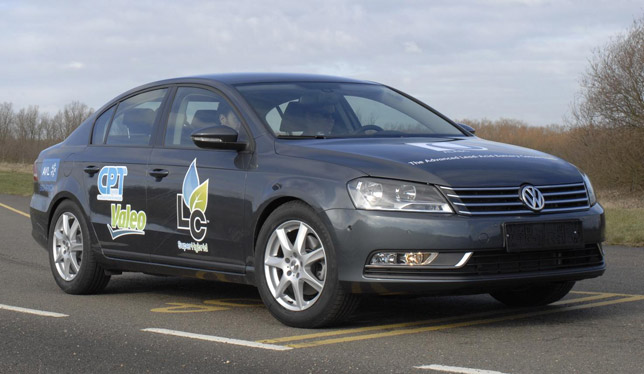
    Volkswagen Passat 1.4-litre TSI model with LC Super Hybrid Technology
    Volkswagen Passat 1.4-litre TSI model with LC Super Hybrid Technology

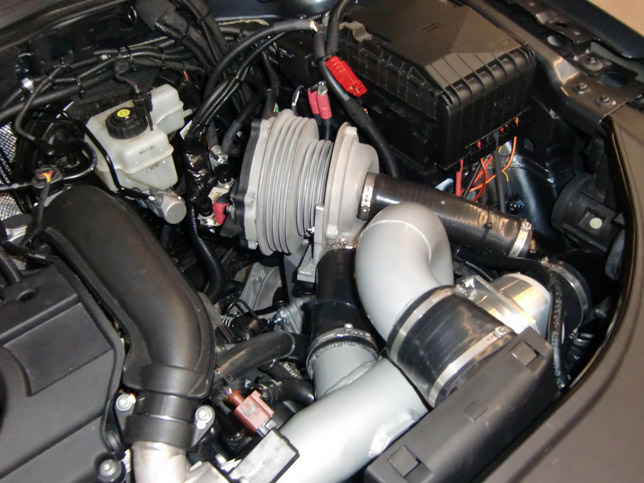
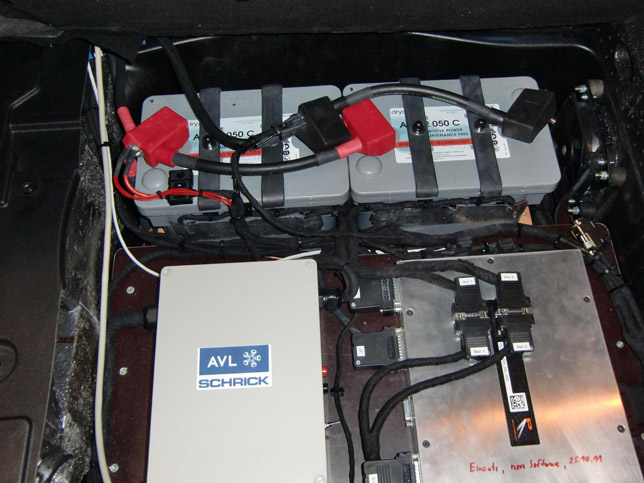
    To be more precise, the technology is mounted on the series production 1.4-litre turbocharged VW Passat TSI model. Including the LC upgrade, the vehicle weighs around 1530kg which means that the technology adds the additional 79kg. Nevertheless, much of this additional mass including the test equipment would be eliminated in a production vehicle as well as the existing starter motor. The additional payload further underscores the excellent performance and drivability of the LC Super Hybrid demonstrator. Going straight to the point, the technologies features an electric supercharger, next generation belt-integrated starter generator with an advanced belt tensioning system, carbon improved valve regulated lead–acid (VRLA) batteries which avoid the need for super-capacitors, and higher gear ratios to reduce engine speed. Thus, this results in increase of power from 122 PS (90 kW) to 142 PS (104 kW) and torque from 200 Nm (148 lb-ft) to 275Nm (203 kW). The effects can be compared to the Passat’s bigger 1.8-litre TSI gasoline engine, which delivers 160 PS (118 kW) and 250 Nm (185 lb-ft), and hence the engine output of the LC Super Hybrid Technology is generally equivalent to vehicles in the 2-litre class. Additional advantage is that the vehicle also achieves near diesel levels of fuel economy, but with substantially lower production costs. Furthermore, the LC Super Hybrid delivers CO2 emissions of less than 130g/km compared with 140g/km for the baseline Passat 1.4-litre TSI.  This represents a reduction in CO2 emissions of 8 per cent. Another benefit is the great fuel economy of 5.6 litres/100km (51mpg), which is significant 11 per cent improvement when compared with 6.2 litres/100km (46mpg) for the 1.4-litre TSI.  Moreover, the 0-100 km/h (0-62 mph) acceleration time is reduced by 2.5 seconds from 11.1 to 8.7 seconds compared with the 1.4-litre TSI. In addition, the demonstrator embraces low voltage switched reluctance (SR) motor-generators, which are not currently used by the automotive industry in mass production. The motors are constructed from steel, aluminium and copper and avoid the use of increasingly expensive rare earth materials.  The SR technology is licensed from Nidec Corporation of Japan, one of the world’s leading suppliers of electric motors.

    LC Super Hybrid Technology
    LC Super Hybrid Technology

    Furthermore, the improved lead-carbon battery design allows for an excellent charge and discharge characteristic, while the carbon-enhanced negative plate formulations enhance life under hybrid vehicle duty cycles. Additional improvements in the battery are achieved by careful attention to battery management and they also retain the long established end-of-life re-cycling benefits of lead-acid batteries. At 48 volts the low voltage LC Super Hybrid is expected to deliver more than the nominal 25 per cent improvement in CO2 emissions and fuel economy already achieved when compared with typical 2-litre naturally aspirated vehicles. In addition, the demonstrator develops low carbon ELC concept by incorporating CPT’s next generation SpeedStart stop-start system. The latter features intelligent torque and current control with enhanced stop-start capabilities. Moreover, it is world’s most powerful belt-integrated starter generator (B-ISG) which operates at 12 volts, and the first and only system based on the highly controllable switched reluctance motor-generator technology.

    LC Super Hybrid Technology
    LC Super Hybrid Technology

    LC Super Hybrid technology demonstrator is based on a VW Passat 1.4-litre TSI model and also features an electric supercharger which boosts the existing turbocharger, and CPT SpeedStart stop-start technology (top right) and Mubea belt tensioner.

    Source: Controlled Power Technologies

  • Vauxhall Offers The Most Low Emissions Models

    The current financial situation means that fleet managers are scrutinising costs even more closely than usual, with concerns including high fuel prices and increasing environmental pressures. With this in mind, Vauxhall is offering fleet customers more choice than any other manufacturer to reduce their environmental impact, with more than 366 model variants to choose from with carbon dioxide emissions of less than 160g/km. (more…)