Tag: Li-ion

  • Toyota Prius+ for a Versatile Summer

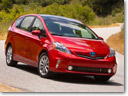
    Toyota-Prius-Plus-thumbThis summer a new example of Toyota‘s hybrid know-how is coming to town…or Europe. It’s the Prius+ – Europe’s first full hybrid seven-seat MPV. Two trim levels will be available, the base T4 and T Spirit.

    One can imagine for example, that in the UK, the sub-100 g/km of CO2 T4 version will be hugely popular as this will be the only MPV out on the streets with zero road tax and it can go in and out of London without paying a congestion charge. The T Spirit, which is kind of more equipped (17-inch wheels, 8, instead of 6, JBL speakrs, leather seats) spews out 101 g/km. Official figures for the fuel economy equal to 68.9mpg for the T4 and 64.2mpg for the T Spirit.

    A pack of li-ion batteries lays within the center console so that no passenger or luggage space is compromised. Five separate folding rear seats are provided and with all of these in place there is 200 litres of luggage space. Remove the third row and you get 505 liters.

    Both of the models get various goodies such as rear-view camera, Smart Entry and Start, climate control, electric windows and heated folding mirrors, panoramic roof with aoutmatic shade, rain sensing wipers, LED daytime running lights and more.

    Quite a bundle considering the projected starting price of $41,578 for the T4. The T Spirit stands at $46,814 and it does not sound like a bargain.

    Toyota Prius Plus MPV
    Toyota Prius Plus MPV

    Source: Toyota

  • Seven Seat Toyota Prius v for Australia

    Toyota-Prius-v-7-seat-thumbAustralia will get a new seven-seater Toyota Prius v as an addition to the already established lineup that comprises of the Prius hatch and Prius c city car. Sales are expected to start in May this year with the idea to broaden the appeal of the hybrid family to the Australian public.

    The seven-seat Prius v is 135mm longer, 30mm wider and 100mm higher than the Prius hatch. The wheelbase alone is 80mm lengthier in comparison, thus enabling the Prius to accommodate adults in all three rows.

    “The Prius v is all about versatility – it is larger and roomier to meet the needs of growing families while retaining the Prius DNA of environmental performance and fuel economy,” said Australia’s sales and marketing executive director Matthew Callachor.

    However, Toyota want to make it clear that this is not just a long-wheel base version of a former Prius. Design was made from scratch and all body panels are new. It will also be the first Toyota hybrid using Li-ion batteries in Australia. Spaced between the driver and passenger seat, under the center console, the battery pack is lighter and more efficient than the Nickel-metal Hydride one used in the past.

    In order not to compromise luggage space, the third seat row can be folded for the sake of cargo space. If that doesn’t prove itself enough, the second row can also be contracted thus making the Prius v a versatile family hybrid.

    Power will come from Toyota’s latest Hybrid Synergy Drive® powertrain which incorporates a 73kW 1.8-litre Atkinson Cycle petrol engine in combination with a 60kW electric motor.

    In Australia, Toyota and Lexus have sold more than 35,000 hybrids, 17,000 of which are Prius models.

    Toyota Prius v (seven seats version)
    Toyota Prius v (seven seats version)
    Toyota Prius v (seven seats version)
    Toyota Prius v (seven seats version)

    Spource: Toyota

  • Nissan LEAF Severe Weather Test [VIDEO]

    Nissan-LEAF-thumbWe have all been there: it’s minus 15 Celsius outside, snow chunks fall down on you like there’s no tomorrow and you can’t call anyone because your cellphone is dead. It wasn’t dead 3 minutes ago. In fact it had 2 lines of battery on the screen but now it’s  over because the reality of the situation is that weather does affect the efficiency of Li-ion batteries. It’s the same frightening story with electric vehicles – what if I run out of juice in the middle of nowhere? Well Nissan are painfully aware of this issue and have gathered members of the media and the public in northern Japan to demonstrate how the LEAF tackles cold weather with a few tricks up it’s sleeve.

    At 230 meters above see level in Shibetsu, Hokkaido the thermometers outside showed minus 9 Celsius. The LEAF was tested out on the snow covered tracks for a while and the battery temperature never dropped bellow 5 Celsius. Under more extreme conditions, like in Sweden or Norway, the LEAF‘s battery packs can be fitted with a warming system to preserve maximum capacity. Chief Vehicle Engineer Hidetoshi Kadota shared some tips with the 350 LEAF owners on how to get the most out of their EV’s. For example, pre-warming the cabin before taking a drive will greatly benefit range and efficiency.

    Motoring journalists however, seemed more interested on how the LEAF would handle on slippery surfaces such as the powdery track in Shibetsu. A pylon slalom was set up and for what might be a surprise for some, the LEAF coped pretty well. The car’s Vehicle Dynamic Control, which monitors driver input and vehicle function is sure to have helped. Also, because of the center of gravity, which is really low (the battery packs are under the cabin), one might argue that on that surface, the LEAF handled better than any other FF or FR car out there.

    Journalist and race driver Takayuki Kinoshita says LEAF proved it’s the one for the road:
    “I think EVs, like the LEAF, will expand in the future. If EVs can only be usable in certain limited conditions, they will not grow. But I was highly impressed by the key message here, that the LEAF can drive normally in hot or cold weather throughout the world.”

    Definitely a point for Nissan there.

    httpv://www.youtube.com/watch?v=_VGu0cfCuTM&feature=player_embedded