Tag: KERS

  • LaFerrari – Price $1,700,000

    LaFerrari now can be visualized by fans or potential customers online. The manufacturer will produce just 499 units with price of $1.7 million (€1.3 million), each.

    You can find all details about the Enzo’s successor at the source link, below. LaFerrari is going to have a huge success, because more than a thousand people are interested in buying this unique vehicle. However, there is a problem, because of the limited series.

    2013 Ferrari LaFerrari is powered by a 6.3 liter V12 with 800HP (588 kW) at 9,250RPM an 700Nm (519 lb-ft) at 6,750RPM. With the help of HY-KERS, the overall power is whopping 963HP and over 900Nm of torque. 0-100 km/h in under 3 seconds, 0-200 km/h in 7 seconds and 0-300 in breath-taking 15 seconds.

    A lap time at Fiorano of under 1’20” – 5 seconds faster than the Enzo and over 3 seconds faster than the F12berlinetta.

    Source: Ferrari

  • 2013 Geneva Motor Show: LaFerrari

    Ferrari has announced LaFerrari Limited Series Special at the 2013 Geneva Motor Show. Only 499 will be built of this spectacular sports car.

    The model introduces the hybrid system which, making full use of the Scuderia Ferrari’s F1 KERS know-how, has resulted in a solution that exalts Ferrari’s fundamental values – performance and driving thrills.

    The hybrid technology used, known as HY-KERS, represents the perfect combination of maximum performance and lower emissions. LaFerrari in fact emits just 330 g/km of CO2 but without resorting to electric-only drive which would not fit the mission of this model.

    The HY-KERS system is, however, designed so that in future applications a car can be driven using exclusively electric power for a few kilometres and, during development testing, a full-electric version of LaFerrari achieved just 220 g/km of CO2 emissions on the combined cycle.

    The engine is a 6.3 liter V12 with 800HP (588 kW) at 9,250RPM an 700Nm (519 lb-ft) at 6,750RPM. With the help of HY-KERS, the overall power is whopping 963HP and over 900Nm of torque. 0-100 km/h in under 3 seconds, 0-200 km/h in 7 seconds and 0-300 in breath-taking 15 seconds.

    A lap time at Fiorano of under 1’20” – 5 seconds faster than the Enzo and over 3 seconds faster than the F12berlinetta. LaFerrari is thus the fastest road car in Maranello’s long history.

    Check out the full technical specs, below!

    httpv://www.youtube.com/watch?v=iRsV6YpLsKA

    TECHNICAL SPECIFICATIONS

    HY-KERS system

    Total maximum power 963 CV
    Total maximum torque >900 Nm
    V12 maximum power* 800 CV @9000 rpm
    Maximum revs 9250 rpm
    V12 maximum torque 700 Nm @6750 rpm
    Electric motor output 120 Kw (163 CV)
    CO2 emissions** 330 g/km

    Performance

    Maximum speed over 350 km/h
    0-100 km/h <3 sec
    0-200 km/h <7 sec
    0-300 km/h 15 sec

    ICE

    Type 65-deg. V12
    Bore and stroke 94 x 752 mm
    Total displacement 6262 cc
    Compression ratio 13.5:1
    Specific power 128 CV/l

    Dimensions

    Length 4702 mm
    Width 1992 mm
    Height 1116 mm
    Wheelbase 2650 mm
    Weight distribution 41% fr, 59% r
    Gearbox
    7-speed DCT

    Suspension

    Front double wishbones
    Rear multi-link
    Tyres (Pirelli P-Zero)
    Front 265/30 – 19
    Rear 345/30 – 20
    Carbon ceramic brakes (Brembo)
    Front 398 x 223 x 36 mm
    Rear 380 x 253 x 34 mm

    Electronic controls

    ESC stability control
    High perf ABS/EBD Performance anti blockage system/electronic brake balance
    EF1-Trac F1 electronic traction control integrated with the hybrid system
    E-Diff 3 third generation electronic differential
    SCM-E Frs magnetorheological damping with twin solenoids (Al-Ni tube)
    Aerodynamics active

    * with dynamic ram effect
    **Undergoing homologation

    Source: Ferrari

  • Ferrari F150 at the Race Track [video]

    Marchettino has published a video with the upcoming Ferrari F150, which has been put on testing at the Fiorano Race Circuit. The hyper-car will make its official debut at the 2013 Geneva Motor Show.

    The car wears a lot less camouflage than before, so some details are completely exposed. The F150 has enormous fenders, ventilated hood and headlights from 458 Italia. There is also a four-tailpipe exhaust system, which sounds sensationally. At the rear, the Ferrari’s signature – two round taillights.

    Nothing is confirmed for the powertrain, but rumors says that the F150 will have a V12 engine backed up by a Kinetic Energy Recovery System (KERS). The power will be around 950HP (699 kW) – 0-100 km/h in under 3 seconds and a top speed of 370 km/h (230 mph).

    The pricing will be around €1,200,000.
    httpv://www.youtube.com/watch?v=NQpRtwxTXj0

    Source: Marchettino via Youtube

  • McLaren P1 Concept – 0-100 km in 2.8 seconds

    McLaren will exhibit their new super car at the 2012 Paris Motor Show. The McLaren P1 has one simple goal: to be the best driver’s car in the world on road and track.

    “The McLaren P1 will be the result of 50 years of racing and road car heritage,” commented McLaren Automotive Executive Chairman Ron Dennis.

    The P1 will be powered by the same 3.8 liter twin-turbocharged V8 engine from MP4-12C, but with a Kinetic Energy Recovery System (KERS). The combined power will be sensational – 963HP (718 kW). 0-100 km/h in 2.8 seconds and a top speed of 384 km/h (239 mph). Still, this is a little less than the world record of McLaren F1 achieving 391 km/h.

    “Twenty years ago we raised the supercar performance bar with the McLaren F1 and our goal with the McLaren P1 is to redefine it once again.”, he added.

    “Our aim is not necessarily to be the fastest in absolute top speed but to be the quickest and most rewarding series production road car on a circuit. It is the true test of a supercar’s all round ability and a much more important technical statement. Our goal is to make the McLaren P1 the most exciting, most capable, most technologically advanced and most dynamically accomplished supercar ever made.” finished McLaren Automotive Managing Director Antony Sheriff.

    Source: McLaren

  • 2011 McLaren F1 Race Car

    The new 2011 F1 Race Car of McLaren Mercedes was unveiled. It will be driven by Lewis Hamilton and Jenson Button. The aerodynamics is slightly changed – a higher nose, a new airbox and re-designed sidepods.

    The most important thing is that the the McLaren 2011 F1 Race Car is now equipped with the KERS system, just like their competitors. (more…)

  • 2014 Lotus Elite with KERS – Kinetic Energy Recovery System

    KERS in a production car? Yeah, right?! You may thought so, but Lotus have other opionion. They released first details about the 2014 Elite.

    The car is modern classic with 2+2 seats and astonishing design. The dimensions are 460cm in length, 190cm in width and 132cm in height. It features superb styling and  a retractable hard top.

    2014 Lotus Elite is going to be powered by an elite motor – 5.0 liter V8 with 620PS and 720Nm of torque. The weight will be around 1650 kg (3638lb), so the car will be able to accelerate to 100km/h in 3.5 to 3.7 seconds and the top speed will be 315 km/h (196mph). (more…)

  • Renault DeZir Concept

    Renault is about to stun the world with their latest concept car – DeZir. The vehicle stands out as an illustration of the brand’s commitment to more emotional styling.

    It is powered by an electric motor proving that the electric vehicles and a love of cars are by no means incompatible.

    The public will get its first opportunity to see DeZir at the 2010 Paris Motor Show. (more…)

  • Xtrac sees a number of applications for flywheel hybrids in road cars

    Transmission technology specialist Xtrac says the flywheel kinetic energy recovery systems (KERS) currently being developed for Formula One could be applied to road vehicles in a number of ways.

    “By providing an additional boost of power, the F1 technology is particularly relevant to the trend to fit cars with smaller engines in pursuit of better fuel efficiency and lower CO2 output,” says Xtrac technical director Adrian Moore.

    “The technical challenge with engine downsizing is compensating for the loss of engine torque and driveability, which can be restored by applying flywheel technology.  It is also possible that a mechanical KERS system could be used as a range extender in a battery electric hybrid vehicle or even to power vehicle auxiliaries.

    “All are potential applications of the technology, subject to the size of the flywheel, compactness of the system and vehicle packaging requirements.  These are all resolvable technical issues.  The intent of the KERS technology in F1 is to consider energy recovery, storage and discharge, and to demonstrate that technology in a novel and effective way.”

    Complementing its work in F1, the transmission technology provider is also an active partner in a new project to develop a flywheel hybrid system for premium cars.  Xtrac forms part of a consortium supported by the UK government’s Technology Strategy Board, which recently announced funding of ?23 million for 16 innovative low carbon vehicle development projects.

    The flywheel hybrid project will involve the design and development of a mechanical KERS system for use in a premium segment passenger car as an alternative solution to other hybrid systems and to prove its effectiveness and viability for production.  Jaguar is leading the project, which will be carried out by a consortium made up of Flybrid Systems, Ford, Prodrive, Ricardo, Torotrak and Xtrac.

    “We are very excited about being part of a consortium that has successfully secured funding to undertake one of the major UK low carbon vehicle programmes,” said Peter Digby, managing director of Xtrac.  “Taking a technology that has been developed for motorsport and implementing it for road vehicles in order to improve fuel economy and reduce carbon emissions so quickly after the emergence of the base technology shows how rapidly the UK motorsport industry can react.  It is no surprise that a number of our consortium members are successful motorsport engineering companies who have taken up the challenge.”

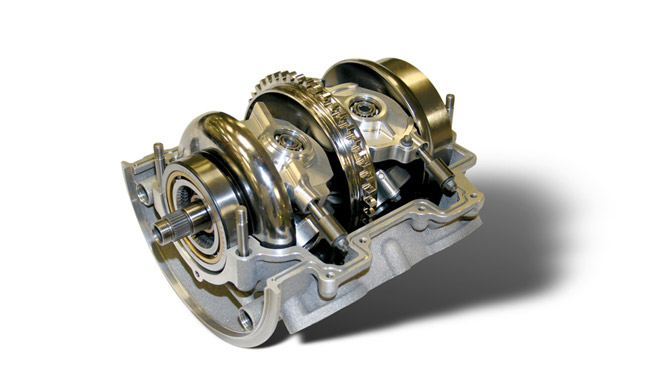
    Xtrac has been involved in energy efficient motorsport initiatives since 2001 and more recently has played a key role in designing, developing and integrating a mechanical KERS system for F1 with partners Flybrid and Torotrak.   Xtrac’s role is to provide the toroidal continuously variable transmission (CVT) between the flywheel and the vehicle powertrain.

    Given the need to develop systems in time for the 2009 season, the CVT has already undergone rigorous bench testing on Torotrak and Flybrid test rigs. The three F1 project collaborators all strongly believe that the mechanics of this system can be transferred to other technology areas including road vehicles.

    “There are some peculiarities which are distinct to F1 due to the regulations, such as the control system, integration of the ECU and the operating parameters,” says Moore, “but as the original Torotrak CVT concept was intended for road vehicle transmissions, the flywheel KERS opportunity readily allows for the use of toroidal CVTs in cars.

    “Historically, there are many instances where a new technology initially looks challenging to install in certain applications only to find a few years later that it is smaller, lighter and performs better than anyone ever envisaged.  F1 will certainly help advance this process.”

    The energy recovery rate and storage requirements of a flywheel for a road car could be considerably less than that required in F1 where the energy which can be recovered from 5g braking is significant.  As the flywheel is required to be charged, some preliminary motion may be required; though road cars could store energy in the flywheel directly from the engine, which is not currently permissible under F1 regulations.  Road driving conditions also vary from the stop-start conditions experienced in a town environment to constant speed cruising found on motorways.

    “Although still maturing, KERS has stimulated the introduction of radical new technologies to F1 and ultimately to other engineering sectors,” says Moore.  “The mechanical based concept offers one such solution and indeed could offer significant energy efficient benefits to the driveline of both race and road vehicles.”

    Moore is presenting a paper outlining the design and development of the CVT used in the Flybrid F1 system this week to leading automotive engineers and technical experts attending the Global Powertrain Congress being held in Vaals in the Netherlands.

    This is not the first time that Xtrac has presented a paper at this high level conference demonstrating the potential crossover of transmission technology between motorsport and road vehicles.  Last year it presented details of its gearbox developed for the world’s first commercially viable diesel-electric drivetrain.  The low-cost energy-efficient drivetrain had been prepared by automotive engineering consultancy Zytek for assessment by carmakers in a vehicle fully meeting the requirements of the UK government’s Ultra Low Carbon Car Challenge (ULCCC).

    A published copy of Xtrac’s latest paper on the CVT development for the flywheel KERS for F1 and its potential for road vehicles is available from the International Council for Powertrain Engineering and Management (ICPEM), the non-profit organisation that organises the conference.  Information is available at www.gpc-icpem.org.

    The Global Powertrain Congress, currently celebrating its 10th anniversary, has established itself as an international event focused exclusively on the needs of the powertrain community.  The event is sponsored by IPCEM to help advance knowledge of science, engineering and safety related powertrain technologies.