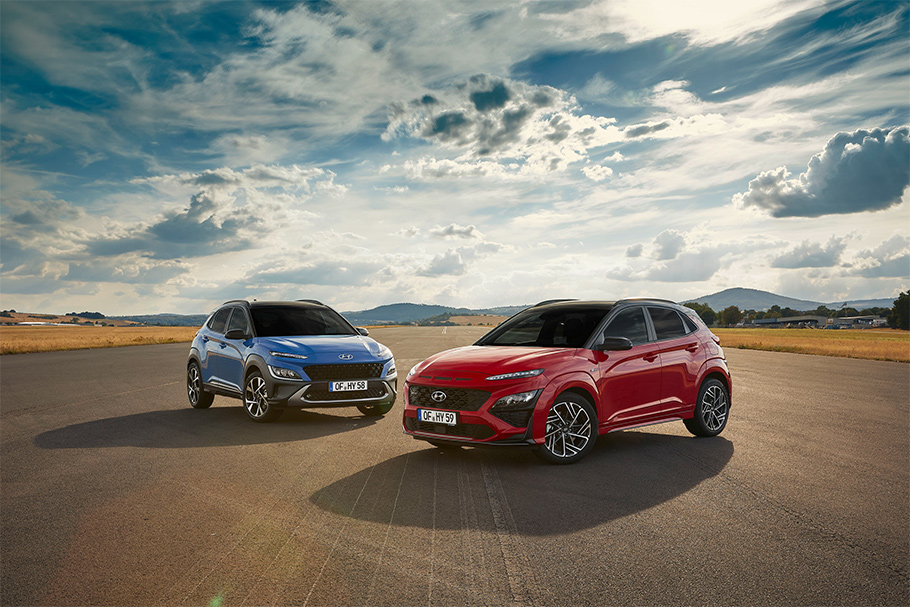
Hyundai UK has confirmed pricing and specifications for its comprehensively updated Kona sub-compact SUV, which now includes for the first time a sporty N Line trim, as well as a full hybrid option and 48-volt mild hybrid technology on all other variants.
The Kona’s design has been enhanced inside and out. Revised suspension and new connectivity and in-car convenience features make it even more comfortable and enjoyable for driver and passengers alike.
With the all-new N Line version the Kona wears its sporty dynamics on its sleeve, thanks to unique design features front and rear, bespoke diamond-cut wheel design, and comprehensive interior styling enhancements.
The 2021 Kona range starts from £21,060 on-the-road for the Kona SE Connect 1.0 T-GDi 48-volt MHEV. The dynamic new N Line specification is available from £23,590 on-the-road.
The Kona is equipped with Hyundai’s 1.0-litre T-GDi Smartstream petrol engine with 48-volt mild hybrid technology and six-speed Intelligent Manual Transmission (6iMT).
Hybrid versions of the Kona are equipped with a Kappa 1.6-litre GDI petrol four-cylinder engine and an electric motor linked to a 1.56 kWh lithium ion polymer battery pack. Transmission is via a six-speed Dual Clutch Transmission (6DCT).
First seen in the new i30 and the all-new i20, the iMT’s clutch operates electronically, decoupling the engine from the transmission after the driver releases the accelerator, saving fuel by switching off the engine and activating ‘coasting’ mode. The engine restarts in the same gear as soon as the driver presses either the brake or the accelerator pedals, thanks to the power provided by the Mild Hybrid Starter Generator.
Specification overview
The Kona range starts with the SE Connect, priced from £21,060 on-the-road, offering a high level of standard equipment. Its exterior is distinguished by its 17-inch alloy wheels, body-coloured door mirrors, LED daytime running lights, roof rails and rear spoiler with integrated LED brake light.
Inside there is manual air conditioning, 60/40 split-folding rear seats, electric windows front and rear, a 10.25-inch Driver’s Digital Supervision Instrument Cluster, USB port, automatic activation for the headlights, plus an 8-inch touchscreen Display Audio with rear-view camera and Smart Device Integration with Apple CarPlay™ and Android Auto™. New for the model is front passenger-seat height adjustment, allowing occupants to ensure a commanding view out.
All models in the new Kona range are equipped with a range of new or enhanced safety and driving assist features for added peace of mind. For example, Leading Vehicle Departure Alert (LVDA) alerts the driver if they do not react fast enough when the vehicle ahead of them starts moving. Another is Lane Following Assist (LFA), which automatically adjusts steering to assist the driver to keep in the centre of the lane. Forward Collision-Avoidance Assist with pedestrian detection (FCA) is now standard. Rear Seat Alert (RSA) alerts the driver if someone or something is in the back seat when they go to exit the vehicle. In addition, all new Kona models are now available with eCall, a feature which automatically alerts emergency services if the airbags are deployed or the e-Call button is pushed.
The sporty new Kona N Line trim starts at £23,590 (on-the-road), and features unique front- and rear-end styling and 18-inch alloy diamond-cut wheels. In contrast to other Kona models, the entire front bumper and the wheel-arch claddings are in body colour. Instead of a rugged front skid plate there is an N-style aerodynamic lip with corner fins to accentuate the car’s road-hugging stance. At the rear there are LED lights, and a large central aerodynamic diffusor in a contrast colour flanked by sharply creased lines and N-style fins that aid airflow.
For the cabin, the new N Line Kona is equipped with unique detailing including distinctive red stitching, metal pedals, and N logos on the gear shift and on the seats – all contributing to a sportier look and feel.
Compared to the entry-level SE Connect, the N Line boasts a range of additional comfort and convenience features. For example, in place of air conditioning there is climate control, and comfort is further boosted by an automatic dimming rear-view mirror, automatic windscreen wipers, USB ports for rear-seat occupants, rear parking sensors, and interior ambient lighting. The driver can also fold the door mirrors at the touch of a button.
The centre console display increases from 8-inch to 10.25-inch and incorporates Touchscreen Satellite Navigation with Mapcare and LIVE Services. Also added is Hyundai’s Bluelink® (free-of-charge for the first five years) – a smartphone app-based connected car service that enables drivers to carry out a number of different functions whilst away from their vehicle, including remote central locking activation and vehicle parked location information. The sound system is upgraded to KRELL Premium Audio with eight speakers, external amplifier and subwoofer.
The Kona Premium is available from £23,660 (on-the-road) and adds anthracite body garnish to the exterior and distinctive 18-inch alloy wheels. Inside there are heated front seats, electric parking brake and front parking sensors, and the active safety features are augmented with Intelligent Speed Limit Warning (ISLW).
The top-of-the-range Kona Ultimate starts at £25,960 (on-the-road). In addition to all of the features available with Premium spec, Ultimate adds LED headlights, electric front seat adjustment, and an electric tilt and slide sunroof. Added to the active safety systems are Blind Spot Collision Warning (BCW), Rear Cross Traffic Collision Warning (RCCW), and the new Safe Exit Warning (SEW) system, which prevents passengers from exiting the vehicle if it is not yet safe to do so.
Prices for the Kona Hybrid start from £23,750 (on-the-road). It is available in SE Connect, Premium or Ultimate trim. The Hybrid is available with two dedicated hybrid-only alloy wheels designs, 16-inch on the SE Connect and 18-inch on the Premium and Ultimate trims.
Design and chassis upgrades
Alongside the all-new N Line model which has its own unique styling, all Kona 2021 models benefit from extensive exterior enhancements, with updates front and rear and new wheel designs for an even more sleek, sophisticated appearance.
The interior gains a rugged yet refined new look, with the console area now appearing to be disconnected from the instrument panel to stress the horizontal layout. The dashboard appears wide and airy to create a generous, spacious atmosphere.
The new Kona has been subject to a series of tuning updates for a smoother ride compared to its predecessor. The suspension has been retuned in order to improve driving comfort, and the stabilizer bars are modified for better ride comfort and isolation.
Ashley Andrew, Managing Director, Hyundai Motor UK, commented, “The new Kona has already received positive reviews for both its styling and dynamics, and it offers a range of standard-fit features and technologies to exceed customer expectations in the segment. The efficient hybrid system, as well as the new 48V mild hybrid powertrain, will deliver a strong balance between economy and performance, and the new N Line model creates a sense of added sporting character.”
All new Kona models come with Hyundai’s industry-leading 5 Year Unlimited Mileage Warranty, Roadside Assistance package, 5 Year Annual Health Check, and 12 Year Anti Corrosion Warranty.
The comprehensively enhanced Kona range goes on sale in the UK from 18 January 2021.





 Hyundai has revealed the first picture of the new i20 three-door, ahead of its official unveiling at the Geneva motor show on March 3rd.
 In an era of soaring gasoline prices, Hyundai Motor Co. is helping frugal-minded drivers meet the challenge of affordable transportation with its newly developed Kappa engine.