Tag: ItalDesign

  • 2012 Italdesign Giugiaro up! azzurra sailing team

    2012-Italdesign-Giugiaro-up!-azzurra-sailing-team-THUMB2012 Italdesign Giugiaro up! azzurra sailing team is a newborn vehicle at Volkswagen, conceived and designed by two exceptionl names in the international car design world: Giorgetto Giugiaro  and Walter de Silva. 2012 Italdesign Giugiaro up! azzurra sailing team carries a Mediterranean soul, because both designers grew up in this environment. And as you can see the design is all about the feeling, which leaves one with the “sunshine in the hair”.
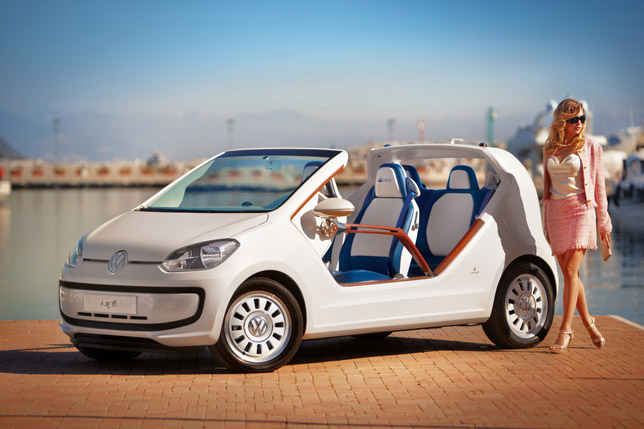
    The prototype is an open, small, eco-friendly vehicle, which is perfectly suitable for who live near the coast where the sea breezes blow. The concept’s name comes from yacht club on the Costa Smeralda.

    Furthermore, the vehicle retains the original character of the up! with its precise and appealing lines. However, what is specifically developed for this concept is that is completely open and even more: there are no doors or roof. Of course, this lets the driver and passengers enjoy the summer breezes, and leave the feeling as if they were aboard a boat.

    2012 Italdesign Giugiaro up! azzurra sailing team
    2012 Italdesign Giugiaro up! azzurra sailing team

    A wide range of high-tech and quality materials were used inside the vehicle, all of which are completely waterproof, and they intentionally resemble the fittings of a luxury yacht. In details, these features include the four seats in white-blue leather, numerous chrome components and a dashboard in mahogany with maple wood inlays. In addition, its surfaces are coated in a synthetic resin. 2012 Italdesign Giugiaro up! azzurra sailing team is a  prototype, which makes the perfect link between the heritages of Italian  yachts  and  German automobiles.

    2012 Italdesign Giugiaro up! azzurra sailing team
    2012 Italdesign Giugiaro up! azzurra sailing team

    Source: Italdesign Giugiaro

  • 2012 Italdesign Giugiaro Brivido

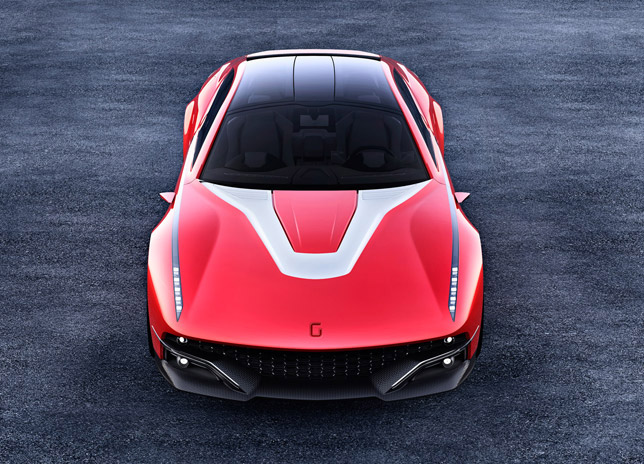
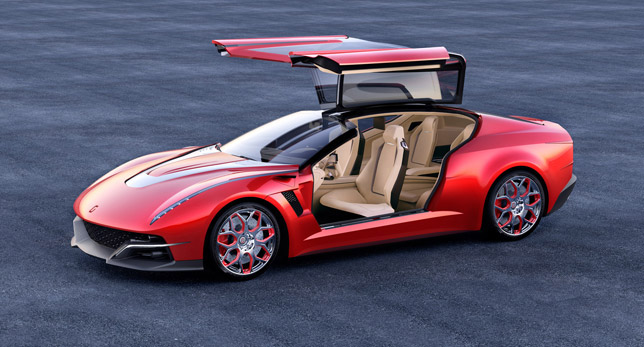
    2012-Italdesign-Giugiaro-Brivido-THUMB2012 Italdesign Giugiaro Brivido is designed to offer supercar performance, as well as respect for the environment. In it has been used the most advanced technologies and innovations. Of course the four-seat hybrid prototype has just made its world debut at the 2012 Geneva Motor Show. More importantly it develops a maximum speed of 275 km/h and accelerates from 0 to 100 km/h for just 5.8 seconds. The super vehicle was designed and engineered in the Italdesign Giugiaro plant at Moncalieri (Turin).

    It seem as the exterior has been designed in such way, which leaves the impression of flow and lightness. Aluminium, carbon fibre, and glass are the materials that define the Brivido’s exterior. The body wears Xirallic pearl luster red color. The windscreen, roof, rear window, and large door windows form a glass dome that lets natural light pour into the passenger compartment. In this way the occupants are surrounded by an exclusive level of finish and high technology. Observed from the side, the supercar has a specific single door, which uses glass as a specific structural element. The waistline hugs the curve of the wheel arch and is interrupted by the door’s side window, which in turn continues below the waistline to significantly increase the transparent surface. All this results in better visibility for the driver, when maneuvering as they can easily see the pavement to the side car. In addition, this also allows the passengers to enjoy better the outside visibility. Another exceptional part of the exterior are the new LED lights. The headlight clusters are not only functional, but also bring more style to the vehicle. They also act as sidelights and direction indicators. Further innovations that can be seen on the Brivido are the side mirrors or actually their absence. They have been replaced with two cameras, which literally emerge from the body. When the control is activated, the wings concealing the two micro cameras, positioned at the height of the side air intakes, open up 90 degrees and activate the cameras. The camera images are then displayed on monitors built into the steering wheel column. Next, viewed from the front, the car has an aggressive front end. In addition to this the vehicle is equipped with a single carbon fiber panel which is placed on the width of the vehicle. This actually allows the ample air flow to cool the engine and in addition acts as a rear spoiler. On the top of all this, there are the DRL system, the driving lights and the fog lights. The back of the car: the tail end is also made from carbon fiber. There also can be seen the rear lights as well as the rear windscreen which offers access to the titanium fiber covered luggage compartment. Furthermore, the supercar is equipped with a superengine: 3000cc, which offers the whole 360 hp (265 kW).

    2012 Italdesign Giugiaro Brivido
    2012 Italdesign Giugiaro Brivido

    Volkswagen Group Electronics Research Lab (ERL) based in California worked in collaboration with IDG, in order to develop and utilize the interactive electronics and displays for the Brivido. This includes one of a kind docking system, climate and comfort controls accessible through a touchscreen.

    And what about the interior of the vehicle: it s technologically equipped, roomy and with ergonomic design and of course offers great level of comfort and luxury. The cockpit The offers a genuine open space where a unique environment encases the front and rear seats and the luggage compartment in a continuous solution, thanks in part to the use of extremely durable and lightweight Titan-Tex® titanium fibre. What is unique here is that the dashboard is symmetrically structured for both driver and passenger. Any key information in addition is displayed on the two LCD monitors mounted inside two binnacles behind the steering wheel and above the dock. In this way the passenger can access the same information as the driver.

    For the interior furnishings, the Color&Trim department at Italdesign Giugiaro invested in research and development on methodologies and materials, opting for a sewing method never used before in the automotive sector: raw cut seams. The hides, specially produced for this prototype, are dyed in two contrasting colors- light on the “upside” and dark on the “backside.” In this way, the light-dark chromatic contrast creates a graphic line that outlines and emphasizes shapes. Furthermore, the front seats are asymmetrical with a cushion overhanging the door sill on the outer sides. This enables the passengers to get in an out of the vehicle with greater ease. The sides of the rear seats has inbuilt LED system which make the entry in the car easier in low visibility by following the design of the seats.

    2012 Italdesign Giugiaro Brivido
    2012 Italdesign Giugiaro Brivido

    The tunnel accommodates the fourteen buttons that activate the entire main and the 8-speed automatic transmission, as well as contains the classic storage compartments and cup holders. The display in the middle of the dashboard replicates key information on the climate control system, fuel consumption, and the hybrid system configuration. Depending on the graphical configuration of the display, the buttons required to activate and deactivate the corresponding functions emerge from the dashboard alongside the monitor. New touchscreen technology and the experience of high-quality rocker switches come together to create a new control system.

    httpv://youtu.be/kxBDRUGcr4w

    VideoSource: YouTube

    Source: Italdesign Giugiaro

  • Italdesign Giugiaro Scirocco and Polo

    Images of Volkswagen Scirocco and Polo by Italdesign Giugiaro are released.

    The two concept cars are expected to debut at the 2011 Geneva Motor show in the next week.

    Further information about both cars is not released, even their names are unknown. Nothing is mentioned about the engines and the sizes. However, both concepts are inspired from the latest Scirocco and Polo. (more…)

  • SsangYong at the Seoul Motor Show

    Ssangyong will be showing an almost production-ready example of its new C200 crossover utility car at the Seoul Motor Show in South Korea, opening on April 2.
    The company says that the C200 unveiled at the show will closely resemble the production C200 scheduled to be launched later this year. SsangYong will also show a new diesel hybrid version of the Kyron. (more…)

  • Giugiaro supercar revives a classic British nameplate

    It seems almost every brand from the automotive industry’s past is ripe for revival – no matter how long ago cars bearing the brand last rolled off the production line.

    The latest candidate is Frazer-Nash, a British sports and racing car maker whose roots date back to the 1920s – but which last made a car in the late 1950s. The company doing the reviving is none other than Italdesign-Giugiaro, and the new Frazer-Nash is a radical hybrid electric car, the fastest of its type in the world. (more…)

  • Brilliance BS2 by Italdesign

    At the 79th International Motor Show in Geneva, Italdesign Giugiaro unveils the Brilliance BS2 at its European preview.

    For the Chinese auto-maker, the Italdesign Giugiaro Style Centre has followed up the design of the interior and the external styling of the new BS2 two-box.
    Built entirely in China, the vehicle features a dynamic, sporting line; in the side view, the muscular right-hand side is further emphasized by large mudguards balanced by the classically inspired grille. The interior is decidedly spacious and richly upholstered for maximum driving comfort; the 5 doors guarantee ease of access, making the BS2 a family-size car that still offers brilliant driving. (more…)

  • VAD.HO Concept

    This year Vredestein and Giugiaro celebrate a decade of successful partnership, one of the main reasons for Vredestein to display the Giugiaro VAD.HO at the Geneva Motor Show this year. The VAD.HO is a concept car that matches the values and thoughts of the Vredestein brand perfectly.

    The challenging “diversion” premiered in Geneva 2007 still represents a niche theme meant to be heatedly discussed: a super-sporty extreme two-seater fuelled by hydrogen to meet the increasingly pressing need to promote and develop alternative and environment friendly propulsion systems and to explore the potential challenge offered to design by a more flexible “displacement” of the chassis lay-out in new engine, mechanical, and electronic equipments. (more…)

  • SsangYong recruits Giugiaro to style new car ranges

    SsangYong showed the first fruits of its relationship with Shanghai Automotive Industries Group – a new compact SUV, codenamed C200.

    It signals the start of a major product offensive – 20 new models on five new platforms, over five years, starting in 2009. “The car is very, very important for us as it’s the first demonstration of the new strategy that was announced at Geneva,” says SsangYong UK managing director Paul Williams. (more…)

  • ItalDesign Vadho

    ItalDesign VadhoOnce again, Geneva offers the opportunity to develop research on form and contents that break away from the industrial approach that Italdesign Giugiaro adopt daily in order to supply their worldwide clients with designs that best suit their markets. The challenging “diversion” this year represents a niche theme meant to be heatedly discussed: a super-sporty extreme two-seater fuelled by hydrogen to meet the increasingly pressing need to promote and develop alternative and environment friendly propulsion systems and to explore the potential challenge offered to design by a more flexible “displacement” of the chassis lay-out in new engine, mechanical, and electronic equipments.

    The decision to remove the steering wheel took Italdesign Giugiaro to the creation of a highly innovative driving system: two joysticks are fixed on the armrests of the pilot’s seating and pedals unit, where all elements can be adjusted and customized to the driver’s needs. The armrest/joystick/ electrical pedals and seating unit is not connected to the chassis. This and its by-wire impulses system allow to adapt the different versions with right, centre and left driving with no onerous works once the vehicle should go into production. This system presents design – construction and performance – characteristics that prompted Italdesign Giugiaro to patent it.

    VAD.HO is meant to be an open “work in progress”: it has been positively welcome by BMW that accepted to provide for it their series 7 12 cylinders hydrogen powered engine.

    One curiosity: the acronym “VAD.HO” is a play on words that uses the name of the Vadò industrial area in Moncalieri where Italdesign Giugiaro headquarters have been located since 1974, and also refers to the hydrogen propulsion system adopted for the vehicle (vado – or “I go” in Italian – on H).

    The cockpit
    This model immediately puts all its ambitions on the line: a longitudinal cockpit in polycarbonate emerges on the left-hand side while the right side houses the engine and hydrogen propulsion devices in the centre. The two Argonauts are seated in tandem in the fuselage, settled into a comfortable and super-equipped ergonomic cockpit.

    The joysticks are fixed in the armrests that are integral with the pilot seat (the left armrest can be raised to facilitate getting in and out of the vehicle).

    Designers and technicians believe that this solution facilitates naturally comfortable – and therefore stable and precise – steering manoeuvres and activation of all the joystick commands, including driving and secondary devices such as entertainment and other options.

    In order to facilitate manoeuvres in curves without having to twist or rotate your wrists, the joysticks were conceived with two grips that help the necessary movements. The joystick moves back and forth along the armrest to ensure driver comfort, as well as the sliding pedal block that, hinged on the lower part, adjusts to the seat, which is in turn fixed to the chassis.

    The control group is designed as an IT console with liquid crystal displays designed for aeronautic applications (EFIS – Electronic Flight Information Systems). The digital driving instrumentation is positioned centrally under the rear-view continual video monitors and the navigator; side video cameras project films externally. The surface occupied by the instrumentation is in any case limited, in order to allow the pilot maximum external visibility.

    Access to IT data from the console is also available to the rear passenger by means of a dedicated joystick, similar to the driver’s, and two monitors built into the back of the driver’s seat. The faces of both pilot and passenger are filmed by video cameras and may appear on reciprocal monitors to enhance team interaction.

    Thanks to video cameras installed in the frontal optical group, the driver can use the monitors either for parking radar and for an infrared effect for night-time driving, or interactive driving between the car and road infrastructures, when they become available.

    Passengers get into the vehicle through two integrated doors/domes that are hinged lengthwise onto the structure and lift gull-wing style. The living space for the pilot and passenger are definitely comfortable because they were calculated at an “OSCAR percentile” larger than 95% and therefore more spacious than those of a luxury sedan. The rear passenger is able to stretch out his legs and change his position by adjusting the footrest platforms on the sides of the front seat. The armchairs are also equipped with four-point belts that can be regulated all around.

    Passenger safety in case of collision or overturning is guaranteed by structural side reinforcements, the steel roll bar on which the two semi-domes rest, and the activation of the air bags in the oval strip under the structure at the cockpit base. The cell is equipped with “umbrella” airbags that surround both the pilot and the passenger. The upholstery materials chosen for the interior are in metallic and phosphorescent opaque grey tones: both for the silver leather armchairs and the synthetic pieces in aeronautic styling. Bolder effects were used in areas around the control console.

    The package
    The sporty-racy ambitions of this project have imposed a wedge-shaped volume, backed up by very subtle lines and modulations that are never forced or exasperating, but rather in perfect harmony with those parameters of balance and elegance that distinguish the Giugiaro trademark. The introduction of stylistic features was intentionally avoided on this project, which is undoubtedly oriented towards contents. In fact, the VAD.HO body is characterised by a feasible decomposition with regards to production logics and meets international homologation regulations (including pedestrian accidents).

    Even the overall dimensions are “reasonable”. The figures are close to those of the Ferrari Maranello, a compact two-seater with similar performances: 4550 mm long, 1980 mm wide, and 1150 mm high, like Enzo model.

    Naturally, the aerodynamic penetration requirements are enhanced by the reduction in the main section because the windscreen/cockpit impacts on only half of the vehicle.

    The nose presents a screwed-on bumper block with ample air intakes. The lower zone of the bonnet features an adjustable spoiler in between the “pagoda”-shaped ridges formed by the fenders that smooth off into the sides.

    The optical devices are housed in a drop-shaped recess that begins with the bumpers and narrows towards the sides: this cavity houses the dual-function projector, the position and direction LEDs, a video camera at the top, and the passenger compartment air intake.

    The asymmetric transparent dome gives this car a strong personality; the windscreen wiper is hidden under the small crowl. From the side, the profile of the fender crest is sinuous and dips towards the centre, while a bird’s eye view confirms the designer’s will to make the front more aggressive and modulated and the tail softer and sharper.

    The originality of the cockpit’s asymmetric solution is even more visible in VAD.HO central body. The fairing of the engine air system, the filter, and the electronics can be seen on lowered section that houses the engine. Since the cut of the passenger door is repeated symmetrically on the engine side, the engine block can be simply accessed by raising the large panel/trapezoidal door hinged onto the centre line with a gull-wing movement. The recess of the side indicator also serves as housing for the video camera.

    The blunt one-piece rear end recalls the Corvette, but is characterised by the line of the bonnet with its asymmetric profile because it must converge with the dipping line of the cockpit and the side/engine line.

    The trunk capacity for a super-sporty two-seater is truly remarkable: 550 dm3.

    The rear end view is “carved” to emphasize all the aggressiveness of this vehicle’s nature. The “G” Giugiaro logo was adopted to house the rear stop LEDs with striking media impact. VAD.HO is following up the content research started by Italdesign Giugiaro with 2004 Toyota Alessandro Volta with hybrid propulsion and the 2005 Mitsubishi Nessie that runs on hydrogen; while the formal aspects evoke the design of the 1988 Aztec, which even then offered driver and passenger a chance to slide into a definitely attractive “aeronautic” atmosphere with a formula that today is much more easily feasible thanks to IT innovations and by wire technologies that have been tested and nowadays are considered to be reliable.

    This evocation of the world of aeronautics is shown again in the colours choice for the body – opaque silver-grey -, in the service decals on the engine equipment and the fuel tank, and the use of large 20″ solid tyres.

    Source: Italdesign