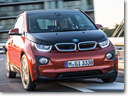
BMW i3 comes back with more strength via the new model added to the range. The new variant will be offered next year and it will deliver to its future drivers more than 50% increased battery capacity. To go into details, the 2017 BMW i3 (94 Ah) has a capacity of 33 kilowatt hours (kWh). This is due to the higher energy density of the lithium ion cells.
But despite the increased energy range, the dimensions of the battery have remained the same. In fact, the team at BMW i has worked very hard to make this possible. As an example the brand says that if one drives the new Battery Electric BMW i3 in everyday conditions, in varying weather and with the air conditioning or heating turned on, the EV achieves a range of up to 114 miles combined (hwy/city).
In terms of performance however, nothing has been changed. The figures of the 170 hp AC synchronous electric motor remain almost the same. Precisely, the motor propels the BMW i3 from 0 to 60 mph in just over 7 seconds. The expected EPA electricity consumption is of 27 kWh/100mi.
What is more, the new i3 will feature also 94 Ah battery. If the driver needs additional range, then he or she can equip their BMW with the Range Extender, which switches the 2-cylinder gasoline engine once the battery is depleted to 6.5% state of charge. In addition, in this state it keeps the charge level of the battery constant while driving and delivers an additional range thanks to a 25% larger fuel tank (2.4 gallons).
At last, but not least, also new for the BMW I family is the introduction of the BMW Home Charger Connect. This is a residential charging station designed for comfortable and fast home charging with additional connected functions.
2017 BMW i3 (94 Ah) will be announced closer to its market launch.
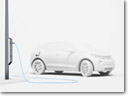
BMW continues with innovations and this time the company has prepared for us an innovative street lighting with integrated charging station for electric vehicles. It might seem futuristic, but in fact we sincerely hope to see this genius technology applied in the near future. The pilot project is dubbed Light and Charge and was part of the Eurocities conference in Munich. The car company will cooperate with the City of Munich in order to create an infrastructure of public charging stations. The pilot project will begin in the spring of 2015.
The prototype combines the latest LED technology with a usable connection way to charge the high-voltage batteries of the electric vehicles. The technology is integrated in the ChargeNow network of the electric BMW i series. In other words Light and Charge is simple and innovative solution which naturally integrates a reliable network of charging stations in the city.
Another benefit from the Light and Charge street lighting is the energy efficiency as well as the LED module’s higher luminous efficiency. In fact, up to four modules are enough to illuminate the lanes of major roads at night. One or two modules provide a pleasant light in the side streets and residential areas.
The used LED technology is similar to this one utilized in vehicle’s headlights. This means that it enables a particularly targeting of light rays. The next advantage is that with the development of the Light and Charge system, BMW signals for the future development of a comprehensive network of charging stations for electric vehicles.
Light and Charge units have a standard connector for EV’s charging cable. The integrated control panel allows the driver to start the charging procedure with just one click. ChargeNow already offers customers of BMW i access to worldwide around 18,000 charging stations.
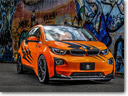
3DDesign and Studie Thailand have collaborated for a special project including the intricate BMW i3. Being more individual than ever, the tuned i3 has been created with the single aim to push the boundaries of the chassis. The personalization of the car began with the styling changes, which include a new exterior color, called Fire Orange, as well as some contrasting graphics in black.
Inside, the same fiery color theme has been used for the set of Recaro LX-F seats. They were wrapped in a combination of orange leather and suede. The dash is in the same fire Orange featured to add more harmony in the overall design.
Next, the right height of the car was lowered by 20 mm. There is also an option for the i3 to be even lower (30 mm) to the ground thanks to the specifically created by Studie suspension setup. In addition, 3D Design created for the BMW more pronounced front lip spoiler and a roof spoiler. The result of this is more balance and perfect addition to the black MAK wheels.
Take a look at the front grille. When I saw it for the first time it looked familiar. Then I immediately though of the F chassis ///M cars. This is where Studie took inspiration and built a custom front grill set with integrated blue LED’s.
Although the i3 is electric, the tuners have made it possible for the driver and occupants to enjoy the BMW active sound in the cabin. The system produces a programmed soundtrack of an inline-six, V8, V10 or even a mighty V12 engine.
BMW US has announced the full details and pricing for the all-new 2014 i3 EV. It is like no other car the world has ever seen. It offers visionary design, a ground-breaking vehicle architecture, dynamic performance and innovative connectivity.
2014 BMW i3 US is expected to hit the market in the second quarter of the next year with pricing starting from $41,350 and $45,300 for the range-extender model. The prices are before any federal or state incentives, and before Destination & Handling fee.
The small city car boasts RWD and an electric motor producing 170HP (125 kW) and 250Nm (184 lb-ft) of torque. 0-50 km/h in 3.5 seconds and 0-100 km/h in just 7.2 seconds. The top speed is electronically limited to – 150 km/h (93 mph). Not bad performance for an all-electric vehicle. The range of the vehicle is 130 to 160 km (80 to 100 miles).
The dimensions of i3 Concept are 3845 mm in length, 1537 mm height and 2011 mm width. The wheelbase is just a bit smaller than 1-Series – 2570 mm. The kerb weight is just 1250 kg, so the vehicle will be easy to drive with good dynamics.
The BMW i3’s tires are a unique 155/70/19 size on 19” light-alloy wheels, but the contact patch is the same of that of a more conventional 16” tire. To improve efficiency, they have low rolling resistance, and the narrow section width is a key factor in the BMW i3’s super-tight turning radius.
Safety is a key criterion in the development of the BMW i models. A range of systems and measures have been implemented in the vehicle that ensure safety in normal operation and in the event of accidental fires. The high-voltage system is designed to cope with accidents beyond the legal requirements, with the high-voltage battery including features that ensure its safe reaction even in situations such as this.
The all-new BMW i3 will be featured at the Los Angeles International Auto Show in November, 2013 and will arrive at BMW i centers in the US beginning in the second quarter of 2014.
BMW i3 Quick-Reference Highlights:
Pricing (before federal or local incentives) starts at $41,350; $45,200 for Range Extender model. Destination & Handling Fee not included.
On Sale: Q2 of 2014 in the USA.
Preliminary Dimensions (subject to change for US models):
Length: 157.4”
Width: 69.9”
Height: 62.1”
Wheelbase: 101.2”
Turning Circle: 32.4 feet
Curb Weight (DIN) 2,635 lbs. (2,899 lbs. for i3 with Range Extender)
BMW’s 360 Electric electro mobility services:
Home Charging
Public Charging
Assistance Services
Flexible Mobility.
BMW Navigation is standard.
Driving:
170-hp, 184 lb-ft hybrid-synchronous electric motor with max. revs of 11,400 rpm.
80-100 mile real-world EV range.
22-kWh lithium-ion battery, which weighs 450 lbs.
650cc gasoline powered Range Extender optional; holds charge, doesn’t power wheels.
0-30mph in 3.5 seconds, 0-60mph in approximately 7.2 seconds (preliminary).
Top speed of 93 mph, electronically limited to preserve efficiency.
Ultra-tight turning radius (32.3 ft), which is ideal for city driving.
Macpherson strut front and 5-link rear suspension set up.
Single Pedal Driving Concept with Brake Energy Regeneration, which feeds power back into battery.
3 drive modes: Comfort, ECO PRO and ECO PRO+.
3 hour 220 V @32 amps charging time.
Optional SAE DC Combo Fast Charging allows for 80% charge in 20mins; 100% in 30 mins.
Chassis and Body:
Purpose built construction. World’s first mass-produced CFRP-constructed electric vehicle.
Built on innovative LifeDrive architecture composed of two parts: Life Module and Drive Module.
Life Module is essentially the cabin, constructed from Carbon Fiber Reinforced Plastic (CFRP).
Drive Module is where all of the powertrain components are housed.
Drive Module is made from 100% aluminum.
Magnesium cross-member for instrument panel saves 20% weight vs. steel.
BMW 1 Series external footprint with BMW 3 Series interior space.
LED headlights and taillights (standard in US market).
Weighs in at roughly 2,700 lbs.
No space-consuming transmission tunnel dividing car’s interior.
Pillar-less design with rear coach doors allow for easy entry and exit to rear seats.
Driver-oriented super-ergonomic controls.
Three vehicle Worlds (trim levels): Mega (standard in US), Giga, and Tera.
Standard 19-inch light alloy wheels with unique 155/70 all-season tires. 20-inch light alloy wheels optional.
No transmission tunnel and low console allows for Slide-through Experience, which benefits urban driving by the ability to exit from the passenger side.
Sustainability:
Made with sustainable, renewable materials.
Instrument panel surround and door trim use fibers from Kenaf plant.
Carbon fiber reinforced plastic (CFRP) roof panel is made partially with recycled CFRP from manufacturing process of other components
25% of plastic used in interior comprised of recycled materials.
Dashboard wood trim crafted from responsibly-forested eucalyptus.
CFRP components are sustainably produced in Moses Lake, WA, USA, where the factory uses hydroelectric power.
The Leipzig, Germany assembly plant uses wind-generated electricity.
Olive-leaf extract is used to tan interior leather surfaces.
BMW US has announced the pricing of the all-new 2014 i3 electric vehicle. It starts from just $42,275, including a $925 destination charge.
“With this leading-edge vehicle and attractive price, we will provide customers with a compelling offer for electromobility,” commented Ian Robertson, member of the BMW board of management, sales and marketing, in a statement.
So, when the $7,500 federal tax credit is factored in, the BMW i3 starts at $34,775, which is a very good price and way below that we expected.
However, the i3 is priced above the 2013 Nissan Leaf and 2014 Fiat 500e ($29,650 and $32,600, respectively). The Fiat 500e is available only in California.
The BMW i3 is equipped with a 170HP (125 kW) electric motor and lithium-ion battery. The German EV has a range of 80-100 miles (around 160 km), according to the manufacturer.
With the North American International Auto Show (NAIAS) in Detroit dangerously close, BMW have kindly offered a glimpse of what their exhibit will look like. So here is a quick summary of what you should be excited about.
BMW 3-Series Sedan – The sixth generation of the compact executive vehicle will be showcased there with an improved design and a new engine lineup. The company is eager to announce that now the new 3 series is around 45 mm wider and 93 mm longer than its predecessor. Despite these stretchy dimensions the sedan has actually managed to lose some weight (40 kg lighter). The trim and equipment level comes in three different categories: Sport Line, Luxury Line and Modern Line.
Initially, customers will have the opportunity to chose from two petrol engines with two diesels coming later the same year. It is important to mention that all power plants will utilize the latest BMW TwinPower Turbo technology
The BMW 328i will carry the new generation 2.0 liter, four-cylinder petrol engine. It will produce 180kW/245 hp and a peak torque of 350Nm (258lb-ft) from as early as 1.250 rpm. That sort of power will give the luxury sedan a 0 to 100km/h (62mph) sprint time of just bellow six seconds. Amazingly enough the stated fuel economy is a generous 44 mpg figure. Keep in mind that all of the trim levels will come with an Auto Start-Stop system as standard.
BMW 3-Series Sedan F30 (2012)
The more power hungry can go for the BMW 335i. It will house a renown 3.0 liter straight-six which develops 225 kW/306 hp and a maximum torque of 400 Nm (295 lb-ft) at just 1,200 rpm. Thus in every single respect the 3 series will outperform their predecessors.
Upon request an 8 gear automatic box can be paired to whichever engine you might chose. This option is claimed to bring benefits in terms of economy and driving experience.
In true BMW spirit the cabin is full with neat gadgets such as a sharp Head-up Display, Active Cruise Control, the Lane Change Warning System and Lane Departure Warning System. A new Driving Experience Control switch not only offers Comfort, Sport and Sport + options, but also ECO PRO mode which will allow drivers to fully optimize their driving in order to achieve stunning fuel economy.
BMW ActiveHybrid 5 – This is something that will make it’s debut on the NAIAS as
the most powerful and efficient full hybrid in its segment. Fuel efficiency and power output are targeted
To provide power, the same engine which can be found in the 335i and 535i is used. However, here it has a co-worker: a 40 kW/55 hp electric motor supplied with energy by a high-performance lithium-ion battery integrated into the luggage area. So that is 250 kW/340 hp overall power which thrusts the ActiveHybrid from 0 to 100 km/h (62 mph) in 5.9 seconds, limits average fuel consumption to between 6.4 and 7.0 litres per 100 kilometres (44 – 40 mpg imp) and puffs CO2 emissions of just 149 – 163 g/km.
BMW Active Hybrid 5 (2012)
Not surprisingly, it is a very clever this hybrid. When the car is coasting or braking, the motor acts like a generator which in turn charges the high-performance battery pack. However, if you put your foot down, the motor will assist the straight-six petrol powerhouse to give the sort of dynamic boost you do not experience in ordinary cars. Then when you have reached a respectable amount of speed (up to 100 mph) what you can do is to shut down the engine and disengage it from the wheels so that you are back to coasting, using that gathered potential energy as efficiently as possible. You’ll be able to do that with no regrets as all safety features will be fully operational.
BMW M5 – Yes, this sensational performance miracle will also be there. BMW boast about how their new engine (as opposed to the old one) has a 10 percent increase in power and 30 percent increase in torque and that consumption has dropped by 30 percent. This is the first time the company gives a chance to the turbo technology to prove itself better than the pure, naturally-aspired, brute force that was in the previous generations of M5s. As a result now the engine is a V8 rather than a V10 and the displacement is only 4.4 liters but the power is up – 412 kW/560 hp at 6,000 – 7,000 rpm, while its maximum torque of 680 Newton meters (502 lb-ft).
BMW M5 F10 (2012)
To handle that massive lump of power, the M5 makes use of a very clever rear axle differential with a variable locking function. It works alongside with the DSC (Dynamic Stability Control) system to ensure the best rear-wheel drive experience there is. The suspension is also notable for its electronically controlled dampers. Dynamic Damper Control uses electro-hydraulic damping force adjustment to provide a set-up suited to the driving situation or the wishes of the driver.
Here is a full list of it’s specifications:
V8 petrol engine, M TwinPower Turbo technology with Twin Scroll Twin Turbo, cross-bank exhaust manifold, High Precision Direct Injection and VALVETRONIC variable valve control.
Acceleration 0–100 km/h (62 mph): 4.4 seconds, acceleration 0–200 km/h (124 mph): 13.0 seconds
Top speed: 250 km/h / 155 mph (305 km/h / 190 mph with M Driver’s Package)
Average fuel consumption: 9.9 litres/100 kilometres (28.5 mpg imp)
CO2 emissions: 232 g/km, exhaust standard: EU5
The i3 and the i8 – No, those are not the latest Apple products although they do have similar visionary ambitions. We are talking about two new concepts which will embody the BMW technological know-how.
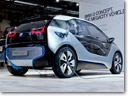
The i3 is a fully electric vehicle which is a result of BMW’s commitment to the environment. Suitable for the urban area, the i3 sets new standards for efficient use of materials, light weight technology and long-distance electricity runs. It has a 125 kW/170 hp electric motor which delivers an impressive amount of torque (250 Nm (184 lb-ft) to the rear wheels. It will take you under four seconds to reach 60km/h (37mph) from a standsill and around 8 seconds to reach 100km/h (62mph).
BMW i3 Concept
BMW say it will be spacious and practical too with a boot capacity of 200 liters, and enough space to breathe freely in the cabin.
The more driver oriented i8 is a daring one with some innovative plug-in hybrid technology inside. Along with the electric wizardry that can be find in the i3, the i8 has a rear-mounted, high-performance three-cylinder combustion engine producing 164 kW/220 hp which delivers 300 Nm (221 lb-ft) of torque. Acceleration from 0 to 100 km/h (62 mph) is under five seconds while economy is stated to be three liters per 100 km (approx. 94 mpg imp). It can travel up to 35 kilometres (approx. 20 miles) on electricity alone and it has seating for four. Because of the two motors (the electric one at the front and the petrol one at the back) it has perfect weight distribution and a low center of gravity which is all beneficial to the driving experience.
BMW i8 Concept
For more technological nirvana, be careful not to miss out on anything at NAIAS in Detroit which starts next year, January the 9th.
BMW will bring the two famous concepts – i3 and i8 at the 42nd Tokyo Motor Show, next month. With the “i series”, the BMW Group is adopting an all-embracing approach, redefining the understanding of personal mobility with purpose-built vehicle concepts, a focus on sustainability throughout the value chain and a range of complementary mobility services. Both vehicles were introduced at the Frankfurt Motor Show, this year.
BMW i3 Concept is a small 5-door city car, which can carry up to four occupants. It is powered by an electric motor with 170PS (125 kW) and 250Nm (184 lb-ft) of torque. 0 to 100 km/h in 7.9 seconds and top speed of 150 km/h (93 mph). The lithium-ion battery pack delivers enough energy for range up to 160 km (100 miles). It can be recharged in just 6 hours to 100%. The overall weight of the vehicle is 1250 kg (2755 lbs).
BMW i8 Concept is a sports car, which comes with a three-cylinder turbocharger petrol engine combined with an electric motor. The total power is 353PS (260 kW) and 550Nm (406 lb-ft) of torque, so the performance is superb – 0 to 100 km/h in 4.6 seconds and top speed of 250 km/h (155 mph). The car weighs just 1480kg. The i8 can go on electricity alone up to 32 km (20 miles). The fuel consumption is amazing for such amount of power – 2.7 l per 100 km with CO2 emissions of 66 g/km.
An additional range of mobility services – which can also be used independently of the cars – will be an integral component of BMW i alongside the vehicles themselves. A totally new development in this area will be vehicle-independent mobility services.
BMW exhibits the ECO-friendly concepts i3 and i8 at the 2011 Frankfurt Motor Show. Both vehicles will set a new bars in turn of efficiency.
The small i3 Concept is a four-seater city car with 5 doors, which is powered only by electric motor, but with astonishing power – 170PS (125 kW) and 250Nm (184 lb-ft) of torque. There is a lithium-ion battery package delivering up to 160 km (100 miles) range. 0 to 100 km/h in 7.9 seconds and top speed of 150 km/h (93 mph). The overall weight of the vehicle is 1250 kg (2755 lbs). BMW i3 is perfect for everyday driving with its range and once the battery is depleted, it can be recharged in just 6 hours to 100%.
The i8 Concept is completely different vehicle. It comes with a turbocharged 1.5-liter three-cylinder petrol combined with an electric motor. The total power is 353PS (260 kW) and 550Nm (406 lb-ft) of torque. 0 to 100 km/h in 4.6 seconds and top speed of 250 km/h (155 mph). The curb weight of the vehicle is 1480kg, so the results are impressive.
The i8 can go on electricity alone up to 35 km (20 miles), which means that you’ll need just 2.7 liters of fuel per 100 km and the CO2 emission are as low as 66 g/km.
BMW has introduced the first series-production all-electric vehicle by the brand. Two vehicles will be exhibited at the 2011 Frankfurt Motor Show in September.
The first is BMW i3 Concept, which is based on Mega City Vehicle concept. The small city car boasts RWD and an electric motor producing up to 170PS (125 kW) and 250Nm (184 lb-ft) of torque. 0 to 60 km/h in 3.9 seconds and to 100 km/h in just 7.9 seconds. Not bad for an all-electric vehicle. The range of the vehicle is 130 to 160 km (80 to 100 miles).
The dimensions of i3 Concept are 3845 mm in length, 1537 mm height and 2011 mm width. The wheelbase is just a bit smaller than 1-Series – 2570 mm. The kerb weight is just 1250 kg, so the vehicle will be easy to drive with good dynamics.
The luggage compartment is satisfying – 200 litres.
Second is the i8 Concept, which is a plug-in hybrid sports car. The same electric motor is mounted on the front axle and is couple with a 1.5 liter three-cylinder turbocharged petrol engine. The overall power is staggering – 353PS (260 kW) and 550Nm of torque.
As you may suggest, the performance is awesome – 0 to 100 km/h in 4.6 seconds and top speed is limited to 250 km/h (155mph). Still, the vehicle manages to return 104 mpg, which is 2.7 litres per 100 km. The range on electricity is 35 km (20 miles).
The dimensions of i8 Concept are 4632 mm in length, 1280 mm height and 1955 mm width. The wheelbase is 2800mm. The kerb weight is just 1480 kg.
The luggage compartment is 150 litres.
Check out the pictures, videos and full specifications, below!
BMW i3 Concept Specifications:
Length/Height/Width
L 3845 mm, H 1537 mm, W 2011 mm
Wheelbase
2570 mm
No. of seats
4
Kerb weight
1250 kg
Output
125 kW / 250 Nm
Top speed
150 km/h / 93 mph
Acceleration
0-60 km/h / 37 mph 3.9 s0-100 km/h / 62 mph 7.9 s
80-120 km/h / 50-75 mph 6.0 s
Electric range
Everyday range: 130-160 km / 80-100 milesFTP72 cycle: 225 km / 140 miles
Battery charge time
Standard: 6 h for 100% chargeOptional: 1 h for 80% charge
Luggage compartment
approx. 200 litres
BMW i8 Concept Specifications:
Length/Height/Width
L 4632 mm, H 1280 mm, W 1955 mm
Wheelbase
2800 mm
No. of seats
2 + (2)
Kerb weight
1480 kg
Output
260 kW /550 Nm system output of which petrol engine: 164 kW / 300 Nmof which electric motor: 96 kW / 250 Nm
Top speed
250 km/h / 155 mph governed
Acceleration
0-100 km/h / 62 mph 4.6 s80-120 km/h / 50-75 mph 4.0 s
 BMW i3 comes back with more strength via the new model added to the range. The new variant will be offered next year and it will deliver to its future drivers more than 50% increased battery capacity. To go into details, the 2017 BMW i3 (94 Ah) has a capacity of 33 kilowatt hours (kWh). This is due to the higher energy density of the lithium ion cells.










 With the North American International Auto Show (NAIAS) in Detroit dangerously close, BMW have kindly offered a glimpse of what their exhibit will look like. So here is a quick summary of what you should be excited about.


 BMW will bring the two famous concepts – i3 and i8 at the 42nd Tokyo Motor Show, next month. With the “i series”, the BMW Group is adopting an all-embracing approach, redefining the understanding of personal mobility with purpose-built vehicle concepts, a focus on sustainability throughout the value chain and a range of complementary mobility services. Both vehicles were introduced at the Frankfurt Motor Show, this year.

 BMW exhibits the ECO-friendly concepts i3 and i8 at the 2011 Frankfurt Motor Show. Both vehicles will set a new bars in turn of efficiency.


