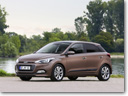
Hyundai Motor UK announced details for the new and restyled MY16 i20 lineup that now also includes i20 Active compact crossover and the special 1.0-liter T-GDi power unit range.
The standard equipment includes 17-inch alloy wheels, LED daytime running lights, DAB radio and rear parking sensors as a part of the standard equipment. And with the distinctive bumpers, roof rails, rear spoilers and 20-mm-inreased ride height, this sweetie has a lot to demonstrate.
In terms of drivetrain systme, the i20 Active also can make one hell of a show-off. It is geared with the latest three-cylinder 1.0-liter T-GDi 100hp (73kW) power unit that offers incredible driving dynamics and superior efficiency.
Furthermore, Premium Nav, Premium SE Nav and Coupe Sport Nav models are now geared with Tom Tom Live traffic service. Also, the vehicles, ordered with Iced Coffee, Passion Red and Stardust Grey exterior finishes will bring and black interior concept, instead of the brown and beige patterns.
As you might know, Hyundai Motor has sold over one million vehicles in the B-segment since the showcase of Getz back in 2002. And throughout the years, the brand established its credibility as one of the most popular and trustworthy companies in Europe.
2016 Hyundai i20 will be available for order later in March this year.
2016 Hyundai i20 Challenger will be competing at the 2016 FIA World Rally Championship (WRC). The new rally car was unveiled at the team’s factory in Alzenau, Germany. The presentation took place in the heart of what will be Hyundai Motorsport’s customer racing headquarters. And by the way, Hyundai Motorsport also revealed that the company’s upcoming R5 rally car will be also based on the New Generation i20.
The five-door i20 WRC was developed from scratch. The motorsport team says that the car is both quick and reliable, because it has already accumulated 8,000km of testing prior launch. The result is that it proved that it is quicker than its predecessor, while its drivers said that it also features improved drivability. But the competitive debut of the new car is scheduled for the Rallye Monte-Carlo 2016.
As Hyundai Motorsport’s representatives state, this new car is an evolution of the car in 2013. Even more, although the team is still young, it is far more established in the WRC community, thus showing bolder ambitions for the 2016 season. And what they could be, else then to fight at the front in every stage and to mount a heightened Championship assault.
Three cars will compete in every round of the 2016 Championship. Their drivers will be Dani Sordo, Hayden Paddon and Thierry Neuville. The trio of drivers will share the #3, #4 and #20 cars during the 2016 motorsport season. And here’s the deal: the precise car-driver composition will differ from event to event, offering the team full flexibility in its Championship strategy.
Hyundai Motorsport is currently focusing on the opening rally in Monte-Carlo in January. We will then (hopefully) witness the start of the fierce competition for 2016. Stay tuned.
The new 2015 Hyundai i20 is nothing new nowadays as the car has been in the news for weeks but despite all the information online the car has not been described in detail. Well, this is something that we will do now thanks to abundance of information that comes straight from Hyundai.
As shown before the new vehicle will come with numerous improvements and new features that are designed to make your life on the road more pleasurable and safer. The i20 delivers on all fronts when it comes to the car. Thus you can expect to find a sophisticated design, elegant lines and refined details, more internal space that makes the car a true five-seater, unique in-segment features and much more. Designed and developed in Europe, the new i20 tries to meet the demands and needs of European customers who are interested in class-leading interior space, high-technology, comfort-enhancing features and clean and refined design.
The new car is longer, lower and wider than the previous model thanks to the inspiration received from the company’s Fluidic Sculpture design philosophy. The wheelbase is extended by 45 millimeters to 2570 mm, which means there is more space for the occupants inside. The class-leading interior space of 1892 mm combined front and rear legroom makes the new i20 a true five-seater car, while the outstanding boot capacity of 326 liters heightens the vehicle’s versatility.
The vehicle has also been fitted with a number of new technologies that provide levels of comfort and convenience normally associated with large-vehicle segments. For example, the inclusion of front and rear parking assist, heated steering wheel, static bending headlamps and automatic defog system are firsts for a Hyundai B-segment vehicle. Additionally, the lane departure warning system is another innovative feature, normally found in higher segments. The unique-in-class panoramic sunroof, able to both tilt and fully open, enhances the comfort and the sense of space for occupants, filling the cabin with natural light and fresh air. The extensive use of lightweight high-strength steel in the platform and bodyshell has yielded a reduction in the core weight of the vehicle, as well as a significant improvement in torsional rigidity, reducing vibrations when on the move and aiding handling performance. The car looks great on the outside – it features nine exterior colors to choose from that include two solid (Baby Elephant and Polar White), four metallic (Mandarine Orange, Iced Coffee, Sleek Silver and Star Dust) and three pearl (Aqua Sparkling, Phantom Black and Red Passion) colors. Inside customers can choose among four colors: Comfort Grey, Elegant Beige, Cappuccino and Blue Grey, while the leather seats are black, featuring distinctive color stitching.
As to the engines provided the new 2015 i20 features a choice between two Hyundai “Kappa” gasoline engines and two “U-II” diesel units. The gasoline engines feature displacement of 1.25 liters and 1.4 liters with the first engine being available in two models. Thus you can get a 1.25-liter low power unit that delivers 75 HP (55 kW) at 5,500 rpm and 122 Nm (90 lb-ft) of torque at 4,000 rpm and a high-powered 1.25-liter engine that gives out 84 HP (62 kW) at 6,000 rpm and the same 122 Nm (90 lb-ft) at 4,000 rpm. The 1.4-liter unit is the most powerful of all i20 gasoline engines – it has 100 HP (74 kW) under the hood at 6,000 rpm and 134 Nm (99 lb-ft) of torque at 3,500 rpm. The outstanding features of the Kappa engine’s modern architecture include dual overhead camshaft (DOHC), dual continuously variable valve timing (CVVT), a very stiff cast aluminum block with cast iron liners, aluminum cylinder head, lighter connecting rods and maintenance-free long-life timing chain.
The diesel family of engines includes two units – a 1.1-liter powerhouse that has 75 HP (55 kW) at 4,000 rpm and 180 Nm (133 lb-ft) of torque at 1,750-2,500 rpm and a 1.4-liter unit that delivers 90 HP (66 kW) at 4,000 rpm and 240 Nm (177 lb-ft) of torque at 1,500-2,500 rpm. There’s also a choice between five-speed and six-speed manual transmissions and a four-speed automatic transmission.
The new car delivers a lot when it comes to safety too. Occupant and pedestrian safety are a key priority for Hyundai and this is why the car comes with numerous active and passive safety systems. There are six airbags in the car that sit up front, to the side and in the curtains. The stronger body shell and chassis of the car means there will be fewer injuries in case of an accident. In addition to that the vehicle comes with Electronic Stability Control (ESC) and Vehicle Stability Management (VSM), which work in combination to reduce wheel spin or loss of vehicle control on low-friction road surfaces. The ESC has been carefully tuned to be as unobtrusive as possible during driving, creating a natural and comfortable driving experience. The implemented Emergency Stop Signal (ESS) system, which activates the hazard warning lights if a driver suddenly brakes heavily, warns drivers of following vehicles of the car’s rapid deceleration. Finally there’s a Lane Departure Warning System (LDWS) that alerts drivers if they are veering off course without signaling their intention to change lane during motorway driving.
The new 2015 Hyundai i20 will be 100 per cent built in the company’s plant in Turkey. The plant has a capacity for 200,000 cars per year so market demand, at least in Europe, should be easily met.
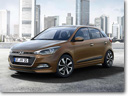
Hyundai has unveiled the 2015 i20 which is expected to make official public debut at the 2014 Paris Motor Show in October. The small city car boasts refined look, extended wheelbase and additional standard equipment.
The exterior is an evolution of the company’s Fluidic Sculpture design language. The car looks a lot better than the predecessor. The black C-pillar is a very nice soluition giving the impression of a floating roof. The dimensions are: 4,035 mm in length, 2,570 mm wheelbase (extended by 45 mm) and a combined front and rear legroom of 1,892mm, a best-in-class figure. The i20 also offers 320 liter luggage space.
The top-of-range models will get LED rear taillights, a rearview camera and a panoramic sunroof. There are also DRLs (daytime running lights) as well as turning signals with LED technology.
The interior comes with a new multi-function steering wheel, armrest with storage compartment as well as rear vents for the air conditioning and driver seat height adjustment. Other notable features include revised instrument cluster, USB, Start/Stop button and Bluetooth connectivity.
The engine range includes a 1.2 liter Kappa petrol with 83HP (61 kW) and a 1.4 liter CRDi with 90HP (66 kW). Both are connected to a 6-speed manual gearbox.
Safety features:
Dual airbags
ABS (Anti-lock braking system)
Smart pedal for better control during panic braking
Impact Sensing Door Unlock
Advanced Rear Parking Camera with Steering Adaptive Parking Guide Lines
Hyundai Motorsport has taken the i20 WRC out of the workshop and onto the road at the start of its testing programme. The new i20 WRC has been put on various tests including checking the car’s systems. The hatchback is scheduled to make its official debut in the FIA World Rally Championship in 2014.
While all key areas of the car’s performance were evaluated, there was a major focus on collecting feedback on the i20 WRC’s 1.6 litre turbocharged engine as part of the continuing development programme for the powertrain.
Totally 550 km were covered over the three days, which enabled the team to start building the knowledge base of testing data from which to prepare its entry to the WRC in 8 months’ time.
The programme will continue for the rest of the year and will involve the assessment and development of the i20 WRC in all of the terrains and conditions expected in World Rally Championship.
Hyundai will take part at the FIA World Rally Championship with its new specification i20 WRC. The model was unveiled at the Geneva Motor Show showing-off all its assets. The model embodies remarkable enhancements to the exterior bodywork and suspension.
To be more precise, the upgrades are the result of collaborative work between Hyundai’s R&D facility in Namyang, Koreaand and the newly formed Hyundai Motorsport GmbH in Alzenau,Germany, headed up by veteran WRC man Michel Nandan.
In fact, the Hyundai i20 WRC boasts striking looks due to the redesigned livery which blends a dynamic treatment of brand’s corporate blue together with an innovative use of characters from the native Korean script, Hunminjeongeum. The livery perfectly complements the
excitement and dynamism of WRC with the Korean heritage of the Hyundai brand.
The latest version of the i20 WRC has a design focused on aerodynamics and in addition – improved cooling systems. A new rear wing and front spoiler give the i20 WRC a new external appearance. Under the bodywork, some enhancements are noticeable on the suspension kinematics and chassis stiffness.
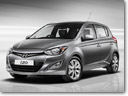
2012 Hyundai i20 debuted a more than a month ago at the Geneva Motor Show. And now Hyundai is announcing full pricing and specification for the new model. It will be available for purchase starting from 7th of May.
The new Hyundai i20 prices start from £9 995, which goes for the three-door 1.2 petrol Classic model. On the other hand the most expensive – 90ps (66 kW) 1.4 CRDi Style model costs £14 295.
What is new in the i20 is the enhanced interior, which includes new wheel designs plus a hexagonal front grille. Additional design changes to the front end feature new rounded front wings while the reshaped bonnet and headlights continue the theme along with new fog light clusters and daytime running lights.
Observed from behind, i20 has a redesigned rear bumper and taillights.
The interior of the Hyundai model is entirely made from high-quality materials, which deliver soft-touch plastics. It also includes a revised and classier centre consol along with updated seat trims.
2012 Hyundai i20
2012 Hyundai i20 is available in three main trim levels: Classic, Active and Style. In each model is included broad list of standard specification featuring remote central locking, six air bags, air conditioning, ESP and, for the first time on i20, Vehicle Stability Management.
In addition to this the brand has added inside even more value with the feature of Active trim, which adds 15-inch alloy wheels, Bluetooth with voice recognition, electric/heated door mirrors, front fog lights, leather steering wheel and gear knob and electric rear windows (five door bodystyle) when compared with Classic.
Thirdly, the range-topping Style comes with 16-inch alloy wheels, automatic headlights, rain sensing front wipers, climate control along with an automatic dimming rear view mirror with an integrated reversing camera.
There is also available the optional Convenience Pack, which encompasses keyless entry, engine Start/Stop button, chrome exterior door handles and supervision cluster.
Another important highlight is that the i20 range will feature the cleanest internal combustion diesel engine in terms of CO2 emissions with the 1.1-litre unit emitting just 84g/km.
In details the improved 1.2-litre petrol engine, is now cleaner, more efficient and more powerful than the model it replaces. The maximum output it creates is now 85 ps (67 kW). Additionally, it delivers improvements in fuel consumption estimated from 55.4mpg to 57.7mpg on the combined cycle, plus emissions reductions from 119g/km CO2 to 114g/km CO2.
All these facts make the 1.2 petrol engine one of the most efficient ones in the world.
Moreover, the 1.2-litre petrol i20 is now available in Style trim.
The Blue Variant of the i20 is powered by Hyundai’s ultra-efficient 1.1-litre “U-ll” three-cylinder diesel engine. The latter is combined with Intelligent Stop and Go and low rolling resistance tyres emits a mere 84g/km.
Last week marked the end of the 82nd Geneva Motor Show – one of the biggest automotive exhibitions in the world.
More than 700,000 visitors feasted their eyes upon the creations of some 260 manufacturers while 11,500 media representatives channeled all there was to channel directly to your screens. It was a vibrant two week marathon of motoring nirvana.
There were ups and downs (mostly ups really), there was music, there was dancing…oh, and cars also.
The scale of the whole event does not allow to sum up everything in a single go and yet, we at Automobilesreview.com decided to give our humble opinion about some of the good, the bad and the ugly.
The Lamborghini Aventador Speedster J
HOT: It’s the lunacy that gets you. Gravely controversial, this topless model caused quite a stir among enthusiasts and observers.
Why wouldn’t it? It’s an Avenatador without a windscreen – first class go-kart experience, an Ariel Atom on steroids.
Despite the fact that any human being would look ridiculous inside (more so after a good trashing), nobody would dare to make a joke about it – the person inside should be, by all accounts, a man of steel.
Lamborghini Aventador J
Tata Megapixel
NOT: It’s got all the right features by the look of things: modern and round and crisp. But, even the name suggests, that it is essentially a big square.
Part of the reason why this is not getting too much attention might be because of the brand. Tata have yet to produce a car that has some aesthetic value.
We get that the idea behind the affordability and the fact that it is ideal for the streets of India but that’s just about it.
It’s too soulless and by looking at those side-sliding doors, original as they might be, we can’t help but thinking of a convenience store.
Tata Megapixel
Peugeot GTI Concept
HOT: You didn’t think we would miss a chance to include a hot hatch, did you? And hot it is this one. Peugeot 208 GTI – an audacious take on an almost thirty year old legend: Peugeot 205 GTI.
How do you stand up to the car that was claimed to be the embodiment of the hot hatch concept? How do you challenge Genesis?
At Peugeot think that an RCZ 200bhp 1.6 turbo engine, a wider-than-standard track and a multitude of handling smarts should do the trick.
We would really like to see that on the streets and chances are, we are not alone in this.
Peugeot GTI Concept
Carlsson Smart forTwo
NOT: Bringing a Smart to an autoshow is like bringing a knife to a gunfight.
Carlsson have made an effort to give this little critter some character but at best, they have given it an orange interior.
Power is up by a few figures – thanks to an ECU upgrade we get 110 bhp which is a lot, considering that the ForTwo weighs less than a lady’s handbag.
But unless you stick to driving it in a straight line, all is in vain we suspect as the ForTwo just doesn’t have the wheelbase for the job. It’s too short and understeery.
Carlsson ForTwo Smart
Touring Disco Volante
HOT: No. This is not hot. Hot is too much of a vulgar word to describe it.
It’s a celebration of aesthetics, a cobweb of passion and style and curves a blissful incarnation of beauty itself. It’s a history lesson as well – Conceived in the 50s, the 1900 C52 Alfa Romeo “Flying Saucer” had a profile made to last and today, the Carrozzeria Touring Disco Volante is the living proof of that.
It’s a genuine car this and not just a pretty body with no engine in it. The world would be a better place with this on the streets so peace’s sake, let’s hope the motoring future looks like this.
Touring Disco Volante
Hyundai i20
NOT: Bland, gray and consumer oriented, this ok family car, with an ok engine and ok quality inside and outside might be the right purchase to make…if one does not care about cars in general and is only interested in going from A to B safely.
You know, Hyundai have a perfectly sensible guarantee policies and… not interested?
No… Understandably you are not, because the i20 will never make your hair on your back stand up.
That is of course, you don’t find yourself driving it on the wrong side of the road with oncoming traffic…while being on fire.
Hyundai i20
The Geneva Girls
HOT:…definitely.
Let’s face it. What would the show be without some models…next to the models?
A big gear-head convention with people mooning about, calculating power-to-weight ratios and arguing over naught to sixty times.
We are not saying, that the 2012 Geneva Motor Show wasn’t like that, but at the very least, the girls were there to balance things out.
We also like how this particular model is thematically coordinated with the car represented – the Bertone Nuccio concept. All Seems legitimate.
The Geneva Girls
Mia Electric
NOT: Don’t get us wrong. It’s an interesting idea this – a tubular sort of, 3 seated van.
And anything that can offer a McLaren F1 type of driving position makes us tingle with excitement. It’s called the Mia and it looks like a Smart stretch which by itself sounds ironic.
Sadly, this is where the similarities with the F1 end. Strictly for the urban environment, this French-made “Microbus” gets its power from a 13 bhp electric, but hardly electrifying, engine that has a range of around 80 miles.
True, it weighs no more than 810 kg with the batteries on board but that’s courtesy to its plastic body. Label it “hot” and it might melt.
Mia Electric
Pininfarina Cambiano Concept
HOT: Much like the Disco Volante, this concept deserves an admirable batch of flattering adjectives.
It’s beautifully styled with clean and simple lines, it has some daring features like that roof over there – no doubt eye candy for all present at the unveiling.
But while the Disco Volante is basically an Alfa 8C Competizione underneath, the Cambiano is an ultra complex plug in hybrid that has electric motors on each wheel and a small diesel turbine that can charge the batteries or provide power by itself.
The overall maximum power output reaches 600 kW with torque being 640 Nm and constantly available. Take it out for a spin and by the time the juice runs out, you’d be 800 km away from home. So, clever and sleek – certainly a pageant winner.
Pininfarina Cambiano Concept
Bentley EXP 9 F Concept
NOT: We are gravely sorry, but Bentley should stick to what they do best – making Continentals.
Just because the world has gone mad-crazy about SUV‘s does not mean that there’s a place for everybody on the market table.
Besides, its not really a looker is it? It looks like a Continental with the aerodynamics taken out – anguliar, upright and awkward.
Also, with those overcomplicated headlights and ridiculous wheels, certainly the EXP 9 F is not doing too much to win our hearts. It may appeal a footballer’s heart but that’s as far as it will go.
Bentley EXP 9 F
Gumpert Apollo Enraged
HOT: This Gumpert Apollo in particuliar is not the melt-my-heart kind of hot (the sheer size of that rear wing is hardly endearing).
It’s more like heartburn type of hot – What you are looking at is a V8 lunatic on the loose, angry and out to get you.
If underestimated, this Griffin will trample over your ego with 780 horses (from a V8!!). But you can guess that by yourself, can’t you? The clues are pretty much in how they called it – the Enraged.
What’s more, you most certainly won’t be looking too hot stuck on a speed bump, but when a ride goes that low, chances are you are going to grind over half the streets in your town. On the plus side, it’s quite probable to be an absolute hit on trackdays, leaving behind Porsches and BMW‘s trailing behind.
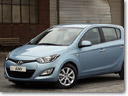
Hyundai has released pictures of the all-new i20, which will make its official debut at the 2012 Geneva Motor Show.
The new model comes with refreshed styling, enhanced equipment and the lowest CO2 emissions of any conventional powertrain car on sale today.
The engine range includes the new 1.1 litre, 3-cylinder ‘U-II’ diesel engine with 75PS (55 kW). If, you opt for Blue Drive, this engine will emit just 84 g/km of CO2.
The engine was developed at Hyundai’s Diesel Centre of Excellence – part of the European R&D set-up in Rüsselsheim, Germany – and showcases Hyundai’s expertise in clean diesel technology.
There is another power unit with sub-100 g/km emissions – 1.4-litre ‘U-II’ diesel with 90PS (66 kw). When combined with Blue Drive technologies, it emits 96 g/km of CO2.
Dimensions: width – 1710 mm, height – 1490 mm, increased length – 3995 (by 55 mm) and wheelbase – 2525 mm.
“The i20 has been very popular with European buyers since it came to market in 2009, thanks to its combination of efficiency, quality, practicality and value. With an enhanced engine line-up that includes the lowest CO2 emissions for a conventional powertrain, and sharper styling influenced by fluidic sculpture, the All New i20 will appeal to a broader range of buyers, including younger consumers. The assurance of our industry-best, comprehensive Five Year Triple Care package makes the All New i20 an even more attractive proposition.”, said Allan Rushforth, Senior Vice President and Chief Operating Officer of Hyundai Motor Europe.
Hyundai has announced its new superefficient 2012 i20 Blue. This is the second car in sub-100g/km CO2 model range. After the i10 Blue, i20 Blue boasts 98g/km of CO2 and it is the lowest emitting vehicle in Hyundai UK’s product line-up.
The i20 Blue is based on the model with Comfort trim level powered by a 1.4 liter CRDi delivering 90PS. The model has several Blue Drive technologies including Intelligent Stop & Go (ISG), low rolling resistance tyres, rear suspension under cover and rear wheel deflector. The car achieves a 12% reduction in CO2 emissions from 111g/km down to just 98g/km.
The engine meets EURO 5 regulations and achieves 76.4mpg on combined cycle. This is a 14% improvement on a combined cycle when compared to the i20 1.4 CRDi 90PS Style model.
Standard extras are 15” alloy wheels, Bluetooth connectivity with voice recognition, electric heated and folding door mirrors, electric front and rear windows, steering wheel audio controls, USB and aux connections air conditioning and remote central locking.
2010 Hyundai i20 is now more powerful and greener under the bonnet. Minor changes to the aerodynamics end engine have been made by the manufacturer. They boosted the fuel efficiency for all power units, while the interior now is more stylish and better equipped.
The 1.2 litre petrol engine,which is already one of the most efficient in its class drops the harmful emissions to just 119g/km, so the tax costs just £30 and company car tax benefit-in-kind rates of just 10%.
The more powerful 1.4 litre version has even greater savings by dropping the emissions to 129g/km. Furthermore, the i20 with this engine now returns a 4.3mpg more. (more…)
Hyundai has revealed the first picture of the new i20 three-door, ahead of its official unveiling at the Geneva motor show on March 3rd.
Building on the success of the recently launched Hyundai i20 five-door, the new body style will broaden the i20’s appeal to the fastest-growing sector of the car market in Europe. (more…)
 Hyundai Motor UK announced details for the new and restyled MY16 i20 lineup that now also includes i20 Active compact crossover and the special 1.0-liter T-GDi power unit range.


 2016 Hyundai i20 Challenger will be competing at the 2016 FIA World Rally Championship (WRC). The new rally car was unveiled at the team’s factory in Alzenau, Germany. The presentation took place in the heart of what will be Hyundai Motorsport’s customer racing headquarters. And by the way, Hyundai Motorsport also revealed that the company’s upcoming R5 rally car will be also based on the New Generation i20.






 2012 Hyundai i20 debuted a more than a month ago at the Geneva Motor Show. And now


 Hyundai has released pictures of the all-new i20, which will make its official debut at the 2012 Geneva Motor Show.

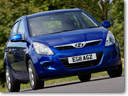 Hyundai has announced its new superefficient 2012 i20 Blue. This is the second car in sub-100g/km CO2 model range. After the i10 Blue, i20 Blue boasts 98g/km of CO2 and it is the lowest emitting vehicle in Hyundai UK’s product line-up.

 2010 Hyundai i20 is now more powerful and greener under the bonnet. Minor changes to the aerodynamics end engine have been made by the manufacturer. They boosted the fuel efficiency for all power units, while the interior now is more stylish and better equipped.
 Hyundai has revealed the first picture of the new i20 three-door, ahead of its official unveiling at the Geneva motor show on March 3rd.