The 2023 Porsche 911 GT3 RS is clear in its intentions: it is uncompromisingly designed for maximum performance. The 518 hp road-legal high-performance sports car takes full advantage of technology and concepts from motorsport. Even beyond the high-revving naturally aspirated engine with racing DNA and intelligent lightweight construction, it is, above all, the cooling and aerodynamic systems of the 911 GT3 RS that connect it most directly with its motorsport brother, the 911 GT3 R.
Central-radiator inspired by motorsport – the foundation for active aerodynamics
The basis for a significant performance boost is the concept of a central radiator – an idea that was first used in the Le Mans class-winning 911 RSR and subsequently in the 911 GT3 R. Instead of the three-radiator layout seen in previous cars, the new 911 GT3 RS relies on a large, angled center radiator in the car’s nose, positioned where the luggage compartment is located on other 911 models. This has made it possible to use the space freed up on the sides to integrate active aerodynamic elements. Continuously adjustable wing elements in the front and on the two-part rear wing, in combination with a number of other aerodynamic measures, provide more than 900 lbs. of downforce at approximately 124 mph, twice that of the 991.2-generation predecessor and three times as much as a current 911 GT3. At 177 mph, total downforce is 1,895 lbs, or the equivalent of a Porsche 356 A.
A drag reduction system (DRS) is fitted in a production Porsche for the first time. To achieve low drag and higher speeds on straight sections of the track, the DRS allows the wings to be flattened out at the push of a button, within a specific operating range. During hard braking at high speeds, the airbrake function positions the wing elements at the front and rear to support deceleration by maximize aerodynamic drag.
The purposeful look of the new 911 GT3 RS is characterized by the large number of functional aerodynamic elements. The most prominent feature of the GT sports car is the swan-neck-supported rear wing, which is significantly larger in all dimensions than the wing of its predecessor. The rear wing consists of a fixed main wing and a hydraulically adjustable upper blade. For the first time on a Porsche production vehicle, the upper edge of the rear wing is higher than the roof. A front splitter divides the air flowing over and underneath working in parallel with side blades on the front fascia that deflect air outwards. Front wheel-arch ventilation is provided via distinctive louvered openings in the front quarter panels. Inlets behind the front wheels inspired by the iconic Le Mans-winning 911 GT1 reduce the dynamic pressure in the wheel arches. Air from the centrally positioned radiator flows out of large nostrils on the front lid – further back, fins on the roof direct the air outwards, ensuring cooler intake temperatures in the rear. In the new 911 GT3 RS, the openings in the rear side panel are used exclusively to improve aerodynamics and not to draw in combustion air. The rear wheel arch also features an intake and a side blade for optimized airflow. The rear diffuser is a modified version of that fitted to the 911 GT3.
Track suspension that can be adjusted from inside the car
Even the suspension is modified for improved aerodynamics. Because the wheel arches of the new 911 GT3 RS are subject to powerful airflows, the components of the double-wishbone front axle are designed with teardrop-shaped profiles. These aerodynamically efficient links increase downforce on the front axle by around 88 lbs. at top track speed and are otherwise only used in high-end motorsport applications. Front track width increases by 1.14 inches (29 millimeters), necessitating longer double-wishbone front axle links.
To ensure that the downforce balance between the front and rear axles is maintained even when braking from high speeds, the suspension engineers have significantly reduced pitching under braking. On the new 911 GT3 RS, the front ball joint of the lower trailing arm has been set lower on the front axle. The multi-link rear axle has also been adjusted, with modified spring rates. The driver assistance systems and rear-axle steering also have an even more dynamic set-up here.
The 911 GT3 RS offers three driving modes: Normal, Sport and Track. In Track mode, the basic settings can be individually adjusted. Among other settings, the rebound and compression damping of the front and rear axles can be adjusted separately and in several stages. The rear differential can also be adjusted via rotary controls on the steering wheel. This is done quickly and intuitively with an operating and display concept also borrowed from endurance racing. Four individual rotary controls and a button for the Drag Reduction System (DRS) are located on the steering wheel. These rotary controls appear in the instrument cluster during the adjustment process. The 911 GT3 RS also features the track screen already familiar from the 911 GT3. At the touch of a button, the driver can reduce the two seven-inch side displays to essential information only. The gearshift indicator lights to the left and right of the analog tachometer have also been taken from the 911 GT3.
High-revving four liter six-cylinder boxer engine
The 4.0-liter high-revving naturally aspirated engine has been further optimized compared with the 911 GT3. The increase in power to 518 hp (911 GT3 – 502 hp) is achieved primarily via new camshafts with modified cam profiles. The single-throttle intake system and the rigid valvetrain are derived from motorsport. Like the 911 GT3, this engine also has six individual throttle bodies; one per cylinder. The seven-speed Porsche Doppelkupplung (PDK) has a shorter overall gear ratio than the 911 GT3 and is aided by air intakes on the underbody to ensure that the transmission can withstand even extreme loads during frequent use on track.
The 911 GT3 RS accelerates from 0 to 60 mph in 3.0 seconds (911 GT3 – 3.2 seconds) and reaches a top speed of 184 mph in seventh gear. Six-piston aluminum monobloc fixed-caliper brakes and brake discs with a diameter of 408 mm are used on the front axle. Compared with the 911 GT3, the piston diameters have been increased from 30 to 32 mm. In addition, the thickness of the discs has been increased from 34 to 36 mm. The rear axle continues to be fitted with 380-mm brake discs and four-piston fixed-caliper brakes. The optionally available Porsche Ceramic Composite Brakes (PCCB) use 410-mm discs on the front axle and 390-mm discs on the rear axle. The new 911 GT3 RS also comes standard with forged light-alloy center-locking wheels. Street-legal Ultra High Performance tires measuring 275/35 R 20 at the front and 335/30 R21 at the rear provide a high level of mechanical grip.
Lightweight construction all the way
Intelligent lightweight construction has been a basic principle of all RS models ever since the legendary 911 Carrera RS 2.7. Thanks to an array of lightweight construction measures such as the extensive use of carbon fiber reinforced plastic (CFRP), the 911 GT3 RS weighs in at only 3,268 lbs.. The doors, front quarter panels, roof and hood, for example, are made from CFRP. Lightweight CFRP is also used in the interior, including the standard full bucket seats, trimmed in black leather and Race-Tex joining carbon fiber trim throughout the interior to characterize the pure, sporty ambience.
Available with Weissach package
The Weissach package, which is available at extra cost, includes a considerable number of changes to the standard vehicle. The hood, roof, parts of the rear wing and the upper portion of the side mirrors housing feature visible carbon fiber. The front and rear anti-roll bars, the rear coupling rods and the shear panel on the rear axle are made of CFRP and contribute to a further enhancement of the driving dynamics. Another highlight of the Weissach package is the PDK shift paddles with motorsport-derived magnet technology. This makes gear changes feel especially precise thanks to a pressure point and a clearly perceptible click. Forged magnesium wheels are included in the Weissach package and save 17.6 lbs of unspring weight compared to the standard wheels.
The 2023 911 GT3 RS is expected to arrive at U.S. dealers by Spring, 2023. The starting MSRP is $223,800 excluding $1,450 for processing, delivery and handling.
Exclusive Porsche Design Chronograph
Inspired by the motorsport mindset – where maximum precision is paramount – Porsche’s own watchmaking operation in Solothurn, Switzerland, has developed the 911 GT3 RS chronograph. This mechanical watch is available as an option, and is reserved for owners of the car. It is based on a glass-bead blasted case, made from either natural or black titanium, and with a screw-down crown. Inside the watch is the mechanical Porsche Design chronograph caliber WERK 01.200, which has been COSC-certified for its high accuracy. Its flyback function allows the wearer to start, stop and reset the second hand with a single action. The chronograph pushers, which feature ”Start/Stop” and ”Next Lap” laser engravings, reveal that this chronograph is not just about telling the time. In addition to innovations, such as the pulsometer scale on the bezel, many design features and materials from the GT3 RS are also found.


 One has to be very brave to make any kind of tuning on a Porsche, especially a GT3 RS. This however, didn’t scare the specialists at KAEGE Automobiles, who stepped in when it came to the conversion of this particular model. The main changes are in the engine, there is also a lot of weight optimization done as well as some exterior and interior cosmetic tweaks.


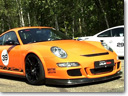



 Porsche will introduce a limited edition of 911 GT3 RS. There are not full details, but the new car will have bigger engine and more extreme suspension.Porsche 911 GT3 RS Limited Edition will be powered by 4.0 liter flat-six with 500HP, which is 50HP more than the current version. It will be lighter and there are rumors, that it will feature a double-clutch gearbox, which is not bad, at all. As we know, Porsche is the first automaker, who managed to create a car, which is faster from 0 to 100 km/h with automatic gearbox, instead of manual.911 GT3 RS Limited Edition is expected to have bigger brakes and some aerodynamic modifications.Stay tuned for more information about the new beast.


 One of the hottest cars on the market – Audi R8 GT has set an un-official Nurburgring lap time, which is a bit slower than the astonishing Porsche 911 GT3 RS, which stopped the clock on 7 minutes and 33 seconds. However, the time of R8 GT is 7 minutes and 34 seconds.


 Porsche announce the latest model of 911 GT3 Cup series. It is based on the GT3 RS, which is the ultimate road version of Porsche.
 The well-known German tuner 9ff has released an extremely powerful refinement program, which fits perfectly the Porsche 997 GT and the 997 GT3.