Tag: gearbox

  • Dual-Clutch Transmissions – The transmission of the future?


    Most people know that automobiles come with two basic transmission types; first there are manual transmissions which require that the driver change gears by depressing a clutch pedal and using a stick shift and then there are automatics which do all of the shifting work using a torque convertor and sets of planetary gears. But there’s also something in between that offers the best of both worlds — the dual-clutch transmission (DCT). This article will explore how a dual-clutch transmission works, how it compares to other types of transmissions and why some predict that it is the transmission of the future.

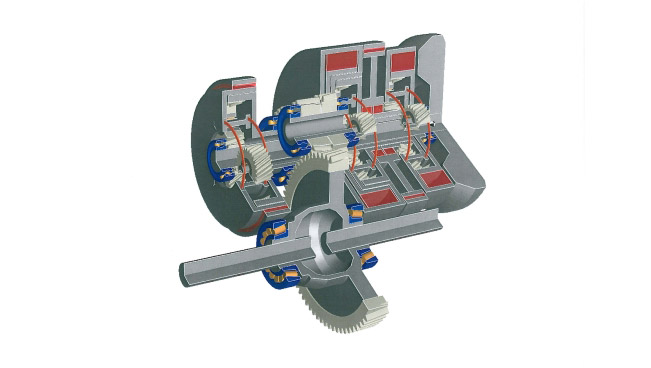
    A dual-clutch transmission offers the function of two manual gearboxes in one. To understand what this means, it’s helpful to review how manual gearboxes work. When a driver wants to change from one gear to another, he first presses down the clutch pedal. This operates a single clutch, which disconnects the engine from the gearbox and interrupts power flow to the transmission. Then the driver uses the stick shift to select a new gear. Once the new gear is engaged, the driver releases the clutch pedal, which re-connects the engine to the gearbox and transmits power to the wheels.

    A dual-clutch gearbox, by contrast, uses two clutches, but has no clutch pedal. Sophisticated electronics and hydraulics control the clutches, just as they do in a standard automatic transmission. In a DCT, however, the clutches operate independently. One clutch controls the odd gears (first, third, fifth and reverse), while the other controls the even gears (second, fourth and sixth). Using this arrangement, gears can be changed almost instantly without interrupting the power flow from the engine to the transmission.

    Some explain that a DCT is an “automated manual transmission.” In principle, the DCT behaves just like a standard manual transmission: It’s got input and auxiliary shafts to house gears, synchronizers and a clutch. What it doesn’t have is a clutch pedal, because computers, solenoids and hydraulics do the actual shifting. Even without a clutch pedal, the driver can still “tell” the computer when to take action through paddles, buttons or a gearshift.

    Perhaps the most compelling advantage of a DCT is improved fuel economy. Because power flow from the engine to the transmission is not interrupted, fuel efficiency increases dramatically. Some experts say that a six-speed DCT can deliver up to a 10 percent increase in relative fuel efficiency when compared to a conventional five-speed automatic.

    Many car manufacturers are interested in DCT technology. However, some automakers are wary of the additional costs associated with modifying production lines to accommodate a new type of transmission. This could initially drive up the costs of cars outfitted with DCTs, which might discourage cost-conscious consumers.

    Source: Honda of Tiffany Springs
  • Chrysler – 9-speed Transmission Factory in Tipton, US

    Chrysler Group’s Chairman and CEO Sergio Marchionne officially dedicated the Company’s new Tipton Transmission Plant and celebrated the production launch of the fuel-efficient nine-speed transmission today. During a ceremony at the plant, Marchionne told the audience, which included Tipton Mayor Don Havens, Tipton County Board of Commissioners President Phil Heron, UAW Local 685 President Rich Boruff, other invited guests and employees, that Tipton is an operation that will play a vital role in creating prosperity for the Company and for the surrounding communities.

    “My confidence is rooted firmly in the knowledge that those of you who work in this area have shown a consistent dedication to delivering products with outstanding quality,” commented Mr. Marchionne.

    “You have embraced the principles of World Class Manufacturing, which is enabling us to compete with the best manufacturers in the world. You are the authors of a major success story, creating a great turnaround and making it possible to create the need for this new plant in Tipton.”, he added.

    Tipton will become one of the global hubs for 9-speed production. When it reaches full capacity, it will ship about 800,000 finished transmissions to Toledo, Ohio, for use in the Jeep Cherokee and Sterling Heights, Mich., for the Chrysler 200 as well as to Fiat plants in Melfi, Italy; Tofus, Turkey; Pernambuco, Brazil; and China. The potential exists to expand production to other international facilities as needed.

    Since June 2009, the Company has invested more than $1.6 billion and hired more than 2,600 people in north central Indiana to produce the next generation transmissions. In total, Chrysler Group employs more than 7,000 people in the five plants in the region.

    Source: Chrysler

  • Next generation Porsche 911 powers ahead with direct fuel injection and double-clutch gearbox

    The Porsche 911 stirs emotions in sports car enthusiasts the world over. Timeless emotions that have been experienced by generations since the model series was first launched in 1963. This summer, Porsche is introducing the next generation of the 911: a car that exemplifies the core 911 principles of distinctive design with inner strength. (more…)
  • Antonov develops low cost gearbox for the low cost car

    Antonov develops low cost gearboxAntonov, the automotive technology company, is returning to first principles in order to develop the radical low cost transmission systems required for ultra low cost cars.

    “We have unique experience of mechanical automatic shifting and alternative launch systems gained over almost 20 years,” says John Moore.

    “Such systems are ideally suited to the development of low cost automatic gearboxes much needed for the low cost vehicles required for emerging markets.

    “Minimum cost can be achieved through the use of innovative technology and design and a careful review of the technical functions required.

    “Above all the transmission must be simple, low cost, reliable and repairable.  And if possible this means no pneumatic or hydraulic controls, minimal components and only the simplest of electrical systems.

    “The transmission must also ensure ease of use for inexperienced drivers trying to cope with heavy traffic and be able to handle a wide range of vehicle payloads.”

    In seeking out viable up-to-date technical solutions, Antonov is exploiting its earlier inventions and innovative engineering roots.  The company started in 1990 with a simple three-speed mechanical transmission, which evolved to four speeds with progressively more functionality to achieve a high quality shift.  This evolution was driven by the need to achieve class competitive performance at reduced cost.

    “The challenge today for the low cost car is to maintain only essential functionality,” says Moore.

    Antonov’s underlying automatic transmission concept uses its original and pioneering patented shift system, which the company is also currently employing for a number of ancillary two-speed applications including alternators, superchargers and engine front-end pulleys – all designed to make modern engines more energy efficient and to facilitate the powertrain downsizing trend and increased electrical loads imposed on modern vehicles.

    The Antonov shift system is implemented through a combination of centrifugal forces and the axial thrust from helical gears.  The elegant simplicity of the system is its use of purely mechanical forces already present in meshing gears.

    The principle can be extended to produce a simple low cost yet highly robust and efficient three or four speed automatic transmission system.

    Antonov’s latest thinking on low cost transmission systems not only builds on its original concepts, but adds years of experience and new ideas to radically simplify the gearbox with respect to launch and shift systems as well as considering the important issue of powertrain and vehicle integration.

    A range of alternative launch systems is being considered including a torque converter and various clutch systems including a centrifugal mechanism and stationary magnetic powder clutch.

    “A low cost torque converter, for example, can be integrated with the engine to avoid the need for a separate transmission oil pump, circuit and cooler,” says chief engineer Simon Roberts.  “A torque converter provides an excellent launch mechanism for a vehicle and allows it to creep along in slow moving traffic – two essential requirements for emerging markets.  Efficiency issues are mitigated by having a direct drive for high ratios and only taking the drive through the converter for low ratios.”

    In essence, Antonov proposes the use of the simplest possible three or four speed systems depending on the application and precise requirements of each car maker approaching the company as a client.

    “Each gear can be selected by a mechanically applied band brake and the whole system splash lubricated to eliminate the need for a pump,” says Roberts.

    “The brakes across one-way clutches can be eliminated provided the vehicle has sufficient brake capacity to avoid the need for engine braking.

    “Shift calibration can be maintained very simply by use of electric solenoids, which only require simple on/off control from a throttle switch and can replace hydraulic pistons.

    “And, if required, we can dispense with electric solenoids and hydraulic pistons altogether and employ a purely mechanical means for shift control, making use of direct linkage from the throttle to alter the shift point.”

    To help facilitate the continued commercialisation of its patents and intellectual property, Antonov has recently opened a new engineering centre near Warwick, which taps into the UK’s wealth of automotive engineering know-how and experience and is close to other automotive technology specialists and sub-suppliers.

    The new facility has allowed the consolidation of all Antonov product development activity onto one site and the expanded engineering team has helped strengthen its design services to the automotive industry and in particular the export of those services abroad.

    The new premises were particularly necessary for the development of Antonov’s full electronically-controlled six-speed gearbox, which is the subject of on-going joint venture negotiations with Loncin in China; the development of its ultra low cost three- and four-speed automatic transmission systems; and the two-speed automatic mechanical module which is already in production as a self controlling mechanical drive for a dual-speed supercharger, with additional applications to engine front end accessory drives also under development.

    “Antonov can offer a high level of continuing innovation through its motivated and capable team,” says Moore.  “Clients globally demand reliable programme delivery and we’re achieving this through the application of the latest computer-aided design and engineering combined with prototype test and development processes to world-class industry standards.”