
Tag: Gas

  • I Love the 60’s American Muscle Cars: Fisker and GAS Reveal Ford Mustang Rocket

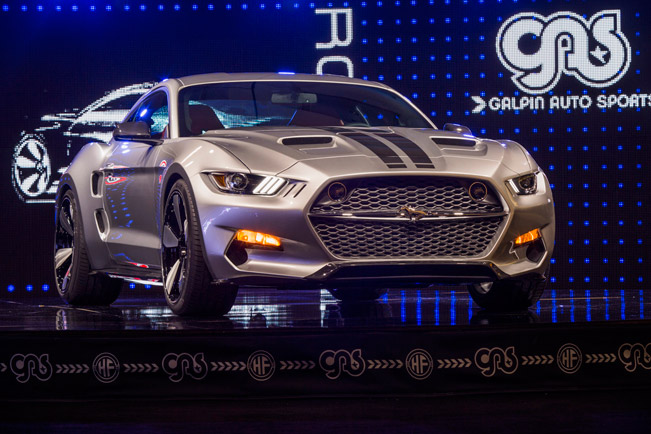
    -Galpin-Auto-Sport-Ford-Mustang-Rocket-THUMBGalpin Auto Sport (GAS) and Fisker have collaborated to create unique Ford Mustang Rocket, which is inspired by those pony cars of the 1960’s and early 1970’s. The most accurate example is the 1968 Shelby GT500. The car is characterized by hexagonal carbon fiber grill, split by a polished aluminum bar and wild horse running across the horizon. The Rocket features elongated lines, sculptured flared fenders and new rear spoiler. This tuning is definitely athletic and we must confirm that it surely pays homage to those iconic Mustangs of the 60s.

    The renowned concept car builder GFMI Metalcrafters constructed the handmade carbon-fiber bodywork. It includes various functional scoops and vents that direct airflow. The front splitter draws out hot air from and makes better the engine cooling. In fact, it works simultaneously with the rear spoiler, enlarged rear diffuser and polished carbon fiber aero skirts.

    As you can see Rocket’s sculptured hood has two large air intakes. Of course, they were designed to channel cooler outside air through the engine compartment. Speaking of the engine, it is the 725 hp (533 kW) V8 unit. There are also two additional scoops, mounted on the rear fenders ahead of the wheels, which help channel air to cool oversized 15-inch Brembo Grand Turismo high performance brakes.

    The exterior of the muscle car looks amazing thanks to the custom mixed silver paint dubbed Éminence Grise. This design scheme is strengthened by the large 21-inch ADV.1 wheels with Pirelli P-Zero extreme performance tires. The rubbers are supported by a front and rear independent and adjustable suspension.

    And the most exciting news is that this is not a one-off concept but the first example of a low-volume series. The production of the car is scheduled to begin this month and the first deliveries are expected in the beginning of 2015.

    Source: Galpin Auto Sport

  • Attention George Jetson, Your Car is Ready

    Not long ago the coolest automobiles were built in America and a good example was the Chrysler turbine. It is probably not entirely coincidental that Hanna-Barbera’s seminal animated TV show, the Jetsons, aired from 1962 to 1963 and the Chrysler Turbine premiered in 1963. True, the Jetson’s animated car flew but having a jet-like turbine in a ground based car seemed like a step in that direction.

    From the viewpoint of engineers, the turbine engine’s smoothness and durability seemed to be a better alternative to the standard piston engine. It had few moving parts compared to piston engines, just a bunch of fan blades on a spinning shaft with one spark plug and no cooling system. It was a car manufacturers dream.

    Chrysler built a few ordinary-­looking prototype turbine cars in the ’50s, but for the pilot-program cars (1960s) an all-new, futuristic body was developed. The bodies were hand-built by the Italian company Carrozzeria Ghia and were shipped to Detroit for installation of the Chrysler-built turbine engine.

    Chrysler built a total of 55 turbine cars between and 50 of these were made available for testing by 203 American families. Each family kept the car for three months and, as part of the deal, they recorded impressions and details in logbooks. The service guys at Earnhardt Dodge, told us that Chrysler actually had a elite team of mechanics on call who would fly out and fix the cars right away if anything went wrong.

    Unfortunately, Chrysler’s Jetson-like turbine car never went into production.  The high cost was one reason. Back in the early 60s you could buy a perfectly fine, reliable V8-powered car for some $5000 or this “jet-engine” car that would have cost around $16,000. Big difference in price! They also had about the same performance; the turbine car was rated at 130 hp about the same as a Chrysler’s 318-cubic-inch V8. Gas mileage was the same on the highway, both would get some 19mpg. The major difference seemed to be mainlyprice.