Tag: funny car

  • Chevrolet Camaro Funny Car is back to deliver more downforce than ever!

    2016 Chevrolet Camaro Funny Car side viewDo you remember the strangely attractive Chevrolet Camaro Funny Car, which debuted a year ago? It was made by John Force Racing and caused a great furor in the automotive world. For the new model year, Chevrolet and 16-time NHRA champion John Force introduced the 2016 Camaro SS Funny Car. The better news is that you can see it this weekend, because it he will race with it this weekend at the NHRA Kansas Nationals.

    What do we see here? It is obvious that the Funny Car’s body is based on the sixth-generation Camaro SS. It carries its distinctive styling characteristics, like the front- and rear-end designs. In addition, the vehicle has been aero-optimized and its body was developed for extreme downforce and stability.

    SEE ALSO: John Force and Chevrolet Reveal the 2015 Camaro Funny Car 

    As a matter of fact, after a computational analysis and scale-model wind tunnel testing, the team gace airflow management qualities of the body that deliver downforce required by the 10,000-horsepower supercharged race car, as it accelerates from 0 to 330 mph in less than 4 seconds.

    2016 Chevrolet Camaro Funny Car and John Force

    You maybe wondering now, which are these unique aerodynamic elements? For instance, there is a new integrated front splitter, which directs more air over the body to increase downforce. Furthermore, the team added dual blow-out (“burst”) panels, which relieve underbody pressure to help keep the body on the chassis. Another beneficial fact is that the new body weighs less then the previous Camaro Funny Car bodies.

    The conclusion is that when two great companies work together to achieve a goal, the result not only looks great, but also surpasses what has been achieved so far. 2016 Chevrolet Camaro Funny Car was designed to perform better than ever before!

    Source: Chevrolet 
  • Drag Racing – Times and Power [part 2]

    Let’s continue with the reaction time. With several words, it is the time between the green light signal and when the car passes the starting line. Normal reaction time is between 0.5 to 1 second and if it is under that, the driver is either lucky or trying to “cheat”.


    All this characteristics are connected and can explain everything that happens on the race track, even how the driver controls the car.

    The time and the terminal speed are the most important characteristics and normally the proportions are these: 15 to 14 seconds on ¼ mile – 150 to 160 km/h, 14 to 13 seconds – 160 km/h to 175 km/h, 13 to 12 seconds 175 km/h to 190 km/h, 12 to 11 seconds from 190 km/h to 210 km/h and all cars in the 10 second mark and below that have terminal speeds of more than 210 km/h.

    So, what happens, when the car have high terminal speed and bad ¼ mile. Usually, there are two reasons – bad start and low traction after that. The cars, which are not 4×4 and have a lot power like turbocharged BMWs, Porsches or Mercedeses. The conclusion is more wheel spin leads to bad ¼ mile time and high terminal speed.

    So, it turns that drag racing is not only a chase between two cars on a straight line and changing gears or waiting for the automatic transmission to do that. There are a lot for very important factors, which can work in your benefit, if you know them and try to improve not only your car, but yourself, too.

    More power, less weight and good, prepared driver – the formula of the success at ¼ mile races.

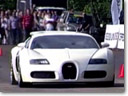
    Bugatti vs Porsche Drag
    Bugatti vs Porsche Drag


    [Part 1]

  • Drag Racing – Times and Power [part 1]

    Drag racing is one of the most interesting events in the automobile world, especially for the spectators. Essentially, it is a race between two vehicles on a special dragstrip, which is a long straight facility for conducting acceleration events. When we say vehicles, we mean everything that can run… fast! – motorcycles, cars, sports cars, “funny” cars and top fuellers.  This time we will talk about ¼ mile races – 402.33 meters.

    There are two main types of events – start-and-fast beat, which is very “easy” to do. Just step on the gas pedal, when the lights are green and change gears (if you drive manual). The second type is bracket racing, which is very popular, too. The contestants choose their fastest time that they think is possible and who finishes first is a winner, but if you beat your announced time of 14.20 with for example 14.05, you will lose. These rules give opportunity to slow cars to catch up with very fast ones.

    Now to say something about times just to have some idea for what’s really going on at the dragstrip. Usually, the normal cars around and under 200HP are in the range of 18 to 15 seconds. Those, which have sports nature, are from 14.9 to 13 seconds and the best of them are under 13 to 12 seconds. The cars with times under 15 seconds has at least 200HP and they are not very heavy like 1500kg (3306 lbs) or more. The cars around 13 seconds have 300 to 400HP and those under 13 seconds are extremely powerful – 500HP and more. Of course, there are a lot of exceptions, but normally this is the situation.

    Other very important thing is the terminal speed, which again can show you how powerful the car is and how it uses that power and puts in on the tarmac. Again, usually the normal cars have terminal speeds of 120-140 km/h. The sports ones – 140 to 160 km/h and the best 160 to 190 km/h. If you see a car with over 200 km/h, it is either very tuned or very powerful with poor driver.

    The start is extremely difficult, because the driver needs to know his car very well. Of course, a start with powerful car is more tricky and, but if you have launch control – congrats.

    The first 60 feet (20 m) usually take from 1.6 to 2.4 seconds or more, if the driver can’t drive his car very well. Once again, the normal cars (if driven perfectly) are between 2.8-2.4 seconds, the sports ones from 2.4 to 1.8 seconds and if the time is around 1.4-1.5 seconds, this is either very powerful 4×4 vehicles or a RWD with slick tires.

    To be continued…

    [Part 2]